




Abstract
Blends of chloroprene rubber (CR) and bromobutyl rubber (BIIR) with low-temperature vulcanization (LTV) technology were found suitable for the encapsulation of temperature-sensitive undersea sensors. Polymeric blends are susceptible to the aging process due to external environments such as heat, oxygen, ozone, light, and mechanical stresses, etc. Hence, the longevity of these blends for hostile seawater applications is a great concern. The marine aging of rubber blends was not investigated much. In this study, the LTV blends with a curing system based on lead and zinc oxides were subjected to accelerated aging in a 3.5% aqueous solution of NaCl from 40°C to 70°C. The retention of tensile strength, % elongation and modulus properties were estimated. It was observed that aging could lead to an initial increase in the modulus and a considerable decrease in ultimate tensile strength and elongation values with an increase in the aging period. Reduction in elongation at break showed a gradual decrease with an increase in both temperature and exposure time. It was observed that the blends with lead oxide cure system were prone to more degradation than ZnO-based blend. A life of 6.5 years and 5.3 years at 25°C for blends based on ZnO and lead oxide cure systems was estimated. The water diffusion coefficient was found to be of the order of 10−12 mm2 s−1 for both blends.
Keywords
Introduction
Polymers are widely used in underwater electronics, cables, and sonar hydrophones by encapsulating them to protect from hostile seawater. 1 Rubber is considered as the material of choice for encapsulation of underwater sensors due to its versatility. 2 Chloroprene rubber (CR) is used extensively for encapsulation due to its superior chemical and physical response to adverse environments. 3 Similarly, bromobutyl rubber (BIIR) offers a set of properties like resistance to weather and chemicals, low gas and moisture permeability, energy absorption or damping, and is co-vulcanizable with other diene rubbers.4,5 Hence, the CR–BIIR blend can be used for the encapsulation of underwater sensors. 6 However, these are susceptible to aging due to external environments such as heat, oxygen, ozone, light, and mechanical stresses, etc. in addition to the seawater proximity. Hence, the longevity of these materials in hostile seawater is a great concern. Functional properties of these blends worsen due to macro and micro-level changes that take place during the aging life. These changes are the manifestation of physical, chemical, and mechanical deterioration resulted from a complex set of physico-chemical reactions simultaneously within the polymer. 7 The acceptable level of deterioration may vary from case to case, depending on which property is more affected and what is the net effect on the functionality of the blend. The rate of deterioration or the % retention of the key property with time etc. should be available for prediction of the long-term performance. The commonly followed method is an analytical method like measurement of chemical, physical, and mechanical properties of the aged polymers and uses the results for investigation and estimation of aging characteristics.8-10
As the blends are intended to use at sea throughout their life, the effect of saltwater on long-term properties was examined in this study. The marine aging of rubber was not investigated much, maybe due to the complexity involved in the degradation mechanisms or the level of deterioration in properties that were quite acceptable for the well-formulated material. 11 However, practical knowledge on the degradation of the encapsulant material is required for assessing the long-term performance of the underwater sensors. For simulating a similar environment of seawater, the samples of CR–BIIR blends were aged in a 3.5% aqueous solution of NaCl. 12 The effects due to saltwater aging can be due to absorption of water, which can lead to hydrolysis, and leaching of any of the ingredients or oxidation. 11
Although polychloroprene does not undergo hydrolysis, a considerable decrease of the tensile properties was observed by Leveque 13 during the accelerated aging in saltwater. In the present study, CR–BIIR blend in 80:20 ratio was formulated with nonconventional low-temperature vulcanization (LTV) systems based on lead and zinc oxides and subjected to aging study. The accelerated aging conditions were generated by exposing the samples to higher thermal conditions from 40°C to 70°C.
Experimental
Materials and process
The CR (Neoprene W, M/s. DuPont Dow Elastomers, USA), BIIR (Polysar X2, M/s. Polysar Ltd., USA), Chlorinated Polyethylene (CPE), which was used as compatibilizer (CM 0136, M/s. DuPont Dow Elastomers, USA), Stearic acid (M/s. Godrej Soaps Pvt. Ltd., Mumbai), Vulkanox HS and Vulkanox 4020 (M/s. Bayer India), Carbon black and Talc, the commercial-grade were the materials used for the blend. Vulkanox HS and Vulkanox 4020 are antidegradants and Carbon black as well as Talc are the fillers. Curing agents used are zinc oxide and red lead (Pb3O4) in commercial grade. The accelerators used are Zinc diethyldithiocarbamate (ZDEC) (M/s. ICI India Ltd.) ethylene thiourea (ETU), thiocarbanilide (TC), and modified tolylguanidine (MTG) (M/s. Goldie Lab Chem, Mumbai, India).
The detailed composition of the basic blend of CR and BIIR in the 80:20 ratio used for the study is given elsewhere. 6 The details of the cure systems used are given in Table 1. The cure system not only controls the processing safety and cure parameters but also decides their end properties.14-16 As practiced in rubber technology,15,17 a combination of accelerators was used for effective synergizing the cure parameters. The final blend compounds B-1 and B-2 were prepared in a two-roll mixing mill by incorporating these cure systems and kept at 25°C ±3°C overnight for maturation.
Cure system used in CR–BIIR blend.

a Modified tolylguanidine, b Thiocabinlide, c Zinc diethyldithiocarbamate
MgO is avoided in the cure system as it retards the cure reaction of BIIR as well as CR. 18 Moreover, MgO is avoided in rubber compounds, where water resistance is a prime criterion. 19 Similarly, a lower concentration of ZnO is preferred to reduce aquatic pollution as it is classified as dangerous for the environment by European Union in Commission Directives 2004/73/EC. 20
Evaluation of cure characteristics
Moving Die Rheometer (MDR 2000, M/s Alpha Technologies Services Inc., USA) was used for the evaluation of the cure characteristics of the blends as per ASTM D 5289 at 90°C isothermal conditions. 21 The parameters evaluated are minimum torque (ML), maximum torque (MH), scorch time (ts2), and the optimum cure time (t90). The ultimate extent of cure, (MH–ML) was estimated from the maximum rheometer torque increase. 14 Both the blends showed a marching cure behavior, and hence the cure parameters were calculated based on a 60 min run time as reported by Amit Das et al. 15 The overall rate of cure was estimated by calculating the cure rate index (CRI)22,23

Molding of test samples and evaluation of vulcanizate properties
Tensile slabs of size 150 mm × 150 mm × 2 mm of blends B-1 and B-2 were molded in a hydraulic press at 90°C for 47 min and 44 min, respectively. Tensile specimens were punched out from the tensile slab and tested in Zwick Model 1476 UTM as per ASTM D412. Hardness was determined using Wallace digital Shore A durometer, Cogenix, Model H 17A as per ASTM D2240. Water absorption characteristics of the blends were determined as per ASTM D471 in 3.5% NaCl solution.
Long term accelerated aging of tensile specimens
Sufficient tensile test specimens of both the blends were immersed in saltwater in separate beakers and maintained at 40°C, 50°C, 60°C, and 70°C by keeping the beaker in aging ovens with precise temperature control. The beakers were covered to reduce the evaporation of water. Distilled water top-up was done on alternate days. The saltwater was replaced with fresh hot 3.5% saltwater once in 2 weeks.
The samples (minimum five numbers) were removed from each test environment in a predetermined time-scale and evaluated their properties. They were conditioned for 16 h at test temperature before testing. Properties evaluated are tensile strength, % elongation, modulus, and hardness. The retention of the properties was estimated from the initial values of the blends.
Life prediction based on accelerated aging studies
Since aging is a long-time process, accelerated thermal aging tests are often used to predict their operating lifetime. 24 From the results obtained, results at lower temperatures can be predicted using the time-temperature equivalence principle.25-27 Time required for the failure of a specific property to a specified level or degradation rate is determined at elevated temperatures of 40°C, 50°C, 60°C, and 70°C and these data are used to predict the performance of the material at ambient temperature. The Arrhenius equation is often used when the temperature is the dominant factor of acceleration in the aging process. 28 It can be written as

where, k—reaction or degradation rate, A—material and environment-related constant, Ea—the energy of activation, R—universal gas constant (8.3143 J/mol K), and T—the temperature in Kelvin. The rate of a chemical reaction generally increases with temperature. From equation (2), a straight line is obtained by plotting the natural log of degradation time for specific retention of property versus the inverse of absolute temperature, the lifetime at any specific temperature is estimated.
In the present study, the retention of tensile strength obtained for various saltwater aging durations was estimated. The time estimated for 20% reduction in failure property was taken for the life prediction of both the blends at 25°C.
Diffusion studies
Diffusion is a process of movement of the penetrant from one part of the system to another as a result of random molecular motion. The penetrant can migrate only when there is free space existing in the polymer matrix and this free space is created by the Brownian movements of the polymer chain segment. 29 Diffusion of molecules depends on several polymer properties: glass transition temperature (Tg) or chain stiffness, crosslinking, crystallinity, crystallite size and distribution, and solubility. 30 The governing equation for the steady-state diffusion is given by Fick’s law 31

where, J—flux gives the quantity of penetrant diffusing across a unit area of medium per unit time and has the unit mole mm−2 s−1, D—diffusion coefficient, C—concentration, and ∂c/∂x—concentration gradient along the axis.
This law is valid for systems with a constant D. For other systems, an average diffusion coefficient can be estimated from the initial gradient of the sorption curve using

where, Mt—total amount absorbed by the sample at time t, M∞—equilibrium sorption, h—thickness of the sample, t—time in seconds. So, D can be calculated from the slope of Mt /M∞ versus t1/2 plot. 32
Specimens of B-1 and B-2 with dimensions 10 mm×10 mm were punched out from a vulcanized sheet of 2 mm thickness. They were kept in a desiccator for initial weight stabilization. When the weight became constant, it was taken as the initial dry weight. Samples were immersed in beakers containing 3.5% saltwater maintained at test temperature 40°C, 50°C, 60°C, and 70°C by keeping in temperature-controlled air ovens. Water uptake was determined by taking the samples out and weighing them at different predetermined time intervals. The outer surfaces of the samples were wiped using a blotting paper before weighing. The difference between the weight thus obtained and the initial weight gives the absorbed quantity of saltwater. Three representative samples were used for the water absorption and diffusion studies. There were no significant dimensional changes for the samples on exposure to saltwater.
Results and discussion
Cure parameter study
The major cure parameters obtained for compounds B-1 and B-2 at 90°C are given in Table 2.
Cure characteristics of blends B-1 and B-2 at 90°C.

A higher MH obtained for the blend B-2 indicated higher crosslinks formation during the curing. The net torque increase (MH–ML) is an indirect measure of the network formation during the vulcanization.33,34 These results showed that the blend with the ZnO cure system resulted in a vulcanizate with higher crosslink density.35,36 Another observation is that the compound with ZnO cure system (B-2) is superior to lead oxide system (B-1) in respect of crosslink formation especially at a low temperature of 90°C. Similarly, blend B-2 showed a higher CRI indicating that the optimum cure takes place with a lesser time.37,38 The higher extent of cure and CRI indicates that the ZnO cure system is more active at 90°C. Magnesium oxide retards the cure reaction of blend with metal oxides. 18 Hence, the elimination of MgO helped in resulting a faster cure reaction in blend B-2. The faster cure reaction that occurred in the blend may be due to the autocatalytic action of zinc chloride (ZnCl2), which was generated in-situ in the cure reaction during the vulcanization process. 39 Elimination of MgO prevented the conversion of ZnCl2 to MgCl2 which is in close agreement with the results reported by Wootthikanokkhan and Clythong. 40
Aging studies and life prediction
The major properties evaluated are tensile strength, % elongation, modulus, and hardness. The initial properties of B-1 are M300: 7 MPa, TS: 14.5 MPa, %EB: 550 and for B-2 the values are M300: 8.5 MPa, TS: 15.6 MPa, and %EB: 490. It was observed that the aging had led to an initial increase in the modulus in all the cases and applied to both blends. Figure 1 represents this general trend observed in the retention of modulus M300 at 70°C.

Retention of M300 on exposure to 3.5% saltwater at 70°C.
During the aging process, two major processes like chain scission and crosslinking can occur. During cross-linking, additional bond formations can occur at the unsaturated sites in the polymer. Chain scission occurs due to the breakage of chemical bonds existing in the crosslinked rubber. These changes were observed for all the samples indicating a strong effect of temperature on the degradation kinetics. Le Gac et al. 11 also observed similar behavior.
Usually, CR-based compounds show a marching cure behavior, and the present blend also showed the same. Hence, additional crosslinks were formed during the initial period of accelerated thermal aging and resulted in increased modulus values. Another reason for the modulus increase was that an optimum cure of 90% was given. Hence, modulus values increased due to the prolonged crosslinks formation during the initial period of aging. There was no considerable increase in the modulus for the samples kept for aging in saltwater at 40°C and 50°C for 8 months. However, the modulus values of both blends showed a decreasing trend after 6 months of aging at 60°C and 2 months of age at 70°C in saltwater. The gradation in modulus was faster in blend with lead cure system than zinc oxide. The same trend was shown by shore A hardness as expected as modulus and hardness were mutually dependent.
A similar trend in the retention of properties due to saltwater aging was observed in the other failure properties like elongation at break and tensile strength. The retention of % EB of both the blends at 70°C in the saltwater medium is shown in Figure 2.
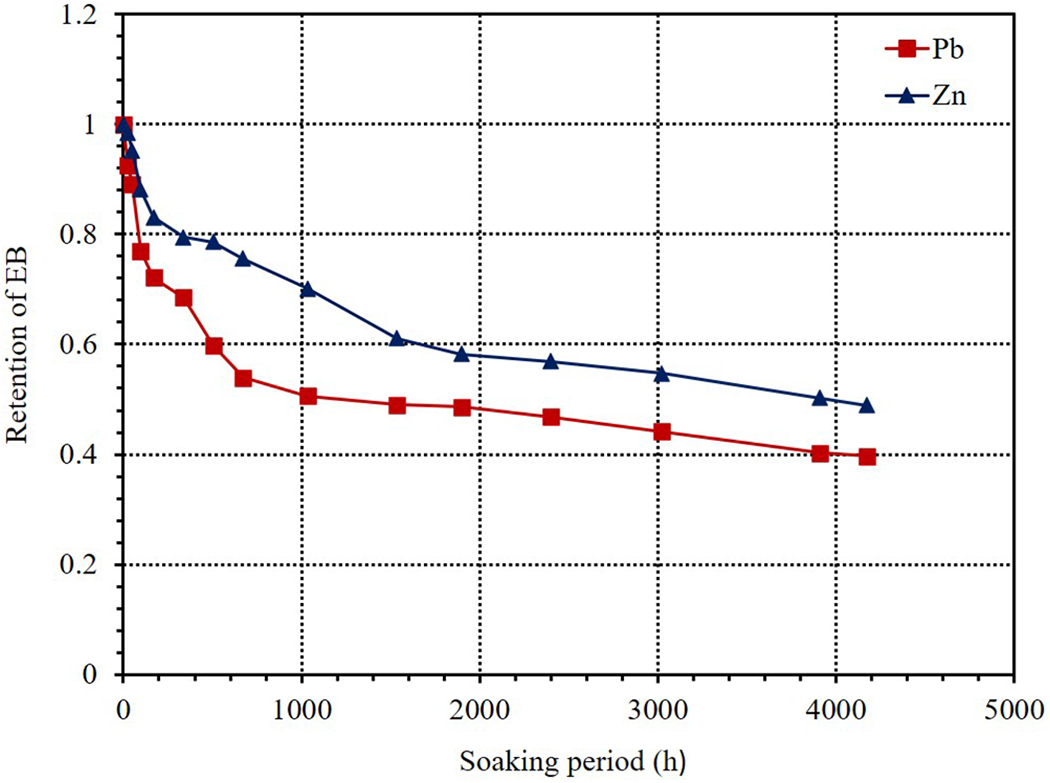
Retention of EB on exposure to 3.5% saltwater at 70°C.
Figures 3 and 4 show the retention behavior of tensile strength. A gradual decline in properties was observed after the initial increase in tensile strength as observed in modulus and % EB.

Dependence of temperature and soaking period on tensile strength of LTV blends cured using ZnO.

Dependence of temperature and soaking period on tensile strength of LTV blends cured using Pb3O4
All these observations indicated that blend with ZnO-based cure systems possessed better thermal resistance than blend with Pb3O4. CR cured with ZnO41,42 and halobutyl rubbers cured with ZnO 43 are used for heat-resistant applications.
In the present study, from the retention of tensile strength, the time taken for 80% retention for both the blend compounds was estimated for the four temperatures. The natural log of the time obtained was plotted against the inverse of absolute temperature and shown in Figures 5 and 6.

Arrhenius plot generated for CR-BIIR blend with ZnO cure system.

Arrhenius plot generated for CR-BIIR blend with Pb3O4 cure system.
From the line fit, the estimated life of the ZnO-based blend is 6.5 years and for lead oxide system is 5.3 years at 25°C.
Diffusion studies
The water absorption of both the blends on soaking in saltwater at the aging temperatures was monitored at various intervals. The weight gained by the blend with ZnO and Pb3O4 based cure systems was plotted against the soaking period and shown in Figures 7 and 8, respectively.

Dependence of temperature and soaking period on saltwater absorption of LTV blends cured using ZnO.

Dependence of temperature and soaking period on saltwater absorption of LTV blends cured using Pb3O4.
Water absorption increased with temperature in both the blends due to the increased polymer segment mobility as observed by Cassidy and Aminabhavi. 44 It was observed that the water absorption increased with the soaking period and equilibrium was achieved. Initially, the surface layer of the rubber absorbed the liquid and penetrated further into the bulk of the material until equilibrium was reached. 29
Mt /M∞ of the linear portion of the sorption curves of compounds with zinc and lead oxide cure systems at 40°C, 50°C, 60°C, and 70°C were determined and shown in Figures 9 and 10.

Linear portion of the sorption curve of compounds with zinc oxide cure system at various temperatures.
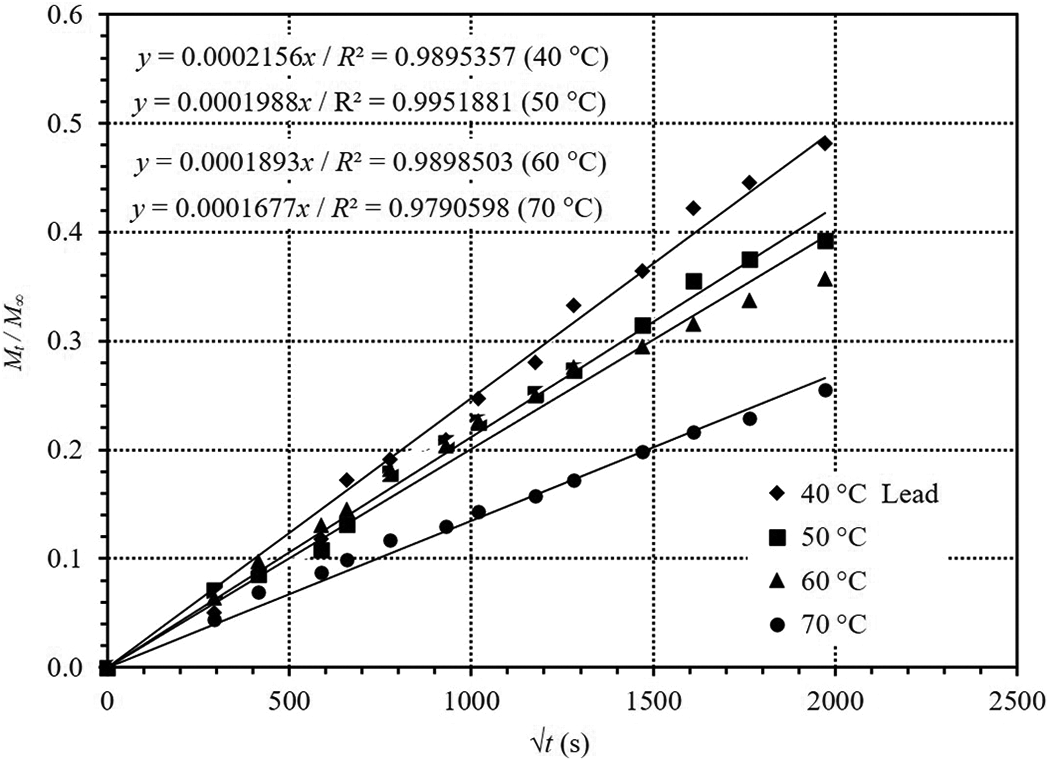
Linear portion of the sorption curve of compounds with lead oxide cure system at various temperatures.
The slope of the linear fit was found out and the diffusion coefficients were computed for each test temperature using equation (4). 32 and are given in Table 3. It was observed that the LTV blends with zinc oxide cure system showed a higher diffusion coefficient at higher temperatures. However, the blends with lead oxide cure system showed an opposite trend above 40°C. This may be due to the additional crosslinking formed during the initial soaking period on exposure to higher temperatures. The additional crosslink formation was also confirmed from the increase in modulus and hardness and reduced the penetrant movement into the polymer molecule. 30 This behavior was predominant in blend with lead than zinc oxide cure systems (Figures 7 and 8).
The parameter n has been calculated by fitting the value of Mt/M∞ and t by the method of least squares, at 95% confidence level and given in Table 3. The value of n that represents the type of diffusion mechanism 30 varied from 0.45 to 0.56, which indicated a slight deviation from the Fickian diffusion.
Diffusion coefficients of LTV blend at various temperatures.

Conclusion
The accelerated aging studies showed that the blend with zinc oxide yielded higher retention of tensile properties. Retention of TS with zinc and lead oxide systems for a soaking period of 3024 h at 70°C is 74%, and 63%, respectively. The life estimation study based on tensile strength revealed that blend with zinc oxide has a better life expectancy of 6.5 years at 25°C than with lead oxide of 5.3 years. The results of the sorption kinetic studies showed the same order of diffusion coefficient for both blends. Weight gain for a blend with 3 phr zinc oxide-based cure system is estimated as 6.2% for 8 months soaking period in saltwater at 40°C and the with 10 phr lead oxide system for the same period of soaking is 5.5%. Diffusion coefficient of the same order was achieved for the zinc oxide-based cure system by the reduction of zinc oxide dosage from 5 phr to 3 phr and elimination of magnesium oxide from the LTV cure system of CR-BIIR blend.
Footnotes
Acknowledgment
The authors thank Director, NPOL for granting permission to publish the paper.
Declaration of conflicting interests
The authors declare that there is no conflict of interest concerning the research, authorship, and publication of this article.
Funding
The author(s) received no financial support for the research, authorship, and/or publication of this article.
