



Abstract
The purpose of this paper is to investigate the torsion and azimuthal shear of an incompressible hyperelastic cylinder having a modified Gent-Thomas strain energy with limiting chain extensibility condition. First, the torsional response of the modified Gent-Thomas model is obtained analytically and compared with those of Gent-Gent, Gent-Thomas, and Carroll strain energy models where the former model incorporates the limiting chain extensibility condition while the latter two are phenomenological models. The results show the modified Gent-Thomas model to be in better agreement with the experimental data of Rivlin and Saunders on torsion than the other three models. To further evaluate the response of the modified Gent-Thomas model, azimuthal shear deformation of an incompressible hyperelastic cylinder with the modified Gent-Thomas, Gent-Thomas, Gent-Gent, and Carroll strain energies is considered, where the angular displacement in azimuthal shear is determined analytically for the first three models and numerically for the fourth model. It is shown that the strain hardening effect, predicted either by the limiting chain extensibility condition for the modified Gent-Thomas and Gent-Gent models or phenomenologically by the Carroll model, is quite significant in the azimuthal shear response of the incompressible cylinder.
Keywords
Introduction
Different models for hyperelastic materials have been proposed where the elastic response of the elastic material is obtained from a strain energy function. In addition to the Mooney-Rivlin model, which is one of the simplest hyperelastic models for incompressible solids, the Gent-Thomas model also has been able to meet the experimental requirements rather well. This model is suitable for continuous and bulk material analysis 1 and models the response of vulcanized and porous rubber better than the Mooney-Rivlin model.2,3
In the present paper, the response of a more recent model referred to herein as the modified Gent-Thomas model, first proposed by Gent, 4 is evaluated in torsion and azimuthal shear deformation. To this end, torsion and azimuthal shear deformation of an incompressible cylinder having the modified Gent-Thomas strain energy are considered and its response is compared with that of Gent-Thomas, 5 Gent-Gent 6 and Carroll models. 7 An important feature of the modified Gent-Thomas model is that it incorporates the limiting chain extensibility condition to model the molecular polymeric behavior of rubber-like materials. The Gent-Gent model also exhibits the limiting chain extensibility property, while the Gent-Thomas and Carroll models are phenomenological models.
In the first part of the present paper, a circular cylinder is considered, which withstands a torsional deformation. To sustain a torsional deformation an isotropic incompressible elastic cylinder must be subjected, in addition to the twisting torque, an axial force exerted at the end of the cylinder. Such force depends on the angle of the twist as shown by the numerous experiments performed on such cylinders. The torsional response of the above four models is obtained analytically and then compared with the experimental data of Rivlin and Saunders in torsion.
Various investigations of the torsional deformation of a cylinder have been carried out, which include torsion of an incompressible cylinder under variable torsion, 3 with residual stresses 8 and having finite torsional eigenstrain. 9 Also, the torsional deformation of soft cylinders 10 and torsion of a composite cylinder with the Poynting effect, 11 among others, have been investigated. In most of these studies, materials with a particular form of strain energy have been considered. For example, torsion and shear deformation of isotropic incompressible materials having the Mooney-Rivlin and neo-Hookean models with additional terms of deformation tensor invariants have been examined. 12
Horgan and Saccomandi 13 surveyed simple torsion of incompressible hyperelastic materials with limiting chain extensibility condition. In their study, the problem of simple torsion for the three popular models, i.e. Gent, van derWaals, and Edward-Vilgis that account for strain hardening at large deformations is investigated.
Tao et al. 14 studied circular shearing and torsion of generalized neo-Hookean materials wherein for certain cases boundary layer effects were observed.
In the context of azimuthal shear deformation, several studies have been carried out. Such investigations include the study of a circular cylindrical tube with the assumption of fixed internal boundary subjected to a uniformly distributed azimuthal shear traction on the external boundary, in which various hypotheses such as compressibility, 15 large shearing (extension, inflation, torsion, and helical shear) in a prestressed tube, 16 limiting chain extensibility 17 and reinforcement by radial fibers 18 have been considered.
In a study by Carroll, azimuthal shear of a compressible hyperelastic cylinder, having an isotropic strain energy function was examined. 19 In addition, Carroll proposed a new strain energy function with three parameters for an incompressible material based on the behavior of vulcanized rubber. 7 In this research, a model was developed based on the Treloar, Rivlin-Saunders, and Jones’s experiments on sheets of vulcanized rubber with remarkable capability for predicting the behavior of rubber-like materials over a wide range of deformations.20,21 Also, the Carroll model, being a phenomenological model, predicts the strain hardening phenomenon from a macroscopic viewpoint. In this paper, the effect of strain hardening in the azimuthal shear response for this model is compared with that of the modified Gent-Thomas and Gent-Gent models.
Combined deformation, such as the helical shear (azimuthal and axial shear) of a hardening generalized neo-Hookean elastic material has been investigated by Horgan and Saccomandi. 22 In this study, the components of stress, angular and axial displacements are determined and compared with the classical neo-Hookean model.
El Hamdaoui et al. 23 have analyzed the ellipticity condition in an isotropic tube that is subjected to a combined deformation, such as axial extension with axial and azimuthal shear wherein basic equations were derived, and loss of ellipticity was examined for this material.
It is noteworthy that in most of the above studies, strain energies depend only on the first invariant of the deformation tensor, whereas in this paper the strain energy considered depends on both the first and second invariants of the deformation tensor like the Carroll model.
In the present paper, for the analysis of torsion, the deformation field, the axial force and the twisting torque are obtained analytically for several models in the second section and then compared with the experimental results of Rivlin and Saunders for torsion. In the third section, the analysis of azimuthal shear deformation with relevant kinematical quantities for several models is carried out and by integrating the equations of equilibrium the angular displacement is determined in quadrature form. The results obtained for torsion and azimuthal shear deformation for various models are discussed and compared in detail in the fourth section. Finally, in the fifth section, some conclusions are drawn with respect to the response of the modified Gent-Thomas model in torsion and azimuthal shear.
Simple torsion
It is assumed that an incompressible hyperelastic material is undergoing simple torsion described in a cylindrical coordinate system according to 24

where (R, Θ, Z) and (r, θ, z) are the cylindrical coordinates in the reference and spatial configurations, respectively, and A is the angle of twist per unit length of the cylinder. The deformation gradient tensor

Incompressibility condition for this deformation holds since det

Using the Cayley-Hamilton theorem for an isotropic, incompressible material, the components of stress are 25

where β1 and β−1 are material parameters which can be determined for different models and are defined as

Therefore, the components of stress for a hyperelastic material are




In the above relations, p is a hydrostatic pressure resulting from material incompressibility, which can be determined using the equilibrium equations and the boundary conditions.
For later reference, equilibrium equations in cylindrical coordinates in the absence of body forces are recorded as



In what follows, the stress field is used to determine the twisting torque and the axial force required in simple torsion for several strain energy models.
Gent-Thomas model
Gent and Thomas 5 proposed the following strain energy function for an incompressible material

where K1 and K2 are material parameters obtained from Kawabata’s experiments (biaxial tensile). 26 These parameters are given in Table 1.
The Gent-Thomas material parameters using Kawabata experimental data. 26

Thus, the components of stress for this strain energy using equations (6) to (10) and equation (14) and assuming that the outer boundary of the solid cylinder is free of tractions, i.e. trr(r = r0) = 0, are determined to be


Integrating equation (11) by using the stress components given in equations (15) to (19) and the boundary condition trr(r = r0) = 0, the hydrostatic pressure is determined to be

The axial force N applied to the cylinder in the axial direction to prevent the Poynting effect and the torque M applied at the end of the solid cylinder are obtained using the relations


Substituting equation (17) into equation (21), the axial force is found to be

Also, substituting equation (18) into equation (22), the torque is obtained to be

Modified Gent-Thomas
The Gent-Thomas strain energy can be modified by incorporating the limiting chain extensibility condition in the model according to 4

where Jm is a constant resulting from the limiting chain extensibility condition. As Jm→∞ in equation (25), the Gent-Thomas strain energy in equation (14) is recovered. A similar model has been proposed by Pucci and Saccomandi, 6 however, the material parameters of their proposed model are different from those in equation (25). In this paper, the model represented in equation (25) is referred to henceforth as the modified Gent-Thomas model and a comparison between this model and the Pucci-Saccomandi model in torsional deformation is carried out in the fourth section.
The components of stress for the modified Gent-Thomas model, using equations (6) to (10), equation (25), and the boundary condition trr(r = r0) = 0 are obtained as





Using equations (21), (22), (28), and (29) the axial force N and the torque M for this model are determined to be


Pucci-Saccomandi model
This model is very similar to the modified Gent-Thomas model with the only difference being in their material parameters. The strain energy for this model, also known as the Gent-Gent model, is defined by 6

where Jm is the limiting chain extensibility parameter. In equation (33), Jm = 88.13 and material parameters μ and C2, obtained using Treloar’s equibiaxial tension data, 27 are given in Table 2.
The Gent-Gent material parameters. 27

Since for this model the components of stress are similar to those for the modified Gent-Thomas model with material parameters K1 and K2 replaced with μ/2 and C2, the axial force and the torque for the Gent-Gent strain energy can be obtained using equations (31) and (32) as


Carroll model
The phenomenon of strain hardening at large elastic deformations can be examined from both the microscopic and macroscopic points of view. From the microscopic viewpoint, the material behavior at the molecular level is constraint by the limiting chain extensibility condition causing it to develop strain hardening. Various models such as Gent, van der Waals, and Edwards-Vilgis predict strain hardening by incorporating the limiting chain extensibility condition.13,17 In the macroscopic viewpoint, however, strain hardening effect may be predicted by a phenomenological constitutive relation as embodied in the strain energy function. As an example, Carroll 7 proposed the following strain energy function for an incompressible material

where A1, A2, and A3 are material parameters, obtained from Treloar’s equibiaxial tension tests defined in Table 3.
The Carroll model parameters using Treloar’s equibiaxial tension tests. 7

The stress components for this model, analogous to the other above-mentioned models are obtained as





The axial force and the torque for Carroll model using equations (39) and (40) are determined to be


Azimuthal shear deformation
In this section, azimuthal shearing of a circular cylindrical tube is considered. It is assumed that an incompressible hyperelastic material in a cylindrical coordinate system is undergoing the deformation 25

where (R, Θ, Z) and (r, θ, z) are the cylindrical coordinates in the reference and spatial configurations, respectively, with R1 ≤ R ≤ R2, where R1 and R2 denote the inner and outer radii, respectively. In this deformation a material point undergoes azimuthal shear with dependence on the radial direction. In addition, the internal boundary of the cylinder is held fixed, i.e.
The deformation gradient tensor

where g′ = dg/dR = dg/dr. Incompressibility condition for this deformation holds since det
The principal invariants of

Gent-Thomas model
For the Gent-Thomas model defined in equation (14), using equations (4), (5), (45), and (46) the components of stress are found to be



Integration of equation (12) yields

where γ is a constant that is determined using the boundary condition for azimuthal shear, i.e.

Using equation (50), equation (53) can be written as

Therefore, the equation for the azimuthal shear function is obtained as

where


Equation (55), has three roots two of which are complex conjugates and therefore not physically acceptable. The only real root is found to be

where


Using the dimensionless parameter T = T0/K1, equation (57) is rewritten as

where


The angular displacement is found by integrating equation (59) to yield
Finally, the hydrostatic pressure is found using equation (11), the components of stress in equations (47) to (51), and the boundary condition

In the above equation, g′ is given in equation (57).
Modified Gent-Thomas
Using equations (4), (5), (25), (45) and (46), the stress components for this strain energy are found to be





For this model, similar to the Gent-Thomas model, shearing stress trθ can be obtained from equation (53). Therefore, using equations (53) and (65), the equation for the azimuthal shear function is obtained as

In the above equation, as Jm→∞, equation (55) is recovered. Using the dimensionless parameter T = T0/K1, equation (67) is rewritten as

where


Equation (68), has four real roots only two of which have positive signs that are physically relevant so that g′(R) > 0. These roots are the second and the fourth ones. All the roots of equation (68) are recorded in Appendix 1.
Of the four real roots, the second one is real in the range 0 ≤ T ≤ 2.29 throughout the thickness of the tube, while the fourth one is imaginary throughout the thickness. In the range where 9.05 < T ≤ 40, the fourth root is real and the second root is imaginary throughout the thickness of the tube. In the range where 2.29 < T ≤ 9.05, the second root is real on some interval in the radial direction while the fourth root is real on the complement of that interval. For example, for T = 3.47, the fourth root given by equation (A4) is real only for 2 ≤ r ≤ 2.47, while the second root given by equation (A2) is real only on the complementary interval 2.47 < r ≤ 4.0. Hence, in the latter range, integration is performed using both roots on two complementary intervals in order to determine the angular displacement.
The hydrostatic pressure for this material, analogous to the Gent-Thomas model, can be determined as

where g′ is obtained from equation (68) and Appendix 1.
It is noticed that the governing equation obtained for the Gent-Gent strain energy is similar to that of the modified Gent-Thomas strain energy, the only difference being that the constants K1 and K2 in the latter model replace the constants μ/2 and C2 in the former model.
Carroll strain energy
The Carroll model has been shown to be highly accurate in predicting material behavior at large deformations.20,21 However, due to the highly nonlinear dependence on both of the invariants, this model presents major challenges when analytical solutions are sought, therefore, the solution for this model is determined numerically. Using equations (4) and (5), the equilibrium equation (12) and equations (36), (45), and (46), the shear stress trθ for this model is found to be

The azimuthal shear function for this model can be obtained using equations (53) and (71) as

Using the dimensionless parameter, T = T0/A1, equation (72) is rewritten as

The solution of equation (73) is obtained numerically using the Mathematica software, and the results are illustrated in Figure 3.
Results and discussion
Results for the torsional deformation
The values of the axial force and the torque for the Gent-Thomas, Modified Gent-Thomas, Gent-Gent, and Carroll models can be determined using the material parameters defined in Table 1 and equations (23) and (24) for the Gent-Thomas model, equations (31) and (32), and the parameter Jm = 97.2 obtained by Gent 28 for the modified Gent-Thomas model, equations (34) and (35), and the parameters in Table 2 for the Gent-Gent model, and finally Equations (42) and (43), and the constants in Table 3 for the Carroll model. In the torsion experiments performed by Rivlin and Saunders, 24 the test specimen was considered to be a vulcanized rubber cylinder with a length of 1 inch (2.54 cm) and a diameter of 1 inch. A comparison between the theoretical values obtained above with the experimental data is shown in Tables 4 and 5.
Comparison of the axial force obtained analytically and Rivlin-Saunders experimental data for the Gent-Thomas, modified Gent-Thomas, Gent-Gent, and Carroll models.

Comparison of the torque obtained analytically and Rivlin-Saunders experimental data for the Gent-Thomas, modified Gent-Thomas, Gent-Gent, and Carroll models.
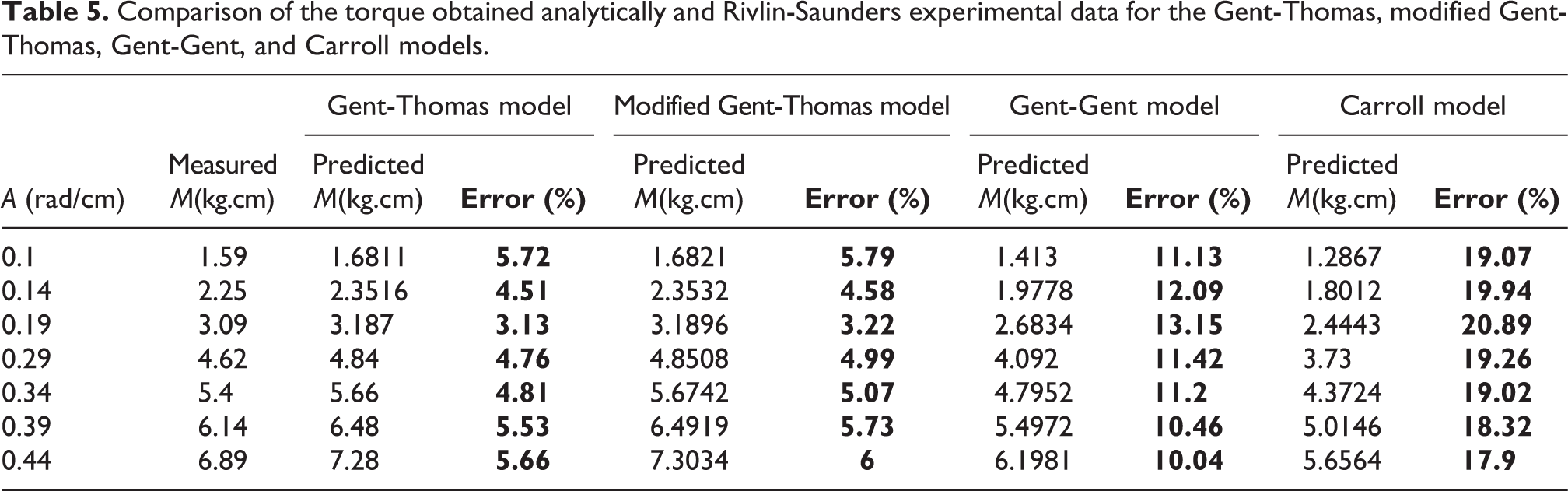
In Tables 4 and 5, the second column indicates the measured values obtained from the Rivlin-Saunders experimental data, 24 and the rest of the columns represent the values of the axial force and the torque obtained analytically. The percentage of error for both the axial force and the torque is obtained by dividing the difference between the absolute value of the measured and predicted values by the measured value. The results reported in Tables 4 and 5 are plotted in Figures 1 and 2 below.
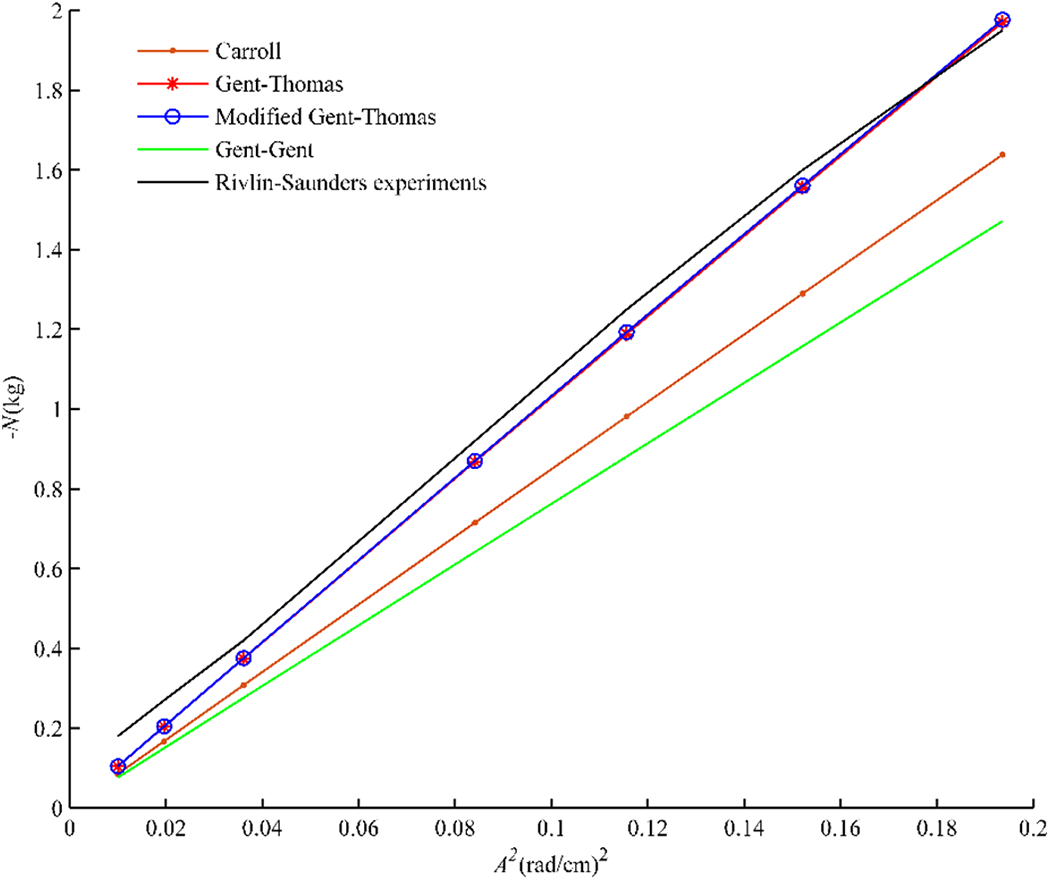
Plot of axial force versus square of angular displacement per unit length A2.

Plot of torque versus angular displacement per unit length A.
The axial force and the torque are plotted against A2 and A respectively. It can be concluded from Tables 4 and 5 that increasing the twisting angle per unit length reduces the error between the axial force and the torque obtained from the exact solution and the experimental data. The error in the axial force for the Gent-Gent and Carroll models are higher than the modified Gent-Thomas model because the value of C2 for the Gent-Gent model and A3 for the Carroll model obtained from the Treloar’s experimental data are small, causing the effect of the second invariant of the deformation tensor to be negligible and the strain energy model to behave more like the strain energies which depend only on the first invariant of the deformation tensor. These errors decrease by taking into account the effect of the second invariant of the deformation tensor in the strain energy function, as in the modified Gent-Thomas model. Although the modified Gent-Thomas and Gent-Gent models have similar equations, the difference in the material parameters defined for the two models plays an important role causing the modified Gent-Thomas model to be in better agreement with the experimental data of Rivlin and Saunders on torsion.
To further elaborate, it is noted that according to Figures 2 and 3 the response of the Gent-Thomas and modified Gent-Thomas models in torsion are almost identical. Since the only difference between these two models, as indicated in Equations (14) and (25), is the introduction of the limiting chain extensibility parameter Jm, it can be concluded that Jm has very little effect on the torsional response of the two models.

Comparison of the angle of twist versus the dimensionless azimuthal shear traction for modified Gent-Thomas, Gent-Gent, and Carroll models.
On the other hand, the parameters multiplying the first invariant in the modified Gent-Thomas and Gent-Gent models, namely K1 and µ/2 given in Equations (25) and (33) respectively, have approximately the same value of 0.15. Thus, the only parameter with a noticeable effect on the torsional response of these two models is the parameter multiplying the term involving the second invariant. This parameter is K2 for the modified Gent-Thomas and C2 for the Gent-Gent model. However, according to Tables 1 and 2, K2 = 0.147 and C2 = 0.0428 N/mm2, so that C2 is almost one-third of K2. The higher value of K2 brings the response of the modified Gent-Thomas model closer to the experimental value as shown in Figure 1. The same trend, albeit to a lesser extent, can be seen in Figure 2 in relation to the twisting moment.
This phenomenon was anticipated by Horgan and Saccomandi 13 when they studied simple torsion of the models which were functions of the first invariant only. They concluded that in order to bring the torsional response predicted by the theory closer to the experimental results it is necessary to take the effect of the second invariant into account. The present work confirms this statement by investigating the behavior of the models that incorporate both of the invariants of the deformation tensor.
Angular displacement in azimuthal shear
For azimuthal shear, the boundary condition at the internal boundary is given by g(R = R1) = 0 and at the external boundary by g(R = R2) = Ψ, where Ψ is the angle of twist so that for the Gent-Thomas, modified Gent-Thomas and Gent-Gent materials, integration of equation (59), along with the two positive roots of equation (68) (for the Gent-Gent model the material parameters defined in Table 2 are used) yields

To plot the angle of twist versus the azimuthal shear traction on the outer boundary, the above integral is evaluated numerically using the fourth-order Newton–Coats (Boole’s rule) numerical integration technique. 29 It is assumed that the cylindrical tube has the internal radius R1 = 2 cm, the external radius R2 = 4 cm with numerical values of K1, K2, μ and C2 shown in Tables 1 and 2, respectively. For the modified Gent-Thomas strain energy, the value Jm = 97.2 is considered from the uniaxial experimental data reported by Gent. 28 For different values of the azimuthal shear traction T0 applied to the outer boundary of the tube, the angle of twist is plotted versus the dimensionless azimuthal shear traction in Figure 4.
The dimensionless azimuthal shear traction for the Gent-Thomas and modified Gent-Thomas models is defined by T = T0/K1, and for the Gent-Gent, and Carroll models is T = T0/μ and T = T0/A1, respectively.
In Figure 3, variations of the angle of twist versus the dimensionless azimuthal shear traction for the modified Gent-Thomas, Carroll, and Gent-Gent models are plotted. The modified Gent-Thomas and Carroll models are shown to be in close agreement even though the former is microstructurally-based, while the latter is a phenomenological model. The close agreement between the two models is considered an advantage for the modified Gent-Thomas model since the Carroll model is highly capable of predicting the behavior of rubber-like materials over a wide range of deformations phenomenologically.20,21
Based on the behavior of the modified Gent-Thomas model in torsion and azimuthal shear deformations, this model can be used as the constitutive relation for vulcanized rubber in various applications. Such applications may include, among others, the use of vulcanized rubber as a matrix in a composite with multiwalled carbon nanotubes as fillers, 30 in the contact model of a robotic soft finger, 31 and other robotic applications for soft manipulation. 32
In Figure 4, for the modified Gent-Thomas, Gent-Gent, and Carroll models, the effect of strain hardening is shown to be quite pronounced for larger values of the azimuthal shear traction, while this effect is absent for the Gent-Thomas model due to the lack of limiting chain extensibility condition.
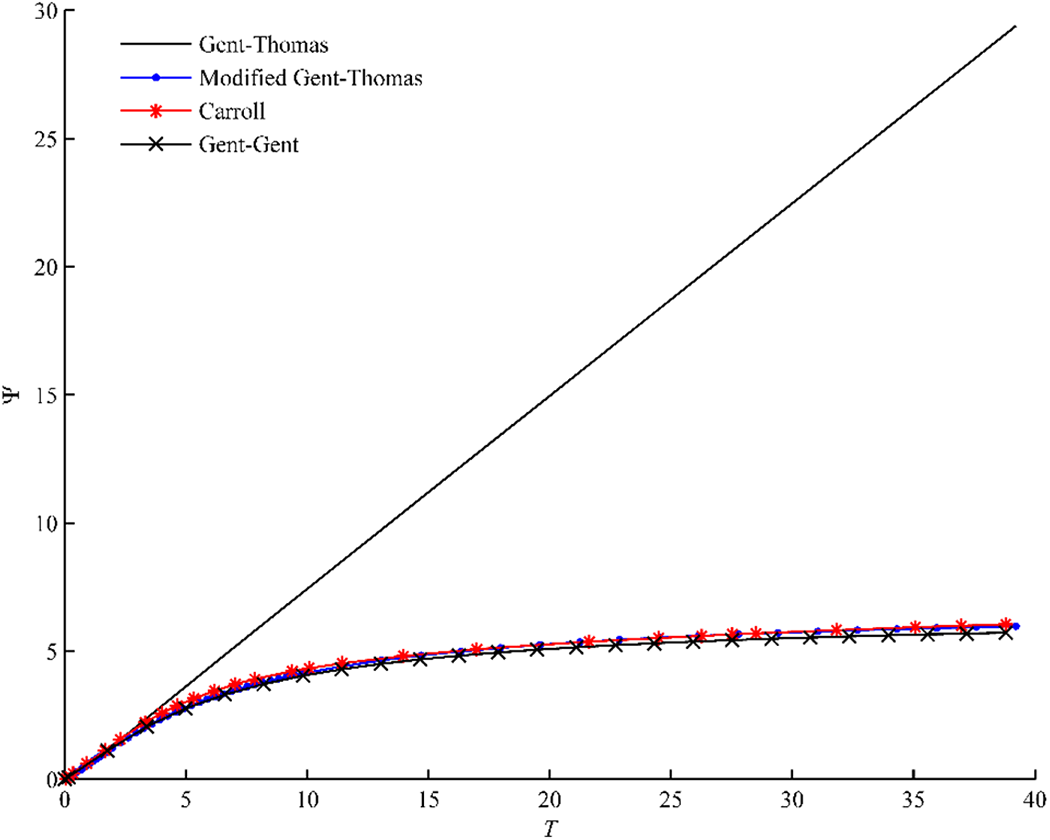
Comparison of the angle of twist versus the dimensionless azimuthal shear traction for the Gent-Thomas, modified Gent-Thomas, Gent-Gent, and Carroll models.
Conclusion
In this paper, the problem of simple torsion and azimuthal shearing of an incompressible cylinder with a modified Gent-Thomas strain energy was solved analytically. Using the specified material parameters, a comparison was made in the torsional deformation between the axial force and the twisting torque obtained from the analytical solution and the experimental data of Rivlin and Saunders for torsion. Considering the results obtained in this paper for the modified Gent-Thomas and Gent-Thomas models, it can be concluded that the errors between the analytical and experimental results for the axial force are lower than those for the Gent-Gent and Carroll models. Accordingly, the modified Gent-Thomas model can be considered to be a suitable model for describing simple torsion of a vulcanized rubber material.
In addition, analytical solutions for azimuthal shear deformation for the modified Gent-Thomas, Gent-Thomas, and Gent-Gent models and numerical solution for the Carroll model were obtained. For the modified Gent-Thomas, Gent-Gent, and Carroll models, being in close agreement with each other, the angle of twist for various dimensionless azimuthal shear tractions was shown to be lower than that of the Gent-Thomas material indicating that the former models have a higher resistance in azimuthal shear deformation than the Gent-Thomas model due to the strain hardening effect.
In conclusion, the modified Gent-Thomas model shows a better agreement with the experimental results on torsion than the other models considered here. Also, this model predicts the strain hardening effect in azimuthal shear deformation in contrast with the Gent-Thomas model, where such an effect is absent. Therefore, the modified Gent-Thomas model is deemed to be a suitable model for describing the response of the vulcanized rubber in torsion and azimuthal shear deformation.
Footnotes
Declaration of conflicting interests
The author(s) declared no potential conflicts of interest with respect to the research, authorship, and/or publication of this article.
Funding
The author(s) received no financial support for the research, authorship, and/or publication of this article.
