



Abstract
In this study poly (vinyl butyral)/silica (PVB/SiO2) composite films were subjected to the cavitation process. The experiments were carried out with a 10 wt.% PVB solution in ethanol. Silica nanoparticles were added into the solution in different concentration of 1, 3 and 5 wt.% SiO2 in regard to PVB. Composite films were cast from these solutions and subjected to ultrasonic cavitation. Optical images of their surfaces were analyzed before and after cavitation, by Image-Pro Plus software. The results revealed that the PVB film with 5 wt.% SiO2 nanoparticles demonstrated the greatest improvement in microhardness with the best cavitation resistance compared to other films.
Introduction
Polymer composites possess various engineering and industrial applications due to their high flexural and tensile strength, and low fabrication cost. Nanoparticles are often used as nanoreinforcement for polymer matrix. These nanoparticles improve the mechanical properties of polymer composites such as modulus of elasticity, stiffness, hardness and wear resistance of their surface. 1 For instance, electrical, mechanical and thermal properties of polymer matrix composites can be significantly improved by adding and mixing silica and alumina particles into a polymer matrix.2-4
Poly (vinyl butyral) (PVB) is a thermoplastic polymer which is produced from condensation of poly (vinyl alcohol) (PVA) with n-butyraldehyde in an acid environment. This polymer is significant for its high impact strength at low temperatures and excellent adhesive properties with different kinds of materials (glass, metals and plastics). It also possesses remarkable optical clarity, film-forming properties, good hydrophobicity, good compatibility with organic solvents and crosslink ability with epoxides. PVB is above all applied in automobile industry to ensure safety in glass laminates. Laminated glass is composed of a PVB interlayer between two pieces of glass. It protects a car’s windshield from flying objects and prevents their penetration. PVB also has its utilization in coatings, adhesives, printing inks, protective clothing and even in health care.5-10 The addition of nanoparticles and nanotubes to the PVB matrix improves its mechanical properties.11-14
Chang et al. reported that the inorganic/organic thin film composed of SiO2 sol and PVB demonstrated outstanding hydrophobicity with good mechanical and optical properties. This thin film fabricated by sol-gel process was pre-coated on polycarbonate (PC) substrate. PC polymer is featured by insufficient hardness and scratch resistance and its abrasion resistance was improved by the (SiO2 + PVB) thin film. 15 In another study, plasticized PVB-silica nanocomposite films were produced by mixing PVB ethanol solution and silica sol prepared from tetraethyl orthosilicate. It was confirmed that the PVB-silica nanocomposite films containing less than 5 wt.% silica were appropriate for use as the interlayer for high-performance laminated glass. 16 Obradović et al. reported that the impregnation of p-aramid fabrics with PVB/ethanol solution which contained 30 wt.% AMEO silane modified silica nanoparticles produced improved mechanical properties in the body armor. 17
Cavitation is a phenomenon in which rapid changes of pressure in a liquid lead to the formation, growth and collapse of bubbles. This mechanism occurs frequently in hydraulic machinery such as pumps, turbine and propellers. The collapses of vapor structures interact with neighboring solid surfaces in via shock-waves, which produces their damage.18,19 Polymer coatings such as thermoelastoplastics, polyurethanes and epoxy resins may be used for improving the cavitation erosion resistance of hydraulic metal elements and equipment.20,21
In this study poly (vinyl butyral)/silica (PVB/SiO2) composite films with different content of silica nanoparticles were subjected to a cavitation process. Their cavitation resistance and microhardness were analyzed.
Experimental part
Preparation of the films
A polymer powder poly (vinyl butyral) (PVB, Mowital B75H, Kuraray Specialities Europe) and absolute ethanol (Zorka Pharma, Šabac) were used for preparing the PVB solution (10 wt.%). The silica nanoparticles with an average particle diameter of 7 nm were obtained from Evonik-Degussa, Aerosil 380. The silica nanoparticles were put into the PVB solution and stirred continuously for 24 h, and then ultrasonically dispersed for 15 min. The silica nanoreinforcement were added into the solution in different concentration of 1, 3 and 5 wt.% SiO2 in regard to PVB. The solutions were poured into the silicon molds and left to stay at room temperature in order to form the films. The thickness of the created films was around 0.2 mm.
Characterization
All the composite film samples were subjected to cavitation in a water bath for 60 min. Cavitation tests were carried out by using a modified ultrasonic vibratory cavitation device in accordance with the ASTM G32-16 Standard. Cavitation testing parameters were as recommended by standard values 22 :
– water temperature in the bath: 25 ± 1°C
– vibration frequency: 20 ± 0.5 kHz
– gap between the test specimen and the transformer for mechanical vibrations: 0.5 mm
– vibration amplitude at the top of the transformer: 50 μm.
The surface of the films was investigated both by optical microscope Carl Zeiss Jena NU 2 and scanning electron microscopy (SEM) on a MIRA3 TESCAN electron microscope at 5.0 kV. The level of surface damage depicted on the optical images was measured and calculated by the software package Image-Pro Plus.
The indentation hardness or the Vickers Hardness Number (VHN) was calculated by using the equation VHN = 1.855P/d2, where P (kilogram-force or kilopound) is the applied load and d (mm) is the length of the mean indentation diagonal.23,24 The applied indentation load was 500 pounds for 25 s and three indents were performed for each sample by micro Vickers machine. Images of the indents were made by the optical microscope and they were used for measuring the indentation diagonal lengths in the Image-Pro Plus program. The mean indentation diagonal length of a certain film is put in the equation for calculation of hardness.
Results and discussion
The thin film samples were subjected to the cavitation process and after 10 min duration of this process, they were dried in the oven at 50°C for 30 min and measured afterward. No mass losses of dried samples were observed with these measurements.
Image-Pro Plus Program was used for determination of surface deterioration from optical images of the samples. The dimension of the images were 733 µm × 549 µm and some of them are presented in Figure 1. The great change in the surface structure of PVB film after 60 min of cavitation can be observed. Compared to the neat PVB film and the PVB/5 wt.% SiO2 film as well (Figures 1(a) and 1(c)), the formation of many damaged areas (the dark spots in the image) and the film cracking due to the cavitation is recognized in Figure 1(b). The crack lines and a few damaged areas are also visible in the PVB film with 5 wt.% SiO2 nanoparticles after 60 min of cavitation (Figure 1(d)).
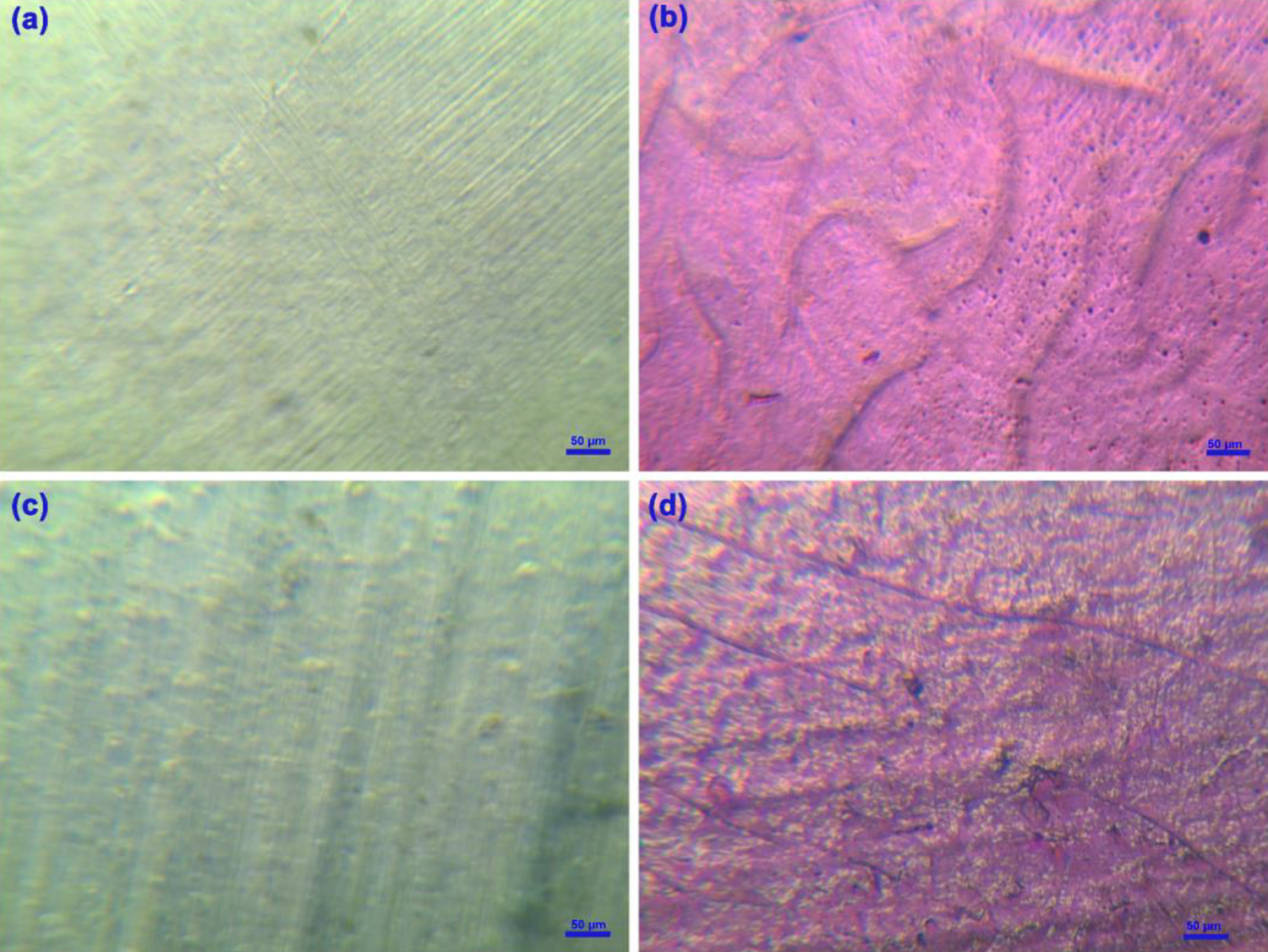
Optical images of PVB films (scale bar 50 µm): (a) neat; (b) neat after 60 min; (c) with 5 wt.% SiO2 nanoparticles; (d) with 5 wt.% SiO2 nanoparticles after 60 min.
The results are presented as the ratio of the sum of the damaged areas and the complete surface of the image (Figure 2). The obtained ratio results presented that the damaged area in the same sample was increasing with the time of the cavitation. The PVB/5 wt.% SiO2 sample was the least damage affected (2.32% after 60 min of the cavitation).
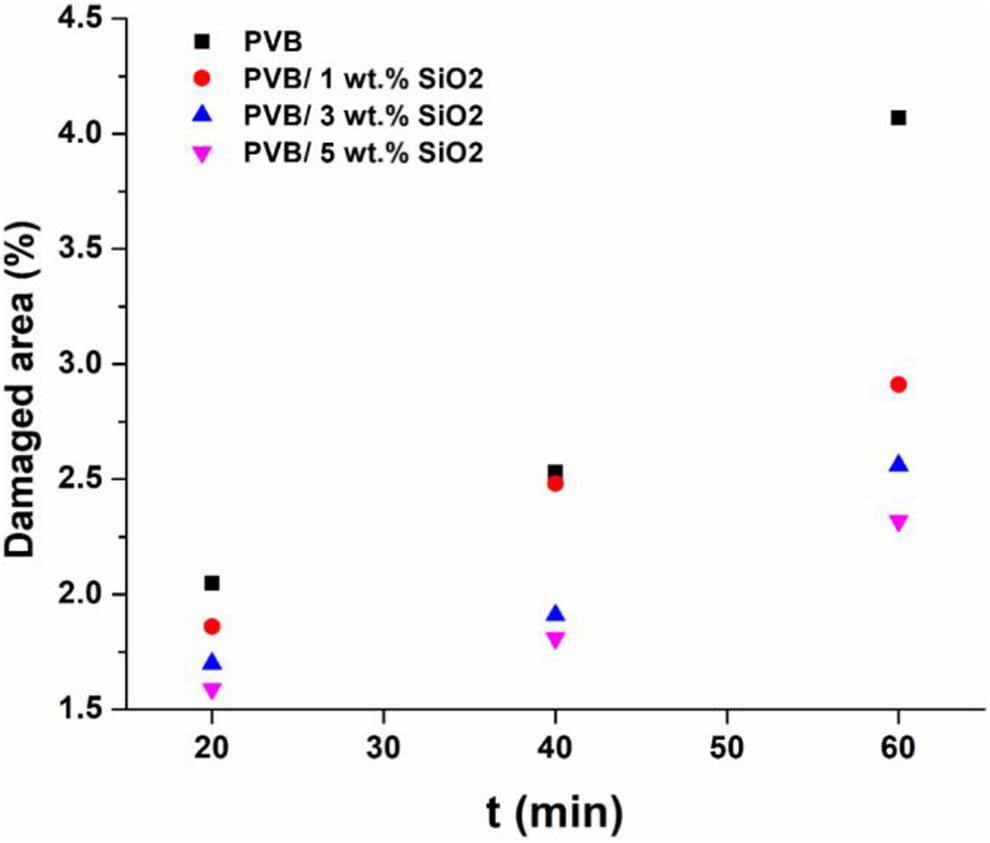
Scatter plot of damaged area vs. time.
The number of analyzed objects defined the number of the damaged parts where their mean area, diameter (D) and roundness have been calculated in Image-Pro Plus. Their values with standard deviations in parentheses are given in Table 1. These results belong to the same samples which were analyzed after different duration of the cavitation. From the obtained results, an increased number of the analyzed objects detected with the cavitation time can be observed. In the PVB/5 wt.% SiO2 sample, the mean diameter decreased after 20 min of the cavitation which indicated that new damaged areas were formed but, simultaneously, the number of analyzed objects increased. The trend with the other samples was opposite—the mean diameter of the damaged parts increased due to their coalescence.
Parameters calculated in Image-Pro Plus.

The appropriate SEM images of the PVB film (scale bar 50 µm) before and after 60 min of cavitation are depicted in Figures 3(a) and 3(b). Although some white impurities are visible, the black damaged areas of the film caused from the cavitation can be observed and they are marked with the orange arrows. In the next two images (scale bar 100 µm), the neat PVB/5 wt.% SiO2 film with white SiO2 nanoparticles is presented (Figure 3(c)), along with the image of this film after the cavitation process (Figure 3(d)). It was observed that the process produced cracks of the composite film which can be noticed with plenty of lines beside the dark damaged areas in Figure 3(d).

SEM images of: PVB film—(a) neat and (b) after 60 min of cavitation; PVB/5 wt.% SiO2 film—(c) neat and (d) after 60 min of cavitation
The micro Vickers indentation testing of the films revealed that the hardness value increased due to the gradually adding of SiO2 nanoreinforcement. All the hardness values with the mean diagonal values are presented in Table 2. The best result in hardness was realized with the PVB/5 wt.% SiO2 film, which had the highest concentration of SiO2 nanoparticles. The result displayed that the PVB film with 5 wt.% SiO2 nanoparticles yielded 23% improvement in indentation hardness compared to the neat PVB film, Table 2. It can be viewed that the indent in the composite PVB film is significantly smaller than the one in the neat PVB film, Figure 4.
Vickers indentation test results for all the samples.


Optical images of indents after micro Vickers indentation (scale bar 50 µm): (a) PVB film and (b) PVB film with 5 wt.% SiO2 nanoparticles.
Conclusion
In this study the PVB/SiO2 composite films with different concentration of 1, 3 and 5 wt.% SiO2 nanoparticles were subjected to the cavitation process. All the composite film surfaces were analyzed in Image-Pro Plus. The best cavitation resistance was achieved with the PVB/5 wt.% SiO2 sample which had the least damaged areas. The results revealed that the PVB film with 5 wt.% SiO2 nanoparticles produced the best microindentation hardness, with 23% improvement compared to the neat PVB film. The improved hardness of this composite could develop its application in the materials with increased wear and scratching resistance.
Footnotes
Declaration of conflicting interests
The author(s) declared no potential conflicts of interest with respect to the research, authorship, and publication of this article.
Funding
The author(s) received the following financial support for the research, authorship, and/or publication of this article: This work was supported by the Ministry of Education, Science and Technological Development of the Republic of Serbia (Contract No. 451-03-68/2020-14/200287) and the COST Action CA18120.
