




Abstract
This research deals with the optimization of buckling and fundamental frequency of a cylindrical panel under various heating conditions, which varies across the surface of the panel. A multi-objective design indicator (MODI) is derived with fiber orientations as a design variable. Finite element analysis is used to calculate temperature variation according to the nature of heating, buckling temperature, and fundamental frequency. In this study, scientific computing software is used to incorporate the finite element method with artificial neural network and particle swarm optimization technique. Five different heating cases, including uniform temperature cases, are considered. It is observed from the analysis that the in-plane temperature field of non-uniform type has a significant influence on the buckling and vibration characteristics of the panel. Further, it is observed that panel with lamination scheme of
Keywords
Introduction
Cylindrical panels believed to be vital in most of the engineering structures. Panels utilized in various aircraft, satellites, missiles and rockets are exposed to aerodynamic heat, which thus stimulates a temperature variation over the panel surface. Composites have become the most promising and dominating material of current and future engineering structures. In recent years, the evolution of composite technology under high temperature has made it possible to use the composite panels in highly sophisticated structures like supersonic aircraft, inflammable fluid containers, nuclear reactors, the hull of the ship, and also in petrochemical vessels. Most of these structural components are exposed to the hostile thermal environment during their service life, thus affects its structural and dynamic behavior. The anticipation of the static behavior of the laminated curved panel under thermal load is cumbersome but vital for the prediction of load-carrying capacity. Similarly, natural frequencies also critical in the design of structures for dynamic conditions. However, buckling strength and natural frequency can be enhanced by proper design and optimization process.
The cylindrical shell was investigated by Patel et al. 1 for critical buckling temperature by applying the finite element method wherein higher-order displacement theory was employed. Laminated cylindrical shell with small geometric imperfection was examined by Shen and Li 2 for the buckling behavior. Composite cylindrical panels with various boundary conditions were analyzed by Zhao et al. 3 employing a mesh-free kp-Ritz method to compute its effect on the fundamental frequency. Laminated shells were analyzed by Kurpa et al. 4 using R-function theory and variational methods to study the vibrational characteristics. Lin et al. 5 presented a theoretical approach based on the Rayleigh-Ritz method to examine the vibration frequencies of a composite panel. It was found from the analysis that with the small ply angle and large spring stiffness, aerodynamic stability can be enhanced. Castro et al. 6 presented the buckling analysis of laminated composite cylinder based on first-order shear deformation theory along with Donnell’s non-linear equation. They used elastic constraints at the edges to obtain the different boundary conditions. They demonstrated the importance of shear correction factor in predicting the buckling strength of thin-walled structures. Almeida et al. 7 employed numerical, analytical, and experimental methods to study the stability of composite tubes fabricated by filament winding under axial compression. They noticed buckling failure in the thinner tube followed by a post-buckling. Whereas for thicker tubes, failure was due to in-plane shear and transverse compression. Shell made of multiwalled carbon nanotubes (MWCNT) reinforced composite was analyzed by Subramani and Ramamoorthy 8 to improve the damping and natural frequencies of polymer composite structure. They conducted experiments and found that the damping and natural frequencies can be enhanced with the addition of MWCNT.
A very few literature9-12 focused on the static characteristics of plates and cylindrical shells exposed to thermal environment. A thick laminated cylindrical shell was investigated by Ganapathi et al.9 to investigate its dynamic behavior. Shell under thermo-mechanical load was analyzed using the direct time integration method along with the finite element method. Jeyaraj 11 employed a finite element tool to study static characteristics of an isotropic plate under non-uniform heating. Later, the same approach was employed by Bhagat et al.12,13 to carry out the study on composite cylindrical shell and isotropic panel subjected to thermal load. The cylindrical panel is analyzed by Bhagat and Jeyaraj 14 using an experimental approach to calculate the buckling strength under various heating conditions.
Spallino and Thierauf 15 employed a guided random-search method to maximize the buckling temperature of a uniformly heated laminated plate. Deka et al. 16 analyzed a laminated plate to minimize its weight and cost using finite element method (FEM) and Genetic algorithm (GA) based multi-objective optimization. The stacking sequence method was employed by Abouhamze and Shakeri 17 to optimize the strength of cylindrical panels subjected to axial compression load. Suresh et al. 18 employed particle swarm optimization technique to optimize the ply angle and cross-section dimension of the composite box beam helicopter rotor blade. They compared the computational efficiency and performance of swarm optimization with design based genetic algorithms. Their result proves that it has a better solution in terms of computational time and performance. Topal and Uzman19,20 employed modified feasible direction (MFD) to optimize buckling temperature of composite panels. Almeida and Awruch 21 used genetic algorithm with finite element method to minimize the weight and deflection or weight and cost of composite laminated structures. The laminated cylindrical shell is analyzed by Gharib and Shakeri 22 using a stacking sequence approach to optimize the fundamental frequency and the buckling temperature. Unified particle swarm optimization was implemented by Sreehari and Maiti 23 to maximize the buckling load of composite plates with internal flaws under hygrothermal environment. To determine the thermal buckling strength they employed finite element method based on inverse hyperbolic shear deformation theory. Almeida et al. 24 employed a genetic algorithm (GA) for a filament-wound composite cylinder to detect the optimum winding angle. To simulate the damage and failure, the finite element package was linked to FORTRAN that has the GA associated with a mesoscale damage model. Their finding shows that the non-conventional and asymmetric winding angle as the best solution for composite tubes with internal pressure. Particle swarm optimization algorithm was employed by Jafari Fesharaki et al. 25 to optimize the pattern and location of piezo patches on a panel for buckling strength. It was found from the analysis that the buckling load is influenced by the patch location. Almeida et al. 26 presented a methodology to optimize both intrinsic thickness and fiber angle for an anisotropic composite structure based on a genetic algorithm. They noticed that the quasi-isotropic stacking sequence has stiffness lower than the structure with optimized topology and cross-section. The structure with optimized cross-section has greater stiffness than the structure with a topologically optimized structure. Optimzation of the plate exposed to different thermal load was analyzed by Emmanuel Nicholas et al. 27 using FEM and GA. Almeida et al. 28 employed direct fiber path optimization framework in conjunction with finite element method to optimize the first buckling mode of variable-axial composite cylinders under axial compression. Wei et al. 29 employed stacking sequence method to maximize the buckling load of composite cylindrical shell exposed to hydrostatic pressure. They proposed stiffness coefficient-based method based on the optimal results found using GA coupled with an FEM analysis.
By review of the literature, it is found that no work has been reported on maximization of the first fundamental frequency and thermal buckling of laminated cylindrical panels exposed to in-plane graded temperature fields. However, few studies available on optimization of laminated composite shells are confined to uniform temperature rise. Structures employed in aerospace vehicles, rockets and missiles, heating furnace and nuclear vessels are exposed to graded temperature field during their service. Further, structural behavior of the panel under graded temperature field is different from uniform temperature field. In summary, the non-uniform thermal load plays a vital role in determining and monitoring structural design. In this regard, the present works deal with the multiobjective optimization of the first fundamental frequency and buckling temperature of laminated composite cylindrical panel subjected to in-plane graded temperature fields. A commercially available finite element tool (ANSYS) is used for structural analysis, whereas particle swarm optimization in conjunction with an artificial neural network is implemented for optimization.
Analysis approach
The numerical approach followed in present work for the maximization of the fundamental frequency, and the critical temperature of a composite cylindrical panel exposed to different in-plane non-uniform temperature variations is given in Figure 1. Initially, heat transfer analysis is performed to acquire the temperature distribution field as per the defined nodal temperature. Further, static analysis is performed to compute the evolved stress fields due to thermal load. Thus the critical buckling temperature is found by the eigenvalue method, as shown in Figure 1. Natural frequency is calculated using modal analysis. A commercially available finite element tool (ANSYS) is used to perform heat transfer analysis, buckling analysis, and modal analysis. The present approach of optimization uses an artificial neural network in conjunction with particle swarm optimization. Inhouse builtin code is used to integrate ANN with finite element code. Wherein ANN develops an effective network from the inputs and outputs generated by the finite element method. After successful completion of training and verification of neurons, the finite element method is replaced by ANNs for predicting buckling temperature and fundamental frequency for a given input. Replacement of the finite element method by ANNs ensures the reduction of computational time significantly. In the present study, particle swarm optimization is used to solve a multi-objective problem.

Flow chart of numerical procedure followed.
Formulation of finite element analysis
Cylindrical panel with curvature (R), length (L), width (S), thickness (h) (Figure 2) is considered. u, v and w denotes the in-plane displacements and
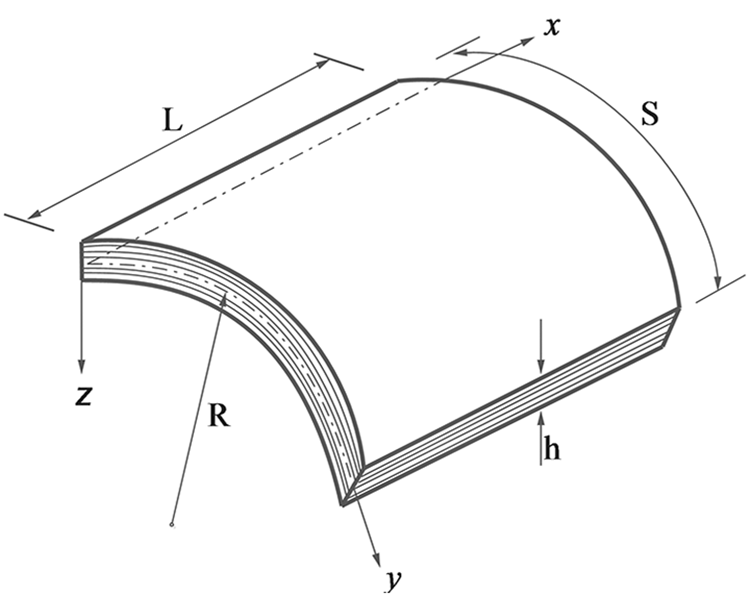
A schematic of the cylindrical panel.
To find temperature distribution
Heat transfer analysis is performed to find the temperature variation according to the heating condition. Temperature variation field on the cylindrical panel is obtained with the help of equation (1) as per the stated thermal boundary constraints.

where nodal temperature, conduction matrix is given by
Structural analysis
Equation (2) is used to find the nodal displacement vector (

Further eigenvalue buckling analysis using Equation 3

where

where
Normalized quantities used in the analysis are computed as follows

where T0 and
Artificial neural network
The neural networks scheme implemented in the present study is shown in Figure 3. The feed-forward neural network always passes information from the first layer (input nodes) to the last layer (output nodes) through a hidden layer. The back-propagation learning algorithm, a supervised learning method is employed as a training method in the present study. An artificial neural network is implemented by using commercially available software, MATLAB.
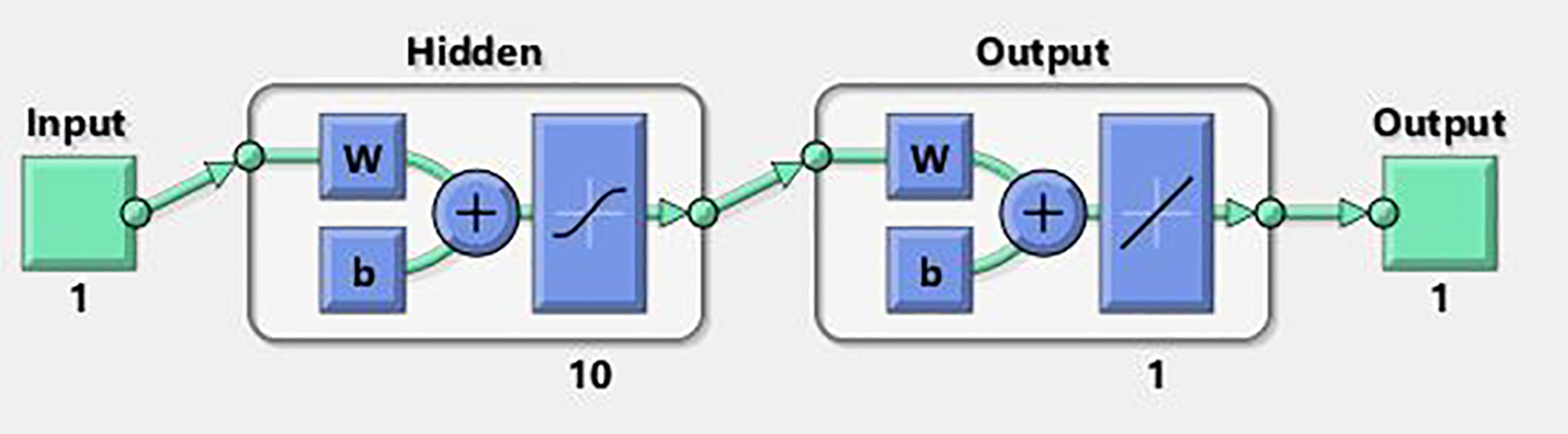
Neural network scheme employed for the analysis.
Particle swarm optimization
Eberhart and Kennedy 30 proposed a powerful and effective evolutionary search algorithm, Particle swarm optimization (PSO) to address the optimization problems. Recently, PSO found its application in optimizing and solving various engineering problems.31,32 Further, it requires only few parameters to adjust for successful and effective implementation. 33 PSO is chosen in the present study for optimization due to its simplicity, easy implementation, faster convergence rate and wide area of application.
PSO algorithm discussed by Bai
34
is followed in the present study. Schema of a PSO algorithm is as follows: Initially, swarm confidence factor (c2), self-confidence factor (c1), number of iterations Set of particles are randomly distributed. Evaluate fitness value. Find particle personal best ( Find global best ( Update velocity using equation (6). Update position using equation (7). Evaluate fitness value. Repeat Steps 4 to 8 until a stopping criterion is met,
Scheme for updating the velocity vector of each particle34,36 is given by

where r1 and r2 are uniformly distributed random variables (0∼1). Best position found by particle i,
Scheme for updating the position of each particle is given by

where

where

Flow diagram illustrating the PSO algorithm.
Problem formulation
Influence of different heating cases (HC) on maximum buckling strength (
Determine fiber orientation (
To maximize critical buckling temperature

To maximize first fundamental frequency

Well known weighted sum method is implemented wherein each objective function is allocated with a weighting factor. In the present analysis the aggregated objective function resulted from weighted sum method, called as multi-objective design indicator, MODI 37 is derived using following equation:

where the weighting coefficient assigned for buckling strength and first fundamental frequency is given by
Find fiber angle (

Validation for evaluation of optimized buckling temperature
All edges clamped laminated plate under uniform heating studied by Topal and Uzman
19
for maximization of buckling strength is considered. Plate dimensions analyzed by Topal and Uzman
19
are R/S = 1000 and S/h = 100 with following properties; E11 = 181 GPa, E22 = E33 = 10.3 GPa, G12 = G13 = 7.17 GPa, G23 = 2.39 GPa,
Comparison of present results with those of Topal and Uzman19 for optimized fiber orientation.

Results and discussion
Cylindrical panel having: h = 0.001 m, L/S = 1, S/h = 100 and R/S = 5 is considered for the optimization, if otherwise mentioned. Panel investigated is made of graphite/epoxy having
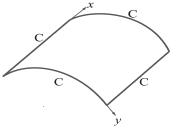
Different structural boundary conditions investigated in the current work are given in Table 2.
Different boundary conditions analyzed.



Different heating conditions
Four variants of in-plane graded temperature fields are considered as per the nature of heating source along with the uniform heating case. Five different heating cases (HC) analyzed are as follows; (i) HC-U: Uniform trend; (ii) HC-D: Decreasing trend; (iii) HC-D-I: Decreasing then increasing trend; (iv) HC-I-D: Increasing then decreasing trend and (v) HC-C: Camel hump trend. 12 Cylindrical panel with thermal boundary constraints and resulting temperature fields is shown in Table 3.
Non-uniform temperature cases studied.

Weighting factor basically shows the importance of one objective over the other and to investigate the influence of weighting factor on MODI max and optimum laminate orientation, a study is carried out on the CCCC panel under different heating cases. Table 4 depicts the influence of weighting factor on MODI max of the panel. As expected, it is noted from Table 4 that MODI max increases with the weighting factor which shows that change of buckling temperature with laminate orientation is more significant compared to change in fundamental frequency with laminate orientation. Further, it is also seen that there is no substantial change in optimum laminate orientation with the weighting factor. It has been observed from Table 4 that optimum laminate orientation ranges between 45° to 50° as properties of laminates in the transverse and longitudinal direction is more effective in this range. Further, it is also found that optimum laminate orientation is not highly influenced by different temperature fields.
Influence of weighting factor and temperature fields on MODI max .

Laminate orientation of panel with five different lamination schemes such as
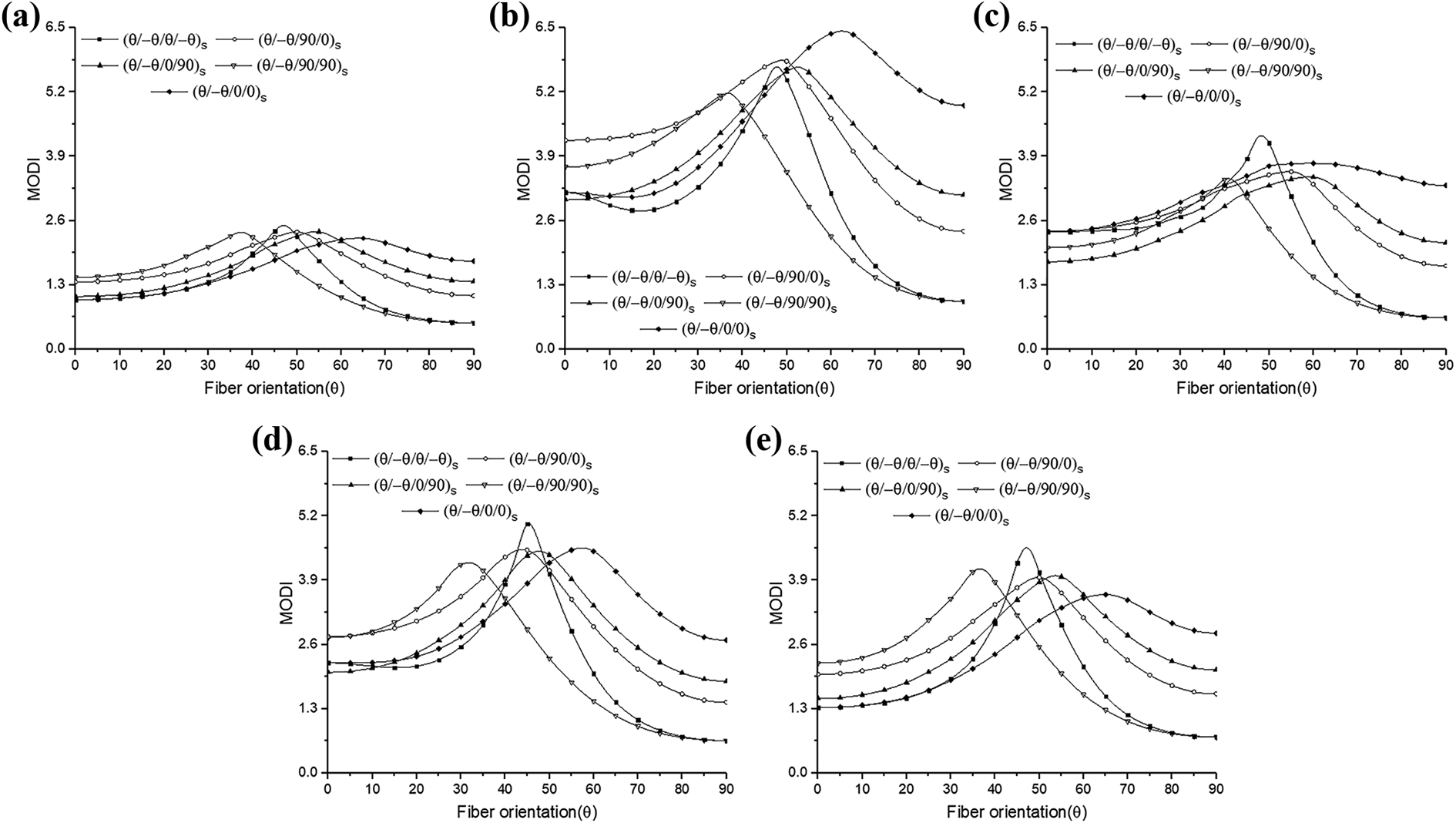
Influence of lamination schemes on MODI of CCCC panel with temperature fields (a) HC-U: Uniform trend, (b) HC-D: Decreasing trend, (c) HC-D-I: Decreasing then increasing trend, (d) HC-I-D: Increasing then decreasing trend and (e) HC-C: Camel hump trend.
Influence of weighting factor and temperature fields on the optimum laminate orientation (

Influence of lamination schemes and temperature fields on the optimum laminate orientation (

Influence of lamination schemes and temperature fields on MODI max .

Thickness ratio and heating condition influence on the MODI
max
and corresponding laminate orientation are given in Tables 8 and 9. The panel is analyzed for three different thickness ratio such as 75, 100 and 125 along with two different lamination scheme. It is found that MODI
max
decrease with the increase in thickness ratio. This is due to a decrease in the stiffness with an increase in thickness ratio. A higher value of MODI
max
is observed for a panel exposed to HC (b) temperature field, whereas lower value is observed for HC (a). Laminate scheme analyzed are found to have a significant influence on the optimum laminate orientation for different thickness ratio. Panel with laminate scheme of
Thickness ratio and heating condition influence on MODI max .

Thickness ratio and heating condition effect on optimum laminate orientation (

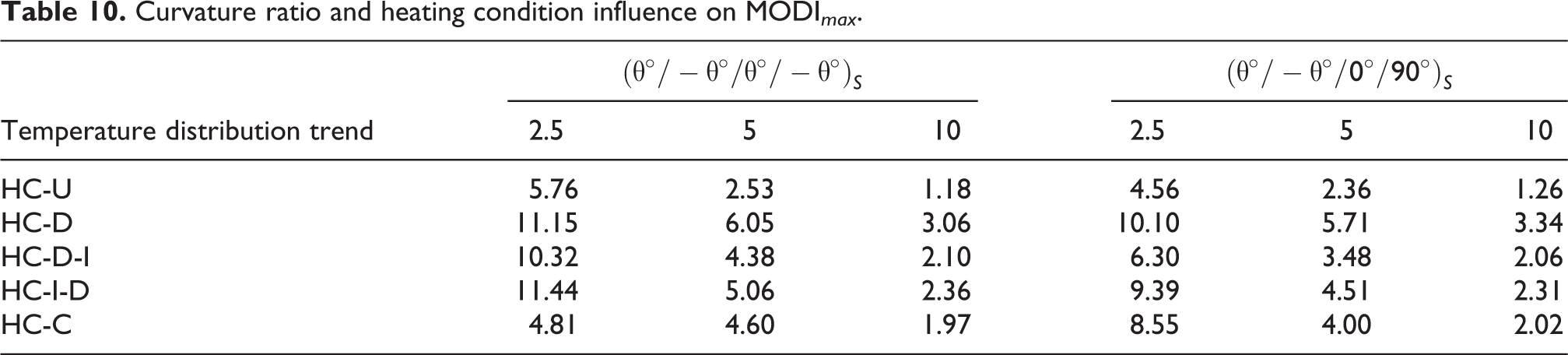
Curvature ratio significantly influences buckling temperature and fundamental frequency of a cylindrical panel. Curvature ratio effect on MODI
max
and corresponding laminate orientation is investigated. Irrespective of temperature fields, MODI
max
decreases with increase in curvature ratio as shown in Table 10. Further, this behavior of MODI
max
is observed with both the lamination schemes. Variation of optimum laminate orientation with the curvature ratio is also investigated. Panel with different curvature ratio is found to have different optimum laminate orientation under different lamination scheme. Further it is observed that for a lamination scheme of
Curvature ratio and heating condition influence on MODI max .
Curvature ratio and temperature fields effect on the optimum orientation (

Table 12 depicts effects of different boundary conditions on MODI max wherein it is found that MODI max changes with boundary constraints. SSSS panel has a high value of MODI max due to relaxation of some degree of freedom, as anticipated, CCCC panel has a low value of MODI max . It is also noted that MODI max of a panel with different boundary constraints also changes with the nature of the heating condition. Table 13 shows the influence of boundary constraints on the optimum laminate orientation. It is clearly seen that the optimum laminate orientation with the boundary conditions which ranges from 45° to 55°.
Boundary condition and heating condition effects on MODI max .

Boundary condition and heating condition effect on optimum laminate orientation (

Conclusion
The study presents optimization of the fundamental frequency and buckling strength of panel under temperature field of non-uniform type. The finite element approach, in conjunction with the artificial neural network and particle swarm optimization is employed to analyze the influence of different non-uniform temperature variation on the optimum buckling strength and fundamental frequency of the panel. Following salient points are derived from this work. Multi-Objective design indicator (MODI) of the cylindrical panel is significantly affected by the heating condition of the non-uniform type. Ply angle and stacking sequence of the laminate plays an important role in deciding Multi Objective-design indicator (MODI). The panel with lamination scheme of
The findings from this work have a high impact on utilizing laminated composite cylindrical panels in aerospace structures as it is exposed to different thermal environment conditions. Further, the results of this study can be used to obtain the best possible lamination scheme and ply angle required to withstand the non-uniform thermal load.
Footnotes
Declaration of conflicting interests
The author(s) declared no potential conflicts of interest with respect to the research, authorship, and/or publication of this article.
Funding
The author(s) received no financial support for the research, authorship, and/or publication of this article.