




Abstract
The aim of this study is to analyze viscoelastic properties of direct composite core (Lightcore, Build-it, Clearfil Photo Core, Rebilda). Experiments are preformed and mathematical models developed, based on derivatives of fractional order, to describe the viscoelastic properties of the studied materials. The basic assumption that materials are of memory type was proved to be correct. For each material, four fractional derivative models are used to fit experimental data and then one model, with smallest error between measured and calculated data for storage and loss modulus, is chosen. On the basis of mathematical model formulated here, it is possible to predict some viscoelastic properties of the materials that are important in clinical application. Central conclusion is that the four studied materials have different rheological properties although they are indicated for the same clinical procedure.
Keywords
Introduction
Teeth receiving endodontic treatment are usually severely affected by decay, previous restorations, or excessive wear; as a result, a significant loss of coronal tooth structure is often observed. 1 Core build-up composites (core composites) are specifically designed to restore the coronal portion of a severely destroyed tooth prior to the placement of an indirect restoration. Also, these materials can be used for post cementation in restoring endodonticaly treated teeth.1,2 These materials are stated by the manufacturers to have high strength, hardness and increased depth of cure providing reliable support for the overlying restoration.
Although the long-term clinical success of an indirect restoration is mostly dependent on the amount of remaining tooth structure (which is responsible for the adequate ferrule effect), the core build-up material plays an important role as well. An ideal core build-up material must present excellent mechanical properties in order to resist the stresses that may be produced during function, providing equitable stress distributions of forces and reducing the probability of tensile and compressive failures. 3
Composite core materials are generally composed of organic polymer matrix and filler particles. Their mechanical properties where subject of many recent investigations.4,5 Most of these materials are methacrylate resin based with high filler content and superior mechanical properties. The incorporation of low molecular weight monomers within methacrylate resin composite materials can enhance the flexural properties and lower viscosity.2,6 Many light cure resin composite core materials are available on the market. They are different in their handling characteristics, compositions (such as matrix type, filler type, filler load) and properties (such as polymerization ability, flexural strength, hardness, etc).
The handling characteristics of resin composites are a very important factor when selecting composites for clinical use. It is determined by how easily the restorative material can be manipulated during the placement.
Development of mathematical models for dental materials has importance in clinical applications.7,8 In previous work mathematical model based on fractional derivatives that describes mechanical properties of a class of dental materials were obtained. 9 The mechanical properties of dental materials are of great importance from both durability reasons and as important factor in formulating clinical procedures. 10 Having this in mind, the rheological properties of core build-up materials were examined here. Rheological properties such as viscosity are directly related to handling properties, which include easy placement into a cavity and shaping, stickiness to an instrument, adhesion, and the ability to retain resistance to slumping after sculpting. These properties greatly affect the restorative procedure, treatment time and the clinical outcome. 11
Rheometry12,13 is a widely used testing method to investigate both the flow properties during processing of the uncured composites as well as their curing properties.14,15 The curing process is mainly investigated in an oscillatory mode.14,16 Experimental data on the viscosity of composite core build up materials are currently lacking in literature and will be presented in this work.
Material and methods
Materials
Four different commercially available composite core materials were tested in this study (see Table 1). They are light cured composite core build up materials commonly used in clinical practice.
Materials tested in this study.

Rheological measurements
Rheological oscillatory tests were performed using an HAAKE Mars Rheometer 17 (Thermo Fisher Scientific Process Instruments, Karlsruhe, Germany) at a constant temperature of 25 ± 0.1°C, using parallel plates module with a diameter of 20 mm. The gap between the plates was 1 mm. Amplitude sweep tests were done in order to detect linear viscoelastic region (LVR) from the plot storage (G’) and loss (G”) moduli versus shear stress (τ). The experiments were performed at shear stress range from 0.01 to 100 Pa at constant frequency (in Hz). Appropriate strains were selected as middle value of LVR and kept constant in frequency sweep tests. Frequency sweep tests were performed in the range of 0.1 to 10 Hz in order to determine the behavior of the complex viscosity (η*), storage shear modulus (G′) and loss shear modulus (G′′) as a function of the frequency. Care was taken that tested materials are not exposed to the light, prior and during testing, since in all materials used are, the polymerization is light induced.
Filler content in materials is designated in percent volume (vol %) or percent weight (wt %). Weight percent is usually higher in value than percent volume. The volume percentage may be a more reliable indicator of filler content than the weight percentage. This is because of differences in density between different fillers. For example, composites can have a similar volume percentage of fillers yet different weight percentages. This is because the composite containing a larger fraction of heavy metal glass fillers will have a higher weight percentage19. In Table 1 we give the properties of the tested materials.
Theoretical background
Materials used in dentistry have viscoelastic properties. Viscoelastic and non-standard diffusion properties of materials may be successfully modeled by the use of fractional derivatives.9,19,20 Viscoelastic body may be fluid like (having infinite creep strain), or solid like (having finite non-zero creep strain). Creep strain is obtained in a creep test, when material is subject to a sudden, but later constant force on its free end.
The Riemann-Liouville fractional derivative of order α with 0 ≤ α ≤ 1 is defined by

Note that

Models
The constitutive equation for the materials used here were assumed in the form 18

where
21
Note that in shear test used in (1) and relations that follow σ and ε should be replaced with shear stress τ and shear strain γ. We shall consider four special cases of (1) that we specify as:
Model 1. There are

where
Model 2. Again, we choose

where
Model 3. We choose

where
Model 4. We consider generalized Zener model

where
For each material that we tested experimentally (Clearfil, Rebilda, Built-it and Lightcore) we determined parameters in all four Models on the basis of measured values of storage and loss modulus

Where G′ and G″ are real and imaginary parts of the complex modulus determined for the models 1– 4 that is defined as

Both G′ and G″ were obtained by applying the Fourier transform to the constitutive relation constitutive equation of each model, i.e.

Then, for a particular material a model is chosen for which the function L has the smallest value.
Considering that the storage modulus (G′) represents the stored energy by the sample as well as elastic portion of viscoelastic behavior which corresponds to the solid—state behavior of the sample. The loss modulus (G″) represents dissipated energy during flow through internal friction in the sample. It is viscose portion of the viscoelastic behavior which describes the liquid—state behavior of the sample. In Figure 1, a-d we present storage and loss modulus versus frequency f, i.e.
The restrictions on the coefficients presented for each model, follow from the Entropy inequality under isothermal conditions. In this work, we used restrictions obtained by, so called Bagley Torvik method. 21 Recently 23 a more general method of exploiting Second law of thermodynamics for determining admissible constitutive equations was proposed. The implications of this procedure, generally speaking, lead to more relaxed conditions than those obtained by Bagley Torvik method used here.
Results and discussion
Viscoelastic properties of material occur when the material exhibits both viscous and elastic characteristics under stress, so it has properties of solid and liquid phase at the same time. Oscillatory tests were performed in order to characterize the viscoelastic behavior of a material. 24 Complex shear modulus G, describes entire range of viscoelastic behavior

Viscoelastic solids would have higher values of storage moduli than loss moduli while viscoelastic liquids show domination of loss over storage moduli. Complex viscosity is defined as

Finally, we note that the angular frequency ω is connected to the frequency f by following relation

The results of the oscillatory rheological measurements (frequency sweep tests) for four different composite core materials, in logarithmic scale, are shown on Figure 1.

Storage G’ and loss G’’ modulus versus frequency F.
The loss moduli G’’ dominated over storage ones G’ for whole range of applied frequencies for Clearfil. Built-it and Lightcore showed mutually similar rheological behavior. The values of storage and loss moduli overlapped at low values of frequencies. For even higher frequencies viscose values exceed elastic responses: 1.5 Hz for Built-it and 2.2 Hz for Clearfil. Rebilda frequency sweep tests showed that G’ values were greater than G’’ for all applied frequencies.
Figure 2 presents the changes in storage moduli and complex viscosities of the tested composite core materials versus frequency, in logarithmic scales. The obtained curves of the complex viscosities η* show that for all analyzed composite core materials η* decreases with increase in applied frequencies (Figure 2a). Cox-Merz empirical rule showed that steady shear viscosity as function of shear rate measured via rotational test showed almost identically curve as frequency-dependent function of complex viscosity measured as function of angular velocity via oscillatory test when they are presented in the same plot.12,13,17 According to Cox-Merz rule and complex viscosity results of composite core materials, it could be concluded that all determined composites exhibit non-Newtonian, pseudoplastic behavior due to the fact that their complex viscosities decreased with increasing frequencies (shear rates). 25 There were no significant differences between complex viscosities of Lightcore and Build-it. The highest values of complex viscosities were showed by Rebilda while the lowest ones were indicated by Lightcore and Build-it. The results for elastic moduli were in the same order as for complex viscosities i.e. one which shows the greater values for complex viscosities shows the greater values for storage moduli as well (Figure 2b).

a) Complex viscosity b) Storage modulus G’, versus frequency f.
Results for two examples of calculation are presented. The first case corresponds to Build-it and Model 1defined by (2). The values of parameters are:

Therefore, that the constitutive equation corresponding to Build-it is

In Figure 3 measured and values calculated according to (12) for G’ are shown.

G’ for Build-it material, measured (circles) and calculated according to (12).
Results for Rebilda were presented as a second example. The results show loss modulus G’’ calculated according to Model 2 defined by (3). Values of parameters are:

Therefore, that the constitutive equation corresponding to Rebilda is

In Figure 4 calculated and measured values of G’’ are shown.
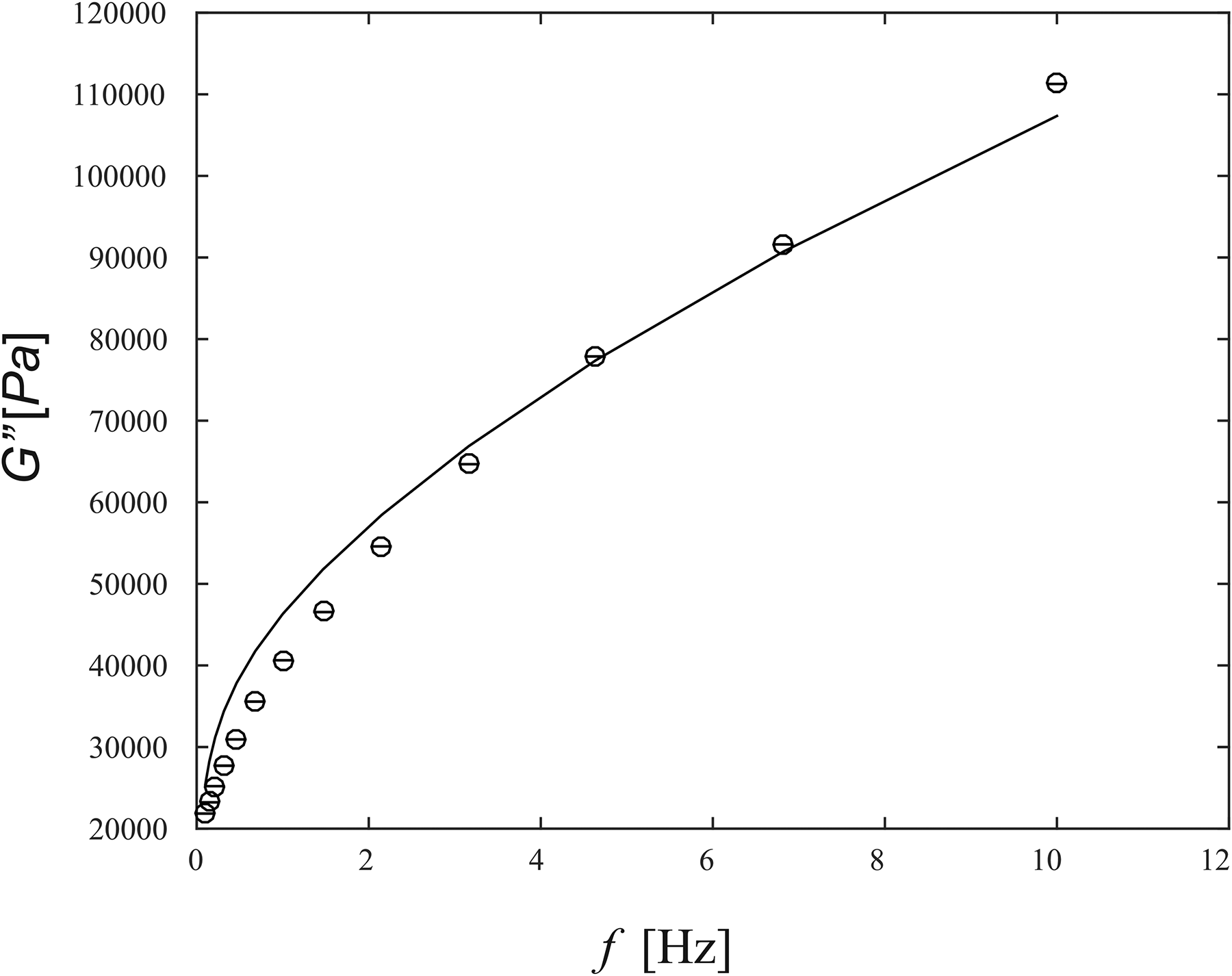
G’’ for Rebilda material, measured (circles) and calculated according to (13).
The agreement of experimental and calculated values are for all other cases better than the one shown in Figure 4. In the Table 2 models and parameters are listed for all four materials are given. For each material the mathematical model (case) is given to which the corresponding parameters of the model refer.
Parameters of the models for all four materials.

The current study investigated rheological properties of four commercially available composite core build-up materials. Rheological properties of materials depend on physico-chemical characteristics of the components as well as their composition. Generally, composite core build-up materials are dispersions of solid particles, so called fillers, in polymer matrix. Type and ratio of components which make structure of the matrix as well as filler size, shape and its content may influence viscosity of the composites. Also, the interaction between matrix and fillers and interlocking between filler particles are important for manifestation of viscoelastic characteristics. 25 All determined composites showed viscoelastic characteristics. Rebilda behaves like viscoelastic solid while other three composites behave like viscoelastic liquids. Also, the all materials exhibit pseudoplastic behavior, which is important handling characteristic. Namely, the viscosity of the composites will decrease during the manipulation, which provides easier work with them and placement.
The higher viscosity that is associated with higher filler load also impedes the injection of the material into the root canal during the post cementation, producing gaps and voids that may influence the bond strength between tooth canal and composite post. In terms of adaptability, they compare favorably with the other types of composites examined in this study and resulted in fewer voids along the interface between the flowable composite and the post surface.
Low-viscosity core materials exhibited excellent adaptability at the post surface which resulted in fewer voids along the interface between the composite and the post surface. They perform marginally better than the other materials tested, showing the highest bond strength to fiber post. 1
This study might provide useful information about viscosity that should be consider before selecting the right material for core build-up procedure.
Conclusion
Within the limitation of this study it can be concluded: All tested materials have different rheological properties although they are indicated for the same clinical procedure. This is the main result and it implies the need for the further study of the influence of storage modulus, loss modulus and complex viscosity on the clinical procedures in which core build-up composites for coronal restoration are used. The mathematical model number 4 can describe (predict) the most precisely the complex viscosity of the core build-up composite materials. Further clinical research is needed to determine the optimal complex viscosity of composite core materials.
Footnotes
Acknowledgement
The authors are grateful to the Ministry of Science of Republic of Serbia.
Declaration of conflicting interests
The authors declared no potential conflicts of interest with respect to the research, authorship, and/or publication of this article.
Funding
The authors disclosed receipt of the following financial support for the research, authorship, and/or publication of this article: This research was supported by the Faculty of Technical Sciences, Novi Sad (TMA), Ministry of Education, Science and Technological Development of the Republic of Serbia Grants TR32035, III44003 (MJ).
