




Abstract
This paper focus on the optimum design of the arc-shaped rubber hose, so that the hose has a good balance performance and a higher burst pressure. Based on the thin shell theory without considering bending moments and shear force, the equilibrium equation was established to obtain the internal force of the arc-shaped hose under internal pressure, and the burst pressure of the arc-shaped rubber hose was obtained by using Tsai-Hill failure criterion. According to the mechanical model of burst pressure, the influence of structural parameters on the burst pressure and distribution of vulnerable positions of arc-shaped rubber hose was studied. Then, in order to determine the structural parameters of the hose satisfying the balance performance, the deformation of the arc-shaped rubber hose was divided into two stages, including braiding angle deflection and tensile deformation of fiber, and the mechanical model of balance performance of the arc-shaped rubber hose was established. Eventually, on the basis of satisfying the balance performance of the hose, the hose was optimized for higher burst pressure. The correctness of the theoretical model and the optimization results were verified by experiments.
Introduction
The rubber hose is a rubber composite hose made of filament braiding. 1 The application of rubber hoses on ship pipelines is becoming more and more important.2-4 In the design of arc-shaped rubber hose, failure analysis of the arc-shaped rubber hose is necessary to ensure that the hose meets the requirements of burst pressure.5,6 In addition, the arc-shaped rubber hose will generate a certain displacement in the axial direction under the internal pressure. It will cause additional force and displacement to the connected pipeline or equipment. When the additional force and displacement are too large, the normal operation of the system will be affected. The balance of the hose is the index to measure the axial deformation of the hose under internal pressure. When the deformation of the hose is 0 mm, the hose has a balance performance. Therefore, in the optimum design of arc-shaped rubber hose, both the burst pressure and balance performance should be taken into consideration.
At present, the research object of burst pressure of fiber reinforced composite tube is mainly cylindrical shell made of rigid composite material.7-9 Bakaiyan et al. 10 analyzed the stress distribution and deformation characteristics of the composite circular tube under the temperature field and internal pressure. Based on the mechanical theory of thin walled cylinders, Shuai et al. 11 deduced the calculation formula of the strength of fiber reinforced tube. Chang et al. 12 proposed a progressive failure model based on continuum damage model. However, the arc-shaped rubber hose is composed of the fiber layer, the inner rubber layer and outer rubber layer. The load is mainly carried in the fiber layer.13,14 The arc-shaped rubber hose is different from the current rigid composite material. It is a typical flexible composite.15,16 Due to the special geometry and fiber composite material, the actual braiding angle and mechanical equilibrium angle of the cord changes with different parts of the hose, 17 so that the arc-shaped rubber hose has complex mechanical anisotropy and nonlinear characteristics. It brings difficulties in deriving the theoretical model for the optimization of burst pressure of arc-shaped rubber hose with balance performance. Here, this paper derived the theoretical model of balance and burst pressure of the arc-shaped rubber hose.
Theoretical method of burst pressure
Forming process of arc-shaped rubber hose
In industry, it is very difficult to wind the cord on the arc-shaped body deviated from geodesic without slipping.
18
In this paper, the forming process of the arc-shaped rubber hose is divided into two steps. Firstly, the straight hose with the same diameter in the axial direction is wound at an angle of
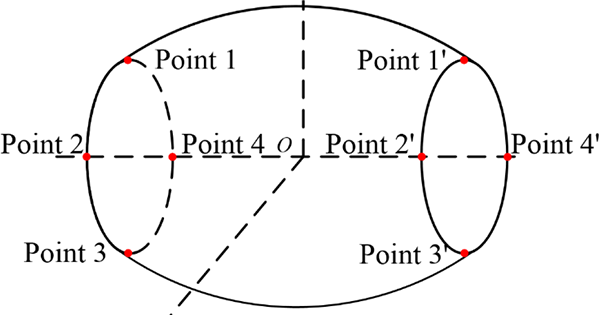
Secondly, the both ends of straight hose are closed, and internal pressure is applied to the inside of the pipe body. The expansion deformation of tube body is occurred until the hose is fitted to the constrained displacement mold. Finally, the hose was placed in an oven at 150°C for 170 minutes for vulcanization. The air pressure in the oven is 0.4 Mpa. The hose body is vulcanized and shaped to form the double arc-shaped rubber hose (As shown in
Geometric parameters
Both of the arc-shaped bodies in the rubber hose are distributed symmetrically, so one of the arc-shaped body is selected for analysis. From

It can be seen from the geometrical parameters of the arc-shaped hose that the curvature radius of point Q in the direction α is IQ, that is,


Cord braiding angle in arc-shaped rubber hose
It is considered that the cord is hardly subjected to force during the expansion process of the hose, and the deformation of the cord can be ignored, that is, the cord length is assumed to be unchanged before and after molding.
According to the deformation characteristics of the rope structure under external force,
15
it is proposed that the geometric relationship of the cords before and after molding is shown in Figure 1. The cord elements of the hose are selected for analysis. Cord length is presented by dl, the initial braiding angle of the cord in the straight hose is presented by


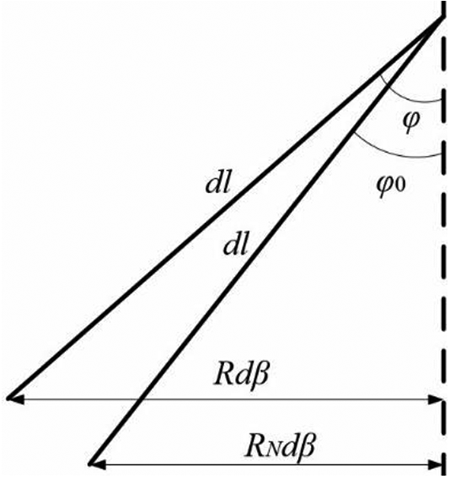
The cord geometric relationship in the forming process From the cord geometric relationship.
The cord braiding angle

Internal force of arc-shaped rubber hose
The elastic modulus of the cord is much larger than the elastic modulus of the rubber. The internal pressure is mainly carried by the cord layer. The fibers in the cord reinforcement layer only provide tensile force. In addition, the thickness of the cord layer is much smaller than the curvature radius of the arc-shaped hose. It is consistent with the assumption of thin shell theory without considering bending moments and shear force. 19
At any point Q, the differential shell QQ1Q2Q3 is selected from the arc-shaped shell with


Mechanical equilibrium analysis of differential shell.
When the arc-shaped rubber hose is closed at both ends, the hose deforms under internal pressure. Then the boundary conditions are:


Substituting the Equation (8) and the Equation (9) into the Equation (7), the tensile force on unit width of the mid-plane in the hose can be solved, as shown in Equation (10) and (11).


The stress along the α direction and the


Burst pressure of arc-shaped rubber hose
The stress analysis of the arc-shaped rubber hose unit element is shown in

The Tsai-Hill strength criterion 20 is used to determine the failure of the arc-shaped rubber hose. The Tsai-Hill strength criterion can be expressed by Equation (15).

Among them, X is the axial tensile strength of the fiber, Y is the transverse tensile strength of the fiber, and S is the shear strength of the fiber.
The burst pressure of arc-shaped rubber hose at any position can be solved by Equation (12), (13), (14), (15), as shown in Equation (16).



Experimental verification
Theoretical calculation of burst pressure
Two kinds of arc-shaped rubber hoses (structure I and structure II) were designed. According to the theoretical model, the burst pressure of arc-shaped rubber hoses were analyzed. The structural parameters of arc-shaped rubber hose are shown in Table 1.
Structural parameters of arc-shaped rubber hose.

The burst pressure of the arc-shaped rubber hose can be obtained by the theoretical model, as shown in Figure 3. The burst pressure of different parts in the structure I decreases as the axial coordinate increases. The burst pressure at the connection between the metal flange and the rubber composite material is the smallest, and the minimum burst pressure is 8.6 MPa, so the burst pressure of the whole hose is 8.6 MPa, and the vulnerable position is the connection between the metal flange and the rubber composite material. The burst pressure of different parts in structure II increase as the axial coordinate increases. The burst pressure at the middle of the hose is the smallest, and the minimum burst pressure is 9.1 MPa, so the burst pressure of the whole hose is 9.1 MPa, and the vulnerable position is the middle of the hose.

Theoretical analysis of burst pressure.
Experimental verification of burst pressure
When the structural parameters of the hose are different, the variation of the burst pressure through the axial coordinate is different, and the distribution of vulnerable position of the hose is different. The reference
21
showed that the vulnerable position of the arc-shaped rubber hose is always located in the middle of the hose. It is inconsistent with the conclusion of this article. In order to verify the correctness of the theoretical model, the burst pressure experiment of structure I and II is performed. The experimental device for the burst pressure is shown in
The experimental results for the burst pressure of Structure I and Structure II are shown in Table 2. The damage morphology of the hose is shown in
Experimental results of burst pressure.

Discussion
The arc-shaped rubber hose with initial braiding angle of 30°, fiber layer thickness of 2.4 mm, the radius at both ends of the hose of 69.8 mm, curvature radius of 52 mm and the length of hose of 68.6 mm was used as the research object. The influence of structural parameters on the burst pressure and vulnerable position of the hose is analyzed by the theoretical model.
Influence of initial braiding angle
Figure 4 analyzes the variation of the burst pressure of the hose through the curvature radius under different initial braiding angles. The ratio of the burst pressure to the maximum burst pressure under different curvature radius, is recorded as the pressure fluctuation ratio. The curvature radius corresponding to the red marked point is the critical curvature radius. Under different initial braiding angles, the critical curvature radius is 78 mm. When the curvature radius is greater than the critical curvature radius, the burst pressure of the hose decreases as the initial braiding angle increases, and the vulnerable position is located at the middle part of the hose. When the curvature radius is less than the critical curvature radius, the burst pressure of the hose increases as the initial braiding angle increases, and the vulnerable position is located at the connection between the rubber-cord composite material and the metal flange.

Influence of fiber braiding Angle on burst pressure.
From the variation of pressure fluctuation ratio through the curvature radius, there is a critical initial braiding angle of 30°. When the initial braiding angle is less than critical initial braiding angle, the burst pressure of the hose increases as the curvature radius increase, and the smaller the initial braiding angle, the greater the influence of the curvature radius on the burst pressure. When the initial braiding angle is equal to the critical initial braiding angle, the curvature radius has almost no effect on the burst pressure of the hose. When the braiding angle is greater than critical initial braiding angle, the burst pressure of the hose decreases with the increase of the radius of curvature.
Influence of radius at both ends of hose
Figure 5 analyzes the variation of the burst pressure of the hose through the curvature radius under different radius at both ends of the hose. According to theoretical calculations, the curvature radius corresponding to the red marked point is the critical curvature radius. When the curvature radius is greater than the critical curvature radius, the vulnerable position is located at the middle part of the hose. When the curvature radius is less than the critical curvature radius, the vulnerable position is located at the connection between the rubber-cord composite material and the metal flange. As the radius at both ends of hose increases, the critical curvature radius increases.
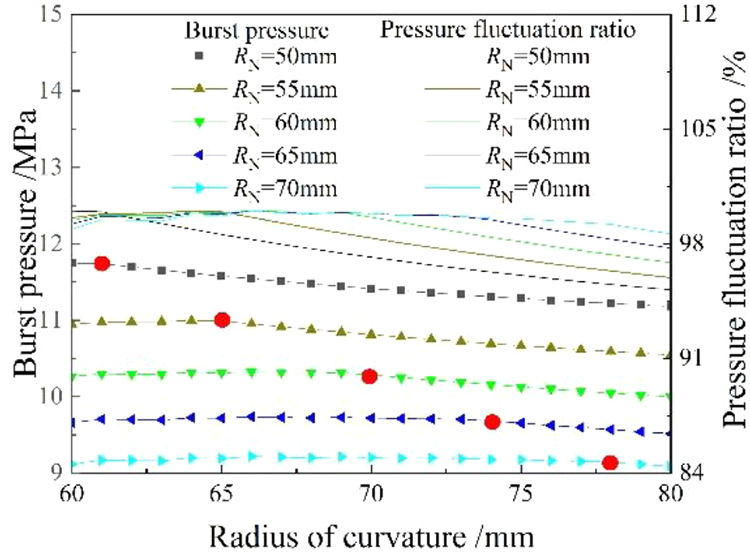
Influence of radius at both ends of hose on burst pressure.
From the variation of pressure fluctuation ratio through the curvature radius, as the radius at both ends of the hose increases, the pressure fluctuation ratio gradually approaches 1, that means, the influence of the curvature radius on the burst pressure of the hose decreases as the radius at both ends of the hose increases. Under the same curvature radius, as the radius at both ends of the hose increases, the burst pressure of the hose decreases.
Influence of the length
Figure 6 analyzes the variation of the burst pressure of the hose through the curvature radius under different length of hose. According to theoretical calculations, the curvature radius corresponding to the red marked point is the critical curvature radius. When the curvature radius is greater than the critical curvature radius, the vulnerable position is located at the middle part of the hose. When the curvature radius is less than the critical curvature radius, the vulnerable position is located at the connection between the rubber-cord composite material and the metal flange. As the length of hose increases, the critical curvature radius increases.
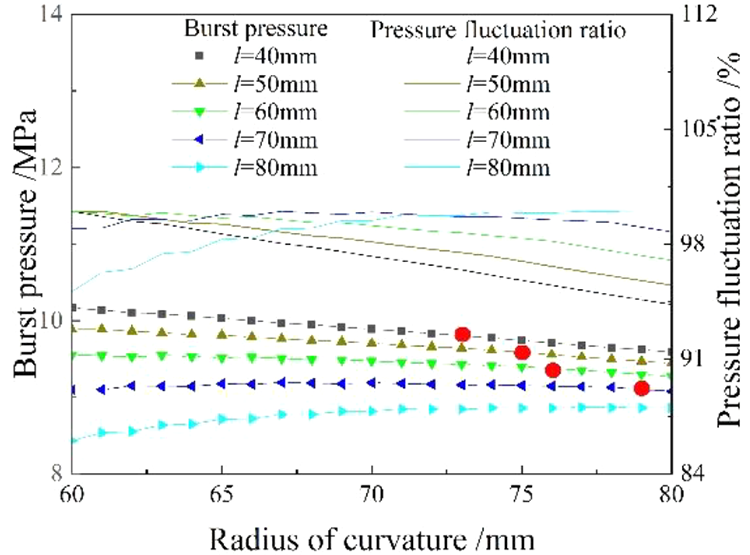
Influence of the length of hose on burst pressure.
From the variation of pressure fluctuation ratio through the curvature radius, there is a critical length of hose of 30°. When the length of hose is less than the critical length, the burst pressure of the hose decreases as the radius of curvature increases, and the smaller the length of hose, the greater the influence of the curvature radius on the burst pressure of the hose. When the length of hose is equal to the critical length, the curvature radius has almost no effect on the burst pressure of the hose. When the length of hose is greater than the critical length, the burst pressure of the hose increases as the curvature radius increases. Under the same curvature radius, as the length of hose increases, the burst pressure of the hose decreases.
Influence of fiber layer thickness
Figure 7 analyzes the variation of the burst pressure of the hose through the curvature radius under different fiber layer thickness. According to theoretical calculations, the curvature radius corresponding to the red marked point is the critical curvature radius. When the curvature radius is greater than the critical curvature radius, the vulnerable position is located at the middle part of the hose. When the curvature radius is less than the critical curvature radius, the vulnerable position is located at the connection between the rubber-cord composite material and the metal flange. The critical curvature radius is not affected by the fiber layer thickness.

Influence of fiber layer thickness on burst pressure.
From the variation of pressure fluctuation ratio through the curvature radius, under different fiber layer thickness, the pressure fluctuation ratio has the same relationship with the curvature radius, indicating that the fiber layer thickness has no effect on the relationship between the burst pressure and the curvature radius. Under the same curvature radius, as the fiber layer thickness increases, the burst pressure of the hose increases.
Structural design and application
The arc-shaped rubber hose was required to have no axial deformation under internal pressure. Therefore, the concept of balance is introduced, and the difference between the length of hose under the working pressure and the initial length of hose is recorded as the balance of the hose. When the deformation of the hose is elongated, the balance is positive. When the deformation of the hose is shortened, the balance is negative. When the deformation of the hose is 0 mm, the hose has a good balance performance. The theoretical model for the balance performance of arc-shaped rubber hoses was established. On the basis of satisfying the balance performance of the hose, the burst pressure of the hose was predicted.
Deformation analysis of arc-shaped rubber hose under internal pressure
According to the geometric relationship of the differential unit in Figure 2, the fiber braiding angle

Without considering the tensile deformation of the cord, when the combined force of the force in the α direction and the force in the

Substituting the Equation (21) into the Equation (20), the mechanical equilibrium angle

According to the deformation characteristics of the rope structure under external force,
15
the deformation of the arc-shaped rubber hose along the α direction was analyzed in two steps, as shown in
In the deformation analysis of the first step,


According to the deformation analysis of the first step, when the cord braiding angle
In the deformation analysis of the second step,


In summary, the total deformation of the hose can be obtained from
Anisotropy-based physics equation of thin shell
For the arc-shaped rubber hose with the cord braiding angle

Under the internal pressure p, the strain in α and
The element
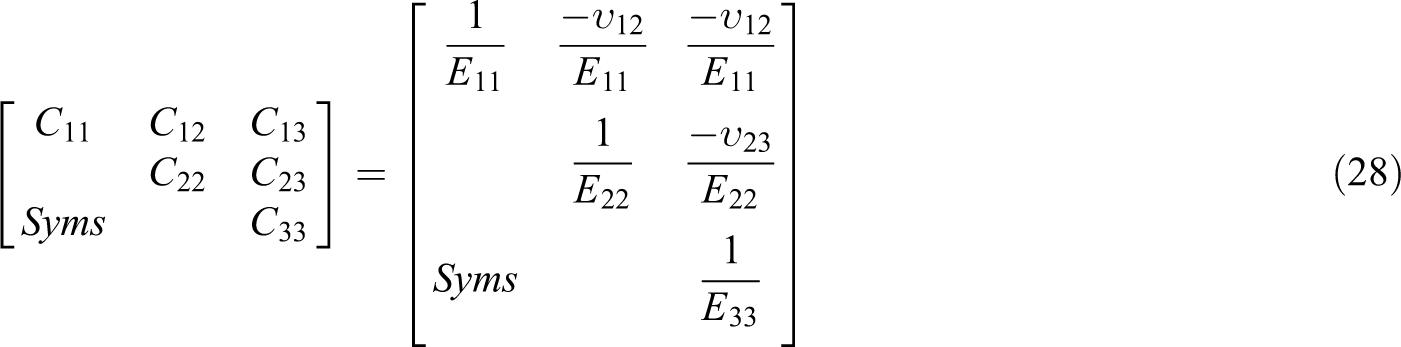
The elastic modulii of the cord in directions 1, 2 and 3 are represented by E11, E22 and E33, respectively. Poisson’s ratios of the cord are represented by
Material parameters of the cord.

The element



Where
Combined physical equations of thin-shell, substituting Equations (27), (28), (29), (30), (31) and (32) into Equations (12) and (13), under the internal pressure p, the strain

Substituting Equation (33) into Equation (25), under the internal pressure p, the axial deformation of the hose can be obtained, as shown in Equation (34).

Optimum design of arc-shaped rubber hose with good balance performance
In working condition, the radius at both ends of the hose is 69.8 mm, the length of hose is 68.6 mm, and the fiber layer thickness is 2.4 mm. In order to meet the requirements of the balance performance and the maximum burst pressure at the same time, the arc-shaped rubber hose is designed by changing the initial braiding angle and the curvature radius. Under the working pressure of 3 MPa, when the deformation of the hose is 0 mm, the variation of the initial braiding angle and the burst pressure of the hose through the curvature radius are obtained, and the corresponding initial braiding angle is called the equilibrium wingding angle.
The calculation results are shown in Figure 8. As the curvature radius increases, the equilibrium braiding angle of the hose increases. Under the condition that the axial deformation of the hose is 0 mm, when the curvature radius is less than 61 mm, the burst pressure increases as the curvature radius increases. When the curvature radius is greater than 61 mm, the burst pressure decreases as the curvature radius increases. When the curvature radius is 61 mm, the equilibrium wingding angle is 37.5°, the burst pressure is the largest. The critical curvature radius is 78 mm, as shown by the red marked point in the figure. When the burst pressure is the largest, the vulnerable position is located at the connection between the rubber-cord composite material and the metal flange.

Design of balance and burst pressure for hose.
The optimization results showed that, for the arc-shaped rubber hose with radius at both ends of the hose of 69.8 mm, the length of hose of 68.6 mm, and fiber layer thickness of 2.4 mm, when the initial braiding angle is 37.5° and the curvature radius is 61 mm, the hose has a good balance performance and the burst pressure is maximum.
Experimental verification
The experiment for the balance and burst pressure of the optimized arc-shaped rubber hose is performed. Firstly, the four uniformly distributed measuring points at both ends of the hose are selected to measure the initial length of hose, as shown in Figure 9. Then increasing the internal pressure of the hose to 3 MPa, the length of hose at the four measuring points can be measured. By measuring the initial length of hose and the length of hose under internal pressure of 3 MPa, the balance of the hose can be obtained, as shown in Table 4. The experimental results showed that the balance of the optimized hose is 0.125 mm under the internal pressure of 3 MPa. In practical applications, the balance of the hose is required to not exceed ±1 mm under working pressure.
Four uniformly distributed measuring points.
Balance of arc-shaped rubber hose.

Continue to increase the internal pressure of the hose until the hose was damaged. The morphology of the hose was shown in Figure 10. The hose was damaged under the internal pressure of 9.8 MPa, and the error was only 2% from the theoretical calculation of 9.6 MPa. The hose was damaged at the connection between the rubber-cord composite material and the metal flange. It was consistent with theoretical calculation.

Failure morphology of the optimized hose.
Results
Based on the thin shell theory and Tsai-Hill failure criterion, the burst pressure and balance performance of the arc-shaped rubber hose was obtained. The burst pressure of the arc-shaped rubber hose with good balance performance was predicted by the theoretical model. The correctness of the theoretical model and the optimization results were verified by experiments.
Supplemental material
supplementary_file_(1) - Study on theoretical model of burst pressure of fiber reinforced arc-shaped rubber hose with good balance performance
supplementary_file_(1) for Study on theoretical model of burst pressure of fiber reinforced arc-shaped rubber hose with good balance performance by Gao Hua, Shuai Changgeng, Ma Jianguo and Xu Guomin in Polymers and Polymer Composites
Footnotes
Acknowledgments
The authors wish to acknowledge, with thanks, the financial support from the Army Key Research Projects.
Declaration of conflicting interests
The author(s) declared no potential conflicts of interest with respect to the research, authorship, and/or publication of this article.
Funding
The author(s) received no financial support for the research, authorship, and/or publication of this article.

Supplemental material
Supplemental material for this article is available online.
References
Supplementary Material
Please find the following supplemental material available below.
For Open Access articles published under a Creative Commons License, all supplemental material carries the same license as the article it is associated with.
For non-Open Access articles published, all supplemental material carries a non-exclusive license, and permission requests for re-use of supplemental material or any part of supplemental material shall be sent directly to the copyright owner as specified in the copyright notice associated with the article.
