



Abstract
In the present work, the mechanical and the tribological properties of eggshell nanoparticulate epoxy biocomposite were studied. The nanoparticles of eggshell were synthesized by planetary ball milling technique. Synthesized eggshell nanoparticulate were characterized with the aid of Scanning Electron Microscopy (SEM), Transmission Electron Microscopy (TEM), X-ray diffraction analysis, and Fourier Transform Infrared (FTIR) Spectroscopy. Fabrication of eggshell nanoparticulate epoxy biocomposite was done by hand lay-up technique with different weight percentages (1 wt%, 2 wt%, 3 wt%, 4 wt%) of eggshell nanoparticles. To examine the solid particle erosion behavior of eggshell nanoparticulate epoxy biocomposite, four different impact angles (30°, 45°, 60°, 90°) and three different velocities (101 m s−1, 119 m s−1, 148 m s−1) were chosen. The effect of eggshell nanoparticles incorporation on the tensile properties, hardness, and the flexural properties was also investigated. The fractured surfaces of the tensile test, flexural test, and erosion test samples were examined with a SEM for morphological analysis. It was found that the eggshell nanoparticulate addition has a fruitful effect on tensile and flexural strength. The maximum tensile strength was found for 2 wt% nanoparticles addition, while the maximum flexural strength was found for 3 wt% of nanoparticles addition. The sand erosion study established a maximum wear rate at 60° of impact angle. The maximum erosion resistance was found in 2 wt% of eggshell nanoparticulate concentration.
Introduction
Epoxy composites are one of the most widely used polymer composites. Epoxy-based composite materials have a wide area of applications in automobile, aerospace, marine, and oil and gas industries; owing to the composite economy, good mechanical properties, high-specific properties, good adhesive property, good heat resistance and so on. 1 For the aforementioned reason, it has become necessary to study and predict the mechanical and tribological behavior of epoxy-based composite materials. Several materials have been used as reinforcement and as filler material in epoxy resin. Glass fiber2-5 and carbon fiber6,7 are most widely used synthetic fiber as reinforcement material, while jute fiber 8 and bamboo fiber9,10 are the some of the most widely used natural fibers. In addition to fiber reinforcement, sometimes filler materials are added to composite to provide additional attributes. In some cases, filler materials act as reinforcing materials. In the present scenario, owing to critical climatic conditions, research is oriented towards the development of biocomposite. A biocomposite utilizes biowaste as reinforcement thereby reducing the burden on the environment and it is economical. Several biowastes found use as reinforcement with the epoxy resin such as jute, 8 bamboo,9,10 rice husk, 11 coconut shell, 12 coir fiber, 13 and eggshells,14,15 and so on. The eggshells are one major waste dumps produced worldwide, although the eggshells are biodegradable, huge production of egg on a daily basis requires a large area for dumping and one of the major pollution risk due to such huge eggshells stock is a potential source of pathogens growth. The annual production of eggs in India was about 82.929 billion units in 2015–2016, 16 if we see the statistics, each year the egg production is growing. An eggshell contains 11% of the total egg weight. 17 If we calculate eggshells waste for the year 2015–2016, it would be 547331.4 tons per year. Statistics show huge egg production worldwide. The basic function of an avian eggshell is to protect the egg against physical damage and microbial activities, provide passage for transfer of fluids (water and gas) and calcium for the embryo growth. 18 The eggshell is an inorganic material that comprises of three-layered structure with an outer layer called cuticle layer, middle layer calcareous layer, and the inner layer mammillary layer. The eggshell is made up of calcium carbonate (by weight) approximately 94% and other organic compounds. 19 Eggshells have been used for numerous purposes. 17
Various composites are made by using eggshell as a filler material and its effect on composite properties have been investigated by numerous researchers. The eggshells filler addition has been found to increase thermal resistance,19,20 moisture absorption resistance, 19 eggshell particulate addition also found to increase mechanical properties of polymer composites when added to some resin such as high-density polyethylene, 21 wheat protein isolate, 22 soy protein, 23 and elastomers, 24 and so on. It reduces the mechanical properties when added to certain polymer resin such as polypropylene (PP), 25 however the properties of PP composite could be improved by modifying eggshells surface. 26 Quite a few examples were found in the literature, where eggshell microparticles were used as a filler material in epoxy resin.27-29
For example, Hameed and Jassim 30 used carbonized and raw eggshell microparticles to improve mechanical properties of epoxy composites.
Inbakumar and Ramesh 31 investigated the tribological, mechanical, and thermal properties of hemp fiber-reinforced egg shell epoxy polymer composites. Azman et al. 32 studied the mechanical and thermal behavior of epoxy composites filled with eggshell and calcium carbonate (CaCO3) particles. Gbadeyan et al. 33 investigated the moisture absorption and mechanical behavior of snail shell and eggshell-filled epoxy composites. The review of the literature suggests that there exists a gap between research on micro and nanoparticulate eggshell epoxy composites. This research work is an effort towards the utilization of waste eggshell in the composite field.
This research is based on the following facts. Very limited or no study has been done on eggshell nanoparticulate epoxy composites. In India, where there is a huge production of eggs daily, the research is done to find a future research direction in the utilization of waste eggshell. The theme of work is pointed towards waste to value.
The aim of this research was to prepare eggshell nanoparticles and to study its effect on mechanical and tribological properties of epoxy polymer–matrix composite.
Materials and methods
A list of raw materials used for the fabrication of eggshell nanoparticulate epoxy biocomposite are described in Table 1.
List of materials.

Nanoparticle preparation
The eggshell flakes were first washed with deionized water, and then with ethanol to remove any traces of contamination. Then, the flakes were sun-dried for 2 days to get rid of moisture. The drying results in crispy eggshell flakes, which were then converted into microparticles using a laboratory ball mill. Then, the microparticles were sieved using the sieve of pore size of 50 μm. The microparticles were then processed into a planetary ball mill to get the nanoparticles. Nanoparticles of eggshell were prepared using a Retsch-PM100 planetary ball mill equipped with stainless-steel. One hundred balls of 10 mm diameter were used with a ball-weight ratio of 20:1 for milling of eggshell particles. The rotational rate of vials was fixed at 400 r min−1. The total milling time was 8 h. Nanoparticles of eggshell were characterized using a Scanning Electron Microscope (SEM; ZEISS EVO, Carl Zeiss AG), a JOEL 3010 High-Resolution Transmission Electron Microscope (TEM; JOEL USA), PANalytical X-Pert Powder XRD (Malvern PANalytical), and PerkinElmer 100 Fourier Transform Infrared (FTIR) Spectrometer (PerkinElmer).
Composite preparation
Fabrication of eggshell nanoparticulate epoxy biocomposite samples was done by hand lay-up process. A mold of dimension 180 × 240 × 4 mm3 was prepared with a wooden board and beats. A sheet of cellulose acetate was kept on mold to facilitate easy removal of casting after solidification. Eggshell nanoparticulate epoxy biocomposite plates with 1 wt%, 2 wt%, 3 wt%, and 4 wt% of eggshell nanoparticulate concentration were made. The density of eggshell particles was 1950 kg m−3, while the density of epoxy was 1200 kg m−3. Using the density of epoxy and eggshell nanoparticles, the required mass of epoxy was calculated for different weight percentage of eggshell nanoparticles using the rule of mixture. Both, the epoxy and eggshell particles were first mixed properly using magnetic stirred for a time period of 30 min at 400 r min−1, and then sonicated in an ultrasonication bath for a time period of 10 min. After a proper dispersion of eggshell nanoparticles in epoxy, the hardener was added to the dispersion. Hardener was used in the ratio of 10:1 (resin to hardener weight ratio). The solution was then stirred and poured into the mold. The solution was then spread throughout the mold using a roller. The molds were then kept on the mechanical shaker so as to get rid of bubble entrapment. Shaking also helps in maintaining constant thickness of casting. Once the casting becomes semisolid the molds were covered with wooden lid and weight were put on the lid to maintain the constant thickness. The molds were then kept for 72 h at room temperature for curing. After adequate curing, the prepared plates were cut into desired sizes according to American Society for Testing and Materials (ASTM) standard. The nomenclature used for different composite samples is given in Table 2.
Nomenclature for different samples.

Characterization of eggshell nanoparticulate epoxy biocomposite
Tensile test and flexural test were conducted on HIECO electromechanical Universal Testing Machine (UTM).
ASTM D638 standard was used for the preparation of a flat dog bone-shaped specimen for tensile testing. A load rate of 2 mm min−1 was used for testing. The dimensions of tensile samples were as follows: length—140 mm, width at center—10 mm, and thickness—4 mm. The samples for the bending test were prepared according to ASTM D790. A rectangular-shaped specimen of dimensions, length—140 mm, width—20 mm, and thickness—4 mm was prepared for bending tests. Three-point bending test was also conducted on HEICO digital UTM using a three-point bending fixture. The parameters for the bending test were load rate 2 mm min−1 and load cell of 5kN was used for applying the load. For both the tests, five samples were tested for each weight percentage of composites, and the average value was calculated. The hardness test was conducted on the Vickers microhardness tester. Square-shaped specimens of dimensions 20 × 20 × 4 mm3 were prepared for the hardness test. A load of 0.25 N was applied on the sample for about 10 s, and then the load was removed. The hardness was calculated using the shape of the indentation obtained. Five samples were tested for each weight percentage of composites to calculate average hardness value. Square-shaped specimens of dimensions (20 × 20 × 4) mm3 were prepared for erosion tests. An air jet erosion test rig. 15 was used to conduct erosion wear tests on eggshell nanoparticulate epoxy biocomposite samples. The erosion rates are measured at various impact angles (i.e. 30°, 45°, 60°, 90°) at different velocities (101 m s−1, 119 m s−1, 148 m s−1). The erosion test was carried out as per ASTM G76 standard. Fractured surfaces of tested samples were examined with a SEM (ZEISS EVO).
Results and discussion
Morphology analysis of nanoparticles
There is a number cluster of particles are visible in the SEM image as shown in Figure 1(a), a big cluster was enlarged to see the morphology of particles. The enlarged SEM image shows that the particles are irregular in shape. TEM image taken for the eggshell particles is shown in Figure 1(b). From TEM images, it was confirmed that the particle size is in the range of 1–20 nm. The TEM images also suggest that the particles are crystalline in nature and have a hexagonal structure similar to that of calcium carbonate. The crystalline nature of eggshells was also observed through the X-ray diffraction (XRD) analysis of eggshell particles.

(a) SEM image (b) TEM image of eggshell nanoparticles.
XRD analysis of nanoparticles
Figure 2 shows the XRD peaks of eggshell nanoparticles. The XRD peaks were analyzed with HighScore plus software. From Figure 2, it is noticed that the peaks were in an exact match with the diffraction peaks of calcite phase of CaCO3. 34 It is found that the eggshell nanoparticles have a hexagonal structure similar to CaCO3. The crystallinity was found to be 91.96%. The crystallite size was calculated using the Scherrer equation 35 ; it was found to be 14 nm.

X-ray diffraction pattern of eggshell nanoparticles.
FTIR analysis of nanoparticles
FTIR spectroscopy was analyzed for eggshell nanoparticles. FTIR spectra of the eggshell particles are shown in Figure 3. The figure exhibits the characteristic absorption bands at 3411 cm−1 (O–H stretching), 2866 and 2927 cm−1 (C–H stretching) which shows the presence of organic layers of proteins in the particles of eggshell. The absorption band at 2517 cm−1 is the molecular fingerprint of amine salt. The peak at 1598 cm−1 is the molecular fingerprint of amine functional group. The absorption bands at 1797 cm−1, 1421 cm−1, 1078 cm−1, 873 cm−1, and 711 cm−1 show the absorption bands of

FTIR analysis of eggshell nanoparticles.
Tensile test
The stress–strain curve of eggshell nanoparticulate epoxy biocomposite under tensile loading is shown in Figure 4(a). Figure 4(a) shows that there is an elastic zone followed by a total fracture of the sample which indicates a brittle failure of the sample. Figure 4(a) shows that the tensile strength improves with eggshell nanoparticulate addition. Mechanical properties of composite samples are presented in Table 3. It is noticed from Table 3 that the tensile strength increased to 27 MPa with 1 wt% eggshell nanoparticulate concentration as compared to bare epoxy, which has a tensile strength of 17 MPa. Further increase in eggshell nanoparticulate concentration up to 2 wt% resulted in the improvement of tensile strength. For 2 wt% concentration of eggshell nanoparticles in eggshell nanoparticulate epoxy biocomposite, tensile strength was enhanced by 117% compared to bare epoxy. The tensile strength decreases with more than 2 wt% of eggshell nanoparticles incorporation. However, with further increase particulate addition, tensile strength was found to decrease when compared to 2 wt% of particulate addition, although the tensile strength was still more than bare epoxy.

(a) Stress versus strain curve and (b) load versus elongation curve for uniaxial tensile test.
Mechanical properties of eggshell nanoparticulate epoxy biocomposite.

Positive enhancement in tensile strength may be due to the incorporation of high stiffness nanoparticles than the matrix material. The addition of high moduli nanoparticles could have enhanced the yield limit of matrix material under tensile loading as reported in the literature.21,26,37 The bonding also plays a significant role in the enhancement of the mechanical properties of nanocomposites. The presence of amine group and organic protein as observed in FTIR analysis of eggshell nanoparticles, ensure good chemical bonding with the epoxy resin, a similar kind of observation was by Ji et al. 27 for interaction between the epoxy resin and eggshell microparticles. The physical bonding between matrix material and nanoparticles depends on various parameters such as particle size, particle shape, surface area, and so on.38,39 In this case, the shape of the particles is irregular which helps in adhesion between the particles and epoxy resin. Nanoparticles have a high surface area which turns results in more area of contact between polymer matrix and nanoparticles. The good physical bonding ensures effective load transfer between matrix and fillers. It is observed that the tensile strength decreases after 2 wt% of eggshell nanoparticulate incorporation. The reduction in tensile strength after 2 wt% of nanoparticle incorporation may be due to an excessive amount of filler addition which leads to agglomeration. The agglomeration has the following consequences which led to a reduction in tensile strength.
The agglomeration reduces the surface area as particles are joined together and behave as microparticles which in turn results in stress transfer.
Reduction of adhesion bonding between particles and resin. Moreover, the interparticle cohesion is weak.
Agglomerated particles may behave as a region of stress concentration which results in rapid crack propagation. 39
From Figure 4(a), it is studied that the slope of the curve decreases from 1 wt% to 3 wt% eggshell nanoparticles concentration in epoxy but again increased for 4 wt% nanoparticulate incorporation. The slope was highest for 1 wt% particulate nanoparticulate addition which indicates that the tensile modulus was highest for 1 wt% nanoparticulate addition. Variation of tensile modulus can be observed from Table 3. It is noticed from Table 3 that the tensile modulus of bare epoxy was increased from 0.69 GPa to 1.28 GPa by 1 wt% nanoparticulate addition. Tensile modulus was reduced to 1.144 GPa for 2 wt% of nanoparticulate addition, compared to 1 wt% of nanoparticulate addition which has a tensile modulus of 1.28 GPa, as observed from Table 3. Further increase in the eggshell nanoparticle incorporation resulted in a further reduction in tensile modulus. The increase in tensile modulus is due to the presence of eggshell nanoparticles, which has a very high tensile modulus (47.4–53 GPa). 13 Tensile modulus is also affected by particle size and it increases suddenly for particle size below a certain critical value (30 nm). 39 As in this case, particle size is below 20 nm the positive change in tensile strength was observed, the tensile modulus was almost doubled with the addition of eggshell nanoparticles, a similar study was reported elsewhere for CaCO3/PP composites. 40 The maximum value of tensile modulus was found for 1 wt% nanoparticulate addition, with further increase in nanoparticulate concentration the tensile modulus decreased. The tensile modulus is influenced by the values of both the stress and strain. The change in any will result in a change in tensile modulus. In our case, the ratio is maximum in case of 1 wt%. However, for 2 wt% and 3 wt% of eggshell nanoparticulate epoxy composite, the elongation (or strain) value is very much higher, which resulted in decreased tensile modulus. The elongation is again less in case of 4 wt% eggshell nanoparticulate epoxy, which resulted in increased tensile modulus when compared to 2 wt% and 3 wt% of eggshell nanoparticulate epoxy composite.
Figure 4(b) shows the load versus elongation curve of eggshell nanoparticulate epoxy biocomposite under tensile loading. It is noted from Figure 4(b) that the load-bearing capacity for 2 wt% eggshell concentration in epoxy is highest followed by 3 wt% and 4 wt%, respectively. Of all the concentrations, 1 wt% is having the lower load-carrying capacity. From Figure 4(a) and (b), it is inferred that the elongation of eggshell nanoparticulate epoxy biocomposites enhanced up to 2 wt% of eggshell nanoparticulate concentration. Further incorporation of eggshell nanoparticles resulted in a reduction in elongation. This may be due to the higher particle concentration of nanoparticles which may induce region stress concentrations, consequently displays reduced plastic deformation. The results revealed that the eggshell nanoparticles addition increases the tensile strength and tensile modulus. 2 wt% particulate addition found to be optimum for tensile strength while the tensile modulus is maximum for 1 wt% nanoparticulate addition. The fractured surface for tensile tested sample can be seen from the SEM images as shown in Figure 5. It shows brittle failure. Figure 5(a) illustrates the fractured surface of bare epoxy, it is inferred from the Figure 5(a), that fracture is clean and smooth. However, for 2 wt% nanoparticulate epoxy biocomposite samples, the fractured surface shows minor cracks as shown in Figure 5(b). The cracks are coming out of the surface during crack propagation suggesting inhibition of crack propagation by nanoparticles thereby enhancing the load-bearing capacity and tensile strength of composites.
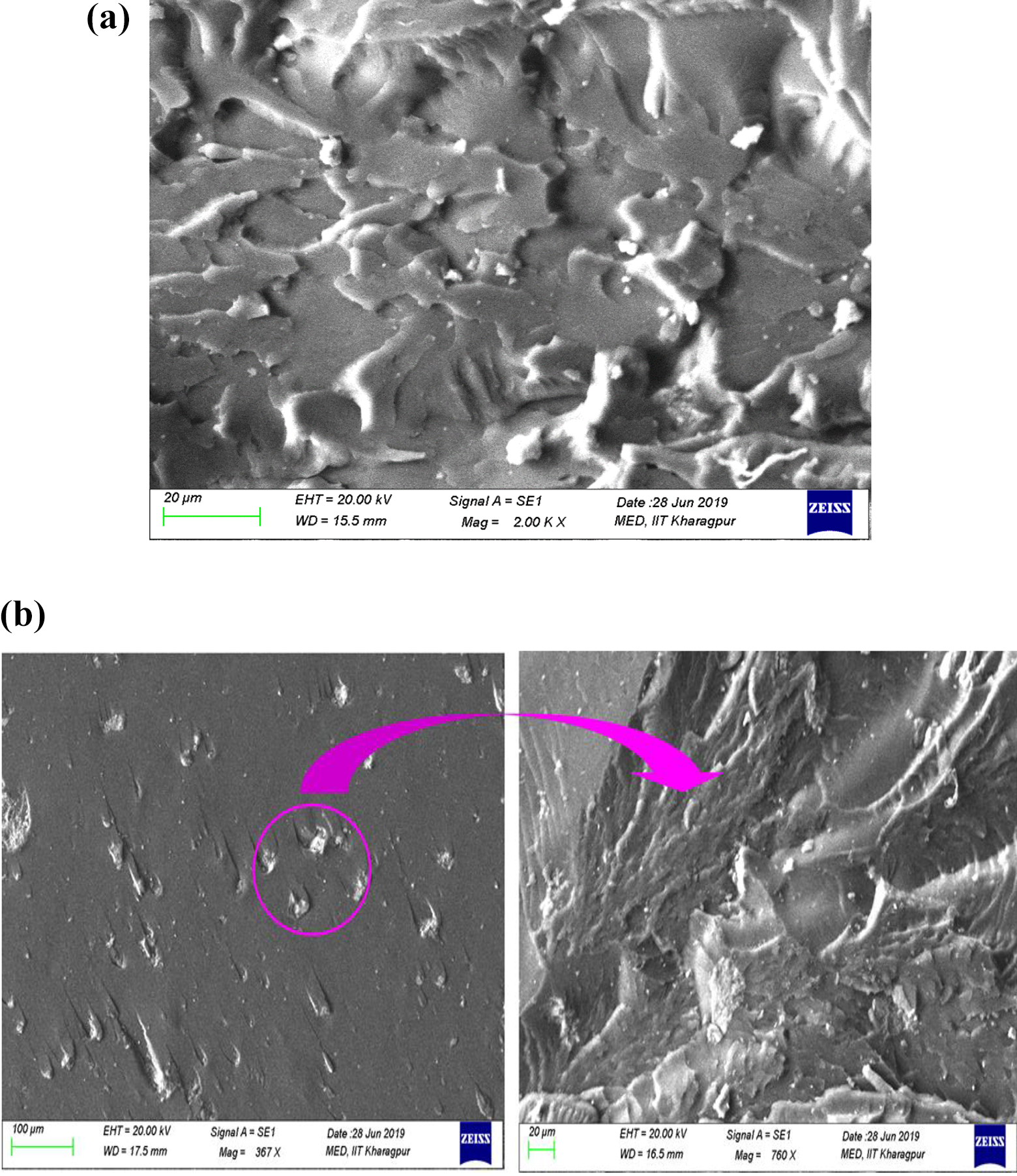
Fractured surface of (a) epoxy and (b) 2 wt% eggshell nanoparticulate epoxy biocomposite tensile sample.
Three-point bending test
The stress–strain curve for a three-point bending test is shown in Figure 6. It is noticed from Figure 6, that with eggshell nanoparticulate addition flexural strength increases just like tensile strength. It is observed from Table 3, that flexural strength was increased from 35.6 MPa to 49.73 MPa for 1 wt% eggshell nanoparticulate inclusion. Further addition of eggshell nanoparticulate resulted in increased flexural strength up to 3 wt%, and then there was a decrease in flexural strength. Figure 6 shows that the maximum flexural strength was found for 3 wt% nanoparticulate addition. The flexural strength was increased from 35.6 MPa to 67.1 MPa for 3 wt% eggshell particulate inclusion, as observed from Table 3. Another observation here is that for 2 wt% and 3 wt% of nanoparticulate addition, the flexural strength is almost the same. There is very slight change in flexural strength due to the fact that in both the 2 wt% and 3 wt% eggshell nanoparticulate epoxy composites, the particles are homogeneously distributed and acting as a barrier for crack propagation, however for 4 wt%, the strength decreases due to the agglomeration.

Stress–strain curve for three-point bending test.
It is noticed from Table 3, that the flexural modulus is maximum for 2 wt% nanoparticulate concentration. The flexural modulus is notably higher for 2 wt% eggshell concentration in epoxy followed by 4 wt% and 1 wt%, respectively. The flexural modulus is lowest for 3 wt% eggshell concentration in epoxy, however, still higher than epoxy. This may be credited to the inclusion of the high modulus eggshell nanoparticles and strong interfacial contact between the epoxy matrix and eggshell nanoparticles.
SEM image of fracture surface after flexural test of 3 wt% eggshell nanoparticulate epoxy biocomposite sample is shown in Figure 7. It is inferred from Figure 7, that there are a number of blowholes, which might be generated from branching out of particles during the application of load. Eggshell nanoparticles may be a reason behind the restriction of crack propagation thereby enhancing the flexural strength.

SEM image of surface of 3 wt% eggshell nanoparticulate epoxy biocomposite flexural sample.
Micro hardness test
It is recognized from Table 3, that the hardness of epoxy was found to increase with the addition of eggshell nanoparticles. With eggshell nanoparticles addition, the hardness value is increased compared to bare epoxy, which has a hardness value of 9.4. The maximum hardness value was found for 4 wt% of eggshell nanoparticles. The hardness value of epoxy is increased by 127% with the addition of 4 wt% of eggshell nanoparticles. It is recognized that an increase in eggshell nanoparticles concentration the hardness value increases. This may be due to the incorporation of hard nanoparticles which results in increased hardness of resin as reported elsewhere. 41
Erosion test
Figure 8 shows the variation of erosion rate with the impact angle of eggshell nanoparticulate epoxy biocomposite at an impact velocity of 101 m s−1 for various percentages of eggshell nanoparticulate epoxy biocomposite. From Figure 8, it is noted that the erosion resistance of eggshell nanoparticulate epoxy biocomposite is far better than that of epoxy irrespective of the percentage of nanoparticulate addition. One further observation is that the maximum erosion rate is found at 60° impact angle depicts semi-brittle behavior23,24 of eggshell nanoparticulate epoxy biocomposite, unlike epoxy. 2 wt% eggshell nanoparticulate epoxy biocomposite shows maximum erosion wear resistance. Further increase in particulate addition resulted in decreased erosion resistance. This may be due to the proper distribution of particles in epoxy and the bonding between epoxy and eggshell nanoparticles which can be appreciated from the SEM image as shown in Figure 9. The reason behind the improved erosion resistance attributed to particle size, which is very minute as compared to erodent particle size. Another important observation one can appreciate that for the same area of interest the number particle resisting the impact are more when compared with microparticles. The presence of CaCO3, as observed in XRD analysis may be the reason behind astounding enhancement in erosion wear resistance, a similar observation was made by Yilmaz et al. 42 for erosion wear behavior of CaCO3/glass fiber polyester composites.
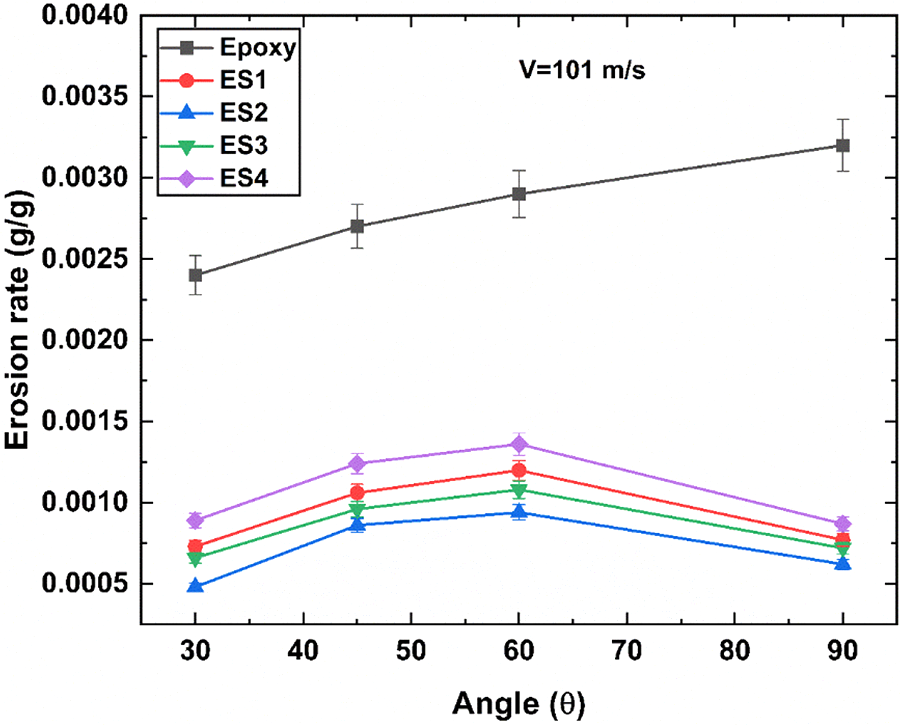
Erosion rate for different weight percentage of eggshell nanoparticulate epoxy biocomposite at V = 101 m s−1.
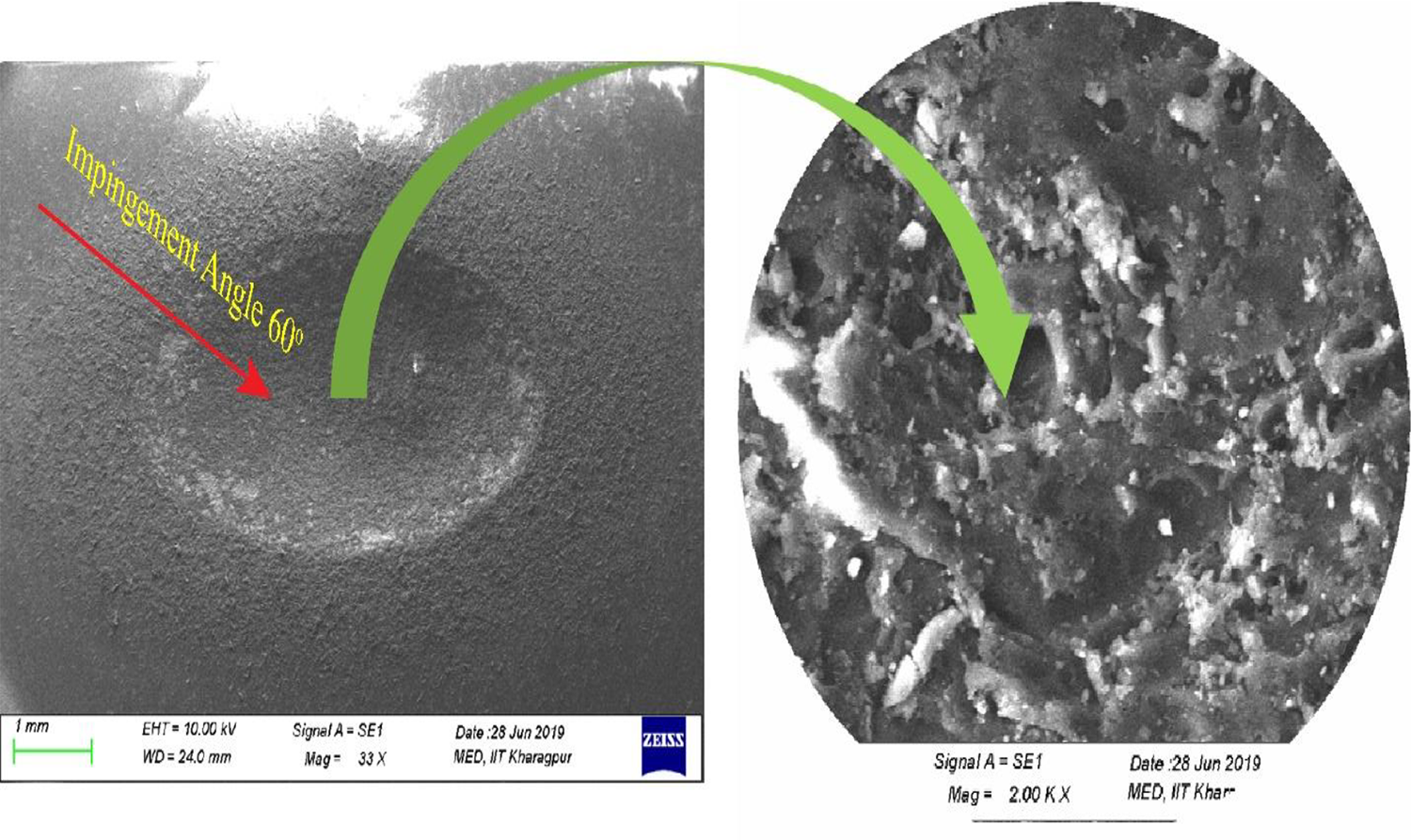
Eroded surface of 2 wt% eggshell nanoparticulate epoxy biocomposite at 60° impact angle.
Figure 10 shows the SEM image of worn out surface of 4 wt% eggshell nanoparticulate epoxy biocomposite. The SEM image in Figure 10 shows that there are sites of agglomeration, which hampers erosion resistance.
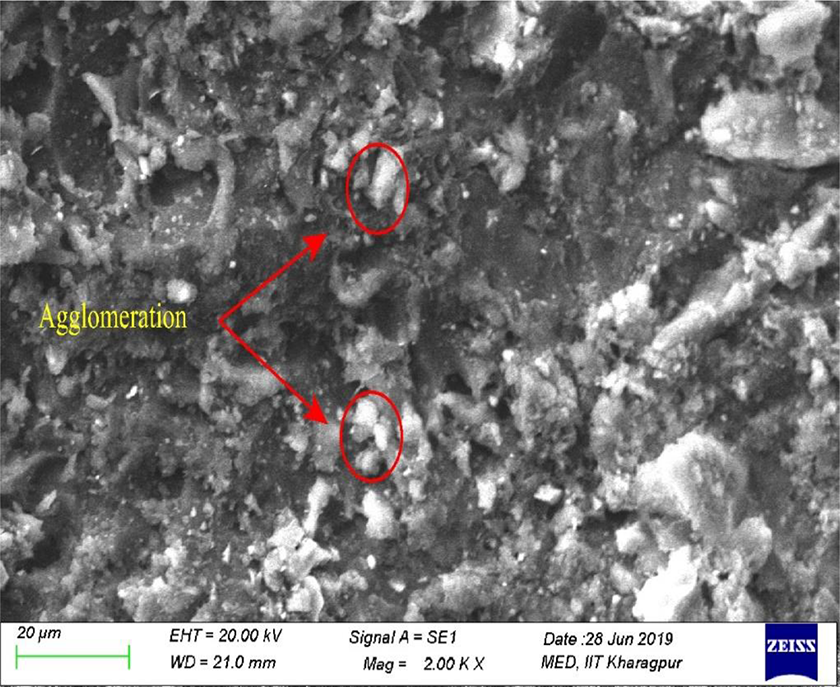
Eroded surface of 4 wt% eggshell nanoparticulate epoxy biocomposite at 60° impact angle.
Conclusion
Following conclusion may be drawn based from the study. The inclusion of eggshell nanoparticles has a positive influence on mechanical properties. The eggshell nanoparticles addition enhances the tensile strength and tensile modulus. 2 wt% particulate addition is observed to be optimum for tensile strength while tensile modulus is maximum for 1 wt% particulate nanoparticulate addition. The tensile strength was enhanced by 117% while tensile modulus was almost doubled by owing to eggshell nanoparticles incorporation. The flexural strength and modulus also increased owing to the eggshell nanoparticle addition. The flexural strength was enhanced by 88% while flexural modulus was multiplied by more than three times owing to eggshell nanoparticles incorporation. 3 wt% nanoparticulate addition was found to be optimum for flexural strength while flexural modulus was maximum for 2 wt% particulate nanoparticulate addition. The hardness value was improved by incorporation of eggshell nanoparticles. The nanoparticles addition results in drastic increase in erosion resistance, the erosion resistance of eggshell nanoparticulate epoxy biocomposite has far better erosion resistance bare epoxy. The maximum erosion wear rate was observed at 60° of impact angle which showed the erosion behavior of eggshell nanoparticulate epoxy biocomposite is semi-brittle. The maximum erosion resistance was observed for 2 wt% nanoparticulate addition. The erosion resistance was enhanced by 67.58%.
Supplemental material
supplementary_materials - Experimental investigation of mechanical and erosion behavior of eggshell nanoparticulate epoxy biocomposite
supplementary_materials for Experimental investigation of mechanical and erosion behavior of eggshell nanoparticulate epoxy biocomposite by Manoj Panchal, G Raghavendra, A Rahul Reddy, M Omprakash and S Ojha in Polymers and Polymer Composites
Footnotes
Declaration of conflicting interests
The author(s) declared no potential conflicts of interest with respect to the research, authorship, and/or publication of this article.
Funding
The author(s) received no financial support for the research, authorship, and/or publication of this article.

Supplemental material
Supplemental material for this article is available online.
References
Supplementary Material
Please find the following supplemental material available below.
For Open Access articles published under a Creative Commons License, all supplemental material carries the same license as the article it is associated with.
For non-Open Access articles published, all supplemental material carries a non-exclusive license, and permission requests for re-use of supplemental material or any part of supplemental material shall be sent directly to the copyright owner as specified in the copyright notice associated with the article.
