




Abstract
The effect of electron beam (e-beam) irradiation on the thermal and mechanical properties of ethylene-vinyl acetate copolymer/ternary polyamide (EVA/tPA) blends was studied. The e-beam irradiation was carried out over a range of dose from 50 kGy to 500 kGy with trimethylolpropane trimethacrylate (TMPTMA) and triallyl isocyanurate (TAIC) as cross-linking coagents. With increasing irradiation dose, the gel fraction of the EVA/tPA blends increased significantly. After irradiated by e-beam at 500 kGy, the insoluble fraction of EVA/tPA blends with 3 parts per hundred rubber TMPTMA increased from 28% to 86%. The tensile strength of EVA/tPA/TMPTMA-3 (70/30/3) considerably increased up to 172% with a value of 10.01 MPa at 500 kGy due to an increase in cross-linking compared to the EVA/tPA/TAIC-3 (70/30/3) blend. However, the melting temperature and crystallization peak temperature of EVA/tPA blends decreased with increasing irradiation dose. Thermogravimetric analysis demonstrated that the irradiation cross-linking could improve the thermal stability of the EVA/tPA blends. The degradation kinetics of the EVA/tPA blends at elevated temperatures were studied using the Kissinger, Flynn–Wall–Ozawa, and Friedman methods. Irradiation cross-linked EVA/tPA blends exhibited a remarkable improvement in their oil resistance, with the identified improvement being most prominent in the EVA/tPA/TMPTMA-3 blend.
Keywords
Introduction
The blending of polymers offers an economically viable and versatile way to produce new engineering materials to meet the standards of scientific and commercial purposes. In recent years, electron beam (e-beam) irradiation processing has gained increased attention when compared with conventional chemical and heat treatment processes due to its potential to enhance the mechanical and thermal properties of polymer blends. 1 -4 The e-beam process is a more environmentally friendly, cost-effective, and efficient process than chemical cross-linking. 5 -11 E-beam irradiation generates free radicals, thereby producing a three-dimensional (3D) network structure, thus improving the mechanical properties, chemical and solvent resistance, and thermal and dimensional stability of polymer blends. The improved properties brought about by the irradiation process lead to polymer blends having widespread applications in relation to cables and wires, tubes, foams, shrinkable warmth tubes, and shape memory products. 10
Ethylene-vinyl acetate (EVA) is a random copolymer of ethylene and varying amounts of vinyl acetate (VA), and it can be tailored for applications as rubber, thermoplastic elastomer, or plastic by altering the VA content. EVA is widely used as a polymer matrix for halogen-free flame-retardant insulating and oil-resistant materials that can be used in the cable insulation and sheathing material, hose, tube, and footwear industries. 8 In recent years, extensive research has been conducted on EVA and its blends, especially on EVA/low-density polyethylene (PE) blends, with e-beam irradiation and coagents being used to enhance the thermal and mechanical properties of the blends. 12 -19 For instance, Rudin et al. 9 found the irradiation could increase the gel content of EVA/epoxidized natural rubber (ENR-50) blend to 82% at 50 kGy. The gel content of EVA/intumescent flame retardant (IFR)/ferric pyrophosphate (FePP) composite with 1.5% triallyl isocyanurate (TAIC) increased from 58.7% to 96.5% with increasing irradiation dose from 40 kGy to 300 kGy, and the tensile strength also greatly increased. 11 Chowdhury et al. 7 found irradiation and TMPTMA could increase the tensile strength of EVA/ethylene propylene diene monomer/TMPTMA blends. Further, Norazlina et al. 20 reported the irradiation could increase the tensile strength of EVA/ENR-50/carbon nanotube composite to 18.4 MPa at 200 kGy. Wang et al. 21 found the tensile strength of EVA/microencapsulated ammonium polyphosphate (MCAPP)/polyamide 6 (PA-6) composite increased from 16.2 MPa to 26.2 MPa after the irradiation at 160 kGy, while gradually decreased to 22 MPa as the irradiation dose reached 300 kGy. Wang et al. 11 also found the residue content of EVA/IFR/FePP composite at 700°C increased from 15.5% to 17.6% after irradiation at 80 kGy, and decreased to 15.3% at 300 kGy. However, at high irradiation dosages (e.g. 300 kGy), the gel content of the EVA blends generally decreases as a result of the chain scission being increased by the irradiation, which causes the blends to fail to achieve the desired properties and so renders them unsuitable for industrial purposes. 7
Ternary polyamide (tPA) copolymer possesses good mechanical and thermal properties with high modulus and excellent chemical resistance. 22 The combination of tPA and EVA could be expected to exhibit the combined properties of tPA and EVA. Additionally, the e-beam irradiation process can increase the tensile strength, thermal stability, and oil resistance of the EVA/tPA blends; therefore, it serves to develop high-performance materials. The high-performance EVA/tPA blends could attribute to new applications in the oil pipeline, electrical cable, and automotive industries. In our previous study, the effects of e-beam irradiation and different coagents on pure tPA were examined in detail. Following e-beam irradiation, the mechanical and thermal properties of the tPA significantly improved in the presence of cross-linking coagents, which represents an essential criterion for cable sheath material. 22 However, to the best of our knowledge, few studies have yet investigated the effect of higher e-beam irradiation doses on the EVA (19% VA content)/tPA blends.
The principal aim of the present study was to examine the combined effects of e-beam irradiation and coagents (TMPTMA and TAIC) on the morphology, thermal and mechanical properties, and oil-resistance of EVA/tPA blends. The thermal degradation kinetics of the e-beam irradiated blends were studied using the Kissinger, 23 Flynn–Wall–Ozawa, 24 and Friedman methods. 25 Thus, our aim was to identify a cross-linking coagent that makes it possible to increase the degree of cross-linking of the EVA/tPA blends even at higher irradiation dosages to achieve the necessary properties (e.g. mechanical and thermal stability) for industrial applications.
Experimental
Materials
EVA (grade EVA UL53019) with VA content 19% was produced by ExxonMobil, Company in the form of pellets, with the melt flow index (MFI) ok 53 g min−1, and the density of 0.936 g cm−3. tPA copolymer, a copolymer of polyamide 6, 66, and 1010 (30/30/40 wt%), was produced by Suzhou Kai Lai Chemical Co., Ltd. (China) with MFI of 3.5 g min−1 and the melting point of 156°C. The trimethylolpropane trimethacrylate (TMPTMA) and TAIC were purchased from Sigma-Aldrich (China).
Preparation of samples
The tPA particles were dried at 60°C in a vacuum oven for 8 h. tPA was mixed with EVA at the EVA/tPA ratio of 70/30 in a Haake rheometer at 180°C and a rotor speed of 65 r min−1 for 6 min to prepare blends. Their basic formulations were EVA/tPA (70/30) and 3 parts per hundred rubber (phr) of TMPTMA and TAIC. The blends were compression molded at 190°C under the pressure of 10 MPa for 10 min to obtain sheets with a thickness of 0.2 mm.
Irradiation of samples
The dumbbell-shaped blend samples were irradiated under nitrogen atmosphere at room temperature using an e-beam accelerator (COMET Group, ebeam Technologies, China). The dose rate was 10 kGy pass−1. Irradiation doses were selected in the ranges of 50–500 kGy.
Measurement and characterization
Gel content
Xylene was used as a solvent at 140°C and refluxing the samples to calculate the gel content value as per the ASTM D-2765 standard. After the completion of extraction with xylene, insoluble samples were put in a vacuum oven at 70°C to a stable weight of the samples. The amount of gel fraction was determined by the ratio of the final weight to its initial weight, as given below

where w1 is the final weight and w0 is the initial weight. The three samples of each blend were analyzed to get the average gel content %.
Tensile properties
The tensile strength of blends was measured according to ASTM D638 M by a universal test machine (Instron 4465, USA) at a crosshead speed of 100 mm min−1.
Thermogravimetric analysis
Thermal stability was characterized by a TA Q50 thermogravimetric analysis (TGA) under nitrogen atmosphere. The heating process was conducted from room temperature to 800°C at a heating rate of 5, 10, 20, and 30°C min−1.
Kissinger method (differential method)
The Kissinger method 23 enacts the below equation

where Tmax is the temperature at the inflection point of the TGA curve, and αmax is the conversion degree at the inflection point. The plot of
Flynn–Wall–Ozawa method (integration method)
The Flynn–Wall–Ozawa method 24 adopts the following equation

At a given α, the plot of log β against 1/T produces a fitted straight line with a slope (−0.457 Ea/R). The Ea could be determined from the slope. In this model, the measurement of temperature with respect to fixed values of conversion (α) is observed at different heating rates β from experiments. Therefore, the result calculated by the Flynn–Wall–Ozawa method shows that the Ea is independent with the conversion degree.
Friedman method
The Friedman method 25 is based on a comparison of weight loss, determined at different heating rates. This method utilizes the following natural logarithmic differential equation

By plotting ln(dα/dt) against 1/T for a constant α, Ea can be obtained from the slope of −Ea/R, according to equation (4).
Differential scanning calorimetry analysis
Differential scanning calorimetric (DSC) measurement was carried out on a modulated differential scanning calorimeter (Q2000, TA Instruments, USA). The degree of crystallinity (Xc) was calculated by the following equation (5)

where ΔHm is the specific melting enthalpy of the sample and ΔHm is the specific melting enthalpy of 100% crystalline PE (288 J g−1), used in the calculations. 10
Oil swelling test
The test specimens were immersed in ASTM 3 oil at room temperature for 7 days. The swelling percentage was measured as follows

where M1 is the initial mass of specimen in air and M2 is the mass of specimen in the air after immersion. The percentage error in the oil swelling was found to be more or less ±1.5%.
Results and discussion
Gel content
The gel content of polymers is commonly used to indicate the changes in the degree of cross-linking of polymers upon irradiation. 26 Figure 1 shows a correlation between the gel content and the irradiation dose of irradiation. With an increase in irradiation dose, the gel content increases indicate a formation of the strong cross-linked network. For the EVA/tPA/TMPTMA-3 and EVA/tPA/TAIC-3 blends, sharp increases in gel content was noted as the irradiation dose increases from 50 to 300 and 150 kGy, respectively. With increasing e-beam dose from 50 to 300 kGy, the gel content of EVA/tPA/TMPTMA-3 (70/30/3) increases from 38.2% to 81.9%. With further increasing e-beam dose, the gel content of EVA/tPA/TMPTMA-3 increased to the highest value of 86% at 500 kGy. Furthermore, the gel content of EVA/tPA/TAIC-3 (70/30/3) blend was significantly increased to 80.9% at 500 kGy lower than that of the EVA/tPA/TMPTMA-3 blend. The suitable coagents can efficiently initiate the cross-linking reactions of EVA/tPA (70/30) blend to reach high gel content, and 3 phr TMPTMA is a suitable loading for EVA/tPA (70/30) blend with high gel content after irradiation at a higher dose. While for the dose range between 150 and 250 kGy, the gel content value of EVA/tPA (70/30) blend in the presence of TAIC shows higher gel content than TMPTMA.

Gel content as a result of different doses.
To discuss possible chemical reactions, EVA/tPA/TAIC-3 blend is taken as an example. Formation of active chains in a polymer matrix (EVA/tPA) by irradiation at optimum dosage could react with the double bond of TAIC to form a long-chain 3D network, as confirmed by increasing dose and gel content in Figure 1. A large amount of radicals can be generated in a short time at a higher irradiation dose, and some of them would lead to chain scission and cause of the reduction in gel content. 22 Therefore, it is necessary to match the dose with TAIC content so that the generation of radicals by e-beam should be matched with double bonds. The cross-linking of chains affects the mechanical and thermal properties. Therefore, it was expected that the optimum amount of coagents would improve the mechanical and thermal properties of the irradiated EVA/tPA blends.
Tensile properties
The tensile strength and elongation at break are shown in Figure 2(a) and (b). As shown in Figure 2(a), significant improvements took place in the tensile properties upon irradiation. The values of the tensile strength of EVA/tPA/TMPTMA-3 (70/30/3) and EVA/tPA/TAIC-3 (70/30/3) has a similar trend at increasing dose up to 300 kGy. With increasing in irradiation dose from 300 kGy to 500 kGy, the tensile strength of EVA/tPA/TMPTMA-3 blend increases sharply, while the tensile strength of EVA/tPA/TAIC-3 decreases. The tensile strength of EVA/tPA/TMPTMA-3 reaches the maximum value at 500 kGy, increasing 172% because of irradiation. The tensile strength of EVA/tPA/TAIC-3 (70/30/3) increases by 54% at 300 kGy and subsequently decreases at 500 kGy. This phenomenon can be explained by the simultaneous occurrence of cross-linking and chain scission reactions. Although both processes occur simultaneously upon irradiation, usually at very high irradiation (beyond 300 kGy) doses, chain scission becomes more pronounced in EVA blends, 8 but it is found that for EVA/tPA blend, choosing appropriate coagent can reduce the effect of chain scission. It can be said that at higher irradiation doses, more free radicals can generate among EVA/tPA blends and TMPTMA, which cause the formation of cross-linking network.

(a) Tensile strength and (b) elongation at break at different doses.
A relationship between the elongation at break of EVA/tPA blends and the dose is shown in Figure 2(b). The elongation of EVA/tPA blend with both coagents decreases with increasing irradiation dose. The elongation of EVA/tPA/TMPTMA-3 (70/30/3) drops from 254% to 114% after irradiation at 50 kGy, beyond which there is a small change till 500 kGy. After irradiation, the elongation of EVA/tPA blends containing 3 phr TAIC decreases consequently at the dose up to 150 kGy. Moreover, with further increasing dose to 200 kGy, the elongation of EVA/tPA/TAIC-3 increases but consequently decreases at 500 kGy. The decreased elongation and the increased tensile strength indicate that EVA/tPA with suitable cross-linking coagent can become stronger by irradiation at an appropriate dose. At higher irradiation dose, the change of the elongation of EVA/tPA blends can be related to the formation of either chemical cross-linking or chain scission, which forms or destroys the molecular structure. However, both processes could simultaneously occur upon irradiation.
Thermal stability
The thermal stability of EVA/tPA blends is shown in Figure 3(a) and (b). The gel fraction and tensile strength of EVA/tPA blends with TMPTMA or TAIC as coagents were useful for increasing the gel content and tensile strength of EVA/tPA blends. Therefore, it was necessary to study the effect of different doses on the thermal stability of EVA/tPA/TMPTMA-3 and EVA/tPA/TAIC-3 blends. Table 1 depicted that the TGA results of irradiated EVA/tPA/TMPTMA-3 and EVA/tPA/TAIC-3 blends at 5% decomposition (T95) were significantly improved from 355°C to 406°C at 500 kGy and 352°C to 407°C, respectively.

TGA results of (a) EVA/tPA/TMPTMA-3 and (b) EVA/tPA/TAIC-3 blend before and after irradiation at a heating rate of 20°C min−1.
Thermal properties of EVA/tPA blends before and after irradiation.
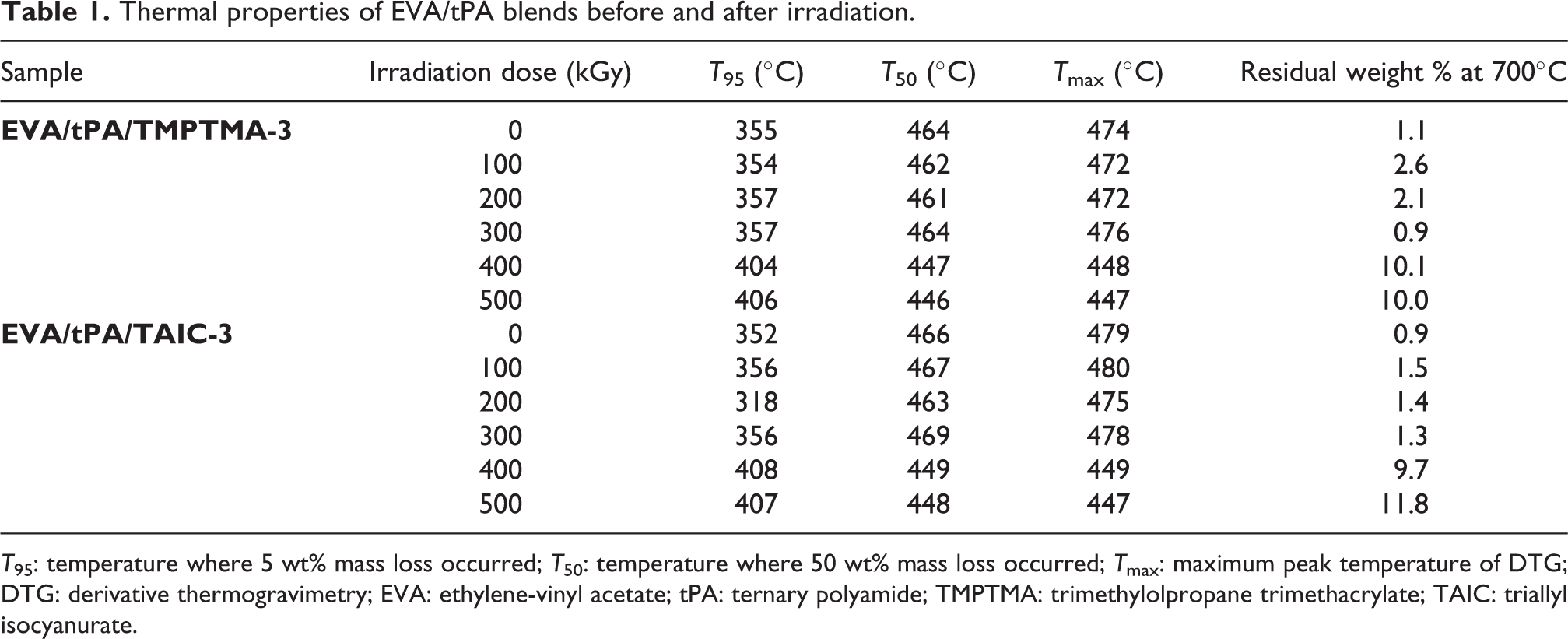
T95: temperature where 5 wt% mass loss occurred; T50: temperature where 50 wt% mass loss occurred; Tmax: maximum peak temperature of DTG; DTG: derivative thermogravimetry; EVA: ethylene-vinyl acetate; tPA: ternary polyamide; TMPTMA: trimethylolpropane trimethacrylate; TAIC: triallyl isocyanurate.
Additionally, at 5% decomposition, the irradiated EVA/tPA/TAIC-3 blend showed the highest thermal stability among all blends, which is stable up to 407°C at 500 kGy. Moreover, the residual weight analysis of EVA/tPA blends at different temperatures significantly increases with increasing irradiation dose. It was also necessary to analyze the degradation mechanism of EVA/tPA blends by e-beam irradiation.
Thermal degradation kinetics
Plots of
Inflection point temperature of TGA curves at different heating rates.

EVA: ethylene-vinyl acetate; tPA: ternary polyamide; TMPTMA: trimethylolpropane trimethacrylate; TAIC: triallyl isocyanurate; TGA: thermogravimetric analysis.
Table 3 compares the activation energy of EVA/tPA/TMPTMA(TAIC) blends obtained using three different kinetics methods. The activation energy obtained by the Kissinger method of EVA/tPA/TAIC-3 increased from 247 kJ mol−1 to 279 kJ mol−1 at 500 kGy, whereas the activation energy of EVA/tPA/TMPTMA-3 decreases from 294 kJ mol−1 to 217 kJ mol−1 at 500 kGy. Overall, the Kissinger method shows that the thermal degradation behavior of the EVA/tPA system could increase by irradiation and choosing suitable coagent. Similarly, the Flynn–Wall–Ozawa method was used to obtain the activation energy of EVA/tPA blends. The results revealed that EVA/tPA/TAIC-3 increased from 246 kJ mol−1 to 277 kJ mol−1 at 500 kGy, while EVA/tPA/TMPTMA-3 decreased its activation energy from 291 kJ mol−1 to 217 kJ mol−1 at 500 kGy. The Flynn–Wall–Ozawa and Kissinger’s method showed (Figure S6 in Supplemental Information) the similar findings before and after irradiation. In other words, both methods can be used for the measurement of activation energy of EVA/tPA matrix, and the result is reliable as Flynn–Wall–Ozawa and Kissinger methods are model-free methods with different heating rates independent of the degradation.
The activation energies (Eα) obtained by different methods.

Ea: activation energy;
The activation energy of EVA/tPA matrix can be determined using both methods, and the results are reliable as Flynn–Wall–Ozawa and Kissinger are model-free methods (independent of degradation model). The Friedman method deals with the main degradation region of the TGA curve of blends and calculates the activation energy. The activation energy obtained by the Friedman method of EVA/tPA/TAIC-3 increased from 274 kJ mol−1 to 299 kJ mol−1 at 500 kGy, whereas the activation energy of EVA/tPA/TMPTMA-3 decreases from 319 kJ mol−1 to 221 kJ mol−1 at 500 kGy. The Friedman method shows that the results of Kissinger and Flynn–Wall–Ozawa these methods are consistent with each other and reliable.
DSC analysis
Effect of e-beam irradiation on melting and crystallization temperature points of EVA/tPA blends is shown in Figures 4 and 5. After melt blending of EVA, tPA, and TMPTMA, melting peaks of EVA/tPA/TMPTMA-3 blends increase (as shown in Table 4). However, after irradiation, the melting temperature of EVA/tPA/TMPTMA-3 decreases with the increasing irradiation dose except for at 300 kGy. Melting peaks of EVA/tPA/TMPTMA-3 blend reveal that the melting temperature of the EVA phase drops by almost 5°C and tPA phase by 10°C at 500 kGy. Similarly, the melting temperature of EVA/tPA/TAIC-3 blend decreased, where EVA phase drops to 5°C and tPA by 12°C at 500 kGy.

Melting temperature of (a) EVA/tPA/TMPTMA-3 and (b) EVA/tPA/TAIC-3 blends at different doses.

Crystallization temperature (a) EVA/tPA/TMPTMA-3 and (b) EVA/tPA/TAIC-3 blends at different doses.
DSC data of EVA/tPA blends before and after irradiation.

Tm1: EVA melting temperature; Tm2: tPA melting temperature; Tc: crystallization temperature; Xc: amount of crystallinity; EVA: ethylene-vinyl acetate; tPA: ternary polyamide; TMPTMA: trimethylolpropane trimethacrylate; TAIC: triallyl isocyanurate; DSC: differential scanning calorimetry.
This decrease in melting temperature of EVA/tPA blends can be attributed to the reduction in the concentration of length segment, suitable for crystallization. 27 Crystallization temperature (Tc) of EVA/tPA/TMPTMA(TAIC) blends decreases with increasing irradiation dose up to 500 kGy (Figure 5). This decrease of Tc can be attributed to the cross-linking. Cross-linking hinders the growth of the crystals and consequently requires more undercooling to crystallize. 28
Oil swelling
Materials used in automotive, electrical cable, and oil pipelines are required to have long-lasting oil resistance, as they remain exposed to the external environment, which may cause oil swelling. Figure 6 shows that oil swelling of EVA/tPA blends with both coagents decreases with increasing irradiation dose up to 500 kGy. The oil swell of EVA/tPA blend containing 3 phr of TMPTMA decreases to to 21% after irradiation at 500 kGy.

The effect of e-beam irradiation on the oil swelling of EVA/tPA blends.
Before irradiation, the oil swell of EVA/tPA/TAIC-3 is 42%, and decreases to 29% at 400 kGy, and further to 27% at 500 kGy, much lower than the unirradiated blend. This improvement indicates the formation of the 3D network (higher degree of cross-linking) and opposes the source of oil swell on the blends.
Conclusions
E-beam irradiation has a significant effect on the gel content, mechanical properties, thermal stability, and oil resistance of the EVA/tPA blends. As the irradiation dose increased, the tensile strength of the EVA/tPA/TMPTMA(TAIC) blends increased, while TMPTMA exhibited better reinforcement effect on the tensile strength than TAIC coagent. Following irradiation at 500 kGy, the EVA/tPA/TMPTMA(TAIC) blends exhibited improved thermal stability and increased residue at 700°C, while the temperature at 5% weight loss on the part of the EVA/tPA/TMPTMA blend increased from 355°C to 406°C. Moreover, the activation energy of the EVA/tPA/TAIC blend was significantly increased by the e-beam irradiation. The melting temperature of the blends decreased as the irradiation dose increased. Following irradiation, the oil resistance of the EVA/tPA/TMPTMA (70/30/3) blend was improved. The use of e-beam irradiation with the EVA/tPA blends represents a useful technique for developing high-performance materials that should prove useful in automotive and oil-pipeline industrial applications.
Supplemental material
Supplemental Material, Supplementary_PPC-19-0247.R1 - Effect of electron beam irradiation on the thermal and mechanical properties of ethylene-vinyl acetate copolymer/polyamide blends
Supplemental Material, Supplementary_PPC-19-0247.R1 for Effect of electron beam irradiation on the thermal and mechanical properties of ethylene-vinyl acetate copolymer/polyamide blends by Jawad Ahmed and Yong Zhang in Polymers and Polymer Composites
Footnotes
Acknowledgements
The authors would like to acknowledge COMET Group, ebeam Technologies (China), and the National Natural Science Foundation of China.
Declaration of conflicting interests
The author(s) declared no potential conflicts of interest with respect to the research, authorship, and/or publication of this article.
Funding
The author(s) disclosed receipt of the following financial support for the research, authorship, and/or publication of this article: This work was funded by the National Natural Science Foundation of China (Grant No. 51273109).

Supplemental material
Supplemental material for this article is available online.
References
Supplementary Material
Please find the following supplemental material available below.
For Open Access articles published under a Creative Commons License, all supplemental material carries the same license as the article it is associated with.
For non-Open Access articles published, all supplemental material carries a non-exclusive license, and permission requests for re-use of supplemental material or any part of supplemental material shall be sent directly to the copyright owner as specified in the copyright notice associated with the article.
