




Abstract
In this article, several thermoset epoxy-based nanocomposites are simulated using molecular dynamics (MD) simulation. Epoxy resin with 75% crosslinking ratio is modeled first and its properties are used as the matrix material mechanical properties. The effects of defects and functional groups on carbon nanotube- and nanographene-reinforced epoxy nanocomposites are investigated. To achieve our goals, various types of defects and functional groups are created on graphene and nanotube in the MD models. The defects consist of Stone–Wales, vacancy, and Adatom. In addition, functional groups consist of O, OH, COOH, and NH2. Mechanical properties of nanocomposites are determined and compared. Moreover, nanocomposites consisting of continuous and short reinforcements are modeled to investigate the effects of reinforcement length on nanocomposite mechanical properties. Numerical results show that defects and functional groups reduce the elastic modulus of the nanofillers and nanocomposites in continuous nanofiller-reinforced epoxy. However, in nanocomposites consisting of short nanofillers, defects and functional groups have mixed effects on nanocomposite mechanical properties.
Keywords
Introduction
Many researchers believe that the reason for the differences between experimentally measured and numerical predictions of nanocomposite mechanical properties is due to the imperfections in the atomic structure of the nanofillers. That is, in modeling nanocomposites it is usually assumed that the nanofillers are perfect and have no defects. 1 -4 The presence of defects in nanofillers reduces their strength and, thus, their efficiency in improving matrix mechanical properties. Laboratory measurements take this effect into account, since the actual nanocomposite is being tested. In numerical models, however, the effects of defects are rarely considered. Different imperfections in the atomic structure of CNTs and graphene have been identified. Nanofiller defect types include Stone—Wales (SW), vacancy (Vac), and Adatom (Ad). These defects undermine the mechanical properties of carbon nanotubes (CNTs) and graphene, and thus, their efficiency in improving the mechanical properties of the matrix material.
The effects of defects on nanocomposite mechanical properties have been investigated by several researchers. 5 -12
Yang et al. 5 conducted a study on the effects of CNT structural defects on shear stresses between CNT and polymer using molecular dynamics (MD) simulation. Among the three defects, the single void defect was found to decrease the interfacial shear strength while SW and Ad defects were found to promote interfacial shear load transfer. Islam et al. 6 investigated the effects of SW and Vac defects on CNT and CNT-reinforced polyethylene elastic properties using MD simulation. Their results indicate that longitudinal modulus of CNT and nanocomposite decrease significantly with increasing the number of defects. They also found that weakening effects of Vac defect are more than SW defect. Also, increasing the number of Vac and SW defects reduces the surface shear stress between CNT and polymer. Lv et al. 7 studied the effects of SW and Vac on elastic properties of polypropylene/CNT nanocomposites using MD simulation. Based on their results, with increasing the number of defects, the longitudinal modulus of CNT and nanocomposite significantly decrease. They claim that SW defects have a larger effect on reducing CNT reinforcing efficiency compared to Ad defects. Also, the increase in the number of SW defects increases the surface shear stress between CNT and polymer. In contrast, increasing the number of Ad defects decreases the surface shear stress between CNT and polymer. In addition, they compared MD results with the rule of mixture predictions. Moon et al. 8 investigated the effects of SW defects on surface forces between graphene and polypropylene using the density functional theory and MD. Their results indicated that SW defects increase the absorption energy and interfacial shear strength. However, due to the weakening of the graphene, this defect reduces nanocomposite tensile strength. Gupta and Harsha 9 investigated the effects of structural pinhole defects on the mechanical properties of polymer-based nanocomposites using multidimensional finite element methods. According to their results, this defect type reduces nanocomposite Young’s modulus.
In addition to the abovementioned defects, factors such as functional groups can affect the properties of nanofillers and, in turn, nanocomposite mechanical properties. 13 -20 Subba Rao et al. 13 studied the effects of CNT functionalization on the mechanical properties of bisphenol E cyanate ester polymer nanocomposite using MD simulation. According to their findings, CNT functionalization improves the mechanical properties of CNT in the transverse direction and decreases CNT properties in the longitudinal direction. Sharma et al. 14 investigated the effects of CNT factorization and the type of functional groups on the mechanical properties of polypropylene-based nanocomposites. They report that CNT functionalization reduces the mechanical properties in CNT longitudinal direction.
Based on the above literature survey, the effects of nanofiller defects, functionalization, and length have not been determined in a single investigation. In addition, high resin crosslinking ratio, 75%, has not been modeled using MD simulation. This investigation aims at covering some of the shortcomings found in the previous works. In this article, several thermoset epoxy-based nanocomposites are simulated using MD simulation. Epoxy resin with 75% crosslinking ratio between bisphenol A diglycidyl ether (DGEBA) resin and diethylenetriamine (DETA) hardener is modeled first. Mechanical properties determined from the MD model of this resin are used as the matrix material properties in the nanocomposite models. In addition, various types of defects and functional groups are created on graphene and nanotube to determine the effects of these parameters on nanofiller mechanical properties. The defects considered are SW, Vac, and Ad. The functional groups investigated consist of oxygen group (O), hydroxyl group (OH), carboxyl group (COOH), and amino group (NH2). Mechanical properties of nanocomposites with the above defects and functional groups are determined and compared. Moreover, nanocomposites consisting of continuous and short reinforcement types are modeled to investigate the effects of reinforcement length on nanocomposite mechanical properties.
Atomistic modeling procedure
In this article, mechanical properties of nanocomposites consisting of epoxy resin with 75% crosslinking ratio as the matrix material are determined. For this purpose, the resin was first simulated in Materials Studio software (2017) to determine pure resin mechanical properties. The simulation procedure for pure resin and nanocomposite and crosslinking process could be found in a previous paper by the coauthors. 21 During the equilibrium process, COMPASS force field and Berendsen and Nose methods were used for controlling the pressure and temperature, respectively. Periodic boundary conditions were imposed on all simulation boxes to eliminate the surface effects. Figure 1 illustrates the crosslinking process and molecular structure of the thermoset polymer with 75% crosslinking ratio between DGEBA resin and DETA hardener. The ratio of DGEBA and DETA in the resin mix is 2:1. The C–O bond in epoxide groups needs to be broken in order to form a reactive –CH2 site capable of crosslinking with DETA molecule.

(a) Crosslinking process between DGEBA resin and DETA hardener and (b) molecular structure of the thermoset polymer with 75% crosslinking ratio between DGEBA resin and DETA hardener.
Next, pristine and defective nanotubes and graphene sheets were modeled to determine the reinforcement mechanical properties. Finally, models of epoxy resin reinforced with these nanofillers were created and analyzed. In order to investigate the effects of reinforcement length on nanocomposite properties, models consisting of continuous and short reinforcements were analyzed as well. Simulation box details are listed in Table 1. Figure 2 shows the short and continuous nanofillers used in different simulation boxes.
Simulations box details.

CNT: carbon nanotube.

Short and continuous nanofillers used in simulation boxes: (a) nanotube and (b) graphene.
In addition, models were created to investigate the effects of nanofiller defects and functional groups on nanocomposite mechanical properties. Defective CNTs and defective graphene consisting of three types of defects are presented in Figure 3.
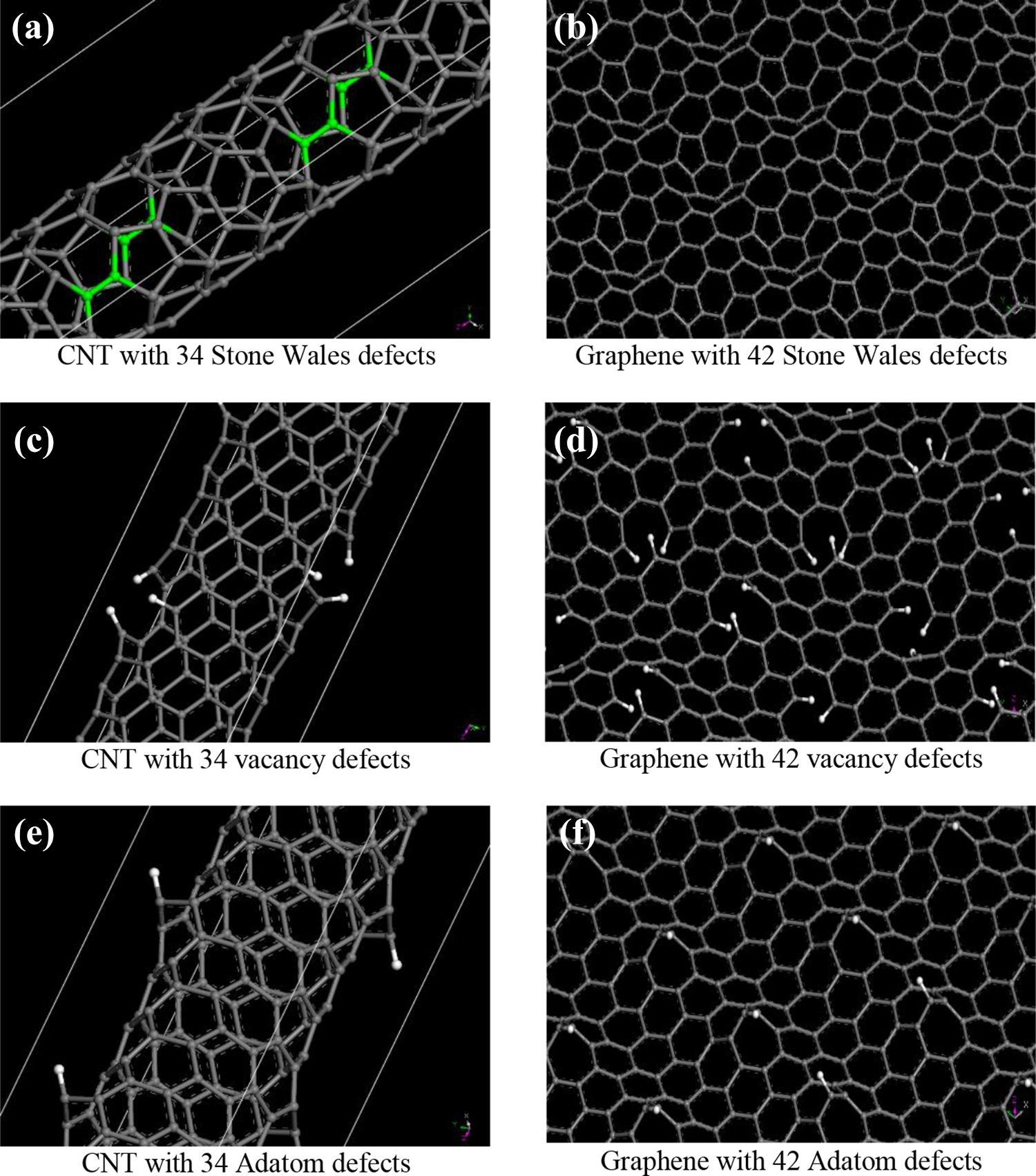
Defective CNTs and defective graphenes: (a) CNT with 34 SW defects, (b) graphene with 42 SW defects, (c) CNT with 34 Vac defects, (d) graphene with 42 Vac defects, (e) CNT with 34 Ad defects, and (f) graphene with 42 Ad defects.
The simulated functional nanotubes and functional graphenes are shown in Figures 4 and 5, respectively.
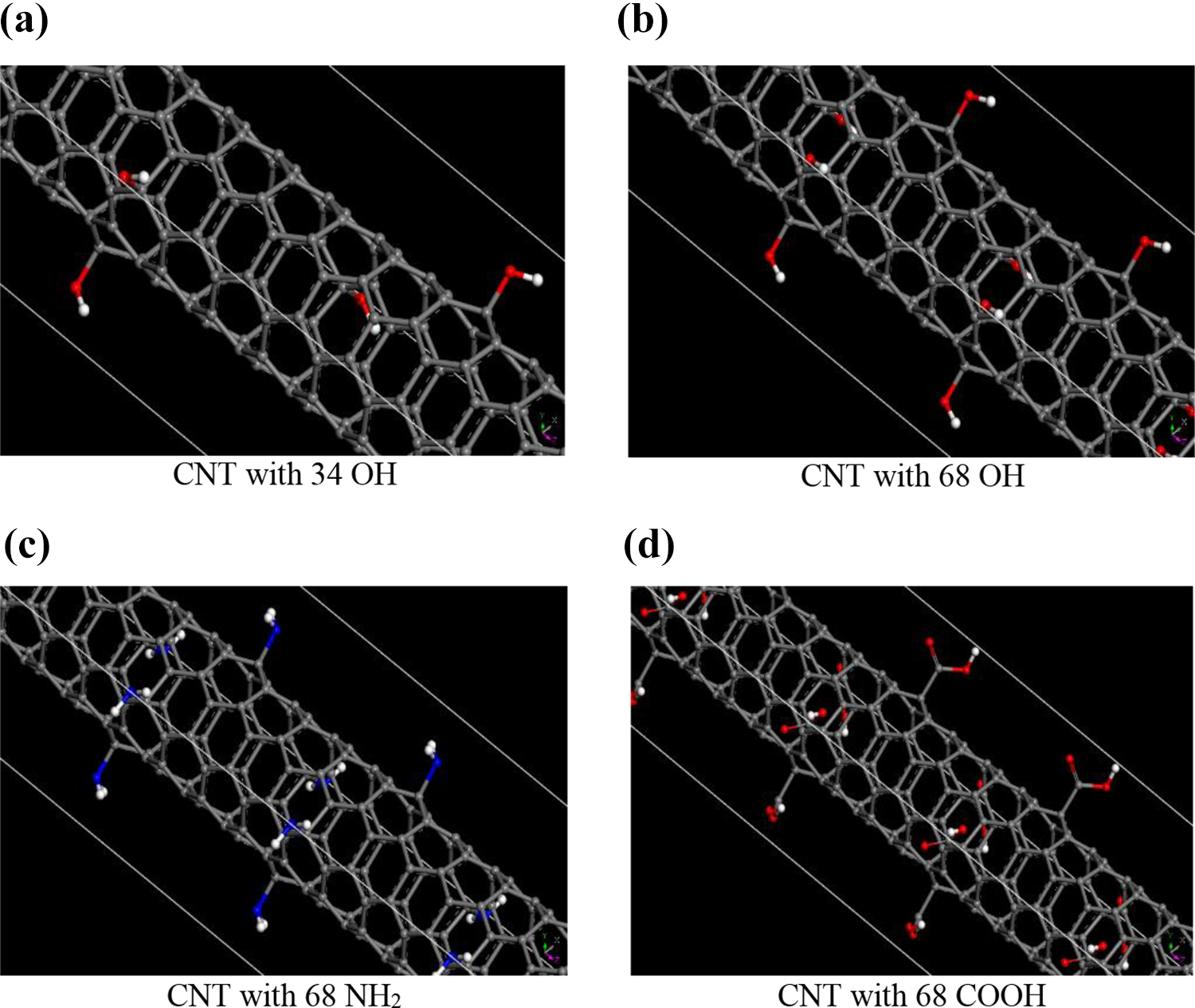
Simulated functional nanotubes: (a) CNT with 34 OH, (b) CNT with 68 OH, (c) CNT with 68 NH2, CNT with 68 COOH.

Simulated functional graphene: (a) graphene with 132 O and 66 OH, (b) graphene with 21 O and 21 OH, (c) graphene with 42 NH2, (d) graphene with 42 COOH, and (e) graphene with 42 OH.
Results and discussion
MD models of pure epoxy and different nanocomposite types were created to determine the effects of various defects and functional groups on nanocomposite mechanical properties. In addition, short and continuous nanofillers were used in the simulation boxes to investigate the effects of nanotube length. The simulation boxes created in Materials Studio software for modeling pure epoxy and nanocomposites are shown in Figure 6. Note that the coordinate axes are shown in the lower right corner in each figure. The results of these analyses are presented in this section.

Simulation boxes of pure epoxy and nanocomposites: (a) MD model of pure epoxy with 75% crosslinking ration, (b) simulated CNT-reinforced nanocomposite, and (c) simulated continuous graphene-reinforced nanocomposite.
Pure epoxy results
First, models were created to determine the properties of pure epoxy with 75% crosslinking ratio. Using the MD results, the elastic modulus of the polymer was determined to be 3.43 GPa. The results of the current investigation are compared with those presented in the literature. 22,23 Note that the predicted resin modulus is in good agreement with that found in the literature. These observations prove that our modeling and analysis procedure on pure resin are correct. Note that our models predict a somewhat higher modulus value than that reported by Aghadavoudi et al. 22 These investigators predicted an elastic modulus of 2.8 GPa for the polymer. It must be noted that Aghadavoudi et al. determined resin modulus for epoxy resin with 50% crosslinking ratio, whereas the crosslinking ratio in our models is 75%. Our numerical result is close to the resin modulus of 3.2 GPa reported by Alian et al. 23
Effects of defects and functional groups on nanofiller mechanical properties
Next, models were created using Materials Studio software to investigate the effects of nanofiller defects and functional groups on nanofiller mechanical properties. To achieve our goals, pristine and nanofillers consisting of SW, Vac, and Ad defects were modeled. In addition, models of functional nanofillers consisting of O, OH, COOH, and NH2 were analyzed. The results of these investigations are presented in the following subsections separately.
Results obtained for nanotube longitudinal elastic modulus and in-plane graphene elastic modulus with various defects and functional groups are presented in Table 2.
Longitudinal modulus of nanotube and in-plane graphene moduli with various defects and functional groups.

CNT: carbon nanotube; SW: Stone–Wales; Vac: vacancy; Ad: Adatom; O: oxygen group; OH: hydroxyl group; COOH: carboxyl group; NH2: amino group.
In each figure and table, numbers and alphabets are used to indicate the model/component details. The numbers indicate the total number of defects or functional groups used in the model. The alphabets indicate the type of defects or functional groups in the model.
The results suggest that all three defects and functional groups reduce CNT elastic modulus in the longitudinal direction. Among these defects, the largest decrease corresponds to SW defect (about 40% relative to pristine nanotube). Also, with increasing OH functionalization from 34 to 68, nanotube elastic modulus decreases by 6%. These results also show that all defects and functional groups reduce graphene elastic modulus as well. The largest reduction is related to Vac defects by about 44%. Functionalization of graphene with 132 O + 66 OH resulted in a 40% decrease in graphene modulus.
The reductions in stiffness are due to the weakening of the nanofiller structure as a result of defects. Vac defects eliminate a number of bonds from the pristine nanofiller. The SW defect is a crystallographic defect which involves the change of connectivity of two bonded carbon atoms. This defect type leads to a bond rotation by 90° with respect to the midpoint of the bond. This results in a reduction of nanofiller modulus. This defect type has a larger effect on nanotube stiffness compared to the flat graphene sheets. The Ad defects interrupt the sequencing in the nanofiller structure. Adding functional groups also causes distortion in the filler structure, which increases with increasing the number of functional groups. In addition, the effect of functional groups on nanotubes is lower due to the cylindrical shape of nanotubes. However, flat graphene sheets undergo large distortions when functional groups are added to them, which results in a pronounced decrease in its elastic modulus.
Effects of defect and functional groups on nanocomposite mechanical properties
Next, models were created to investigate the effects of nanofiller defect and functional groups on nanocomposite mechanical properties. To achieve our goals, nanocomposites consisting of nanofillers with the three mentioned defects and functional groups were simulated. In addition, short and continuous nanofillers were used in the simulation boxes to investigate the effects of nanotube length on nanocomposite mechanical properties. The results of these models are presented in this section.
CNT-reinforced nanocomposite results
A total of eight different models were created and analyzed in this investigation. Predicted nanocomposite longitudinal modulus are presented in Figure 7 for continuous CNT-reinforced nanocomposites. The results obtained for pristine CNT/epoxy nanocomposite are also included for a better comparison.

Nanocomposite longitudinal elastic modulus for continuous nanotube-reinforced epoxy with various defects and functional groups.
As can be observed in this figure, all three defects and functional groups result in a decrease in nanocomposite longitudinal modulus. The largest decrease is related to SW defect by about 60% relative to pristine nanotube-reinforced epoxy. Also note that increasing the number of OH functionalization from 34 to 68 reduces nanocomposite elastic modulus by about 2%.
The elastic modulus in nanotube direction results of this investigation are presented in Figure 8 for short nanotube-reinforced epoxy. Note in this figure that in short CNT-reinforced epoxy all defects and functional groups result in an increase in nanocomposite longitudinal elastic modulus. Only Vac defect has a negligible decreasing effect. The largest increase in nanocomposite longitudinal modulus is related to 68 OH functionalization by about 61%.

Nanocomposite longitudinal elastic modulus for short nanotube-reinforced epoxy with various defects and functional groups.
Nanocomposite transverse modulus results for the continuous and short CNT-reinforced polymer are presented in Table 3. These results suggest that all defect types and functional groups have a reducing effect on continuous nanotube nanocomposite transverse modulus as well. The largest decrease in this case corresponds to 68 NH2 functional group by about 56%. However, increasing the number of OH functionalization from 34 to 68 increases nanocomposite transverse modulus by about 16%.
Nanocomposite transverse elastic modulus for continuous and short nanotube-reinforced epoxy with various defects and functional groups.

CNT: carbon nanotube; SW: Stone–Wales; Vac: vacancy; Ad: Adatom; OH: hydroxyl group; COOH: carboxyl group; NH2: amino group.
On the other hand, defects have a negligible effect on nanocomposite transverse modulus of short CNT nanocomposite. However, functional groups reduce transverse elastic modulus of this nanocomposite type. The largest reduction, about 20%, corresponds to NH2 functionalization compared to pristine nanotube. Note also that increasing nanotube OH functionalization from 34 to 68 results in a decrease in nanocomposite transverse modulus.
Graphene-reinforced epoxy results
Finally, models were created to investigate the effects of defect type, functional groups, and length on graphene-reinforced polymer.
The predicted in-plane nanocomposite elastic moduli for all cases are presented in Figure 9 for continuous graphene-reinforced polymer. The results indicate that, all defects and functional groups reduce elastic modulus of continuous graphene nanocomposite in the graphene plane as well. The largest decrease corresponds to SW defect by about 77% and 132 O + 66 OH functionalized graphene-reinforced polymer by about 79%. Also, note that increasing the number of O + OH functionalization from 21 O + 21 OH to 132 O + 66 OH reduces nanocomposite elastic modulus by about 32%.

In-plane elastic modulus of continuous graphene nanocomposite with various defects and functional groups.
The in-plane modulus results for the short graphene-reinforced epoxy are shown in Figure 10. These results suggest that, defects and functional groups have different effects on this nanocomposite in-plane modulus. Note that all defect types result in an increase in nanocomposite in-plane modulus. However, functional groups have mixed effect on this nanocomposite in-plane modulus. That is, 42 OH and 42 COOH functionalizations have an increasing effect, whereas 132 O + 66 OH and 42 NH2 have a decreasing effect. Finally, 21 OH + 21 O has a negligible effect on this nanocomposite in-plane modulus.

In-plane elastic modulus of short graphene nanocomposite with various defects and functional groups.
Predicted graphene-reinforced nanocomposite transverse modulus are presented in Table 4 for all cases. Defects and functional groups have the same reducing effect on transverse modulus of nanocomposite containing continuous nanofiller as well. The largest reduction is related to Ad defects by about 46% and 42 OH functionalization by about 56%. Also, note that increasing the number of O + OH functionalization from 21 O + 21 OH to 132 O + 66 OH reduces nanocomposite transverse modulus by about 44%.
Transverse elastic modulus of graphene nanocomposite with various defects and functional groups.

SW: Stone–Wales; Vac: vacancy; Ad: Adatom; O: oxygen group; OH: hydroxyl group; COOH: carboxyl group; NH2: amino group.
Note that in short graphene case, all defect types result in an increase in nanocomposite transverse modulus, except for the Ad defect. Functional groups have conflicting results on this nanocomposite transverse modulus as well; 132 O + 66 OH, 42 NH2, and 42 COOH functionalizations increased nanocomposite transverse modulus. However, 42 OH and 21 OH + 21 O functional groups resulted in a decrease in nanocomposite transverse modulus of short graphene-reinforced epoxy. This could be due to the fact that short graphene distorts in the simulation box when the box is placed under loads. This distortion affects graphene/functional group/matrix interaction in the short graphene-reinforced epoxy. The same is true in case of short CNT-reinforced epoxy.
Conclusions
In this article, MD models were created to determine the mechanical properties of epoxy-based nanocomposites. First, epoxy resin with 75% crosslinking ratio was modeled to determine the matrix mechanical properties. MD-determined resin properties were used as the matrix material mechanical properties in modeling the nanocomposites. The effects of nanofiller type and length were investigated by analyzing models consisting of short and continuous CNTs and graphene. In addition, various types of defects and functional groups were created on graphene and nanotube to investigate the effects of these parameters on nanocomposite mechanical properties. The defects consisted of SW, Vac, and Ad. Modeled functional groups consisted of O, OH, COOH, and NH2. The following conclusions can be drawn from the results of the MD models: MD models predicted isotropic properties for the pure resin. Defects and functional groups resulted in a reduction in elastic modulus of both nanofiller types. Defects and functional groups reduced elastic modulus of nanocomposites with continuous nanofiller-reinforced epoxy. Defects and functional groups have mixed effects on nanocomposite properties of short nanofiller-reinforced epoxy. In short CNT-reinforced epoxy, all defects and functional groups resulted in an increase in nanocomposite longitudinal modulus. Defects had a negligible effect on nanocomposite transverse modulus in short CNT-reinforced epoxy. Functional groups resulted in a decrease in short CNT-reinforced epoxy transverse modulus. In short graphene-reinforced epoxy, all defect increase nanocomposite in-plane modulus. In short graphene-reinforced epoxy, all defect increase transverse modulus of nanocomposite. Longitudinal (in-plane) and transverse moduli of continuous nanofiller-reinforced epoxy were higher than those of the short nanofiller nanocomposites.
Footnotes
Acknowledgement
The authors would like to appreciate the use of the computational clusters of the High Performance Computing Center (Shahrekord University, Iran), in completing this work.
Declaration of conflicting interests
The author(s) declared no potential conflicts of interest with respect to the research, authorship, and/or publication of this article.
Funding
The author(s) received no financial support for the research, authorship, and/or publication of this article.
