




Abstract
The influence of basalt filler on mechanical properties of polyethylene (PE)- and polypropylene (PP)-based composites, and the effect of basalt on heat resistance and inflammability of polymer composite materials were studied. The introduction of basalt into the composite increases its elasticity modulus. The best mechanical properties are observed when 40 parts by weight of basalt per 100 parts of low-density PE and high-density PE are introduced. At the same time, a slight decrease in the deformation at failure is observed in basalt-filled PE composites. Deformation before failure is reduced from 380% for original PE to 250% for the composite containing 40 mass of basalt per 100 parts of PE. In the case of PP, this tendency is not observed. Other mechanical characteristics of polymer composites slightly change with the introduction of basalt particles as a filler. Incorporating basalt into PE and PP influences the combustibility of composites: oxygen index increases 1.3 times compared with the unfilled polymers, self-burning time decreases more than 2 times, and the loss of mass during ignition in the air decreases 2.15 times for PE-based composite and 1.75 times for PP-based composite. All indicators of flammability vary additively to the content of basalt, which is a noncombustible material.
Introduction
Polymeric composites modified by inorganic fillers are widely used due to their good mechanical and thermal properties. The modification efficiency of the filler incorporated into the polymeric matrix depends strongly on its shape, size, and structure. Development of the composites with improved thermal stability and, simultaneously, a reduced price, compared to neat polymer, may be achieved, among others, by the application of powder-like low-cost natural fillers such as talc, zeolite, bentonite, or calcium carbonate. 1 -6
Modification of both thermoplastic and thermoset polymers achieved by using the inorganic fillers leads to a significant extension of the application of polymer composites. Despite many studies, there are still many possibilities of novel polymeric composites development as well as the improvement of the performance properties of materials produced so far. Basalt is an inorganic mineral that may be shaped into fibers or finely ground powder. 7,8
Basalt is an environmentally friendly, nonhazardous, and naturally available volcanic rock that comprises up to 33% of the earth’s crust. 8,9 Its chemical composition differs based on the geography of origin. Basalt has remarkable physical and mechanical properties, high chemical resistance and thermal stability, and good adhesion to polymers. 10,11 Due to its properties, basalt can be used as inexpensive reinforcing filler of polymer–matrix composites (PMCs) with high mechanical strength, reduced coefficient of friction, and high thermal stability. 12 -14
Due to localization of the basalt rock deposit in Europe and also in Russia, finding new ways of its applications, such as a filler for composite materials, seems reasonable.
PMCs might be reinforced by both fibrous and particulate basalt. Most studies are devoted to determination of the mechanical properties of polymer composites reinforced by basalt fibers, 8,9,15 and less studies are focused on composite materials filled with dispersed basalt particles. 11,13
Eslami-Farsani et al. 16 their study focused on the hybrid PP composites containing basalt fiber and nanoclay. The study has shown that the mechanical properties of PP-based composites filled with basalt fibers might be significantly improved by the simultaneous addition of clay used as third-phase filler.
Despite many studies on the application of the basalt fibers, characterized by excellent mechanical properties, there is still a further possibility to discover new applications of the dispersed basalt. High amounts of this material are formed during basalt rocks crushing; this fact allows us to treat the dispersed basalt as low-cost waste filler. Moreover, only a few scientific reports refer to its application in the polymer composites. In most of the case studies, the dispersed basalt has been incorporated to polyethylene (PE) to improve the wear resistance 17,14 or to the polyester resin to produce composite stone of basalt–polyester type. 11
The most substantial advantage of the application of dispersed basalt into polymeric matrix denoted in the literature is a significant reduction in composites friction coefficient as well as an improvement in the wear resistance of PE. 17
In our previous investigations, the dispersed basalt was used as a filler incorporated into epoxy composite. The introduction of dispersed basalt extras provided an increase in the physicomechanical characteristics of polymer composites and also reduced their combustibility. 18
The idea of the dispersed basalt application as a filler for thermoplastic composites used to improve the thermomechanical stability and reduce flammability is based on its excellent thermal stability and stiffness. This study aims to investigate the influence of the dispersed basalt content on mechanical and physicochemical properties of PMCs based on PE and PP as well as the flammability of the novel PP/PP-based composite materials.
Materials and methods
Commercial grade PE and PP were supplied by Stavrolen Ltd (Russia). Basalt was taken from Mugalzhar locality in Western Kazakhstan.
PMCs filled with dispersed basalt from Mugalzhar locality were developed. Low-density polyethylene (LDPE; mark: PE6FE-68, density 920–925 kg/m3), high-density polyethylene (HDPE; density 946–950 kg/m3), and PP (mark: PPG2002-24, density 920–930 kg/m3) were filled with 30, 40, and 50 parts by weight of basalt with particle size ≤140 µm. The effect of dispersed filler was evaluated by the change in physicomechanical and chemical characteristics of composites.
The chemical composition of basalt was explored on the X-ray fluorescence spectrometer. The particle size of dispersed basalt and its distribution in polymer matrix were studied using the Phenom scanning electron microscope, which allows obtaining images with resolution up to 45,000, and by the laser diffraction particle size analyzer. The specific surface area of milled basalt was determined by the multipoint Brunauer–Emmett–Taylor method.
Preparation of PE/PP incorporated basalt composite: the basalt was crushed in a ball mill 62ML-A (Mekhanobr-Tekhnika, St Petersburg, Russia) for 15, 30, and 60 min at 50 rev/min. The ratio of the ground material weight to the grinding weight is 1:8. After the grinding process, the product was sieved through 0.140 mm diameter.
The composites were prepared by dispersing basalt in PE/PP by using extruder granulator EPK 25x30 (Polyprom Kuznetsk, Russia). Test specimens were produced in an injection molding machine Haitian SA 900 (Haitian Plastics Machinery, China). Melt flow index testing according to ISO 1133 was done using Aflow Extrusion Plastometer 032295 (Zwick Roell, Kennesaw, GA, USA). The test conditions for HDPE: temperature −(190 ± 0.5)°C, load −5 kg and for LDPE: temperature −(190 ± 0.5)°C, load −2.16 kg.
The effect of dispersed filler was evaluated by the change in mechanical and physicochemical characteristics of composites. The bending stress, impact toughness, and Brinell hardness of composites were determined by the methods described in Mostovoy et al. 19 Breaking bending stress was determined according to ISO 178:2010; tensile stress at break and elongation at break were determined in accordance with ISO 527 -1. Mechanical properties of composites were investigated by universal testing machine “WDW-5E” (Time Group Inc., Beijing, China) at 20 mm/min loading rate. The testing accuracy was 3–5%. The tests were carried out on samples in the form of spatulas with 2 mm thickness, 5 mm width, and a working part length of 50 mm. According to the test results, the values of the elasticity modulus, the yield stress, the fracture strength, and tensile strain were determined. The impact strength was determined according to ISO 179-82 using a plastic tensile impact testing machine LCT-50D (Beijing United Test Co., Ltd, China). Brinell hardness was determined in accordance with ISO 2039/1-87 using HBE-3000A electronic Brinell Hardness Tester (Beijing United Test Co., Ltd, China).
The composite materials were tested for flammability through the oxygen index (EN ISO 4589-2). Standard methods were used to determine Vicat heat resistance (ISO 306: 2004) of composites, method B50-load 50 N; the rate of temperature increase 50°C/h.
Change in mass, rate of change in mass, and magnitude of thermal effects during the heating of the samples were studied using the method of thermogravimetric analysis with the help of a derivator of the “Paulik–Paulik–Erdei” system of the MOM brand Q-1500D under the experimental conditions: weight 100 mg, medium air, heating interval up to 1000°C, heating rate 10°C/min, and relative error does not exceed 1%.
Results and discussion
Basalt of Mugalzhar district in Aktobe region is rich in oxides of silicon, iron, calcium, magnesium, and sodium, contains less than 1 wt% of titanium, potassium, and manganese oxides, along with traces of sulfur oxide (Table 1).
The chemical composition of basalt.
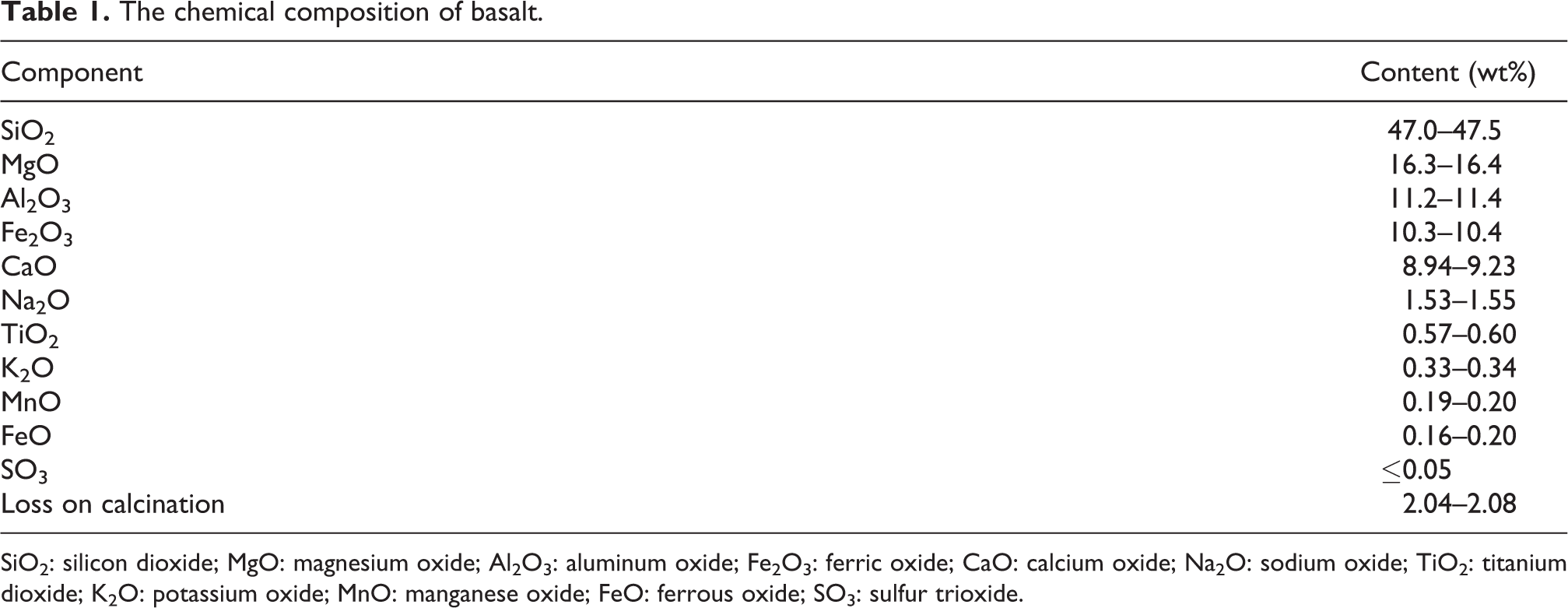
SiO2: silicon dioxide; MgO: magnesium oxide; Al2O3: aluminum oxide; Fe2O3: ferric oxide; CaO: calcium oxide; Na2O: sodium oxide; TiO2: titanium dioxide; K2O: potassium oxide; MnO: manganese oxide; FeO: ferrous oxide; SO3: sulfur trioxide.
The result of electron microscopy analysis shows that the particles of basalt milled in a ball mill for 3 h have sizes from 1 µm to 140 µm (Figure 1). Most of them are less than 50 µm in size; fraction of particles with sizes over 100 µm is small.

SEM images of milled basalt: (a) ×680 and (b) ×3800.
These results are confirmed by the data got on a laser diffraction particle size analyzer. Figure 2 shows the integral volume distribution of basalt particles by sizes. According to a study conducted, the volume fraction of basalt particles with sizes less than 50 µm is 87%.

Integral volume distribution of basalt particles by sizes.
The specific surface area of milled basalt depends on the degree of milling and is 9.18 m2/g for particles with sizes <50 µm while for particles with diameters 50–140 µm it is 8.82 m2/g.
The specific surface area of the dispersed basalt’s pores is more than 5 cm2/g and the pore volume is 0.016 cm3/g. Both of these characteristics slightly increase with an increase in pore diameter.
On analyzing the surface area of the pores, differential curves show the presence of mainly micro- and mesopores with a surface area from 0.2 cm2/g to 0.45 cm2/g in basalt (Figure 3).

Differential curve of the pores’ surface area dependence on their diameter for milled basalt.
Electron microscopy of PE and PP filled with 40 parts by weight of basalt with particle size ≤140 µm shows that basalt is evenly distributed inside the binder (Figure 4).

SEM images of polyolefins filled with dispersed basalt: (a) polypropylene and (b) polyethylene.
To study the possibility of processing filled compositions by injection molding, which is the main method for producing products from thermoplastics, we evaluated the effect of the filler content on the fluidity of the compositions. According to technological requirements, the melt flow rate for PMC casting grades is 2–20 g/10 min. 20
Study of the effect of dispersed filler content on rheological properties of PMCs based on HDPE and LDPE showed that the fluidity of the composition decreases with an increase in the basalt content (Table 2). Melt flow index of LDPE is reduced by 29–45% and the fluidity of HDPE falls by 40–60% when the filler is introduced into the composition, therefore, PMC filled with basalt can be processed by injection molding techniques.
Flow index at 200°C and impact toughness of polymers and composites.

LDPE: low-density polyethylene; HDPE: high-density polyethylene.
a Samples without a notching do not break.
b Parts by weight.
Study of the dependence of mechanical properties of composites on the content of filler in comparison to those of unfilled polymers showed that the best characteristics are observed when 40 parts by weight of basalt per 100 parts of LDPE and HDPE are introduced (Figure 5 and Table 2). The bending failure stress increased by 32%, impact resilience increased by 400%, and Brinell hardness for LDPE increased by 70% and for HDPE by 40%. Therefore, the introduction of basalt fillers in polymers led to significant changes in the physicochemical and mechanical properties of polymer composites. This may be due to changes in the mobility of macromolecules in the boundary layers, the orienting effect of the surface of basalt filler, and the influence of the filler on the structure formation and the structure of the polymer. 12,17,14

Changes in the mechanical properties of PMC depending on the content of basalt: (a) LDPE and (b) HDPE.
Results of tests carried out in the uniaxial tension mode of PMC samples on the basis of PE and PP with the content of basalt 40 parts by weight per 100 parts of polymer are presented in Table 3 and Figure 6.
Mechanical properties of PMC in comparison with HDPE and PP.
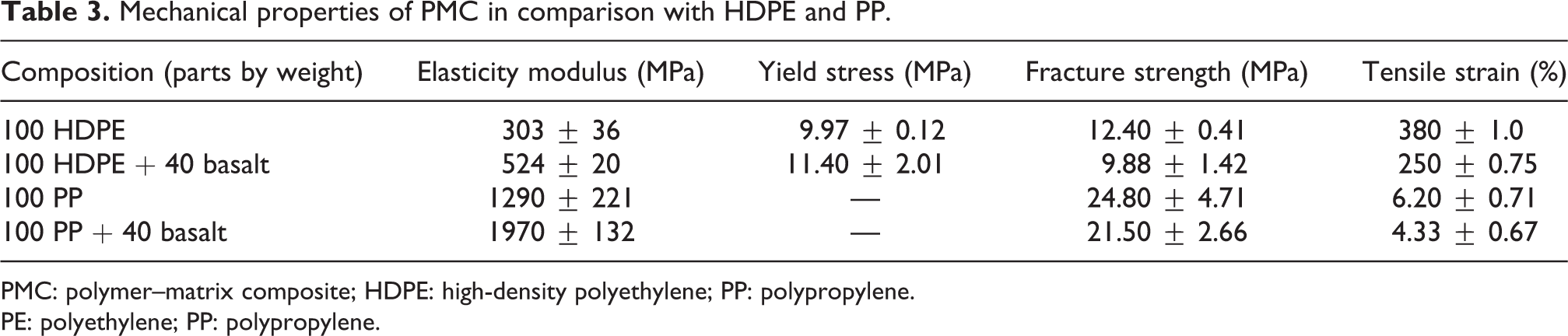
PMC: polymer–matrix composite; HDPE: high-density polyethylene; PP: polypropylene.
PE: polyethylene; PP: polypropylene.

Tensile stress of polymer–matrix composite as a function of strain: (a) basalt-filled PE and (b) basalt-filled PP.
Introduction of basalt into thermoplastic polymers leads to an increase in the elasticity modulus. At the same time, basalt incorporation into PE composites shows a slight decrease in deformation during fracture. So, the tensile strain is reduced from 380% typical for the original PE to 250% for the composite PE + 40 mass of basalt. The properties of polymer composites containing dispersed fillers are determined by the structure formation of filler particles in a polymer medium and their bonding to each other through segments of polymer macromolecules adsorbed on the surface of the filler particles, 18,21 their deformation, and orientation of unfixed segments from the particle into the polymer bulk. An ordered partially oriented boundary layer arises, where stresses relax and crack growth stops, which is also one of the factors that increase the complexity of mechanical properties.
In the case of PP, this tendency is not observed. The degree of change of other mechanical characteristics of polymer composites with the introduction of basalt particles is small. PP stretching occurs with the formation of a “neck,” since it is characterized by the formation and development of forced elastic deformation. The filler, as well as its distribution in the material, significantly affects the nature of fracture under tensile loads. With a content of 40 parts by weight, the filler is distributed evenly and when stretched, the sample is still destroyed with the formation of a “neck” but is already characterized by greater rigidity. This is due to the fact that the introduction of solid particles of fillers that are not deformed under load leads to a decrease in the deformability of polymer composites and an increase in stiffness. This is a positive factor since PE, PP, and other elastic thermoplastics have high deformability under load, which helps to reduce the tensile strength. 12 -14,20
The use of noncombustible fillers of inorganic nature is an effective and cost-effective method of reducing the combustibility of polymer composites. The introduction of such fillers in polymers can reduce the content of the combustible component of the material and affect the thermophysical characteristics of the composite and the conditions of heat and mass transfer during combustion. 22
Since PE is a combustible polymer, the developed materials have been tested for fire resistance by the oxygen index method. As shown by the studies (Table 4), the introduction of 40 parts by weight of basalt into LDPE and HDPE provides the growth of Vicat heat resistance of PMC by 7% and 10%, respectively.
Physicochemical properties of PCM on the polyethylene basis in comparison with unfilled polymer.

PMC: polymer–matrix composite; HDPE: high-density polyethylene; LDPE: low-density polyethylene.
The temperature of the destruction initiation rises by 3°C and 4°C, respectively. Basalt incorporation causes an increase in oxygen index by 30–35%. The incorporation of basalt reduces the self-burning time of PMC by more than 2 times compared to unfilled PE, while there is a significant reduction in weight loss during ignition in the air (Figure 7).

Effect of basalt introduction on the physicochemical properties of PCM.
Introduction of 40 parts by weight of basalt into PE and PP influences the combustibility of composites: oxygen index increases 1.3 times in comparison with the unfilled polymers, self-burning time decreases more than 2 times, and the loss of mass during ignition in the air decreases 2.15 times for PE-based composite and 1.75 times for PP-based composite (Table 5). All indicators of flammability vary additively to the content of basalt, which is a noncombustible material.
Effect of basalt on combustibility of PMC.

PMC: polymer–matrix composite; HDPE: high-density polyethylene; PP: polypropylene.
Conclusions
PMCs were obtained by the introduction of milled basalt obtained from Mugalzhar district in Western Kazakhstan, with particle sizes from 1 µm to 140 µm into the binders—PE and PP.
Study of the effect of dispersed filler content on rheological properties of PMCs based on HDPE and LDPE showed that the flow index of LDPE is reduced by 29–45% and fluidity of HDPE falls by 40–60%, when the filler is introduced into the composition, therefore, PMC filled with basalt can be processed by injection molding techniques. The best mechanical properties are observed when 40 parts by weight of basalt per 100 parts of LDPE and HDPE are introduced.
Filling of thermoplastic polymers with basalt leads to an increase in the elasticity modulus. At the same time, introduction of basalt into PE composites shows a slight decrease in tensile strain. So, the deformation before failure is reduced from 380% typical for the original PE to 250% for the composite PE + 40 mass of basalt. In the case of PP, this tendency is not observed. The degree of change in other mechanical characteristics of polymer composites with the introduction of basalt particles is small.
Incorporation of 40 parts by weight of basalt into PE and PP influences the combustibility of composites: oxygen index increases 1.3 times in comparison with the unfilled polymers, self-burning time decreases more than 2 times, and the loss of mass during ignition in the air decreases 2.15 times for PE-based composite and 1.75 times for PP-based composite. All indicators of flammability vary additively to the content of basalt, which is a noncombustible material.
Thus, basalt is an effective filler for PE and PP, providing improved physicochemical and mechanical properties of PMCs, and moreover, basalt is an alternative cheap filler that makes it possible to reduce the costs of polymer composite materials.
Footnotes
Declaration of conflicting interests
The author(s) declared no potential conflicts of interest with respect to the research, authorship, and/or publication of this article.
Funding
The author(s) disclosed receipt of the following financial support for the research, authorship, and/or publication of this article: This study was funded by (Grant No. AP05133460) the Ministry of Education and Science of the Republic of Kazakhstan.
