



Abstract
Neat and surface silanized barite (BR) was compounded with poly(lactic acid) (PLA) at the loading range of 5, 10, 15, and 20 wt% by melt blending process. Surface characteristics of BR samples were examined by infrared spectroscopy in attenuated total reflectance mode. Mechanical, thermal, water resistance, melt flow, and morphological characterizations of composites were performed by tensile and impact tests, dynamic mechanical analysis, water absorption test, melt flow rate (MFR) test, and scanning electron microscopy (SEM) analysis, respectively. BR additions lead to increase in tensile strength and modulus of PLA. The maximum improvement is obtained for 15 wt% of silanized BR containing composite. In contrast, percent elongation of PLA decreases with the incorporation of BR. Treated BR-loaded composites give higher impact energy values compared to untreated BR. Impact performance of composites increases with concentration. Silanized BR-filled composite at 5 wt% concentration exhibits higher storage modulus than unfilled PLA, where other composites yield relatively lower values in the case of storage modulus. Glass transition temperature of PLA extends to higher values by the addition of BR. Inclusions of BR samples cause a slight decrease in MFR of unfilled PLA. Water absorption of composites is found to be higher than that of PLA. Silanized BR-filled composites display lower water absorption values compared to untreated BR, thanks to hydrophobic nature of Si containing surface. According to SEM microimages of composites, more homogeneous dispersion in PLA matrix is achieved for treated BR particles than neat ones due to enhancement for interfacial adhesion of BR to PLA after silanization.
Introduction
Environmentally friendly materials have received considerable attention from scientific and industrial researchers due to ecological issues in recent years. Composite materials consist of renewable products and natural resources which are named as green composites have been gradually developed for the aim of replacement for conventional petroleum-based materials. Green composites have several advantages, such as having biodegradability, low weight, and low production costs. They are favorable in several application areas, including construction, packaging, and transportation, thanks to these advantages. 1,2
The reinforcement of renewable polymers has gained importance because of their ecofriendly and recyclable properties compared to commercial polymers. Moreover, the hydrophilic nature of bio-based polymers makes strong adhesion with most of the fillers. 3 Poly(lactic acid) (PLA) is the most popular candidate among natural polymers, which are derived from renewable sources. PLA is a versatile biopolymer that its use is considered as reduction of the municipal solid waste disposal problem for recently packaging and consumer products. 4,5 Reinforcing biopolymers such as PLA with suitable fillers have been a hot research topic because these polymers have some limitations, including poor toughness and melt strength, low thermal stability, and narrow processing window. 6,7 Mineral fillers were widely preferred for reinforcing plastics due to their low cost and naturally obtained characteristics. The influence of mineral fillers on the main properties of plastics depends on some factors, such as shape, size, loading ratio of fillers, and, most importantly, polymer–filler adhesion. 8
Barite (BR), barium sulfate, mineral is obtained mostly in depositional environments and it is deposited through various numbers of processes, including biogenic, hydrothermal, and evaporations. 9,10 BR containing polymer composites have found effective usage in medical, industrial, and construction applications, thanks to BR that provides improvements on radioactivity shielding, 11,12 mechanical, 13,14 abrasion resistance, 15 -19 and sound isolation 20,21 performances. Additionally, based on a literature survey, BR has been used as an additive for several polymer matrices, including polypropylene, 22 -24 polystyrene–polypropylene blends, 25,26 polyethylene terephthalate, 27 polytetrafluoroethylene, 28 polymethylmethacrylate, 29 polydimethylsiloxane elastomer, 30 polyurethane elastomer, 31 natural rubber, 32 and styrene–butadiene rubber. 33 A few number of studies were obtained in the literature regarding the BR containing PLA. 34,35 These research works were devoted to the production of composites for biomedical applications and limited findings were reported.
The main aim of this study is the investigation of mechanical, thermomechanical, water resistance, melt-flow, and morphological properties of BR-filled PLA biocomposites to enlighten their larger volume production in industrial applications, including mainly packaging and other products for outdoor usage. For this purpose, melt blending process was preferred to fabricate the composite samples. BR powders were subjected to silane treatment to enhance interfacial interactions between filler and matrix. The surfaces of neat and silane-treated BR samples were examined by infrared spectroscopy (IR) in attenuated total reflectance (ATR) mode. Composites were produced using lab-scale compounder and test samples were prepared by injection molding process. In addition to mechanical (tensile and impact tests) and thermomechanical (dynamic mechanical analysis (DMA)) studies, water absorption test was performed to evaluate the outdoor applications of composites, melt flow rates (MFRs) were reported to investigate the ease of processability of materials, and scanning electron microscopy (SEM) technique was conducted to postulate the dispersion homogeneity of BR particles into PLA matrix.
Experiment
Materials
The commercial PLA, Ingeo biopolymer 6100D, was supplied from Natureworks LLC, Minnetonka, Minnesota, USA. It has a density of 1.24 kg m−3 and a relative viscosity of 3.1 according to CD Internal viscotek method. BR was purchased from Karakaya Bentonite Inc., Turkey. It has a density of 4.2 kg m−3 and volume mean diameter of 9.4 µm.
Ethanol and aminopropyltriethoxysilane (APTES) were used as solvent and silane coupling agent, respectively. They were obtained from Merck AG, Germany.
Surface treatment of BR
Silanization process was applied to BR samples according to similar treatment routes in the literature. 36 -38 BR powders were mixed in 2 wt% of APTES/ethanol solution for 2 h at room temperature. After mixing, samples were dried at 70°C overnight. Pristine- and silane-treated BR samples were coded as BR and BR (S), respectively.
Production of composites
PLA-based composites were fabricated by 15 cc DSM Xplore microcompounder (Sittard, the Netherlands) at 210°C for 5 min with the mixing speed of 100 r min−1. Neat PLA was mixed with these parameters and coded as PLA. Concentrations of BR and BR (S) in PLA were 5, 10, 15, and 20 wt%. Dog-bone shaped test samples with the dimensions of 80 × 7.5 × 2.5 mm3 were prepared by Daca Instruments microinjection molding machine, California, USA at a barrel and mold temperatures of 215°C and 40°C, respectively.
Characterization techniques
IR technique in the ATR mode was conducted to investigate the surface characteristics of pristine- and silane-treated BR powders using Bruker Optics, 66/S series (BrukerVERTEX70, Massachusetts, USA) at the resolution of 4 cm−1 with 32 scans. Tensile tests were performed using Lloyd LR 30 K universal tensile testing device, West Sussex, UK with 5 kN load cell and 5 cm min−1 was applied as crosshead speed according to the standard of ASTM D-638. Tensile strength, percentage strain, and Young’s modulus values were recorded of minimum of three samples with standard deviations. Impact test was carried out by Coesfeld material impact tester (Dortmund, Germany) with the 4 J pendulum according to the standard ASTM D256. DMA tests of PLA and composite samples with the dimensions of 50 × 7.5 × 2.5 mm3 were studied using Perkin Elmer DMA 8000 (Waltham, Massachusetts, USA) in dual cantilever bending mode. Temperature range of analysis was between −150°C and 200°C at the heating rate of 10°C min−1 under nitrogen atmosphere. MFRs of samples were measured using Meltfixer LT, Coesfeld, Germany. The tests were conducted with the standard load of 5 kg at 210°C. The MFR values were calculated and expressed as g/10 min. During water absorption test, samples were conditioned according to the standard ASTM D570. Test samples were immersed in water bath at room temperature, and they were taken out from water and weighted periodically. The fractured surfaces of composites after impact test were examined by FEI Quanta 400F FESEM (FEI Quanta 400F,Oregon, USA). SEM microphotographs were captured at magnifications of 1000× and 3500×.
Results and discussion
IR study
IR spectrum of BR and BR (S) samples is represented in Figure 1. The two peaks around 610 and 630 cm−1 assign bending vibration of the SO4 2− ion of BR. 39,40 The shoulder peak at 980 cm−1 and intense peak at 1070 cm−1 are due to symmetrical vibrations of SO4 2− group. 41,42 These characteristic sulfate-based S–O stretching bands are seen in both BR and BR (S) samples with equal intensities. The peaks located in the region from 1200 cm−1 to 1400 cm−1 wave numbers assign to oxygen-related bonds 43 -45 and it can be clearly seen that neat BR sample gives higher intensities compared to BR (S). This finding indicates that silane coupling agent causes reduction of oxygen functionality on BR surface by forming bonds with these groups. It can be obtained from the spectra of BR (S) that there are shoulder peaks around 800 cm−1. These peaks can be seen only for BR (S) sample, which are due to Si–O vibrations. 46 -48 This result is another identification of silane covered the neat BR surface during treatment process.

FTIR spectra of barite samples.
Tensile test
Mechanical test data of PLA and composites are listed in Table 1 and their stress versus strain curves are given in Figure 2. It can be seen from Table 1 that tensile strength increases with the concentration of BR. This increasing trend reaches to a maximum at optimum concentration of 15 wt%. Further addition of BR causes sharp decrease in tensile strength. This behavior may be due to agglomeration formations of BR particles into PLA matrix at 20% concentration. BR (S)-filled composites exhibit about 5–6 points higher tensile strength values compared to BR-filled ones for all loading ratios. Improvement of adhesion of inorganic BR surface to organic polymer is the reason for this finding. The highest strain value is obtained for unfilled PLA according to Figure 2. Elongation at break of PLA decreases about 3–4 level with the BR additions regardless of neat or treated samples. Composites show slightly higher Young’s modulus results with respect to PLA. It can be seen from the results that surface treatment and concentration cause minor effect to the modulus of composites.
Mechanical test results.
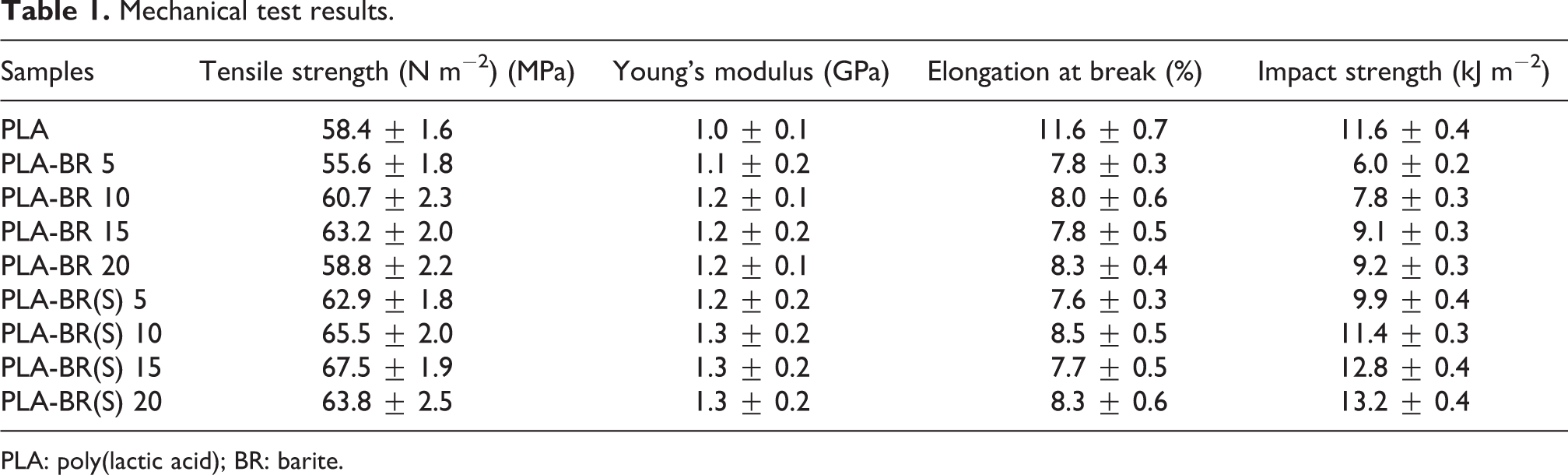
PLA: poly(lactic acid); BR: barite.
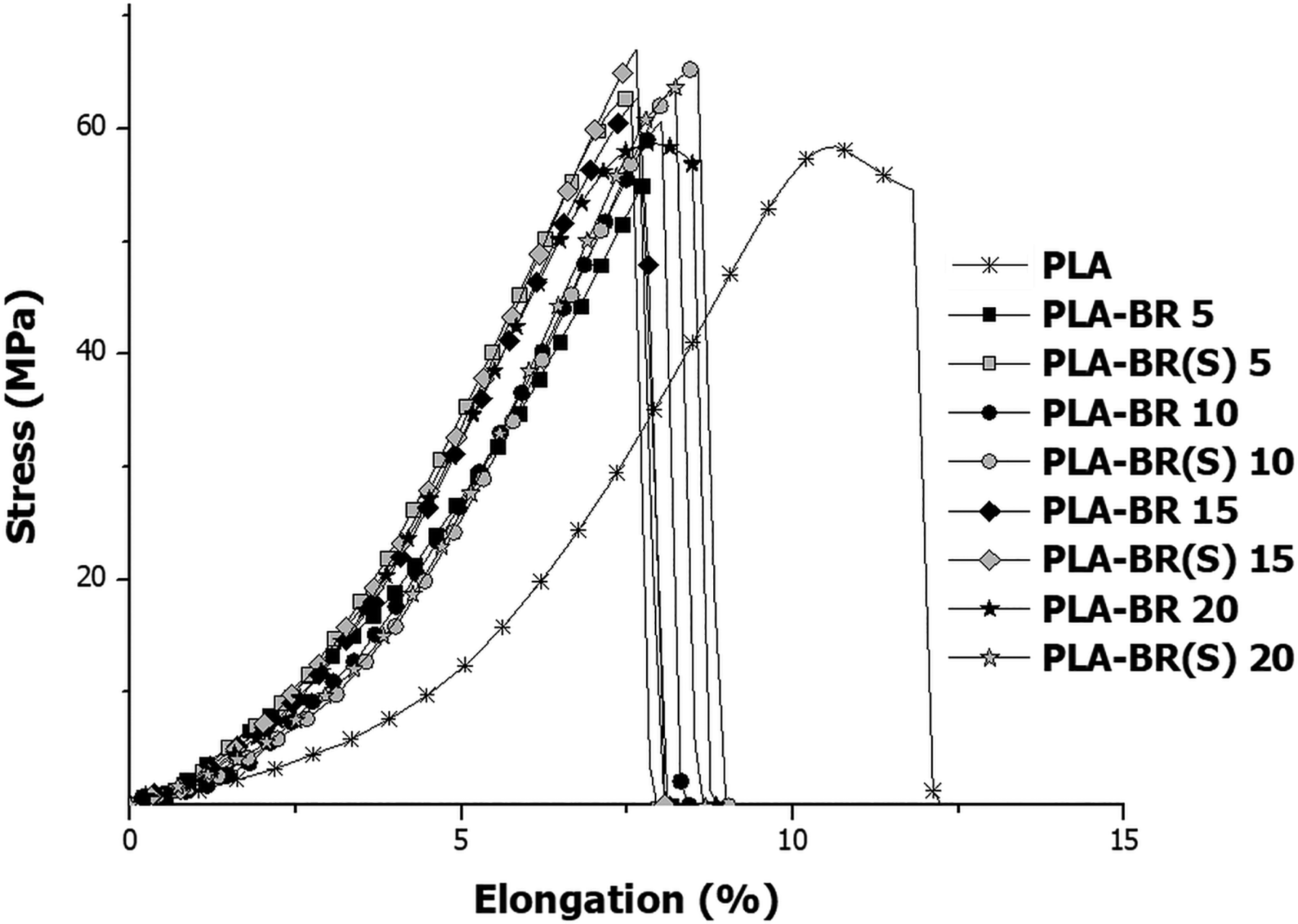
Stress versus strain curves of PLA and composites.
Impact test
Impact strength values of PLA and its composites are listed in the last column of Table 1 and represented as bar graphs in Figure 3. Impact strength of composites shows improvement with increase in concentrations. BR additions to PLA cause significant reductions with all loading ratios. On the other hand, BR (S) additions with 15% and 20% concentrations give higher impact strength results compared to unfilled PLA. PLA-BR (S) composites also show about 4 point higher impact strength values than that of unmodified ones at the same concentrations of PLA-BR composites for all of the filling ratios. These results are related with more homogeneous dispersion of silane BR particles into PLA matrix occurs with respect to neat BR particles.
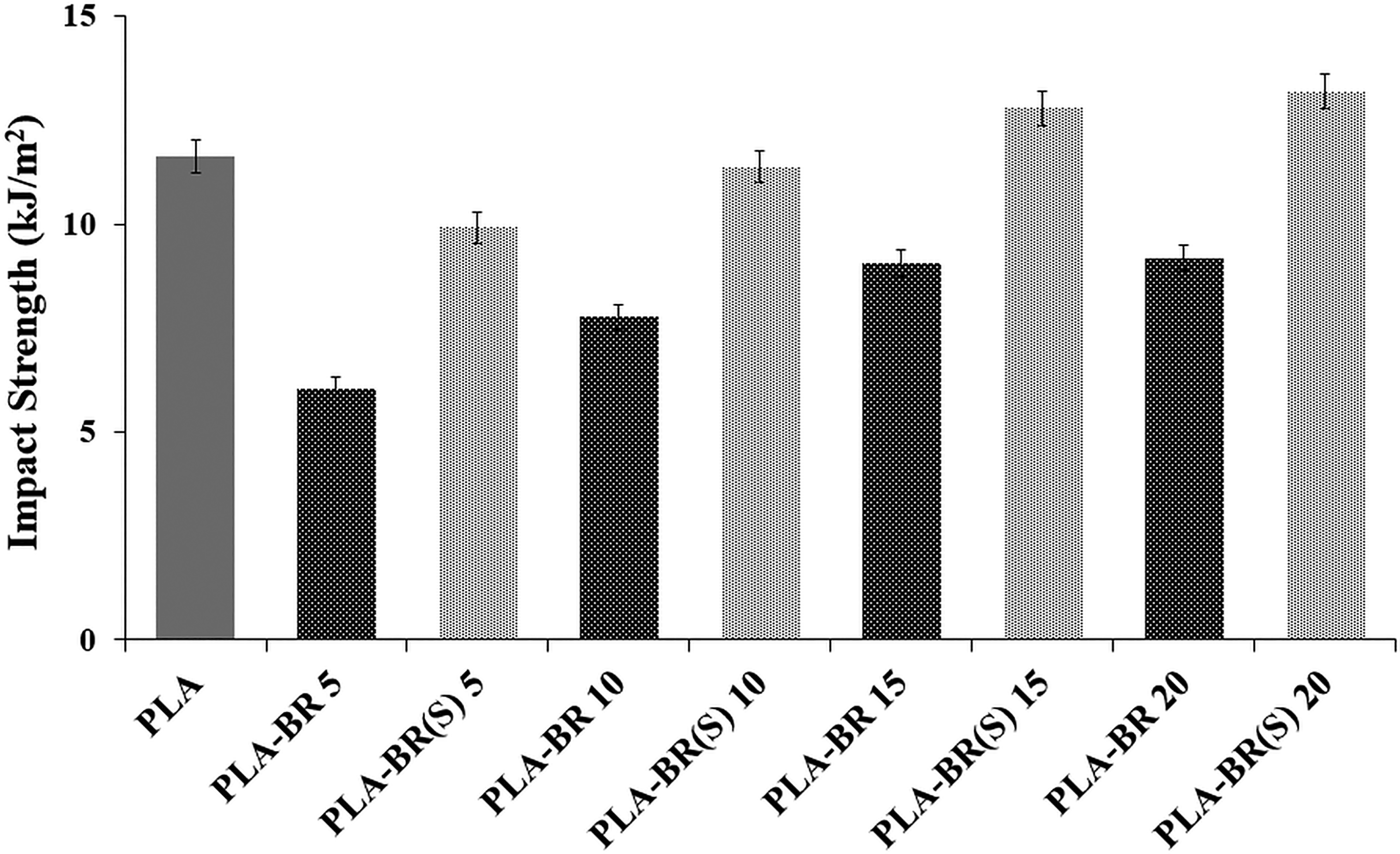
Impact test results.
Dynamic mechanical analysis
Storage modulus and tan δ curves that were derived from DMA data are illustrated in Figures 4 and 5, respectively. According to Figure 3, storage modulus curves reduce immediately around 70°C due to the glass transition temperature (T g) of PLA.

Storage modulus curves.

Tan δ curves.
Neat BR addition causes lowering on storage modulus of PLA for all of their concentrations. Silanized BR-filled composites give higher storage modulus than that of neat BR. The highest modulus value is obtained for PLA-BR (S) 5 sample among composites. This candidate exhibits a higher result compared to unfilled PLA in the case of storage modulus. The temperature value at the peak of tan δ curve indicates the T g of the polymer. It can be observed from the tan δ curves displayed in Figure 5 that T g of PLA shifts to higher temperatures with the addition of BR and BR (S). The greatest increase for T g is obtained in PLA-BR (S) 15 composite. Other composite samples give similar results in the case of tan δ. These results may cause from the restriction of polymer chain motions after the addition of BR particles. 49,50
MFR measurements
MFR values are indicated as bar chart format in Figure 6. All of the MFR values are obtained in a narrow range. This result implies that the processing of composites can be accomplished smoothly in large-scale applications. BR inclusions cause a slight decrease for MFR of unfilled PLA. MFR values display reduction trend with increase in concentration. Silane-treated BR containing composites yield relatively higher MFR, which may due to better adhesion of their surface than that of neat BR.

MFR test results.
Water absorption study
Table 2 represents the water absorption test data of PLA and composites for a time period of 15 days when the constant values are achieved. Unfilled PLA sample absorbs nearly 1% of water, where BR containing composites give higher amount of water. Water absorption of composites increases with the concentration. It can be clearly seen from Table 2 that BR (S)-filled composites exhibit lower absorption values as compared with the same concentrations of BR-filled composites. The lowest water absorption is obtained for PLA-BR (S) sample among composites. This finding can be explained by hydrophobicity of silanized surface. 51 -53
Water absorption test results.
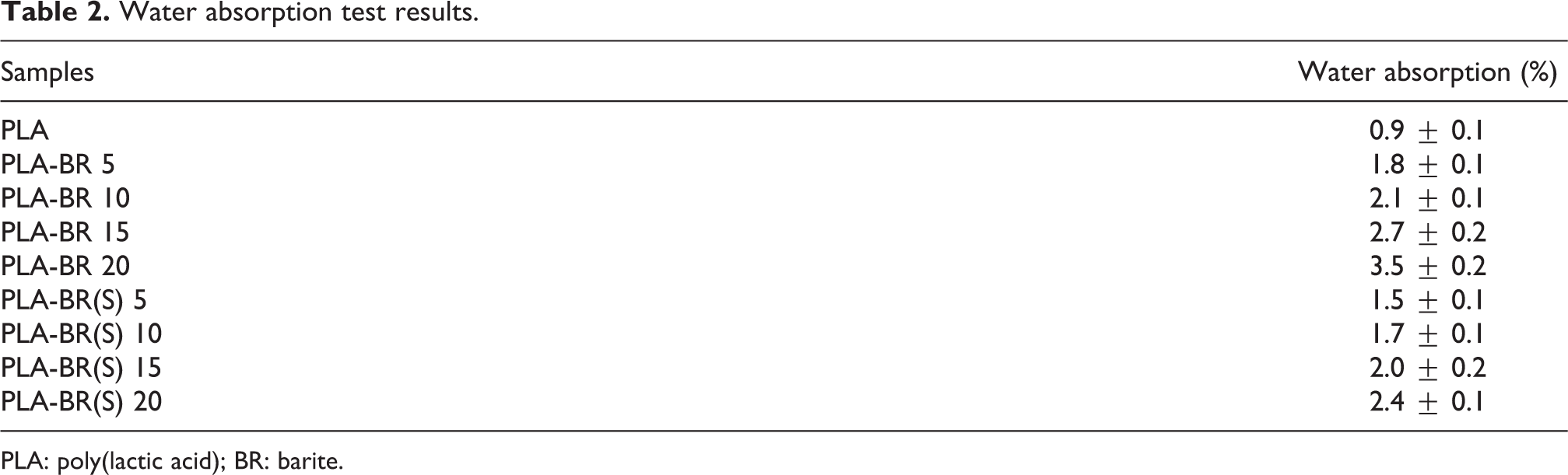
PLA: poly(lactic acid); BR: barite.
SEM analysis
SEM microimages of composites with the lowest (5%) and the highest (20%) concentrations are displayed in Figure 7. According to SEM microimages, neat BR particles form agglomerates by sticking together despite of PLA. In contrast, homogeneous dispersion of BR particles is observed for BR (S) containing composites. It can be seen from the SEM microimage of PLA-BR (S) 5 composite that the surface of BR particles is covered by the PLA matrix. Some agglomeration regions are observed for 20% concentration of BR (S) but these regions are seen more predominantly for untreated BR containing composite with the same filling ratio. These findings are the evidence for achievement of well-dispersion and adhesion improvement of BR particles with PLA matrix, thanks to surface treatment.

SEM microimages of composites.
Conclusion
This study focuses on the impact of surface silanization and loading ratio of BR on mechanical, thermomechanical, melt flow, water uptake, and morphological properties of PLA-based composites. IR analysis reveals that the surface of neat BR is covered by silane coupling agent after treatment process. Mechanical test results show that treated BR-reinforced PLA composites give higher tensile strength and impact strength values compared to neat BR-filled ones. The optimum concentration is obtained for 15% BR containing composites in the case of tensile strength. Additions of both BR samples cause reduction for elongation of PLA. According to DMA study, storage modulus of unfilled PLA decreases after the addition of BR and BR (S) with the exception of 5% BR (S) containing composite. It is found from the tan δ curves that glass transition temperature of PLA increases slightly with the inclusion of treated BR samples. All of the composites exhibit lower MFR values with respect to unfilled PLA but the quantities of these reductions are found as negligible for causing problems in processing steps of composites. Water absorption test reveals that the incorporation of BR samples displays an increasing trend for the water uptake behavior of PLA. Silanized BR-filled composites give lower water absorption values than untreated BR. SEM study claims that treated BR particles show more homogeneous dispersion compared to BR particles inside the PLA matrix. This finding indicates the improvement of mechanical and physical performance of composites after the addition of silanized BR into PLA due to increasing of adhesion of BR surface to polymer matrix after treatment process.
Footnotes
Declaration of conflicting interests
The author(s) declared no potential conflicts of interest with respect to the research, authorship, and/or publication of this article.
Funding
The author(s) received no financial support for the research, authorship, and/or publication of this article.
