




Abstract
In this article, the notched strengths of asymmetric woven hybrid laminates were studied by using both experiment and the finite element-based point stress criterion (FEMPSC). It was experimentally shown that the notched strength decreases with the increase of hole radius for all the laminates machined by water jet cut, drilling, and milling. Particularly, it is noted that the notched strength of specimens of the same hole size made by water jet cut is obviously higher than those made by both drilling and milling, due to stress redistribution. The results also indicate that the notched strengths predicted by FEMPSC agree well with the experimental data, with only a 4% margin of error.
Introduction
In using composite laminates for building structures, holes or cut-outs were often made to facilitate fastening of structural parts or to provide access to the interior of the structures. These holes or cut-outs will induce stress concentrations, which can significantly reduce the strength and service life of the composite structures. Therefore, many fracture models were developed for predicting the notched strengths of composite laminates. 1 Among them, the point stress criterion (PSC) and average stress criterion (ASC) developed by Whitney and Nuismer 2 have been found to be used most often by reason of simplicity. These stress fracture criteria were based on the normal stress distribution adjacent to the notch edge and were initially two parameter models in which the characteristic dimension is a material property. They were then modified into three parameter models by Pipes et al. based on experimental evidence. 3
Because analytical solutions 4 -6 are required in evaluating the notched strengths of composite laminates, both PSC and ASC were only applied for calculating the notched strengths of composite plates each with a center hole, 7 -14 which may be either circular or elliptic. To tackle this limitation, a novel computational procedure has been developed by the authors for predicting the notched strengths of composite plates each with either a center hole 15 or lateral holes. 16 This new approach is called the finite element-based PSC (FEBPSC), which can effectively predict the notched strengths of composite plates without using analytical solutions. 4 -6 This method was then successfully applied to predict the notched strengths of woven hybrid composite laminates. 17 Recently, Batista et al. studied the effect of anisotropy and the presence of holes on mechanical properties and final fracture characteristics in epoxy composite reinforced by carbon/glass and carbon/aramid hybrid fabrics. 18 In 2018, Belgacem et al. investigated the notch effect and ply number on the mechanical behavior of inter-ply hybrid laminates (glass/carbon/epoxy) by experiment. 19
Woven hybrid composite laminates have been widely used in various industries since the woven fabric on their outer layers not only can improve their aesthetic appearance but also decrease the possibility of delamination during drilling. Specially, asymmetric woven hybrid composite laminates have recently been used in hybrid composite robot fork for moving LCD panels, due to their high strength-to-weight ratio. However, their notched strengths have not been examined so far. In this article, both experiment and the FEBPSC will be applied to study this problem. Moreover, the effect of machining method, such as milling, drilling, and water jet cut, on the notched strengths of asymmetric woven hybrid laminates each with a center hole will also be investigated.
Theoretical background
Prediction of the effective elastic moduli of asymmetric woven hybrid laminates
In this study, the cross section of the asymmetric woven hybrid laminates is shown in Figure 1. The stacking sequence for those laminates is [w/±45°/0°/w] in which w denotes woven fabric layer. To predict the effective elastic moduli of the asymmetric woven hybrid laminates, the effective elastic moduli of each woven fabric layer are first evaluated by applying the Spring Model Method. 20 The effective elastic moduli of each unidirectional layer are then calculated by the rules of mixture. Finally, the overall effective elastic moduli of the asymmetric woven hybrid laminate are obtained by employing the stiffness averaging method. 21
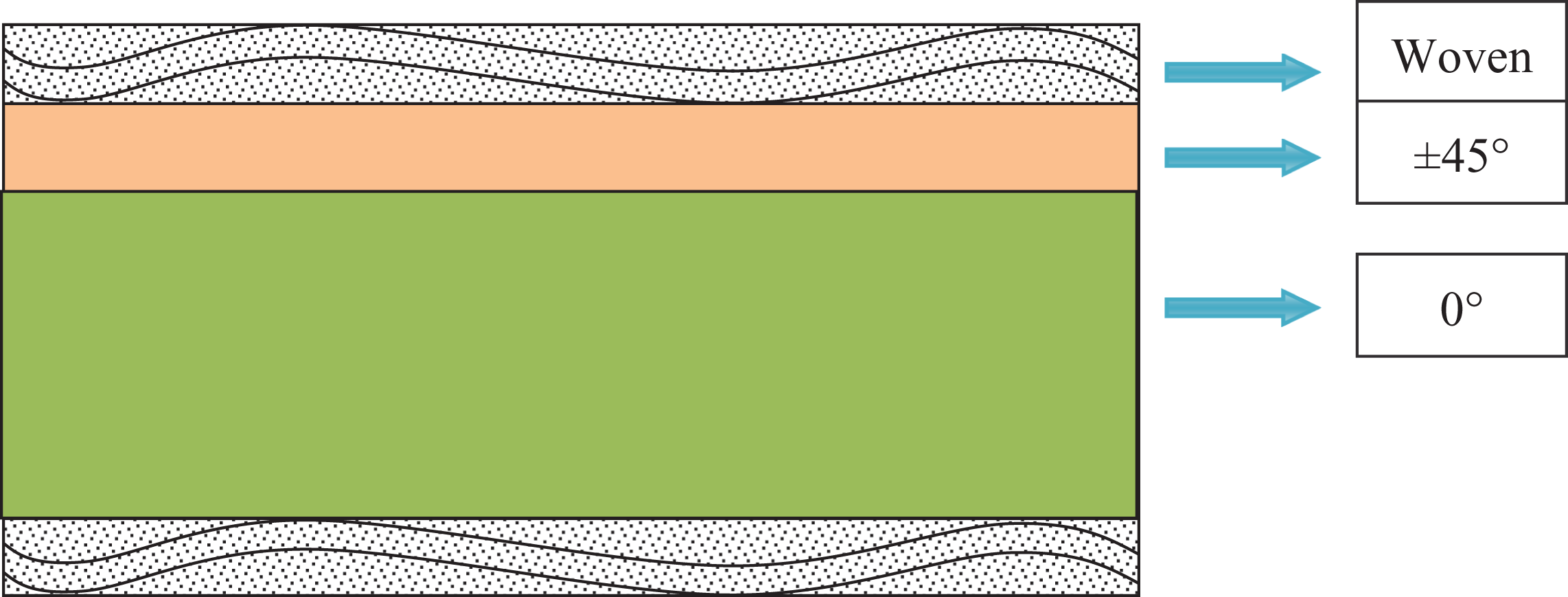
Cross section of an asymmetric woven hybrid laminate.
Finite element-based PSC
Because of simplicity, PSC has been used most often among the two-stress criteria proposed by Whitney and Nuismer.
2
It can be briefly introduced as follows. As depicted in Figure 2, a composite laminate with width W contains a center circular hole of radius R and is under the loading of a distribution of uniform stress

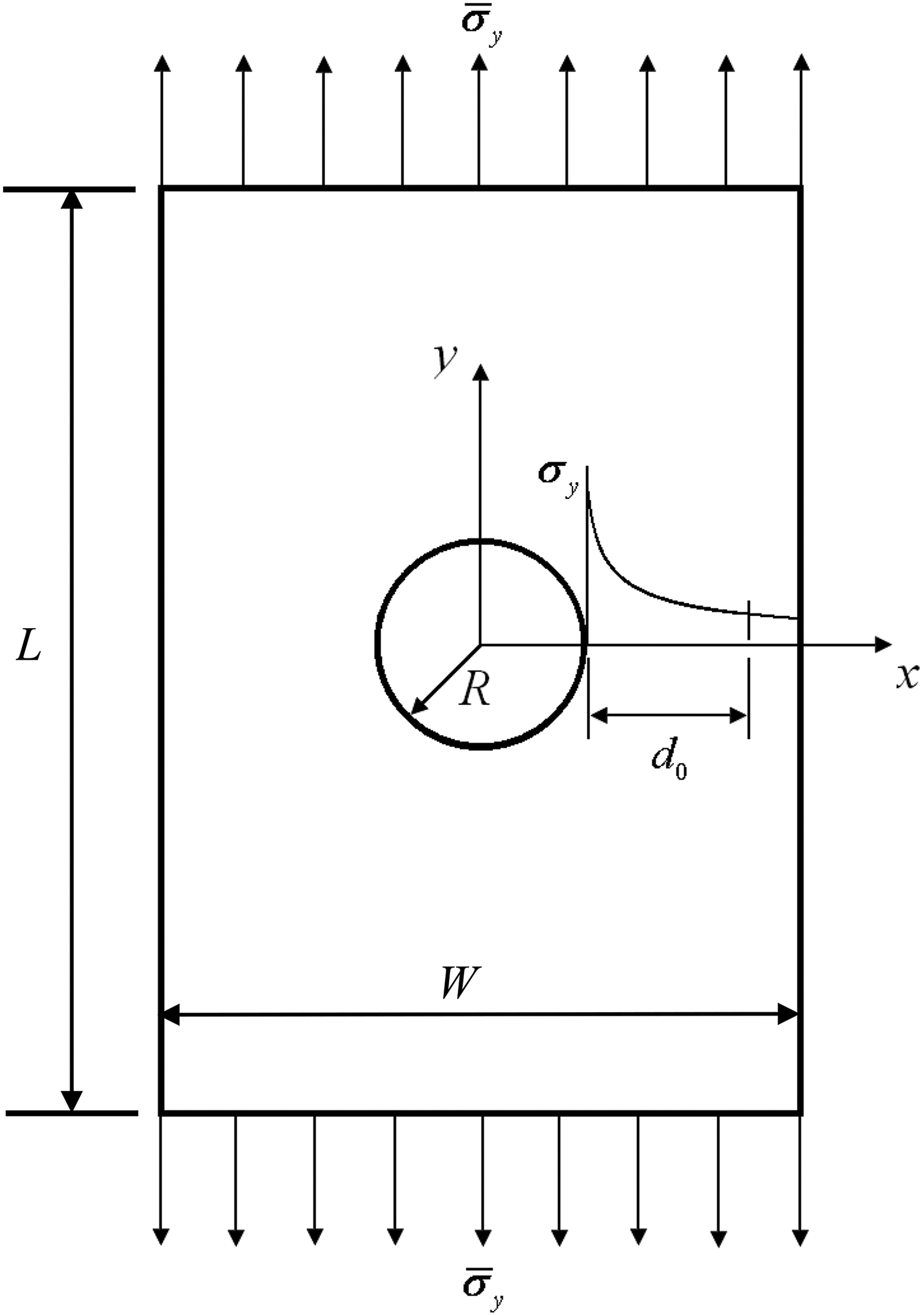
A schematic illustration of Whitney–Nuismer PSC.
Moreover, the dependence of characteristic length

where k is the notch sensitivity factor concerning 2R and W, and m is an exponential parameter.
Traditionally, PSC can only be applied for predicting the notched strengths of composite plates each with a center hole because analytical solutions were required. To extend the capability of traditional PSC, a FEBPSC 15,16 has been developed for predicting the notched strength of composite plates each with notches located either at the edge or in the center of the plate.
In this study, the FEBPSC proposed by Tsai et al. 15 and Hwan et al. 16 was utilized for predicting the notched strengths of asymmetric woven hybrid laminates each with a center circular hole. The procedure for this methodology is briefly explained as follows. Firstly, the stress distribution of an asymmetric woven hybrid laminate with a center circular hole is obtained by a finite element analysis, in which the experimental notched strength is applied as the loading at the boundary of the finite element model. Secondly, PSC is employed to find the characteristic length for each plate with different size of hole by an interpolation of the finite element analysis results. Thirdly, using Kim’s model 7 and the least square method, the characteristic length is then expressed as an empirical function of the hole size as well as the width of those asymmetric woven hybrid laminates. Therefore, the characteristic length of a laminate with any size of hole can be predicted based on the empirical function. Finally, the predicted characteristic lengths of composite plates are obtained by the empirical function, and the notched strengths of composite plates are acquired by the predicted characteristic lengths and the finite element analysis results incorporated with the principle of superposition in elasticity.
The last step mentioned above can be explained in detail as follows. As shown in Figure 2, if a uniformly distributed tensile stress

According to PSC, when

Experiment
In this study, woven fabrics and unidirectional composites were used to make asymmetric woven hybrid laminates for investigation. As shown in Figure 1, the woven fabric layers in the woven hybrid composite laminates were fabricated by plain weave. The fiber type for the woven fabric and unidirectional composite (UD) (±45°) layers is HTA-W12K, while the fiber type for UD (0°) is CN60. The elastic moduli of these two fibers are depicted in Table 1.
The elastic moduli of fibers used for the asymmetric woven hybrid laminates.

To make the asymmetric woven hybrid laminates, prepregs of all layers were firstly stacked in the mold, they were then cured by hot pressing at 150°C for 40 min under pressure of 5 MPa. Resin content, fiber volume fraction (Vf
), and thickness of the corresponding layers in the asymmetric woven hybrid laminates are given in Table 2. The same epoxy resin was used in all layers with mechanical properties listed in Table 3. The predicted effective elastic moduli of the asymmetric woven hybrid laminates are depicted in Table 4. Axial Young’s modulus (
Resin content, fiber volume fraction, density, and thickness of each layer.

RC: resin content; Vf : fiber volume fraction.
Mechanical properties of epoxy.

Predicted elastic moduli of the asymmetric woven hybrid laminates.

The dimensions for all specimens tailored from the laminates are 35 mm wide, 2 mm thick, and 250 mm long with 160 mm gage length. For demonstration, a schematic diagram of the fabricated specimens is depicted in Figure 3. To meet our experimental need, center circular holes (with radii 2, 3, 4, 5, and 6 mm) were formed in the specimens, respectively, by drilling (spindle speed: 900 r/min), milling (spindle speed: 3000 r/min), and water jet cut (water pressure: 310 MPa; abrasive mass flow rate: 6.45 kg/min). According to ASTM-D3039, all the tensile tests are conducted by the AG-100KNX machine (Shimadzu Corporation) using serrated wedge grips to fix the specimens. In each test, the specimen is loaded by tension until failure, at a crosshead speed of 2 mm/min, and at room temperature. For each case, five identical specimens are tested, and the measured notched strengths are averaged with standard deviation indicated. For example, the un-notched strength of the specimens is 792.39 ± 57.07 MPa. The notched strengths of those asymmetric woven hybrid composite laminate specimens obtained by experiment are listed in Table 5.

Geometry and dimensions of specimens.
Notched strengths of asymmetric woven hybrid laminate specimens.

Results and discussions
Evaluation of the notched strengths of asymmetric woven hybrid laminates
As mentioned above, the characteristic length,
Characteristic lengths of asymmetric woven hybrid laminate specimens.

Values of k and m.

Then, using the last step of FEMPSC, the notched strength of an asymmetric woven hybrid laminate can then be obtained, and all the predicted notched strengths are shown in Table 8. The results indicate that the predicted notched strengths by this procedure agree well with the experimental data, with only a 4% margin of error.
Prediction of notched strengths by FEBPSC.

FEBPSC: finite element-based point stress criterion.
The effect of machining type on the notched strengths of asymmetric woven hybrid laminates
As shown in Figure 4, the notched strength decreases with the increase of hole radius for all the laminates machined by water jet cut, drilling, and milling. Among them, the notched strength of specimens made by water jet cut is obviously higher than those made by both drilling and milling. For example, when radius of hole is 2 mm, the notched strength reduces 25.2% (from un-notched strength 792 MPa to 592.72 MPa) for specimens made by water jet cut, while the notched strength reduces 35.4% and 40.4%, respectively, for specimens made by drilling and milling. On the other hand, the difference between the notched strengths of specimens made by both drilling and milling is less significant.
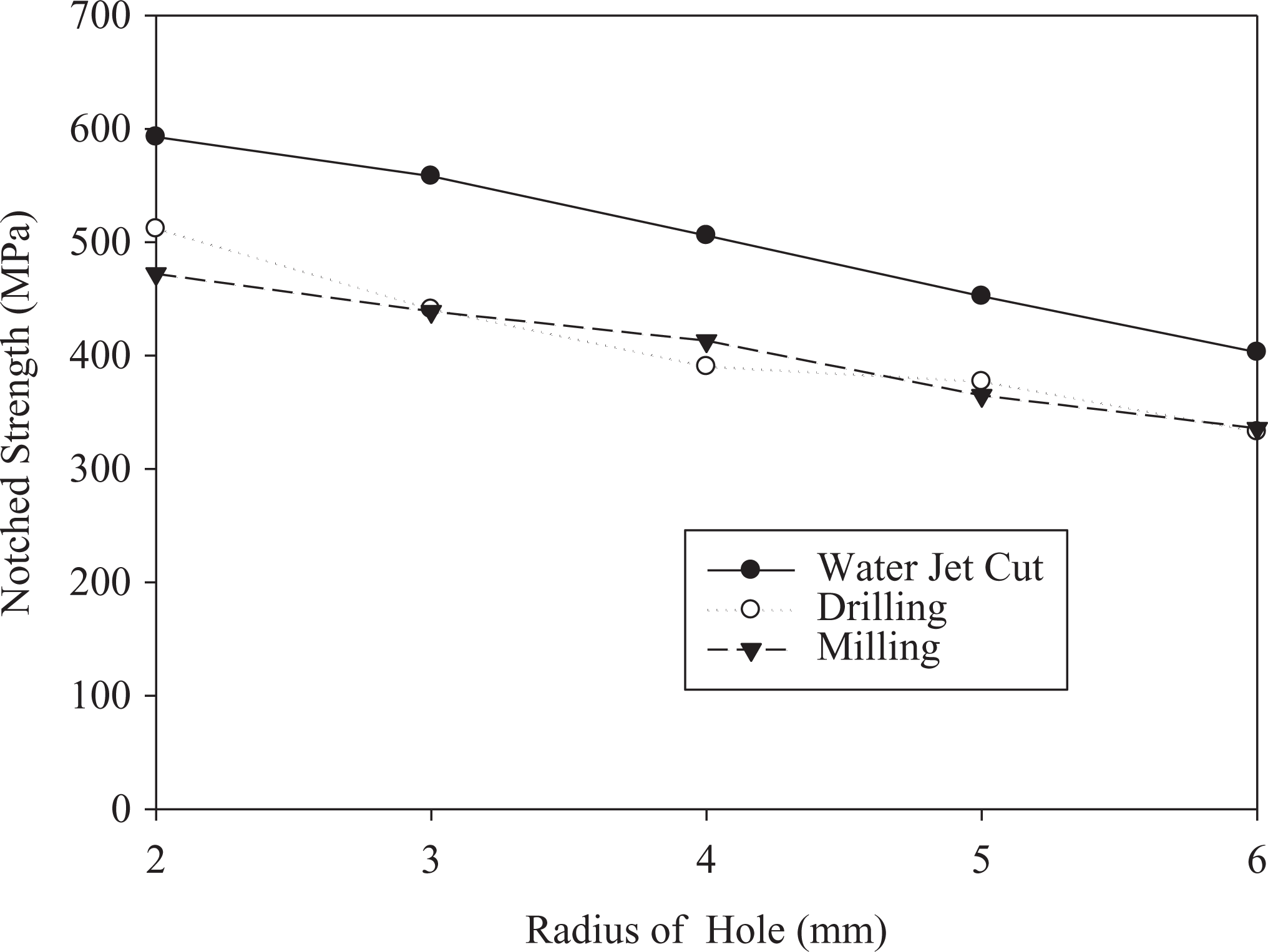
Notched strength versus radius of hole for laminates made by different type of machining.
The reason why the notched strength of asymmetric woven hybrid laminates made by water jet cut is the highest among those made by the three types of machining can be explained as follows. As shown in Figure 5, a macroscopic delamination due to high speed impact is found to occur around the hole edge between woven and ±45° layers in the specimen made by water jet cut. This will induce pseudoplastic behavior and cause stress redistribution in the vicinity of hole, thereby increasing the notched strength of the laminate.

Delamination around the hole between woven and ±45° layers in the specimen by water jet cut.
Fracture mechanism
To explore the micro-damage of notched specimens after tensile test, one of the fractured specimens was sliced near the hole edge along two directions as shown in Figure 6 and then observed by using a metalloscope. As shown in Figure 7, delamination occurs among all neighboring layers and matrix crack do exist clearly in the ±45° layers. In addition, fiber pull-out is found to occur in the 0° layer.
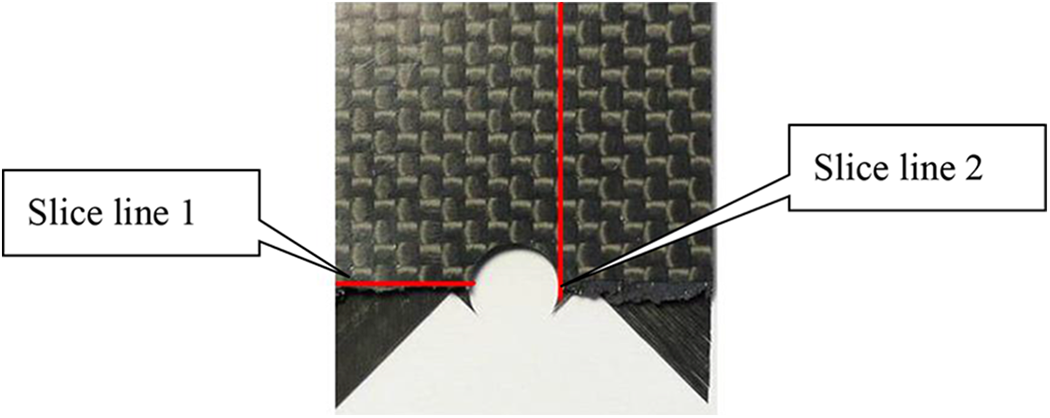
A schematic illustration of the slice lines on a fractured specimen.

Micro-damage in a fractured specimen (a) along slice line 1 and (b) along slice line 2.
Conclusions
Notched strengths of asymmetric woven hybrid laminates each with a center circular hole have been predicted by FEBPSC. It is shown that the predicted notched strengths of those laminates by this approach agree well with the experimental results. It is also found that the notched strength of those laminates decreases with the increase of hole radius for all the three machining types, including water jet cut, drilling, and milling. Among them, the notched strength of specimens made by water jet cut is obviously higher than those made by both drilling and milling.
Footnotes
Declaration of conflicting interests
The author(s) declared no potential conflicts of interest with respect to the research, authorship, and/or publication of this article.
Funding
The author(s) disclosed receipt of the following financial support for the research, authorship, and/or publication of this article: This study was supported by the Ministry of Science and Technology of the Republic of China under the Contract NSC102-2221-E-035-022.