




Abstract
A high performance epoxy composite with very high toughness and heat resistance had been designed and prepared. Epoxy resin TDE-85 with an impact strength of 10.2 kJ m−2, a heat distortion temperature (HDT) of 121°C, and a glass transition temperature of 127°C was chosen as the matrix of the composite, while carboxylic nitrile-butadiene elastomeric nanoparticles (CNB-ENPs) coated with triethanolamine on the surface with a diameter of about 100 nm was selected as the modifier. Surprisingly, the rubber-modified epoxy resin exhibited not only very high toughness but also very high heat resistance. The HDT of epoxy resin TDE-85 after modification increased 57°C, reaching 178°C, while the impact strength increased by 107%, increasing to 21.1 kJ m−2. The relationship between the microstructure and performance had been evaluated by transmission electron microscopy, mechanical testing, and dynamic mechanical analysis. The results showed that the CNB-ENP/TDE-85 composite resulted in large interface and a special morphology after modification.
Introduction
Epoxy resins have been widely used in industrial applications. Almost all kinds of epoxy resins have a major drawback of brittleness, so their toughness needs to be improved. Rubber is considered as one of the best candidates to improve resins’ toughness. However, it usually deteriorates the heat resistance of epoxy resins. In our previous work, we had developed a method to improve the toughness and the heat resistance of epoxy resins at the same time, where the heat distortion temperature (HDT) usually increased by about 30°C. Herein, we report a new method of modifying the epoxy resin, which can further improve the HDT of the epoxy resin by nearly 60°C and the toughness greatly as well.
The epoxy resin used in this work is TDE-85, an aliphatic glycidyl ester type of epoxy resin with a high epoxy value and a low viscosity, which is one of the most important matrix materials in liquid forming composite. 1 There are three epoxy groups in its molecular structure as shown in Figure 1. One epoxy group is directly connected to the alicyclic ring and the other two epoxy groups are located on the side chain of alicyclic ring. 2,3 Therefore, TDE-85 epoxy resin has higher activity compared to general alicyclic epoxy resin. Moreover, its low viscosity is especially suitable for preparing prepreg with high volume content.
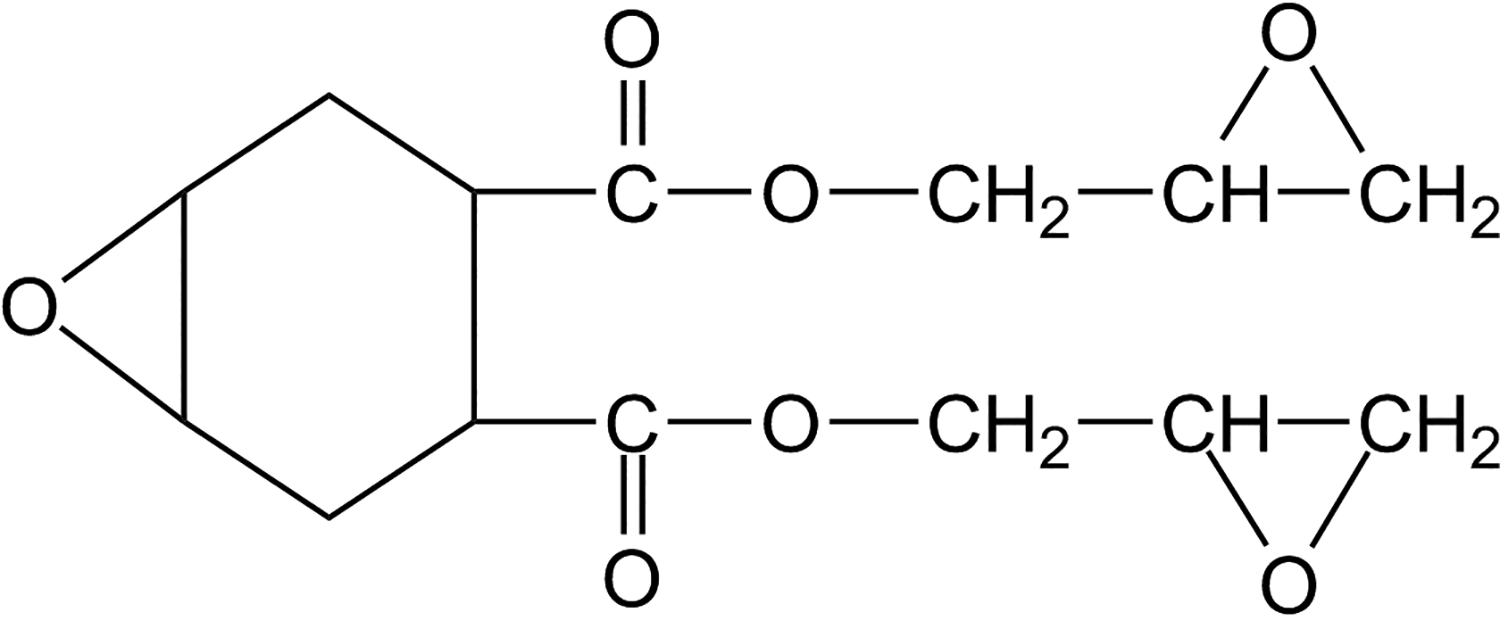
Structural formula of TDE-85.
Cured TDE-85 epoxy resin exhibits high shear strength and low shrinkage. However, its heat resistance and toughness are not high enough, both of which need to be improved for a wider application. In this work, carboxylic nitrile-butadiene elastomeric nanoparticles (CNB-ENPs) coated with triethanolamine (TEA) on the surface were used to modify TDE-85 epoxy resin. Surprisingly, the modified epoxy resin exhibited not only very high toughness but also very high heat resistance. The HDT of the modified epoxy resin TDE-85 increased by 57°C, reaching 178°C from 121°C, while the impact strength increased by 107%, increasing from 10.2 kJ m−2 to 21.1 kJ m−2. Also, the results showed that the glass transition temperature (T g) of the modified epoxy TDE-85 increased from 127°C to 179°C. The relationship between the microstructure and performance had been evaluated by transmission electron microscopy (TEM), mechanical testing, and dynamic mechanical analysis (DMA). The results showed that the CNB-ENP/TDE-85 composite resulted in large interface and a special morphology after modification.
Experiment
Raw materials
Diglycidyl 4,5-epoxycyclohexane-1,2-dicarboxylate (TDE-85 epoxy resin) and its curing agent Anhydride 70 were supplied by Tianjin Jing-Dong Chemical Composite Materials Co., Ltd, China. TEA was provided by Jiamusi Petrochemical Factory, China. Aluminum acetylacetonate was provided by J&K China Chemical Ltd, China. Carboxylic nitrile-butadiene latex was supplied by Shijiazhuang Hongtai Rubber Co., Ltd, China. Trimethylol propane triacrylate (TMPTA, radiation sensitizer) was provided by Beijing Dongfang Chemical Plant, China.
Preparation of CNB-ENP
CNB-ENP was prepared according to a modification of our invention. 4 The raw material was carboxylic nitrile-butadiene latex. After pre-mixing with radiation sensitizer TMPTA, the latex was irradiated with γ-ray (dosage: 30 kGy and dose rate: 50 Gy/min), which cross-linked the primary carboxylic nitrile-butadiene particles resulting in high cross-linking degree on the surface. 5 -9 Then, TEA was added into the irradiated latex dropwise while stirring, and subsequently the mixed latex was stirred for another 1 h. The amount of TEA in the final latex was 0.9 wt%. Finally, CNB-ENP was obtained by spray drying the latex. The average particle size of CNB-ENP was about 100 nm.
Preparation of modified epoxy resin
100 phr TDE-85 resin and 12 phr CNB-ENP were mixed manually and the mixture was added into a three-roll mill, as shown in Figure 2. The roller space for the first run was 20 µm, followed by stewing for 48 h. Then, the second run was carried out with a roller space of 10 µm, followed by stewing for 72 h. Afterward, the third run was handled with a roller space of 5 µm. After three runs of mixing by the three-roll mill, the mixture was weighed and added into a three-neck flask, followed by adding curing agent Anhydride 70 with the amount equal to that of TDE-85 epoxy resin. After stirring at 90°C under the vacuum for 20 min, accelerator aluminum acetylacetonate with the amount of 1% wt of TDE-85 epoxy resin was added into the flask. Then, the mixture was stirred under vacuum for another 5 min and poured into the mold in a pre-heated oven for curing. The curing process was set as follows: 110°C for 1 h, 130°C for 2 h, 160°C for 3 h and 180°C for 1 h.

Mixing epoxy resin and CNB-ENP with a three-roll mill.
Characterizations
The three-roll mill was an Exakt 80E machine.
TEM was obtained on a Philips TECNAI 20 at 200 kV. A Reichert-Jung Ultracut-E microtome was utilized to prepare ultra-thin sections of the sample with the thickness of about 100 nm at −50°C for TEM imaging.
Unnotched Izod impact strength test was conducted on a Zwick HIT25P instrument according to ISO 180:2000, and flexural test was conducted on a Zwick Z020 instrument according to ISO 178:2001. HDT was measured on a Yasuda 148-HDR-S instrument according to ISO 75:2003.
DMA was performed on a Rheometric Scientific DMTA V analyzer at a fixed frequency of 1 Hz and heating rate of 2°C per minute from 40°C to 200°C under nitrogen environment.
Results and discussion
Mechanical properties
The mechanical properties of pure TDE-85 (T-0) and modified TDE-85, that is, CNB-ENP/TDE-85 composite with rubber content of 5.66% (T-1), are listed in Table 1. The results show that the CNB-ENP/TDE-85 composite exhibits not only higher toughness but also higher heat resistance. The HDT of the CNB-ENP/TDE-85 composite increased 57°C, reaching 178°C from 121°C, while the impact strength increased by 107%, increasing from 10.2 kJ m−2 to 21.1 kJ m−2.
Mechanical properties of pure TDE-85 and modified TDE-85.

HDT: heat distortion temperature.
Dynamic mechanical analysis
According to traditional theory, it was difficult to understand the results above. Therefore, DMA was conducted to confirm the testing results of mechanical properties. The storage modulus (E′) and loss modulus (E″) versus the temperature plots recorded from the DMA measurements were shown in Figure 3. It can be found that the storage modulus of T-1 (modified TDE-85) was much higher than that of the control sample T-0 (pure TDE-85) in the testing range of temperature, especially in the range of 100°C to 160°C. It indicated that the elastomeric nanoparticles in the epoxy resin composite could significantly increase the ability of resisting deformation, especially at high temperature.

Storage modulus and loss modulus curves of TDE-85 and modified TDE-85.
Furthermore, we measured the T g of pure TDE-85 and TDE-85 modified with elastomeric nanoparticles. 10 In DMA, the temperature corresponding to the tan δ peak is usually used to determine the T g of the test sample. Figure 4 showed the damping curves of pure TDE-85 and modified TDE-85. It can be shown that the T g of epoxy TDE-85 was enhanced by 52°C, increasing significantly from 127°C to 179°C after being modified by CNB-ENP. It is well known that for polymer materials the higher the T g is, the higher the HDT is. Therefore, TDE-85 modified with elastomeric nanoparticles should have higher HDT.

Tan δ curves of TDE-85 and modified TDE-85 with elastomeric nanoparticle.
Modification mechanism of TDE-85 with elastomeric nanoparticles
Firstly, we need to understand why CNB-ENP could increase the T g of TDE-85 greatly. According to traditional theory, it is hard to understand. However, based on our previous study, the results could be explained. 11 Our previous results showed that a rubber-modified plastic with special morphology could have high toughness and high heat resistance simultaneously. The special morphology should be that nanosized rubber particles covered with a hard shell were dispersed uniformly in the plastic matrix and the shell must have greater hardness than the plastic matrix. The hard shell was several nanometers in thickness, which not only allowed elastomeric nanoparticles to absorb impact energy but also protected elastomeric nanoparticles from deforming at high temperature. In this work, the key point of the rubber-modified epoxy resin designed according to our previous study was that elastomeric nanoparticles were covered with TEA, a cross-linking promoter for epoxy resins. The existence of TEA could allow the cross-linking reaction to start from the surface of the elastomeric nanoparticles. Hence, the cross-linking degree of epoxy on the surface of the elastomeric nanoparticles should be much higher than that of epoxy matrix. Accordingly, a hard shell around the elastomeric nanoparticles was formed after cross-linking. As TEM results shown in Figure 5, the elastomeric nanoparticles dispersed uniformly in the epoxy matrix without aggregation even though elastomeric nanoparticles were covered with TEA. A hard shell around elastomeric nanoparticles could be seen clearly in the zoom-in TEM photo. In addition, the hard shell could also connect the rubber particles and epoxy matrix covalently, making the epoxy molecular chains around rubber particles difficult to move. Therefore, it was reasonable that the epoxy resin modified by the specially designed elastomeric nanoparticles exhibited higher heat resistance.
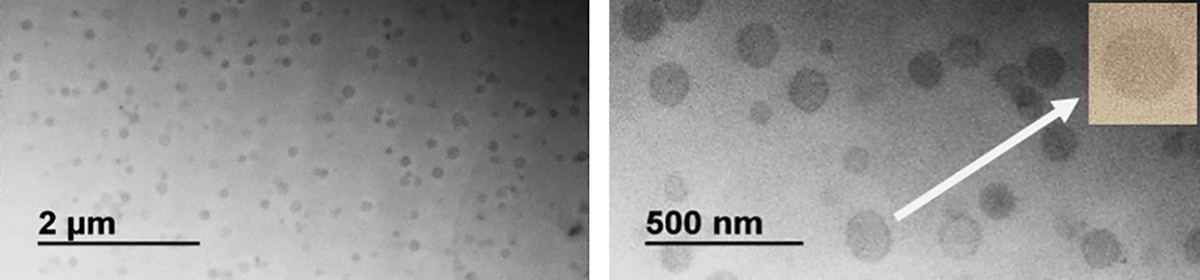
TEM image of TDE-85 resin modified by the CNB-ENP.
Toughening mechanism of tearing energy of rubber can also be helpful to understand the high toughness of the modified epoxy composite. 12 Rubber particles at the end of the crack could be stretched to absorb energy, which prevented the crack development and improved the impact strength of the modified epoxy. There were much more rubber particles in this modified epoxy than traditional rubber-modified epoxy because the size of the rubber particles here was much smaller. Therefore, the crack of such modified epoxy could absorb more energy. Besides, the hard shell which connected the rubber particles and epoxy matrix with covalent bonds could scatter impact energy effectively. Hence, the specially designed epoxy resin modified by elastomeric nanoparticles had higher toughness.
Conclusions
A specially designed epoxy resin modified by CNB-ENP exhibiting both high heat resistance and high toughness had been prepared successfully, which could play an important role in expanding the application fields of epoxy resins. The crucial TEA located on the interface of CNB-ENP enhanced the cross-linking degree locally, resulting in a hard shell around the CNB-ENP particles which covalently bonded the elastomeric particles and epoxy resin matrix. Thus, the specific special morphology brought about high toughness and an amazing increase in HDT at the same time.
Footnotes
Declaration of conflicting interests
The author(s) declared no potential conflicts of interest with respect to the research, authorship, and/or publication of this article.
Funding
The author(s) received no financial support for the research, authorship, and/or publication of this article.