




Abstract
Fiber-reinforced laminated composite structures are extensively used in aircraft and aerospace industries for their high specific strength and stiffness. In such applications, they are generally subjected to nonuniform thermal loads due to change in thermal conditions. Therefore, the composite structures used in the applications in which they are subjected to nonuniform thermal loads must also be designed to withstand thermal loads. As mechanical and thermal properties of fiber-reinforced laminated composites are greatly influenced by the direction of fibers and stacking sequences, they are optimally varied in this article to maximize the critical buckling temperature of the composite plate. The ply angle and stacking sequence of the laminated composite plate are optimized using genetic algorithm to maximize the thermal buckling temperature. As the plate is subjected to different kinds of nonuniform thermal load cases, finite element technique is used to analyze the plate during the optimization process. As geometry and supporting conditions of the plate also have great influence on its thermal buckling strength, the investigation is further widened by carrying out the optimization process for the plate model constructed with various types of support conditions, aspect ratio, and nonuniform load cases. The numerical results clearly show the necessities that the optimum ply angle and stacking sequences are greatly varying based on the aspect ratio, support conditions, and nonuniform loading cases.
Introduction
Most of the structural members used in aerospace industries are usually made of fiber-reinforced polymer (FRP) composites to attain better strength and stiffness at low weight. In such applications, these structures are quite sensitive to environmental changes caused by mechanical, thermal, and acoustic loadings. Thermal stresses induced due to aerodynamic heating may induce thermal buckling and dynamic instability in structures. Several researchers investigated exhaustively the buckling behavior of FRP composites under mechanical loads. 1 –13 However, very few researchers have considered the thermal loads that may cause thermal buckling in laminated composite structures. Kuo 14 stated that the structural panels of high-speed flight vehicle are not only subjected to aerodynamic loading, but also to aerodynamic heating, and therefore, he conducted aerothermoelastic analysis on angle-ply laminates with variable fiber spacing. Emam and Eltaher 15 identified that buckling is the possible mode of failure for composite beams when they are exposed in hygrothermal environment. They investigated buckling and postbuckling of composite beams in hygrothermal environment. Asadi et al. 16 identified that there is a possibility of compressive thermal forces and buckling phenomenon while the composite cylindrical shells are subjected to thermal fields. So, they investigated thermal bifurcation behavior of cross-ply laminated composites that are embedded with shape memory alloy fibers. Natarajan et al. 17 studied the effect of moisture concentration and the thermal gradient on the free flexural vibration and buckling of laminated composite plates with central cutout. Hong et al. 18 presented a multiobjective optimization method to optimize the multiple objectives, such as strength, deflection, and weight of the composite bladed marine propeller. Li et al. 19 presented an optimization scheme by using genetic algorithm (GA) to design a composite connecting bracket used in manned spacecraft. Vosoughi and Nikoo 20 used a hybrid method to maximize the fundamental natural frequency and thermal buckling temperature of moderately thick laminated composite plate. Jin et al. 21 used a digital image correlation technique and studied the thermal buckling behavior of a circular aluminum plate.
In all these works, the researchers have investigated the buckling of laminated composite structures under thermal loads by assuming that they are subjected to uniform temperature rise above ambient temperature. However, the mechanical elements which are used in aircraft and space vehicles are rotating at high speeds and are generally subjected to nonuniform temperature distribution due to aerodynamic forces and solar radiation heating. So, it is more significant to investigate the effect of design parameters such as ply angle, stacking sequence, and aspect ratio on thermal buckling behavior of composite structures that are subjected to nonuniform temperature distributions. Hence, the authors of this article aim to maximize the buckling strength of the composite plate, which is subjected to nonuniform thermal loads by optimally varying its design variables. When the laminated composite plates are subjected to nonuniform thermal loads, the analysis of these structures become more complex and need numerical methods like finite element analysis (FEA). In this article, the commercial FEA software ABAQUS is used to calculate the maximum buckling temperature of the laminated composite plate during the optimization process.
Materials and methods
Problem definition
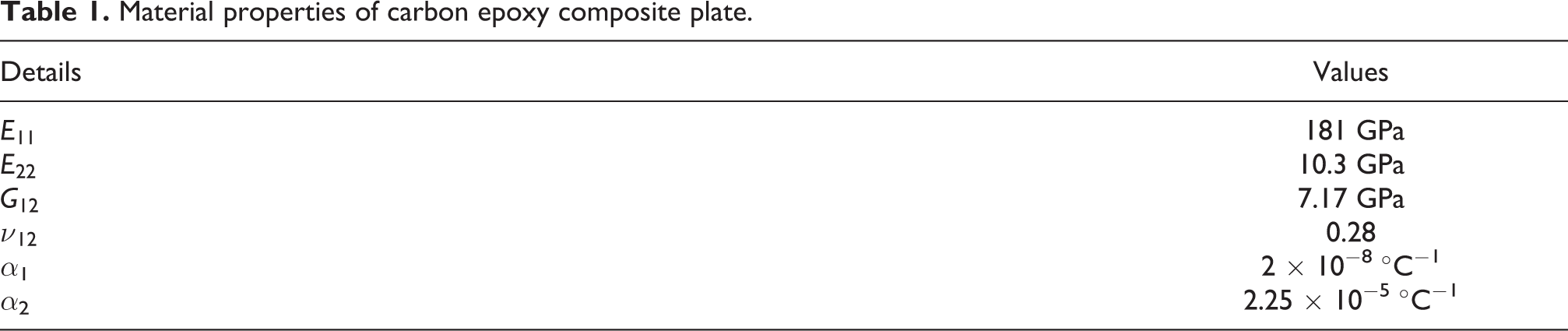
The composite structures used in aerospace industries are generally made as thin plates and shells and are subjected to very high thermal loads as they fly at high altitude. Therefore, there is potential for failure due to lack of thermal buckling strength. So, the authors of this article are interested to maximize the thermal buckling strength of the composite plate by simplifying the geometry as a rectangular plate. The composite rectangular plate shown in Figure 1 is considered in this work with the material properties listed in Table 1. The edges of the plate are subjected to various boundary conditions. The angle of each ply (θ) and the stacking sequence of the plate are to be optimized to increase the thermal buckling strength of the plate.

Geometry of fiber reinforced laminated composite plate.
Material properties of carbon epoxy composite plate.
Jin et al. 22 applied energy method to theoretically calculate the buckling temperature of laminated composite plate and they showed that the critical buckling temperature of the plate is the function of geometry, supports, loads, stacking sequence, and material properties of the plate. As the stacking sequence is chosen as a design variable, the optimization processes are carried out for different aspect ratios of the plate and loading conditions. As the plate is subjected to a nonuniform temperature distribution, the finite element technique is needed to calculate the thermal buckling strength. The in-plane strengths of the plate calculated using Tsai–Wu criterion are considered as design constraints. The objective function, design variable, and constraints of the single objective optimization problem are given by

Finite element analysis
The finite element technique is used to analyze the structures when they have nonlinear geometry, loads, or material properties. Jin et al. 21 used FEA software ABAQUS to calculate the thermal buckling of circular aluminum plate. Tran et al. 23 used isogeometric finite element approach to analyze the thermal bending and thermal buckling load of laminated composites. They used higher order shear deformation theory to calculate the transverse deformation numerically. Zhao et al. 24 used finite element method to calculate the thermal buckling loads in automotive clutches. Kandasamy et al. 25 formulate finite element technique based on first-order shear deformation theory and implemented in ANSYS software to calculate the thermal buckling of functionally graded structures in thermal environment. Wang et al. 26 presented a three-dimensional finite element model to analyze the progressive damage of fiber-reinforced laminated composites that are subjected to low-velocity impact. Rui-Xiang et al. 27 used ABAQUS to simulate the interface of the delamination region of the composite plates. In this work, the commercial FEA software ABAQUS is used to calculate the in-plane strengths and critical thermal buckling load of the stacking sequence configurations that are generated during the optimization process. The four-noded rectangular shell element as S4 R is used for modeling the laminated composite plate. The element is derived based on first-order transverse shear flexible theory, whereas the transverse shear strain is presumed to be constant through the thickness of the plate.
Genetic algorithm
The GA is used to find the optimum stacking sequence of the composite plate to offer maximum buckling strength. The simple GA used in this article applies the genetic operators such as roulette wheel selection, uniform crossover, and uniform mutation to evolve the best solution. The initial population of size “N” is generated in a random manner using MATLAB code. The objective function (critical buckling temperature) of these initial solutions (stacking sequences) is calculated by conducting linear Eigen buckling analysis using the FEA software ABAQUS. The PYTHON script is written to interface MATLAB with ABAQUS software. The chromosomes of these initial populations are ranked based on their objective values. The parent chromosomes are chosen from the current population based on their fitness values by using the roulette wheel selection process to generate the successive generations.
Subsequently, genetic operators are applied to create child chromosomes so as to form the children populations. Crossover is one of the genetic operators used to combine two selected parent chromosomes and to produce the offspring chromosomes. The main aim of the crossover operator is that the new chromosomes may be better than the parent chromosomes, if they take the best characteristics from each of their parents. A user-defined crossover probability is used to control this process. The uniform crossover operator is used in this work, as it allows the parent chromosomes to be mixed at the gene level rather than the segment level by using the probability known as the mixing ratio. Mutation is also a genetic operator that is applied after the crossover to preserve genetic diversity from one generation to the successive generation. The major objective of the mutation process is to prevent the population from stagnating at any local optima. The uniform mutation operator is applied in this work and it identifies a gene of the chromosome randomly and replaces it with a uniform random value that has been selected between the upper and lower bound values for that gene. As the performance of GA highly depends on the choice of its control parameters such as crossover probability, mutation probability, size of the population, and number of maximum generations, these parameters are optimally found in this work by using a trial and error method by varying them within the predefined specified range.
Results and discussion
Pingulkar and Suresha 28 calculated natural frequency and mode shape of cantilever glass FRP composites and carbon FRP composites by using ANSYS. They validated the results obtained using ANSYS with the results obtained from the previous literature and proved that the results found using ANSYS are excellent. Similarly, the accuracy of the finite element technique used in this article is first validated with the results obtained by Jeyaraj. 29 He used the finite element method and analyzed the critical thermal buckling temperature of isotropic plates that are subjected to different nonuniform load cases. A square isotropic plate (mild steel) was analyzed in his work by taking the side to thickness ratio as 100. The plate was subjected to the nonuniform thermal loads that are listed in Table 2, where T(x) is the temperature of the plate at a location “x” from the lower left corner of the plate, T max is the maximum temperature of the plate (assumed as 1°C in all the cases), and “n” is the linear variation factor.
Different nonuniform thermal load cases. 29

The same work is replicated using the finite element software ABAQUS in order to evaluate the accuracy of the finite element technique. The mild steel plate is modeled using ABAQUS with the material properties and supporting conditions specified by Jeyaraj. 29 The different nonuniform load cases listed in Table 2 are applied to the plate and the critical buckling temperatures are found and listed in Table 3. The results compared in Table 3 prove that the finite element procedure used to calculate the critical buckling temperature under nonuniform load cases is finding the solutions more accurately.
Validation of proposed method for uniform temperature cases. 29

The optimization procedure and finite element technique used in this article are further validated by comparing our results with the results obtained by Topal and Uzman. 30 They used a nine-noded Lagrangian rectangular plate element in which each node has five degrees of freedom and analyzed a clamped square laminated composite plate with the dimensions and material properties, as listed in Table 4. The plate was assumed that it was made of plies having same fiber orientation and was subjected to uniform thermal load.
Dimensions and material properties of the plate considered for the validation. 30

The composite plate with similar configuration has been modeled using the PYTHON script written for commercial finite element software ABAQUS and coupled with MATLAB to implement GA-based optimization process. The optimum results were obtained and compared in Table 5 with the results obtained by Topal and Uzman. 30 The results prove that the proposed optimization procedure and finite element method are accurate.
Validation of proposed method for uniform temperature case. 30

Now the proposed concept is used to obtain the optimum critical buckling temperature for the laminated composite plate subjected to nonuniform thermal loads. The optimization is carried out with an additional constraint of not grouping more than three plies having same orientations to avoid interlaminar stresses. The rectangular laminated composite plate shown in Figure 1 is modeled and the material properties that are listed in Table 1 are applied. The dimension along the vertical coordinate is kept constant and the dimension along the horizontal coordinate is varied to get different aspect ratios. The aspect ratio of the plate is varied from 1.0 to 3.0 with an increment of 0.5. The thickness of the plate is kept constant and assumed as 5 mm and the thickness of each ply is set as 0.5 mm. To avoid the coupling stiffness agents, the symmetric stacking sequence alone is preferred. Therefore, only the first five plies of the stacking sequence are optimized with the help of simple GA.
The MATLAB code is used to apply GA for optimizing the stacking sequences of the plate to maximize the critical buckling temperature. The PYTHON script is written to couple ABAQUS software with MATLAB. During the optimization process, the angle of each ply is varied from −90° to 90° with an increment of 5°. The objective function and the design constraints are found using FEA. The plate is subjected to different nonuniform temperature distributions as given in Table 2. The finite element model of the laminated composite plate, which is constructed by using four-noded shell elements, is shown in Figure 2. The optimum control parameters used for GA are listed in Table 6.

Finite element model of the laminated composite plate.
Control parameters used for GA.

GA: genetic algorithm.
The convergence of solutions is plotted in Figure 3 for all load cases in which the aspect ratio of the plate is equal to 1 and CFCF type supporting condition is applied to the plate edges. The results show that the solutions are converged within 100 generations in all load cases and the critical buckling temperature obtained for the load case 3 is maximum and it is minimum for the load case 2. The optimum stacking sequences obtained for each load case under the specified aspect ratio and supporting conditions are listed in Table 7. The stacking sequence listed in Table 6 shows that there is no grouping of plies in the optimum stacking sequences as grouping of plies in the stacking sequence is restricted in order to avoid the possibilities for interlaminar stresses. The first critical buckling mode of the optimum solution that is by using ABAQUS software for load case 1 is shown in Figure 4, where the aspect ratio of the plate is set as 1 and CFCF type support condition is applied to the plate edges. As the thermal load is zero at the edges and uniformly increased toward the center of the plate, the maximum deflection is obtained at the center with the maximum critical buckling temperature of 262.33°C.

Convergence graph for the plate having the Aspect Ratio 1 and CFCF type support.
Optimum stacking sequence for the aspect ratio is 1 and load case is CFCF.


Critical buckling mode for the plate having the Aspect Ratio 1 and CFCF type support.
Finally, the stacking sequences are optimized for various configurations of the laminated composite plate consisting of three different support conditions, five aspect ratios, and four kinds of nonuniform load cases. The optimum buckling temperatures obtained under each set of aspect ratio, load case, and supporting conditions are plotted in Figure 5. The results obtained for the entire range of aspect ratio show that the maximum critical buckling temperature is obtained in load case 3 for which the temperature is uniformly decreased and increased from one end of the plate to another end. Similarly, the value of optimum buckling temperature is found low in load case 2 for which half sinewave temperature distribution is applied. Further, it is also observed that there are no significant variations in the optimum buckling temperature based on the type of load cases, when the edges of the plate are simply supported. On the other hand, there are huge variations in optimum buckling temperatures among the various load cases while the edges of the plate are given CFCF type support.

Optimum buckling temperature vs. load cases for different aspect ratios and supporting conditions.
Conclusion and future scope
The ply angles and stacking sequence of the laminated composite plate subjected to nonuniform temperature distribution have been optimized in this article to maximize the critical buckling temperature of the plate. As the plate is subjected to nonuniform thermal loads, the FEA has been used to compute the critical loads. The optimization procedure and finite element technique used in this article were validated with the research works already published in this domain. The main outcomes and findings of this work are as follows: The proposed optimization technique in which the finite element method is used as an analysis tool predicts the optimum solution efficiently and also it has been found that the results obtained by FEA are more accurate. The optimum results obtained for different nonuniform load cases proved that the buckling behavior of the laminated composite plates that are subjected to nonuniform temperature distribution is entirely different from the uniform temperature. Irrespective of the aspect ratio, the critical buckling temperature is found maximum in load case 3 and minimum in load case 2. Further, it is also observed that there are no significant variations in the optimum buckling temperature based on the type of load cases, when the edges of the plate are simply supported. On the other hand, there are huge variations in optimum critical buckling temperature obtained for load cases while the edges of the plate are given CFCF type support.
As the optimum stacking sequence of the laminated composite plate subjected to nonuniform thermal loads is highly influenced by the aspect ratio and supporting conditions of the plate, it is important to consider these parameters also as design variables when the composite plates are optimized to maximize their thermal buckling strengths.
The composite structure is simplified as a rectangular plate in this work to minimize the computational complexity developed due to the insertion of FEA in the optimization procedure. However, the aircraft structures subjected to nonuniform thermal loads may have highly complex geometry as well as nonlinear loading conditions. In such cases, it is further desired to include the weight of the structure also as an objective function by optimally varying the thickness of each ply or the number of plies. The nonlinear geometry and increases in number of design variables critically rise the computational cost of FEA and optimization technique. These difficulties will be handled in our future work by replacing FEA in the optimization technique by the well trained artificial neural network to predict the critical buckling temperature.
Footnotes
Declaration of conflicting interests
The author(s) declared no potential conflicts of interest with respect to the research, authorship, and/or publication of this article.
Funding
The author(s) received no financial support for the research, authorship, and/or publication of this article.