




Abstract
Two different types of microwave absorbers composed of two layers and four layers of nanocomposites have been designed in the light of the theory of electromagnetic wave absorbers and tested. The nanocomposites were prepared from glass fiber/epoxy filled with carbonaceous and magnetic nanoparticles. The carbonaceous nanoparticles include multiwalled carbon nanotubes, graphene nanoplatelets (GNPs), and thermally exfoliated GNPs, whereas magnetic nanoparticles include CoFe3O4, CoNiFe3O4, MnFe3O4 in different weight percentage. The absorbers with two layers of nanocomposites had total designed thickness of 3.3 mm. The surface layer of those absorbers is made of lower permittivity nanocomposite as compared to the bottom layer. On the other hand, the absorbers with four layers of nanocomposites have alternating combination of layers filled with carbonaceous and magnetic nanoparticles. The measurement of reflectivity using free space method have shown that among all the designed microwave absorbers, one of the absorber with two layers of nanocomposites have shown least reflectivity (−24 dB) and higher −10 dB bandwidth (9 GHz). That absorber is composed of low permittivity surface layer filled with equal wt% (4 wt%) of magnetic nanoparticles, that is, CoFe3O4, CoNiFe3O4, MnFe3O4, and a bottom lossy layer filled with 2.6 wt% of carbon nanotubes.
Introduction
The low density and broadband width are the most desirable properties of fiber-reinforced composites for their applications in the electromagnetic interference shielding and microwave absorption. 1 –3 There are various possible types of magnetic and dielectric absorbers that exist to work in different frequency ranges. Those variants include Dallenbach absorber, Jaumann absorber, graded absorber, and hybrid absorber. A Dallenbach absorber is a single sheet of either dielectric or magnetic backed by a metallic conductor. The magnitude of attenuation in this type of absorber and the bandwidth depends on its thickness, surface impedance, and attenuation coefficient. Usually those absorbers work in a narrow bandwidth. However, the shortcomings of the absorbers in regard to reflectivity and bandwidth can be overcome by designing and implementing a hybrid structure. 4 The hybrid structure can account for all the necessary conditions, that is, impedance matching, attenuation strength, graded conductivity, quarter wavelength condition, and so on, to work in a wide bandwidth. In the present article, we have evaluated different combinations of magnetic and dielectric layers for their potential to work in a wide frequency bandwidth of the microwave region. The graphene nanoplatelets (GNPs), multiwalled carbon nanotubes (MWCNTs), and ferrite nanoparticles gained considerable attention due to their potential to induce dielectric and magnetic properties in polymer composites. 5 –7 Therefore, we have used those nanoparticles for the present study.
Theoretical considerations
Before designing and implementing a microwave absorber for minimum −10 dB reflection in wide frequency range, some theoretical equations must be taken in to consideration. 8–9 According to transmission line theory, the refection coefficient Γ is defined as

where Zm and Zo are the impedances of the medium and free space, respectively. By rewriting equation (1)

According to equation (2), the reflection coefficient can be reduced to zero by making the impedance of the surface of the absorber equal to the free space impedance, that is, 377 Ω. The characteristic impedance, which is a function of intrinsic impedance of the absorber medium is given as follow

where

Therefore, in the case of a dielectric absorber, the higher the dielectric constant, the smaller will be the required thickness of the absorber sheet, and the imaginary part of permittivity determines the attenuation of the wave through this thickness. By following equations (1) to (4), a multilayered microwave absorber can be designed to work in a wide frequency band. Since, complex permittivity and permeability are the decisive parameters, therefore, we have first prepared glass fiber epoxy composites filled with different types of dielectric and magnetic nanofillers. The complex permittivity and permeability of those composites were measured and later used to design multilayered structure. The requirements of impedance matching and the attenuation by the lossy medium were taken into account during designing. The concept behind the designing of multilayered absorber is depicted in Figure 1, which shows that with the increase of either dielectric constant or permeability, the required matching thickness for a certain wavelength is reduced.

Schematic of a two-layered absorber and absorption conditions.
On the other hand, the wave propagating through the layers of increasing conductivity suffer multiple reflections and result in multiple attenuations through the thickness that produces microwave absorption over a broad frequency range. Different combinations of magnetic and dielectric sheets were simulated in Computer Simulation Technology (CST) Microwave Studio to select the best combination. The details of the selected combinations are given in Table 1 and depicted in Figure 2.
Layup sequence, number of laminates per layer, mass of the sample, measured thickness of the nanocomposite absorbers.

MWCNT: multiwalled carbon nanotubes; GNPs: graphene nanoplatelets; C1: MWCNTs (1 wt%); C5: MWCNTs (2.6 wt%); G4: GNPs (2.2 wt%); XG2: exfoliated GNPs (1.4 wt%); XG4: exfoliated GNPs (2.2 wt%); CoFe4: CoFe2O4 (10 wt%); CoFe5: CoFe2O4 (12 wt%).
a Numbers in parenthesis are the designed thicknesses used in the simulation.

Depiction of two-layered and multilayered absorbers presented, designed, and tested in the present work. (a) ML-1, (b) ML-2, (c) ML-3, (d) ML-4, and (e) ML-5.
The reflectivity curves of the selected samples obtained from simulations are shown in Figure 3. The simulation results have predicted that the two-layer structure with surface layer of magnetic nanofillers (4 wt% of CoFe2O4, CoNiFe2O4, and MnFe2O4) and bottom layer of lossy dielectric composite has higher −10 dB bandwidth and least reflectivity of −60 dB at 11 GHz as compared to all other designed composites.
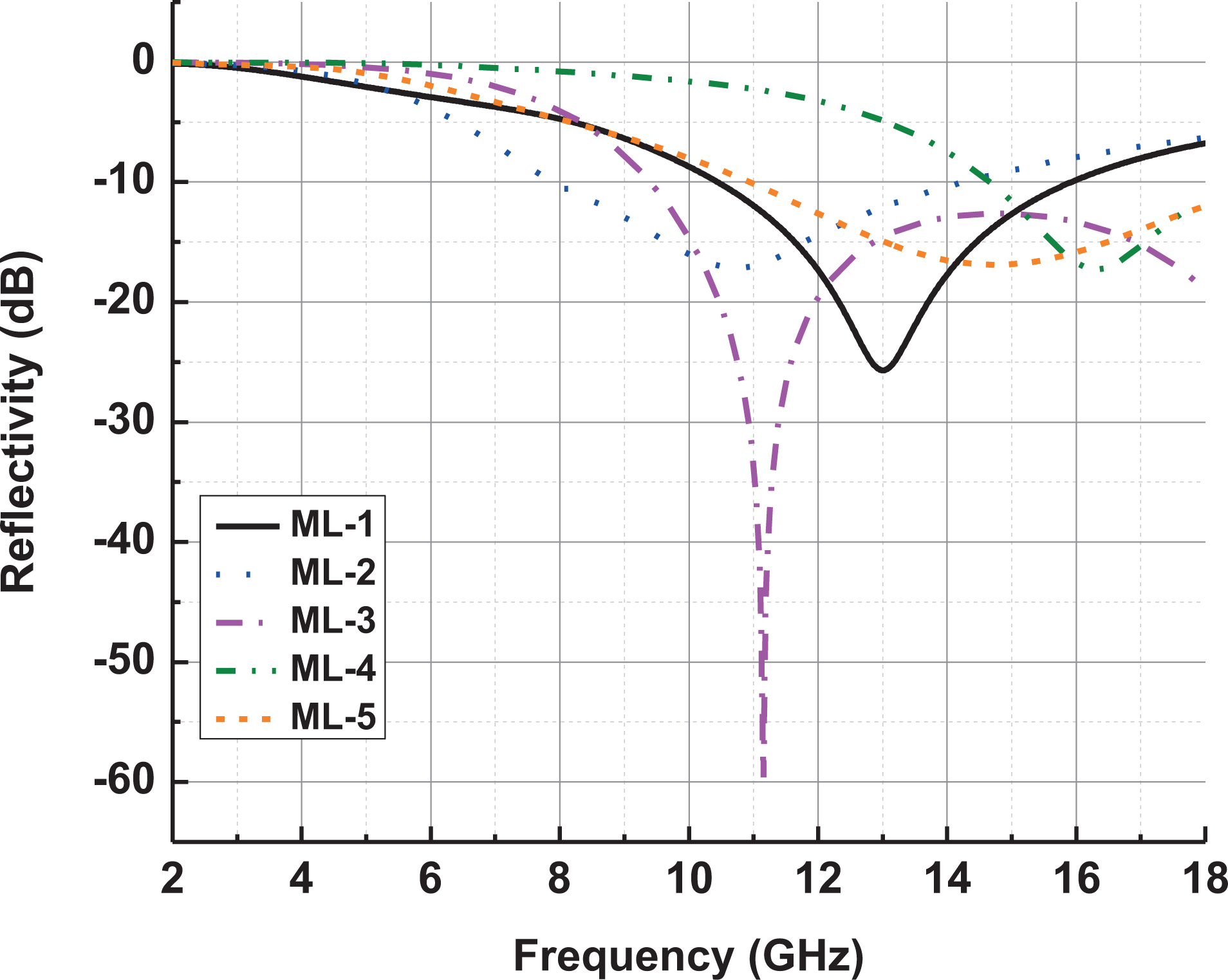
Reflectivity curves of the designed two-layered and multilayered absorbers obtained from simulations in CST Studio.
Materials and methods
We have prepared glass fiber/epoxy composite sheets (8″ × 8″) filled with different wt% of MWCNTs, as received GNPs and thermally exfoliated GNPs for the measurement of their complex permittivity using the method of free space by a vector network analyzer. 10 Similarly, following the same procedure, the glass fiber/epoxy composites were also prepared by using CoFe3O4 nanoparticles in 4, 6, 8, 10, 12 wt% to be used as magnetic layers in multilayer absorber. In another glass fiber/epoxy composite layer equal weight percentages (4 wt%) of CoFe2O4, CoNiFe2O4, and MnFe2O4 nanoparticles were used. The dielectric permittivity of both type of magnetic nanoparticles-filled composite sheets was also measured by the free space method. The multilayer and two layer absorbers were prepared from E-glass plain weave (100 g/m2) by coating of epoxy filled with the magnetic (carbonaceous) nanoparticles using wet layup method. To maintain the discreteness of the multiple sheets, the individual layers were kept at room temperature for 1 h followed by vacuum sucking for another 1 h before its attachment to the second layer. This technique helps to prevent interdiffusion of the two resins at the interface with different magnetic or dielectric properties. The multiple layers attached together were kept under vacuum for 24 h. The reflectivity was measured in an anechoic chamber in 2–18 GHz frequency range. The description of the nanocomposites with different nanofillers are given in Table 2. It can be seen that the thicknesses of the prepared multilayer absorbers are slightly different from those of designed thicknesses.
Sample codes and the corresponding wt% of nanofillers in nanocomposite absorbers.
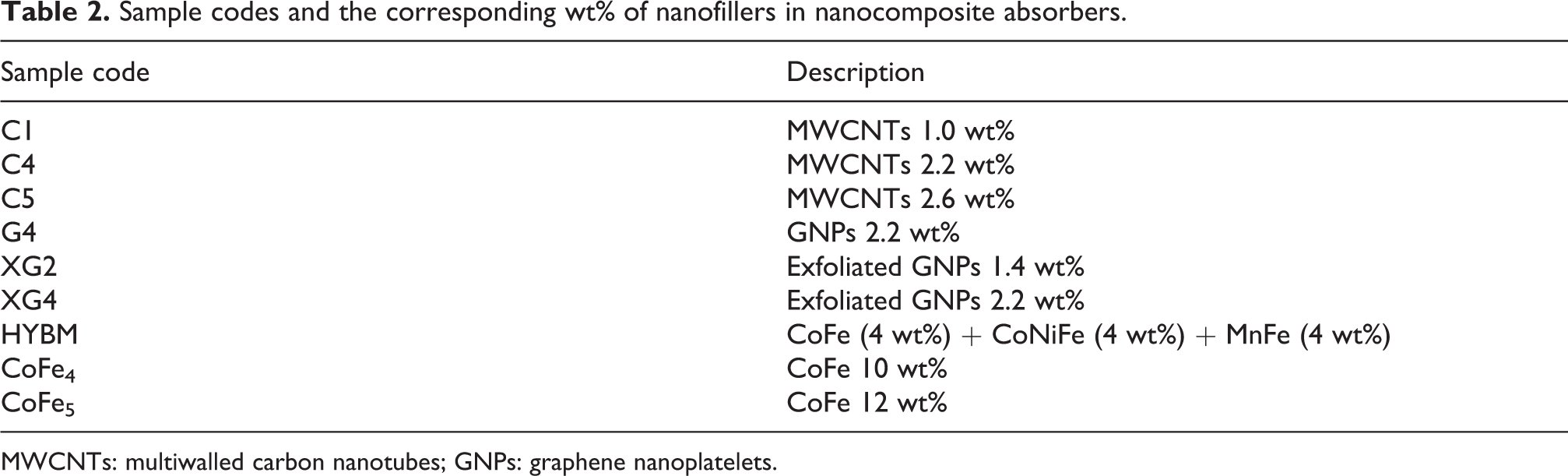
MWCNTs: multiwalled carbon nanotubes; GNPs: graphene nanoplatelets.
Results and discussion
The real and imaginary parts of complex permittivity of the selected wt% of carbonaceous and magnetic nanofillers in the 8–12 GHz range are shown in Figure 4. The results shows that the carbonaceous fillers, that is, MWCNTs, and GNPs have higher values of permittivity as compared to that of magnetic nanofillers. Therefore, nanocomposites sheets with carbonaceous fillers seems more suitable for lossy layer in the structure. These results have been utilized to design different combinations of the layers filled with carbonaceous and magnetic nanoparticles with the aim to get broadband microwave absorption at least below −10 dB. In the first step, three different two-layered structures were prepared. In these structures, the thickness of the surface layer fixed at 2.1 mm and that of bottom layer at 1.2 mm. In the first such structure (ML-1), the top layer is filled with 1.0 wt% MWCNTs, whereas the bottom layer is a higher loss layer filled with 2.2 wt% of as received GNPs. In the second two layer structure (ML-2), the bottom layer of ML-1 was replaced with lower loss layer of epoxy composite filled with 1.4 wt% of thermally exfoliated GNPs. The reflectivity results of the two microwave absorbers in 2–18 GHz frequency range are shown in Figure 5(a) and (b). It can be seen from Figure 5(a) that the minimum reflectivity for this structure is −12 dB at 12 GHz with −10 dB bandwidth of 5 GHz.
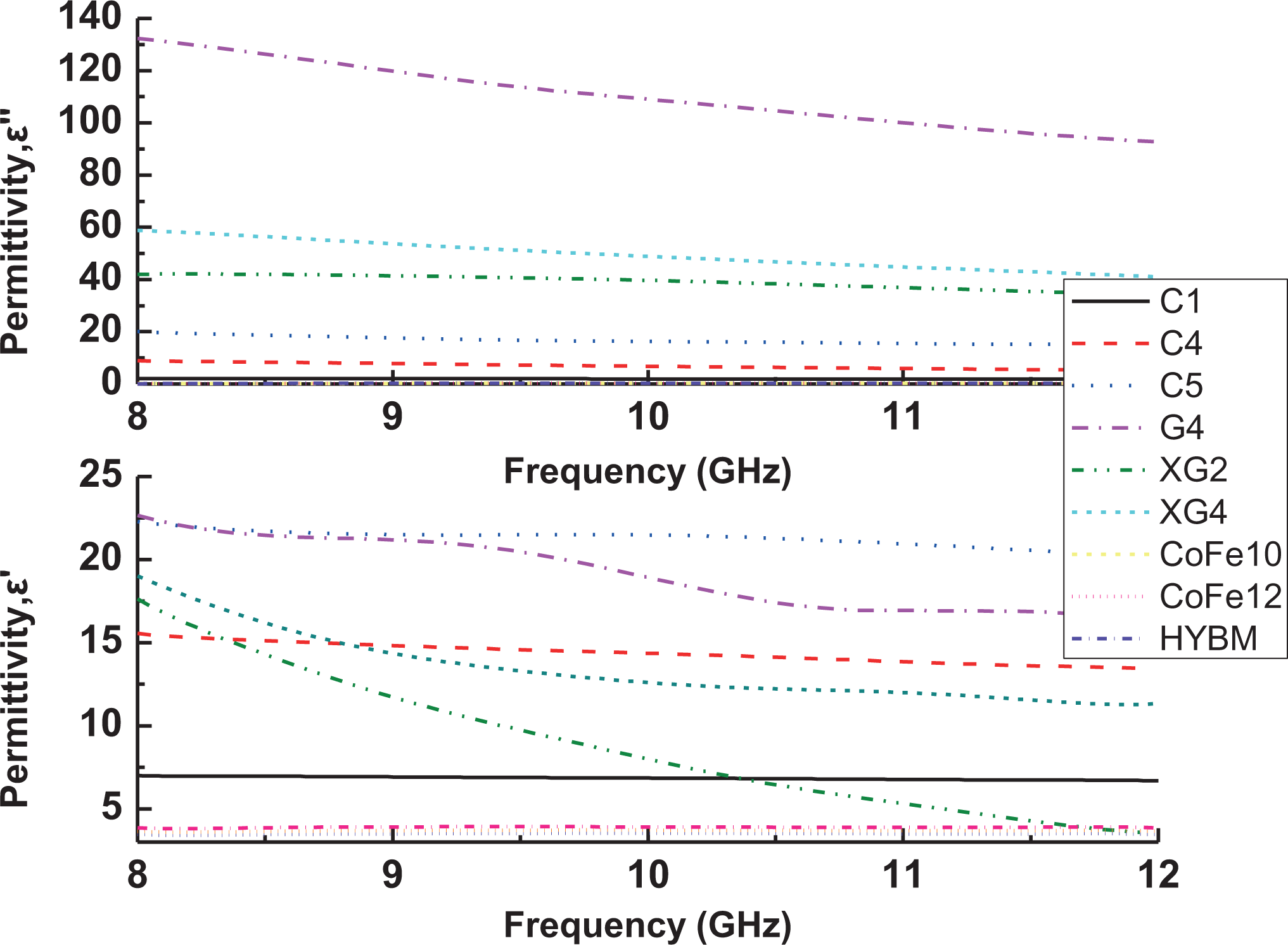
Real and imaginary parts of complex permittivity of the selected nanocomposite sheets in 8–12 GHz frequency range.

Measured reflectivity curves of two-layered microwave absorbers in 2–18 GHz.
However, the replacement of the bottom layer with lower loss composite has resulted in the shift of the frequency of minimum reflectivity of −14 dB to 6.5 GHz. In this case, the −10 dB bandwidth has also decreased to 2 GHz. The two-layer sample ML-3 have shown superior electromagnetic properties, when the surface layer was replaced with magnetic nanocomposite of lower dielectric permittivity, minimum reflectivity is −24 dB at 17 GHz with −10 dB bandwidth of 9 GHz, Figure 5(c). In published literature of similar work, a larger thickness of the composite sheets of two-layer absorber was required to achieve a −10 dB bandwidth over 10 GHz frequency range. 11 In the study by He et al., 12 a two-layer thin absorber was proposed with very high concentration, that is, 85 wt% of metal magnetic particles, but −10 dB bandwidth was achieved over very narrow frequency range. In another work, although a 10 GHz bandwidth was achieved in two-layer absorber, but it had to use a higher thickness and very high weight percentage of magnetic and dielectric fillers to achieve that wide bandwidth. 13 In a recent work by Choi and Jung, a triple-layer absorber was designed and implemented to attain a −10 dB bandwidth of 11 GHz, however, it had to use a larger thickness of more than 5 mm. 14 Gogoi and Bhattacharyya 15 were able to achieve −10-dB bandwidth only in X-band of microwave by using very high filling wt% of the nanomaterials and higher thickness of the two-layered structure.
Moreover, the comparison of ML-1 and ML-3 shows that in both samples, the dielectric constant of surface layer nanocomposite sheets with MWCNTs and magnetic hybrid fillers, respectively, are comparable, whereas, the loss component of the complex permittivity of bottom layer of ML-1 is larger than that of ML-3. This result shows that there is an optimum value of complex permittivity of both the surface layer and the bottom layer, which should be selected to get larger bandwidth and least reflectivity. The effective impedance of the three double-layer samples calculated using equation (5) 11 are shown in Figure 6. It can be seen from this figure that ML-1 and ML-2 composites have higher effective impedance as compared to that of ML-3.
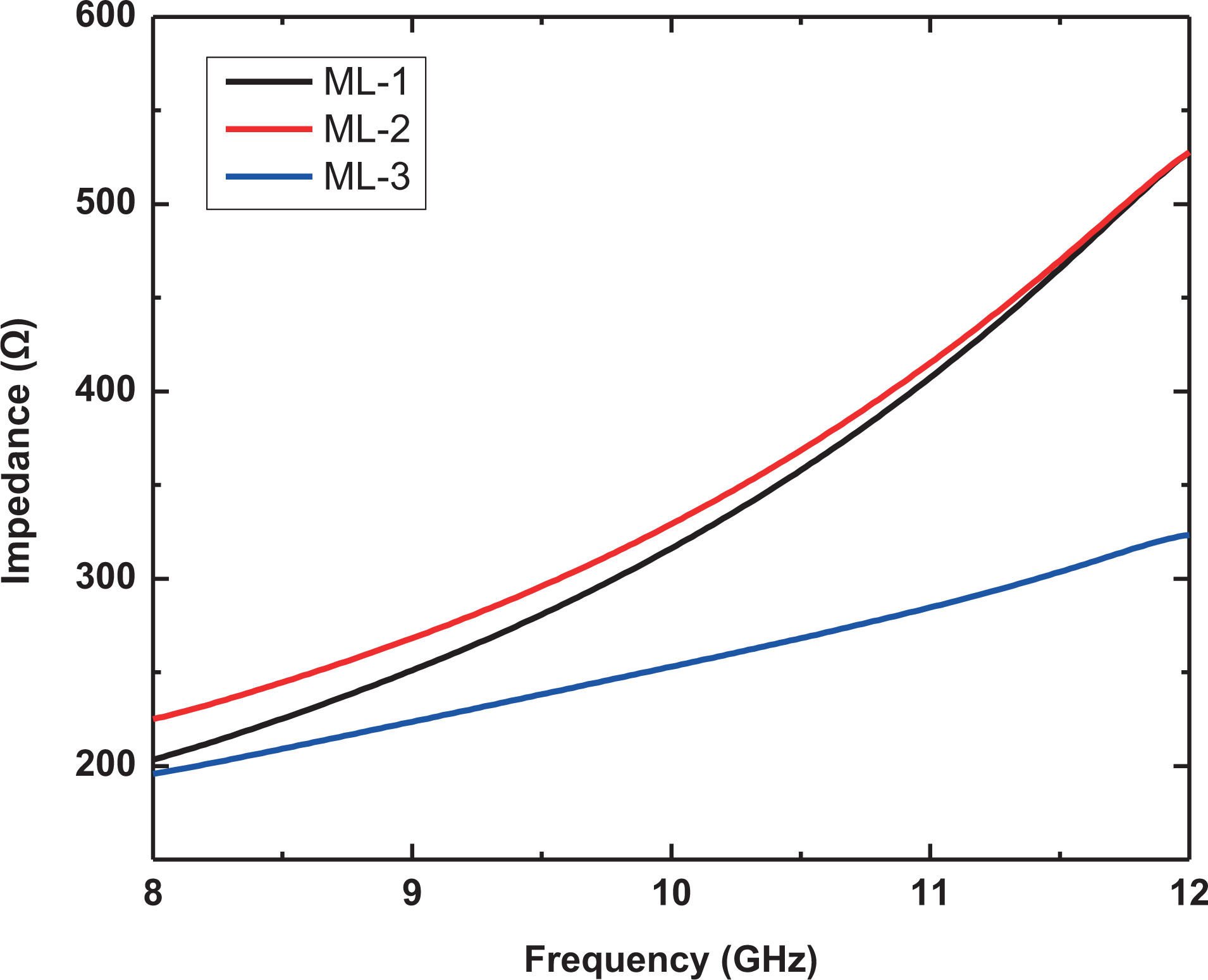
Effective impedance of two-layered absorbers as a function of frequency calculated using equation (4) in 8–12 GHz frequency range.
The effective impedance of ML-3 is close to the impedance of free space in the measured frequency range.

where Z eff is the input effective impedance measured from the surface of the absorber to the termination, Z 0 is the characteristic impedance of vacuum, and Z1, γ 1, and d1 and Z2, γ 2, and d 2 are the characteristic impedances, propagation constants, and thicknesses of the first layer and second layer, respectively

The reflectivity measurements of two multilayered absorbers are shown in Figure 7(a) and (b). The multilayer sample can be considered as a dual two-layer absorber in which each pair consists of a low permittivity layer backed by a higher dielectric constant and loss component of permittivity.
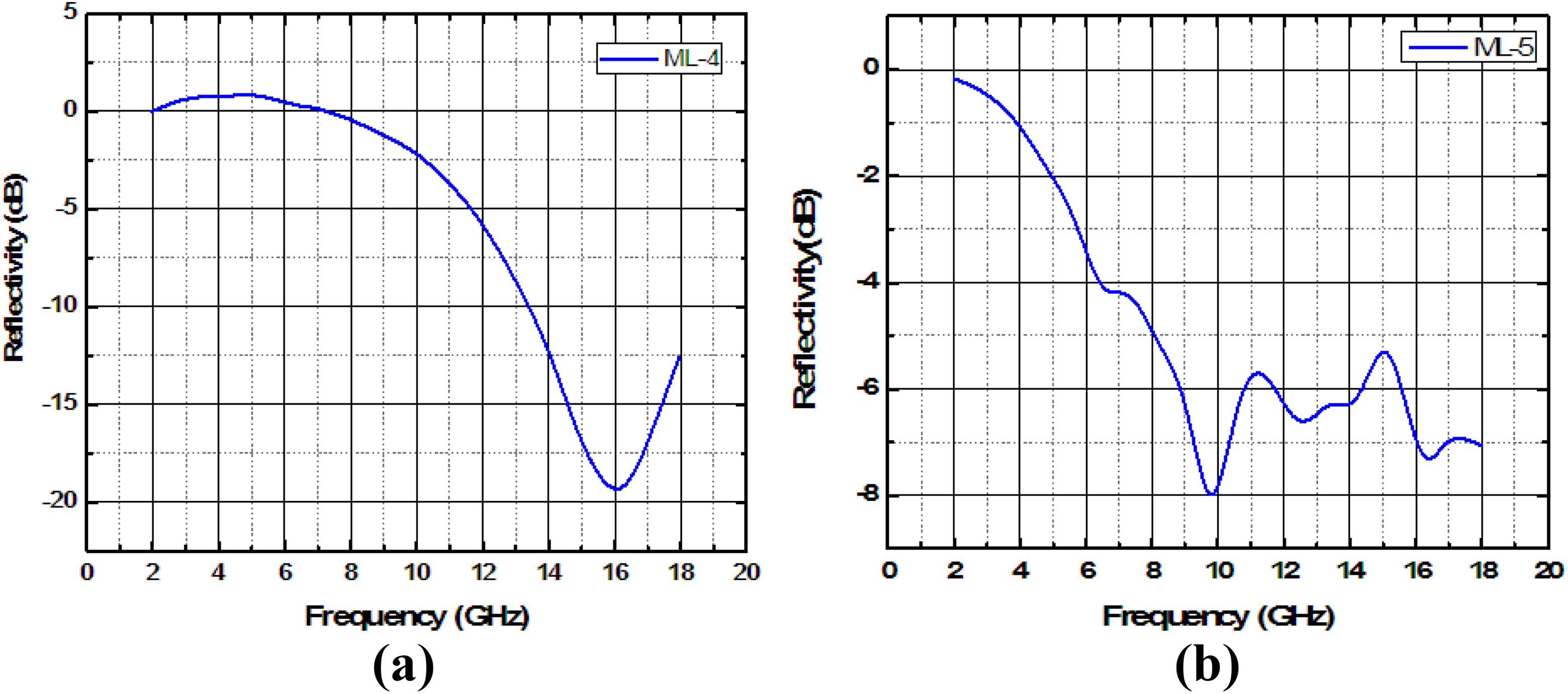
Measured reflectivity curves of multilayered layered microwave absorbers in 2–18 GHz frequency range.
The results of reflectivity measurements show that the composite with alternating sequence of the layers filled with magnetic and carbonaceous particles have minimum reflectivity −20 dB at 16 GHz with −10 dB bandwidth of 4.5 GHz. On the other hand, the multilayered composite with thin carbonaceous layers on the surface has poor absorption characteristics. It has a minimum reflectivity of −8 dB at 10 GHz. It can be noticed that both ML-4 and ML-5 have lower thickness as compared to that of rest of the three other absorbers. The simulated and experimental results are compared in Table 3. It can be seen from this comparison that the simulated and experimental results are almost matched in terms of frequency of minimum reflectivity and bandwidth. However, the magnitude of minimum reflectivity is different from simulated results (Table 1). The simulations were also performed with actual thicknesses and obtained the similar results as those of designed thicknesses. In simulations, the layered composites were designed by assuming sharp interfaces between the layers, the discrepancy between simulated and measured reflectivity in terms of magnitude of minimum reflectivity is most probably due to possible diffused interfaces.
Comparison of the simulated and the experimental reflectivity of the nanocomposite absorbers.a

a The number in parenthesis is the frequency in GHz.
Conclusions
The reflectivity measurements of the nanocomposite microwave absorbers designed on the basis of measured complex permittivity of glass fiber/epoxy composites filled with carbonaceous and magnetic nanomaterials show that the bandwidth and reduction in reflectivity depends largely on the moderate values of real and imaginary complex permittivity. Either very high or too low values of the complex permittivity of both layers in a two-layered structures could not produce desired reflectivity and bandwidth. On the other hand, in multilayered structures, the −10 dB bandwidth is lower as compared to that of two-layered structure, which shows that a minimum thickness was necessary to obtain the desired reflectivity reduction over a wide frequency range.
Footnotes
Declaration of conflicting interests
The author(s) declared no potential conflicts of interest with respect to the research, authorship, and/or publication of this article.
Funding
The author(s) received no financial support for the research, authorship, and/or publication of this article.