



Abstract
The creep behavior of a high density polyethylene (PE-HD) was evaluated before and after aging in contact with gasoline and diesel oil. Four viscoelastic models were used to assess changes in creep properties of the material: three parameters model, four parameters model, stretched Burgers model and Findley Law. Viscoelastic properties, stationary creep rate and compliance were used to analyze and compare the behavior between samples. A strain increase could be seen in aged samples in comparison with as-received ones, caused by plasticization due to aging effects. An increase in flexibility and decrease in stiffness in aged samples was also noted. This work also shows that the effects of aging on the creep response of a polymeric material can be analyzed using short term creep tests.
Introduction
Polymers represent a diverse group of engineering materials. Low cost, ease of manufacture, installation and maintenance, low density and good appearance are some of the many features that combined to bring polymers to great attention in the engineering scenario over the last decades 1 .
Among the various types of polymers, polyethylene (PE) can be highlighted due to its high production and largest use among plastics 2 . Depending on the manufacturing process and conditions employed, such as pressure and temperature, many types of PE can be obtained. The types most used in industry are low density polyethylene (PE-LD) and high density polyethylene (PE-HD). PE-HD is obtained from a polymerization process at low pressure with aid of catalysts. The material obtained exhibit high linearity of chains. Linearity makes orientation, alignment and packing of chains more efficient resulting in high levels of crystallinity, high density, increased stiffness and decreased permeability and chemical affinity3,4.
The good mechanical properties of PE-HD make it suitable to be used in the production of several different products in industry, from basic items in construction like tubes, pipes and geogrids3,5,6 to sophisticated items in advanced industries, such as aerospace, medical and defense 7 .
In many of the aforementioned applications the need to describe the behavior of the material when submitted to significant levels of stress for an extended period is essential. Under such loading polymers can present large and undesirable time-dependent strains, i.e., creep, that can ultimately cause their failure.
In general, PE shows two different viscoelastic behaviors when under creep, namely: linear and nonlinear. Linear behavior may be found for short load application times and is characterized by strain dependence on temperature and on the applied loads 8 . Nonlinear behavior is found for long load application times, where the strain also depends on the applied load and temperature 9 . Also, nonlinear behavior is directly associated with the morphology of the material. In relation to PE, this behavior can be linked with its semi-crystallinity where crystalline regions show a linear behavior and the amorphous phase plays a significant role in nonlinear behavior 10 .
Because of the importance of creep in polymeric materials, different models and empirical laws have been developed along the years. Most of them are based on simple models like the Maxwell and Kelvin-Voigt models, and try to describe the linear 8 and nonlinear viscoelastic5,11–13 behavior of different kinds of polymeric materials.
This study aimed to describe and compare the PE-HD behavior under creep in different conditions of aging after immersion in two different working fluids, i.e., gasoline and diesel oil. It also intended to verify which model best described the creep behavior of the material under study. The models used in this work were the three parameters, the four parameters (Burgers model), and the stretched Burgers models, and the semi-empirical Findley law.
Theoretical Background
Viscoelasticity Models
Viscoelastic models are characterized by showing an intermediate behavior between elastic solid and Newtonian flow. A material can be considered viscoelastic when it presents the phenomena of creep and stress relaxation, showing, therefore, a combination of both elastic and viscous effects 14 .
There are several physical/mathematical models in the literature to analyze the behavior exhibited by polymeric materials. These models are usually based on two main elements with different schematic arrangements: a spring, representing the elastic behavior and characterized by Hooke's elastic model, and a damper, representing the viscous behavior and characterized by Newton's viscous model.
Creep models are essential for a better understanding of mechanisms associated with creep, as well as changes in the material mechanical properties, making possible to predict the behavior of the material along the time. The models used in this study were three parameters model, four parameters model (or Burgers model), stretched Burgers model and Findley Law.
Three Parameters Model
Three parameters model, also called standard linear solid model, was developed in order to reduce the restrictions present in the Maxwell and Kelvin-Voigt basic models. The Maxwell basic model is schematically described by a spring associated in series with a damper, and the Kelvin-Voigt model can be schematically described by a parallel combination of an elastic element (spring) and a viscous element (damper).
Restrictions are reduced by associating, in series, a spring to the Kelvin-Voigt model (


Three parameters model schematic representation
The four parameters model, also called the Burgers model, is schematically represented by a combination of a parallel association of a spring and a damper (Kelvin-Voigt model), associated in series with another spring and damper (Maxwell model), as shown in

Four parameters model (Burgers model) schematic representation
Based on the relationship between the constitutive elements, creep behavior can be calculated as follows
9
:

Relaxation time represents the relationship exhibited between viscosity of the damper (η2) and elastic modulus of the spring (E2) in Kelvin-Voigt element. Relaxation time is given, therefore, by the ratio between these two parameters (t = η2/E2).
The Stretched Burgers model is based on the same schematic and mathematical construction as the four parameters model (Burgers model). However, it considers a distribution of relaxation times9,11 rather than a single relaxation time. It is also assumed that recovery of the material is complete, i.e., schematically there is not a damper connected in series with the system.
Based on these assumptions the time-dependent strain of the stretched Burgers model is given by the following relationship
15
:

The exponent n usually takes values between 0 and 1, characterizing in that way the relaxation time distribution along the material. The closer n reaches 1 (n → 1), greater is the uniformity shown by the relaxation spectrum, i.e., a single relaxation time is sufficient to describe the viscoelastic behavior of the material. But if n reaches 0 (n → 0), the width of the relaxation distribution becomes greater, and it is important to consider a spectrum of relaxation times9,15.
The Findley Law is given by an empirical relationship and is usually used to describe long-term creep behavior of polymeric materials
15
. The great advantage of this law is its simplicity. However, this simplicity creates some restrictions in its use. One of them is the difficulty to describe the behavior of the material under creep when it is subjected to complex loadings
8
. This model can be numerically represented by the following equation
16
:

Making a comparison between the other models and the Findley Law, it can be seen that all other models have an exponential term which graphically can be associated with an equilibrium plateau for long creep times, while the Findley equation suggests the opposite, a constant strain growth without a limit over time.
It could be seen that for a short time interval Stretched Burgers model and Findley Law behave similarly. In fact, expanding the exponential term in Stretched Burgers model (Equation 3) for small times (t < t), and ignoring all but the first terms, Equation 3 is reduced to
15
:

Equating the terms
A commercial grade PE-HD with a melt flow index of 7.3 g/10 min and a 65.2% degree of crystallinity, without any type of additives, was used in this work. Tensile dog-bone specimens (ASTM D 638, type V) were obtained from the as-received pellets by extrusion + injection molding.
At first, extrusion was performed on a micro twin-screw extruder (Micro 5cc Twin Screw Compounder – DSM Xplore), using the following temperatures for, respectively, the feeding, mixing and exit zones: 180°C, 180°C and 200°C. The speed of the screws was 100 rpm, as recommended by the manufacturer of the equipment to extrude PE. The extruded material was collected in a barrel and subsequently fed into a micro- injection molding machine (Micro 5,5cc Injection Molding Machine – DSM Xplore). The temperatures used in the injection barrel and in the mold were 180°C and 60°C, respectively. The pressure used in the process was 8 bar (0.8 MPa).
The obtained injection molded specimens had a gauge length of 27.00 mm, and a cross section of 3.20 mm height and 3.10 mm thick. Some specimens were then soaked into gasoline – without additives -and diesel oil, obtained both in commercial chemical compositions A glass container was used, and the specimens were suspended into the two aging media, to guarantee uniform contact of all their surfaces with the liquids. The glass container was kept tightly closed and it was also wrapped with an aluminum foil to avoid any effect of the ambient light. The aging process lasted 388 days and was conducted at room temperature, 23 ± 2°C.
Creep tests were conducted in a universal testing machine, with 2 kN capacity. Each sample was subjected to a constant tension load of 30 N, which simulated an initial stress approximately of 3 MPa since the cross section area of the samples was of 9.90 mm2. This load was applied within 5 to 10 s, so it can be considered that an instantaneous load was applied to the test samples. The creep tests lasted 10 min, and three specimens were used per condition at room temperature. As-received specimens were tested using the same experimental procedure.
Results and Discussion
Results obtained by applying viscoelastic models - Eq. (1), (2), (3) and (5)

Results obtained by applying viscoelastic models - Eq. (1), (2), (3) and (5)
All models showed excellent convergence with experimental data. This can be verified: (i) graphically by the clear approach found between experimental data and models curves (

Comparison of creep behavior in different aging fluids
Despite small differences in coefficient of determination (r 2 ) between models, convergence can be organized in an increasing order as follows: three parameters model, four parameters model, Findley Law and stretched Burgers model.
From
The lack of another viscous parameter to describe the viscoelastic behavior, besides the viscosity of the damper, η (
In fact, it is not correct to consider a single relaxation time to describe the creep behavior of PE-HD. Despite having high crystallinity due to its low number of branches and excellent morphological organization, PE-HD is a semi-crystalline material. Therefore, PE-HD has regions with high levels of molecular organization (crystalline) and regions with low molecular organization (amorphous)5,6,10,17,18. This structural difference implies regions with different characteristics and properties, it being very difficult to describe stiffness, relaxation of molecules and other properties taking into account only a single relaxation time (τ).
Although from the data listed at
The Stretched Burgers model and Findley Law were developed to describe creep behavior of viscoelastic materials with nonlinear characteristics8,15,19. However, both models exhibited excellent convergence in the present study describing PE-HD viscoelastic behavior, although PE-HD exhibits linear viscoelastic behavior5,6,10,17 when subjected to low stress for short times.
It should be noted that the Findley Law is based on a power law, unlike the other models that have exponential behavior. Thus, excellent convergence of the Findley Law could be associated with the short times used in the creep tests in this study (10 min). Indeed, Faraz 15 conducted studies with nanocomposites and found that for short time tests, the application of the Findley Law is entirely plausible and even preferred because of its simplicity. However, the stretched Burgers model is recommended for long-time tests.
Although the models have different schematic arrangements and the values of the parameters obtained were different, one can make comparisons between the results listed in
Comparing the curves obtained for each tested sample (
It must be emphasized here that the results presented at
It is already known that PE is resistant to a variety of chemical agents because it has a simple and low-reactivity chain. But it can absorb hydrocarbons at ambient temperature and that can lead to modifications in its properties 3 . The fluids used in the aging tests, gasoline and diesel oil, are rich in hydrocarbons and thus have a great chemical affinity with the material tested (PE-HD). For long aging times, as used in this study (t > 1 year), gasoline and diesel oil can be absorbed into PE-HD by diffusion. During the absorption process until saturation, the material is plasticized and its flexibility increases 18 . Other parameters that can be compared are η and E2, which are present in all models with the spring and damper parallel configuration, and they represent, respectively, the stiffness and viscosity of amorphous zones in the polymer 9 . Graphically, η and E2 are responsible for the concavity assumed by the curve after instantaneous strain.
It can be seen on
Viscosity values (η) and elastic modulus (E2) found for the stretched Burgers model and the Findley Law showed some differences between them and in comparison to those obtained for the other two models. This difference can be linked to the models’ approaches. While the three and four parameters models consider a single relaxation time, the stretched Burgers model and Findley Law consider a distribution of relaxation times. Mathematically, the difference found in values is natural, because the equations have mutual dependence on several parameters and the number of equations is insufficient to determine a single solution for the system20.
Parameters such as time and temperature are significant in a creep test but, in addition, the strain obtained also strongly depends on microstructural characteristics and morphological changes during load application 21 . As already mentioned, PE-HD is a semi-crystalline polymer that has amorphous and crystalline regions. The amorphous regions are the most responsible for the deformation suffered by the material.
According to the molecular model, three different types of chains may be identified in amorphous regions: (i) “relaxed” chains, which have a random arrangement and are coiled, (ii) chain ends or branches, linked to the surface of lamellar crystalline structures and (iii) chains in the amorphous regions connecting two adjacent lamellar crystalline structures17,22. Depending on the behavior shown by these chains over a long time due to an applied constant load, different stages of creep can be established. The tested samples showed only two stages of creep: primary and secondary creep stages, the last one also called steady state creep. The final creep stage was not reached because the stress applied was small and, mainly, the test was conducted over a short time. Although there is an intrinsic difficulty to describe the macroscopic behavior obtained with the mechanisms of molecular flow, a generic analysis can be made regarding the creep behavior of PE-HD.
The primary creep region is characterized by a decreasing creep rate. At this stage, from a microstructural point of view, the chains presented in the amorphous region that were “relaxed” begin to stretch and unwind, contributing to the instantaneous elastic deformation shown by the first linear region at the strain-time graph. In addition, stretching of molecules also occurs in chains between adjacent crystalline lamellae regions acting as a connection bridge, transferring stress and strain across crystalline regions. The strain contribution in this stage is mainly due to the amorphous region. The crystalline regions will only feel the stress when the amorphous regions become fully stretched6,17.
In fact, for PE-HD, the amorphous phase has a glass transition temperature (T g ) below room temperature (used in this study), i.e., PE-HD is completely or largely in the rubbery state 17 . The rubbery state is characterized by great flexibility and elasticity. Most of the strains associated with the amorphous phase are in the elastic range, i.e., after removal of load the material shows complete recovery, although time-dependent. E1 and E2 are associated with this phase.
The secondary creep region is characterized by a constant creep rate. In a microstructural scale, chains in amorphous phase are fully stretched and strain begins to occur in lamellar crystalline structures by sliding, and generates a high intermolecular shear, which is the main viscous flow mechanism at this stage
23
. Steady state, or stationary creep rate is the main parameter of this region (
Rates of steady-state creep

It can be seen that the greatest creep rate was obtained for samples aged in diesel followed by those aged in gasoline and finally those without aging. Creep rate can be associated with the strain capacity of a material over time. So it can be said that samples aged in diesel will show lower service life under application of a constant load because they will undergo the greatest strains.
From a morphological scale, discussed earlier, samples aged in diesel were those with the highest intermolecular shear, i.e., the resulting strain caused by slip of chains in lamellar crystalline structures was the largest among the situations tested.
To check the effect of absorption of fluids in PE-HD due to immersion time the values of creep compliance were also determined. Material compliance over time J(t) can be calculated by the ratio between time dependent strain and the constant applied stress
The results are shown in
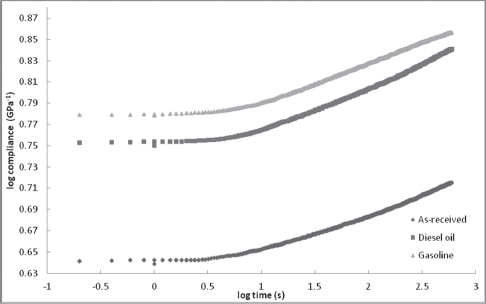
Compliance comparison between as-received and aged PE-HD
High values of compliance are linked with high material flexibility and low material stiffness. Therefore, through the results found it can be said that stiffness decreases in aged specimens in comparison with as-received samples. The lower stiffness is shown by samples aged in gasoline.
All the models tested showed excellent convergence with experimental data demonstrating little difference from each other. However, there are structural considerations that can be made on the feasibility of using some of the models to characterize PE-HD creep behavior.
The three parameters model showed excellent numerical convergence with experimental data, but graphically it does not match the convergence displayed by the other models. The difficulty for this model to reproduce graphically the behavior of experimental data is linked with two factors: lack of parameters to describe the viscous permanent flow and consideration of a single relaxation time.
The four parameters model (Burgers model) showed excellent numerical and graphical convergence, but demonstrated some limitations associated with the distribution of relaxation times. Therefore, this model should be used with care to describe the viscoelastic behavior of PE-HD.
The Findley Law also showed high convergence. However, its use is limited to short creep times because the model is governed by a power law, not by an exponential function, showing a constantly increasing strain over time, which is not usually experimentally observed.
The Stretched Burgers model was the only one that did not show any restrictions on its use to describe the creep behavior of PE-HD. Although it is recommended for nonlinear viscoelastic behavior materials, it showed excellent convergence with the PE-HD experimental data.
In regard to the observed creep behavior, samples aged in diesel oil and gasoline showed a higher instantaneous strain than unaged samples. Material flexibility increase was associated with chemical affinity between gasoline and diesel oil with PE-HD, which caused plasticization. Aged samples also showed higher values for viscous flow and therefore greater viscous strain, which can be linked to the weakening of bonds between chains within the material due to occupation of the free volume by molecules of the working fluid (gasoline or diesel oil). Moreover the aging effects can be analyzed using short term creep tests, which speeds the evaluation of how aggressive a working fluid can be in respect to PE-HD parts.
Finally, aged samples showed higher creep rates than those as-received with highest values found for samples aged in diesel oil. These samples will therefore have shorter lifetimes than the unaged material. Compliance was also higher in the aged samples, showing the highest values for gasoline. This result confirmed a stiffness decrease in aged specimens in comparison with as-received ones.
Footnotes
Acknowledgements
The authors acknowledge the financial support from the Brazilian Agency CNPq.