




Abstract
A fast and effective numerical method to predict mechanical properties of carbon fibre reinforced polymer (CFRP) composites, even elastic properties, is complicated due to the mismatch of mechanical properties among the constituents. Furthermore, it is not possible to completely characterise the influence of multiple parameters including mechanical and structural parameters on the bulk properties of CFRP by experiments. In this study, a three-phase finite-element model consisting of matrix, carbon fibre and interface was developed to predict the elastic mechanical behaviour of unidirectional CFRP. The elastic properties in terms of two Young's moduli, two Poisson's ratios and a shear modulus were calculated by means of a homogenisation method. High-accuracy Kriging surrogate models were constructed to fast-calculate the elastic responses for a large number of samples. Combining Kriging and high-dimensional model representation (HDMR) methods, a global sensitivity analysis was performed to study how the microscopic parameters influence the elastic responses to get a deeper understanding of elastic property-structure relationship. Eleven parameters, including mechanical and geometry properties of constituent phases, were chosen as inputs. Independent and cooperative effects of input parameters on the elastic properties of the studied composites were surveyed via first- and second-order sensitivity indices, respectively. An importance ranking of these parameters for each elastic response was derived directly by these indices. The procedure proposed in this work could serve as a theoretical guide for further design optimisation of CFRP.
Keywords
Introduction
Carbon fibre-reinforced polymers (CFRP) are manufactured by compressing and curing polymeric matrix and carbon fibres under certain volume fractions. The general microstructure over the transverse cross-section of unidirectional CFRP is illustrated in

Cross-section of unidirectional carbon fibre reinforced composites 1
Many efforts have been made to predict the elastic properties of composites by linking microstructures together with mechanical parameters of constituents to the macro properties. Except for mechanical experiments which are of high cost, there exist two main kinds of quantitative methods to predict the mechanical properties of unidirectional fibre reinforced composites, namely the analytical method and the numerical method. Various micromechanical analytical models have been proposed, for instance, the Rule of Mixtures5,6, Halpin-Tsai model 7 , Chamis model 8 and the Bridging model 9 . Analytical models could give direct mathematic formulations between elastic responses of composites and the parameters of constituents, which facilitate fast calculation of elastic constants. However, the mathematic expressions naturally limit in describing the details of stress and strain fields of microstructure. Besides, almost all analytical models were proposed on the basis that the composite is composed of only two phases: matrix and filler, which is in disagreement with the recognised fact that a transition zone of different properties exits between matrix and inclusions because of complex physical and chemical actions during manufacturing of composites 10 . Moreover, the assumption of isotropic property of fibre is incompatible with the property of carbon fibre.
Numerical methods, in particular, finite element method, were emerging as a widely used tool to study the mechanical behaviours of composites for its potential to overcome the disadvantages of analytical models11–14. Within the framework of computational micromechanics, the transversely isotropic properties of carbon fibre can be modelled easily, and the microscopic stress and strain fields can be resolved, leading to the ability to better estimate not only the elastic properties but also damage and failure of CFRP 15 . Fibre-reinforced composites are heterogeneous on the microscale while they could be treated as a periodic array of a specific volume of material called Representative Volume Element (RVE). The homogenisation method could be applied to such materials to gain bulk properties by computing the representative unit when given the properties of constituents and microstructural parameters. Numerical modelling method has been recognised as a reliable tool, but the time consumed on the geometrical construction, model parameter definition and calculation represents a major drawback since the relation of results and input parameters of finite element simulation is not as explicit as mathematic formulations. In order to reduce the modelling and computational time and facilitate fast optimisation iterations when analysis of a composite material system is conducted, statistical methods such as surrogate models have been used, combined with the finite element simulations16,17.
To better understand elastic responses of unidirectional CFRP, and quantify the influence of numerous input parameters, including microstructure parameters and mechanical properties of constituents, statistical methods such as sensitivity analysis are necessary. Existing research is limited to studying only the independent effects of a few microscopic parameters on the macromechanical properties of fibre-reinforced composites, mainly depending on analytical methods 18 , mechanical experiments19,20, or finite element method via simply controlling a single variable1,21. Various experiments have been developed to research the dependence of mechanical properties of unidirectional CFRP on the microscopic parameters. However, only partial parameters can be considered, and merely a trend of influence could be demonstrated by means of controlling variables during experiments. Meanwhile, there exist several analytical empirical formulae that could express the relationships between some microscopic parameters and elastic constants explicitly, but they cannot predict the elastic properties more precisely than numerical methods owing to several idealised hypotheses, limited parameters and inability to describe the detailed microscopic stress and strain fields. Neither experimental nor analytical methods can handle the elastic property-structure problem entirely in a quantitative way due to their inability to cover all parameters that may play definite roles in the mechanical behaviour of a unidirectional CFRP. Moreover, existing work on global sensitivity analysis for properties of composites relies on large amounts of finite element modelling and simulation 22 , along with relatively high computational costs. An efficient quantitative global sensitivity analysis to investigate both independent and cooperative effects of microscopic parameters on the elastic properties of unidirectional CFRP based on finite element modelling and high accuracy metamodels has not been reported.
In this work, three-dimensional unit cell finite element models composed of matrix, carbon fibre and interphase were developed to predict the transversely isotopic elastic properties of unidirectional CFRP in terms of moduli and Poisson's ratios. High-accuracy Kriging models of elastic response were then constructed to facilitate rapid calculation of responses for further sensitivity analysis instead of relatively expensive finite-element simulations. To parameterise the relationship between input parameters and elastic properties of composite in a quantitative manner, a global sensitivity analysis based on HDMR method using the computational results of constructed Kriging models was finally performed to characterise the independent and cooperative effects of microscopic input parameters on the elastic properties of unidirectional CFRP.
The finite-element models to predict the elastic properties should first be developed instead of numerous experiments. Once the accuracy is verified, the models could be used to predict elastic constants under different combinations of input parameters.
Finite-element Modelling
It has been widely recognised that the unit cell homogenisation method, whose main idea is to compute a homogeneous medium equivalent to the macro heterogeneous composites, is accurate and efficient to calculate the mechanical properties of fibre-reinforced composites under elastic conditions. The general steps are as follows: firstly, an average stress or average deformation is applied to a detailed model (unit cell) on a given length scale in which the material is heterogeneous; secondly, equilibrium microscale stress and strain fields are computed by numerical methods such as finite-element simulations under specific loading conditions; finally, macroscopic responses are gained via a spatial average of microscale stress and strain fields. The periodicity of microscale stress and strain fields is characterised as:


The microscale stress and strain tensors are governed by constitutive equations of constituents below:






The stress and strain tensors are calculated through applying appropriate boundary conditions under given macroscopic loads and then the elastic properties of composites can be calculated by using Equations (7) and (8).
For unidirectional CFRP, the fibres are often distributed randomly over the cross-section as shown in

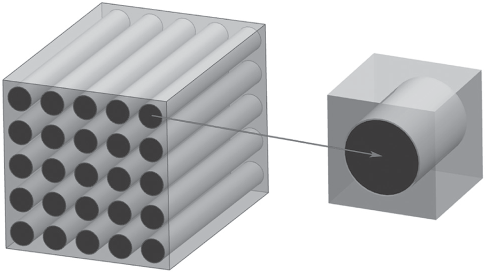
Idealised microstructure of unidirectional carbon fibre reinforced composite and a 3D unit cell
In order to take into consideration the interface, which is recognised as a transition zone between fibre and matrix, a microstructure-based three-phase unit cell model composed of fibre, matrix and interface was developed. The epoxy resin matrix was presumed to be an isotropic elastic material and the carbon fibre was modelled as a transversely isotropic material. An eight-node cohesive element was adopted in the unit cell model to simulate the mechanical behaviour of the interface, as shown in
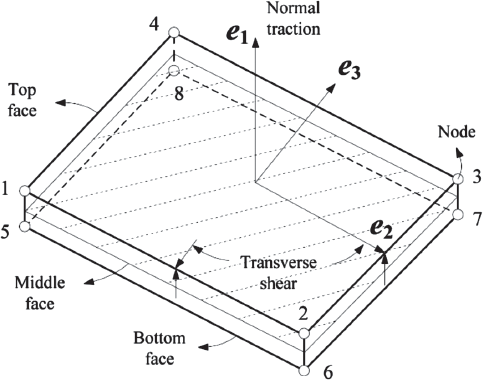
Description of 8-node cohesive element
Deformation of a cohesive element includes relative normal motions and relative tangential displacements between top face and bottom face, which measure the normal traction due to opening or closing and transverse shear deformation of the interface, respectively. The mechanical behaviour of cohesive elements is governed by a traction-separation law of various forms, e.g. bilinear, linear-parabolic, exponential, trapezoidal
24
. A typical bilinear traction-separation law was selected in this study, as illustrated in

Bilinear traction-separation law for cohesive element
The nominal traction stress vector



Three-phase finite element unit cell model
In order to fulfil the periodical characteristics of composites, the unified periodic boundary conditions
27
defined in terms of displacements, which satisfies not only the boundary displacement periodicity but also boundary traction periodicity when using displacement-based finite element simulation, should be applied to the unit cell model. The unified periodic boundary conditions are expressed as follows:



The unified periodic boundary conditions above were realised by applying displacement boundary conditions to the unit cell model. For the considerations of symmetry characteristic and reducing computing time, one-eighth of the cubic unit cell model was used when calculating the Young's modulus and Poisson's ratio, as shown in

Models for different loading conditions: (a) normal loading (b) shear loading
As for calculating shear modulus, half of the unit cell model was modelled as shown in
Under the unified periodic boundary conditions, the macroscopic strain in Equation (8) can be calculated as:



The elastic responses of the unit cell models subject to tensile and shear loads were simulated by the FE code ABAQUS/Standard. The macroscopic stress and strain were calculated through Equations (16) and (15) after recording the required traction force during simulation. Hence, the elastic constants of the studied composite were obtained, based on Equation (17). The deformation mode and stress distribution showed reasonable patterns under each load conditions, which in turn ensured the mesh convergence of the finite element models.
Based on the developed finite element models and the material parameters of constituents as listed in
Mechanical properties of epoxy resin matrix28

Mechanical properties of carbon fibre29

Comparison of finite element predicted results and experimental data

Metamodelling technique has been widely used to construct surrogate models for the purpose of parameterising the relationship between inputs and outputs and avoiding adding more relatively expensive finite element simulations. Once the approximate mathematic relationship based on sufficient experimental or computational simulation data was established, metamodels could be used to predict the outputs at given untried inputs immediately. Then the predictions could be adopted for further use of computation or optimisation, and so on, as long as the predicted accuracy was verified to be high enough.
Kriging Metamodels
Kriging metamodel is an unbiased estimate model within which sample points are interpolated to predict the values of unknown points and estimate the trend of stochastic process used in metamodelling by Gaussian random function. Kriging metamodel was adopted as the surrogate model for its high global approximate accuracy. The basic formulation of Kriging model is composed of a global model of polynomial regression and a stochastic term:



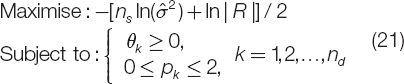



In this work, eleven parameters, including geometric and mechanical parameters, were selected as input parameters as listed in
Ranges of input parameters
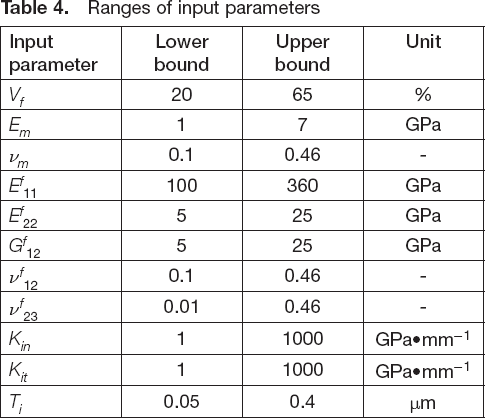
Ranges of input parameters
Sufficient data of different set of input parameters and corresponding target responses are needed to construct the metamodels, and several additional data should be used to evaluate the accuracy of the constructed models. In this work, 150 training sample points and 30 test points are generated by Optimal Latin Hypercube Design (OLHD)
30
. Following the lower bounds and upper bounds of input parameters, the OLHD sampling method could generate sample points uniformly filled in the entire design space most. Corresponding finite element model for each set of input parameters was established following the modelling method developed in section 2, five individual elastic responses of each sample were calculated subsequently based on simulation results operated on parallel computing facilities. A Gaussian function was used as the correlation function and the surrogate models of five outputs were constructed through the Kriging metamodelling technique. To verify the accuracy of these metamodels, coefficient of determination (R
2
) criterion as expressed below was selected:

The values of R
2
are listed as
Coefficient of determination (R2) of Kriging metamodels

To better understand the bulk properties of unidirectional CFRP and fully characterise the influence of various microscopic parameters, a global sensitivity analysis based on RS-HDMR is performed. High dimensional model representation (HDMR) 31 is a set of quantitative model assessment method for expressing the input-output relationships of a complex system with a high dimensional input space. HDMR allows the model responses to be captured by the first few lower-order terms as higher-order correlated behaviour of input parameters is expected to be weak for most well-defined systems. HDMR reveals the hierarchy of correlations among input variables for each component function represents a unique contribution of the input parameters to dependently or cooperatively influence the output response. The main purpose of sensitivity analysis is to investigate either isolated or combined effects of inputs on the outputs of model, thereby the main contributors were identified. HDMR presents a model replacement that can be conveniently employed within sensitivity analysis, while relatively large numbers of samples are needed to achieve higher accuracy. In this work, the HDMR method combined with the Kriging models established above were employed to perform the global sensitivity analysis for the elastic responses of unidirectional CFRP.
Theoretical Framework of HDMR
As the impact of multiple input variables on the output can be independent and cooperative, the mapping between the input variables x1, …, x
n
and the output variables f(
Experience has shown that even a low order HDMR expansion provides already a sufficient description of f(
There are two commonly used HDMR expansions
31
: Cut-HDMR, which depends on the value of the value of f(
To construct RS-HDMR expansion, a set of random sampling points over the entire domain 


The higher-order component functions can be evaluated via direct Monte Carlo integrals which is prohibitively expensive due to large number of full model runs. To reduce the sampling effort and facilitate the calculation of sensitivity indices in the next section, the component functions can be approximated by analytical basis functions (orthonormal polynomials, for instance)
32
:




The same eleven parameters as listed in
As for the sampling process, five sets of training samples with different sizes N = (200, 300, 400, 500, 600) and a set of test samples with size N=100 were generated using OLHD
30
to get the samples that uniformly filled the entire design space to the best. All the input variables were rescaled by mathematical transformations such that x
i
∈[0,1]. The outputs of each sample point were calculated by high-accuracy Kriging metamodels developed in Section 3.2 rapidly, which dramatically spare the computational efforts compared to direct FE simulations to facilitate specifically high efficiency of sensitivity analysis. RS-HDMR expansions up to second-order of each output were adopted. A set of orthonormal polynomials
32
shown as follows were chosen to approximate the component functions:



The best polynomial order that approximating each component function is determined by an optimisation algorithm developed by T. Ziehn et al
33
based on a least-squares method. Sobol's method
34
is widely used in global sensitivity analysis, and RS-HDMR is convenient to imbed into sensitivity analysis as it is conceptually the same as Sobol's method. The total variance D is given as:

The partial variances are given by:


Considering the orthonormal property of approximated component functions, the partial variances can be calculated as follows
35
:


Finally, the global sensitivity indices can be defined as:

The sensitivity indices can then be used for importance ranking of input variables on each output.
The overall accuracy of constructed RS-HDMR expansions was also tested by the coefficient of determination (R
2
) as shown in Equation (25). Values of R
2
for each elastic output response with different sample sizes are listed in

Scatter plots for the calculated and predicted elastic constants. (a) longitudinal Young's modulus. (b) major Poisson's ratio. (c) transverse Young's modulus. (d) transverse Poisson's ratio. (e) in-plane shear modulus
Coefficient of determination (R2) of RS-HDMR expansions under different sample sizes

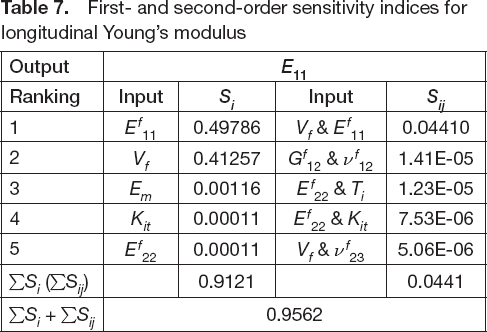
The calculated global sensitivity indices for five outputs with sample size N=600 are illustrated in
First- and second-order sensitivity indices for longitudinal Young's modulus
First- and second-order sensitivity indices for major Poisson's ratio

First- and second-order sensitivity indices for transverse Young's modulus

First- and second-order sensitivity indices for transverse Poisson's ratio

First- and second-order sensitivity indices for in-plane shear modulus

The sensitivity indices were ranked to show which input parameter or combination of two input parameters contribute most to the overall variance, acting as the criteria that determine the relative importance of each parameter. According to the overall values of first- and second-order sensitivity indices for each elastic response of composite, all five elastic properties are affected by input parameters acting both independently and interactively while with different rankings. Almost the independent influences of input parameters account for most of the variance; meanwhile, the interactions of parameters also play a relatively important role. For each elastic property, all first- and second-order sensitivity indices add up to nearly 0.95 or above, indicating that the majority of the total variance has been covered, which further proves the accuracy and good approximation of second-order RS-HDMR for predicting the elastic properties of the studied composites.
The optimal orders of orthonormal polynomials used to approximate the first five first-order RS-HDMR component functions that influence corresponding output the most are listed in

First-order component functions of longitudinal Young's modulus for the two most important parameters: (a) longitudinal Young's modulus of carbon fibre. (b) volume fraction of carbon fibre
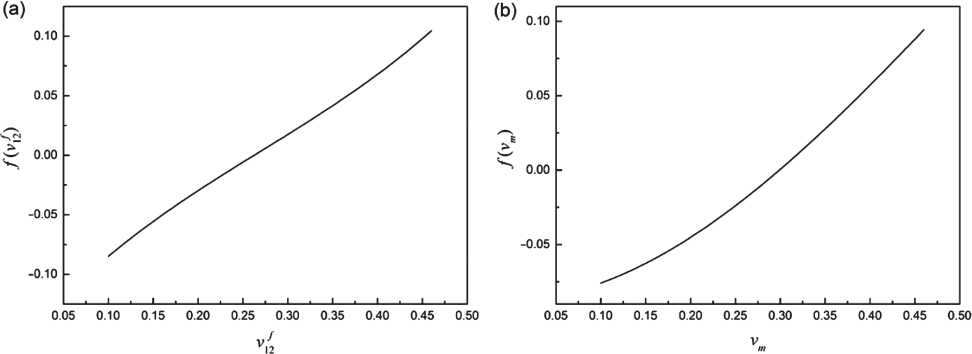
First-order component functions of major Poisson's ratio for the two most important parameters: (a) major Poisson's ratio of carbon fibre. (b) Poisson's ratio of matrix

First-order component functions of transverse Young's modulus for the three most important parameters: (a) Young's modulus of matrix. (b) volume fraction of carbon fibre. (c) transverse Young's modulus of carbon fibre

First-order component functions of transverse Poisson's ratio for the three most important parameters: (a) Poisson's ratio of matrix. (b) transverse Poisson's ratio of carbon fibre. (c) volume fraction of carbon fibre
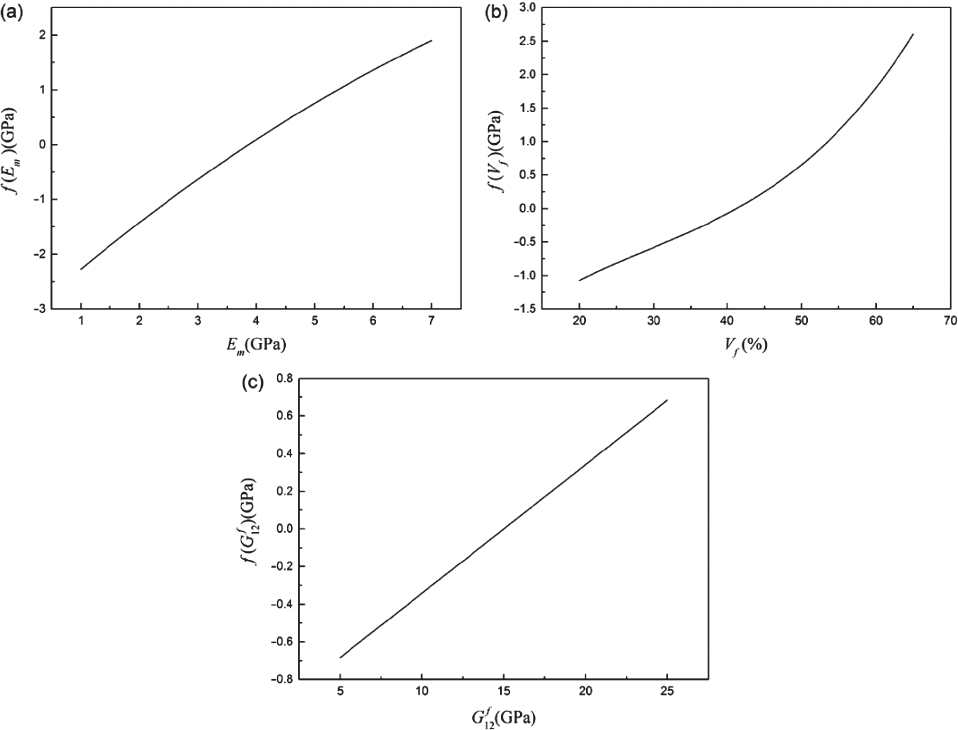
First-order component functions of in-plane shear modulus for the three most important parameters: (a) Young's modulus of matrix. (b) volume fraction of carbon fibre. (c) in-plane shear modulus of carbon fibre
Order of polynomials used for the approximation of first-order RS-HDMR component functions of elastic models using a sample size N=600

As shown in
For major Poisson's ratio v12, major Poisson's ratio of carbon fibre v
f
12 and Poisson's ratio of matrix v
m
contribute most to the variance of v12 by the close percentages of 47% and 44.8% respectively as listed in
As for the transverse Young's modulus E22 shown in
As shown in
As illustrated in
The sensitivity indices and rankings can also be explained by physical reality to some extent. Firstly, V f nearly ranked as the main affecting factor for all elastic properties corresponds to the fact that the constitution of composite decides the main properties, which is directly reflected in V f . Secondly, as carbon fibre presents much higher modulus and lower major Poisson's ratio than the epoxy matrix, carbon fibre is stronger to resist deformation; meanwhile, the transverse deformation of carbon fibre is extremely tiny under transverse load. For longitudinal loading conditions, the longitudinal modulus of carbon fibre leads the whole longitudinal deformation; meanwhile, Poisson's ratio is the combined action of Poisson's ratios of fibre and matrix. For transverse and in-plane shear loading conditions, the matrix is in the first stage to bear the deformation caused by transverse tensile and in-plane shear, so that the modulus and Poisson's ratio of the matrix seem to have more influence on the transverse and in-plane shear properties of the composites.
In this work, a global sensitivity analysis for the elastic constants of unidirectional CFRP based on finite element simulations and metamodels was performed to characterise the independent and cooperative effects of various microscopic parameters on the elastic properties and quantify the importance rankings of these parameters. A reliable three-phase unit cell finite element model in which the interface was modelled by cohesive elements governed by a bilinear traction-separation law was simulated to obtain the elastic properties of unidirectional CFRP by homogenisation method. By comparison with the experimental data, the modelling method was verified to be valid. Some other microstructure features of the studied composite such as non-periodic arrangement of carbon fibres should be taken into consideration for a finer finite-element model to gain accurate predicted results. Although this issue is beyond the scope of this paper, it is an important issue especially for predicting damage and failure, which deserves further research.
Kriging metamodels were constructed to establish a parameterised relationship between input microscopic parameters and elastic constants of composites by combining Optimal Latin Hypercube Design (OLHD) of the experiment method and finite element simulations. The Kriging metamodels present specifically high accuracy that are reliable for further directly predicting the elastic properties at any given input parameters, which greatly reduces the computational cost in the next RS-HDMR-based sensitivity analysis. RS-HDMR expansions were then efficiently constructed, based on rapid calculation of numerous sample points using Kriging metamodels. RS-HDMR expansions up to second-order were verified to be sufficient to represent the studied elastic constants of composites. Global sensitivity indices were computed following Sobol's method to quantify the influence of eleven input parameters on the elastic properties, the ranked indices clearly identify the most important parameters for each elastic property.
From the perspective of sensitivity indices of input parameters on the elastic outputs, the elastic properties of unidirectional CFRPs strongly rely on the elastic properties of carbon fibre and matrix, while slightly affected by the elastic properties of interface. As an important manufacturing parameter, carbon fibre volume fraction Vf has an obvious independent influence on five elastic properties, except for the major Poisson's ratio v12. Moreover, Vf participates in the cooperative effects for all the individual elastic responses of composites. In the relationship between eleven microscopic input parameters and macroscopic elastic properties of studied composites, there exist some identical parameters that have obvious influence on different outputs, namely the coupled variables, which could be considered into further research on the influence of input uncertainties on the macroscopic properties.
The procedure proposed in this work is very efficient to calculate the global sensitivity indices without the need for large amounts of highly time-consuming simulations, which provides a straightforward method to study the property-structure relations, proving to be a useful tool to providing information for further design optimisation of CFRP.
Footnotes
Acknowledgments
The research leading to the above results was supported by National Natural Science Foundation of China (Grant No.11372181).