



Abstract
A simple, highly efficient and low cost roll-to-roll (R2R) UV imprinting lithography facility was achieved for fabricating micro-structures. Firstly, a novel microlens array with focuses distributed on a curved surface was designed and analyzed by an optical software ZEMAX. Then an ultra-precision diamond machine was applied to generate the freeform microlens array features on the master mold, and a belt-type polydimethylsiloxane (PDMS) mold with a microlens array pattern was prepared from the machined master mold. The R2R process was employed to replicate the microlens arrays, followed by an evaluation of their profiles and optical properties. Our experiments demonstrate that the applied method is reliable and efficient for producing the polymeric microlens arrays.
Introduction
Microlens arrays have been applied in many electro-optical and micro-optical systems, such as flexible light-field smart-phones 1 , solar concentrators 2 , data storage 3 and Integral Imaging 3D displays 4 , etc. These microlens arrays are typically composed of microlens cells arranged in a deterministic pattern 5 . The function of such arrays is dominated by the spacing between the cells, as well as the geometries of the individual microstructure cells. In previous research, various methods have been proposed for fabricating the microlens arrays, including photoresist thermal reflow 6 , non-ionic poly(vinyl chloride)/dibutyl adipate gels 7 , overplating in electroforming 8 , gray-scale photolithography 9 , projection photolithography 10 , excimer laser micromachining 11 , hot embossing 12 , wet etching 13 , etc. However, these processes are complicated and time consuming. Furthermore, the geometry profiles of the microlens fabricated are hard to precisely control by those methods.
Compared to the present work, two techniques, ultra precise turning and R2R imprint, have a great advantage of making such polymeric microlens array. Single point diamond cutting could generate complicated micro -structures with high form accuracy and good surface finish by the fast tool servo (FTS) technique on a precision lathe 14 . In addition, R2R UV manufacturing was always an ideal method for replicating the microlens arrays, which has been demonstrated in many researches as a simple, low-cost, and high throughput process for fabricating micro patterns 15 . Due to its excellent properties, the R2R method has been rapidly developed over these years as a promising alternative to conventional nanolithography processes to fulfill the demands of the semiconductor and flexible electronics industries.
In our study, several process steps were employed to make an innovative design of optical polymeric microlens array. Firstly, a microlens array with different focal lengths was designed and optimized by the commercially available numerical optical modeling software, ZEMAX (ZEMAX Development Corp., WA, USA). Secondly, an ultra-precision diamond lathe was applied to accurately control the surface of the designed microlens lens. Thirdly, to achieve higher quality lenses, lower cost and higher production efficiency, the R2R process was applied to replicate the microlens array. Finally, the profiles and optical properties of the microlens array were measured and compared with the design to demonstrate the microlens array fabricated by the R2R process.
Optical Design and Simulation
Microlens arrays with focuses distributed on a spherical surface can be used to fabricate complex microstructures on non- planar surfaces
16
. Besides, they can also be applied in a large field of viewing optical systems, such as compound eyes, large field Fresnel lenses
17
, etc. In our design, the focal lengths of the microlens at the center, on the second circumference and on the third circumference were 18 mm, 18.24 mm and 19 mm respectively. The focuses of the microlens array were distributed on a spherical substrate with a radius of 16.5 mm.

The focuses are distributed on the spherical surface, the SR=16.5 mm, and focal length F=18 mm, F1=18.24 mm, F2=19 mm, the heights of the microlens from center to outside are 31.30 mm, 30.89 mm and 29.65 mm, the distances of the circles centers are 3.665 mm, 5.687 mm respectively
Imprinting Roll Mold
The fabrication process of the roller mold is shown in

Imprinting roller mold fabrication process, (a) positive mold was fabricated by nanotech 350FG, (b) PDMS liquid was poured on the mold and cured, (c) the soft mold was obtained, and (d) the roller mold was achieved
The R2R process inherits the high resolution of the traditional imprint lithography, and also has the advantages of low cost, high-speed and large area. In this paper, an experiment setup for R2R process was developed as shown in
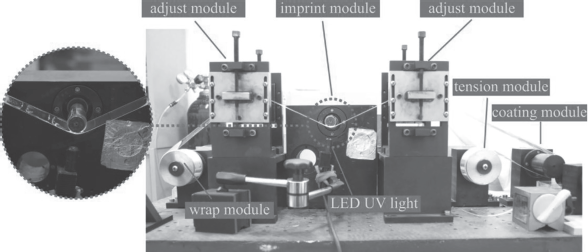
Experiment setup for R2R process
The device includes the following modules: the tension module to strain the substrate, the coating module for coating the resin onto the substrate, the imprinting module to supply the imprinting force, UV light for operating the replicating process, the adjustment module for tuning the wrap angle between roller mold and poly(ethylene terephthalate) (PET) film.
In this study, two key materials were used for the printing: 1) a high transparency flexible PET film (A4300, TOYOBO, 188 μm thickness, produced by Toyobo Co Ltd) was used for the substrate; 2) an acrylic resin, with good adhesion strength for PET film, low viscosity for easily coating, high transparency and small scattering coefficient, etc. In this work, we chose Tex Year, 1551M2, with optical grade properties, 450 mPa.s viscosity and 1.54 refractive index.
In R2R process, the roll mold was set up in the imprinting module, and the PET film was wrapped on the roller of each device's modules, and then UV resin was coated onto the PET film. Consequently, the coated PET was transported to the imprinting module at a speed of 0.2 m/min driven by the wrap module. At the same time, the resin was cured by an LED UV light in the imprint module. Finally, the microlens arrays were obtained after demolding from the imprinting roller.

(a) Microscopic picture of the imprinted microlens array, (b) surface profile of a microlens measured by a WYKO profiler (the height of the microlens is 31.302 μm)
In order to validate the microlens profile, a WYKO profiler was employed.
The replicated microlens array was measured by an optical setup shown in

The system for measuring the microlens array's focal length
The focus of the microlens array captured by the CCD camera is shown in

The focuses of the microlens array at the focal position of the microlens in third circumference
This paper proposed a novel process to fabricate a microlens array focusing on a curved substrate. The microlens array was designed and optimized by ZEMAX and the master mold was machined by an ultra-precision machine tool. In order to reduce costs and increase production efficiency, the R2R process was applied to replicate the microlens array at an imprinting velocity of 0.2 m/min. Finally, the optical properties of imprinted microlens array were measured, which showed a good agreement with our design. The results demonstrated the feasibility of this method to fabricate lower-cost freeform microlens arrays with higher quality. This cost-effective technique has great industrialization potential for fabricating components with micro and nano- scale microstructures.
Footnotes
5.
This work was supported by the Natural Science Foundation of China (No. 50905173, No. 51075381), the Fundamental Research Funds for the Central Universities.