



Abstract
This paper discusses the experimental results on the shear behavior of concrete wide beams reinforced with glass fiber reinforced polymer (GFRP) plates as shear reinforcement. In order to examine the shear performance, a total of six concrete wide beams were manufactured and tested. All the specimens were designed to have the same number of legs of shear reinforcement. The transverse spacing of shear reinforcement was considered as a variable to investigate the influence of transverse spacing of concrete wide beams. From the test results, it is observed that the shear strength increased when transverse spacing of the shear reinforcement decreased. In addition, an equation is proposed to predict the shear strength of concrete wide beams in order to consider the influence of transverse spacing of the shear reinforcement. The equation is based on the test results and modified ACI 318–14. It is verified that the proposed equation is considered to be better than ACI 318–14.
Introduction
A beam is classified as a wide beam when the width of the beam is wider than the column width; or when the width of the beam is more than twice the beams’ height. The concrete wide beams, which are simple and economical systems, can provide shallower structural depth. Therefore, wide beams are utilized in warehouses, commercial buildings, parking areas in order to reduce floor height. According to ACI 318–14 code
1
, shear strength of reinforced concrete beams is determined by the summation of concrete and longitudinal stirrups as expressed by Equation (1) to (3).



In shear reinforcement of wide beams, the stirrups legs are normally placed around the outermost longitudinal reinforcement. The lack of shear reinforcement across the web of the beam could lead to a concentration of diagonal compressive stresses. Nevertheless, the influence of transverse shear reinforcement is not considered in ACI 318–14.
Some researchers had tested several beams with different stirrup configurations2–4. They concluded that the use of a single leg could lead to a concentration of diagonal compressive stresses at the joint of the stirrup leg. Lubell et al. 4 performed a test on the concrete wide beams, in which the variables included were the transverse spacing of stirrups and shear reinforcement area. The test results showed that the shear capacities decreased as transverse spacing of stirrups increased. They recommended a maximum transverse spacing of stirrups. Shuarim 5 experimentally evaluated the influence of stirrup configurations in wide beams, and observed that by reducing the transverse spacing of stirrups, the shear capacities can be improved. In addition, he proposed an equivalent spacing design equation and a transverse spacing limit for stirrups.
The transverse stirrup spacing for concrete wide beams must be considered for an accurate prediction of shear strength. However, ACI 318–14 code does not provide a shear strength equation, which includes transverse spacing. The main objective of this paper is to propose a shear strength equation, which includes transverse spacing, and a modified shear design of the existing ACI 318–14 for concrete beams.
In this study, shear testes on six concrete wide beams shear reinforced with glass fiber reinforced polymer (GFRP) plates were performed in order to evaluate the shear capacity considering the transverse spacing of shear reinforcement. In addition, the shear strength equation for shear reinforcement is proposed by modifying the equation in the ACI 318–14.
Materials
The design compressive strength of the concrete used for the fabrication of the specimens was 35 MPa. The average compressive strength measured at the end of 28 days was 35.2 MPa. The deformed steel bars with a diameter of 22 mm and 16 mm were used as longitudinal reinforcement. In addition, their tensile strength and modulus of elasticity were 400 MPa and 200 GPa, respectively. The GFRP plate with openings is used as shear reinforcement and was embedded in concrete. The tensile stress of the GFRP plate was 480 MPa. The GFRP plates were manufactured as shown

Schematic view of a wide beam reinforced with GFRP plates
A total of six concrete wide beams embedded with GFRP plates with opening were tested. The transverse spacing of shear reinforcement is selected as a variable in the shear performance test of concrete wide beams. Each beam had the same number of legs of transverse shear reinforcement. Also, all specimens were designed to have the same longitudinal shear reinforcement area and spacing. The specimen details are shown in

Cross-section of specimens
Details of specimens

Load was applied to each specimen using a hydraulic jack with maximum capacity of 5000 kN as shown in

Test setup
The crack distributions of specimens are shown

Shear failure

Crack patterns of the specimens

Effect of transverse spacing on shear strength

Load-displacement curves
Test results

According to the ACI 318–14, V
sL
can be calculated using equation (3). In this paper, equation (4) and equation (5) were derived by replacing the sectional areas of steel stirrups with those of vertical components of the GFRP shear reinforcement. The amount of shear reinforcement was the product of the number of vertical components in the critical shear span, width of the vertical components and thickness of vertical components. In 

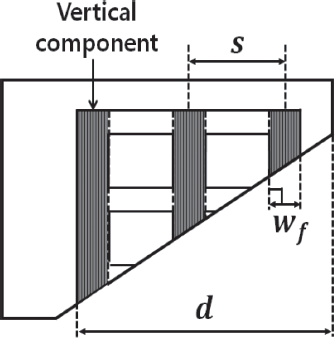
Components of GFRP shear reinforcement
The proposed shear strength equation has modified the ACI 318–14 code. It is intended to reflect the effect of transverse spacing of shear reinforcement. It is indicated that the transverse spacing of the shear reinforcement affected shear strength of wide beams. A shear strength equation incorporating the transverse spacing of shear reinforcement as a variable was proposed through the modification of ACI 318–14. ACI 318 code only used a spacing of longitudinal shear reinforcement whereas in proposed equation, the equivalent spacing S is used, which incorporates the spacing of transverse shear reinforcement. A concept of equivalent spacing proposed by Shuarim
5
was adopted. The equivalent spacing is used instead of spacing of longitudinal shear reinforcement in computing the shear reinforcement contribution to consider the influence of transverse reinforcement. It is expressed by equation (7) is a function of both longitudinal spacing s
L
and transverse spacing s
T
. In terms of equivalent spacing S, it was proposed as two equations based on the transverse spacing to effective of depth ratio. The proposed shear strength of GFRP shear reinforcement was expressed by equation (8).


In
Experimental versus predicted shear strength

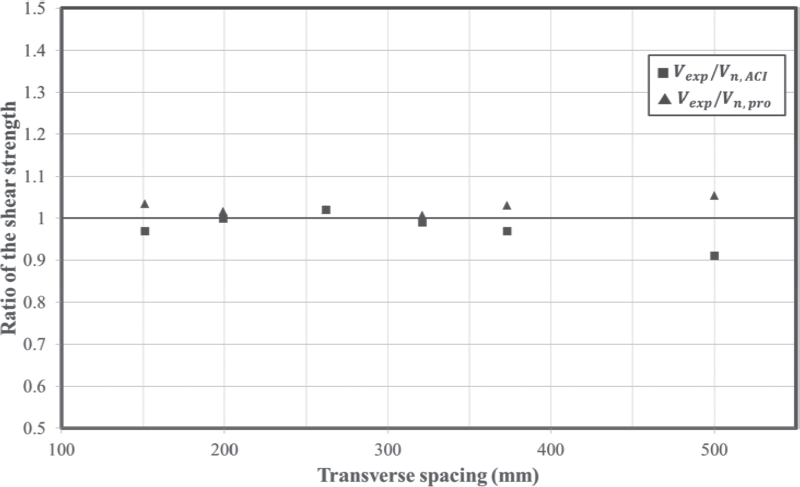
Ratios of the test results to the ACI and proposed equation predictions on shear strength
In this paper, the behavior of concrete wide beams shear reinforced GFRP plates have been investigated experimentally. Shear tests on six wide concrete specimens were performed to examine the effect of the spacing of transverse shear reinforcement. The cracking pattern and maximum shear strength were analyzed. Also, shear strength equation was proposed based on test results. Test results were compared with the estimation calculated by ACI and proposed equation. The following conclusions were drawn from this study:
In the wide beam shear reinforced with GFRP plates, it could be noted that the shear performance increases as the spacing of the traverse shear reinforcement decreases until the spacing of 1.16 times effective depth, and once the spacing decreases to below the value, the shear performance starts to decrease again. It is determined that the increase of spacing on the wide beam results in the occurrence of compression stress concentration while at a decrease below 1.16 d, it forms a spacing too narrow for its beam member, resulting in the decreases of shear performance.
In case of shear strength calculation for a wide beam shear reinforced with GFRP plates based ACI 318–14, an accurate estimation of shear strength based on the transverse spacing variations could not be predicted as the influence of the transverse spacing was not considered. ACI 318–14 tends to relatively overestimate the shear strength. It is important to consider transverse spacing of shear reinforcement in the design of concrete wide beams.
The proposed equation of shear strength that clearly showed a great improvement in predicting the shear reinforcement contribution. It is concluded that the spacing limit and its influence should be taken into consideration in shear strength calculations for accurate estimations in wide beams.
Footnotes
Acknowledgment
This work was supported by the National Research Foundation of Korea (NRF) gran funded by the Korea government (MSIP) (NRF-2013R1A2A2A01067754).