



Abstract
Radar absorbing structure (RAS) is a composite laminate with a low reflection coefficient for the electromagnetic illumination in microwave frequency range, and thereby can be used in the stealth technology and electromagnetic compatibility (EMC). In this study, microwave absorbing properties of a two-layer composite laminate (carbon black impregnated rubber sheet attached to the carbon fiber–epoxy composite panel) has been investigated. Complex permittivity and permeability of the composite materials were measured in C- and X-band frequencies (4–12 GHz) by reflection/transmission technique using a coaxial waveguide and network analyzer. Complex permittivity can be controlled with the amount of carbon black in the rubber composite. High values of dielectric constant and dielectric loss are observed in the carbon fiber composite. Optimization of microwave absorption is conducted for the two-layer RAS on the basis of transmission line theory. It is found that microwave absorption is strongly sensitive to carbon black content in the rubber composite and its layer thickness. For the rubber sheet containing 10% carbon black (with dielectric constant ≍5), the maximum microwave absorption (30 dB) is predicted at 10 GHz.
Introduction
Conventional ferrite absorbers in tile or composite form are attached on the existing metal structures and thereby reduce the wave reflections from the conductive substrate. For this metal-backed (short-circuited) absorber, many studies were carried out to design the zero-reflected absorber and to improve the microwave absorbing properties1–9. However, in movable semi-anechoic chamber or other types of moving vehicles, the structures are preferable as light as possible. For this demand, the metal parts can be replaced by carbon fiber polymer composites with high mechanical strength and low weight. Furthermore, the carbon fiber composites can be used as a microwave reflector, due to its high electrical conductivity10–12. Therefore, a two-layered absorber consisting of the carbon black and carbon fiber composite substrate can be proposed as a light-weight structural absorber having low microwave reflections13–15.
The purpose of this study is to investigate the microwave absorbing properties of carbon black composite attached on the carbon fiber polymer composite substrate. On the basis of wave propagation theory, a modified equation for wave-impedance-matching at the front surface of absorbing layer is proposed. It is demonstrated that the microwave absorbance of front carbon black-absorbing layer is strongly influenced by the electrical properties of the attached carbon fiber polymer composite.
Reflection and Absorption Loss of Two-Layer Ras
Consider a situation that a plane wave illuminates the microwave absorber attached by a quasi-reflective substrate, as illustrated in

Schematic description of (a) two-layered RAS and (b) its equivalent circuit
If the relative permeability and permittivity of the substrate and absorbing layer are designated by μr1(2) and εr1(2), respectively, the characteristic impedance Zc1(2) and propagation constant v1(2) in the two medium is expressed as


When the wave is incident normally on the boundary between two media, part of incident wave is reflected while another part is transmitted into the second medium. The amplitude of the reflected wave (E) is related to that of the incident wave (E) by the reflection coefficient (Γ), defined by


For normal incidence, the reflection coefficient at the front surface of the absorbing layer is given by

In the case of matched line (Zin(2) = Z0), there is no reflected wave from the absorber (Γ = 0). Since Zin2 is a function of not only Zc2 and V2 but Zin1 as well, the electromagnetic properties and dimension of the reflective substrate influence on the microwave absorbing properties of the front absorbing layer.
The transmitted wave is attenuated by the material loss (dielectric or magnetic) inside the material. Absorption loss (AL), in decibel, is given by

In Eq. (7), a is attenuation constant (real part of propagation constant), which is a increasing function of loss tangent (tanδ) as expressed in Eq. (8)


Carbon fiber–epoxy composites were prepared by lamination technique with commercially available prepreg with 0°/45° orientation and Bisphenol–A type epoxy resins. The carbon fiber fabric was cut by 15 cm × 15 cm and dipped in epoxy resin. After drying at 80°C in a vacuum oven, the prepreg was laminated by using uniaxial press with automatic temperature and pressure controller. The lamination temperature was 130°C.
The absorbing layer was prepared from the mixture of carbon black and silicone rubber. The dielectric lossy material used as filler was carbon black and its amount was varied in the range 10–40% in volume. The mixture was molded in a coaxial die with a dimension of 3 mm in inner diameter and 7 mm in outer diameter.
The complex permeability and dielectric constant were determined by using a network analyzer. Measurements were made in the C- and X-band frequencies (4–12 GHz). The precisely machined toroid samples were inserted between the inner and outer conductors of standard coaxial line. The complex permeability and dielectric constant were determined from the measured reflected and transmitted scattering parameters. 16
Results and Discussion
Material Parameters (μr, εr)

Material parameters of carbon black-silicone rubber composite with carbon black content of 30% in volume

Complex permittivity of carbon black-silicone rubber composites at different contents of carbon black (measured at 9.0 GHz)
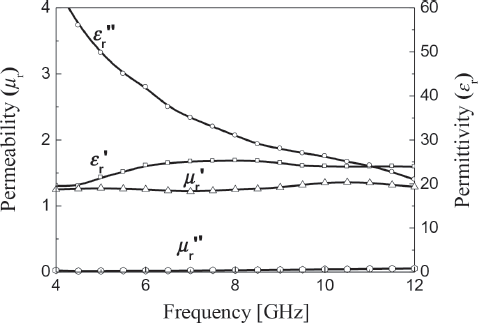
Material parameters of carbon fiber-epoxy composite (fiber content = 60% in volume)
When a composite layer having low intrinsic impedance and high loss such as carbon fiber composites is illuminated by incident plane wave, the microwave reflection occurs at the front surface due to impedance mismatching and the penetrated wave is attenuated inside due to material loss. The reflection and absorption loss can be predicted from the material parameters by using equation (5) and (7).

Reflection and transmission properties determined in carbon fiber-epoxy composite panels: (a) reflection loss, (b) attenuation constant, and (c) absorption loss
With the advantage of high values of microwave reflectance and absorption, the carbon fiver composites can be used as the terminal plate in multi-layer RAS. Since about 50% of incident wave is reflected at the boundary and 90% of the remained transmitted wave is attenuated inside the material, the penetrating wave through the composite panel is only 5% (20 dB in shielding effectiveness). The carbon fiber composites can thus be suggested as a good terminal material with high capability of microwave shielding in multi-layer RAS.
As explained previously, microwave reflectance from the carbon fiber composites is as high as 50% due to low intrinsic impedance (high dielectric constant). Impedance transforming layer of high impedance (low dielectric constant) must be attached to the carbon fiber composites to diminish the microwave reflection. As the impedance transforming layer, carbon black-impregnated rubber composites of low dielectric constant can be used.

Reflection loss determined in two-layer RAS of carbon black/carbon fiber composite laminate with increasing carbon black content: (a) 10%, (b) 20%, and (c) 30%. The thickness of carbon black composite was varied d2 = 2–4 mm

Measured value of reflection loss of two-layered RAS composed of carbon black composite (thickness = 3 mm, carbon black content = 10%) and carbon fiber composite (thickness = 2 mm)
It is evident that absorbing frequency band is quite sensitive to the dielectric constant of impedance transforming layer. As presented in
High value of microwave absorbance was demonstrated in the two-layer composite laminate of the carbon black impregnated rubber sheet attached to the carbon fiber–epoxy composite panel. In the impedance-transforming layer of carbon black composite, complex permittivity can be controlled by the amount of carbon black. High values of dielectric constant and dielectric loss were determined in the carbon fiber composite, which can thus be used as the reflecting substrate. On the basis of transmission line theory, highly absorptive RAS can be designed by laminating the carbon black and carbon fiber composites. For this two-layer structure with the rubber sheet containing 10% carbon black (with dielectric constant of ε′ r ≈ 5), the maximum microwave absorption (30 dB) is predicted at 10 GHz.
Footnotes
Acknowledgment
This research was supported by the Basic Science Research Program through the National Research Foundation of Korea (NRF) funded by the Ministry of Science, ICT & Future Planning (grant number: 2016R1A2B4007970) and by the Basic Research Program from the Agency Defense Development, Korea. The authors thank Dr. H. J. Kang for his help in providing the carbon fiber composite samples.