



Abstract
A lightweight design is proposed for a 2800 ml HDPE milk bottle. In designing the bottle, a three-dimensional elastic-plastic dynamic finite element model is first constructed to explore the effect of the bottle thickness on the critical load and stress distribution. The validity of the proposed model is confirmed by comparing the numerical results for the load-displacement response of the bottle with the experimental results. A parametric analysis is then performed to examine the effects of the body thickness and bottom thickness on the critical load and weight of the HDPE bottle. The results show that the critical load increases with an increasing body thickness, but is insensitive to the bottom thickness. Finally, a lightweight design is proposed in which the structural shape of the original bottle is retained, but the thickness is varied in different regions of the body in order to reduce the weight. It is shown that the redesigned bottle achieves the same maximum top-load 315 N, but reduces the weight by 21.4% compared to the reference design obtained in the parametric analysis.
Introduction
High density polyethylene (HDPE) is one of the most important polymer materials currently available. With its good mechanical properties, ease of processing and low cost, HDPE is commonly used for the fabrication of milk or oil containers. However, these containers are often subjected to large externally-applied loads during delivery and handling. As a result, they are required to be physically strong and robust. However, to improve their recyclability, they should also have a light weight and be easily crushed. Consequently, the need exists for an improved bottle design, in which the weight under columnar crush conditions is reduced, while the original strength and stiffness are retained.
In general, experimental studies tend to be time consuming and expensive. Consequently, numerical methods, such as finite element modeling (FEM), are commonly preferred. Abbes et al. 1 conducted a finite element analysis (FEA) investigation into the top-load strength of aged polypropylene bottles and showed that the results were in good agreement with the experimental findings. Hu et al. 2 calculated the buckling load and stress distribution in a PET bottle using an explicit nonlinear finite element (FE) model. The analysis results were used to design an improved bottle with a lower weight and an increased buckling load. Masood and KeshavaMurthy 3 used an FEM approach to design a collapsible PET water fountain bottle. It was shown that compared to a traditional PC bottle, the new bottle had an improved collapsibility and a lighter weight, but retained the strength required to hold 15 L of water.
Miranda et al. 4 optimized the design of a 500 ml PET bottle by means of FE simulations and parametric computer-aided design software. The validity of the optimized design was demonstrated by fabricating and testing an experimental prototype. The results showed that the optimized design reduced the weight of the original bottle by approximately 21%. Jarod and Panos 5 used an FE model to examine the structural stress distribution in a 600 ml PET bottle. The results indicated that the maximum von Mises stress for the optimized design bottle occurred on the bottle bottom. Demirel and Daver 6 examined the effects of the dimensions and geometry of a standard PET bottle on its strength and thermal stability. It was found that the magnitude of the internal stress within the bottle could be reduced through a careful design of the base geometry. Thusneyapan and Suvanjumrat 7 performed simulated drop tests of PET bottles with various structural shapes and designs. The results showed that bottles with a smooth continuous surface and no edges at the wall have an improved sturdiness in resisting the impact force generated during the drop test. The work done by Keawjaroen and Suvanjumrat 8 was to design one liter HDPE bottle and analyzed the top load resistance of the bottle. The results indicate that the maximum vertical deformation by the top load of 250 N for the one liter bottle obtained from the finite element simulation and experimental measurement were 2.09 mm and 2.4 mm, respectively. The study of Suvanjumrat and Chaichanasiri 9 used the finite element model (FEM) to simulate the creep behavior of HDPE lubricant oil bottles and compared with the experimental results to validate the FEM. It was shown that the FEM simulation results agreed with the experimental results.
Although various studies have addressed the lightweight design of PET bottles, the literature contains only limited information regarding the lightweight design of HDPE milk bottles. Consequently, the present study commences by constructing a three-dimensional FE model of a 2800 ml HDPE milk bottle. The model is verified by comparing the simulated load-displacement response and deformation of the bottle with the experimental results. The model is then used to examine the effects of the body thickness and bottom thickness of the bottle, respectively, on the maximum sustainable top-load and bottle weight. Finally, a lightweight bottle design is proposed in which the body thickness is adjusted in different regions of the bottle in order to reduce the weight while maintaining the same physical strength. It is shown that the lightweight design achieves the same maximum top-load as the original bottle, but offers a weight saving of approximately 21.4%.
Finite Element Model

Geometric dimensions of considered 2800 ml HDPE milk bottle (unit: mm)

Finite element model of HDPE milk bottle

Boundary conditions of finite element model
Mechanical properties of HDPE bottle used in FE simulations
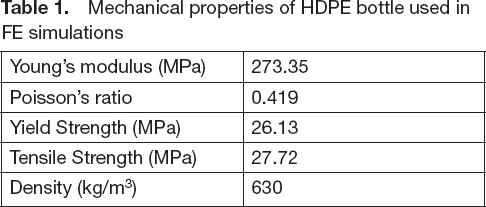
Preliminary simulations were performed to establish an appropriate mesh size for the convergence test of the FE model.

Convergence test results for FE model
The validity of the dynamic FE model was evaluated by comparing the results obtained in a simulated load-displacement test with those observed experimentally.

Experimental setup for HDPE milk bottle load-displacement test

Experimental and simulation results for force-displacement response of HDPE milk bottle

Experimental and simulation results for HDPE milk bottle deformation (a) experiment (b) finite element simulation
A parametric analysis was performed to investigate the effect of the body thickness t
a
and bottom thickness t
b
on the critical top-load of the bottle. In performing the analysis, the neck thickness was set as a constant 2 mm (see

Force-displacement response of HDPE milk bottle given different body thicknesses
In other words, the body thickness of the bottle has a significant effect on the maximum sustainable load, P
cr
.
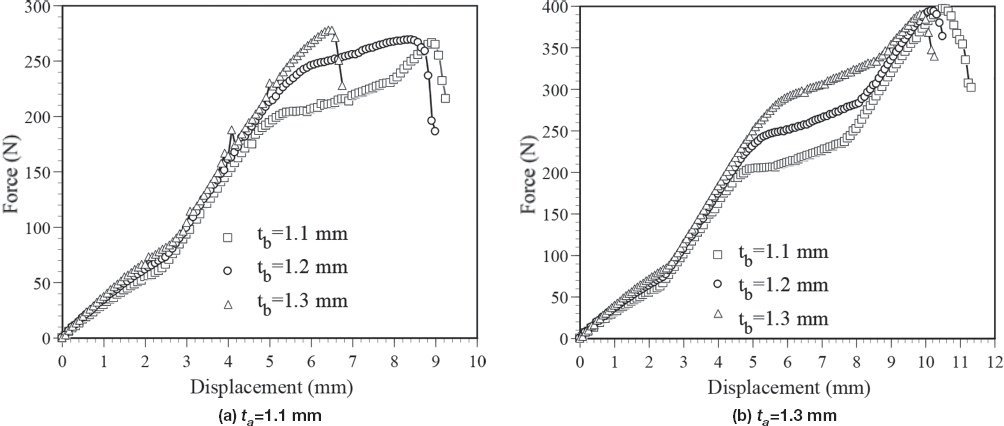
Force-displacement response of HDPE milk bottle given different bottom thicknesses
As shown in
Effects of body thickness and bottom thickness on critical load, displacement and weight of HDPE bottle

A lightweight analysis was performed to reduce the weight of the HDPE bottle while maintaining the critical load target of 315 N. As shown in

Geometrical model used for lightweight analysis
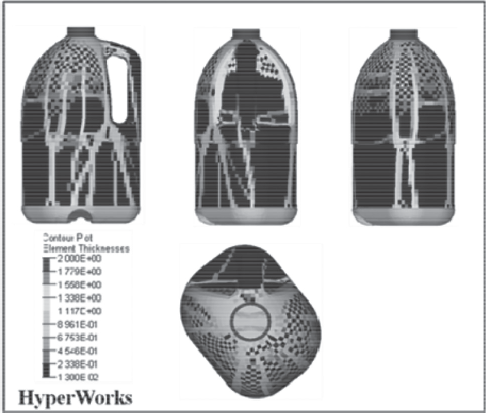
Body thickness distribution obtained from topology analysis for Design-1 HDPE bottle
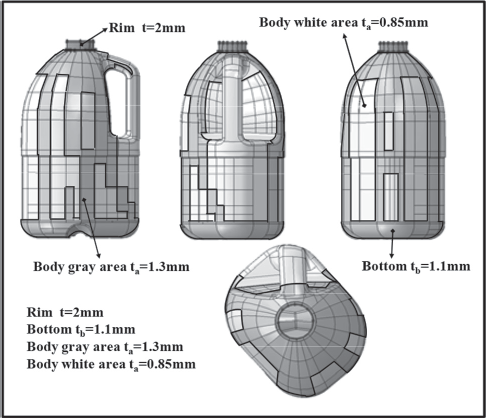
Wall thickness distribution for Design-1 HDPE bottle

von-Mises stress distribution for Design-1 HDPE bottle
The maximum load of the Design-1 bottle 340 N is significantly higher than the target critical load of 315 N. Therefore, the thickness of the white regions in the upper area of the Design-1 bottle was reduced from 0.85 mm to 0.75 mm in order to achieve a further weight saving (see the gray regions of the upper area in

Bottle thickness distribution of Design-2 HDPE bottle

Load-displacement curves of three different bottle designs
This study has performed 3D numerical simulations to design and optimize a 2800 ml HDPE milk bottle. The feasibility of the proposed FEM model has been confirmed by comparing the numerical results for the load-displacement response of the bottle under columnar crush conditions with the experimental results. Further simulations have then been performed to explore the effects of the body and bottom thickness of the bottle on the critical top-load and to develop an optimized lightweight design. The numerical results support the following main conclusions:
The proposed elastic-plastic dynamic finite element model provides an accurate prediction of the critical top-load and deformation of the HDPE milk bottle.
The critical top-load of the bottle increases significantly (∼50%) with an increasing body thickness, but increases only slightly (∼4.4%) with an increasing bottom thickness.
The Design-2 HDPE milk bottle, in which the body thickness is varied in the range of 0.75∼1.3 mm, achieves the same maximum top-load 315 N, but has a weight saving of 21.4% compared to the reference bottle obtained in the parametric analysis.
Footnotes
Acknowledgment
The authors gratefully acknowledge the financial support provided to this study by the Ministry of Science and Technology, R.O.C., under Grant No. MOST 104-2221-E-020-025.