



Abstract
Recently, the sandwich structures with thermoplastic faces and metal foam cores have been received much attention in the automobile, aerospace and naval industries. Since the material properties of the polymer-based faces and adhesive films employed in the sandwich structures are sensitive to the temperature and humidity, the knowledge of the environmental effect on the mechanical properties are important to the design and application of such structures. Therefore, the hygrothermal effect on the static and fatigue bending strengths of the sandwich beams with glass-polypropylene faces and aluminum foam cores were experimentally analyzed in the present study. The monotonic and cyclic four-point bending tests were conducted under four environmental conditions, i.e., 25°C/45% RH, 25°C/75% RH, 50°C/45% RH, and 50°C/75% RH, to evaluate the influence of combined temperature and humidity on the strengths against the static and cyclic flexural loads. Experimental results show that the humidity has tiny effect on the static and fatigue strengths when the specimens were tested at fixed temperature. However, the temperature plays an important role in the environmental effect because the monotonic and fatigue strengths of the studied sandwich specimens decrease significantly when the ambient temperature rises from 25 to 50°C. Furthermore, under four considered environmental conditions, two crack systems, the core shear ones and the face/core interfacial ones, were observed both in the monotonic and cyclic tests. The development of interfacial cracks strongly depends on the environmental variables. Accordingly the interfacial cracks play an important role in the static and fatigue strengths of the studied sandwich structures.
Introduction
Due to the characteristics of high specific stiffness and high specific strength, the sandwich structures have been widely applied in the fields where the lightweight of structures is strictly required, such as automobile, aerospace and shipbuilding industries etc. Furthermore, the excellent abilities of heat insulation, sound insulation, and energy absorption extend the application of sandwich structures. The sandwich plates are generally prepared by bonding two faces on the core material. The faces and the cores are designed to resist the bending stress and the transverse shear stress respectively when the sandwich structures are subjected to the bending loading. Traditionally, the polymer foams are employed as the core materials because of their easy of manufacturing and low cost.
Recently, the improvement of productive techniques makes the metal foams become the alternatives of the core materials for their higher melting points, stronger mechanical properties, and better capability of heat insulation. Especially, the high melting point of metal foam core makes it possible to utilize the thermoplastic composites as the face materials. Accordingly, the sandwich structures with thermoplastic composite faces and metal foam cores have received much attention in the related applications of sandwich structures.
Since the sandwich structures are widely employed in various fields, the related mechanical properties have been paid much attention by the researchers recently. Among the properties investigated, the fatigue characteristics of the sandwich structures were seldom analyzed. However, the knowledge of fatigue resistance is important for the design and application of sandwich structures because in practice the sandwich panels are frequently subjected to the cyclic loading. Reviewing the past investigations on concerning the fatigue behaviors of the sandwich structures subjected to the cyclic loading demonstrates that lots of studies were dedicated to predicting the fatigue life of the sandwich structures. Some works have shown that the fatigue strengths of the sandwich structures strongly depend on the failure modes1–4. The fatigue-life curves corresponding to various failure modes can be theoretically or experimentally obtained. The failure modes are dependent on the geometries of the sandwich structures, and the mechanical properties of the employed core/face materials. Accordingly, the design map can be developed to obtain the decisive predicted fatigue life of the sandwich structures by comparing the fatigue strengths with different failure modes. Besides, Jen et al. found that the face/core interfacial debonding was the major failure mode of the aluminum honeycomb sandwich beams subjected to the cyclic bending loading5–7. The finite element based local parameters were proposed to evaluate the effects of core density 5 , amount of adhesive 6 , and face thickness 7 on the bending fatigue strength of the sandwich beams. Moreover, the stiffness degradations of the sandwich structures under cyclic loadings are another indicators frequently employed to evaluate the fatigue strength of the sandwich structures8–10.
On the other hand, many efforts have been made to experimentally or numerically study the fatigue behavior of sandwich panels with face/core interfacial cracks11–18, core cracks 19 , inserts 20 , face wrinkle defects 21 , artificial defect 22 , or weld notches 23 . Moreover, the influences of some loading variables, such as variable amplitudes of cyclic loading24–25, load ratios26–27, load frequencies 28 and low-velocity impact 29 on the fatigue strength of sandwich structures have been also investigated.
Surveying the aforementioned studies reveals that almost no fatigue studies of the sandwich structures with thermoplastic faces and metal foam cores are available. Moreover, in spite the metal foams were employed as the core materials for the innovative sandwich structures, the polymer materials were still used in the specific occasions, such as the matrix of the face composites and the adhesive films between the face and core. Since the polymer materials are sensitive to the temperature and humidity, the knowledge of the hygrothermal effect on the mechanical behavior of these sandwich structures is important to the future employment of these sandwich structures under various environmental conditions. In the past, the environmental effect on the monotonic mechanical properties of the sandwich structures are rarely studies. In 2004, the effect of sub-ambient temperature on the compressive strength of the S2-glass–vinylester foam core sandwich specimens was studied by Thomas et al. 30 . The specimen showed higher compressive strength when tested at low temperature than that tested at room temperature. However, the significant influence of low temperature on the failure mode of the studied sandwich structure was observed.
In the same year, Veazie et al. studied the effects of marine environments on the critical strain energy release rates of the sandwich structures with face/core interfacial pre-cracks 31 . The sandwich structures displayed the core degradation evidently after high temperature exposure, and the sea-water exposure made the specimens fail with interfacial damage. Furthermore, the high temperature is detrimental to the mechanical properties of the studied sandwich structures with face/core pre-cracks.
In 2006, Gates et al. performed the toughness tests on the sandwich structures with face/core interfacial cracks at cryogenic temperatures 32 . Experimental results demonstrate that the toughness of the specimen increases when the ambient temperature decreases. Furthermore, Siriruk et al. investigated the effect of sea water exposure on the delamination behavior of the sandwich specimens with a closed cell polymeric foam layer and carbon/glass fiber reinforced polymeric composite faces in 2009 33 . The cracks of the wet specimens propagated along the face/core interface, while the cracks grew into the cores when the specimens were tested in dry environments. Moreover, the fracture toughness of the wet specimen decreased significantly when compared with the specimen tested in the dry environment.
In 2014, Zhibin et al. performed the quasi-static three-point bending tests on the aluminum foam sandwich specimens at various temperatures 34 . The failure modes of the studied specimens were found to change with the test temperatures. When the test temperature increases, the leading failure mode of the studied sandwich specimen transfers from core shear to face yield. A design map was proposed to predict the temperature-dependent failure modes of the studied specimens.
Compared with the monotonic studies, fewer investigations on concerning the environmental effects on the fatigue strength of the sandwich structures are available. In 2003, the sandwich structures with PVC foam cores and S2-glass/vinylester faces were fatigue tested at various temperature by Kanny et al. 35 . The fatigue lives of the studied sandwich specimens were found to decrease with increased temperatures.
Soni et al. performed the four-point bending fatigue tests on the sandwich specimens with foam cores and carbon-epoxy/glass-epoxy faces at room temperatures and sub-zero temperatures in 2009 36 . The core shear is the main failure modes observed both in the room-temperature and sub-zero temperature tests. Longer fatigue life was observed when the ambient temperatures change from room temperatures to sub-zero ones. The room-temperature specimens experienced a long-term gradual loss of stiffness before the final failure. However, the catastrophic failure mode of the low-temperature specimens was observed without any early warning.
In 2013, Jen and Lin studied the temperature effect on the monotonic and fatigue bending strengths of the aluminum honeycomb sandwich beams 37 . The monotonic and fatigue strengths of the studied specimens decrease as temperature increases. The failure modes of the specimens change from the face indentation to the face/core debonding. An analytical procedure was proposed to predict the fatigue life and the corresponding failure mode of the sandwich specimens by comparing the temperature-dependent fatigue strengths of various failure modes.
Reviewing the previous mechanical-property investigations with the consideration of environmental factors indicates that the environmental effects on the sandwich panels with thermoplastic faces and metal foam cores have not been explored. In the present study, the aluminum foam will be selected as the core material because the environmental variables have slight effect on the mechanical properties of the metal core materials. Moreover, the metal foam core can withstand the high operating temperature when preparing the sandwich structures with thermoplastic faces. Hence, the purpose of this investigation is to experimentally study the combined influences of temperature and moisture on the monotonic and fatigue strengths of the sandwich beams with glass-polypropylene composite faces and aluminum foam cores. Monotonic and cyclic four-point bending tests will be performed under various hygrothermal conditions to understand the environmental effects on the static and fatigue properties of the innovative sandwich structures.
Experimental Procedures
Materials and Specimen Preparation
The faces of the studied sandwich structure were obtained by hot-pressing four layer Twintex balanced ±45° stitched glass-polypropylene fabric prepregs at 5 bar and 200°C for 30 min. The prepregs were supplied by Owens Corning Reinforcements Co., France. The glass-polypropylene faces employed in the present study were prepared by hot-pressing the Twintex prepregs. The glass-polypropylene prepregs have been commercialized for many years and the resin of the product has been functionalized to improve the adhesion ability with other metals. Accordingly this composite material has been applied frequently as the thermoplastic faces of the sandwich structures for various applications. The aluminum foam plates provided by the Sichuan Yuantaida Non-Ferrous Metals Co., China, were employed as the core material of the studied sandwich structures. The aluminum foam plates were manufactured by heating the foaming agency and the powder of aluminum metal in a hermetic space. The composition of pure aluminum accounts for more than 95 wt.%. The average value and standard variation value of diameter of the cell are 3.09 and 1.35 mm, respectively. The density of the received foam plate is 0.49 g/cm3, and the corresponding relative density is 0.183.
The sandwich plates were obtained by hot-pressing the faces and the aluminum foam core at 5 bar and 165°C for 15 min with the polypropylene-based adhesive films adhesive placed between the core and the faces. The adhesive films were supplied by the Collano Co., Switzerland, and coded by Collano 23.111. According to the datasheet provided by the supplier, the yield stress, tensile strength and elastic modulus of the employed adhesive film are 17.2, 30.3, and 870 MPa, respectively. Moreover, the lap shear strength on aluminum is 1050 MPa, which indicates that the adhesive film presents excellent bonding performance with the aluminum alloys. During the manufacturing process, the spacers with 25-mm height were employed to ensure the thickness of the sandwich plates. Next, the sandwich plates were cut to the required sizes of the beam specimens (300 × 50 × 25 mm) using a water-jet.
Moisture Absorption Tests
To understand the characteristics of the moisture absorption for the polymer materials employed in the preparation of studied sandwich specimens. The moisture absorption test of the aluminum foam materials was skipped because the environmental variables considered in the present study have slight influences on the mechanical properties of metal materials. The moisture absorption tests under high humidity conditions were performed on the glass-polypropylene composites and polypropylene-based the adhesive films. The standard specimens were prepared and dried first at 120°C in a chamber for 24 h to eliminate the water and the weight of the dry specimen were measured and recorded. The dried specimen was subsequently kept in the chamber under specific hygrothermal condition. Two hygrothermal conditions, i.e., 25°C/75% RH and 50°C/75% RH, were considered in the experimental program. The weight of the specimen was measured and recorded per hour till the weight reached the saturated value. The water absorption (in percentage) is defined as the ratio of the increased weight due to the moisture absorption to the weight of the originally dried specimen.
Monotonic and Cyclic Tests
All monotonic and cyclic bending tests were performed using an MTS 810 servo-hydraulic material testing system with a four-point bending jig.
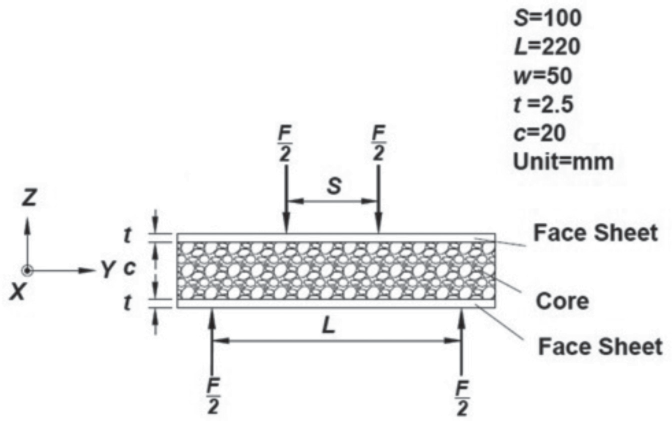
Schematic illustration of the setup of the four-point bending tests
The monotonic bending tests were conducted by controlling the speed of loading rollers at 0.01 mm/s. The applied load F and the displacement of the loading rollers δ were recorded during the monotonic bending tests. The peak load values of the load-displacement curves are the ultimate loads, F ult , which will be used as the reference data of subsequent cyclic tests.
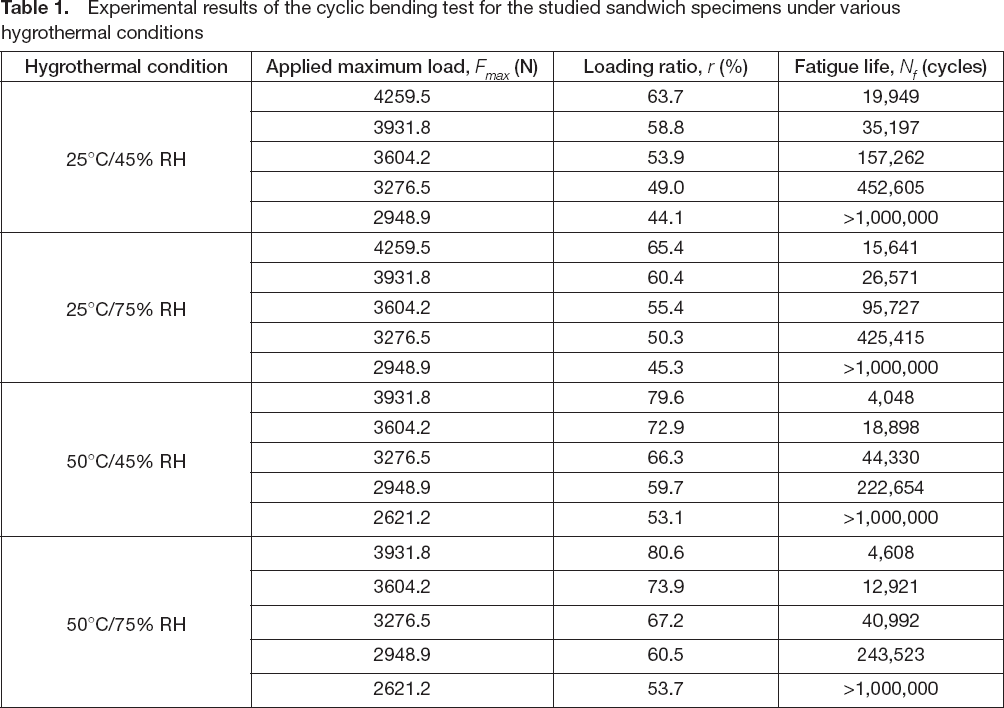
The cyclic bending tests were performed by controlling the applied loads with the load ratio R equal to 0.1. The load ratio is defined as the minimum applied load F min to the maximum applied load F max . Note that the downward loads are considered to be positive in the present study. The waveform of the applied load was sinusoidal and the frequency of the fluctuated load was 3 Hz. Five loading levels r were selected in the cyclic tests for the specimens tested under each hygrothermal condition. The loading level is defined as the ratio of the maximum applied load in the cyclic test F max to the ultimate applied load in the monotonic test F ult under the same hygrothermal condition. The fatigue life N f is defined as the number of cycles when the maximum displacement reaches the one corresponding to the ultimate load obtained in the monotonic test. The maximum displacements of the upper rollers corresponding to the ultimate loads obtained in the monotonic tests under the four hygrothermal conditions, i.e., 25°C/45% RH, 25°C/75% RH, 50°C/45% RH, and 50°C/75% RH, are 12.431, 12.221, 11.453, and 11.696 mm, respectively. After the monotonic and cyclic tests, the failure modes of the specimens were observed using an optical microscope.
Moisture Absorption Tests

Variations of the water absorption with the exposure time for the (a) face composites, and (b) adhesive films

Relationships between the applied load F and the displacement of the loading roller δ obtained in the monotonic bending tests performed under various hygrothermal conditions

Ultimate applied loads F ult obtained in the monotonic bending tests performed under various hygrothermal conditions
Two crack systems were observed for the studied specimens subjected to the monotonic bending loading under various hygrothermal conditions. The core-shear crack system was found to initiate at the face/core interface and grow into the core area between the loading and supporting rollers. The other crack system initiated and propagated along the face/core interface.

Examples of the failure modes obtained in the monotonic bending tests performed under (a) 25°C/45% RH, and (b) 50°C/75% RH

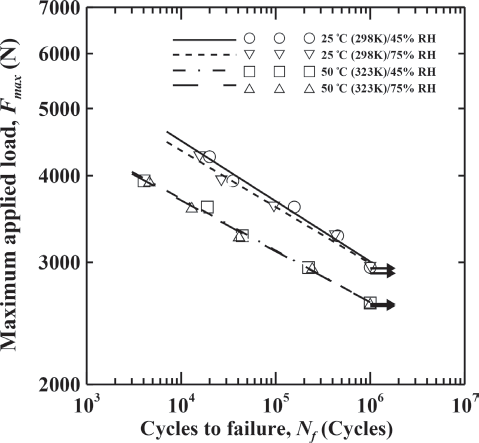
Relationships between the maximum applied loads F max and the fatigue lives of the studied specimens obtained in the cyclic bending tests performed under various hygrothermal conditions
Experimental results of the cyclic bending test for the studied sandwich specimens under various hygrothermal conditions
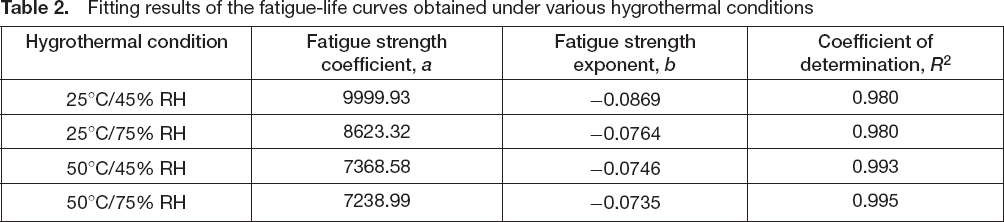
Fitting results of the fatigue-life curves obtained under various hygrothermal conditions
Similar to the crack behavior observed in the monotonic test, the core shear cracks were found first to form at the interface and grow into the core area between the inner and outer rollers in the cyclic tests. The other crack system subsequently developed along the interfaces and played a decisive factor in fatigue strength due to the environment-sensitive characteristics of the polymer adhesive film. The interfacial cracks of the specimens tested in the severe environments are more evident than those tested in the normal environments. Since the properties of the adhesive film are sensitive to the temperature and humidity, the degradation of the adhesive is expectable. Accordingly, the interfacial crack system develops rapidly in the hot-wet environments, which weakens the fatigue strength significantly.

Examples of the variations of specimen stiffness with the fatigue cycle ratios

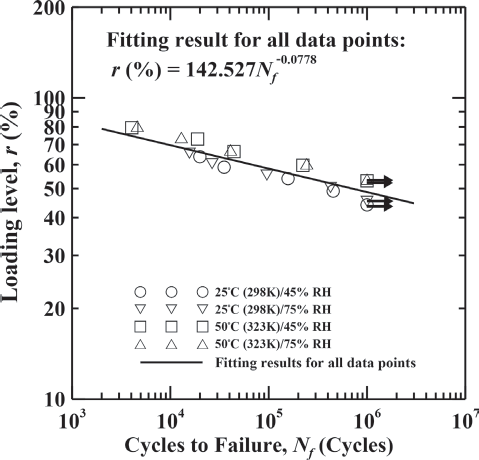
Relationships between the loading levels r and the fatigue lives of the studied specimens obtained in the cyclic bending tests performed under various hygrothermal conditions

Prediction performance of the loading level parameter for fatigue-life evaluation of the studied sandwich specimens under various hygrothermal conditions
In the present study, the hygrothermal effect on the static and fatigue bending strengths of the sandwich beams with glass-polypropylene faces and aluminum foam cores were experimentally analyzed by performing the monotonic and cyclic four-bending tests under various temperature-humidity conditions. Some conclusions can be drawn from the experimental observations:
The static and fatigue bending strengths of the studied sandwich panels decrease remarkably as the ambient temperatures increase. However, the effect of humidity on the static and fatigue strengths is slight.
Two crack systems, the core shear cracks and the face/core interfacial cracks were observed both in the monotonic and cyclic tests. The development of the interfacial cracks strongly depends on the hygrothermal conditions, accordingly affects the fatigue lives obtained in the hot-wet tests.
The loading level parameter can be used to provide a conservative fatigue-life prediction for the studied specimens cyclic tested under various hygrothermal conditions.
Footnotes
Acknowledgment
The authors would like to thank the Ministry of Science and Technology of the Republic of China, Taiwan, for financially supporting this research under Contract No. MOST 100-2221-E-019-027-MY3.