



Abstract
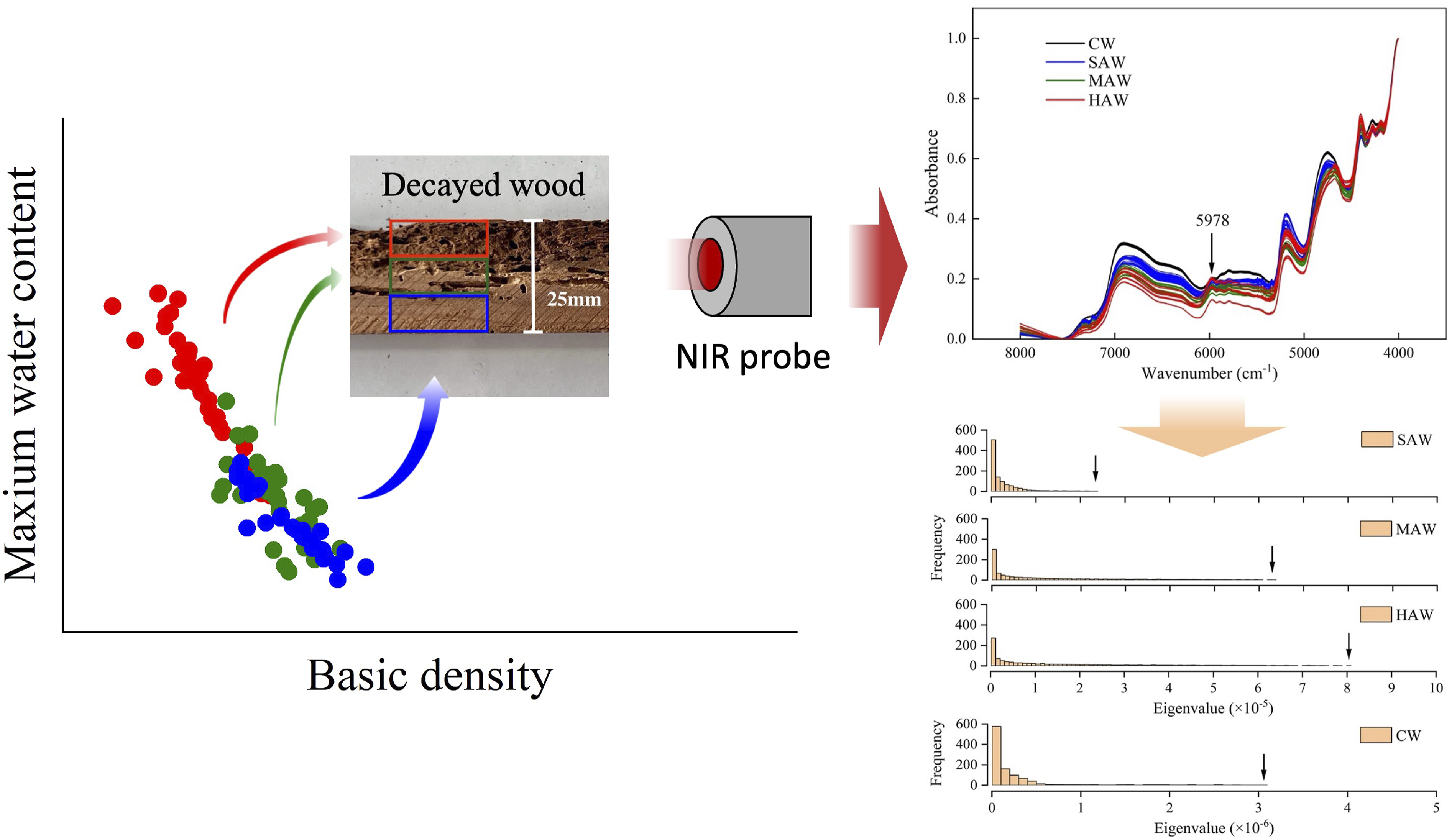
This study evaluated the wood preservation state of archaeological wood timber based on eigenvalue analysis of the near infrared spectral matrix. Near infrared (NIR) spectra were acquired from archaeological wood with different degrees of decay, thereby showing greatly varying molecular configurations in the cell wall. The set of eigenvalues calculated from the variance-covariance matrix created by the NIR data was treated as the Hamiltonian representing the energy eigenstate of the archaeological wood with different decay levels. This variation has been discussed from the viewpoints of thermodynamics and statistical mechanics. The eigenvalues were widely distributed, showing that the spectral data changes in relation to the degree of decay. The gradual increase in the first eigenvalue (E1), equivalent to the Helmholtz free energy, indicates that the heavily decayed archaeological wood system was likely to change to a more unstable state. The probability corresponding to each energy eigenstate of the heavily degraded wood timber was steeply distributed compared to the slightly degraded groups. The Helmholtz free energy was high, and the Shannon entropy low, in the heavily decayed archaeological wood timber. The variations in Shannon entropy and density matrix with degree of decay reveal structural instability in all of the groups. The results obtained in this study provided concrete data on the relationship between the physical properties (i.e. basic density and/or maximum moisture content) and the degree of wood decay, while the first eigenvalue and/or Shannon entropy obtained from the NIR spectral matrix provides a potential parameter to assess the degree of degradation of archaeological wood timber.
Keywords
Get full access to this article
View all access options for this article.
References
Supplementary Material
Please find the following supplemental material available below.
For Open Access articles published under a Creative Commons License, all supplemental material carries the same license as the article it is associated with.
For non-Open Access articles published, all supplemental material carries a non-exclusive license, and permission requests for re-use of supplemental material or any part of supplemental material shall be sent directly to the copyright owner as specified in the copyright notice associated with the article.
