




Abstract
This article explores how labour regulation functions as a core instrument within Italy’s securitized migration management regime, framing migrants as security threats through processes of material and symbolic dispossession. I introduce the concept of securitization by dispossession to demonstrate how systemic overexploitation, underpayment and structural precarity dispossess migrants and transform them into a distinct and marginalized labour category. Through a genealogical analysis, this study uncovers the enduring entanglements between labour policies, migration control, and Italy’s colonial legacies, exposing how contemporary governance perpetuates colonial patterns of racialized exclusion. By rethinking securitization through labour, the article offers new insights into the intersection of neoliberal economic imperatives and migration management while contributing to ongoing debates on racialized securitization and strategies of critique.
Introduction
In 2018, the brutal murder of Soumalia Sacko, a young farmer and trade unionist of Malian origins, in southern Italy sparked a wave of protest. Industrial actions, strikes and picket lines spread quickly across the country. The protesters voiced a powerful, paradigm-shifting message: we are not threats; we are all workers. They reclaimed their working-class identity to detach their subjectivity from territorialized claims and racialized arguments that portray them as dangers and resist Italy’s systematic ostracism and marginalization. Within their rhetoric, labour acts as affirmative ontology, which does not deny intersectional vulnerabilities and situates belonging in relation to the comradeship of the workforce, regardless of birthplace and skin colour. Migrant workers demanded recognition as political subjects through an act of self-affirmation that reasserted their belonging to the local work community. Resistance, after all, is a process of subjectification that challenges structural exclusion (hooks, 2014).
I have been following and studying these protests since their emergence and noted – like others before me (de Vries, 2016; Stierl, 2018) – that the contexts in which they mature tend to be characterized by securitized migration management regimes (MMR), which demonize and persecute human mobility as a threat to national security. Transformed into a menace, migrant workers face coercive and punitive policies allegedly designed to protect the state’s security.
The protesters’ explicit attempt to redefine subjectivity through labour targets the political core of securitization as a system of categorization and differentiation that produces governable subjects. Their resistance represents a process of subjectivation – an active redefinition of identity that defies securitized frameworks dictating social hierarchies and relationships (Foucault, 1982; Massumi, 2002). Yet, the promise of labour as a site of redemption remains precarious in neoliberal societies, where these processes of subjectification are deeply embedded within structural dynamics that limit individual agency. As this research shows, the regimes of security, mobility and labour reveal more patterns of continuity than divergence, further entrenching the systemic forces that shape and limit self-definition.
In this article, I explore how labour is a structural component of Italy’s securitized MMR to construct and manage migrants as security threats. Focusing on labour – both as an analytical lens and as a material reality shaping subjectivities and social relations – highlights how Italy controls, coerces and displaces through logics and mechanisms borrowed from beyond the traditional security realm. I am interested in how labour regulation within MMR dispossesses migrants both materially and symbolically; overexploited, underpaid, segregated and constrained by structural precarity, migrants are made into a different type of worker. This process, which I call ‘securitization by dispossession’, reveals that the construction and management of threats inherent to securitization are achieved through socio-economic deprivation. I argue that Italy’s MMR establishes forms of working as constitutive of forms of being, where dispossession is strategic to securitization: by dispossessing specific categories of workers, it securitizes specific categories of migrants. This dispossession alienates migrant workers from the local workforce and broader communities, embedding a securitized subjectivity that morally and pragmatically justifies the punitive and segregationist practices at the core of securitization.
Theoretically, securitization by dispossession transcends the conventional framing of securitization as merely a meaning-making, coercive, or disciplinary project and emphasizes the interplay between structure and agency in producing securitized subjectivities. While it foregrounds securitization as a process of subject formation, it situates subjectification within the material conditions that shape how individuals experience and internalize imposed subject positions. This perspective challenges the linear view of securitization as simply causing othering and alienation. Instead, it highlights how socio-material dispossession may pre-configure the categorial diversity that facilitates the formation of securitized subjects. The main theoretical goal is to reformulate securitization in a move that goes beyond securitization theory (ST). Through labour, it is possible to see securitization as part of a continuum of violence, which surpasses security, transcends exceptionality and historicizes its discrimination.
By decentralizing the attention from security needs, discourses and practices, I explore the diverse socio-material formations that threat construction and management mobilize. My intent differs from early securitization studies; by studying labour, I do not search for ‘novel’ referent objects or broadened security agendas (Alker, 2005; Charrett, 2009). I do not seek to impose securitization; put simply, I do not argue that labour is securitized. Instead, I suggest approaching securitization through its ability to dialogue and intersect with other hierarchical orders, producing relational assemblages that transform its essence, timeliness and spatiality.
To avoid the trap of merely describing these assemblages, I recognize that such dynamic interactions demand intervention across multiple analytical levels. Writing labour into securitization enables the reinsert of contingent relations of violence and coercion into broader cycles of socio-material dispossession. It also requires rethinking migration regimes from one of its most important root causes, namely Western economies’ persistent demand for cheap labour (De Haas, 2023). This demand is historically rooted in the intercontinental displacements driven by European colonial expansion to sustain exploitative labour systems (Van Den Boogaart and Emmer, 1986), a legacy that continues to reinforce global hierarchies and shape contemporary migration patterns and labour markets.
Inspired by recent debates on the Eurocentric and civilizationist assumptions underpinning the ST framework (Gomes and Marques, 2021; Hansen, 2020; Howell and Richter-Montpetit, 2020), I propose countering its epistemic limitations by shifting the analytical focus away from security itself. By centring the analysis on labour, I reveal how contemporary MMR mirrors colonial industrial relations, operating as a mechanism that perpetuates securitization. This perspective challenges the structural presentism prevalent in securitization studies by situating the ongoing mechanisms of securitization and dispossession within the enduring legacies of colonial power structures.
In Italy, labour within MMR acts transversally, intersecting the political economy of immigration with the desire for control and discipline typical of securitization and a racialized social order inherited from colonialism. Paying attention to the colonial gradient is particularly relevant for the case of Italy because it brings to the surface the heritage and persistence of coloniality in a country that has removed its imperialist past from its collective memory (Lombardi-Diop and Romeo, 2012; Pes, 2012; Visconti, 2021) and historiography (Veracini, 2018).
Italy’s colonial ambitions began in the late 19th century, shortly after nation unification, with the acquisition of Eritrea in 1882 and Somalia in 1889. The annexation of Libya in 1911 marked a strategy to expand Italy’s colonial foothold in North Africa. During Mussolini’s Fascist regime, these ambitions peaked with the invasion of Ethiopia in 1935, culminating in the creation of Italian East Africa, uniting Ethiopia, Eritrea and Somalia into a single colonial entity designed to entrench settler colonial frameworks and intensify labour extraction from the local population.
While less expansive than the empires of Britain or France, Italy’s colonial ventures imposed brutal systems of settlement and domination, entrenching global economic dependencies. Labour and industrial relations were integral to these ambitions, serving to assert demographic dominance by relocating Italian workers to the colonies while enforcing systematic exploitation of Indigenous labour through extractivist practices and institutionalized subjugation. The Italian myth of benign imperialism (Del Boca, 2003) continues to obscure the continuity between colonial practices and contemporary migration management regimes, which replicate similar extractivist and exclusionary logics.
Migrant workers protesting securitization today, mostly seasonal farmworkers and former asylum seekers predominantly from Mali, Ghana, Gambia, Senegal, Ivory Coast and Nigeria, may not originate from Italy’s former colonies but are deeply embedded in a broader pattern of European imperialist exploitation. Disproportionately subjected to racialized violence, exploitative labour conditions and precariousness, these workers embody the persistence of colonial logics in global labour hierarchies (Vergara-Figueroa, 2017). Colonial legacies embedded in migration policies – shaped by exploitative agricultural labour, racialized hierarchies and unpaid work – continue to normalize objectification and dispossession, perpetuating practices of exploitation and exclusion that mirror colonial domination.
Methodologically, this article integrates critical policy analysis (Bacchi and Goodwin, 2016; Baker and McGuirk, 2017) with genealogical methods (Kearins and Hooper, 2002; Vucetic, 2011) that use ‘history as a means of critical engagement with the present’ (Garland, 2014: 367). This methodological combination is particularly valuable as it shifts the focus beyond the surface-level rhetoric of overtly xenophobic discourses to examine how racialized logics are embedded within legislation that ostensibly upholds principles of equality and justice. By treating policies as tangible instruments of governance, this approach interrogates the structural and material implications of securitization practices. Genealogical analysis further situates contemporary policies within the historical development of power, revealing how colonial legacies continue to shape governance. While recent studies have highlighted Italy’s colonial undercurrents through narratives of racism (Mainwaring and DeBono, 2021), this combined focus aims to uncover the often-hidden mechanisms that sustain securitization.
Italy is a meaningful case study primarily because it is one of the main entry points for migrants into Europe and holds one of the highest shares of migrant workers across the EU countries (Corbanese and Rosas, 2022). There is solid evidence that the country securitizes migration through alarmist narratives and exclusionary practices targeting non-white individuals (Bello, 2021; Colombo, 2013; Tazzioli, 2021). Moreover, Italy’s shift from an emigration to an immigration country post-1960s economic growth, ignored in public and legislative discourse until the late 1980s, has often become a justification for the country’s inadequacies in managing labour immigration. Yet, 50 years on, Italy’s immigration policy adaptation remains sluggish (Chiara and Frisone, 2021; Hermanin, 2022), revealing a long-standing reluctance to confront migration as an enduring structural reality rather than a temporary challenge.
In my research design, I first selected Italy’s cardinal laws on migration (Table 1). Since Italy’s legislative matter on migration is abundant and complex, branching out in parallel directions and at multiple scales and mostly happening through executive orders, I prioritized the foundational decrees ratified by the Parliament and become laws. Next, I analysed legislative texts alongside primary archival materials on Italian colonial labour law and colonial industrial relations policies and incorporated secondary sources that contextualized these archival findings within broader historical and political frameworks. Finally, I drew on data collected during fieldwork conducted in Calabria, particularly in San Ferdinando, in 2018 and 2019 – a period marked by widespread migrant worker protests, catalysed by the tragic death of Soumaila Sacko.
Key Frameworks of Italy’s Migration Management Regime (1931–2019).
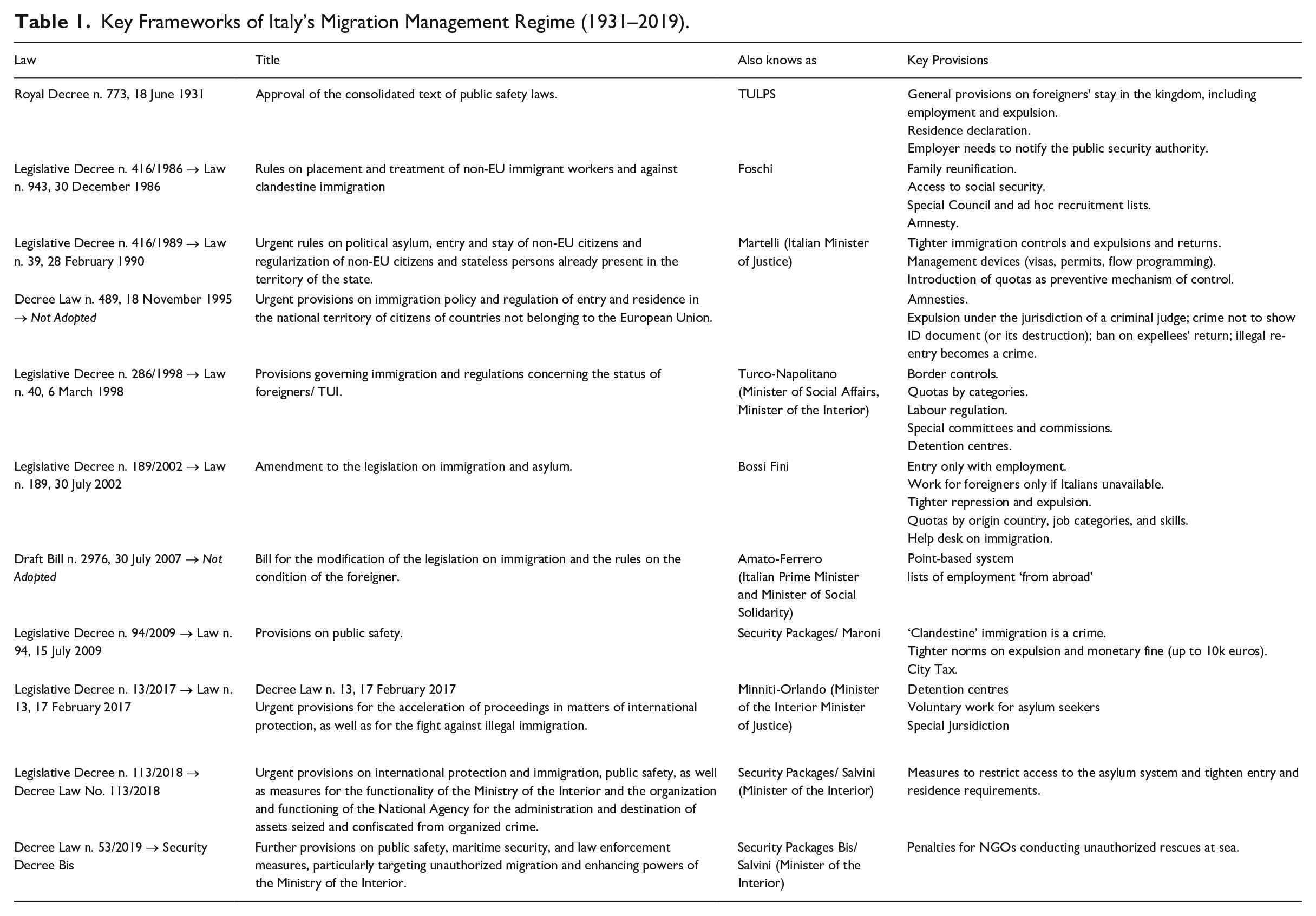
This article proceeds as follows. Initially, it problematizes a view of securitized migration as a by-product of contingent security policies, proposing instead a revision of securitization theory that expands its purview beyond security. It then incorporates Marxian and decolonial critiques to introduce ‘securitization by dispossession’ as an innovative analytical framework. In its empirical sections, the framework is applied to the Italian context, illustrating how labour regulations within the country’s MMR establish forms of working as constitutive of forms of being; these dispossess specific categories of workers to securitize specific categories of migrants.
Securitization entrenched
Albeit its variants (Balzacq, 2011; Bigo and McCluskey, 2018; Buzan et al., 1998), securitization broadly identifies with a process that transforms a political issue into a security concern of the highest priority, requiring utmost resources, stricter control, and extraordinary tools of repression. Central is the notion of exceptionality, which operates both as a rhetorical device to emphasize the extraordinariness of the threat and as a justification for measures – such as emergency laws, bans, and exceptional normative tools – that bypass ordinary legal and institutional frameworks in the name of security. Although not all scholars agree on the negative nature of securitization and suggest contextualization (Roe, 2012; Taureck, 2006), ST is most compelling in revealing how contemporary politics, particularly in liberal democracies, claims to ensure security but often produces violence and inequalities instead. In this context, securitization reflects a decisionist mode of governance where threat construction and threat management enact antagonistic, force-driven power dynamics (Balzacq, 2014), creating zones of inclusion and exclusion in the name of security (Aradau, 2004; Guild, 2009). These boundaries operate at the level of the subject, employing dividing practices of social categorization that not only determine who is recognized as belonging to the nation-state and deserving of protection but also shape the very ontology of subjecthood – defining who is seen as fully human, with inherent rights, versus who is reduced to a condition of disposability and exclusion.
In the case of migration, securitization integrates it into national security strategies, prompting states to enact systems of border control and enforcement aimed at excluding unwanted foreigners. These measures include militarized walls, detention camps, targeted policing, and laws that criminalize migrants and the NGOs that assist them (Goldstein and Alonso-Bejarano, 2017; Huysmans, 2000; McConnachie, 2016; Valle, 2020). Beyond physical exclusion, studies reveal that such securitizing practices actively produce ‘abject subjectivities’ (Tazzioli, 2021: 110), racializing and hierarchizing identities to reframe individuals as existential threats to the national collective. The securitization of migration not only enforces exclusion but also unleashes exemplary violence against racialized individuals, reinforcing their constructed status as threats (Gregory, 2004). Securitizing migrants carries profound social and human costs, from normalizing racism and xenophobia to justifying marginalization and perpetuating the idea that certain lives are disposable (Bilgic, 2018; De Genova, 2009; Huysmans, 1995).
The connection between securitization and race is both evident and widespread. As Danewid (2022) argues, racial violence underpins the exceptional sovereignty central to securitization, with the construction of racialized subjectivities acting as both a precondition and a legitimizing force of its exclusionary practices. Its racialized logic produces unequal freedoms in mobility and transforms MMRs into tools of ‘security-driven racism’ (d’Appollonia, 2017), reinforcing imaginaries of the non-white migrant as a threat to social and cultural stability. In liberal societies, these imaginaries also centre whiteness as a marker of belonging, intertwining securitization with exclusionary national identity narratives rooted in colonial beliefs of white superiority. As De Genova (2016: 90) argues, this heritage positions European migration management regimes as a ‘racial formation of postcolonial whiteness’, restricting mobility from former colonies and enacting segregationist practices rooted in racial hierarchies (Davies and Isakjee, 2019; Rutazibwa, 2010; Thomas, 2021).
The recent debate on the racist epistemological premises of ST (Gomes and Rodrigues Marquez, 2021; Howell and Richter-Montpetit, 2020) has urged scholars to avoid juxtaposing securitization against conventional liberal politics, attesting once again to ‘the constitutive nature of coloniality in European security’ (Hoijtink et al., 2023: 335) and calling out the different forms in which racial violence and injustice are ingrained in liberal democracies. To theorize securitization as detached from liberal governance is to overlook its profound entanglement with the construction of threats and the routine enactment of marginalization and exclusion, both of which are embedded in the foundational dynamics of liberal political systems.
Building on this critique, I argue that overcoming this issue requires rethinking the relationship between securitization and racism beyond racial biases and othering narratives. This relationship extends beyond the discursive legacies of colonialism or a reflection of contemporary xenophobia and racist nationalism. It is also intricately tied to the material processes of imperialist extraction and accumulation, which securitization both depends on and perpetuates.
In the course of my research with migrant workers, I observed that their condition as racialized labourers, forming a globally fragmented, displaced and disposable workforce, consistently highlighted the systemic and everyday exploitation they endure beyond contingent securitizing practices. This condition is indicative of the inescapable constitutive nature of property in processes of subject formation. Dispossession, commodification and the political-economic interplay of class inequalities and resource management hold ontological significance in categorizing individuals, shaping social relations and influencing localized histories (Appadurai, 1995; Salemink and Rasmussen, 2016). Whereas ST successfully captures the production of dangerous subjects through language and power structures, it risks neglecting and decontextualizing the material aspects of this subjectification. This dynamic is further illustrated in my case study, where I noticed that the transformation of a specific category of migrants into a distinct type of workforce often bypasses conventional practices of threat construction and management. The devaluation, segregation and criminalization of specific collectives are not merely based on demonizing the other through exclusionary identity politics but are also deeply embedded in broader forms of structural domination and material dispossession that are performative of macro-political and economic structures.
Core elements of global capitalism’s modes of production and reproduction remain deeply tied to colonial legacies and industrial relations. Colonial systems of extraction, grounded in land expropriation and labour exploitation, have been reconfigured through privatization, outsourcing and modern forms of slavery. These structures sustain and reproduce global economic dependencies, which in turn perpetuate conditions of scarcity and deprivation in formerly colonized regions, driving migration (Gonick, 2021). These processes shape relationships with the state, economy and society by determining access to resources, labour opportunities and legal protections, thereby reinforcing systemic inequalities and hierarchies rooted in colonial legacies. Hence, the critique of ST must reckon with the fact that, as Anthias and Asher (2024: 9) assert, ‘decolonization must be a material and political rather than simply epistemic process’. While situating securitization within the normalcy of liberal governance is essential, envisioning alternatives cannot rely on an abstract detachment that ignores its forced entanglements with the material relations of colonialism and capitalism. As Tilley (2024) suggests, focusing solely on epistemic transformation risks sidelining the concrete material demands of decolonial struggles, which, in my research, proved critical for uncovering ST epistemological limitations in the first place. Such reckoning requires addressing the structural and material underpinnings that sustain and perpetuate securitization as part of the liberal order itself.
The focus on the material processes exposes the need for a more robust engagement with political economy, especially with its more recent decolonial turn. ST often reduces structural dynamics to economic rationales driving securitizing acts, which are then reframed within the security realm and interpreted as specific referent objects of national security. In securitization studies, the nexus between neoliberalism and securitization is predominantly analysed through the massive privatization of the national security sector as evidence of an ever-expansive security industry (Abrahamsen and Williams 2010, 2011; Low, 2017). Scholars have rightly shown that securitization is complementary to neoliberalism (Deukmedjian, 2013; Mavelli, 2017): it expands capital, enables accumulation, bolsters corporatism, and reproduces the socio-economic divisions that have emerged out of neoliberal globalization (Ganz, 2021; Massé and Lunstrum, 2016; Neocleous, 2008). However, attention is mainly devoted to capital and its accumulation rather than dispossession and the class and race dynamics attached to it. Consequently, this approach often presents neoliberalism in a reductive manner, as a straightforward trajectory, glossing over its inherent complexities and overlooking the multifaceted paradoxes and contradictions it contains.
The same issue applies to securitization, as ST often remains entrenched in its narrowly defined security domain, focused on security actors, tools and rationalities while neglecting its interactions with other hierarchical systems. In this sense, labour provides a compelling lens to challenge prevailing tendencies in securitization studies, particularly by dismantling the perceived universality, objectivity and uniformity often attributed to securitization.
The struggles of migrant workers, such as those exemplified in the protests following Sacko’s murder, suggest that their experiences of unequal and unsafe working conditions, often leading to forced and involuntary servitude, reveal forms of violence that neither begin nor stop at securitization. The condition of racialized and dispossessed workers situates them within a system of structural exploitation and deprivation, underscoring how property relations remain foundational to shaping social hierarchies and subjectivities. Workers’ experiences suggest that securitization extends beyond the particular and contingent sites of security, absorbing, rejecting and negotiating with alternative oppressive orders. What emerges is a more complex and dispersed picture in which the violence of security exceeds its exceptionality and borrows logics and praxis from outside the security realm.
For instance, ST emphasizes how securitized regimes primarily operate on forms of exclusion – banning, rejecting and blocking certain forms of mobility. However, a focus on labour suggests a more nuanced perspective, in which the effort of excluding migrants from the local society coexists with the paradoxical necessity of including foreign workers because neoliberal economies cannot prescind from outsourced labour.
There is general agreement in political economy that migrant workers play a strategic role in meeting distinct economic and labour demands. During economic growth, they address labour shortages, filling positions locals avoid; in downturns, they sustain critical occupations essential to recovery (Finch and Mulley, 2009; Ruhs, 2012; Ruhs and Anderson, 2012). Yet, their inclusion is fraught. Governance simultaneously depends on and penalizes labour mobility, maintaining a dependency on migrant labour while enforcing its criminalization. As I will show, these ambiguous conditions of inclusion and exclusion are inherently privative, relying on and producing forms of dispossession. Existing frameworks explore these dynamics, often highlighting migrants’ ‘partial’ and ‘differential’ economic participation (Baban et al., 2017; De Genova et al., 2014; Fabini, 2017). Others, however, argue that such contradictions reflect a coherent policy agenda to sustain migrant precarity, ensuring their control, compliance and exploitation (De Giorgi, 2010; Fabini, 2017; Tazzioli, 2021).
What matters here is that these apparent contradictions, rooted in the logic of the liberal order, reveal that the othering practices of securitization are not anomalies but normalized processes, reinforcing critiques of the epistemological foundations of ST.
Security scholars often associate labour dynamics with questions of social security rather than securitization, as labour is traditionally framed as integral to welfare provision and economic stability. Social security policies are perceived as tools for managing societal needs, ensuring redistribution and stability, and are thus seen as distinct from the coercive logics of defence and policing typically linked to securitization (Buzan et al., 1998: 120). This distinction assumes that social security functions within the realm of routine governance, while securitization is framed as an exceptional departure from normal politics.
The power struggles, violence and racialization underpinning the international system also permeate Western social security policies. Long shaped by selective redistributive principles, European governments have used social security to marginalize ‘others’ (Ennser-Jedenastik, 2018; Merkel, 2002). Foucauldian analyses expose welfare and social insurance as biopolitical tools for classifying, controlling and managing subjectivities (Lazzarato, 2009: 112), aligning with securitization’s logic of ‘sovereign exceptionalism and disciplinary normalization’ (Aradau and Blanke, 2010: 44). This reveals an enduring continuity between security as welfare and as policing, obscured by the illusion of distinct logics.
What remains absent is a framework that situates securitization within the broader continuum of the liberal order, connecting it to historical systems of exploitation and dispossession that underpin contemporary mechanisms of threat construction and management. Such a framework would reveal the interplay between securitization and other hegemonic forms of governance, exposing the structural and material continuities of the liberal order. The securitization by dispossession framework aims to address this gap, as I elaborate in the following section.
Securitization by dispossession
Marxian theories link class divisions and economic inequalities in capitalism to the processes of land expropriation and workers’ deprivation of the means of production in 18th- and 19th-century Europe. In this ‘primitive’ act of capital accumulation (Marx, 2004), land and resources were privatized. While large masses of the population were corralled into and made dependent on wage labour, wealth was concentrated in the hands of the asset owners. Capitalism, marked by private property and the perpetual drive for wealth expansion and reproduction, emerged from this dichotomy: the enrichment of elites and the exploitation of the dispossessed masses (Harvey, 2005). Dispossession reveals how access to – or exclusion from – property fundamentally determines individuals’ positions within societal hierarchies, highlighting the violent processes that underpin capitalist development. The forced expropriation of land and commodification of labour were central to the emergence of nation-states as key authorities in capitalist systems. These transformations were enabled by state power, often enforced through coercive measures framed as security, which legitimized and institutionalized these shifts (Di Muzio, 2016; Jackson, 2013; Neocleous, 2008, 2018).
Post- and decolonial interventions have expanded the Marxian focus on the European proletariat by situating dispossession within the broader frameworks of imperialism, settler colonialism and neocolonialism (Chakravartty and Ferreira Da Silva, 2012; Molina, 2014). These analyses trace the origins of such dynamics to early colonial enterprises and medieval European feudal systems, where land enclosures and serf dispossession established hierarchies foundational to capitalist accumulation – hierarchies sustained and codified through systemic racism (Gilmore, 2002; Robinson, 2000).
By foregrounding the colonized experience, these critiques demonstrate that the dispossession and dehumanization of European workers under early capitalism were refined and intensified in the colonies, where the creation of the Indigenous ‘less human’ and exploitable worker was central to its order: ‘the people of Africa were hunted, captured, kidnapped, commodified, trafficked, shackled, deported, tortured, raped, mutilated, and killed, in order to subject them to a permanent regime of brutally coerced labour’ (De Genova, 2023). In the colonies, violence was never mediated, and biologism provided not only the political but also the moral grounds for enslavement and subjugation (Fanon, 2005; Saito, 2020).
Colonial expansion, deeply intertwined with early capitalist development, shaped the modern nation-state by extending its role beyond Marxist interpretations: consolidating domestic control to enable capitalist accumulation while institutionalizing racialized hierarchies on a global scale. This dual function highlights how the state's power to expropriate and commodify was not only central to domestic transformations but also instrumental in establishing a global order predicated on systemic inequalities. The coercive measures legitimizing state power in the capitalist core were mirrored and amplified in the colonial periphery, embedding systemic inequalities into the global order. Security practices, essential to colonial administrations, facilitated resource extraction, labour exploitation and territorial domination – mechanisms that remain embedded in the governance structures of modern states (Mainwaring and DeBono, 2021; Samaddar, 2010, 2017).
Contemporary analyses also challenge the perception of capitalist accumulation through dispossession as purely historical, emphasizing its enduring relevance (De Angelis, 2001; Mitra et al., 2017; Negi and Averbach, 2009; Visentin, 2013). Practices of confiscation, exploitation and segregation have been reconfigured to meet the demands of neoliberalism, ensuring that capital’s relentless drive for accumulation remains deeply rooted in its racial and colonial origins. Robinson (1983) terms this dynamic racial capitalism, highlighting how racial distinctions are not incidental to capitalist expansion but intrinsic to its logic.
More recently, Massé and Lunstrum (2016) have linked capital accumulation to securitization, demonstrating how threat construction and exceptional measures serve to legitimize capitalist expansion and reinforce state sovereignty. Their study on the securitization of conservation demonstrates that framing conservation as a matter of security justifies military-backed expropriation and displacements. This predominantly affects vulnerable communities and serves multiple objectives: it paves the way for profitable wildlife tourism, inflates private wealth, bolsters state elite circles, and ultimately strengthens state sovereignty.
The concept of ‘accumulation by securitization’ introduced by Massé and Lunstrum inspired me to explore its reversed yet complementary dynamic: securitization by dispossession. This framework, which appears to be absent from existing securitization literature, offers a reverse perspective on the interplay between economic processes and security practices. By ‘securitization by dispossession’, I refer to a process whereby threat construction and management are enacted via socio-economic deprivation. Dispossession intervenes in the formation of securitized subjects, pre-constitutes the categorial diversity that renders exceptionality possible, and eases – materially and morally – the punitive and segregationist practices of securitization.
To operationalize this framework, I drew on existing definitions of dispossession, particularly within decolonial perspectives (Brass, 2011; Butler and Athanasiou, 2013; Das, 2017; Gordon, 2019; Quintana, 2022). Dispossession encompasses the erosion, degradation and exploitation of land, resources and autonomy, as well as the systemic denial of social recognition and agency. These perspectives link dispossession to the enduring colonial remnants that persist beyond the formal dismantling of colonial rule, sustained through racial hierarchies and extractive practices foundational to racial capitalism. This lens also facilitates a critical departure from the presentism typical of securitization-focused analyses, including frameworks such as accumulation by securitization.
Through these definitions of dispossession, I identified three interrelated techniques that capture how it operates: separation, devaluation and subjugation, each reflecting distinct but interconnected mechanisms of marginalization and domination.
Separation, the first technique, refers to the severance of individuals from property and ownership, reinforcing structural inequalities and limiting access to means of production under exploitative conditions. It emphasizes material expropriation, such as the loss of land, services and resources, while also encompassing social, emotional and psychological estrangement that fosters alienation (Bayırbağ and Penpecioğlu, 2017; Harvey, 2014). This dual deprivation profoundly shapes individual agency and subjectivity, leaving dispossessed individuals without control over the wealth they produce or the power dynamics they navigate.
The separation from property and ownership central to dispossession is deeply tied to capital accumulation and profit, reinforcing severe inequalities in access to resources, goods and opportunities. As Melamed (2015) notes, accumulation thrives on these disparities, with capitalists controlling production while workers are deprived of subsistence. This dynamic persists in modern labour systems, where profit depends on wage suppression and the demand for cheap labour, often met by migrant workers (Fine and Saad-Filho, 2018). The rise of a cheap foreign workforce cannot be reduced to market functions but must be understood through the cultural and racialized dynamics embedded within the market (Bhandar, 2013; Cross, 2013; Paul, 2012). Occupational segregation and discriminatory practices, as Fays et al. (2021) show, systematically create wage disparities beyond productivity differentials.
These disparities illustrate the second technique of dispossession, devaluation, which assigns differential economic value to workers through social categorization. Racialized hierarchies, where non-white labourers are systematically devalued, are essential to capitalist accumulation, perpetuating inequalities through both economic exploitation and symbolic exclusion (Çağlar, 2022; Kapoor, 2013). Fanon (2005) highlights how racial antagonism overtakes class exploitation, embedding colonial divisions into modern capitalism.
Subordination, rooted in the hierarchical logic of devaluation, represents the third technique of dispossession. It forces dispossessed individuals into positions of reduced autonomy and agency, involving not only the appropriation of value but also the erosion of self-affirmation, often resulting in dehumanization. Thompson and Modood (2022) argue that dispossessed individuals are alienated from their polity, stripped of belonging and self-recognition. In labour contexts, racialized subordination is a legacy of colonial practices, shaped by racist ideologies and the systematic management of industrial relations. Colonial systems framed non-white workers as illegitimate, irrational and less human, embedding these constructs into labour regimes that normalized their exploitation and subjugation (Mignolo, 2009; Moffette and Vadasaria, 2016; Wynter, 2003).
In the following analysis, I apply the concept of securitization by dispossession to Italy’s migration management regime (MMR), examining its dual dimensions. The first section explores the historical and structural entanglements between securitization, labour regulation and colonial legacies, demonstrating how these logics inform contemporary governance. The second section analyses the techniques of separation, devaluation and subordination, illustrating how these mechanisms sustain the securitization of migrant workers by embedding them into precarious and exploitative labour systems.
Labour regulation in Italy’s MMR: Securitization, dispossession and colonial legacies
While there is growing preoccupation around Italy’s securitized borders, migration in the country has always been treated as a security concern. In this sense, Italy’s MMR has been securitized from its inception, always enduring ways of thinking of and acting over threats. Earliest attempts to regulate migration (1889, 1931) inserted foreign presence into questions of public order: as migrants were ‘dangerous social forces’ (RD 6144/1889), migration management prioritized expulsion.
Historically an emigrant nation, Italy’s policy infrastructure during the Fascist era was not designed for managing complex migration patterns but rather for controlling a limited foreign presence. This included mainly servants, workers, soldiers and seasonal farmers, often from Italy's colonies or neighbouring Eastern European countries. Migration policies were shaped by economic protectionism and a Fascist ideology deeply suspicious of foreign influence. By the late 1970s and 1980s, the onset of migratory pressures from geopolitical upheavals in Eastern Europe, Africa and Central Asia did not trigger an immediate transformation of Italy’s MMR. Instead, the regime evolved at a measured pace, with migration legislation remaining fundamentally unchanged between the Fascist-era immigration laws of 1931 and the first structural reforms introduced in 1986.
The securitized logic that treats migrants antagonistically and is sympathetic to managing them through the state’s defence and security apparatus has never been abandoned. Successive legislations have all aimed to manage the ‘migrant threat’ by punishing, repressing and criminalizing mobility, defending borders and policing foreigners. For instance, in the past decades, laws have criminalized undocumented migration (Law n. 94/2009), expanded detention centres (Decree Law n. 13/2017), accelerated deportations (Decree Law n. 53/2019), restricted humanitarian protections (Decree Law n. 53/2019) and increased penalties for rescue operations (Decree Law n. 53/2019).
Securitization has become more pressing and explicit in recent decades, particularly amid growing concerns over rising deaths at the borders and the normalization of widespread racism (European Union Agency for Fundamental Rights [EUFRA], 2023; International Organization for Migration [IOM], 2024). Over time, public discourse in Italy has increasingly portrayed new arrivals as threats to national security, culture and community cohesion, culminating in a more recent narrative that conflates mobility with terrorism and criminality (Ceccorulli, 2024; Colombo, 2017; Galantino, 2022). While authority over migration has historically been non-linear, alternating and overlapping between the Ministry of Labour and the Ministry of Interior, the latter ultimately solidified its dominance in the 2000s, establishing itself as the primary legislative authority. Hence, I argue that rather than introducing securitization, contemporary legislative tools have driven its increasing sophistication, expanding security mechanisms both qualitatively and quantitatively, making repressive techniques more encompassing, precise and punitive. Security interventions have expanded into military operations within and beyond the national territory, cementing migration’s place in national security affairs.
In this context, ST has provided a valuable lens for examining how the ‘migrant threat’ is both discursively and practically constructed. Frequently positioned as a challenge to national security, migration also highlights the state’s efforts to safeguard its perceived social cohesion and dominant cultural identity. This underscores the reliance on securitization as a tool to legitimize exclusionary identity policies and reinforce centralized authority.
By engaging with contemporary interpretations of ST that foreground the transition from constructing threats to managing them, and by seeking to transcend the conventional focus on security apparatuses, I observed that Italy's legislative tools for managing migration extend beyond a purely security-driven framework.
Labour stands as the cornerstone of Italy’s MMR, with all legislation framing migration predominantly through the demands of the labour market and tightly linking migrants’ legal status to their employment. Central to this framework is the quota system, which functions both as a quantitative instrument to control inflows and a qualitative mechanism for conferring legal status. Introduced by the 1986 Foschi Law, which was Italy's first modern legislative intervention on migration since the Fascist era, the quota system has since become the bedrock of migration regulation.
The concurrent regulation of mobility and labour is a characteristic not unique to Italy; it is, in fact, a broader feature of Western liberal nations, where migration policies, despite their differences, are primarily shaped by labour demands. These systems establish increasingly selective mechanisms of access, tying migrants’ rights and mobility to their economic roles. For instance, while the Italian legislations often refer to the ‘migrant worker’ as a broad, undifferentiated category of non-Italian workers, the legal and material conditions determining and specifying the status of the worker reveal a different scenario where not all foreign workers are subjected to the same restrictions or conditions. Similar to most liberal democracies, Italy implements ad hoc regimes, which facilitate entry for high-income and highly skilled workers. These schemes – such as the Digital Nomad Visa, the Investor Visa and the EU Blue Card scheme – create preferential channels that exempt such workers from restrictive measures and bypass many of the bureaucratic hurdles faced by less privileged migrants. Thus, strict migration regulations are primarily enforced on workers who arrive in the country under conditions of severe precarity or remain within it without access to stable employment, social protections or legal pathways to regularize their status.
This pattern reveals that exclusionary practices are not exclusive to securitizing moves but are deeply rooted in liberal governance itself. The shift of emphasis on migration as an economic issue to a security concern depends on this continuity, highlighting how securitization builds on rather than breaks from the logics of liberal political and economic systems.
The focus on labour, as both a symbolic and material force, is key to tracing this continuity. Within Italy’s sociocultural framework, labour holds a uniquely central role in shaping and sustaining national identity, influencing not only perceptions of identity and belonging but also policy arrangements. Influenced by historical labour struggles and movements, the first article of the Italian Constitution (Costituzione della Repubblica Italiana [Constitution of the Italian Republic], 1948) establishes labour as the foundation of the Italian Republic. It ties Italy’s liberal democratic transition and state sovereignty with the commitment to defending workers’ rights. Within national imaginaries, labour also lays the groundwork for how Italians perceive themselves and their country’s role in the world. The nation’s legacy of craftsmanship and industry, dating back to the Renaissance artisans and continuing through the postwar economic boom, has fostered a profound sense of pride in the Italian work ethic. Italian culture highly values the figure of the skilled worker, the integrity of family-run businesses and the prestige of the made-in-Italy label, regarding these as emblems of Italian excellence (Loy, 2009). The reputation of Italians as committed and skilled workers is central to the stories of Italian emigration, where the mobility of nationals is framed through narratives of industriousness and resilience (Gabaccia, 2013).
Nonetheless, the valorization of work in Italy is not a universal celebration of labour but rather a concept uniquely tied to notions of Italianità (‘Italianness’) and the formation of national pride, often excluding those positioned outside this cultural framework. Exclusionary labour narratives and the structural inequalities embedded in labour practices have been widely analysed in the context of the internal marginalization of the South by the industrial North, commonly described as internal colonialism and shaped by processes of racialization (Conelli, 2014). However, their application to external industrial relations, particularly within colonial administrations, has received significantly less attention (Panico, 2024). This is surprising given that labour has served as one of the most pervasive and effective metaphors to obscure the horrors of Italy’s colonial endeavours, acting as a powerful legitimizer of the country’s colonial ambitions during the formation and consolidation of the Italian state.
Italy’s early colonial acquisitions and settlements were established shortly after the nation’s unification in 1861 and became central to the dual processes of ‘making Italy’ during the liberal era and ‘making Italians’ under the Fascist regime. In this context, l’Italianità was performatively constructed to align with the state’s imperialist aspirations, merging capitalist ambitions with entrenched racist ideologies. Both the liberal (1890s–1920s) and Fascist (late 1920s–1941) phases of Italian colonialism projected a narrative of moral virtue and superiority rooted in the image of the Italian colonizer as a committed worker. Italian colonialism was depicted as one of a good kind: proletarian in its essence; done by the workers, for the workers; and in opposition to the exploitative bourgeois imperialism of other European countries. Colonial documents used labels like ‘corporative’ – but also ‘economic’, ‘capitalist’, ‘agricultural’, or ‘entrepreneurial’ – to describe Italian colonial campaigns as a specialized form of labour, purportedly productive of industrial modernity and economic growth (House of Deputies, 1948; Ministero dell’Africa Italiana, 1939; Pasetti, 2016). The colonizer was a worker among workers but gifted with the superior knowledge, skills and capital that justified occupation. Archives on the Fascist propaganda celebrated colonialism as ‘an important project of renovation and progress’ (Ministero dell’Africa Italiana, 1940: 1095), portraying settlers as ‘pioneers of an Empire of Labor’ destined to bring about ‘a period of deep moral, political, and economic change’ in the African colonies, achieved through ‘faith, sacrifice, and fight’ (Barile, 1935: 161).
The rhetoric on the benevolence of Italian colonialism has been passed on for generations (Del Boca, 2003), often citing the abolition of slavery in the colonies as evidence of Italy’s allegedly positive impact on the lives and working conditions of Indigenous peoples (Pergolesi, 1937). A more accurate reading of the colonial archives indicates that while slavery may have been officially abolished, various forms of coerced labour emerged in its stead, which, in many cases, were as harmful – if not more so – than the practices they replaced. These forms of labour were unregulated and subject to the whims of colonial administrators. Collectively, they shared a common goal: to reduce black workers to mere instruments of economic production, disregarding their humanity and rights.
In colonial industrial relations, a model emerged that fused racial identities with land ownership and private property systems, creating an unquestioned social hierarchy between the settlers and the colonized. Despite variations in their colonial regimes (Goglia and Grassi, 1981; Randazzo, 2006), the labour systems in Somalia, Libya, Eritrea and Ethiopia shared key characteristics, primarily in the racialized labour hierarchies that implemented forced labour quotas, exploitative contracts and restrictions on mobility (Miele, 2016; Pergolesi, 1939). These systems also involved widespread land expropriation, disrupting traditional land-use systems and fostering dependency on colonial governance. In Libya, Eritrea, Ethiopia and Somalia, colonial policies systematically deprived Indigenous populations of landownership while granting Italian settlers extensive rights, including free or subsidized land, agricultural equipment and financial support, particularly in the most fertile areas (Noor, 2024). Under Fascism, these systems became increasingly centralized and militarized, driven by Mussolini’s agenda for economic exploitation and social control, leaving a lasting legacy of inequality and dispossession beyond Italy’s imperial era.
The archives reveal a concerted effort to transform proletarian Italian workers into ‘entrepreneurs’, both discursively and materially, to align with the colonial agenda. Propaganda depicted the ideal settler through a moral civilizationalist lens, framing them as disciplined, industrious agents of progress tasked with bringing modernity to the colonies. To ensure this ideal became a reality, settlers were carefully selected from among farmers, craftspeople and professionals such as engineers and pharmacists, reinforcing the productive image of the colonies (Pes, 2022). Mussolini’s documents further emphasized these qualities, portraying settlers as embodying the ‘strength, vitality, and sobriety’ central to the Fascist vision of racial superiority (Podesta, 2011).
Recent studies on Italy’s colonial industrial relations, however, challenge this binary framework by exploring the precarious position of unskilled Italian workers within settler colonial contexts (Ertola, 2020). In a stark reflection of colonial biases, administrative records describe these workers in dismissive and derogatory terms as ‘a mass of people burdened by grueling and dangerous work … more or less coexisting with the Indigenous population … resembling a crowd of ragged, starving individuals’ (quoted in Pes, 2022: 54). These workers, far from consistently benefiting from the privileges of whiteness, often found themselves on the fringes of settler society. Their lack of land ownership, which fostered their physical and social proximity to the colonized, unsettled their racial status and undermined the colonial order’s claims to white superiority. This anxiety precipitated processes of ghettoization, surveillance and forced repatriation, as the Fascist administrations sought to control and repress this working-class mass, preventing it from collapsing into the same category as the colonized.
This suggests that framing social categorization solely through racialized identity construction seems inadequate. What emerges is once again the foundational role of property relations in structuring the material inequalities and socio-economic hierarchies that underpin and are intertwined with the relational processes of subject formation. Thus, discomfort with poverty – or more precisely, the anxiety to preserve material and symbolic boundaries – becomes central to understanding the interplay between property relations, socio-economic hierarchies and racialized subject formation. These mechanisms of exclusion and regulation, foundational to colonial regimes, continue to manifest in modern systems through foreign worker categories and segmented labour markets.
For instance, during my ethnographic work in Calabria, where Sacko’s killing brought renewed attention to the struggles of migrant workers, union leaders highlighted how the demands of migrant labourers, such as access to housing, transport and basic welfare, echoed the grievances of local impoverished communities, whose members similarly grappled with precarity and exclusion.
Italy’s colonial endeavours and its current MMR reveal striking parallels in their approach to addressing domestic socio-economic tensions and managing internal class struggles. Both frameworks rely on the strategic displacement of social conflict – either onto the colonies or the migrant population – through mechanisms designed to alleviate demographic pressures such as labour shortages and poverty. By presenting colonial and migrant labour as avenues for Italian workers to achieve social mobility and entrepreneurial aspirations, these strategies serve dual purposes: sustaining the country’s economic growth while politically deflecting accountability for socio-economic shortcomings away from state institutions.
At the core of both regimes is the systematic undervaluation of colonial and migrant labour, treated as a disposable and easily exploitable workforce. This exploitation is not incidental but integral to a broader model that positions migrants and colonial subjects as tools of economic productivity while simultaneously shielding political leadership from blame. These practices cultivate national cohesion by uniting collective identity around a shared national project, achieved at the expense of racialized subjects, who are scapegoated for societal challenges yet remain indispensable to sustaining privilege and reinforcing systemic inequality.
This perspective highlights the importance of developing a framework that situates securitization not as an isolated act of criminalizing mobility but as a process deeply intertwined with the broader structures and logics of the liberal order. In this view, precarity and vulnerability should not be understood as merely contingent outcomes of exclusionary securitized regimes but as deeply embedded in systemic patterns. Drawing on Butler and Athanasiou’s (2013: 5) assertion that ‘we can only be dispossessed because we are already dispossessed’, I propose that the analysis of dispossession must necessarily adopt a genealogical perspective, tracing contemporary marginalization to enduring cycles of socio-economic deprivation. The differential inclusion of migrants, characterized by their selective incorporation into the socio-economic fabric and maintenance in a state of controlled vulnerability to serve economic and political agendas, is not, in fact, a recent policy strategy. Italy’s colonial industrial regime provides a critical historical antecedent. During Fascist colonialism, for example, the administration of Italo Balbo explicitly formulated a ‘differential inclusion’ strategy aimed at incorporating Libyans into colonial governance and labour systems through selective rights and measures while maintaining racial segregation and exploiting Indigenous labour for agricultural and pastoral activities (Miele, 2016: 184). Securitization, as a politics of dealing with the other, relies on dispossession to materialize boundaries of belonging and to constitute subjects as threats. Before being securitized, migrant workers are primarily dispossessed, as a move that not only justifies their securitization but also renders their exploitation as labourers more acceptable and functional to the system.
Building on this discussion, the next section illustrates how the processes that construct migrants as security threats are intrinsically shaped by, and fundamentally dependent upon, their dispossession as labouring subjects.
Strategies of dispossession: Separation, devaluation and subordination in the Italian MMR
Italy’s primary regulatory mechanism for managing migration is its quota system, which sets numerical caps on the number of individuals legally allowed to enter the country. The Foschi and Martelli Laws institutionalized quotas within a fragmented attempt that failed to resolve the unequal treatment between Italian and foreign workers, criticized as contravening both constitutional principles and international labour standards, such as those outlined by the International Labour Organization (ILO, 1975) Convention. This inadequacy prompted reforms such as the 1998 Turco-Napolitano Law, which introduced a centralized framework for managing migration that remains foundational to Italy’s immigration policy today. However, rather than eliminating disparities, the law perpetuated inequalities by regulating migration through labour, aiming to curb irregular arrivals by tying entry permits to specific job categories, especially low-wage and physically demanding professions.
While often perceived as quantitative tools to set measurable ceilings on migration, quotas are, in fact, intricate mechanisms that actively shape migrants’ legal and social conditions, influencing their legal status, access to labour markets and political agency. Employment-based criteria dominate the quota system, rendering forms of working constitutive of forms of being. This suggests that the capacity and opportunity to work are not only critical determinants of one’s economic and legal status but also deeply tied to one’s very being – shaping not only social identity but also the fundamental ways in which existence is recognized and valued. Hence, the subjectification of the migrant as a threat under securitization is inseparable from the foundational processes through which the migrant worker is made into a labouring body and, through dispossession, is tethered to a condition of perpetual precarity within the labour market.
Subsequent legislative amendments, such as the Bossi-Fini Law, further entrenched the exclusionary nature of labour regulation within the quota system by limiting entry to migrants already in possession of an employment contract (art. 5-bis). Losing a job gives migrants a limited time to find new employment, after which they risk falling into irregularity (art. 5) – a system that has left many undocumented even after years in Italy.
The quota system, while superficially rooted in a utilitarian logic of matching labour supply with demand, often deviates from economic realities, reflecting political contingencies and ideological imperatives. Despite growing labour demand, the quota system has steadily curtailed the issuance of permits and, at times, suspended them altogether, as witnessed in 1982 and 2009, highlighting a shift in quotas from preventing inflows to enforcing outright prohibitions. As quotas consistently fail to address the country’s actual labour market demands, organic amnesties have become the most important channel for legal admission. Since the criminalization of unauthorized entry in 2009, amnesties have functioned as a pragmatic workaround to reconcile economic necessity with restrictive policies, while preserving the notion of migrants’ moral and political culpability. Within this hyper-punitive framework, illegality is portrayed as an inherent fault, shifting responsibility for unauthorized status onto migrants themselves.
At the same time, the rationale behind quotas draws on demographic arguments, positioning migration as a tool for population management aimed at maintaining perceived social and economic balances. This reliance on demographics is not new. In colonial contexts, quotas were instrumental not only in regulating the movement of workers and settlers but also in justifying the demographic transformation of colonized territories. Settlements in Somalia and Libya, for example, exemplified how demographic policies during the colonial period sought to address population ‘imbalances’ by presenting colonies as outlets for surplus populations from the metropole (Podesta, 2011; Urbano, 2017; Veracini, 2018). This approach, framed within the broader ideological strategy of ‘valorizzazione’, justified Italy’s colonial ambitions by presenting demographic policies through a dual-benefit rhetoric that depicted worker mobility as mutually advantageous (Ministero dell’Africa Italiana, 1939). Colonial propaganda, notably from the Ministero dell’Africa Italiana (1940), characterized these efforts as entrepreneurial and transformative, promoting the modernization of colonies while obscuring the exploitative dynamics that privileged Italian settlers and reinforced racial hierarchies.
Over the years, the rhetoric of dual-benefit (Massi, 1940) has largely vanished, yet migration policies remain deeply rooted in managing perceived population ‘imbalances’, subtly mirroring colonial logics of demographic control aimed at safeguarding Italy's numerical and racial identity. Such policies tap into anxieties over racial replacement (Marchesi, 2016; Quassoli, 2024), perpetuating a selective framework. Since the Turco-Napolitano Law (art. 22), preferential quotas have explicitly reserved entry for workers of Italian origin up to the third degree of descent and for individuals from politically aligned states, while enforcing harsher penalties on migrants from nations with weaker migration controls. This approach reflects a continuation of colonial-era practices, where ethnicity and socio-economic status determined social hierarchies and access to rights. Just as colonial policies elevated Italian settlers as ideal citizens through their ethnic and national identity, contemporary frameworks similarly prioritize ethnic and political ties in regulating migration and access to legal status.
Unlike the colonial-era practices discussed earlier, which openly justified migration through dual-benefit rhetoric and direct involvement in the colonies, the contemporary MMR shifts its focus entirely to meeting domestic labour market demands. This marks a distinct departure from any postcolonial responsibility, emphasizing instead a prioritization of national interests. Direct justifications have become obsolete in a global economic order where resource and labour extraction persist indirectly, facilitated by unequal trade agreements, debt dependencies and exploitative labour practices.
Historically, this logic of separation and extractivism was designed to exploit Indigenous labour and resources, reshaping social and racial hierarchies to serve colonial interests. Labour and land were the cornerstones of Italy’s settler colonial project, which aimed to construct a permanent white society through the appropriation of Indigenous land – a process achieved by displacing, confining or physically eliminating Indigenous populations (Wolfe, 2001, 2006; Veracini, 2010). Today, Italy’s migration legislation reproduces this logic of separation, enforcing measures that render migrant workers’ status permanently transitory and migration inherently temporary. Over the years, Italian laws have progressively shortened work permit durations (Law 189/2002, Decree Law 113/2018), complicated residency processes (Law 189/2002, Decree Law 113/2018), restricted family reunification (Law 40/1998; Law 189/2002), facilitated expulsions and blocked access to social and legal safety nets (Law 189/2002, Decree Law 113/2018). Also, the denial of access to land still manifests in multiple ways for migrants: they tend cultivated fields, houses or infrastructure projects that they cannot legally claim, while the land on which they reside remains physically restricted, qualitatively degraded, and subject to cycles of destruction and reconstruction that perpetuate their precarity. The story of Soumaila Sacko exemplifies this pervasive reality, reflecting the conditions of thousands of migrant workers confined to ghettos and slums, forced to endure overcrowded and unstable living environments that reinforce their social and economic marginalization.
Precarity is intrinsic to quotas’ qualitative criteria, which favour temporary over permanent jobs; seasonal work often benefits from exemptions to restrictive laws. As entry conditions tighten and quotas shrink, seasonal workers encounter more lenient norms and higher limits. For sectors such as tourism and agriculture, where 90% of jobs are seasonal and foreign (Nomisma, 2022), these quota exceptions reflect a structural reliance on racialized labour, reinforcing a labour market that systematically channels migrants into low-productivity, minimally innovative sectors.
Policies such as the Bossi-Fini Law (2002), the Maroni Security Decree (2009) and the Salvini Security Decree (2018) further institutionalized precarity by reducing residence permits and tightened family reunification requirements.
Furthermore, precarity is perpetuated by an ongoing lack of long-term planning. While the 1998 law required governments to issue ‘Flow Decrees’ guided by three-year plans outlining quota size and composition, this approach was quickly dropped after the last plan in 2004 and replaced by annual decrees, which make migration management inherently short-term.
Prevailing interpretations frame institutionalized precarity as a consequence of emergency-driven logics and securitization efforts (Canavesi, 2019; Caponio and Pavolini, 2008; Caputo, 2008; De Marco and Pittau, 2013; Einaudi 2007). Critics often view this as a reflection of improvisation and inefficiency, stemming from the lack of a unified migration governance system – a challenge shared by other Southern European countries – which perpetuates perceptions of disorganized and reactive policy frameworks (Devitt, 2023; Finotelli and Echeverria, 2017; King and DeBono, 2013). Additionally, frequent legislative changes are argued to exacerbate inconsistency and further undermine systemic cohesion (Loprieno, 2018; Università degli Studi di Firenze, 2019). In turn, a genealogical analysis reveals that precarity and short-termism are not arbitrary but rather deliberate mechanisms embedded within enduring governance structures. For instance, colonial industrial relations were similarly marked by a lack of planning. In Somalia, the fragmented and reactive nature of colonial governance was a strategic tool of control, allowing the Italian administration to retain flexibility in managing labour and resources while asserting dominance (Urbano, 2017). Much as colonial administrators leveraged the illusion of planning to legitimize their authority, contemporary migration management employs annual quotas as a façade of control, sustaining institutionalized precarity while evading the need for structural transformation.
Rather than reflecting fragmentation, Italy’s migration system reveals a deliberate coherence, intentionally structured to perpetuate precarity through mechanisms of separation and exclusion. The recurrent use of amnesties, often misconstrued as ad hoc responses to a disjointed system, instead highlights a purposeful strategy: producing and managing instability as an integral feature of governance.
Separation does not operate in isolation but leads directly to devaluation, transforming labour exploitation from an extractivist logic, focused on extracting value from resources and bodies, to one of degradation, where the worker is stripped of social worth and political agency. In colonial contexts, land expropriation and labour segmentation were intertwined mechanisms that not only ensured economic extraction but also assigned differential value to labour based on racial hierarchies. Italian settlers occupied skilled or managerial positions, while Indigenous populations were relegated to subordinate, expendable roles (Pes, 2015). Spatial and legal segregation confined Indigenous workers to exploitative and precarious conditions, as seen in Eritrea and Libya, where displaced populations were forced into labour schemes that primarily benefitted settlers (Bellucci, 2014; Bertizzolo and Pietrantonio, 2004). This devaluation was reinforced by demographic policies, such as racial categorization and forced labour systems, that systematically assigned Indigenous workers the lowest social and economic worth (Podesta, 2011; Urbano, 2017; Veracini, 2018).
Today, migrant workers experience a similar devaluation: their labour is confined to the most precarious and least-valued economic sectors, such as agriculture, domestic work and construction, while their contributions are systematically stripped of recognition, rights and opportunities for upward mobility. As discussed earlier, Italy’s MMR creates increasingly selective mechanisms of access, tying migrants’ rights and mobility to their economic roles. Ad hoc regimes facilitate entry for high-income and highly skilled workers from wealthier nations, who are actively encouraged to relocate. Meanwhile, restrictive migration regulations are disproportionately enforced on workers from the Global South, who are systematically categorized as ‘low-skilled’ to fill labour gaps in low-wage sectors. This enforced categorization ensures their continued devaluation and exclusion, reflecting not their actual abilities but a condition imposed by structural policies. Despite outdated data, studies reveal that many migrants possess higher education and skills that remain unrecognized (Devillanova and Frattini, 2006), leaving them trapped in subordinate roles. The prioritization of seasonal workers reinforces these hierarchies. The alleged unavailability of domestic labour and Italians’ lack of interest in such jobs is not only rhetorical but also embedded in the legal system, which requires proof that no Italians with similar qualifications are available (Law No. 40/1998). Migrants, particularly those facing extreme distress or coming from marginalized backgrounds, are often left with no alternatives but to accept these jobs. For many of these workers, the inability to validate diplomas or professional experience exacerbates these challenges, further restricting access to better opportunities and perpetuating cycles of exploitation.
Over time, labour regulation has further entrenched this hierarchy by creating a parallel jurisdiction for foreign workers, consolidating segmented recruitment systems based on specific placement lists and ad hoc visas. Policies such as ‘employment from abroad’ schemes and category-specific rights restrict migrants’ access to upward mobility, relegating them to roles excluded from pathways to social and economic advancement. This structural marginalization was exacerbated by the Minniti-Orlando Law (Law 46/2017), which aimed to streamline migration governance by introducing expedited asylum procedures and specialized tribunals for migrant cases. Although framed as a measure to enhance efficiency, it formalized a dual judicial framework that undermined procedural guarantees of justice and weakened the principle of equality before the law, further institutionalizing the precarity and marginalization of migrant populations.
Economic status represents another critical dimension of devaluation. Since 1990, legislation has imposed financial benchmarks tied to criminal provisions for deportation, expulsion and pushback. Minimum income thresholds determine eligibility for entry, amnesties and family reunification, but function as mechanisms of exclusion rather than inclusion. For instance, Law 38/1990 permitted expulsion and pushback for failing to meet financial requirements. Later laws, such as Law 94/2009, raised thresholds and introduced mandatory costs, such as health insurance and municipal taxes, excluding economically vulnerable groups while framing exclusion as economic regulation. These prerequisites echo colonial efforts to uphold material and symbolic boundaries. As Frantz Fanon observed, ‘you are rich because you are white, you are white because you are rich’ (Fanon, 2005: 28).
Building on the extractivist logic of separation and the degrading mechanisms of devaluation, subjugation marks their culmination. In colonial contexts, economic systems relied on a deliberately dependent and tightly controlled workforce, as seen in Somalia, Ethiopia, Eritrea and Libya, where Italian colonialism institutionalized these dynamics through labour systems that entrenched Indigenous subjugation and reinforced strict hierarchies (Barrera, 2003). These systems subordinated Indigenous workers to the demands of the colonial state, not only ensuring economic extraction but also consolidating domination through the systematic denial of agency, autonomy and access to resources.
Today, migrant workers experience a similar structural dependency, though the mechanisms of enforcing it have evolved. In the 1990s, the MMR introduced sponsorship under Law No. 39/1990, which allowed individuals or organizations to sponsor migrants, enabling them to enter Italy without a specific job offer. Sponsors were responsible for guaranteeing the migrants’ financial and social support, creating a framework of institutionalized dependency. The Bossi-Fini Law abolished the sponsorship mechanism, replacing it with strict labour conditionality that tied legal entry for foreign workers to nominative job offers. This shift deepened migrants’ dependency on employers by making residence permits contingent on ongoing employment. The law, which remains in force, requires foreign workers to sign a formal contract with their employer to obtain or renew their residence permit. This effectively transferred oversight responsibilities from the state to employers, exacerbating migrants’ vulnerability. Losing a job now jeopardizes legal residency, while employers often offset the costs of providing social security benefits by lowering wages, further eroding the economic stability of migrant workers.
This circumstance engenders a legal and economic dependency of migrants on their employers, particularly for seasonal workers, whose livelihoods remain tied to Italy’s seasonal labour demands. Seasonal agricultural labourers, many of whom are migrants from sub-Saharan Africa, depend on intermediaries in ways reminiscent of colonial systems where labourers were bound to concessionaires or landowners. The caporalato system, an illegal but persistent practice in Italy, perpetuates this dependency, with intermediaries (caporali) controlling workers’ access to jobs, housing and wages: caporalato exploits workers’ economic vulnerability, funnelling them into precarious roles where wages often fall below the legal minimum – ranging from €2 to €4 per hour – while forcing them to live in overcrowded and unsafe ghettos. These exploitative conditions evoke colonial labour systems, where hierarchical structures excluded Indigenous workers from rights and governance, relegating them to subordinate roles solely for economic extraction. This historical resonance underscores how labour policies have long been used to entrench inequality and control vulnerable populations. In contemporary Italy, migrants face systemic denial of contracts, health benefits and union representation, leaving them in positions of extreme marginalization. Despite legislation formally prosecuting caporalato (Law No. 199/2016), these measures fail to address the structural precarity and dependency on which the system thrives. Excessive restrictions on legal entry, imposed alongside real labour shortages, create conditions where arriving without regular permits becomes not just a byproduct but a necessity for many workers seeking employment. This dynamic ensures a steady supply of vulnerable labourers who remain reliant on exploitative intermediaries and excluded from formal protections.
A significant portion of migrants apply for asylum or are granted refugee status after their arrival, yet they encounter systemic barriers to meaningful employment. Although asylum seekers can legally work after 60 days of submitting their applications, the restrictions of their residence permits – such as their inability to convert them to work permits and their temporary nature, which limits long-term employment opportunities – combined with the stigma they face in the labour market, often confine them to precarious roles. Recent interventions, frequently presented as progressive policies aimed at fostering migrant inclusion, have instead reinforced subjugation by institutionalizing devaluation and exploitation. For instance, to address labour shortages in sectors deemed unattractive to domestic workers and to integrate migrants into the labour market while minimizing costs, Law 13/2017 allows asylum seekers and refugees to perform unpaid labour in public benefit sectors such as waste management and community services – fields that are typically underfunded and experience high turnover. Although framed as a means of fostering social integration, this policy institutionalizes unpaid work and reinforces the perception of migrant workers as external others. It devalues migrant labour, diminishing its significance and relegating workers to the periphery of formal economies. Echoing historical exploitation, this marginalization is justified through ostensibly benevolent narratives, such as addressing labour shortages in public services. Far from fostering inclusion, these policies deepen separation, devalue contributions, and entrench systems of subjugation and exclusion, reducing workers to mere instruments of economic extraction.
Conclusions
The article critically engages with securitization theory, placing primary emphasis on securitization as a process of subject formation rather than a merely coercive and disciplinary project. Through the concept of dispossession, it argues that the ways in which migration gets securitized do not pertain exclusively to security logic and practices. Instead, it foregrounds securitization as part of a continuum of violence and invites considering how dispossession creates the conditions for securitization to thrive: dispossessed, alienated, deprived individuals are not an unfortunate cost of securitization but the preconditions for its becoming.
Workers’ fight inspired me to develop a philosophical awareness of the performative entanglements of security. The protesters’ claims are a reminder that contemporary MMR are undoubtedly securitized but also reliant on forms of exclusion that are not attributable exclusively to the contingencies of current security policies. Thus, disclosing the vicious relationship between labour and security and placing it in relation to the country’s colonial heritage helped me break with a view of securitization as a malaise of our time. Rather than a tear or a turning point, securitization is a coherent ramification of the liberal, neocolonial order.
Hence, while ‘labour’ – at a superficial level – could appear as a strategic de-securitizing tool to reimagine migrant as part of the workforce that builds the nation, it is not effective in targeting what falls outside/beyond the most apparent manifestations of securitization. More dramatically, securitization cannot be simply reverted because it is not a linear process temporally confined to present politics and discursive constructions. Instead, it is inserted in larger circuits extending beyond contemporary discourses and practices.
In this article, dispossession served as a necessary partner to correct some of the limitations of ST: it decentralizes from security and recommits to a broader critique of power relations beyond any deceitful separations from ‘normal’ liberal politics. Instead of being a moment of exceptional force, securitization by dispossession shows that Italy’s migration management is inherently violent, racist and coercive, even when its violence and racism are not explicitly connected to security policies and even when they are kept hidden and sanitized by the technical language of legislation. Securitization by dispossession argues for analysing coercive securitization in the broader context of a deregulated economy that links migration hyper-criminalization with the creation of an insecure workforce fit for segmented labour markets. As such, dispossession complexifies the causal relationship between securitization and othering by showing that securitized subjects are very often dispossessed individuals. In this sense, dispossession makes securitization cognizant of stubborn realities of discrimination and violence and recalibrates the importance of the structural dimensions of power, which risk getting lost in the micro-politics of power.
Throughout this study, I wondered whether securitization is still a helpful and appropriate framework to grasp the complexity of the processes it addresses and whether it is possible to overcome the enduring tension between different ‘strategies of critique’ (Koddenbrock, 2015), confronting an epistemological quarrel that cyclically preoccupies international relations scholarship (Huysmans and Nogueira, 2021; Jahn, 2021; Selby, 2007).
While critique and reconceptualization are urgent, I still consider securitization an appealing theory. The concept has unique relevance and analytical force: it offers a tool to question security as necessary and self-evident, reveals the illusions and biases that guide security policies, and criticizes the liberticidal and discriminatory measures taken in its name. Its popularity has embedded its terminology in everyday vocabulary and, in doing so, has spread its critical spirit outside books and academic inquiry, instilling doubts about governance. In this respect, I disagree with Howell and Montpetit, who critique the temporal framing of securitization for perpetuating a racialized understanding of security and, as a result, dismiss the framework entirely. To me, the terminology of securitization retains a unique value as a tool for illuminating the insecurities inherent in security practices. When focused on praxis, rather than temporalities, the concept of securitization facilitates critical engagement with political agency and accountability.
Empirical relevance aside, the different foci between securitization and dispossession are, first and foremost, revealing of an epistemological diversity that is often considered to be antithetical and irresolvable, a chasm between strategies of critique: the poststructuralist imprint of securitization foregrounds the situated nature of knowledge and rejects totalizing vocabularies and ontologies, whereas the Marxian root of dispossession targets dominant power relations through recognition of their structural, stable and hegemonic nature. A growing number of scholars suggests less rigidity toward onto-epistemological diversity, approaching it as ‘complementary rather than antagonistic’ (Selby, 2007: 340). This approach operates in an in-betweenness that requires a more comprehensive repertoire of theories and an eclectic mobilization of Foucauldian, Marxian and decolonial perspectives (Brenner et al., 2011; Rankin, 2011).
Yet, these perspectives risk undermining the socio-material dynamics that underpin and sustain extensive political processes. The emphasis on immanent heterogeneity and transformation often leads to the rejection of overarching structures in favour of ‘fractured historical conjunctions and disjunctions’ (Huysmans and Nogueira, 2021). This shift towards micro-politics has drawn scepticism, particularly when it appears to repudiate macro-level dynamics. Straddling the tension between abstraction and complexity, critical theories caution against the ‘overprivileging or fetishization of micro-level interactions’, which risks obscuring the structural forces shaping broader systems of power (Wachsmuth et al., 2011: 742). Ethical engagement with assemblage theories suggests caution towards fracturing totalities because it risks disguising and naturalizing dominant normativities while falling into regressive political thought (Kinkaid, 2020a; Koddenbrock, 2015). In his caution against uprooting categories such as race and racism and structuring logics, Kinkaid notes how the emphasis on transformation and flexibility is itself infused with a neoliberal ethos and a white male subjectivity.
In my analysis, I followed those scholars who suggested foregrounding the context of contexts and retaining a sensitivity toward stability and consolidation (Brenner et al., 2011; Legg, 2011). This is not the perfect or sole path, but it is a route that begins reflexively and requires of the researcher a considerable degree of clarity and honesty towards their normative and political commitments (Asberg et al., 2015; Kinkaid, 2020b; Povinelli, 2016).
Preoccupation over complicit epistemologies better situates the criticism against ST, deprovincializing the debate and revealing that racist epistemology is a much more common problem. This does not redeem ST, but it also denies that troubles begin with nostalgia for a purer framework. In turn, it is a reminder that political thought requires a constant critical and reflexive engagement with its own genealogies, as inevitably embedded in a politics of privilege, which, if ignored, rearticulate problematic feudal beliefs.
Footnotes
Acknowledgements
I would like to express my gratitude to the SECUREU research group for their support and to the EURAC Research Institute for hosting me during a research visit.
Funding
The author received no financial support for the research, authorship, and/or publication of this article.
