




Abstract
This study provides an example of riskification in the economic sector using the case of Australian Prime Minister Anthony Albanese’s speech act as a response to energy price increases in late 2022 and the consequent 2023 Gas Market Code. The speech act claims the risk of energy price increases to the referent objects of Australian households and businesses and justifies the legislation of the Energy Price Reduction Plan Act. This affords the government unprecedented authority to cap wholesale gas price as a measure to increase the resilience of Australia’s energy market towards the risk. The issuance of the Gas Market Code and the delegation of this authority to cap wholesale gas price to the Australian Consumer and Competition Commission are argued to be a form of technocratic exception marked by the practices of routine, seemingly banal technologies of governance, with significant consequences for the issue of accountability. This study suggests that analysing the economic sector from a risk-orientated perspective offers a more insightful approach within security studies. Additionally, introducing the concept of technocratic exception allows for a normative examination of how riskification affects normal, democratic politics.
Introduction
On 9 December 2022, during a press conference at the conclusion of the National Cabinet meeting, Prime Minister Anthony Albanese introduced his government’s Energy Price Relief Plan (EPRP), which consists of four steps to ‘shield Australian families and businesses from the worst impacts of predicted energy price spikes’ (Albanese et al., 2022). These four steps are gas price cap, coal price cap, targeted energy bill relief for households and businesses, and further investment in cleaner, more affordable and reliable energy. Citing international pressures on global energy markets as well as climate and energy policy uncertainty by previous governments as contributing factors to energy price increases, the decision to cap gas and coal prices has been unprecedented in Australian history since the establishment of the National Electricity Market (NEM) in 1998.
In the press conference where he unveiled the above plan, the Prime Minister stated that ‘extraordinary times call for extraordinary measures’ (Albanese et al., 2022), justifying the need to employ these unprecedented measures to address the danger of energy price increase. 1 The Parliament legislated the first and third measures of this plan (the gas price cap and energy bill subsidy) into the Treasury Laws Amendment (Energy Price Relief Plan) Act 2022 (EPRP Act) as an amendment to the 2010 Competition and Consumer Act on 15 December 2022. Based on this act, a price cap of AU$12 per gigajoule and an energy bill subsidy of AU$1.5 billion in total were decided on 23 December 2022. The future determination of the gas price cap was further codified in the Gas Market Code (GMC) issued on 6 July 2023, and this authority is delegated to the independent Australian Consumer and Competition Commission (ACCC). The second measure of coal price cap was legislated by the New South Wales and Queensland state governments, and the last measure of further investment in cleaner, more affordable and reliable energy was to be addressed through other government policies.
This study focuses on the first measure of the gas price cap and argues that this is an instance of riskification in the economic sector. This study elaborates on the nature of riskification in the Prime Minister’s speech in announcing the plan and the following routinization of this plan in the form of the EPRP Act and the GMC. It investigates the product of this speech act (both the EPRP Act and the GMC) as an exceptional means to address the vulnerability of NEM. Furthermore, this study demonstrates how this riskification aims at increasing the resilience of Australia’s energy market through these two instruments. It illustrates how the GMC is a form of delegation of exceptional decisionmaking by the government to a liberally orientated, independent government institution of the ACCC.
This study’s focus on the issue of riskification of the economic sector contributes to the discussion of the place of the economic sector within the study of security. The inclusion of the economic sector in the study of security has been conducted mostly through a securitization framework; however, even in this manner, there has been almost complete ignorance towards the discussion of this sector within the study of securitization (Floyd, 2019: 174). This minimal discussion is owing to the nature of the economic sector. Buzan et al. (1998) argued that the logic of survival in the economic sector is difficult to justify because insecurity is ‘a basic feature of life in a market economy’ (1998: 103). Following the neoliberal logic of the market as an avenue to achieve efficiency, the language of vulnerability, threat and insecurity is part of the competitive aspect of this avenue. Thus, registering an issue as economic security will have to be done on a much stronger, legitimate basis.
Still following the same logic, differentiating between threatening and normal behaviours is much more difficult to do within the economic sector (Buzan, 2007: 192). Wæver (2003) argues that firms, as the perceived main referent objects in the securitization of the economic sector, do not have a legitimate claim to survive in a liberal economy (2003: 16). Recognizing the difficulty of analysing the economic sector from a security perspective, this study demonstrates that analysing this sector through the lens of risk better fits the case of the Australian government’s response to energy price increases in late 2022.
Some instances of securitization and riskification in the economic sector have been investigated within security studies. For example, Best (2017) analyses the securitization of the 2008 global financial crisis, focusing on the role of the political economic logic of exceptionalism in justifying policies taken to address the impact of the crisis. Floyd (2019) locates evidence of economic securitization through an investigation into Russia’s economic blackmail of Ukraine at the beginning of the conflict between the two countries in 2014 and the European Union’s capital control as a condition of a bailout of the Cypriot economy in 2013. She concludes that economic securitization does exist and that the economic sector of security needs to be retained within security studies. Judge and Maltby (2017) investigate the presence of both securitization and riskification in the energy sector among members of the European Union (Poland and the UK are used as examples representing cases of securitization and riskification, respectively) that makes it difficult to create a European energy union.
This study contributes to this body of work by providing a different way of approaching the issue of security in the economic sector through a riskification lens. This study is divided into four sections. Following this introduction, the next section provides a theoretical framework on risk, riskification and resilience. This section particularly investigates riskification, what this means in relation to securitization, as well as its relation to resilience. In this section, two new sets of categorizations of exception (procedural vs. substantive and sovereign vs. technocratic) are introduced to help understand the exceptional aspects of the Albanese government’s policies in its attempt to address the vulnerability of Australia’s energy market to price fluctuations. The third section elaborates on how this riskification occurred by analysing the speech act by the Prime Minister. The following section explains what I refer to as the phenomenon of technocratic exception, where the government delegates the authority to determine the reasonable gas price cap to ACCC, an independent and liberally orientated government institution. This key section therefore connects the phenomenon of risk with a mode of governance whereby a state delegates its authority in making exceptional measures to a technocratic institution. The final section concludes this study.
Risk, riskification and resilience
According to Rasborg (2021: 15), Western civilization started to rationally ponder the concept of risk in the 13th century. This rational treatment of risk comes with the desire to colonize the future (Bernstein, 1996: 15). In this context, a more sociological/anthropological approach to understanding risk takes two main forms of trajectory. The first is on the importance of cultural schemata in perceiving and selecting risk (e.g. Douglas and Wildavsky, 1983) and the second is on the relations between risk and modernity (e.g. Beck, 1992; Giddens, 1990). The publication of Beck’s (1992) Risk Society: Towards a New Modernity in 1986 has intensified the study of risk seen as a consequence of modernity.
The elaboration of risk in Beck’s work is conducted through an understanding of the transformation of Western societies from the stage of simple modernity to that of reflexive modernity, when societies confront their own modernity and its negative consequences (Rasborg, 2021: 90) in the form of environmental catastrophes, health crises, etc. In reflexive modernity, the accumulation of wealth that was the focus in the simple modern stage has given way to the management of the ‘latent side effects’ (Beck, 1992: 13, 19) of the industrialization as the trademark of this early modernity. An interesting part of Beck’s analysis is his perception of risk as, firstly, the negative impact of modernization, the ‘latent side effect’, the very thing that disrupts the stability of the simple modernity stage and the cause for reflexivity, and secondly, as ‘a systematic way of dealing with hazards and insecurities induced and introduced by modernization itself’ (Beck, 1992: 21), a management of risk in the first formulation. Thus, in Beck’s understanding, risk comes with an inclination towards its management.
In its role as a source of societal vulnerability, risk is abstract in nature, increasingly global in origin and impact, and to which therefore it is increasingly difficult to assign causal relations and responsibility (Beck, 1992: 25, 62, 70). For this reason, according to Beck (2011), the effective way to address risk is through the construction of imagined cosmopolitan communities collapsing the territoriality associated with nation-states (2011: 1355). To help with this process, social sciences also need to change by exchanging methodological nationalism for methodological cosmopolitanism and doing away with zombie categories of nation-state, culture and politics (Beck, 2002: 53).
Security studies has responded to this invitation by taking into account the evolving nature of threats that go beyond the binary distinction between domestic and foreign, ‘crime and security’, as well as ‘normal and exceptional political life’ (Petersen, 2012: 710). Particularly due to the 9/11 events, security studies started to treat risk as a new kind of threat that requires a ‘proactive intervention’ (van Munster, 2005: 9) through ‘the prism of precautionary risk rather than the traditional theoretical lenses of [international relations]’ (Aradau and van Munster, 2007: 108). War in a risk age is a ‘proactive risk management’ and no longer a reactive response towards foreign-based threats (Heng, 2006: 19). Critiquing the Copenhagen School’s securitization framework, Petersen argues for the need to reform it to adapt to the increasing prevalence of risks (Petersen, 2012: 710).
This study traces the concept of riskification to that of securitization. Securitization is viewed as a framework of analysis that links speech acts with the creation of a security issue, where the enunciation of an issue as a security one moves it into the security domain (Wæver, 1989: 6). Thus, securitization creates security issues. In a securitizing move, the securitizing actor claims an existential threat to a certain referent object (the unit that is existentially threatened and has a legitimate claim to survival), and a certain extraordinary countermeasure is required to address it (Buzan et al., 1998: 21). The element of the speech act that is the focus of a securitization move is its illocutionary dimension, in which the speech of the securitizing actor creates a security issue (Wæver, 1989: 42) as long as the act meets the conditions of the right grammar of security (the claim of an existential threat towards a referent object and the need for an extraordinary measure to address the threat), the social capital of the securitizing actor, and the alarming nature of the threat (Buzan et al., 1998: 33). The direction of the movement of issues in securitization in accordance with the so-called Copenhagen School (McSweeney, 1996) is linear: non-politicized (where the issue is not part of public discussion), politicized (the issue is part of public debate and requires government decision or policy) and securitized (because of the extraordinary and threatening nature of the issue, it requires government to address the issue outside the normal bounds of deliberative politics). In sum, to securitize an issue is to portray it as threatening to the survival of a referent object and, consequently, provide government with extraordinary authority to address the threat.
Exceptionalism is the logic governing securitization for the Copenhagen School: an exceptional issue (in its capacity to threaten the survival of a referent object) to be tackled using an exceptional measure (in terms of the extraordinary process of enacting it and its extraordinary reach). This is in relation to the employment of Carl Schmitt’s idea of exception and friend/enemy distinction within the Copenhagen School’s securitization framework (Williams, 2003: 512). Owing to the potential abuse of power by the state through establishing the exceptional nature of the threat and granting exceptional authority to deal with it, the Copenhagen School argues for an in-principle need to return security issues back to the political realm through a desecuritization process (Wæver, 1995).
Corry (2012) differentiates riskification from securitization due to the former’s orientation more towards the possibility or constitutive causes of harm rather than direct causes of harm. He proposes a new framework of riskification as a response to the rising occurrences of dangers that do not pose existential threat, are not immediate in their effect, and cannot be eradicated but can only be managed (or ‘risks’). This framework focuses on the construction of conditions of possibility of harm to a referent object, where the logic of precautionary, not exceptional, measures prevail, and with increasing governance and resilience as the measures to address the danger. In the different sort of danger risks pose and in the non-exceptional logic of handling risks lies the difference between Corry’s riskification and the Copenhagen School’s securitization. While the definition of risk, as opposed to threat elaborated above, is widely accepted, some scholars have argued against the deletion of the logic of exceptionalism in talking about risks (e.g. Clapton, 2021; Kirk, 2020).
The riskification approach used in this study combines elements from Corry’s riskification framework, the Copenhagen School’s securitization framework and its critiques, while adding some additional features that would help with our understanding of the process of creating a risk out of the energy price increases in Australia in late 2022 to mid-2023. The first element in this study’s riskification framework is the use of speech act by the riskifying actor. A speech act is required to bring an issue into the public arena and to solicit a form of approval from the intended audiences. While aware of criticisms towards the Copenhagen School’s emphasis on speech act in its securitization framework, especially on its narrow focus on the role of an authoritative actor, only on the moment of intervention, and only on the enunciation of threat (McDonald, 2008: 573–580), this study maintains that in this instance of riskification, the process was indeed initiated through a speech act. Therefore, it is still relevant to seriously look at the elements of threat (or in this case, risk), referent object, and the proposed measures to address this threat presented in speech act to understand the process of creating a risk in this instance.
However, riskification does not stop with speech act. With the embodiment of the proposed measures into law, the management of risk enters into the routinization stage where there is a certain governance programme enunciated and implemented towards a certain governance object (Corry, 2012: 252) as the target of the intervention and may or may not be similar to the referent object. By doing so, this study argues that riskification, like securitization, also involves the day-to-day, routinized enactment of security measures (Aradau and van Munster, 2007; Bigo, 2008; Huysmans, 2004; Neal, 2012) and that incorporating both modalities of exceptionalism and routinization (Bourbeau, 2014; Mavelli, 2013) is useful to obtain a more comprehensive look at how riskification actually takes place.
The third element of the riskification framework employed in this study is the role of audiences and their approval of the riskifying move. The original securitization framework by the Copenhagen School does not pay significant attention to the audience aspect of the speech act, if at all (Balzacq, 2005; Roe, 2008). Salter’s (2008) analysis of the securitization of terror threats and its impact on the authority given to the Canadian Air Transport Security Authority resulted in the categorization of audience: popular, elite, technocratic and scientific; and furthermore concludes that the reception of a securitizing move occurs through ‘a complex play of competing authorities, power metrics, and discourses’ beyond a simple acceptance/rejection dichotomy (2008: 322). This study argues that riskification needs to attend to the audience aspect of the move and will do this by identifying the target audience of the riskifying move and the type of approval needed from each type of audience.
The fourth, and last, element in the riskification framework in this study is the concept of exceptional measures. And to help make sense of the case of riskification move by the Albanese government, two sets of categorizations of exception need to be established. The first categorization is that between procedural and substantive exception. A procedural exception is the suspension of the rules regarding the decisionmaking process in a democracy. This is in line with Schmitt’s (2010: 5) definition of a sovereign as ‘he who decides on the exception’. Schmitt’s focus on the issue of the sovereign when discussing exceptions was evident when he emphasized, ‘apart from the question of content’, the sovereign has the authority to break the democratic rules of decisionmaking (2010: 34). For Schmitt, following this logic, it does not matter what sort of decision is made as long as it is made using the procedural exception of sovereignty; this is the foundation of the procedural exception. An example of the procedural exception at work is when the Indonesian government issued a presidential decree in lieu of law in 2017, which does not require a legislative deliberation and approval until the next session of the Parliament, to effect an immediate ban on Hizbut Tahrir Indonesia (Harijanto and Fozdar, 2023). To fully comprehend the issue of exceptionalism in security studies, however, we also need to supplement this aspect of exceptionalism with that of substantive exception, defined as policies that are, in essence, unprecedented and targeted at eradicating threats or managing risks.
When describing exceptionalism in the context of securitization, the Copenhagen School embraced both conceptions of procedural and substantive exception, although without using the exact terms. For example, Buzan et al. (1998) mentioned the fulfilment of securitization as consisting of both the invoking of existential threats that legitimize ‘the breaking of rules’ (1998: 25) as well as the securitizing actor’s claim for the need to tackle threats of supreme priority using ‘emergency action’ (1998: 26). However, the presence of these two types of exception is never articulated by the Copenhagen School, and to some extent, this has caused confusion in trying to establish the success benchmark of securitization through establishing the presence of exceptions. Floyd (2016), for example, owing to the lack of clarity of what constitutes exception in the Copenhagen School’s theory of securitization, decided to lower the bar to meet the criteria of securitization’s success by describing exception in the above substantive manner: either in the form of new laws passed, the granting of new emergency powers to the government, or the granting of authority to existing government institutions to deal with new issues (2016: 678).
The second categorization is that between sovereign and technocratic exception. As the name suggests, a sovereign exception is one taken by the government to take measures to address the risk at hand, What I mean by a technocratic exception is the delegation of the substantive aspect of government’s exceptional measures to a technocratic institution within a government system. The institution then would perform this function based on its technocratic skills and not on political deliberation. While a sovereign exception can take either a procedural or substantive dimension, a technocratic exception is an authority to decide on this delegated, substantive-only exception by a non-political institution.
While securitization, normally associated with procedural exception, suspends normal democratic politics, the creation of technocratic exception brings the process of riskification, in this instance, to the non-politicized level (Buzan et al., 1998: 23-24). It does this by providing a non-political institution with the authority to make exceptions, a sort of governance ‘without government’ (Dillon and Reid, 2001: 47), which is in line with neoliberal governmentality (Joseph, 2013: 33).
The linkage between liberalism and the role of governance in security issues has been an important topic investigated by scholars focusing on the governmentality aspect of securitization. Huysmans (2004) investigates how the EU embeds a modality of governance to maintain security in the context of free movement of people within its borders. In this instance, the EU exercises tight control on the movement of people from outside the borders into its territory, while internalizing dangers through monitoring technology to profile categories of problematic people in the population. Thus, a supposedly liberal system of free movement of people in Europe contains and requires, in order to guarantee the proper functioning of itself, this security apparatus, working based on technocratic exception, embedded as part of its operation. The freedom of movement within the EU is dependent on the success of this security apparatus.
Investigating the association between the issues of defence and internal security in Europe, Bigo (2008: 38) argues that the region’s mechanics of surveillance provides the impression of freedom to its population while still maintaining a high degree of control over this population. These apparatuses work quietly behind the scenes to maintain the integrity and ensure resilience of the system. This is related to an important character at the base of the operation of technocratic exception – that their success can be deduced from the presence of two factors: (1) the normal working of the system, while (2) their operation remains invisible to the public. This quiet working of the system poses a concern for democratic politics.
In the context of liberal economy, liberalism has a high degree of affinity with risk due to the characteristic of uncertainty attached to the latter and the perception of uncertainty as a strong force to unleash individual creative force (O’Malley, 2004: 29, 59). This is of an important consequence in the way a liberal economy formulates danger as an opportunity to improve the system on which it operates. To address this danger to the liberal system, thus, is to govern risk; and to govern risk is to employ heterogenous, and sometimes seemingly contradictory, types of government technology at the state’s disposal (Miller and Rose, 1990: 11–12). These technologies might involve political and non-political apparatuses and can blur the lines between contradictory objectives of governance (e.g. intervention vs. providing freedom for economic actors) as well as those between ‘public and private, compulsory and voluntary, law and norm’ (Rose, 1996: 38). While on the surface these technologies seem to serve different purposes, they work alongside each other to create a certain effect on the governance object. In this study, this effect refers to the governance of maximum gas price benchmarking in NEM. The Albanese government attempts to achieve this effect through the use of different and seemingly contradictory technologies: direct intervention and technocratic delegation.
The summary of the riskification framework employed in this study is provided in Figure 1. As can be seen from this figure, riskification occurs through a combination of speech act resulting in exceptional measures and the routinized implementation of those measures. By using two novel categorizations of exception, it is understood that while all exception categories are part of a speech act, only its substantive and technocratic dimensions are parts of the routinization aspect of riskification. Furthermore, while the speech act aspect needs an audience and its approval, the process in the routinization component of riskification takes the shape of a bureaucratic process in effecting the delegation of substantive exception from the state to a technocratic institution via regulations.
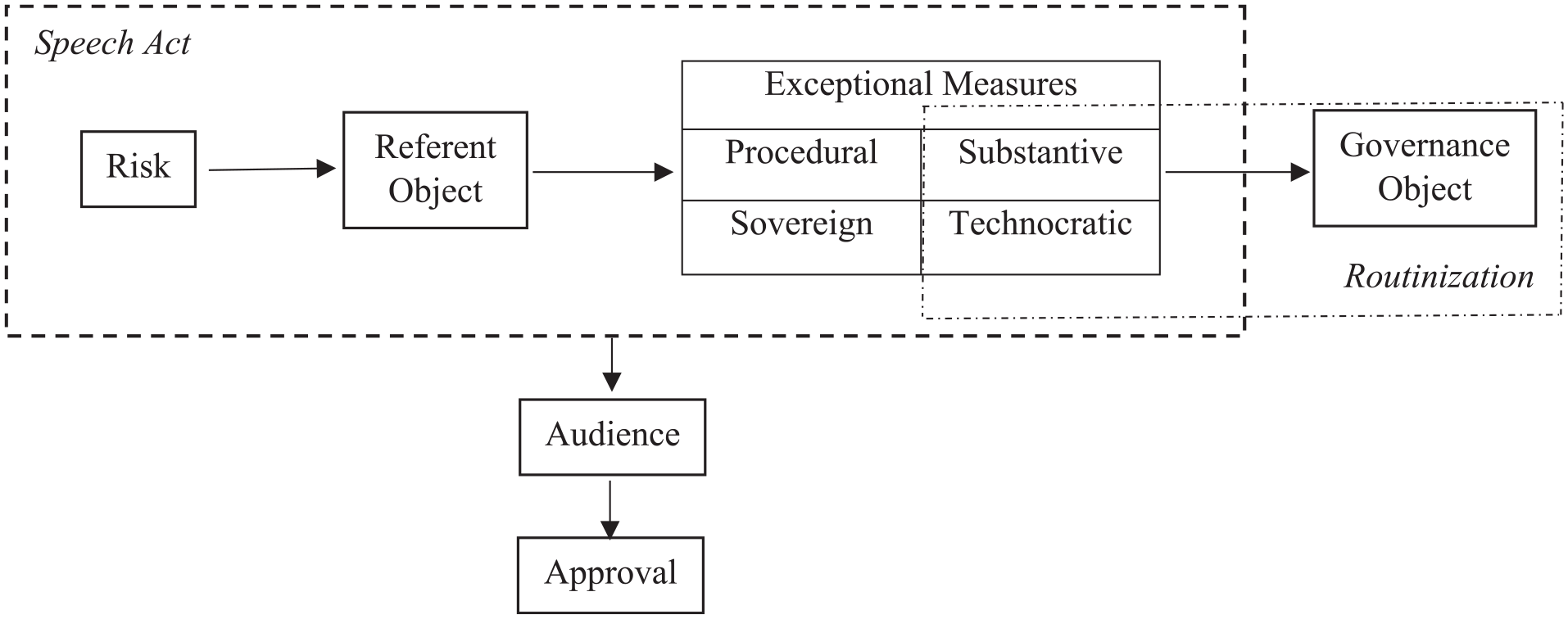
A riskification framework.
Within Corry’s (2012) riskification framework, owing to the constitutive nature of harm related to risks, government policies for addressing risks cannot be in the form of security policy, marked by ‘urgency, short-termism and tackling external sources of danger’ (2012: 248), and these policies instead focuses on improving long-term resilience of the referent object. Resilience, in other words, is the objective of governmentality within riskification and there are two main schools of thought examining the topic of resilience. The first school of thought views it as heavily linked to neoliberal governmentality project, whereas the second one is more open-ended when assessing the normativity and effectiveness of resilience.
Walker and Cooper’s (2011) work on the genealogies of resilience is the first to link the topic of resilience with neoliberal governance in the context of security studies. Their work traces the origin of this concept to the study of systems ecology in the 1970s. Their research maintains that its evolution in various disciplines, including security studies, was in line with the philosophy of Friedrich Hayek and its emphasis on internal adaptation to crises. Outside security studies, those works that link resilience with neoliberal governance include Joseph (2013), Zebrowski (2013), Chandler (2014) and Tierney (2015).
Other works linking resilience with security, such as Bourbeau (2018) and Corry (2014), view the concept of resilience as originating from various disciplines, such as psychology and ecology; thus, they do not necessarily share the perceived neoliberal implication that works such as Walker and Cooper (2011) above argue. This concept has multiple definitions, depending on the discipline in which it is used. For this study, three definitions offered by Bourbeau (2013) in the context of securitization study are used: resilience is defined as the maintenance, marginality and renewal of the system. Resilience as maintenance emphasizes the need for the system to be able to bounce back to its original state after a certain disruption, while resilience as marginality, in the face of a disruption, is willing to adjust the system at the margins only while maintaining the core of the system. Resilience as renewal treats disruptions as a wake-up call to revise the system to adjust to the reality of the world. In the context of this last definition, resilience can be emancipatory instead of sustaining existing governmentality.
Moving from this theoretical discussion and relying on the speech by Prime Minister Albanese in introducing the EPRP, the next section analyses this speech act to elaborate on the riskification of energy price increases in Australia in late 2022. In particular, it explores how the Prime Minister’s speech act describes the dangers related to these price increases as well as the proposition of extraordinary measures to address this danger, using the riskification lens elaborated above.
Riskification of energy price increases in Australia
Three main energy markets operate in Australia: NEM (covering Queensland, New South Wales, Victoria, Tasmania, South Australia and the Australian Capital Territory), the Wholesale Energy Market (WEM) in Western Australia (covering the majority of consumers in the state), and the Interim Northern Territory Electricity Market (I-NTEM). A partial deregulation of the West Australian market was introduced in 2006, resulting in the establishment of WEM. The Northern Territory government still controls the price mechanism through the I-NTEM, and NEM applies the most liberal version of the retail market mechanism in the country through its spot market. The EPRP Act only impacts NEM.
The Australian Energy Market Operator (AEMO) monitors and controls NEM. As mentioned on the operator’s website, some of its roles are to determine the electricity price within NEM based on market demand and the offers provided by electricity generators, and to take steps required to stabilize the market in the event of market disturbances. AEMO set a price cap of AU$300 per megawatt hour on 14 June 2022, as part of its function to stabilize NEM (ABC, 2022b). AEMO made this decision after a price hike in the spot market due to high demand coupled with a decrease in supply availability; however, this decision further resulted in electricity generators reducing their offer in the spot market, which prompted a further electricity price rise and, in turn, forced AEMO to suspend the spot market on 15 June 2022 (Clarke and McElroy, 2022). The price cap was lifted on 22 June 2022, and the spot market resumed on 23 June 2022.
Further increases in gas prices, which accounted for approximately 30% of national electricity production in 2019–2020 (DISER, 2021: 22), forced the government to consider pulling the ‘gas trigger’ (a restriction on gas exports as authorized by the Customs (Prohibited Exports) Regulations 1958 and the Customs (Prohibited Exports) (Operation of the Australian Domestic Gas Security Mechanism) Guidelines 2020) in September 2022. The Resource Minister eventually did not need to proceed with this plan owing to an agreement reached between the government and gas producers in September 2022, whereby gas producers agreed to increase their gas supply to the domestic market (ABC, 2022a). However, the problem did not stop here, and in response to the still-increasing trend of gas prices, the Prime Minister decided to riskify the energy price increases and to acquire approval for its extraordinary measure of the EPRP. This was done on 9 December 2022, when he made an illocutionary utterance
2
in a press conference at the conclusion of the National Cabinet Meeting: I am pleased to announce that there is an agreement at the completion of the National Cabinet on a way forward to provide the energy price relief for households and to businesses.
3
In the same press conference, he further made the following claims: Extraordinary times call for extraordinary measures. And we know with the Russian invasion of Ukraine, what we’ve seen is a massive increase in global energy prices. And because of Australia not investing enough on our own energy assets, what we have is vulnerability to international price movements and that is placing pressure on business here and also on households going forward.
The first thing to be highlighted in this case is the fact that the riskification was conducted through speech act, similar to the Copenhagen School’s securitization framework. This speech act claimed potential vulnerability to two main referent objects: Australian households and businesses. The Prime Minister used the phrases ‘Australian families’ and ‘industry’ in other parts of his speech to refer to the above two referent objects, respectively. The claim put forward here is that these two referent objects are vulnerable to the international price movements of the resources required to produce energy in Australia, mainly coal and gas, and that these referent objects’ economic well-being is under threat from the pressures created by energy price increases due to the international price movements of coal and gas. The focus on these two referent objects, rather than an abstract one such as the national economy, signifies the popular audience (Salter, 2008) targeted by the Prime Minister’s speech act: the Australian public. This is notable, as it shows that riskification in this instance started with a speech act targeted at a specific audience(s) whose approval is needed by the riskifying actor to justify its actions. Moreover, this referent object differs from NEM as the governance object of the extraordinary measures of the EPRP Act and the GMC (more in the next section).
The element of danger in the Albanese speech act relates to risks, instead of threats, that Australian households and businesses will face if the government does not address Australia’s vulnerability to coal and gas price volatility in the market. Based on the above quote, the warning was conducted through a sequence of events: the Russia–Ukraine War and the poor performance of the previous three Coalition governments in the energy and climate sectors increased the energy market’s vulnerability to international energy price movements, which in turn increased energy prices and created pressure for Australian households and businesses.
The risk nature of the danger depicted in the speech act is evident through several observations. First, the causes of the danger cannot be attributed to the malevolent intent of a certain actor to disrupt Australia’s security. The causes of the energy price increases identified in the speech act are ‘not that of an externalized enemy’ and the Russia–Ukraine War and previous governments’ failed energy policies are seen as normal parts of ‘life itself’ (Dillon, 2007: 12). Second, as a consequence of this, the danger reveals itself through the vulnerability of the referent object. Thus, the danger is of a constitutive, not direct, nature. Related to the second observation, the danger in this context does not threaten the existence of the referent object and instead disrupts only its economic well-being. Nowhere in the speech act is the issue of the survival of Australian households and businesses invoked.
Considering these observations with respect to the nature of the danger posed by the energy price increases, this case presents a risk as identified in Corry’s riskification framework. However, contrary to Corry’s framework, this study contends that this decision to implement gas price caps can be seen as an exceptional measure. But in what way is this policy exceptional?
In the case at hand, the exceptionalism in the form of unprecedented policy in both the EPRP Act and the GMC is fundamentally a form of substantive exception. Regarding the procedural exception, however, the evidence does not support its presence. Owing to the urgency of the matter, the Prime Minister recalled members from both houses from their summer break in 2022 to discuss and pass the law effecting the EPRP. The Parliament reconvened on 15 December and passed the legislation without amendment, a quick turnaround for a legislative process in Australia, but the normal parliamentary process prevailed, and parliamentary approval was secured before effecting the policy. In this instance, there was no breaking of decisionmaking rules; instead, what transpired was only an intensification of normal politics to pass the EPRP Act.
As mentioned earlier, Albanese’s riskification speech act was targeted at a popular audience. The first type of audience, the popular one, requires the securitizing actor to (1) emphasize the facilitating conditions in popular imagination, (2) present an oversimplified version of regulatory systems, and (3) misrepresent the level of attainable security (Salter, 2008: 339). In the case at hand, Prime Minister Albanese mentioned two causes of the vulnerability: the Russia–Ukraine conflict and its impact on the massive increase in global energy prices, and ‘nearly a decade of division, inaction, and policy uncertainty on climate and energy under the Liberals and Nationals’ (Albanese et al., 2022). By doing this, the Prime Minister focused on factors external to the government and thus deflected attention away from the question of the government’s own economic performance.
This speech act oversimplified the regulatory mechanisms within AEMO and its spot markets. The potential impact of the gas price cap on the market mechanism underlying AEMO’s spot market and what this means for the probable undersupply of gas in the domestic market and consequently to electricity prices were not mentioned. With respect to the tendency of the securitizing actor to misrepresent the level of attainable security when facing a popular audience, there was neither an allusion to the possibility of complete energy and economic security in Albanese’s speech nor a claim that the EPRP is the quick solution to address the vulnerability. However, the government was certainly upbeat about the potential of the EPRP to protect Australian households and businesses from the adverse impacts of price increases.
The reception to the EPRP varied. Gas producers reacted negatively towards the legislation, with one CEO calling it a ‘Soviet-style policy’ (Evershed, 2022) and the chief executive of the industry group Australian Petroleum Production and Exploration Association describing it as ‘radical’ and would ‘smash investor confidence, [and curb] future supplies’ (Hannam, 2022). We can consider that in general these producers rejected the exceptional measures suggested by the government. This sentiment was shared by the opposition leader, Peter Dutton, who in a press conference immediately after the EPRP announcement said that ‘nowhere in the world has there been any experience of success in capping prices’, and that the price cap will instead push supply down, increase prices, compromise jobs, and jeopardize Australia’s energy security into the future (Sydney Morning Herald, 2022).
Consumer groups, renewable energy groups, as well as the market regulators, however, agreed with these measures. The CEO of Energy Consumers Australia, for example, was optimistic that they would help curtail price increases and bring relief to households and consumers, while the director of Climate Energy Finance praised the price rebate as an important tool to help the poorest hardest hit by the price increases, and the chair of the Australian Energy Regulator (AER), the organization in charge of implementing the National Electricity Rules (NER), argued that ‘even the federal government talking about restrictions had put “downward pressure” on wholesale power prices’ (Hannam, 2022). From the government’s side, there has been a consistent message provided to the public of the efficacy of the legislation, e.g. by the energy minister Chris Bowen on the positive impact of the price cap on reducing energy prices (Borys, 2023).
While the debate occurred in the public arena as a response towards the 9 December announcement of the EPRP, the Albanese government conducted a separate speech act in the Parliament (both the Lower and Upper Houses) to the parliamentarians as its target audience and with the aim to secure their approval for the measures. Similar to the public speech by the Prime Minister, the speech act delivered by the Treasurer in the House of Representatives and repeated by the Minister for Finance in the Senate 4 also designated both Australian households and business as its referent objects. The vulnerability of these referent objects was also associated with the impact of ‘Russian aggression in Ukraine – [a]nd nearly nine preceding years of energy policy chaos here at home’. The non-existential danger and the absence of a clear enemy as the source of the danger is again a mark of the presentation of this issue as a risk. Different from Albanese’s speech act, though, the ones conducted in the Parliament mentioned ‘national economic interests’ as an additional reason for the issuance of the policy. Moreover, this speech act was also more specific. It explained the ACCC’s calculation that led to the AU$12 per gigajoule as the price cap the government decided, as well as the reason behind the designation of the ACCC as the operator of the GMC. This speech act was successful, as the bill passed in both the House of Representatives (81 vs. 45 votes) 5 and the Senate (28 vs. 22 votes) 6 on 15 December 2022.
Gas Market Code and technocratic exception
While there were four strategies enunciated by the Prime Minister in his speech act (gas price cap, coal price cap, targeted energy bill relief for households and businesses, and further investment in cleaner, more affordable and reliable energy), the government focused on the first and third strategies in its EPRP Act. The gas price cap of AU$12 per gigajoule set on 23 December 2022, on top of the provision of AU$1.5 billion for energy bill subsidies, was the result of the riskification of energy price increases by the government. While the EPRP Act authorizes this gas price cap, the GMC, issued on 6 July 2023, normalizes it through the provision of Article 29(2)(b) of the Code, where the ACCC can set a reasonable price (cap) for gas in the future without the government having to renew the legislation. It is this delegation of gas price cap determination to the ACCC that is the focus of this section. However, before we engage this topic further, a short introduction to Australia’s liberal energy governance would be helpful.
Australia started its economic liberalization from the early 1980s to the early 1990s under the Labor governments of Hawke and Keating (Goldfinch, 1999). Liberalization measures were applied to the international trade, currency, financial, fiscal and industrial relations sectors (Castles et al., 1996). The liberalization of the electricity market in most parts of the country commenced in 1998, as mandated by the National Electricity (South Australia) Act 1996, which, in a federated Australian system, became the basis for the nationally managed NEM. The Australian Energy Market Commission (AEMC) and the AER were established in 2005 to formulate and implement electricity rules within NEM, respectively. AEMO was established in 2009 to operate NEM using the NER, last amended in May 2023.
NEM operates based on the logic of efficiency. As mentioned on the AEMC’s website, NEM is designed to ‘promote efficient investment in, and efficient operation and use of, energy services for the long-term interests of consumers with respect to price, quality, safety, reliability, and security of supply’ (AEMC, n.d.). The assumption in NEM is that the market mechanism, as governed by AEMO, is the best guarantee to produce market efficiency and the best result for electricity consumers. Threats to efficiency and to consumer welfare originate from factors outside the market and will require an actor external to the market, especially the government, to identify and address them. To be specific, in this instance, the disruption of the role of NEM in providing the most efficient results for electricity consumers originated from outside the market: the Russia–Ukraine War and the underperformance of the previous three Coalition governments in the energy sector. The Albanese speech act claims these factors as contributing to the risk of energy price increases that threaten energy affordability and, consequently, NEM. The EPRP Act is devised to address NEM’s vulnerability to external risk factors. This is an example of a substantive exception at work through the Prime Minister’s speech act riskifying energy price rises. Thus, it should be understood that while Australian households and businesses are the referent objects in the Prime Minister’s speech act, NEM is the governance object of the EPRP Act.
Further to this decision of substantive exception, through the GMC, the government is delegating this authority to the ACCC, allowing any substantive exception in the future to be decided by a non-political institution. Any future exceptional decision taken by the ACC is an example of what I call a technocratic exception, as opposed to a sovereign exception taken by the government when issuing the EPRP Act and deciding on the gas price cap of AU$12 per gigajoule. In this case of the GMC, the riskification process of energy price increases in Australia has resulted in the creation of a technocratic exception in Australia’s energy market. The decision encompassed in the technocratic exception in this instance is that which was previously taken by government as sovereign.
To provide more details, this delegation of authority was established on 6 July 2023 through the Competition and Consumer (GMC) Regulations 2023, in which the independent ACCC is given the authority to determine a reasonable price in the future when the current gas price cap of AU$12 per gigajoule is no longer considered reasonable (Article 29(2)(b)). Rather than moving the process of determining the reasonable gas price level to the political process, as it did with the EPRP Act, the GMC assigns this role to the ACCC. The ACCC’s role is to enforce the Competition and Consumer Act 2010 and other relevant legislation to promote, according to its website, ‘competition and fair trading, and regulate national infrastructure, for the benefit of all Australians’ (ACCC, n.d.). The result of this riskifying move is the provision of authority to make an important economic decision to a non-political institution without a clear, democratic accountability process.
In the case of the EPRP Act, while the government’s riskifying move to set the gas price cap relies on sovereign exception, the delegation of authority to decide future exceptions on this price to the ACCC is a case of embedding technocratic exception into NEM using the modality of governmentality. While the EPRP Act is an exceptional measure to address the vulnerability of Australia’s energy market to a set of risks, the GMC normalizes any future intervention in the market (a form of substantive exception) into a law and into the governance of NEM.
Using Cory’s riskification framework, it will be difficult to understand the place of exception due to its insistence that while securitization is heavily linked with exceptional politics, risk management is conducted through the routine implementation of policies that are aimed at improving the long-term resilience of both the referent and governance objects. Thus, risks by their very nature cannot be eradicated, only managed, and thus a politics of emergency and exceptionality is replaced with a politics of permanence and long-termism. As security politics as a field imports risk-orientations and preventive doctrines, the impulse towards social engineering inherent in traditional risk-management fields is felt in the security field. (Corry, 2012: 245)
Corry’s riskification framework rejects (both procedural and substantive) exception, but more recent works on risk, such as Clapton (2021) and Kirk (2020), attempt to bring back this concept into the discussion of risk. In her analysis of US response to the 2014–2016 Ebola outbreak in West Africa, Kirk demonstrated the workings of what is referred to in this study as the logic of substantive, but not procedural, exception: This is most evident in risk’s emphasis on bureaucratic and technological management, which is ultimately the routinization of emergency practices, the dispersal of ‘the decision’ among multiple actors, and the alteration of the ‘norm’ to accommodate them. The emphasis on conditional causality and vulnerability is also a recognition of the exception as perpetually inherent to the norm. (Kirk, 2020: 271)
The folding of the exception back into normality to address risks related to the outbreak – a key element in Kirk’s understanding of the place of exception within risk – reminds one of Agamben’s (2000) descriptions of ‘camp’ as ‘the space that opens up when the state of exception starts to become the rule’ (2000: 38). On the association between risk and exception, thus, Agamben’s condition of ‘exception-as-the-rule’ (Huysmans, 2008) might better fit the nature of risk, whereby, post-sovereign exception, the laws as substantive exception are embodied into normal law.
It is this delegation of authority to set the very thing that the sovereign exception previously decided, through its embodiment into normal law, that constitutes a technocratic exception. Looking at the issue of risk through this lens allows us to understand exceptionalism with all its nuances and beyond Schmitt’s rigid understanding of this concept as related to the removal of political limits, as suggested by Kirk (2020: 275). Different from Kirk, nevertheless, this study offers categorizations of exceptional measures to better understand the working of exceptionalism in riskification, and not in terms of a spectrum consisting of risk on the one end and security on the other. This study argues that Kirk’s suggestion of this sort of spectrum does not offer the specifics of the criterion, or the unit of measurement, to establish this spectrum. For example, should the spectrum be built around the level of breach an exceptional measure inflicts upon a democratic process? If the answer is yes and that the risk end of the spectrum should cover the normal formulating of the law, what makes this law any different from normal, non-exceptional, measures?
Categorizing exception using the classification of procedural vs. substantive and of sovereign vs. technocratic provides a clearer identification of different types of exception at work as well as a justification of why some measures are considered exceptional and different from non-exceptional ones. Moreover, this study suggests that the two categories belonging to each of the two categorizations are not mutually exclusive and that the two categories belonging to each categorization may occur simultaneously in an instance of riskification. Particularly in the case at hand, it is this very appearance of substantive, sovereign and technocratic exceptions in the riskification of energy price increases by Prime Minister Albanese that speaks of both the speech act and the routinization components of riskification.
This study also shows how the working of the GMC, a seemingly normal mechanism in a market economy produced as the result of a normal democratic process, is related to the sovereign exception when the government legislated the EPRP. This relation should raise some concerns about its impact on democratic politics. First, how is the gas price cap decided? Does the government require the non-political institution to use a certain method to determine this cap? Having a clear method to decide this cap that is open to public scrutiny is important for accountability. If it was urgent for the government to intensify the normal process of decisionmaking to legislate the EPRP Act and determine the subsequent AU$12 per gigajoule gas price cap, it is important to know what sort of method the ACCC will use to decide on this cap in the future, as this would also influence the upper benchmark of gas price for retail purposes. Second, to expand on this issue of accountability, what is the political process that would ensure the accountability of the work of this institution? In this specific case, what is the monitoring mechanism to ensure that the ACCC, in its future decisions about the gas price cap, prioritizes ‘competition and fair trading, and regulate[s) national infrastructure for the benefit of all Australians’?
Both the EPRP Act and the GMC do not state any method (open to public scrutiny) that the ACCC should use when exercising its technocratic exception. There is also no mention of any monitoring mechanism for the work of the ACCC in this respect. As much as security studies prefers to qualify their treatment of the economic sector within security, the two concerns above are similar to those raised as a result of the increasing tendency in the security field to rely on ‘professional knowledge and skills, and technocratic routines’ (Huysmans, 2004) of security professionals and institutions (Bigo, 2002, 2008), which result in ‘banal, little security nothings’ (Huysmans, 2011).
Regarding resilience and borrowing Bourbeau’s (2013) framework of resilience with respect to either maintenance, marginality, or renewal, the EPRP Act and the GMC are devised to increase resilience within Australia’s energy market through maintenance. The assumption is that NEM is the best system to bring the best electricity competition and price for consumers; however, external factors may always threaten its viability. The provision of the gas price cap is to enable the system to adapt to these external factors by allowing it to work below a certain boundary over which the system can be suspended. Once the external factors subside, however, the system can work as per normal.
Conclusion
This study attempts to provide an example of riskification in the economic sector. It uses the example of Australia’s Prime Minister’s speech act in December 2022 in justifying the government’s plan to address the impact of energy price increases. It elaborates on how this speech claims the existence of a risk posed by energy price increases to the referent objects of Australian households and businesses and justifies the measures to address the vulnerability of Australia’s energy market towards this risk. The measures proposed are in the form of the EPRP, while the claimed sources of the risk are the Russia–Ukraine War and the underperformance of the previous three Coalition governments in the energy sector.
The most important element of the EPRP Act is the determination of a gas price cap of AU$12 per gigajoule, which was an unprecedented move in the history of Australia’s energy market. Differentiating exception in terms of procedural and substantive, this move can be considered as a government deciding on a substantive exception. The establishment of the GMC through Article 29(2)(b) of the EPRP Act, which authorizes an independent and market-orientated ACCC to set a reasonable price for gas without the government having to renew the legislation, can be viewed as a form of delegation of exceptional decisionmaking to a non-political institution. By enacting the gas price cap through the EPRP Act, the government exercises its sovereign exception in its substantive dimension. By delegating the authority to determine the gas price cap in the future, the government is endowing a technocratic exception to the ACCC – a move that has important implications for the issue of accountability in economic decisions.
This study contributes to the discussion of economic sector in the security field. What makes the issue of securitization in this sector difficult to argue is its heavy reliance on the principles of neo-liberal governance, and thus the argument that since competition is the underlying logic in this type of governance, any attempt to argue for creating an economic issue into a security one is rather tough to accept (Buzan et al., 1998: 103). However, investigating the case of the Australian Prime Minister’s speech act responding to energy price increases in late 2022, approaching the economic sector from the logic of risk and riskification can result in a more productive analysis.
In particular, this study finds that the technocratic exception resembles the development in the more traditional security fields with its emphasis on the knowledge of professionals in the management of security through routine and seemingly banal practices and technologies, as elaborated mainly by the Paris School of security studies (see e.g. Bigo, 2008; Huysmans, 2011). And while it is common for a market economy like Australia to rely on the work of a non-political institution to maintain stability, what makes the GMC exceptional is the fact that it was a form of delegation of an authority that the government managed to secure through the enacting of its sovereign and substantive exceptions. In other words, the exceptionalism of the GMC thus lies in the delegation of the substantive exception previously belonging to the sovereign. The implication of this development to democracy and the issue of accountability cannot be ignored, mainly owing to the current public acceptance of the perception of heavily technical nature of economic issues and the subsequent justification for technocratic approach in their management.
This study also shows a riskification conducted using both speech act and routinization methods. What started as a seemingly reactive response to the changing circumstances in the global gas market, in the form of the Prime Minister’s speech act, expanded into the promulgation of a mechanism to proactively respond to future spikes in gas prices. Thus, the riskification in this case study occurred through the performance of speech act and continued through the routinization in the form of normalized regulations of the GMC. This informs us that riskification can start as a reaction towards a perceived danger and continue through the routinization of these measures into the everyday economic governance regime.
In conclusion, exploring the economic sector from the lens of risk and riskification might prove to be more promising compared to examining it from the viewpoint of threat and securitization. This is an ontological justification to retain the economic sector within security studies. Normatively, analysing the economic sector from a risk perspective allows us to scrutinize the professional, technocratic exception embedded in the day-to-day, banal management practices of the economic sector and its impact on democratic politics.
Footnotes
Funding
The author received no financial support for the research, authorship, and/or publication of this article.

Notes
Christian Harijanto is a sessional lecturer at the School of Media, Creative Arts and Social Inquiry at Curtin University. His research interests include the themes of risk and resilience in Australian and Indonesian security policies, and the role of norms in international politics.