




Abstract
This article examines settler militarism and how it is mobilized through affective practices that ultimately bolster the settler colonial project. With this intent, it develops the concept of ‘militarized atmosphere’ defined as a staged environment where war is positioned outside politics and critical scrutiny through a series of affective manoeuvres and aesthetics. A militarized atmosphere operates through military aesthetics to attune people’s bodies to a position of uncritical validation of a given discourse of war. This article argues that a militarized atmosphere crucially sustains the settler colonial project by removing or reducing contestation around the theme of war, which is a pillar of settler colonialism. In settler societies, numerous Indigenous individuals perceive themselves as embattled and seek acknowledgement of the history and legacy of colonial violence and warfare. In contrast, settler governments have a vested interest in concealing this history and its enduring legacy, and they do so by exalting military warfare as the foundation of the modern nation and creating affective attachments to the military. The article uses the case of Australia to elucidate the argument. It examines how the aesthetics of war commemoration at the Dawn Service, Australia’s major commemorative event, contributes to producing a militarized atmosphere that sustains the Australian settler colonial project. It proposes a framework that links the feminist concept of affective militarism to settler colonialism and contributes to the emerging literature on settler colonialism and militarism.
Introduction
In the past decade, settler states such as Australia, Canada and New Zealand have actively promoted the inclusion of Indigenous people in defence to advance national reconciliation (Hohaia, 2016; Lightfoot, 2020; Riseman and Trembath, 2016). In the civilian sphere, Indigenous military inclusion is manifested in national war commemorative events that feature Indigenous personnel and cultural symbols. While Indigenous service has been included in the official war commemoration of settler states, colonial warfare remains outside of its remit, cast out to preserve settler legitimacy. Colonial warfare is a pillar of settler societies. It was often fought without a war declaration and the deployment of the military, which allowed settlers to take possession of Indigenous land without the legalities of war and postwar reparation. Today, Indigenous people demand recognition of this history and its legacy to bring justice and foster reconciliation. Nevertheless, the history of colonial warfare remains in the far corners of national history, and in a secondary position to the modern history of warfare that has been established as the foundation of modern settler nations.
The literature has extensively documented that war commemoration holds political and nation-building implications in the present (e.g. Bell, 2006; Sumartojo and Wellington, 2014; Waterton et al., 2016). Starting from this premise, this article examines how war commemoration can be implicated in the ongoing settler colonial project and settler nationalism. It finds that national war commemoration reproduces the narrative that portrays the settler nation as arising from modern warfare, thereby overshadowing colonial warfare as the foundation of the nation. I call this settler militarism, that is, the ideology that exalts and elevates the military to national moral authority and depoliticizes war to uphold settler legitimacy and possession of Indigenous land. The article also finds that the settler power of war commemoration rests on the affective dynamics that create affective attachments to the military and, most importantly for this article, to the settler narrative that military warfare is the foundation of the modern nation.
The argument that I put forward in this article is that settler militarism relies on affective power manifested in what I call ‘militarized atmosphere’. I define militarized atmosphere as a staged environment that involves bodily sensations in reproducing militarism and shields war from critical examination through a series of affective and aesthetic manoeuvres. A militarized atmosphere induces affective attachments to the military that facilitate the reproduction of the settler narrative about military warfare as the national foundation. Within a militarized atmosphere, settler militarism becomes embodied knowledge. I build my argument with a discussion of Australia’s war commemoration and analysis of the militarized atmosphere produced by the Dawn Service in Canberra which not only valorizes the military but also positions war beyond contestation by deploying a religious tone and aesthetics. The Dawn Service produces a militarized atmosphere that imprints on the body of participants the settler narrative that the nation rests on the suffering of the soldier-martyrs who fought in modern wars and foreign lands. This embodied knowledge effectively erases colonial warfare from the narrative of national origin and forecloses the possibility of questioning its role in nation-building as an act of national apostasy.
The concept of settler militarism and the analysis of its affective dynamics aim to contribute to the emerging International Relations (IR) literature on martial politics and settler colonialism (Howell, 2018; Manchanda and Rossdale, 2021; Millar, 2021) which responds to the inadequacies of the mainstream scholarship on militarism and the distinction between civil and military. A main contribution of this literature is Howell’s (2018) concept of martial politics to capture the everyday war-like relations that characterize liberal and settler societies. While sympathetic to this literature, I find that in the attempt to spotlight martial politics and the martial violence of coloniality and race, it lost track of the role of the military and militarism in settler colonialism. While martial politics describes the violence of surveillance, policing and hyper-incarceration suffered by Indigenous people in settler societies, it has little purchase to analyse how the military is ideologically mobilized to legitimize the settler colonial state. This article goes back to the IR feminist scholarship – a subject of critique by the literature mentioned above on martial politics and settler colonialism – to develop a discussion of the role of militarism in sustaining the settler colonial project. While the feminist literature lacks an engagement with settler colonialism, it identifies militarism as an ideology that centres on the military as a societal moral compass and offers the tools to analyse how militarism operates through affective power. Weaving this scholarship with that on settler colonialism, I elaborate on the dynamics of settler militarism enacted through the militarized atmosphere of war commemoration.
This article proceeds as follows. Firstly, it introduces the definition of settler colonialism and traces the contours of settler militarism as a contribution to the literature on settler martial politics. Secondly, it outlines its manifestation in the settler context of Australia. The examination of Australia reveals that settler militarism rests on an affective dimension whereby sentimentalism and affective attachments to the military and military history make questioning war unwelcome, thus foreclosing public conversations about colonial warfare and its role in settler nation-building. The article identifies that war commemoration is a key institution that promotes these affective attachments. Thus, it deploys the methodology of atmosphere to investigate how these affective attachments are produced and how they operate to uphold settler colonialism.
Settler militarism
Settler colonialism is a distinct type of colonization characterized by the persistent and sedentary nature of the colonizers who, as Wolfe (1998: 2) puts it, ‘come to stay’ and replace Indigenous societies and life. In settler societies, Indigenous people are a disempowered minority on their land. In these societies, militarism and militarization have unique characteristics that differ from postcolonial societies. 1 The language of settler colonialism came to the fore of academic debates at the turn of the 21st century following the perceived limitation of postcolonial studies to speak about the condition of those societies where the colonizers never left (Carey and Silverstein, 2020). Concerning militarism and militarization, the postcolonial literature illuminates how contingents of administrators and soldiers militarized the colonies to govern and extract labour and resources for the empire (Barkawi, 2017; Killingray and Omissi, 1999) and how colonial military power lingers after decolonization and operates to maintain a connection between former imperial powers and colonies (Chisholm, 2022; Na’puti and Frain, 2023; Rashid, 2020; Teaiwa, 2008). However, this scholarship has limited analytical power in settler societies that were established as imperial offshoots at the fringes of the world by pioneers seeking alternative social and political formations (Caso, 2024; Veracini, 2021) and where there has never been formal decolonization.
As a distinct type of coloniality, an account of militarism and militarization in settler colonial societies must capture the rationalities of dispossession of Indigenous land as well as the governing practices that legitimize the existence of the settler state and society on Indigenous land. Settler colonialism remains largely unexamined in the literature on militarism and militarization. Recently, scholarship has emerged on militarism, militarization and settler colonialism but instead of elaborating on the specificities of settler militarism and militarization, it has shifted attention to martial politics. This concept was introduced by Howell (2018: 120–121) to capture ‘the war-like relations that permeate “peaceful” domestic civil order’ in liberal and settler societies. Martial politics has proven particularly effective in bringing to the fore the war-like politics enacted by the police in settler societies. For example, Howell (2018) notes that in settler states, the police emerged as a martial institution of Indigenous dispossession, a point corroborated by historians Anderson and Killingray (2017), who find that in early settler societies, police had a blend of military and civilian roles ultimately intended to protect imperial interests and land. Building on Howell, Manchanda and Rossdale (2021) contend that the police and policing practices are integral to what they call ‘racial militarism’, a racist logic of oppression that upholds the structure of settler colonialism in societies such as the United States and Israel. In their analysis, the police are a manifestation of settler colonial warfare and operate to uphold settler colonialism under the pretence of peace and order.
Indeed, settler colonialism is martial and the focus of the emerging literature on martial practices of policing expands our understanding of how Indigenous people can experience everyday politics as a form of war (Wegner, 2023: ch. 5). Settler colonialism is a long-term project where settlers take over Indigenous land to establish a new society that eradicates Indigenous ways of life. While the majority of the population in a settler colonial society experiences everyday politics as peace, Indigenous people are involved in forms of martial politics such as surveillance, the threat of violence and targeted policing, but also in forms of resistance such as community organizing against oppression, care for community members negatively affected by settler colonialism, and truth-seeking. Wegner (2023: ch. 5) also discusses how in Canada, the military has been deployed to quell Indigenous resistance against landgrab. Thus, under settler conditions, Indigenous people experience settler politics as war-like relations ultimately intended to dispossess them from their land. Indigenous people themselves articulate their everyday experiences as experiences of war. For example, in Australia, a prominent anti-colonial Aboriginal group is called WAR, Warriors of the Aboriginal Resistance, a name that remarks Australia’s war-like dynamics for Indigenous people resisting settler colonialism. Another example is the recent book by Indigenous scholar and activist Watego (2021), Another Day in the Colony, which speaks about the ongoing settler war against the Indigenous people of Australia that is sustained by colonial caricatures of Indigenous people as dangerous and dysfunctional bodies to be policed and corrected. Scholars remark that the ongoing settler war is fought not with armies but through means of policy, domestication and control of the narrative (Moreton-Robinson, 2015; Nicoll, 2014; Strakosch, 2019).
Martial politics is a useful and welcome concept to capture the present dynamics of settler colonial warfare but does not substitute militarism and militarization, as Howell (2018) advocates in her article ‘Forget “Militarisation”’. Martial politics allows examining manifestations of war that do not conform to the European experience of military war, including colonization and settler colonialism which are often missing in the literature on militarism (Millar, 2021). However, as Barkawi points out in a rebuttal to Howell, there is a danger that martial politics may denote everything as war, and ‘if everything is war, we need to make distinctions anew’ (MacKenzie et al., 2019: 823). Barkawi remarks that there is a distinction between martial politics and militarism/militarization whereby the former is about war as the foundation of society whereas the latter is specifically concerned with the military, ‘a rationalized form of life that valorizes a variable, but archetypally Western, set of values putatively associated with the profession of arms’ (Mackenzie et al., 2019: 823). This distinction is important because while settler colonialism describes an ongoing war and indeed martial politics against Indigenous people, militarism and its enactment – militarization – have a specific role to play in sustaining settler martial politics to dispossess Indigenous people from their land and govern their behaviour to legitimize settler authority. For example, the military enacts Indigenous dispossession by taking over Indigenous land for military bases and testing (LaDuke with Cruz, 2012), and by operating as an institution of settler governance and assimilation (Caso, 2022).
This article aims to develop the concept of settler militarism besides martial politics. Before proceeding, it is worth clarifying the definitions of militarism and militarization. This article’s definitions draw from the feminist IR contribution. Throughout the 20th century, militarism and militarization were linked with military build-up, the arms race and military dictatorships, especially in the developing world, with feminist scholars noting that this perspective overlooked the experiences of women. Thus, since the 1980s, feminist scholars have expanded the research agenda to consider how domestic life, personal feelings and non-uniformed individuals are involved in militarism and militarization. Accordingly, militarism and militarization are everyday occurrences (e.g. Lutz, 2002; Shepherd, 2013). Prominent feminist scholar Cynthia Enloe formulated influential definitions that remain widely cited. She defines militarism as an ideology, or a package of ideas, assumptions, values and beliefs about the necessity of war and the military. Militarization is linked with militarism and is defined as a sociopolitical process that roots the ideology of militarism down into the soil of a society (Enloe, 2004: 220). According to Enloe (2000: 3), militarization is ‘a step-by-step process by which a person or a thing gradually comes to be controlled by the military or comes to depend for its well-being on militaristic ideas’. Understood in these terms, militarization is the process by which militarism takes hold and is reproduced in daily life.
The feminist scholarship on militarism and militarization produced important insights on questions of race and coloniality (e.g. Chisholm, 2022; Rashid, 2020; Teaiwa, 2008) but has relatively little to say about settler colonialism. The emerging literature on martial politics mentioned above has criticized the feminist IR literature on militarism and militarization for subsuming race and Indigeneity under the identity category of gender (Howell, 2018: 130; Manchanda and Rossdale, 2021: 8). Howell has railed against feminist work on militarization for suffering from ‘White nostalgia’ (Mackenzie et al., 2019: 830). According to Howell, the framework of militarization suggests that there was a non-militarized society we can go back to, thus erasing the martial foundations of liberal and settler politics. Instead of engaging with the feminist literature, Howell brushes it off with a plea to forget militarization and disregards the feminist concept of militarism. Howell’s argument has generated a rebuttal (MacKenzie et al., 2019), including that it largely overlooks the rich scholarship on militarism and militarization in the Pacific that builds on feminist frameworks (e.g. Na’puti and Frain, 2023; Shigematsu and Camacho, 2010; Teaiwa, 2008). Indeed, feminists can do better to account for settler colonial dynamics, but they can do so from the foundations that have already been laid.
As already noted, an important foundation set by Enloe is the characterization of militarism as an everyday ideology that normalizes and ascribes moral virtue to the military. According to Enloe (2004: 2019), when a person or institution ‘embraces militarism it is thus embracing particular value assertions about what is good, right, proper . . . and how the world works’. More recently, Eastwood (2018: 48) elaborated on militarism as ideology to unearth the ‘structural relationship between social practices and the individuals who participate in them, which works by producing those individuals as subjects’. Eastwood’s conceptualization of militarism as ideology underlines the process of subject formation that occurs when individuals participate in social practices that make war and the military desirable. The desirability of war and the military, however, is not linked to an individual desire to use violence but rather is derived from the fact that militarized social practices give meaning to the subject. Eastwood uses the example of the soldier who ‘may fight in a war to consolidate an identity of military masculinity, rather than because the war is necessary to achieve a strategic outcome’ (2018: 49).
The characterization of militarism as ideology is key for my theorization of settler militarism which I define as an ideology that contributes to Indigenous dispossession and settler nation-building by centring the military and military warfare. Settler militarism is not the ideology that mobilizes martial violence against Indigenous people (that being better captured by the concept of martial politics), but a process of settler subject formation within the discourse that elevates the military to societal moral compass and military warfare to national foundation. Thus, it targets both settlers and Indigenous people to constitute them as subjects of the settler nation. The constitution of settler subjects – that is, people who understand themselves as attached and belonging to the settler nation – is crucial for the maintenance of settler legitimacy, especially in the face of the Indigenous challenge which remarks that the settler state stands on Indigenous stolen land.
To elaborate further, let us consider Goenpul scholar Moreton-Robinson’s (2015) contention that settler colonialism rests on the discursive practices that legitimize settler authority and possession of the land. According to Moreton-Robinson, the stories about the settler nation are as important as the violent practices of Indigenous extermination and marginalization to secure and reproduce the settler state and society. Similarly, Wegner (2023: ch. 5) finds that Canada’s peacekeeping and peace-loving myth is constructed to obscure the historical and contemporary settler violence against Indigenous people. Settler militarism operates in this order. It produces settler subjects within the discourse that articulates the military as an institution that gave birth to the nation, protects the domestic settler polity, and more recently, that is representative of the diversity of the polity (Caso, 2024). By elevating the military and military warfare, however, settler militarism casts non-military warfare, and especially colonial conflict, in the shadow and to a subordinate position in the formation of the settler nation, thereby contributing to the discursive practices of settler colonialism that Moreton-Robinson and Wegner identify. Thus, settler militarism operates to indigenize settlers by erasing colonial warfare as the foundation of the nation in favour of military warfare. Settler subjects are invested in this ideology because it gives them a dignified national identity that is not founded on colonial dispossession and violence but rather on the bravery of soldiers in foreign lands. When individuals engage with social practices that propagate settler militarism, such as war commemoration, they become invested in the legitimization of the settler nation and the martial politics of Indigenous dispossession. The following section exemplifies settler militarism with reference to the Australian case.
Australia’s militarized colonial pursuits
Australia’s militarism is grounded in the Anzac Legend, the nation’s myth of origin that elevates the Australian soldiers of World War I – the Anzacs – to the fathers of the modern nation. According to the Anzac Legend, the Australian nation was born when the Anzacs demonstrated the valour and values of the nation in war. Lake et al. (2010) find that military history permeates Australia’s national identity, and a study from 2015 corroborates that 90% of Australians associate the Anzac Legend with national identity, with little variation by sociodemographic factors (Donoghue and Tranter, 2015). A recent report by the Women’s International League for Freedom explains that the Anzac Legend is linked to a popular perception of the military as a force for good that provides support, services and jobs to domestic and international populations (WILPF, 2021: 24), The Anzac Legend is invoked to mobilize and praise Australian nationals as it was during the bushfires and the COVID-19 pandemic and to justify military intervention and spending (McDonald, 2010).
Australia’s militarism also has a settler dimension as it works to consolidate the settler colonial project. Australia’s militarism is geared towards emphasizing the military origin of the modern nation in World War I to conceal its history of colonial warfare and dispossession and thus legitimizes the settler state. Colonial warfare is the unacknowledged core of modern Australia. In 1788, British settlers invaded what we now call Australia and established it as a penal colony. Upon arrival, the British settlers encountered Indigenous people but perceived them as savages without social structures and government, and therefore unworthy war adversaries (Broome, 2010). They did not declare war and instead proclaimed the land theirs on the premise that Indigenous people did not tenure it. While there was no war declaration, Australia was vexed by colonial violence and warfare that decimated the Indigenous population and expanded British sovereignty (Reynolds, 2013).
The lack of a war declaration facilitated the concealment of colonial warfare, but it was the establishment of the institutions of war commemoration that erased it from national memory for most of the 20th century. Until the 1980s, most settler Australians were completely oblivious to the history of colonial warfare and instead believed (so they were taught in school) that Australia was settled peacefully and Indigenous people died from diseases and lack of adaptation (Reynolds, 2000). Australia has a strong tradition of war commemoration that dates to World War I (Frame, 2016a). Like other nations, Australia’s war commemoration has important nation-building functions (Sumartojo and Wellings, 2014), and like in other Anglo-settler states, World War I has been framed as the moment that brought the modern nation into existence (Wellings et al., 2021). Soon after this war, journalists proclaimed the Australian involvement in the Gallipoli military campaign in modern-day Turkey as the nation’s baptism of fire (Lake, 1992). This idea was codified in Australia’s official war historiography written by Charles Bean, wherein he not only posited that World War I was Australia’s baptism of fire but also asserted that Australians never experienced war before this, thereby obliviating the experience of colonial warfare. Then, Bean further consolidated this belief when he led the development of the Australian War Memorial, which became the temple of the modern soldier and spirit of the nation. The Australian War Memorial contributed to the settler colonial project by bookmarking World War I as the birth of the nation while erasing colonial warfare. It also elevated the White Anzacs to fathers of the nation and their sacrifice in wars in foreign lands as the model for citizenship (Caso, 2020, 2024).
Throughout the 20th century, Indigenous people were largely absent from Australia’s war commemoration. This reflected the largely White settler nation that was built through policies such as the White Australia Policy, which restricted the immigration of non-White people until 1973. Furthermore, people not substantially of European origin were barred from enlisting in the military until 1951 (McDonnell and Dodson, 2018). Despite the racist ban, some Indigenous people served in the Australian Defence (Beaumont and Cadzow, 2018; Riseman and Trembath, 2016), and in the 1980s, veterans and their families pushed for recognition and inclusion in war commemoration. Simultaneously, Indigenous activists and historians brought to the fore of public attention colonial violence and warfare, which became a source of national shame. In this fragile environment, Australian politicians endorsed a settler type of militarism to restore national pride and propel the settler nation. McKenna (2010) explains that in the late 1980s, the Australian government embraced military history to counter feelings of shame about the colonial history of violence. Under the pressure of the Indigenous movement for recognition that became particularly vocal around the bicentennial of Australia celebrated on Australia Day in 1988, the government adopted Anzac Day as an unofficial national day. Anzac Day was a less controversial and much preferred day to celebrate the nation. While Australia Day celebrates the arrival of the British fleet and therefore the start of colonization, Anzac Day celebrates the military bravery of the Anzacs in faraway lands. Thus, Anzac Day became an institution of settler militarism in the ways that it took the spotlight away from colonial warfare and made the suffering of soldiers abroad into a bipartisan national glue (Holbrook, 2018).
The political embrace of war memory as an institution of settler militarism became even tighter in the early 2000s when it came to include the faces and stories of Indigenous soldiers. As Australia embarked on its reconciliation efforts in the 1990s and Anzac Day was consolidated as a key national institution, Indigenous soldiers came to be progressively included in national war commemoration (Beaumont, 2018; Riseman, 2017). War has come to be presented as a situation in which Indigenous and non-Indigenous people found ground for solidarity and the military as an institution that helped Indigenous people achieve rights and recognition (Caso, 2022). Remembering, however, is the other side of forgetting. While modern Indigenous soldiers have been included in official war commemoration, the Indigenous experience of war is commemorated only partially. Notably, the Australian War Memorial continues to exclude colonial warfare on the grounds that it is beyond its remit to commemorate Australia’s modern warfare (Caso, 2020).
The exclusion of colonial warfare from the remit of war commemoration is a settler power move that discounts the full Indigenous experience of war and dismisses that First Nations Peoples are embattled nations on their land. It is a function of Australia’s settler militarism that creates a demarcation between modern military warfare and pre-modern colonial warfare. Within this discourse, the history of colonial warfare can emerge and be taught in schools as long as it is characterized as pre-modern history that is relatively irrelevant to the modern post-colonial nation. This characterization occurs by bookmarking military warfare as the benchmark for the beginning of modern Australia thus casting everything before as pre-modern history. Thus, the Anzac Legend as a national myth of origin indigenizes settler subjects by giving them a narrative of national origin and ancestors linked to the Australian continent. Within the Anzac Legend, settlers are neither immigrants nor invaders but brave men who went abroad, fought and sacrificed their lives to protect their land and for the love of their people and way of life. Extended to include Indigenous soldiers, the Anzac Legend shifts attention away from colonial warfare by putting the Indigenous face on the story of national origin and giving it a multicultural flavour.
The militarized atmosphere of the Dawn Service
Australia’s war memory and military heritage are increasingly surrounded by a form of sentimentalism (Crotty and Spittel, 2012; McKenna and Ward, 2007; Scates, 2006), which suggests that settler militarism has an affective dimension that requires examination. According to Holbrook (2018), Australia’s militarized sentimentalism developed in the 1970s and 1980s within two relevant contexts. First, by the 1970s, most surviving soldiers who fought in World War I were dying from age, and their families were engaging in the war memory boom of the second half of the 20th century to keep their memories alive, thereby encouraging a personalized and familial connection with the tragedy of war (Holbrook, 2018: 56). Second, following the collapse of the British Empire in the 1970s, Australia presented the Anzacs as victims of war in the effort to detach its war heritage from that of the British Empire. According to scholars, the well-known Australian film Gallipoli (1981), directed by Peter Weir and scripted in consultation with Bill Gammage, the first Australian historian who first researched the diaries and personal letters of the soldiers of World War I, did a great deal of work to change the narrative (Holbrook, 2018: 57; McKenna, 2010: 133). It presented the Australian contribution to World War I as a story of Australian tragic heroes, focusing on soldiers’ personal suffering. From these two contexts, a new version of Australia’s military heritage emerged that was ‘less British and martial, but more emotional, tragic and traumatic’ (Holbrook, 2016: 175).
While the Australian military has long been an institution of national identification, as discussed above, since the late 1970s it is also a site of spiritual and personal affective attachment, with the implication that scrutiny of the military and war is increasingly precluded. In school, children are introduced to military heritage through personalized and emotive stories of soldiers (Lake, 2010), and families take pilgrimages to Gallipoli and other sites of Australian battles to connect with their family history, family members and the nation (Scates, 2006). Australian nationalism is mediated through a sentimental connection with military heritage (McKenna and Ward, 2007), thus allowing militarism to thrive, protected by those Australians who take it upon themselves to defend the honour of the military and military mythology. For example, the historians and authors of the book The Militarisation of Australian History (Lake et al., 2010) have spoken about the threats and abuse they received while disseminating their research on Australia’s militarized history and education. They were accused of treachery for smearing the deeds of Australia’s war heroes and labelled un-Australian. Similarly, historian David Kent was accused of treason and subjected to other forms of verbal abuse for his historical research on Charles Bean correcting military mythology (Frame, 2016b). The response to scrutiny was even more vitriolic when it came from women of colour Yumi Stynes and Yassmin Abdel-Magied, who respectively questioned the morality of the Australian military and the cult of war commemoration in 2012 and 2017. These women animated the hatred of White nationalists who demanded that they ‘go back to where they came from’. Because of the settler politics of race that assumes Australia is a White society, Stynes and Abdel-Magied were discredited as maladjusted immigrants and dangerous outsiders, despite both being Australian citizens.
A key site where Australia’s militarized sentimentalism is reproduced is war commemoration (Lake et al., 2010; McKenna and Ward, 2007). This became particularly evident to me when I conducted fieldwork research at the Australian War Memorial in Canberra around Anzac Day in 2017. I arrived in Canberraa few days before Anzac Day and visited the Australian War Memorial a few times in those days. I found the Memorial to be an affective institution on an everyday basis, with its hefty building, semiotics of sacrifice and military heroism, and discourse of sentimental military history. I saw groups of school children enthralled by the stories of heroism and sacrifice and people searching for their family members in the Memorial’s archive and roll of honour. The Memorial functions as an affective institution that brings Australians together around their military heritage and the theme of national sacrifice.
On Anzac Day, the Memorial was emotionally charged in a way that it was not in the previous days. Sumartojo (2015; Sumartojo and Stevens, 2016) captures this charge with the concept of ‘Anzac atmosphere’. Coming from the human geography literature, atmosphere indicates ‘a quality of environmental immersion that registers in and through sensing bodies while also remaining diffuse, in the air, ethereal’ (McCormack, 2008: 413). This concept is designed to capture the emotional charge of an environment and Sumartojo deploys it to analyse how the space design, sounds and lights of Anzac Day commemorative events are orchestrated to connect the individual participant to the nation. For example, focusing on the Dawn Service, which, as the name suggests, takes place at dawn, Sumartojo (2015) finds that darkness is a sensory device to bring people together by creating intimacy among participants and between civilians and soldiers. Participants stand next to one another in the dark of dawn, not knowing who is next to them but sharing the emotional experience of hearing from soldiers’ diaries and commemorating their service and sacrifice.
Sumartojo’s analysis shows how Anzac commemoration creates an immersive experience that reproduces the nation through embodied and affective articulations of war commemoration. What Sumartojo leaves unexamined, however, is that the Anzac atmosphere not only reproduces the nation but also propagates militarism. Therefore, I suggest that the Dawn Service is better understood as a militarized atmosphere, that is, a space design that produces affective attachments to the military and military heritage. Building on Enloe’s definitions of militarism and militarization discussed above, a militarized atmosphere embeds militarism in society through affective and embodied mechanisms. In my fieldwork research, I deployed the methodology of militarized atmosphere to analyse how the Dawn Service creates affective attachments to the military. This is captured in the words of a woman I overheard at the Dawn Service. Responding to her friend’s remarks about the cold and rain, the woman commented that the weather would have helped them identify with the misery endured by the Anzacs landing in Gallipoli. But first, let us examine the methodology of atmosphere.
An atmosphere is particularly effective in propagating militarism because it is necessarily contingent on the participation of subjects to be produced. The work of Wegner (2021) already establishes that participation in rituals creates affective attachments to militarism, but the literature on atmosphere takes this a step further. Scholars explain that atmospheres are experiences created by the confluence of space design, the bodies of participants, the rituals that they perform, and the social, cultural and political context that informs an event (Edensor and Sumartojo, 2015). Space design creates an atmosphere only when subjects tune in to the tone of an event and reverberate a mood. Tuning in rests on participation in rituals, but the tone is engineered by the organizers of the event as well as the political climate. Ultimately, while atmospheres can be engineered through design by manipulating space, lights, sounds, and orchestrating movement, they depend on subjects tuning in and creating a unified experience (Anderson, 2014: 145; Edensor and Sumartojo, 2015: 255). Notably, this experience is defined by the political discourse within which the event takes place.
The contingent and intersubjective nature of an atmosphere makes it a methodologically challenging concept. The study of atmosphere requires techniques that capture the multisensory nature of experience as it arises in a particular context but do not reduce the findings to the individual experience of the researcher. The scholarship on atmosphere indicates auto-ethnography as the most suitable method (Dittmer and Waterton, 2016; Edensor and Sumartojo, 2015; Sumartojo, 2015; Sumartojo and Stevens, 2016). Auto-ethnography is a research method that requires researchers to use their own body as an instrument of research to record sensations and feelings as they arise in the immersive engagement with the event they are studying (Dittmer and Waterton, 2016; Sumartojo, 2015). This is particularly apt if we consider that atmospheres ‘do not float free from bodies’ (Anderson, 2009: 80).
Using one’s own body as an instrument of research involves a willingness to attune to the atmosphere by engaging with the purpose, design, people and activities of a given event. Then, the researcher must pay attention to the environment as it registers on their body, while also observing other bodies around them. Data is recorded through notes, photographs and videos, which are then interpreted holistically to reconstruct the experience a posteriori in light of the power relations that inform the event (Edensor and Sumartojo, 2015). Using one’s own body to sense the atmosphere allows the researcher to capture the immediacy of the atmosphere. Recording the experience in visual and narrative forms grants some distance to look at the experience from the angle of the broader social, political and historical context and to consider the researcher’s positionality (Bleiker, 2019; Reeves, 2018).
Using the methodology of atmosphere, I found that in the Dawn Service, militarism creates affective attachments to military heritage primarily through religious aesthetics and tone. The service resembled an open-air religious function. The crowd gathered before the Stone of Remembrance, an altar-like table common in Christian and other religious forms of architecture. From this altar, a military chaplain led the service, separated from us by a long flight of steps. Behind the chaplain and the Stone of Remembrance, there was the hefty building of the Memorial surmounted by a dome that dwarfed us. This space design evoked in me feelings of being small and before something bigger and more important than me. I arrived half an hour before the designated start of the service and found soldiers reading from other soldiers’ diaries in a way that reminded me of the reading of the gospels. Around me, people were gathering in the darkness of dawn. I could not see any faces except those illuminated by the candles they were holding.
The religious tone of the Dawn Service is important to note, especially in light of Inglis’s point that the Anzac Legend operates as Australia’s civic religion, that is, a moral compass for its citizens (Inglis, 2016). Anzac Day is rooted in religion, devised by the Australian church after World War I to offer solace to the public for the loss of lives in war (Moses, 2016). By the 1950s, however, veteran organizations the Returned Service Leagues took over Anzac Day from the church, replacing the content but maintaining the religious aesthetics, thus creating a civic religion (Inglis, 2016). They removed denominational content from the Anzac Day services but maintained the use of darkness, the cross and collective incantations. The worship of God through the sacrifice of soldiers was replaced with reverence for the soldiers as godly figures who offered moral guidance to citizens (Inglis, 2016: 18–19). Within the Anzac Legend as civic religion, soldiers are explicitly commemorated as national heroes. Their virtues are not solely military but attributes citizens should aspire to (Beaumont, 2014). This creates an aspirational attachment to the figure of the soldier.
The religious aesthetics of the Dawn Service produced the figure of the soldier-martyr. The martyr represents a grammar of sacrifice elevated to the sacred (Winter, 2017: 125). Inscribed onto the soldier, it sanctifies the soldier’s sacrifice and death to protect the community and thus generates a sense of veneration. During the Dawn Service, the soldier-martyr was produced not only in the reading of soldiers’ diaries as if they were gospels, but also through large-scale images of soldiers that were projected onto the hefty walls of the Australian War Memorial throughout most of the service (see Figure 1), as if they were martyrs in the stained-glass windows of a church. The soldier-martyrs were represented in black-and-white, an aesthetic that evokes melancholia and grief for the lives lost too soon. The images were devoid of the violence of war and represented the soldiers in mundane activities that emphasized their innocence and invited a sense of contemplation for their curtailed life. Their positioning in the upper part of the walls of the Memorial invited a sense of devotion by establishing a vertical relation between us and the figures of the soldier-martyrs. We were effectively standing at their feet and had to look up to see their faces as if in an act of reverence towards those angelic apparitions.
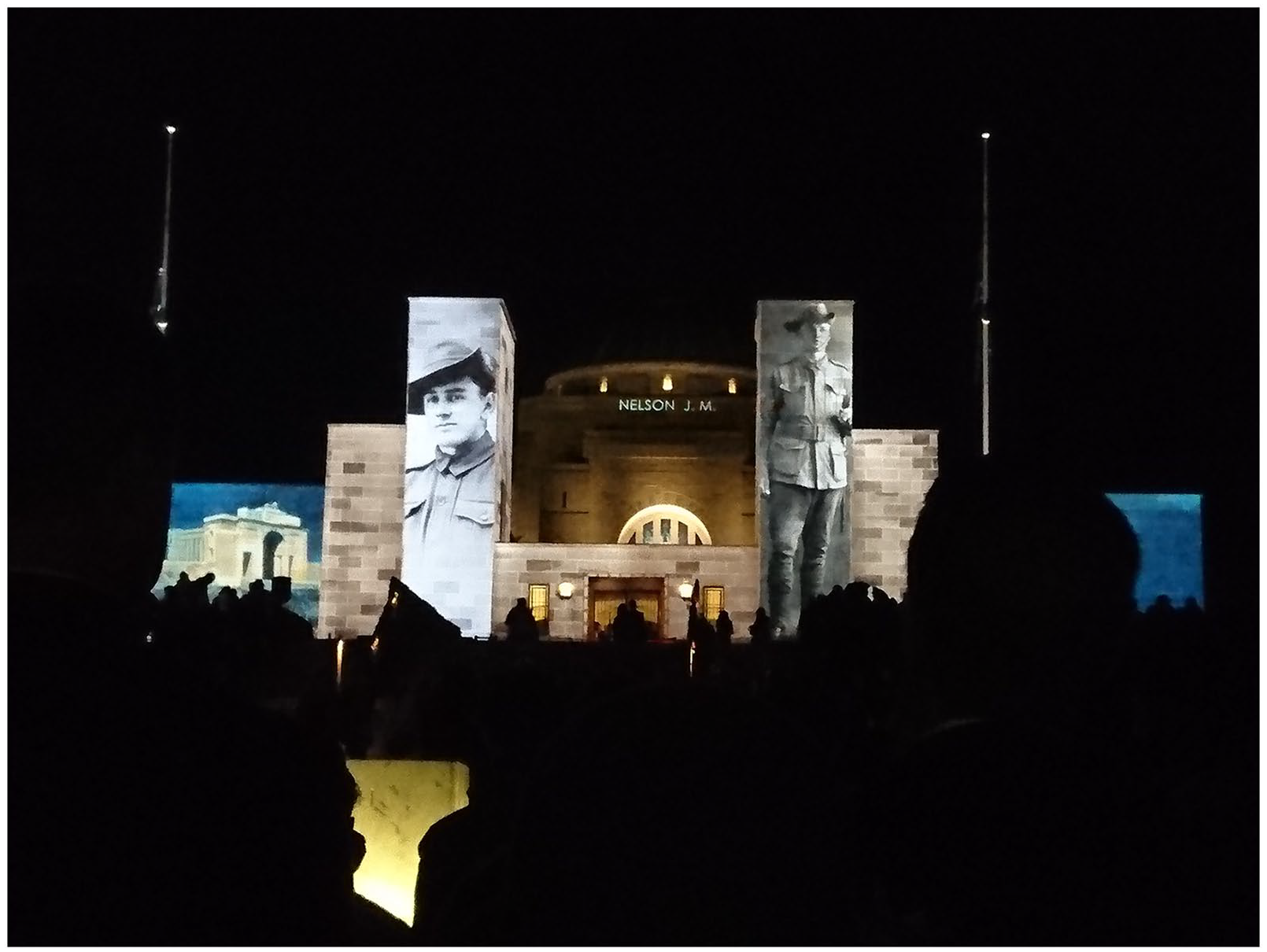
Dawn Service at the Australian War Memorial, Canberra, 2017. Copyright of the author.
The representations of the soldier-martyrs invited unity in compassion, a feeling further evoked through the religion-inspired act of pronouncing ‘lest we forget’ after the chaplain and the rite of singing the hymns together. Both activities are designed to bring people together through collective unison. Singing the hymns created a communal experience that bonded us together not only in the synchronicity of utterance but also because the lyrics use the pronoun ‘we’ which replaced the individuality of the pronoun ‘I’. Frame (2016c: 199) suggests that the invitation to sing the hymns is also a solicitation to make the words of the hymns one’s own words. Most of us in the crowd took on the chaplain's invitation to sing and found the words of the hymns in the leaflet that the volunteers handed out before the service. We sang of the tragedy of war and invoked a benevolent God who cannot end war but can forgive our mistakes and offer spiritual comfort from the tragedy of war. We also sang of brave and selfless soldiers who fight righteous wars in the name of God, and in the hope that there will be no more wars. The hymns evoked a sense of unity in tragedy and of compassion and solidarity towards soldiers who fight for a just cause sanctioned by God and whose wrongdoings are judged and ultimately forgiven by God.
Despite coming as a critical researcher, participating in the Dawn Service and attuning to the Anzac atmosphere with my body gave me an appreciation of the affective power of the Anzac atmosphere. The images of the soldier-martyrs induced affective attachments to the soldiers and evoked a sense of reverence for their sacrifice. The collective incantation and singing of the hymns evoked a sense of closeness to the other participants and national unity as well as a feeling that it was not my place to scrutinize war, the military, and the people who support them.
The affective dimension of settler militarism
This final section weaves together the IR feminist literature on affective militarism and my discussion on settler militarism to explicate how the affective dimension of Australia’s war commemoration functions to uphold settler colonialism. In mapping the everyday geographies of militarism, the IR feminist literature establishes that militarism has an affective dimension and can be operationalized through economies of feelings and emotions (Åhäll, 2016, 2018b; Baker, 2020; Chisholm and Ketola, 2020; McSorley, 2013; Rashid, 2020; Wegner, 2021; Welland, 2021). McSorley (2016: 105–106) contends that militarism ‘is felt, as much as, if not at times more than, something that is explicitly thought about’ (emphasis in original). Åhäll (2018a) remarks that the the domains of the discursive and the visual do not fully capture the operation of militarism, and therefore we need to turn to feelings and emotions. Accordingly, she argues that militarism can be operationalized through both expressions, or what we see and hear, and impressions, or what we feel (Åhäll, 2016).
Affective militarism creates affective attachments to the military that operate at the subconscious level (Wegner, 2021). Åhäll (2018a: 49) explains that affective militarism produces bodily reactions and sensations that create ‘obtuse meanings’, that is, interpretations and understandings of the world formed through feelings and embodied receptions rather than reason. Obtuse meanings about the military generate or reinforce subconscious ideas that normalize war. She exemplifies discussing a British media event staged for Remembrance Week featuring the reunion of a father soldier and his daughter. She contends that the feeling of tenderness generated by the father–daughter embrace reinforces or generates obtuse meanings about masculine heroism and protection and the paternal benevolence of war. This promotes a sentimental perception of war and the military which obliviates questions relative to the individual subjectivity of military personnel, the structural and economic conditions that lead people to join the military, and the ethics of war. When these questions are not asked, the moving spectacle of a military father reuniting with his daughter only invites a sentimental attachment to the military as a paternalistic institution that protects the nation like a father protects his daughter.
In the literature, affective militarism has two functions. Firstly, it depoliticizes war. Åhäll (2016) contends that the invitation to feel emotionally touched by war and the military renders us complicit in militarism because ‘when we get emotionally involved, questioning becomes difficult, and in the process, we risk forgetting the politics of what we are watching’ (2016: 165). Secondly, affective militarism contributes to the reproduction of nations as affective communities. 2 For example, in her work on Pakistan, Rashid (2020) shows that the Pakistani political elites mobilize affective militarism through the theme of soldiers’ sacrifice in war commemoration to reproduce a politically conforming nation. This scholarship calls attention to the political interventions of affective militarism in the reproduction of nations as communities held together by feelings for the military (see also Basham, 2016).
These two functions of affective militarism have important implications in settler societies like Australia. Concerning the depoliticization of war, when war is positioned outside of political deliberation, we fail to see how given definitions of war influence the structure and organization of society (Barkawi and Brighton, 2011). Barkawi (2016; see also Barkawi and Laffey, 2006) shows that the prevailing discourse on war is fundamentally rooted in the European experience and characterizes war as a clash between national armies. Wars that do conform to this discourse are often labelled as ‘small wars’ or insurgencies, with the implication that we overlook their actors and profound influence on contemporary political landscapes. Affective attachments such as those produced through the militarized atmosphere of the Dawn Service contribute to creating obtuse meanings about military warfare as the foundation of the nation and thus contribute to reproducing the settler nation through the erasure of colonial warfare from national identity. They etch onto the body the belief that the nation was established through military warfare rather than colonial warfare, thus privileging a colonial narrative of collective trauma that holds the national community together.
In Australia, the Dawn Service contributes to establishing the Anzac soldier as the national pillar whose sacrifice in foreign lands created the nation. Sanctified as a martyr, the figure of the Anzac soldier and his role in the making of the nation is unquestionable and can bolster feelings of antagonism towards those who dare do so, such as the historians and public figures mentioned above. This forecloses deliberation about the military and military history as an act of disrespect towards the soldier, the nation, and ultimately as national apostasy. Emotionally attached to and signified within the settler discourse that posits the Anzac soldier as martyr and father of the nation, settler subjects are personally invested in protecting the narrative of origin within which they exist and make sense of themselves and their political community.
Attachments to the sacrifice and suffering of the soldier-martyr are also important to reproduce the nation as a settler affective community. Hutchison (2016) explains that affective communities are held together through shared understandings of trauma. Therefore, the project of nation-building involves the reproduction of coherent understandings of trauma that can bring individual nationals together. War is indeed such a trauma (Edkins, 2003). In Australia, two war traumas are core to the nation: the trauma of colonial warfare and violence, and the trauma of World War I. While these are not mutually exclusive or competing, through war commemoration they are hierarchically positioned such that the latter functions as foundation of the modern nation at the expense of the former. The coexistence of these two as equals threatens a unified understanding of war trauma that holds the national community together.
Conclusion
This article developed the concept of settler militarism as a contribution to the emerging literature on settler colonialism and militarism which offers an analysis of the martial politics that underpin liberal and settler societies. Settler militarism is the ideological mobilization of the military to advance and sustain the settler colonial project. This ideology is particularly evident in Anglo-settler societies such as Australia, Canada and New Zealand, where the military wars of the 20th century have been established as key definers of the modern nation at the expense of colonial warfare. In this respect, settler militarism operates to conceal colonial warfare or mark it as less relevant for the modern nation vis-à-vis military warfare. Thus, it operates as a function of martial politics in the ways that it reproduces discursive practices of Indigenous dispossession that ground and reproduce the settler nation.
This article argued that settler militarism operates through affective power, which I examined in the context of the militarized atmosphere produced by Australia’s war commemoration. A militarized atmosphere is an immersive environment co-produced by bodies attuning to the tone of the event who reverberate militarism. The militarized atmosphere of Australia’s war commemoration produces affective attachments to the military that foreclose deliberation about war and to the settler narrative that military warfare is the pillar of the nation. This generates the obtuse meaning that colonial warfare is irrelevant to the modern nation.
Settler militarism is particularly effective in consolidating settler colonialism in light of recent developments in settler societies where activists and scholars have brought to public attention the history of colonial warfare. This history represents a threat to the legitimacy of the settler state that was established through an undeclared and concealed colonial conflict that enabled settlers to take possession of Indigenous land. Settler governments have a vested interest in dealing with this potentially divisive history by promoting a more unifying and recent alternative. The trauma of military warfare has thus been mobilized to reproduce a militarized affective community held together by reverence for the suffering and sacrifice of the soldier.
Footnotes
Acknowledgements
I wish to thank the Women in IR working group and Nicole Wegner for their feedback on earlier versions of this article.
Funding
The author received no financial support for the research, authorship, and/or publication of this article.
