




Abstract
Facing the spread of the novel coronavirus (COVID-19), leaders of many countries attempted to securitize the COVID-19 issue. The Japanese government, however, neither attempted to securitize it nor implemented strong measures to control its circulation. Yet the behavior of Japanese citizens changed significantly to prevent the spread of COVID-19. What were the mechanisms that drove them to voluntarily change their behavior? By introducing the analytical concept of ‘undersecuritization’, this article tries to answer this question, as well as to broaden the scope of the securitization argument. It first analyzes why Prime Minister Shinzo Abe did not attempt to securitize COVID-19. It then examines the mechanism behind citizens’ behavioral change. When Japanese citizens perceived the measures taken by their government as too weak to address the life-threatening COVID-19 issue, they started to feel that it was undersecuritized. This article argues that such awareness was the reason behind the voluntary behavioral changes that the Japanese people made in self-defense. It also shows that such self-defense measures can be more formidable than the measures taken by the government in a situation of oversecuritization.
Introduction
As of the end of June 2023, over six million people have died as a result of the novel coronavirus (COVID-19). Unprecedented crises often require unusual policy responses. Hence, the policy process is often unusual as well (Atkeson and Maestas, 2012; Birkland, 1997). When faced with a problem that threatens the very survival of the nation, political leaders often attempt to securitize the problem. Indeed, to tackle this COVID-19 pandemic, leaders of many countries employed war-related terminology to frame COVID-19 and to attempt to securitize the issue. For example, Chinese President Xi Jinping declared a ‘people’s war’ against COVID-19 to portray himself as firmly in charge, leading an army of health workers in a war against the disease (Asahi Shimbun, 2020c). French President Emmanuel Macron emphasized repeatedly that his country was ‘at war’ when announcing restrictions on movement (Momtaz, 2020). US President Donald Trump called himself a ‘wartime president’ and likened the country’s COVID-19 response to the United States’ mobilization during World War II, asserting: ‘Every generation of Americans has been called to make shared sacrifices for the good of the nation’ (Oprysko and Luthi, 2020).
Securitizing an issue makes it possible for leaders to legitimize the mobilization of every possible policy measure, sometimes even extralegal measures, to fight it. The Japanese government, however, neither attempted to securitize the COVID-19 issue nor implemented strong measures, such as lockdowns, to control the virus’s spread. While it is true that the Japanese government declared a state of emergency for the first time since World War II, it was not to implement a lockdown but to ‘request’ the public to change its behavior. Although the majority of the population recognized that this was not enough, the government made no attempt to securitize COVID-19 in order to legitimize the implementation of stronger measures. Even so, the behavior of Japanese citizens changed significantly to prevent the spread of COVID-19. Why did the Japanese government not employ war-related terminology to securitize COVID-19? What were the mechanisms that drove the Japanese people to voluntarily change their behavior? By introducing the analytical concept of ‘undersecuritization’, this article tries to answer these questions as well as to broaden the scope of the securitization argument.
Securitization, oversecuritization, undersecuritization
The theoretical framework of securitization in international relations was developed by the so-called Copenhagen School, led by scholars such as Barry Buzan and Ole Wæver. This framework focuses on how a certain issue gets transformed into a matter of security. The process of securitization starts when an actor attempts to securitize a certain object/ideal by framing it as a threat to a referent object. Such an actor is called a securitizing actor. The Copenhagen School mainly assumes securitizing actors to be states, which attempt to transform subjects into matters of security to enable the use of extraordinary means to tackle them (Buzan, Wæver and De Wilde, 1998: 25). In order to successfully securitize a certain object/ideal, it is essential that the audience, the target of the securitization act, accepts the object/ideal as a security threat.
There are many criticisms of the securitization argument. The main ones are that it focuses excessively on speech acts (Hansen, 2011; McDonald, 2008; Williams, 2003), that it neglects counter-movements against securitization attempts (Aradau, 2004; Stritzel and Chang, 2015), that it is an elitist framework (Booth, 2012; McDonald, 2008), that it falls into the determinism that securitization will occur if the audience accepts it (Bilgin, 2011; Peoples and Williams, 2010; Wilkinson, 2007), that it lacks research on audience and context (Balzacq, 2005; McDonald, 2008; Roe, 2008), and that it neglects the role of the everyday practice of experts (Bigo, 2008; Peoples and Williams, 2010). Nevertheless, thanks to its theoretical clarity and easy-to-use framework, the discussion of securitization has become security studies’ most widely cited approach (Baysal, 2020).
Many studies have applied this framework to understand the process of how certain issues such as terrorism, drugs, or immigrants come to be recognized as security issues and receive disproportionate amounts of attention and resources (Bourbeau, 2013; Brown and Grävingholt, 2015; Hindmarch, 2016). Once an issue is securitized, sometimes the use of even extraordinary means, such as military mobilization, is legitimized to solve the issue. And this is exactly what happened when state leaders employed war-related terminology to frame COVID-19 and attempt to securitize it (Hapal, 2021; Laksmana and Taufika, 2020).
It may therefore seem natural to analyze government policies from a securitization perspective and to warn of the risk of ‘oversecuritization’, where excessive measures are taken in the name of security (Hapal, 2021; Utama, 2021). In fact, human rights violations by the police or the military when they enforce measures to prevent the spread of COVID-19 have been widely observed (Ratcliffe, 2020). While oversecuritization is often seen as a problem, the concept has not been well theorized. Responding to a problem with excessive means is often called oversecuritization. However, it is not clear what is considered excessive. Indeed, mobilizing the military to respond to those who do not comply with a COVID-19 lockdown may represent an improper use of military means. The shooting of drug-related criminals as a result of securitizing the drug problem is often pointed out as an example of oversecuritization. On the other hand, there is often strong public support for mobilizing the military in such contexts (Utama, 2021), and advocates of this policy do not consider it excessive. Who, then, determines when oversecuritization takes place?
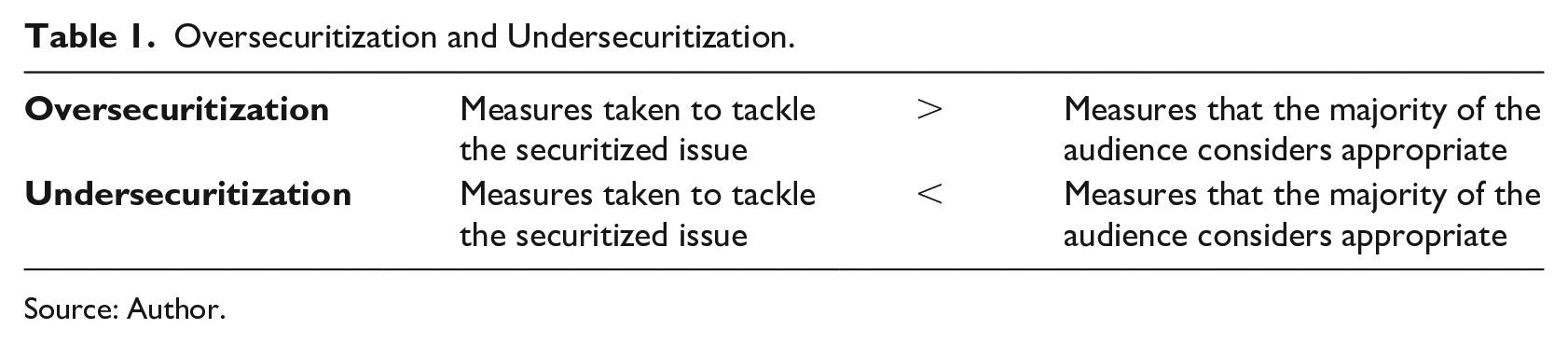
In this article, I will define oversecuritization as a case where the measures taken by a securitizing actor to eliminate a securitized threat are excessive compared to the measures the majority of the audience considers appropriate (Table 1). In other words, I will focus on the perception gap between the securitizing actors and the audience. When government leaders attempt to securitize a particular threat, the target audience is the public at whom the policy is directed. However, it would be extremely rare for citizens to agree unanimously with a particular securitization move taken by government leaders. For such a move to be accepted, it must have the support of a sufficient percentage of the public to make it possible to implement the extraordinary measures in the name of security. It would require the backing of at least a majority, and sometimes even more than that. Even if the majority of the public agrees to a certain issue being securitized, it does not necessarily mean that they will delegate full authority regarding the extent of measures to be taken for the securitized issue. Even if a country is attacked militarily by another country, this does not mean that no one would object to an immediate counter-attack with nuclear weapons. Governments do not have carte blanche on how to respond to an external military attack. If a government responds in a manner beyond what is acceptable to its constituents, it will naturally face criticism from them. If there is a debate over whether an issue is a security issue in the first place, the government needs to gain the public’s support for how to deal with the issue, even after the issue has been securitized. The interaction between securitizing actors and their audience is not only over the framing of the issue, but also over what steps to take. And when measures are taken that are in excess of what the majority of the audience considers appropriate, it leads to a backlash. This is what I will call oversecuritization.
Oversecuritization and Undersecuritization.
Source: Author.
Clearly, the opposite phenomenon can also occur. Measures taken to eliminate the securitized threat may be insufficient compared to what the majority of the audience considers reasonable. In this article, I will call this situation ‘undersecuritization’. If the audience feels that lives are threatened and demands a response, but the measures taken are less than what it expects, what will happen? This is what this article attempts to analyze, by studying the case of Japan under COVID-19. I argue that people’s perception that the COVID-19 issue was undersecuritized led to a voluntary behavioral change in Japan. The article also points out that the behavioral change that accompanies undersecuritization may help to tackle the problem to a certain extent, but it may also create other problems.
The Japanese government’s response to COVID-19
The Japanese government confirmed the country’s first novel coronavirus case on 15 January 2020, in a resident of Kanagawa Prefecture who had returned from Wuhan, China (WHO, 2020). The government’s response was swift. On 27 January, it designated COVID-19 as an ‘infectious disease’ under the Infectious Diseases Control Law and as a ‘quarantinable infectious disease’ under the Quarantine Act. These measures allowed it to order patients with COVID-19 to undergo hospitalization and to quarantine people suspected of infection and order them to undergo diagnosis and treatment. On 30 January, the government announced it was establishing the Novel Coronavirus Response Headquarters. After its eighth meeting on 12 February, then Prime Minister Abe announced that he was implementing emergency measures, including securing 500 billion yen for emergency lending and loan guarantees to small and medium enterprises affected by the COVID-19 outbreak, as well as setting aside 15.3 billion yen from contingency funds to facilitate the donation of isolated virus samples to relevant research institutions across the globe.
However, the Japanese people criticized the Japanese government’s response to COVID-19 as slow and ineffective. This led to increasing doubts about Prime Minister Abe’s leadership, and in February, disapproval for his administration outweighed approval for the first time since July 2018 (Sieg, 2020a). One of the reasons for such criticism was that the Prime Minister did not give a press conference until the end of February. In the meantime, the handling of the COVID-19 outbreak on the Diamond Princess cruise ship gave the impression that the Japanese government was not ready to tackle the COVID-19 issue. 1 There was also growing criticism that the government was too focused on the cruise ship outbreak and that it had relegated measures to prevent the spread of COVID-19 in Japan to the back burner (Yomiuri Shimbun, 2020a). While Abe was severely criticized for his weak response to COVID-19, he refrained from following in other state leaders’ footsteps in trying to securitize COVID-19, which would have raised the priority of the issue and justified spending large amounts of resources, or even enabled extraordinary means in the name of security. Why?
In an interview, renowned journalist Soichiro Tahara asked Abe why the Japanese government was not enforcing strong measures, instead only ‘requesting’ Japanese citizens to take measures to prevent the spread of COVID-19. Abe answered: ‘If we enforce strong measures with penalties, that is despotism. Japan’s post-World War II political system does not permit such policies’ (Tahara, 2020). It is often pointed out that the Japanese feel deep remorse for World War II and have thus developed a strong aversion to conflict (Berger, 1998; Hook et al., 2001; Katzenstein, 1996). In a situation like this, attempting to securitize COVID-19 by framing the issue using war-related terminology could have backfired and ended up provoking more criticism of the government rather than enabling the authorities to take extraordinary measures. In addition, the government perhaps did not feel it was necessary to securitize COVID-19, as the number of infections in the country remained limited (Iwasaki and Grubaugh, 2020).
Securitization by private actors
The Japanese government thus intentionally avoided securitizing COVID-19. This did not necessarily mean, however, that there was no attempt to securitize COVID-19 in Japan. Recognizing the public’s perception of COVID-19 as a significant threat, some private actors such as journalists and writers used war-related terminology to securitize it, as we will see later. Is it possible for an audience to accept securitization moves by private actors? If so, what are the conditions for such a securitization move to be accepted? Despite the key for successful securitization being the audience’s acceptance of the securitization move, there has been little research on the process of such acceptance. Balzaq states that ‘the success of securitization is highly contingent upon the securitizing actor’s ability to identify with the audience’s feelings, needs, and interests’ (Balzaq, 2005: 184).
However, merely identifying the audience’s feelings, needs, and interests is not a sufficient condition for a securitization move to be accepted. To consider an issue to be one of security requires a major decision, given the gravity of the measures that could be taken as a result. Most existing literature on securitization has assumed the national government as the securitizing actor. When governments attempt to securitize an issue, their claims are more likely to be granted political legitimacy, and can be widely disseminated. Therefore, securitization moves by governments would probably be more easily accepted by their audience.
Generally speaking, it is not easy for private actors to securitize a certain issue when the government or political leaders avoid doing so. Private actors do not have the same political legitimacy as governments. It is also more difficult for them to disseminate their claims to securitize a certain issue. But a securitization move by private actors may have a chance of being accepted if it is made in a way that is accessible to a large audience, and if it is perceived as legitimate. If private actors’ attempts to securitize a certain issue are repeatedly covered by the mass media, their voices are more likely to be heard and recognized by a large audience. Moreover, if many people perceive the object of the securitization move as a threat to their lives, they are likely to accept a securitization move made even by private actors. In short, the more exposure the audience has to claims that a certain issue is being securitized, and the more they perceive the issue as life-threatening, the more receptive they become to securitization attempts.
When is a threat to life perceived? According to Slovic (Slovic, 1987; Slovic et al., 1985), people’s perception of the risk of dying is heightened by unknown risk and dread risk, which involve a sensed lack of control and potentially catastrophic consequences. In the case of COVID-19, unknown risk was perceived as high because it was an unknown virus; the virus itself was invisible, a characteristic that tends to arouse fear. According to a survey conducted in March 2020 by the Survey Research Center, 78.4% of respondents said they were concerned because the virus was invisible, and 85.1% said they were concerned because they did not know how long it would last (Survey Research Center, 2020). Sentiment about COVID-19 on Twitter in Japan after the first outbreak was characterized by feelings of fear (Toriumi et al., 2020). When the first cases of infection were confirmed in Japan, 34.9% of respondents were concerned that they themselves might be infected, according to the poll conducted by the Survey Research Center. The percentage continued to rise after that, and 68.1% expressed concern at the end of February 2020 (Survey Research Center, 2020).
The risk communication by the Japanese government during the early days of COVID-19’s spread was not very effective in reducing this fear (Ebina, 2020). As the Ministry of Health, Labour and Welfare’s real-time information was limited, the government was unable to centralize information management. As a result, the public was exposed to a jumble of information, some of whose sources were not clear. Coupled with the intense media attention on the issue, this made the public uneasy (Yomoda, 2020). Recognizing the audience’s perception of the high threat of COVID-19, some private actors started to use war-related terminology to securitize it. For example, Toyo Keizai Online, the largest Japanese business news site, began publishing a serial column in February 2020 entitled ‘Understanding the War on COVID-19’. However, at this point, attempts to securitize COVID-19 were not yet widespread, and their impact was still limited.
The undersecuritization of COVID-19
Those who had an elevated threat perception of COVID-19 felt that the Japanese government measures to prevent the spread of the virus were inadequate. Criticism of the Japanese government’s response grew stronger when it was reported that there were many with a fever or other symptoms who could not be tested – so-called ‘test refugees’ – due to limited testing capacity (NHK News Web, 2020a). Although Abe promised to expand testing capacity, the actual number of tests did not increase.
When Prime Minister Abe finally held his first press conference about COVID-19 on 28 February, he abruptly requested the closure of all schools from 2 March to the end of scheduled spring vacations, which usually conclude in early April. This decision to request nationwide school closures despite the fact that COVID-19 had not spread widely, especially among schoolchildren, faced strong criticism (Asahi Shimbun, 2020a). Shimane Prefecture and several cities rejected the request and kept its schools open. Later, it became clear that school closure was not effective in preventing COVID-19’s spread (Fukumoto et al., 2021).
Restrictions on arrivals from China and the Republic of Korea took effect on 9 March. However, many perceived the government’s delay in implementing entry controls as stemming from its concern for relations with the Chinese government in anticipation of President Xi Jinping’s visit to Japan, as there had been strong calls for such measures since February (Asahi Shimbun, 2020b). In addition, despite the spread of COVID-19 in Europe since March 2020, there was a delay in implementing entry restrictions from Europe, resulting in a series of confirmed cases of infections originating there (Asahi Shimbun, 2020d).
In March 2020, there was also growing interest in whether the Tokyo Olympics, scheduled to take place in July, could be held as planned. In fact, International Olympic Committee member Richard Pound, among others, had cast doubt on the feasibility of the Games during a global pandemic (Wade, 2020). Although the International Olympic Committee had the authority to make this decision, the Japanese government’s response to this issue was also becoming increasingly criticized by the public. Prime Minister Abe had said during the Japan–USA summit phone call that he wanted to ‘win the fight against the virus and make the Olympics a success’ (Yomiuri Shimbun, 2020b). On 16 March he claimed to have the support of all G7 leaders for the full realization of the event and expressed his intention to hold the Olympics as scheduled. However, a poll conducted during this period showed that almost 70% of the public believed that the event could not go ahead (Yomiuri Shimbun, 2020b). Eventually, on 31 March, the decision was made to postpone the Olympics for one year. A series of government policies and responses during this period led to a growing perception among the public that the government was not taking appropriate measures in the fight against COVID-19.
As the threat perception of COVID-19 increased, so did the demand for stronger measures to counter it. Sensitive to this atmosphere, on 23 March, Tokyo Governor Yuriko Koike mentioned the possibility of taking ‘strong measures, including a lockdown of Tokyo’ (Yomiuri Shimbun, 2020c). While it is true that it is legally impossible to implement such a lockdown in Japan, the government did not even attempt to overcome such legal constraints in the name of security. According to a NHK poll conducted on 6 March 2020, 74% of respondents said they were concerned about infection, and 47% said they were not satisfied with the government’s measures to tackle COVID-19 (NHK, 2020a).
By late March 2020, there was a noticeable increase both in the number of new COVID-19 cases in Japan and an associated threat perception (Figure 1). According to Witte, who proposed the widely referenced ‘extended parallel process model’ to analyze how individuals react to a fear-inducing message, people first appraise the perceived fear. In doing so, their perception of how likely the threat is to impact them (susceptibility) and of the magnitude of the threat (severity) modifies the appraisal. If the fear appraisal is low, they do not react. If the fear appraisal is moderate to high, people begin to assess the efficacy of the recommended reaction. When the efficacy appraisal is perceived to be moderate to high, people change their behavior and follow the recommended reaction (Witte, 1992).
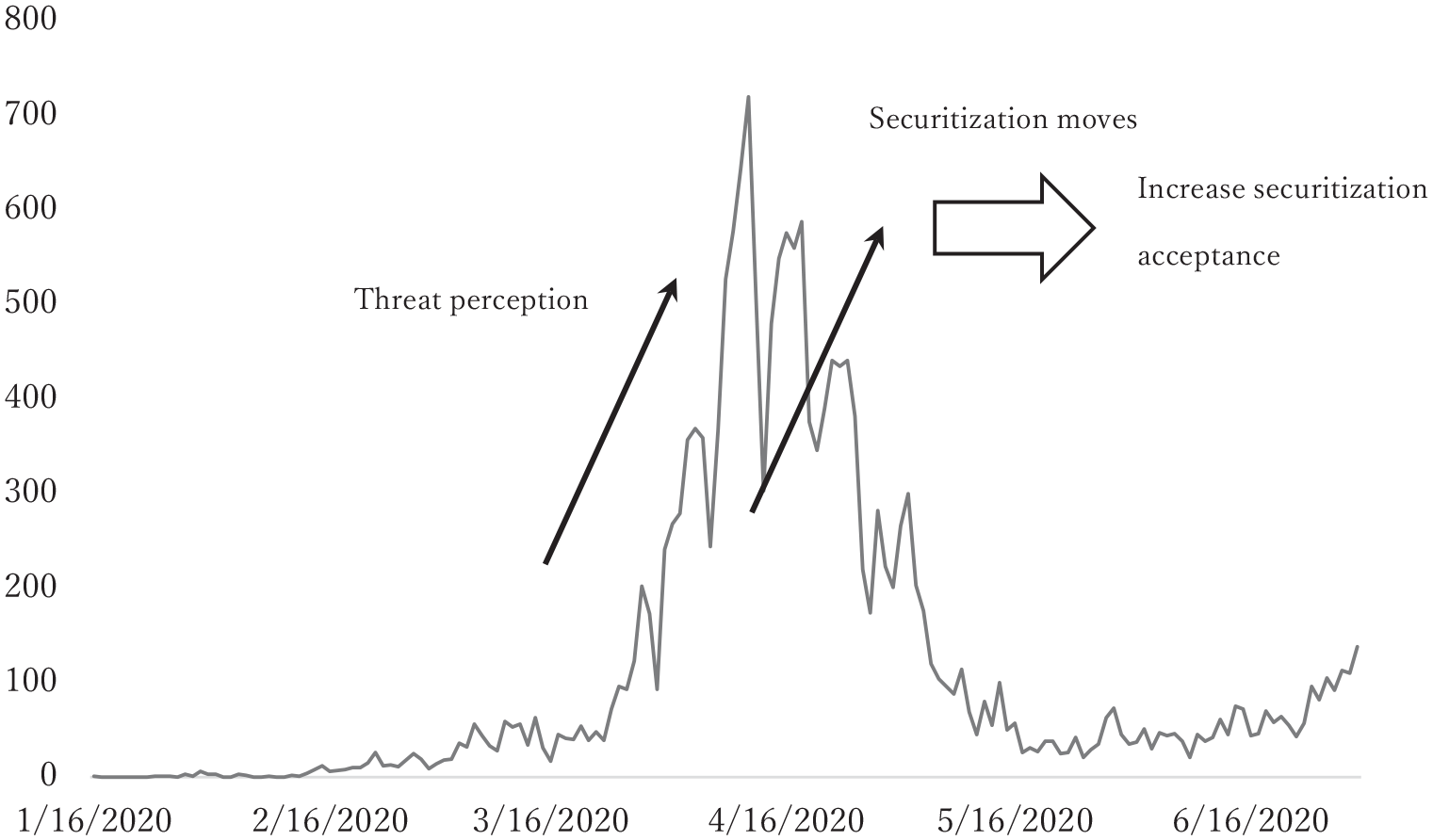
COVID-19 new cases per day in Japan and securitization. New case data compiled by the author from NHK data available at: https://www3.nhk.or.jp/news/special/coronavirus/data-all/
At the time of the survey mentioned earlier (6–9 March), the fear of becoming infected had risen to 75.3% (Survey Research Center, 2020). As the infection spread, perceived susceptibility was increasing. According to the same survey, more than 90% of respondents feared the circulation of the virus within Japanese society. The nature of the fear also became more diverse in March, expanding to fear of changes and restrictions on respondents’ lifestyle, and instability in society (Yomoda, 2020). An increasing number of people perceived COVID-19’s severity as well as their susceptibility to it as high. When Abe announced on 1 April that the government would distribute two cloth masks, which were not considered at that time to be very effective at shielding against COVID-19, to every household in the nation, he was slammed for being out of touch with reality (Osaki, 2020). In a poll conducted by Yomiuri Shimbun, 73% of respondents did not view this move favorably (Yomiuri Shimbun, 2020e). In the public opinion polls conducted in early April, a large majority of respondents did not judge the government’s measures against COVID-19 to be appropriate. 2 As a large majority of people perceived the COVID-19 issue as life-threatening and the government’s response to it as inappropriate, we can see that COVID-19 was considered by many to be undersecuritized around this time.
A behavioral immune system
The Japanese government proclaimed a one-month state of emergency on 7 April, to run from 8 April to 6 May. 3 However, under this state of emergency, the governors could only ‘request’ that citizens refrain from going out, that schools close, that shop owners limit operations, and that event organizers cancel events. 4 The Japanese government never implemented strong measures such as lockdowns. Japan’s mild measures are often contrasted with the stringent lockdowns in some countries that mandated fines and arrests for non-compliance (Sieg, 2020b). A poll conducted by Yomiuri Shimbun revealed that 81% of respondents felt that the government’s declaration of a state of emergency came too late. And 59% said that the government’s request for people to refrain from going out was not sufficient, indicating that the majority of the public preferred stronger measures (Yomiuri Shimbun, 2020e).
There was concern that the daily COVID-19 news reports themselves could lead to physical and mental illness (Jungmann and Witthöft, 2020). Moreover, as many of the reports on COVID-19 were linked to deaths, people’s threat perception of COVID-19 had increased greatly (Yomoda, 2020). In fact, according to a survey conducted in April 2020, the dread risk involving COVID-19 was perceived as very high, second only to earthquakes, and the least controllable of all the hazards in the survey (Parady et al., 2020). Hiroshi Nishiura, a member of the Novel Coronavirus Expert Meeting and a specialist in mathematical modeling of infectious diseases, held a press conference to announce his estimate that 400,000 people would die if appropriate measures were not taken (Yomiuri Shimbun, 2020f). People became even more aware of the threat of COVID-19, and the tendency to view the virus as a life-threatening issue was further reinforced, making them more receptive to securitization moves.
According to Slovic et al., (1985: 111), the greater the dread risk and unknown risk, the more likely people are to seek more stringent regulations to reduce that risk. As we have already seen, the risk perception for COVID-19 in Japan was very high in April 2020, meaning the people were receptive to securitization moves and expected the government to take very strict measures to address the issue. However, according to an April 2020 survey conducted in 11 markets, only 11% of respondents in Japan answered that the government’s measures were ‘meeting their overall expectations for how they should be responding in this crisis’ (Edelman Trust Barometer, 2020). That percentage was by far the lowest among the markets surveyed. In a poll conducted by Nippon Television Network Corporation (NTV) in April 2020, 81% of respondents felt that the government’s declaration of the state of emergency had come too late, and 58% said that the state of emergency declaration ‘requesting’ people to refrain from going out was not enough. 5
What will people do when they perceive that they are in an undersecuritized situation? If they consider that their government is not taking appropriate action to address a life-threatening issue, their only choice is self-defense. However, when it comes to COVID-19, people could not proceed to the efficacy appraisal stage, as there were no agreed-upon measures to prevent the spread of COVID-19 available in early 2020. In such situations, people often rely on their behavioral immune system to reduce a risk. The behavioral immune system is a psychological adaptive function that reduces a risk by arousing a sense of aversion and anxiety toward objects and situations that increase that risk, and by encouraging behavior that avoids such objects and situations (Schaller, 2011). And that was exactly what Japanese citizens did, by refraining from going out.
Of course, not everyone took such self-defense measures. According to Shoji et al., those who had a lower perception of infection risk were less likely to refrain from going out even when the number of infections increased (Shoji et al., 2022). Staying at home, as well as social distancing, also offered the benefit of not spreading the infection throughout society and hence could be considered as a public good during the pandemic. Thus, those who were highly altruistic or highly sensitive to public shaming were more likely to follow social distancing (Cato et al., 2020). At any rate, whether as a means of self-defense or out of a sense of altruism to prevent the spread of infection, this change in people’s behavior seems to have been voluntary, rather than driven by government policies.
In fact, behavioral changes among Japanese citizens, especially withdrawing from social situations, started to take place before the government’s request for such changes (Figure 2). The Cabinet Office reported significant drops in activity in large employment and commercial hubs of the Greater Tokyo Area even before the state of emergency (Parady et al., 2020: 1). Figure 2 also shows that people’s mobility decreased sharply on 28 March and remained significantly low even before the government declared a state of emergency on 7 April.
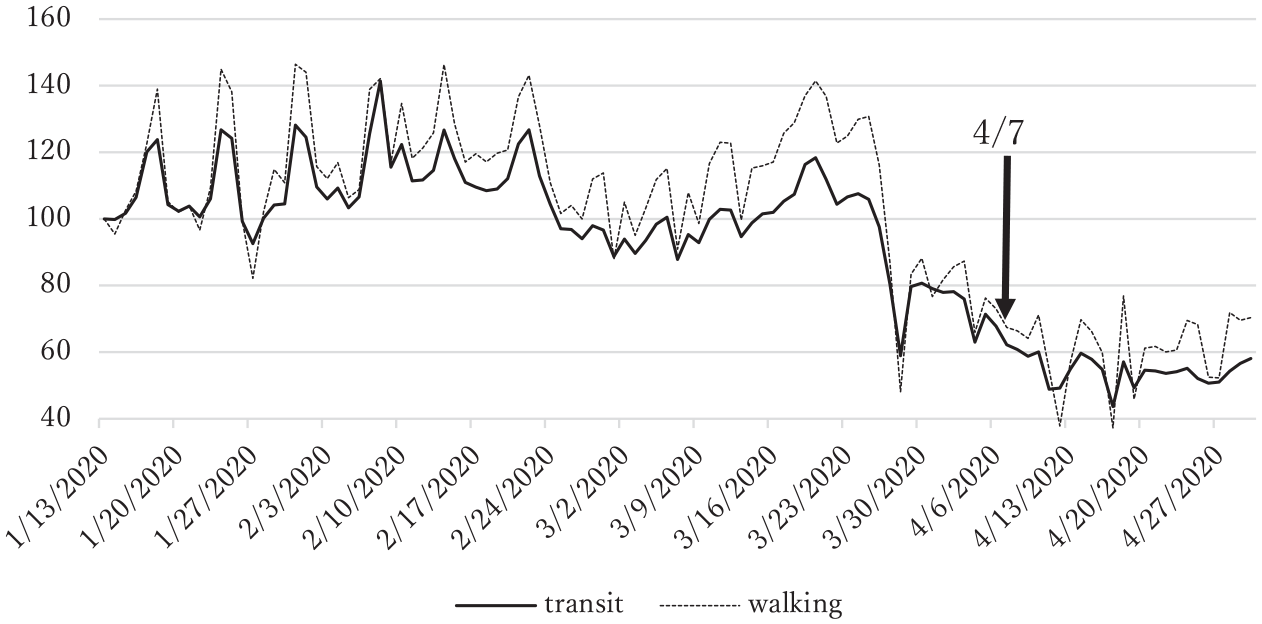
Mobility Trend (Tokyo). Percentage change compared with 13 January data. Source: Created by the author, data from Apple Mobility Trend Reports available at https://covid19.apple.com/mobility
Of course, this does not mean that the government had no influence at all on these behavioral changes. On 26 February the government requested that people refrain from holding large-scale events, and on 28 February it requested that all elementary schools should close, appealing to the public to change their behavior. From 19 March, the Novel Coronavirus Expert Meeting repeatedly warned of the dangers of the 3Cs (sanmitsu: closed environments, crowded conditions, and close-contact settings) as situations where coronavirus infections could easily spread. However, these did not have an immediate impact on the public’s behavior. Rather, the change in public behavior was more pronounced when the number of confirmed cases increased, amplifying the threat perception among the public. 6
The emergence of vigilantes
As people’s frustration with the undersecuritized situation increased, attempts by private actors to securitize COVID-19 picked up pace. For example, Bungei Shunjyu (2020), the most widely read monthly general magazine, featured an article entitled ‘War on COVID-19’ in its May issue (published on 10 April). Shukan Toyo-Keizai, a weekly business magazine, also published an opening article in its 11 April issue entitled ‘War on COVID-19 will be all-out war: Looming “explosion of infections”’. Articles juxtaposing the words ‘COVID-19’ and ‘war’ started to appear in major newspapers as well, increasing dramatically in April. While leading newspapers Yomiuri Shimbun and Sankei Shimbun attempted to securitize COVID-19, Asahi Shimbun attempted to de-securitize it. 7
On 14 April, it was reported that the Prime Minister had used the term ‘war’ in relation to COVID-19 (Tahara, 2020). During his interview with journalist Tahara, Abe said: ‘I thought that World War III would be a nuclear war, but it was the spread of COVID-19’. He was not, however, using the word to frame the virus as a national security issue. COVID-19, in his view, was not an enemy of Japan, but rather an enemy of the world, and must be tackled through international cooperation. 8 In fact, Japan had already allocated 15 billion yen to the WHO and other international organizations in March 2020 to fight against COVID-19 (Motegi, 2020).
From this interview, we can see that Tahara felt that the government’s actions to prevent the spread of COVID-19 were inadequate, and was calling for stronger measures. Criticizing the bureaucrats who opposed the declaration of a state of emergency as being rooted in a ‘peacetime mindset’, Tahara insisted that ‘it is already “wartime”, as so many Japanese have been infected’. He added: ‘I never expected my 86th birthday to be in “wartime”’ (Tahara, 2020). During this period, certain political commentators used terms related to war to assess the government’s response to COVID-19 (Furuya 2020; Iwata A, 2020). Some lawmakers in the Diet also began to link the COVID-19 issue to war and to demand that the government take further action. However, Prime Minister Abe and other government officials continued to avoid securitizing COVID-19. 9
As more and more people felt COVID-19 to be undersecuritized, some began to take further self-defense measures against the threats. So-called jishuku-keisatsu, or ‘vigilantes’ (literally, ‘voluntary restraint police’), began trying to impose ‘voluntary restraint’ (jishuku) on others. 10 Those who did not comply with the government’s request risked increasing the spread of COVID-19. Therefore, according to the behavioral immune system argument mentioned earlier, people felt aversion toward those who did not follow government advice. In fact, the more anxious they felt about getting infected, the more hostility they tended to feel toward those who did not comply with the request for restraint and those who did not wear masks (Motoyoshi, 2021: 106). It has been pointed out, however, that such aversion could lead to excessive or even discriminatory behavior. The vigilantes displayed a clear example of excessive behavior based on the behavioral immune system.
The activities of the vigilantes were not based on any rule or law, and residents in Japan did not know who the vigilantes were. As a result, the power of the vigilantes became very strong. Since people did not know when they were being watched, they were motivated to act as though they were being watched at all times. This is what Jeremy Bentham intended when he designed the ‘panopticon’. Coupled with widespread use of social media, which can be utilized as an ‘electronic panopticon’, the panoptic power of the vigilantes became even stronger (Lyon, 1993). Many attributed the strong panoptic power in Japan to the Japanese collectivist nature (Sieg, 2020b), though some refute this view (Takano and Osaka, 1999).
The vigilantes believed extreme measures were justified in order to stop the spread of COVID-19 in the name of security. Of course, the government’s declaration of the state of emergency was certainly a catalyst for the vigilantes to consider their activities legitimate and to increase their activity. While the government did not enact compulsory measures to prevent the spread of COVID-19, the vigilantes cracked down rigorously on activities that could spread infection. For example, in just two weeks following the declaration of the state of emergency, there were more than 500 calls within Osaka prefecture alone reporting the names of stores that continued to operate (Kyodo News, 2020). Police received thousands of calls related to COVID-19, including complaints about children playing in parks and people speaking loudly in restaurants (Sankeibiz, 2020).
The vigilantes did not stop there, but started to ‘enforce’ compliance directly. They threatened to forcibly close small businesses that continued operating out of financial necessity (NHK News Web, 2020b), disclosed the names and addresses of infected persons, and sometimes segregated medical personnel and their families (Yahoo News, 2020). Tatsuo Inoue, a leading scholar of legal philosophy, severely criticized the government’s mild request-based measures, arguing that ‘such de facto peer pressure where the government “requests” and the public “supports” can easily be used arbitrarily’ and noting that ‘depending on such de facto peer pressure can invite the irresponsible abuse of power’ (Inoue, 2020: 38).
Objecting to the argument that the Japanese government was cleverly utilizing the Japanese tendency to conform to peer pressure, Inoue warned that ‘such peer pressure will invite “social tyranny” where the public, not the state, discriminates and persecutes those who are viewed as heretical’ (Inoue, 2020: 38). In fact, incidents of vigilantes’ harassment of people whom they unilaterally labeled as non-conformists became alarmingly frequent. As John Stewart Mill pointed out, social tyranny can be ‘more formidable than many kinds of political oppression since, though not usually upheld by such extreme penalties, it leaves fewer means of escape, penetrating much more deeply into the details of life, and enslaving the soul itself’ (Mill, 1991: 6–7).
The vigilantes severely criticized those who did not adhere to government advice or to what they considered appropriate for preventing the spread of the virus. For example, although it was not a legal obligation to wear a mask, when they found out that a TV broadcaster was not doing so, she became the target of severe criticism (Haefelin, 2020). When the researcher Kazuya Nakayachi and his team surveyed people’s reasons for wearing masks, they revealed that peer pressure was the most influential determinant. People might wear masks simply because they think they should when others do so, irrespective of masks’ objective effectiveness in reducing risk (Nakayachi et al., 2020). 11 People perceived (sometimes incorrectly) to be traveling were threatened by the vigilantes, and cars with other prefectures’ identification number had their paint scratched. The vigilantes frequently targeted those whom they considered to be ‘bad’ or ‘inappropriate’ citizens and forced them into strict compliance. For instance, those who enjoyed pachinko (Japanese pinball) and those who went to local nightlife districts during the pandemic, though perfectly legal activities, were subjected to harsh enforcement and condemnation by the vigilantes. Chief Cabinet Secretary Yoshihide Suga warned at a press conference on 13 May that the government would punish the vigilantes if they violated the law. However, the activities of the vigilantes did not easily wane (Kodama, 2020), and as a result of their increasing actions, the public was forced to ‘self-refrain’ from going out, dining out, traveling, and participating in events. Thus, despite the fact that the Japanese government avoided securitizing COVID-19, other actors fulfilled that role (Table 2).
Audience Perception and Behavior Regarding Securitization.

Source: Author.
Conclusion
The spread of COVID-19 and the policies of national governments to prevent it are often analyzed through the concept of securitization. In such cases, oversecuritization tends to be considered a problem. However, as this article has shown, securitization moves may originate from other sources. And oversecuritization is not the only potential problem. As we have seen, even when governments do not attempt to securitize a certain issue, private actors can attempt to step in as the threat perception increases among the public. Even if the government does not enact appropriate policies to tackle the threat, the public may take self-defense measures in response to the threat. The article argues that this is the mechanism behind the significant changes in behavior among the Japanese people during the pandemic, despite the fact that the Japanese government refrained from securitizing COVID-19 and imposed only modest measures to prevent its spread compared to other countries. The higher the threat perception and the more securitization moves are made, the more receptive the audience becomes to such measures, even if they are implemented by private actors. As the audience continued to perceive the government’s measures to tackle COVID-19 as inadequate, while its threat perception also heightened, it resorted to further self-defense measures. Such self-defense measures can become excessive if the audience’s perception of undersecuritization is too strong, as we have seen in the activities of vigilantes, or jishuku keisatus. In such a scenario, problems caused by undersecuritization can be as bad as problems caused by oversecuritization. It is thus important to expand the scope of securitization to deepen our understanding.
As time passed, the degree of unknown risk from COVID-19 decreased. In fact, the number of respondents who felt uneasy about the spread of COVID-19 peaked in April and May 2020 and continued to decline after that (Ministry of Health, Labour and Welfare, 2020). In June 2020, those who answered that the state of emergency declaration ‘requesting’ people to refrain from going out was ‘enough’ (58%) surpassed those who answered ‘not enough’ (36%). In the fall of 2020, more respondents listed economic recovery as the government’s top priority than those who listed tackling COVID-19, for the first time since the latter was added as an option (Nihonkeizai Shimbun, 2020). In this context, self-defense by the audience in response to a perceived undersecuritized state decreased. In fact, the second and third state of emergency declarations issued from January to March 2021 and from the end of April to June 2021, respectively, did not have much effect on restraining people’s circulation, compared to the first time (Fujiwara, 2021). The activities of the vigilantes also became less prominent after the first declaration and remained silent during the second and third declarations of the state of emergency (Jiji Tsushin, 2021).
With threat perception declining and the population not feeling undersecuritized, people may no longer be expected to change their behavior voluntarily or on request by the government. This article has answered the question of why the Japanese people changed their behavior in early 2020 by introducing the concept of undersecuritization and self-defense in the context. It is the author’s hope that it could serve as a modest first step in advancing research on undersecuritization.
Footnotes
Acknowledgements
I would like to express my sincere gratitude to anonymous reviewers who played a part in the review process. Their time, expertise, and feedback are deeply appreciated.
Funding
This article benefited from funding from Kakenhi grants from the Japan Society for the Promotion of Science (JSPS) numbers 17K03605, 20H04407, and 22K01367.
