




Abstract
This article explores the obituary as an important, yet neglected, site of everyday security discourse. Through an original analysis of 86 published obituaries of 11 prominent ‘terrorists’, we offer three arguments. First, obituaries play an important constitutive role in shaping public understanding of terrorism and terrorists. Second, in so doing, terrorist obituaries frequently draw upon and reproduce established constructions of terrorism. Especially important here, we argue, are claims associated with the influential, yet heavily contested, ‘new terrorism’ thesis that posits profound transformations in the motives, organization and violences of terrorist groups from the late 20th century onwards. Third, notwithstanding the above, the (terrorist) obituary also offers important resources for nuancing and problematizing dominant constructions – such as of ‘new terrorism’ – in part because of the opportunity for sociopolitical critique afforded by this mnemonic genre. In making these arguments, the article therefore offers new empirical and conceptual insight into the obituary as a genre of everyday security knowledge, and into the mobility and resilience of established security discourses.
Introduction
On 27 October 2019, Abu Bakr al-Baghdadi – leader of what was variously known as ISIS, ISIL, Islamic State or Daesh – was killed during a US raid, likely through detonation of a suicide vest. Al-Baghdadi’s death, unsurprisingly, attracted considerable attention, with President Trump’s characteristically colourful announcement trumpeting the demise of this ‘brutal killer’ who had ‘died like a dog . . . like a coward’ (Farrington, 2019). Evaluations of the death’s significance – for ISIL, for terrorism, for the region and so on – emerged with predictable rapidity (e.g. Byman, 2019). As, indeed, did retrospectives on al-Baghdadi’s life and legacies. The UK’s Times newspaper, for instance, using al-Baghdadi’s given name, concluded its obituary with a boldly quantitative assessment of his importance: ‘In terms of human suffering and cultural destruction, few terrorists have matched the record of Ibrahim al-Badri, the first self-proclaimed caliph of the Muslim world for almost a century’ (Times, 2019). The Guardian’s obituary depicted his life in similarly magnitudinous terms: In less time than it had taken any terrorist leader before him, he and his organisation, Islamic State (Isis), had successfully provoked upheaval across the Middle East and stirred trepidation around the globe. To many, Baghdadi was the sum of all fears, a man who had been transported straight from the savage early wars of Islamic history to the modern battlefields of the region nearly 1,500 years later. (Chulov, 2019)
In these early efforts to take stock of al-Baghdadi’s life we encounter a relatively consistent figure of the terrorist as a religious fanatic inclined towards savagery and indiscriminate violence. Such themes are prominent within contemporary terrorism discourse (Gunning and Jackson, 2011), and important contributors to the ‘new terrorism thesis’ that gained considerable academic, media and political traction in the post-9/11 period (Jäckle and Baumann, 2017: 876–879; Spencer, 2016). The new terrorism thesis posited profound transformations in the motivation, structure and violences of terrorist organizations from the late 20th century onwards (e.g. Kurtulus, 2011). Here, where previous incarnations of terrorism were hierarchically configured, politically motivated and discriminating in their target selection, new terrorism is purportedly characterized by informal association, religious motivations and a propensity for excessive violence (Neumann, 2009: 29). As Neumann (2009: 28) summarizes, with reference to the ideal-typical IRA and Al-Qaeda: ‘significant changes have . . . taken place in three areas: the diffusion and transnationalization of terrorist group structures; the rise of religiously inspired ideologies; and the greater lethality and brutality of terrorist operations’.
Leaving aside its verisimilitude, for the moment, the new terrorism thesis has proved pervasive within terrorism scholarship and counter-terrorism policymaking. For critics, indeed, it contributed directly to the worst excesses of the post-9/11 ‘war on terror’: The idea of the ‘new terrorist’ in so far as the risk of terrorist attack is now said to be global, indiscriminate, and incorrigible, creates the rationale for a new counter-terror precautionary principle: a strategy that excuses the most extreme responses from state agencies and from the wider body politic. (Burnett and Whyte, 2005: 7)
And: While the new terrorism thesis had no clear evidence to support its claims at the time it was made and the trends that it falsely identified did not move in the directions indicated, the damage that the new terrorism thesis caused in the wars and other measures undertaken to defeat the falsely identified new terrorism has been devastating. (Stohl, 2012: 47)
Criticism, such as this, of the thesis’s undue and pernicious influence finds multiple targets. Field (2009: 195), for instance, highlights its post-9/11 impact on policymakers: ‘Since the terrorist attacks of 11 September 2001, the concept of a “new terrorism” has grown to dominate the security agenda on both sides of the Atlantic’. Spencer (2006: 4) noted its ubiquity across multiple, interconnected, audiences: ‘many scholars, government analysts and politicians claim that since the mid 1990s “terrorism” has changed into an inherently new form with new characteristics’. And, Duyvesteyn (2004: 439), positioning it as the ‘dominant view’ of contemporary terrorism, argues it has ‘been used by many and questioned by few’. Although such criticism undoubtedly impacted the thesis’s credibility – and perhaps diminished the prominence of ‘new terrorism’ as a label – its principal claims remain powerful today, not least through their percolation into related analytical approaches including ‘postmodern terrorism’, ‘mega terrorism’, and ‘catastrophic terrorism’ (on this, see Jäckle and Baumann, 2017: 878-879). That contemporary overviews of terrorism research dedicate stand-alone sections (Martin and Prager, 2019), or even chapters (Jackson and Pisoiu, 2018; Muro and Wilson, 2022), to the thesis, indeed, demonstrates its ongoing resonance as an explanatory framework deemed worthy of academic debate.
Our concern, in this article, is with the thesis’s continuing influence on security knowledge in sites less rarefied than policy or academic discourse. By focusing specifically on published obituaries within the mainstream news media – such as those with which we began – we develop three arguments. First, as a popular and influential journalistic genre (Bytheway and Johnson, 1996; Moore, 2002: 500), obituaries play an important constitutive role in shaping public understanding of the motivations and actions of those deemed ‘terrorist’. As narrative devices, obituaries construct the deceased as specific subjects by curating and storying their lives in particular ways. Second, obituaries that story their subjects as terrorist frequently mobilize claims associated with the new terrorism thesis and its equivalents. As demonstrated below, the foregrounding of, say, Osama bin Laden’s brutal religiosity in obituaries contrasts dramatically with the overtly rationalist framing of ‘older’ terrorists such as George Habash. Third, notwithstanding this, obituaries also provide opportunities for nuancing and problematizing dominant constructions of terrorism. This is, in part, because of the scope for sociopolitical commentary as well as biographical reflection within this distinctive genre (Moore, 2002).
In making these arguments, the article offers three contributions to knowledge. First, empirically, it helps broaden the purview of (critical) security studies via a substantive focus on newspaper obituaries as a surprisingly neglected site of (in)security discourse (for exceptions, see Jarvis, 2019a; Zehfuss, 2009). By concentrating on obituaries of ‘terrorists’ in particular, the article shifts attention towards representations of alterity in this genre, moving beyond the emphasis on heroism, victimhood and grievability that dominates work on terrorism and memory. Second, conceptually, the article situates the obituary as an important site of everyday security discourse in which knowledge of violence, its causes and consequences, is not merely communicated, but (re)produced and (de)contested. Third, in so doing, the article also reflects on the mobility and resilience of established security discourses such as the new terrorism thesis.
The article begins by situating our discussion within the expansive gaze of contemporary security studies in which ostensibly trivial practices, texts and technologies are increasingly recognized as vital ‘little security nothings’ (Huysmans, 2011) within the construction of (in)security. In so doing, it demonstrates the constitutive importance of everyday texts such as the obituary as multiple or plural sites of (in)security knowledge. A second section explores the obituary and its importance for (re)producing wider social and political discourses. A methodological section then details the collection and analysis of our sample of obituaries, upon which we discuss our findings around the new terrorism thesis’s reproduction, negotiation and contestation therein via three themes: (i) violence, discrimination and motives; (ii) religiosity; and (iii) structure, organization and scope. The article ends with a reflection on the genre’s capacity to problematize dominant constructions of terrorism.
Security texts: Official and everyday
The dramatic expansion of critical security studies across the past 30 years or so has been well documented (e.g. Peoples and Vaughan-Williams, 2020; Salter and Mutlu, 2013), with its proliferation of new ‘turns’ (e.g. material; practice; visual), methods (e.g. narrative approaches; autoethnographies), frameworks (e.g. ontological security; vernacular security) and ‘schools’ (e.g. Copenhagen; Paris). This vibrancy has drawn from developments in related disciplines including international relations, gender studies and sociology, and has generated considerable political, normative and methodological debate (Sylvester, 2013). Important early contributions to critical security scholarship, for instance, now encounter the sort of unflinching critique earlier levelled against the discipline’s antecedent orthodoxies (e.g. Howell and Richter-Montpetit, 2020).
One longstanding concern within this expansive critical scholarship has been to demonstrate the fundamentally discursive existence of security threats. To illustrate through well-known examples: Campbell’s (1998) work on US foreign policy offered early exposition of danger’s interpretive and constitutive importance for self-identity. Doty’s (1993) study of discursive practices emphasized the textual construction of reality through presupposition, predication and subject-positioning in US counterinsurgency policy. Weldes (1999) demonstrated the role of official representations within constructions of foreign policy crisis. And, with different conceptual moorings, work on securitization theorized the discursive construction of security threats across multiple ‘sectors’ (e.g. Buzan et al., 1998).
Work such as this offers important rejoinder to the ontological foundationalisms and epistemological positivisms still dominating security research. By pulling attention to the contingent and mutable architectures through which threats are constituted, it highlights the productive power of security texts, shedding light on the scope for thinking and doing security otherwise. This discursive orientation has, in more recent contributions, been applied to a range of sources far removed from the official documents emphasized within earlier scholarship. Such work redresses the prevailing tendency towards ‘top-down’ analyses of security discourse, offering new models and maps through which to analyse constructions of danger (see Hansen, 2006: 73–92). Feminist researchers (e.g. George, 2017) have been vital here in foregrounding the telling of ‘security narratives from the ground up’ (Wibben, 2011: 21). Work on the ‘vernacular’ and ‘everyday’ (Bubandt, 2005; Jarvis 2019b; Jarvis and Lister, 2013), similarly, focuses attention on non-elite ‘constructions, experiences and stories of (in)security’ (Vaughan-Williams and Stevens, 2016: 42) to investigate ‘how ordinary people themselves define, experience and try to ensure their own security’ (Luckham, 2017: 112). Scholarship on popular culture and international security emphasizes the constitutive importance of ostensibly fictional texts in constructing (in)security (Grayson, 2013), approaching television series (Dixit, 2012), videogames (Robinson, 2015) and comic books as ‘narrative sites of global politics’ (Shim, 2017: 398). And considerable literature on the news media highlights its role not only as intermediary between elite producers and public consumers of discourse, but as productive, too, of security knowledge (e.g. Gray and Franck, 2019; Schäfer et al., 2016).
This heterogeneous scholarship contains four insights of importance to our argument. First: security’s historical tethering to political elites, statecraft and war contributed to the marginalization of vitally important sites of (in)security knowledge. Ostensibly banal or quotidian constructions of (in)security merit serious attention. Such constructions may have causal importance, as Crawford and Hutchinson (2016: 1196) put it: ‘What someone reads on the Internet and reads on the television news about security may have direct impacts upon how that person experiences, responds to and feels security measures in their everyday life.’ They may also have constitutive significance, as Nyman (2021: 318) argues: ‘From bedrooms to subways, public parks, supermarkets, social media feeds, and the Buffyverse, in/security is (re)produced and experienced in mundane locations outside of formal politics.’
Second, the theoretical recognition that the ‘mundane matters’ (Enloe, 2011) has also been methodologically liberating for security researchers. Analytically, it widens the archive of security texts to those traditionally beyond this field’s purview. Pragmatically, it supports experimentation with new techniques for accessing, creating and problematizing ‘data’. Lobo-Guerrero (2013: 25) nicely captures this sense of liberation in discussing ‘wondering as research attitude’, the starting point of which is ‘to encourage the researcher to pose questions on why something has been presented or analysed in a particular way; what needs to be in place for a particular idea, which appears obvious or simple, to be possible, and indeed, thinkable’.
A third important insight is that security texts are often polysemous, and capable of sustaining multiple readings. Grayson (2013), for instance, demonstrates the reproduction and contestation of liberal constructions of the foreign in A Bear Called Paddington. Clapton and Shepherd (2017) explore the reproduction, negotiation and subversion of gendered assumptions in Game of Thrones. Such analyses remind us that (security) texts are always marked by ambiguities, exclusions and aporias, and that their meaning is a product of context and the (inventive) work of readers. Fourth, because of this scope for multiple readings, security texts – official or unofficial; descriptive or fictive – contain important opportunities for problematizing security knowledge. In the following we build on these insights by theorizing the obituary as an important, yet underappreciated, everyday security text.
Obituaries and (security) knowledge
The etymology of obituary derives ‘from the Latin verb obire [“to go to, to go to meet, to go against, to die”]’ (Starck, 2005: 268). The genre’s origins, in English, may be traced to the 17th century, where reports of dead luminaries began to feature in newsbooks (Starck, 2005: 268). This longevity has witnessed considerable evolution (Starck, 2008), including some pluralization of the obituary’s subjects beyond the already privileged – white, male, heterosexual, privately educated – figures who historically dominated the genre (see Fowler, 2005; Fowler and Biesla, 2007). Recent work on obituaries highlights four features central to our analysis.
First, as with other mnemonic activities, obituaries are shaped by the concerns of the present (Fowler, 2005: 56; Hamann 2016: 1). In Starck’s (2005: 270) words, ‘obituary practice, over the centuries . . . has demonstrated its capacity to reflect prevailing mores’. For Tausig (2017: 461), similarly, ‘obituaries carry collective memory. But they are also influenced by collective memory as it exists at the time of the writing’. Second, obituaries are constitutive of their subjects, contributing to public evaluation of their lives including through narrative and positioning practices that help categorize individual worth (Hamann, 2016: 11). Third, obituaries are a heterogeneous phenomenon, varying across time and space (Fowler, 2005; Starck, 2005: 278–279; 2008). Fourth, obituaries have social and political importance that exceeds the lives and deaths of their subjects. Bridget Fowler (2005: 61), here, approaches national newspaper obituaries as an important source of collective memory as much as of post-death evaluation of the deceased (see also Árnason et al., 2003: 278).
Taken together, these features spotlight the obituary’s capacity to bring the ostensibly private, individual event that is death into the social or public domain. This transfer has been facilitated, traditionally, by the already public lives of the genre’s subjects, although the recent growth of ‘vernacular’ obituaries marks an important contemporary shift here (Jarvis, 2010). Recognizing the bridging and blurring of public and private in this genre matters, we argue, because it enables exploration of the multiscalarity of – in our case – (in)security discourses, including the interplay between elite and ‘everyday’ constructions of death, and the potentially disruptive ‘processes of accommodation, rejection and reformulation [that] take place in the interstices between global, national and local representations’ of otherness (Bubandt, 2005: 276). In so doing – as demonstrated below – the everyday emerges not only as an ontological site distinct from, say, ‘the international’ or ‘the public’, but also as an opportunity to recognize and engage with the denseness and precarity of the political (Guillaume and Huysmans, 2019) and social worlds it generates (Laclau and Mouffe, 1985). Obituaries, put simply, materialize deaths into discourse in ways that negotiate and potentially problematize antecedent frameworks of understanding, while conferring meaning on (the lives of) specific subjects. 1
Given the above – and given the proliferation of work on memory in critical international relations/security studies (e.g. Edkins, 2003; Heath-Kelly, 2016) – there have been surprisingly few dedicated analyses of the connections between obituaries and (in)security. Maja Zehfuss (2009) offers important exploration of UK Ministry of Defence (MoD) obituaries, arguing that their framing helped to legitimize the post-9/11 wars. In so doing, Zehfuss builds on Judith Butler’s (2004, 2009) brief post-9/11 engagements with obituaries as conveyers of grievability. Danilova (2015: 277), focusing on British fatalities in Afghanistan and Iraq, argues that the politics of mourning in online obituaries directed ‘public attention from the context of modern conflicts . . . [reintroducing] nationalistic framings of war commemoration’. And Tidy (2021), again exploring MoD obituaries, focuses on humour as a gendered practice vital to the British military’s social legitimacy.
Beyond the UK, Frisk (2018: 909) compares official obituaries of Danish soldiers killed in World War II and post-2002 Afghanistan, charting ‘the emergence of a post-patriotic discourse on military self-sacrifice and heroism’ that emphasizes ‘the uniqueness, moral worth, humanitarian goal and high professionalism of the deceased’. McElroy’s (2013) analysis of US civil rights leaders’ obituaries demonstrates the endurance of nostalgic, racialized frames and their contribution to the movement’s framing as a narrow ‘morality play’ (Bond, cited in McElroy, 2013: 349). Revier (2020) argues that online obituaries of opioid overdose deaths help destigmatize drug addiction while reproducing a white racial frame that negatively stereotypes people of colour. And, Morse (2018: 249), finally, with reference to the 2015 Paris attacks and Baga massacre in northern Nigeria, argues that conventions from obituaries now structure the news media’s reporting of death, terming this journalistic style ‘obituarial news’.
This work contains important insight into obituaries’ contribution to the production – and reflection – of (social) memory. Engaging with this influential journalistic genre, it emphasizes the role of obituaries in shaping public knowledge of issues such as substance abuse, terrorism and war, and in (re)producing collective narratives on violence and identity. Sharing a broad constructivist ethos on ‘how canonization occurs’ (Hamann, 2016: 3), this scholarship, though, remains dominated by an interest in the obituaries of those we are meant to admire or lament: the fallen soldier, the victim of terrorism, and so on. With few exceptions (Jarvis, 2019a), obituaries of less sympathetic subjects are almost entirely absent. The reasons for this may be conceptual: for instance, due to a scholarly concern with the storying of collective selves and national identity. They may be methodological: from limited access to, or competence with, the obituaries of non-Western others, perhaps. Or they may reflect the continuing (albeit shifting) tendency of obituaries to focus on those deemed admirable (Fowler, 2005: 65). Our argument here is that obituaries of figures of alterity such as the deceased terrorist may be as insightful for understanding the working of (in)security discourse in everyday life.
‘Terrorist’ obituaries
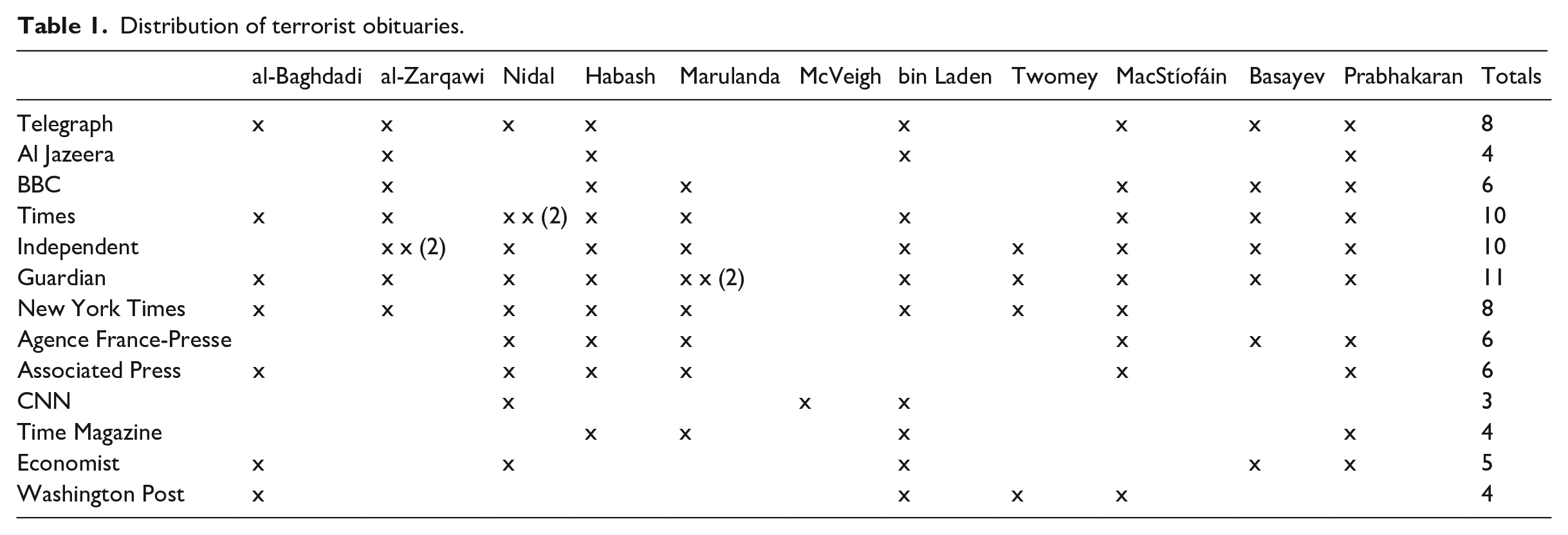
The remainder of this article focuses on obituaries of 11 individuals remembered primarily for their involvement in violences deemed ‘terrorism’: Abu Bakr al-Baghdadi (1971–2019); Abu Musab al-Zarqawi (1966–2006); Abu Nidal (1937–2002); George Habash (1926–2008); Manuel Marulanda (1930–2008); Timothy McVeigh (1968–2001); Osama bin Laden (1957–2011); Seamus Twomey (1919–1989); Seán Mac Stíofáin (1928–2001); Shamil Basayev (1965–2006); and Velupillai Prabhakaran (1954–2009). We analysed every obituary of these individuals published across 13 international media outlets: Agence France-Presse, Al Jazeera, Time Magazine, Associated Press, BBC Online, CNN, the Economist, the Guardian, the Independent, the New York Times, the Times, the Telegraph and the Washington Post. Although these outlets often published considerable additional commentary on these men and their deaths, our focus on the obituary genre meant we only included articles explicitly designated thus, or on rare instances where this designation was not explicit, exhibited all the features distinguishing this genre from other content (see Starck, 2005: 268). This produced a corpus of 85 obituaries comprising 108,691 words accessed via Lexis Nexis and targeted internet searches (see Table 1).
Distribution of terrorist obituaries.
Our selection of individuals was structured by two primary criteria. First: representativeness of an organization or acts widely considered ‘terrorist’. Nine of the 11 had held leadership positions in organizations on lists such as the US Department of State’s list of Foreign Terrorist Organizations or the UK Home Office’s list of Proscribed Terrorist Organisations: al-Baghdadi (ISIS); al-Zarqawi (Al-Qaeda in Iraq); Nidal (Abu Nidal Organization); Habash (People’s Front for the Liberation of Palestine); Marulanda (Revolutionary Armed Forces of Colombia); bin Laden (Al-Qaeda); Prabhakan (Liberation Tigers of Tamil Eelam); Twomey (IRA); and Mac Stíofáin (IRA). The others – Basayev and McVeigh – were included for their involvement in high-profile attacks: Basayev for the 2002 Moscow theatre attack and 2004 Beslan school massacre, McVeigh for the 1995 Oklahoma City bombing. Second, reflecting our focus on the remembrance of abject figures, was that the individual remained, at their death, associated with, or primarily remembered for, violence such that this dominated their obituarization. Beyond these initial purposive criteria (see Etikan et al., 2016), a strategy of heterogeneous sampling was employed to include individuals with diverse geographical, political and historical backgrounds (Howarth, 2005: 331).
This sampling approach satisfied our aim of investigating terrorism obituaries as a site of everyday security discourse with potential to (re)produce, entrench and contest particular knowledge claims. It should, therefore, be noted that the non-probabilistic research design cannot sustain claims to generalizability. Indeed, many notorious individuals satisfying our first criterion – e.g. Shoko Asahara of Aum Shinrikyo – were not sufficiently obituarized for inclusion, in part perhaps because negative obituaries constitute a recent – and still rare – phenomenon (Fowler, 2005: 65). Other individuals deemed ‘terrorist’ at some time, by some – e.g. Nelson Mandela – were excluded following initial reading because their obituarization concentrated on their political careers as much as, or more than, any violences of which they were accused.
Our focus on obituaries published within the mainstream news media reflects the global reach of the English-language press (Gray and Franck, 2019: 277), its continuing importance as a ‘social forum’ (Schäfer et al., 2016: 81) and the pragmatic advantages of media data which is ‘readily available and easily accessible’ (Schäfer et al., 2016: 82). Our selection of the 13 news media outlets reflected four specific criteria: (i) diversity of political standpoint (see Gray and Franck, 2019: 277); (ii) diversity of format to reflect multiple forms of news consumption; (iii) international reach; and (iv) reputation for publishing obituaries. Although the over-representation of ‘Western’ publications further militates against our corpus’s representativeness, the sample nevertheless includes two broadcasters with international reach, the BBC and CNN; prominent international agencies in Al Jazeera, the Associated Press and Agence France-Presse; two of the highest circulation newspapers in the US in the New York Times and the Washington Post; the UK’s ‘four leading obituary pages’ (Starck, 2005: 278) in the Telegraph, the Guardian, the Independent and the Times; and two longstanding, influential publications – Time Magazine and the Economist.
Following collection, the obituaries were collated into one master document for coding via a hybrid deductive and inductive approach. Here, a code book was formulated via an initial literature review as the road map for navigating our corpus. This generated codes on the ambitions, causes, organization and violences of terrorist groups. These themes represent key foci within the new terrorism thesis, and were applied to the first reading of the data which focused on comprehension and testing their relevance. All codes were found applicable, and highlighted hundreds of excerpts of potential interest. This was followed by an inductive coding process comprising two further readings: a bottom-up reading of the entire corpus for recurrent themes which, unsurprisingly, generated new codes such as references to individuals’ early lives; and a further inductive reading of the entire corpus to test codes that emerged part-way through the penultimate reading. As demonstrated below, our approach amounts to a double reading of ‘terrorist’ obituaries that charts how they reproduce claims associated with the ‘new terrorism’ thesis, then analyses internal assumptions, contradictions and exclusions therein, before reflecting on the discourse’s wider political and normative implications (Jackson, 2009: 67–69; see also Jackson, 2005). By exploring how obituaries reproduce and call into question constructions of new terrorism, we can therefore discern their constitutive importance noted above (Baker-Beall and Mott, 2022: 1090–1092) and, importantly, the precarity of this thesis and its simplistic binary organization (Ashley, 1988; Shepherd, 2008).
Old terrorism, new terrorism and media obituaries
Given the relatively recent emergence of the ‘new terrorism’ thesis, one might expect to trace its origins to the day ‘everything changed’ on 11 September 2001. Yet the thesis had, in fact, grown in popularity amongst terrorism researchers, at least, throughout the final two decades of the 20th century (Jenkins, 1985; Hoffman, 2017; Laqueur, 1999). 9/11, of course, added to its currency, popularizing the sense that ‘a radically altered form of terrorist threat’ (Gofas, 2012: 17) had emerged; a threat characterized by a fundamental change in the ‘ancient practice’ of terrorism in which terrorists had begun operating in ‘unprecedented ways’ (see Kegley, 2003: 1). These changes, as noted above, were deemed to include radical transformation in terrorism’s aims, structural organization and methods, with purported differences in the religiosity and types of violence waged by contemporary terrorist groups vis-à-vis their antecedents (Gunaratna, 2014; Neumann, 2009). In the following sections, we explore how terrorist obituaries reproduce, negotiate and contest this set of claims via thematic analysis of three key constructions therein: (i) violence, discrimination and politics; (ii) religiosity; and (iii) structure, organization and scope. By reading these alongside illustrative examples of the new terrorism literature, we show the thesis’s continuing traction in this site of media discourse in – and indeed beyond – the first decade of the 21st century in which it emerged. As this demonstrates, this traction is evident, importantly, where the thesis itself is not explicitly invoked.
Violence, discrimination and politics
A first claim of the new terrorism thesis is that terrorist groups have moved away from strategic, targeted attacks and increasingly embraced indiscriminate, brutal and ostensibly random acts of violence (Juergensmeyer, 2003). Mass-casualty attacks (Morgan, 2004; Neumann, 2009; Tucker, 2001), suicide operations (Lynch and Ryder, 2012) and egregious violences are often here taken to typify terrorism’s newer incarnations. Despite some recognition that ‘old terrorism’ was never entirely ‘clean’ in its targeting of victims (Neumann, 2009: 37), historical campaigns are widely held to have been more discriminate than ‘newer’ equivalents: targeting representatives of oppressive or occupying forces, for instance, rather than waging ‘murder and destruction on an unprecedented scale’ (Laqueur, 2005: 74).
This first distinction between old and new terrorism finds widespread reproduction in terrorist obituaries. Individuals widely seen as archetypes of new terrorism – al-Baghdadi, al-Zarqawi and bin Laden, for instance – are routinely obituarized around their involvement in mass casualty attacks. 9/11, of course, features prominently, as do other destructive, if less publicized, violences including the 1998 car bombings at the US embassies in Dar es Salaam and Nairobi (Daily Telegraph, 2011), the four suicide bombs that killed 57 in Amman (Times, 2006a) and the ‘destruction of the headquarters of both the Kurdish parties in the city of Arbil in February 2004’ which killed 117 (Times, 2006a). Such violences are often linked in these obituaries to their architects’ psychological excesses, from the narcissism of bin Laden’s 1998 fatwa that all Americans be ‘killed wherever they might be found anywhere in the world’ (CNN Wire Staff, 2011), to al-Zarqawi’s ‘fascination with death’ (Darwish, 2006) as a man having known ‘little apart from violence’ (Times, 2006a). Shamil Basayev’s brutality – ‘a man only of violence . . . peaceful politics bored him’ (Economist, 2006) – here helps explain his wanton disregard for such outrages as the Moscow theatre hostage crisis of October 2002, in which 130 of the hostages died when Russian special forces raided the building, and the 2004 Beslan school siege, with its bloody outcome that involved the deaths of several hundred schoolchildren. (Times, 2006b)
Individuals more commonly associated with older forms of terrorism, in contrast, often see their violences remembered in more descriptive terms with reduced emphasis on the magnitude or innocence of their casualties. Abu Nidal’s group, for instance, ‘carried out assassinations and hijackings’ (Agence France-Presse, 2002). George Habbash’s PFLP ‘pioneered the tactic of hijacking aeroplanes, to try to achieve political objectives’ (Thorold, 2008), such as calling ‘attention to the cause of his people’ (Daily Telegraph, 2008). Velupillai Prabhakan’s call for ‘the assassination of Rajiv Gandhi in 1991’ is described in overtly geopolitical terms, as ‘intended to keep India . . . from further meddling’ (Daily Telegraph, 2009). And FARC’s 2002 attack on the Colombian presidential palace as depicted in the Times’s obituary of Marulanda receives similarly strategic interpretation as his effort to show ‘that he was still a force to be reckoned with’ (Times, 2008a).
The ostensibly discriminate nature of old terrorism was famously captured in Jenkins’s (1974) suggestion that terrorists wanted a lot of people watching, not a lot of people dead. New terrorists, in contrast, find their aphorism in James Woosley’s similarly ubiquitous rejoinder that today’s terrorists ‘don’t want a seat at the table, they want to destroy the table and everyone sitting at it’ (cited in Morgan, 2004: 30–31). This distinction again emerges in these obituaries, such that Sean MacStíofáin, on the one hand, is remembered for his 1972 leadership of the ‘IRA delegation that secretly negotiated with the British government’ (New York Times, 2001). Obituaries of new terrorists, in contrast, emphasize their subjects’ ‘non-negotiable’ demands (Von Hippel, 2002: 25) and indifference to human life (see Laqueur, 1999; Tucker, 2001). Thus, bin Laden is remembered for ‘boasting’ about his search for chemical, biological and nuclear weapons (Zernike and Kaufman, 2011), and al-Zarqawi for passing his ‘specialised knowledge of chemical weapons’ (Daily Telegraph, 2006) to students at training camps (BBC, 2006). Other obituaries remember their subjects’ excessive violences (see Neumann, 2009: 27) from the Guardian’s referencing the CIA belief that al-Zarqawi ‘had personally sawed off the heads of two kidnapped American contractors’ (Joffe, 2006), to the Daily Telegraph’s attention, in al-Baghdadi’s obituary, to the ‘more than 100 Shia soldiers from Tikrit lying in a gutter on a roadside, their hands tied behind their backs as they were summarily murdered’ (Daily Telegraph, 2019). As the Washington Post summarized of al-Baghdadi’s penchant for cruelty, Mr. Baghdadi reveled in ghoulish displays of violence, often as the subject of elaborately produced videos. His followers carried out mass crucifixions, turned female captives into sex slaves and gleefully executed prisoners by stoning, hacking or burning them alive – always with Mr. Baghdadi’s implicit blessing. (Warrick, 2019)
Religion
Terrorist obituaries, then, often reproduce a distinction central to the new terrorism thesis in which older forms of moderate, strategic terrorism have been replaced by newer forms of indiscriminate, wanton violence. A key explanatory claim within the terrorism thesis for this shift is the increasing importance of religious motivations to contemporary terrorists (Juergensmeyer, 1997). Here, specific emphasis is placed upon the ‘Islamist’ nature of post-9/11 terrorism, such that it is ‘widely assumed in policy circles that some extreme version of Islam has been a major driving force behind contemporary terrorism’ (Mills and Miller, 2017: 46). Terrorist obituaries, again, reproduce this construction: a love of violence, for instance, is deemed to have ‘turned Zarqawi to the path of Allah’ (Darwish, 2006); his incarceration as a young man offering plentiful opportunity for radicalization, ‘sat for hours on his bunk bed bent over a Koran . . . trying to memorize all the verses’ (Gettleman, 2006). bin Laden, similarly, is obituarized as a figure of religious intensity. An assiduous student of the faith and ‘much more pious than political’ in his early years (Graham, 2011), the young bin Laden is said regularly to have discussed religious matters with local clerics; the importance of his faith anecdotally evident through his belief that music was ‘un-Islamic’ (Beyer, 2011). In related vein, ISIS’s al-Baghdadi possessed a ‘soul . . . connected to the Mosque’ and a ‘spiritual gift’ (Callimachi and Hassan, 2019); his exceptional memorization of scripture (Times, 2019) as well as his academic credentials facilitating the PhD in Islamic Studies he earned (Schreck and Karam, 2019).
In these examples, devotion to Islam is coherently and intimately linked to terrorist violence. In line with the new terrorism thesis, religious motivations are seen to create ‘radically different value systems, mechanisms of legitimation and justification, concepts of morality and worldviews’ (Hoffman, 2017: 90). Consequently, religiosity is positioned as a salient explanatory factor for violence: a precursor as well as a justification for indiscriminate attacks. The cosmic or divine motivations of new terrorism mean its tools will be brutal and relentless: not only the culmination of political strategy, but also ‘evocations of a much larger spiritual confrontation’ (Juergensmeyer, 2017: 18). This also helps explain the attention given in these obituaries to historical Islamic figures, from bin Laden’s likening himself to the Prophet Muhammed (Zernike and Kaufman, 2011) to al-Zarqawi’s adoption of Abu Musab as his nom de guerre after the Islamic warrior who kept the Prophet’s flag flying at the Battle of Yathrib (Darwish, 2006). Through such constructions, new terrorists are positioned within a lengthy historical conjoining of Islam and violence, which, if anything, augments the threat posed by those such as bin Laden with his ‘confidence’ in the ability of Muslims ‘to end the legend of the so-called superpower that is America’ (Zernike and Kaufman, 2011).
Structure, organization and scope
A third distinction of the new terrorism thesis concerns the structure, organization and scope of terrorism. Old terrorism, on the one hand, is believed to mimic the institutional frameworks of traditional militaries, deploying hierarchized vertical chains of command with concentrated decision-making powers. New terrorist groups, in contrast, are associated with a horizontal structuration (Morgan, 2004: 40), in which authority is diffuse rather than concentrated (Neumann, 2009: 19) and acephalous (or polycephalous), thus lacking a clear centre of gravity (Arquilla et al., 1999: 86).
Although less prominent in terrorist obituaries than the above themes, this differentiation is evident here too, especially in relation to the internal organization of old terrorism campaigns. References to the IRA’s Army Council granting Sean MacStíofáin permission to form a London unit, for instance, confirm the ‘top-down’ power of the IRA as a far cry from the ‘franchise model’ of new terrorist groups (McHardy, 2001). As, indeed, does mention of the Council’s ordering of an end to his 1972 hunger strike while in Mountjoy jail (Daily Telegraph, 2001). Similar constructions emerge in the discussion of Manuel Maralanda’s imposition of ‘strict military discipline and hierarchy’ (Times, 2008a) upon the FARC, with the military organization of its fighters prominent in the Independent’s obituary. Apart from a number of autonomous groups of six . . . the lowest formation of the FARC’s 17,000 full-time fighters has been the 12-person squad; the guerrilla was a group of two squads; the company was two guerrillas; the 110-person column was two or more companies while a Frente or front, of which there were five, was two or more columns. In addition there were two ‘joint commands’ in areas of less activity. The organisation was commanded by the Central General Staff. (O’Shaughnessy, 2008: 32)
Such accounts differ markedly to discussion of new terrorist groups such as Al-Qaeda. In the New York Times obituary for Osama bin Laden, for instance, Al-Qaeda is positioned as a ‘far-flung and loosely connected network of symbiotic relationships’ in which bin Laden provided money, training and expertise in exchange for ‘operational cover’ (Zernike and Kaufman, 2011). In his Daily Telegraph obituary, the organization is ‘a loose coalition of militant Islamists and jihadist groups’ (Daily Telegraph, 2011); in the Guardian, similarly, it is a ‘network of networks’ (Burke and Joffe, 2011).
Remembrance, problematization and reformulation
The above discussion illustrates a widespread reproduction within newspaper obituaries of the new terrorism thesis’s claims to radical transformation in the actions, motives and organization of terrorism. Where older terrorists tend to be remembered as discriminating, political and constrained by formal institutional structures, the new terrorist is responsible for indiscriminate, religiously motivated violence waged through looser networks of belligerents. The dominance of this binary notwithstanding, we finish our discussion by highlighting how these everyday security texts also negotiate, problematize and contest established security constructions such as ‘new terrorism’.
First, consider the structural transformation in terrorism’s organization with which we concluded the above section. Central to the new terrorism thesis, as we have seen, is a transition from militarized hierarchies to looser networks of terrorists. This organizational shift is often linked to geographical transformations, with globalized forms of terrorism replacing more local campaigns (e.g. Brinkley, 2013). Where previously restricted, new terrorists are believed to operate internationally, garnering recruits from across the world, facilitated by contemporary digital technologies. The obituaries considered here, however, pull into question this old-local, new-transnational dichotomy (see also Zimmerman, 2004: 23). Ex-Secretary General of the PFLP George Habash, for instance, is described as being ‘one of those responsible for introducing the world to international terrorism’, through cultivating transnational alliances including with the Baader-Meinhof group and the Japanese Red Army (Daily Telegraph, 2008). The Tamil Tigers, similarly, are given an explicitly international reading in Prabhakaran’s obituarization, given his ability to raise ‘vast funds from Tamils in Canada, Britain, Switzerland, Australia, Singapore and Malaysia’ (Times, 2009) and make use of a ‘worldwide support network’ (Al Jazeera, 2009).
A similar nuancing of the thesis’s claims emerges in some framings of violence within these obituaries. Discussion of historical terrorist brutalities, on the one hand, call into question the novelty of contemporary terrorisms, from the multiple-casualty attack described in the Telegraph’s obituary of Habash – ‘so barbaric that the PFLP was said to have had trouble recruiting Palestinians to do the job’ (Daily Telegraph, 2008) – to CNN’s citing of witness testimony of McVeigh’s World Trade Center attack: ‘people everywhere profusely bleeding from the head, body parts laying on the ground around the north side of the building here’(CNN, 2001). Acts of wanton cruelty akin to the al-Zarqawi beheadings discussed above do similar work, too, in the Guardian’s discussion of Abu Nidal’s treatment of his prisoners. Sometimes, while the committee waited for its leader to confirm a death sentence, a prisoner would be placed in a freshly dug grave with the earth shoveled over. A steel pipe in his mouth allowed him to breathe. Water was poured in from time to time to keep him alive. (Hirst, 2002)
Where these examples problematize the old terrorism side of this dichotomy (see Crenshaw, 2008: 128–129; Field, 2009: 203), other obituaries construct the violences of new terrorists in a more strategic and discriminatory register than typical in the thesis. Al-Zarqawi’s Independent obituary, for instance, contrasts the discriminatory violences of Osama bin Laden – the archetypal new terrorist – with its subject’s willingness to attack any ‘who did not share his Salafi ideology’ (Darwish, 2006).
The existence of political demands and a realistic strategic framework surfaces, as we have seen, in discussion of many old terrorist groups, not least those engaged in formal negotiations such as MacStíofáin’s dialogue with the British government. Other old terrorists, however – from Abu Nidal to Habash and Marulanda – also, on occasion, receive less moderate obituarization. Thus, Nidal is described as having sought the ‘obliteration of Israel’, such that ‘anyone willing to settle for less . . . was his enemy’ (Fisher, 2002). Habash is positioned as having led his movement’s ‘rejectionist wing’, ‘insisting that under no circumstances should any negotiations be held with the Israeli state for a peaceful resolution of the conflict’ (Times, 2008b). And Marulanda, in turn, is described as ‘aloof’ in negotiations and so affected by the murders of government death squads that he ‘would never agree to take part in any peace process that involved a cessation of hostilities’ (Times, 2008a).
Other obituaries, finally, question contemporary terrorism’s religiosity including through reference to bin Laden’s ‘glossing over the faith’s edicts against killing innocents and civilians’ (Zernike and Kaufman, 2011) and al-Zarqawi’s instrumental discovery of Islam after a youth of sexual assault convictions (Joffe, 2006), ‘heavy drinking, tattoos and fighting’ (Times, 2006a). Such reflections on the very banal, very human, nature of contemporary terrorists finds complement in the positing of ostensibly secular motives for new terrorism. The Israeli invasion of Lebanon and the arrival of American troops in Saudi Arabia, for instance, are said to have motivated bin Laden to ‘drive out the infidels, to establish Palestine and destroy Israel, [and] to eject the “heretics” who ruled in Saudi Arabia’ (Economist, 2011). The Daily Telegraph’s obituary of al-Zarqawi, relatedly, notes of the killing of Nick Berg, that the executioner – widely identified as al-Zarqawi – asked future viewers of the recording: ‘“Where is the protection for Muslims’ pride in crusaders’ jails?”’ (Daily Telegraph, 2006).
These alternative constructions are important because, following Clapton and Shepherd (2017), they demonstrate the obituary’s potential to challenge and subvert dominant ways of understanding terrorism across the 20th and 21st centuries. Despite the continuing prominence of the new terrorism thesis’s claims across this genre, terrorist obituaries also contain important moments of critique and disruption in which reflection on the lives of deceased others renders visible its limitations, perhaps even its ‘fundamentally unsatisfactory’ nature, as an explanatory framework for political violences (Clapton and Shepherd, 2017: 15). To return to themes at the article’s outset, they allow us to theorize these obituaries as multiple texts capable of reproducing and problematizing established constructions of threat. And, in so doing, to contribute to contemporary critical work on everyday security discourse, and on memory and global politics. Existing relevant scholarship on memory has been vital in unpacking the ‘contemporary salience of victimhood’ in the politics of security (Heath-Kelly and De Mosteyrín, 2021: 1–2), by tracking how individual lives are made grieveable through constructions of innocence or goodness, and the consequences of this for sovereign identity and violence (Butler, 2004). The importance of our argument, in turn, is to demonstrate the political productivity of constructions of alterity and otherness in mnemonic texts such as these with their own role in the making, remaking and potential unmaking of comprehensible, and indeed permissible, identities and violences.
Conclusion
This article explored the obituary as an important yet neglected site of everyday security discourse. Through analysis of 86 obituaries of 11 individuals published across 13 prominent media outlets. we offered three arguments. First, drawing on existing scholarship on memory, we argued that obituaries play an important constitutive role in shaping public understanding of terrorism and terrorists. The terrorist, here, is not only remembered: they are also (re)produced. Second, obituary productions of the figure of the terrorist frequently draw upon wider discourses, illustrated through the prominence of the still pervasive, if contested, ‘new terrorism’ thesis. Third, notwithstanding this traction, terrorist obituaries also offer opportunity for nuancing and problematizing dominant constructions of terrorism, in part because of the scope for sociopolitical critique afforded by this genre.
These findings are important, we argue, for several reasons. First, empirically, our analysis contributes to the broadening of (critical) security studies via substantive focus on newspaper obituaries as a largely neglected site of (in)security discourse. As a distinctive mnemonic genre, terrorist obituaries merit attention because they produce their subjects and their deaths as worthy of remembrance in ways that draw upon and negotiate established discourses of (in)security. In so doing, individual deaths are rendered visible (as we have seen, not all ‘terrorists’ are remembered in this medium; not all are remembered equally) and meaningful through their positioning in wider discourses of death and security. And this focus on ostensibly exceptional lives individualizes – at times even humanizes – its subjects in ways that move beyond the homogenizing constructions of terrorists in better-studied discursive sites (see Jarvis, 2019a). At the same time, the consistency with which individual motives and actions are written around prominent narratives such as the new terrorism thesis also serves to flatten potentially pertinent differences, creating new equivalences between ‘terrorists’.
Second, conceptually, the article also pulled attention to the obituary as an important site of security discourse in which knowledge of violence – by ‘terrorists’, and, in some instances, against them – is (re)produced and (de)contested as well as communicated. Obituaries, we suggest, are usefully theorized as an everyday security text with their writing around particular (if mobile) stylistic conventions, and their consumption in spaces far removed from more formal sites of ‘high’ politics. They are usefully theorized as political, moreover, because their creation of that which they purport to reflect – memorable lives – is contingent and inevitably predicated on exclusions. Such exclusions are substantive – as with the decision of some publications not to obituarize certain figures. They are also thematic – through the omission of alternative, plausible, interpretations of violent contexts, causes and events. Treating this neglected genre with seriousness, therefore, itself constitutes a politicizing move that helps ‘densify’ or ‘thicken’ our understanding of the wider politics of death within which terrorists and their obituaries are situated (Guillaume and Huysmans, 2019: 286–287).
Third, by showing the continuing pervasiveness of the old–new terrorism binary within newspaper obituaries, the article sheds light on both the mobility of security knowledge across sites of discourse, and – through recent examples such as al-Baghdadi – the ongoing power of prominent claims around (in)security despite the apparent atrophy of the broader conceptual frameworks from which they emerged. Our analysis matters, put otherwise, because it indicates the continuing relevance of the new terrorism thesis – within this mnemonic genre, but likely elsewhere too – despite sustained academic critique thereof, and indeed, despite recent softening of its claims by advocates (Neumann, 2022). Although beyond the scope of this article, this resilience raises profound political and normative questions for the analyses and impact of researchers of ‘terrorist’ violence and beyond. 2
Footnotes
Acknowledgements
We gratefully acknowledge Alan Finlayson, Michael Lister and Keith Spiller for their perceptive and challenging comments on earlier drafts of this article or ideas contained herein. Our thanks, too, to participants at earlier presentations of this work at the University of Adelaide and the University of Warwick, and to the editors and three anonymous reviewers at Security Dialogue.
Funding
The author(s) received no financial support for the research, authorship, and/or publication of this article.
