




Abstract
This article examines the #SdScandal: the backroom and public fracas surrounding an article on epistemic racism in classic securitization theory that we authored. It argues that what the #SdScandal illustrates is that disciplinary whiteness in international relations has been upheld not despite, but in part through, the ‘critical turn’. Using textual analysis as well as cyber-ethnographic and auto-ethnographic methods, it details how post-positivist knowledge-frames sometimes become vehicles for the rehabilitation of racial-colonial concepts, and how white femininities and novel tender masculinities can be evoked in the defence of institutional hierarchies. That such gendered shifts in disciplinary whiteness (seem to) depart from old-guard ‘white man’s IR’ (per Lake, 2016) only increases their efficacy in securing the status quo. The article further contextualizes this argument about international relations within the broad backlash against resurgent claims for racial justice both inside and outside the academy. It identifies political-intellectual convergences, not only between orthodox and some critical thought, but between right-wing and some self-identified liberal, leftist and/or feminist scholars, especially around the supposed threat of ‘cancellation’ of scholars and scholarship. Examining what critics of the #SdScandal called threats of retribution against this journal, it argues that at stake are issues of editorial independence and academic freedom, and, more broadly, contending visions of how to pursue anti-racism.
Introduction
It is now well established that the Anglo-American discipline of international relations was conceived as the handmaiden of white imperial order. Despite rich archives of concurrent dissident thought challenging the global colour line, the discipline as such has only recently begun a fuller reckoning with ‘the question of race’ (Biswas, 2001: 485) and of indigeneity. 1 In his article ‘White Man’s IR: An Intellectual Confession’, former president of the American Political Science Association David Lake (2016: 1116) diagnoses the problem as ‘white man’s IR begets white man’s IR’. Yet effectually grappling with disciplinary whiteness, in both its knowledge-frames and its institutional hierarchies, requires confronting possibly even more uncomfortable truths: that this is not just a matter of ‘old-guard’ and ‘white man’. This article argues that international relations’ failure to substantively reckon with racism and colonialism in its canons and institutions has occurred not despite, but in part through, the post-positivist ‘critical turn’ from the late-1980s onward. This is not to dismiss the contributions of post-positivist international relations or to diminish the influence of postcolonial international relations. Rather, it is to challenge disciplinary narratives of the critical turn as a radical upheaval, viewing it instead as an ‘ambivalent rebellion’ (Agathangelou and Ling, 2004: 29).
To develop this argument, we examine a controversy that erupted in May 2020 surrounding an article we co-authored in Security Dialogue (SD): ‘Is Securitization Theory Racist? Civilizationism, Methodological Whiteness, and Antiblack Thought in the Copenhagen School’ (Howell and Richter-Montpetit, 2020, hereafter ISTR). The discipline, in Shilliam’s (2020: 153) words, ‘witnessed an academic controversy over race, when Wæver and Buzan (2020[a]) responded emotively and at length to an article published by Howell and Richter-Montpetit (2020) asking if securitization theory was racist and answering in the affirmative’. The controversy produced ugly exchanges across social media platforms, coverage in both mainstream and far-right news media, and extraordinary download counts (Figure 1), swiftly turning five white scholars’ work, including ours, into ‘go-to’ publications on race and international relations, despite the longstanding leadership of scholars of colour in the field. Over 450 scholars, across a wide array of disciplines, signed an open letter (see Appendix A 2 ) decrying how the controversy involved an attack on academic freedom, threatening anti-racist and anti-colonial research more broadly. The case is interesting for its impact and broad participatory nature on social media and elsewhere, but, above all, for what it teaches us about novel and harder-to-track operations of disciplinary whiteness at the current juncture.
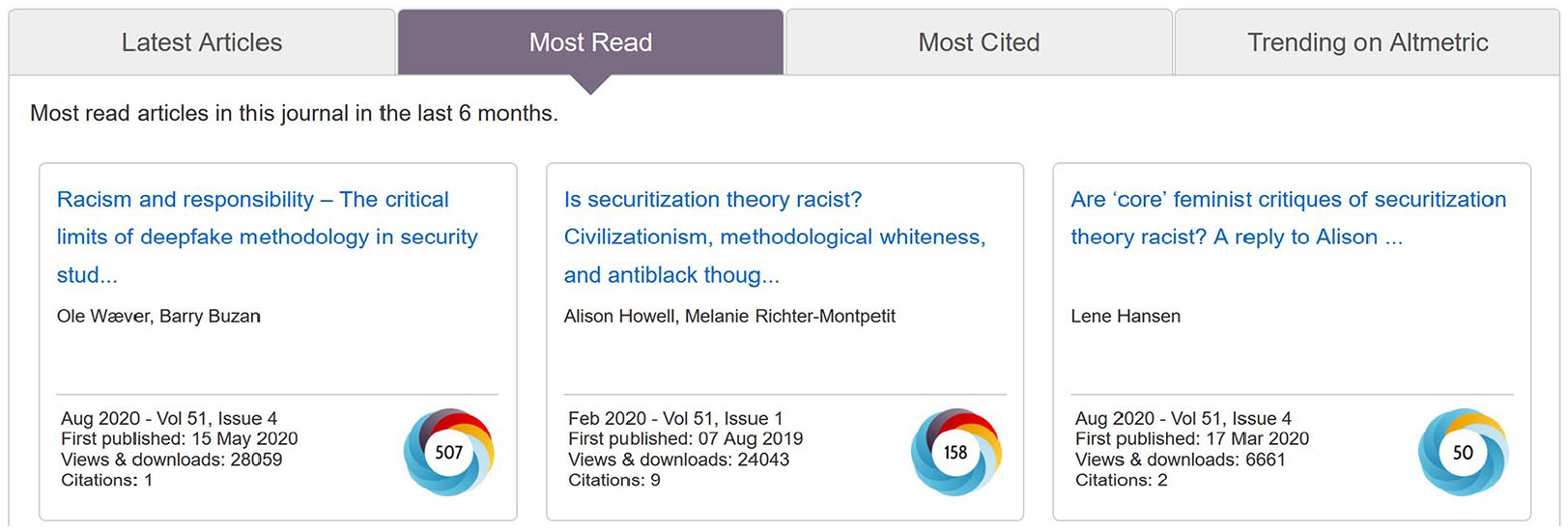
Screenshot from https://journals.sagepub.com/home/sdi of SD’s ‘most read’ articles after the #SdScandal, measured by download counts (17 November 2020).
The #SdScandal 3 ‘did not erupt out of thin air, but arrived as part of a deep and long-term swell in the critical study of race in IR’, including the ‘retrieved and relaunched’ ‘critique of race and racism in IR’ during the 1990s and 2000s (Shilliam, 2020: 153). Indeed, the post-positivist turn saw powerful postcolonial interventions (see Agathangelou and Ling, 1997; Biswas, 2001; Chowdhry and Nair, 2002; Doty, 1993; Grovogui, 1996; Inayatullah and Blaney, 2004; Krishna, 1993; Ling, 1999; Paolini, 1999; Persaud, 1997). Still, most international relations, including critical security studies, persisted in underestimating or ignoring what is ‘hidden in plain sight’: the raciality and coloniality of global politics (Henderson, 2013). As Biswas (2001: 485) noted at the time: ‘even the new critical turn in security studies, which has done much to unsettle the epistemological and ontological presuppositions in dominant security thinking, has failed to raise the question of race as an explicit category of analysis’.
Dominant narratives of international relations’ ‘Great Debates’ cast the post-positivist turn as a radical shake-up. Despite intensive gatekeeping, it did create significant institutional openings, challenge orthodox methodological assumptions and assert ‘a composite claim for a more diverse, less epistemologically and ontologically naïve, and more critical IR’ (Balzacq and Baele, 2017: 4). Yet we pause in the wake of the #SdScandal to ask: What kinds of naïvety remain intact, through what strategies, at what cost? More pointedly, what kinds of diversification did this turn produce?
To theorize how the critical turn involved upholding disciplinary whiteness, we approach it as an instance of ‘diversifying whiteness’ (Smith, 2018) in a broad context of ‘white reconstruction’ (Rodríguez, 2020). This pernicious modality of neoliberal (anti)racism minimizes white dominance by reframing it as a general ‘lack of diversity’, then ‘solves’ this problem by including marginalized white subjects, especially white women and LGB people, such as ourselves. We argue that within international relations and security studies, white reconstruction has proceeded under the banners of criticality and diversity: the institutional ascension of some previously marginalized white subjects and knowledge-frames has contributed to shoring up the raciality and (settler-)coloniality of the discipline’s intellectual and professional cultures, and associated material benefits.
Our analysis of the #SdScandal connects intellectual and institutional aspects of white reconstruction. It highlights gendered racial-sexual dynamics beyond aggressive old-guard masculinities, pinpointing how tender new-guard white masculinities and critical theory approaches work alongside white femininities and white feminist knowledge-frames. Using textual analysis as well as auto-ethnographic and cyber-ethnographic methods, we chart disciplining techniques across four terrains:
Back-room struggles over the defence of SD, involving issues of editorial independence and academic freedom.
The reception of the first of two rejoinders to ISTR (Hansen, 2020, hereafter Rejoinder 1), which we read as exemplifying the power of maternal discipline in defending white feminist knowledge-frames and subject-positions.
The reception of the second rejoinder (Wæver and Buzan, 2020a, hereafter Rejoinder 2) and its concept of ‘deepfake methodology’ (see Lindsay, 2020), which we read as exemplifying paternal discipline protecting disciplinary whiteness.
A public fracas stoked on social media (#SdScandal and #securitizationtheory) and covered in news media.
These disciplinary techniques met with resistance, including pushbacks on social media, open letters and statements by institutional bodies (e.g. the British International Studies Association Colonial/Postcolonial/Decolonial Working Group and the International Studies Association LGBTQA Caucus) (see Appendix A).
In theorizing the #SdScandal and disciplinary whiteness, our racialization as white 4 and our status as settlers pose intellectual, political and ethical challenges. Structurally, for white audiences, white knowers are positioned as authoritatively ‘neutral’ in relation to racism and colonialism. The promotion of ‘white authenticators’ (Mills, 2007: 32) replicates the global colour line, marginalizing or erasing theorists with lived experiences of racism and colonization, whose trailblazing work is often produced at great cost to professional advancement (see Agathangelou and Ling, 2002; Biswas, 2014). Simultaneously, there is a clear ethical demand on white scholars (especially those who, like us, have job security, access to employer-provided legal counsel and union representation) to take responsibility for challenging disciplinary racism rather than minimizing our research findings to make things (more) comfortable for international relations’ status quo.
On the basis of these considerations, and in an effort not to further foster heated, all-white discussions of racism in our discipline, we declined this journal’s invitation to write a rejoinder response. We also refrained from making any public/online statements. For better or worse, our decision was to take a slower, scholarly route: to theorize, rather than react to, the #SdScandal, harnessing our privileged access to this significant international relations event to draw out generalizable knowledge and work towards undoing the object of our analysis: disciplinary whiteness, a system we are ourselves complicit in and materially benefit from.
The article first discusses theory and methods, then examines the four terrains listed above in reverse chronological order: the public fracas, then paternal and maternal discipline, and finally the struggles over this journal and academic freedom. Throughout, we trace imbrications between knowledge-frames and material-institutional arrangements.
Theory and methods for studying disciplinary whiteness in international relations
In theorizing the #SdScandal, we draw together a range of anti-racist and anti-colonial literatures in international relations and beyond to work through three main quandaries:
1. Structures/agents. On social media, the #SdScandal was sometimes interpreted through the concept of ‘white fragility’. While not without merit, this concept risks reducing racism and investments in whiteness to individual psychological states, losing sight of racism and disciplinary whiteness as structural forces. Yet treating structures in isolation from the social actors that shape them – in this case, (communities of) scholars, corporate journal managers, research institutes, lawyers, social media users, publishers, journalists and editors, among others – risks producing a defeatist account of racial-colonial disciplinary structures as all-powerful and unchangeable.
To theorize the persistent raciality of international relations’ theory canon, we draw on Charles Mills’s (2007) concept of ‘white ignorance’: the pervasive structural pattern of not-knowing (‘ignorance’) about white supremacy among individual white cognizers. Advancing this concept in the context of critiquing canonical international relations theory, Sabaratnam (2020: 11, 7) recently argued that it is ‘not a coincidence’ that (international relations) theorists with lived experiences of racism have ‘been more consistently attuned to these problems’, while ‘the life experiences and ideological exposures of scholars racialised as White tend to normalise and render invisible Whiteness and White supremacy’. This theorization recognizes white knowledge-frames as structural without conflating identity and standpoint. In other words, white ignorance is neither absolute nor ‘confined to white people’ (Mills, 2007: 22, emphasis in original).
Further, to navigate the pitfalls of a structurally deterministic account of the ongoing raciality of international relations’ theory canon, we adduce Krishna’s (2001: 401) concept of ‘willful amnesia’. This wilful ignorance in dominant accounts of global politics about the role of white supremacy and empire may be animated either by fundamental resistance to acknowledge racism or by what Rutazibwa (2016) theorizes as ‘strategic reluctance’ to use the ‘R-word’: using more ostensibly ‘neutral’ concepts like Eurocentrism, 5 speaking of ‘racialized’ over racist thought and, when using the concept of racism at all, analytically limiting it to biological racism associated with Hitler, the Ku Klux Klan and the pre-1945 era.
Finally, paralleling Sabaratnam, we supplement our analysis of the complex connections between racialized subject-positions and racialized knowledge with Wekker’s (2016) concept of ‘white innocence’. This traces how white knowledge-frames relegate racism to the interpersonal level when emphasizing the unintentional and exceptional character of racist speech and practices (Sabaratnam, 2020: 13), while stressing its structural character when refusing to give up material benefits.
2. Ideational/material. Following Siba Grovogui’s suggestion, we analyse the workings of disciplinary whiteness in the #SdScandal in terms of two inseparable senses of ‘discipline’: as structure of knowledge and technique of social control. To theorize entanglements between knowledge production and institutional cultures/material inequalities, we turn to Agathangelou and Ling’s (2004) analytic of ‘the House of IR’ as a gendered colonial household (i.e. property), headed by Pater Realism, with Mater Liberalism to his side. Also ‘upstairs’ are Rebel Sons (Marxist, Gramscian international political economy, postmodern international relations, constructivism-pragmatism) and Fallen Daughters (postmodern feminism, queer studies). ‘Downstairs’ are Native Informant Servants (area studies, comparative politics) who provide empirical ‘raw materials’ for ‘high theory’ upstairs. Outside the House altogether is Postcolonial IR, among the ‘Bastard’ children. This analytic is helpful for highlighting important gendered racial-colonial dynamics of labour, extraction and desire, for drawing together the discipline’s intellectual, institutional and material dimensions, and for treating the discipline in terms of property relations. This article theorizes the #SdScandal as illustrative of shifts in the House’s hierarchies in the wake of the critical turn.
Certainly, divisions in the House of IR have never been total or ossified: members may straddle different ‘quarters’ and/or pursue collaborations across ‘floors’. Yet recent decades have seen some Rebel Sons and Fallen Daughters (among whom we are positioned) ascend into positions of power in the House, actively inheriting ideas, disciplinary techniques and material rewards. To theorize these material relations, we draw on Harris’s (1993) classic conceptualization of ‘whiteness as property’. 6 Harris demonstrates how US law enforces ‘settled expectations’ that those racialized as white can continue to enjoy material entitlements accrued under white supremacy. This concept also has global resonance (Bhandar, 2018). We examine how, in the #SdScandal, settled expectations shaped the renewal of the gendered, colonial character of the House of IR.
3. Continuity/change. Our analysis of the #SdScandal identifies both continuities (the defence of white knowledge-frames and institutional power) and change (methodological diversification, the securing of settled expectations through novel, gendered modes). To theorize these dynamics, we turn to research on how systems of racism endure resistance in part by shapeshifting.
Most relevant are theorizations of the post-1945 shift in (global) liberal order from open white supremacy and naked imperial power towards ‘sophisticated, flexible, “diverse” (or neoliberal) white supremacy’ (Rodríguez, 2008) under US hegemony. In response to surging anti-colonial movements and Soviet indictments of Nazism and Jim Crow, the white global order recast the incorporation of racially oppressed populations into the expanding capitalist system as the path to global liberation (Melamed, 2011). Rodríguez’s (2020) concept of ‘white reconstruction’ captures the ‘dreadful genius’ (Rodríguez, 2008) of valorizing certain forms of gendered, sexualized and racialized difference without ending the global colour line and racial capitalism. To examine international relations’ critical turn specifically, we turn to Malinda Smith’s research on universities’ equity and diversity programmes. Smith demonstrates how these programmes respond to calls to tackle institutional racism by reframing the problem as a general ‘lack of diversity’. The solution: ‘diversifying whiteness’ (Smith, 2018: 55) – that is, including white women and, more recently, white LGB people. 7 Since the critical turn, the House of IR has undergone a similar process of including more diverse white subjects and knowledge frames. Rodríguez’s and Smith’s conceptualizations enable us to examine this process as the reconstruction of whiteness through its diversification, without diminishing the important inroads made by some postcolonial scholarship or downplaying the persistence of overt and structural forms of racism.
Informed by these conceptual considerations, our analysis adopts a multi-method approach:
Textual analysis is used to unpack ‘cultures of knowledge’ (Grovogui, 2020) around racism in international relations exemplified in the #SdScandal. We examine scholarly (peer-reviewed rejoinders), para-scholarly (blogs, podcasts, social media), trade (higher education publications) and popular (newspapers, online news magazines) sources. Aiming to productively move the conversation forward, we approach these texts, and the #SdScandal generally, by asking: How can one (set of) text(s) seem so different from alternate viewpoints? What assumptions operate in these different interpretative frames? What can this tell us about intellectual, institutional and material investments in whiteness across the discipline?
Cyber-ethnographic methods are used to examine the online eruption of the #SdScandal, especially on Twitter. Cyber-ethnography takes online cultures as field sites, while remaining sceptical regarding whether they can be divorced from offline contexts (Hine, 2015: 23–24). We do not treat ‘IR Twitter’ or ‘Academic Twitter’ as representative of ‘international relations’ or academia, but as central sites for ethnographic study of public discussion concerning the #SdScandal, which, in turn, offers insights about the ‘real’ discipline. Informed by ethics debates in the literature on cyber-ethnography (Bonilla and Rosa, 2015; Hine, 2015), we exclude posts by more materially vulnerable social media users such as PhD students and postdoctoral scholars, as well as material from Facebook because, unlike Twitter or Reddit, posts are not publicly archived. For transparency, tweets that are either directly quoted or forming the basis of the analysis are included as a replication dataset (Appendix B).
Auto-ethnographic methods are used to analyse material and institutional contexts, including this journal (SD). Auto-ethnography begins from the premise that all knowledge is situated. Efforts to present the researcher as absent in their research constitute ‘fictive distancing’ (Inayatullah, 2010: 5; see also Mehta and Wibben, 2018). Brigg and Bleiker (2010: 792) argue that auto-ethnographic methods are appropriate when they ‘generate new and valuable insights for particular knowledge communities’, especially when ‘more conventional accounts’ might not produce such insights. Rather than editing ourselves out of a ‘scandal’ in which we were centrally situated, we seek to harness our privileged access 8 to generate new insights into contemporary operations of white reconstruction in international relations.
In using auto-ethnographic methods, we navigate several tensions: the epistemic challenges that our racialization as white poses; the ethical demand that white scholars not ignore, minimize or remain silent about the raciality and coloniality of the discipline; and that we ourselves are part of the inheritor class who benefit from the diversification of whiteness in the House of IR. We negotiate the difficulties of refusing the positionalities of not just ‘white authenticators’ but also victims/heroes of the #SdScandal. The victim role is one that white women have privileged access to. To the extent that we were personally targeted in the #SdScandal, it was for publishing research on racism (Persaud, personal communication) and breaking with ‘white solidarity’ (Grovogui, personal communication), even if some attacks were articulated through misogynistic homophobia (see Evans, Zalewski, Appendix B). 9
A public fracas: Politics of victimhood, ‘cancel culture’ and ‘replacement’
The #SdScandal unfolded in a global context of escalating backlash against antiracist, anti-colonial, anti-caste and (trans)gender studies research and teaching. In the West, white supremacist demands for platforms on university campuses in the name of ‘free speech’, efforts to suppress academic freedom, especially on Black and Palestinian liberation, and the maligning of research on race and (trans)gender issues as ‘grievance studies’ form part of broader white reconstruction. These assaults are often underwritten by moral panics concerning ‘cancel culture’ (the idea that people with influence, power or privilege are victims of being silenced), which can connect to the ‘Great Replacement’ conspiracy theory (the belief that white Christian/secular populations are under existential threat).
Such attacks and associated logics are not confined to fascists. They have also been advanced by (neo)liberal governments and, importantly, by some self-identified liberal, leftist and/or feminist scholars. Animated by impoverished conceptualizations of racism-as-personal-animus/anti-racism-as-personal-accusation (while typically opposed to overt white supremacist fantasies, such as the ‘Great Replacement’), such scholars reduplicate logics of being under threat of material loss. Critiqued or deplatformed elite/privileged scholars are positioned as victims (of cancellation), and canons of (Western) thought as under threat of elimination (and replacement). The #SdScandal is illustrative of some of these dynamics and logics playing out in international relations.
On 15 May 2020, SD published Wæver and Buzan’s rejoinder to ISTR. On the same day, a Danish student newspaper published an article profiling Wæver’s perspective, the University of Copenhagen’s website released a 98-page supplement to the rejoinder, and Buzan and Wæver sent emails (later published on Twitter) 10 to over 500 scholars, suggesting several action points. These included a potential boycott of submitting/reviewing for SD pending change in the journal’s policies and/or leadership and/or a retraction of ISTR; contacting the editor of SD and the director of the Peace Research Institute Oslo (PRIO, which houses the journal) and ‘whatever contacts you have at Sage’; organizing seminars, conference panels, fora and blog posts to discuss the (de)merits of ISTR as a model in addressing racism in international relations and/or on questions of what rules and responsibilities journals have ‘in cases like this’; and joining social media discussion, including via a link to Wæver’s twitter thread, which was hashtagged #SdScandal and #SecuritizationTheory. Social (and other) media discussion immediately erupted.
Driven by interpretations of ISTR as an absolutist and fraudulent critique defaming the personhood of individual theorists, the (social) media campaign seemingly zeroed in on us (often using the acronym ‘H&RM’). Attacks went beyond castigating our scholarship, to maligning our personhood (e.g. ‘attention-seeking entrepreneurs’, ‘Queer fascism’, ‘trans extremists’ and ‘very very fat’; see Appendix B). Yet, as Puar (2016) argues apropos of backlash to her research on Palestine: ‘When hate mail and threats of violence are sent to one person, they actually target an entire community . . . to shut down not just a single voice, but rather an apparatus of diverse thinkers, student and faculty activists, and political spaces.’ Akwugo Emejulu wrote on Twitter of Rejoinder 2: ‘[It] isn’t a critical engagement, it’s meant to ridicule and serve as a warning to other scholars not to challenge hegemonic thought’ (see Appendix B). Indeed, the worst online bullying targeted women of colour colleagues. After Quillette (in an article interviewing Wæver) reproduced a tweet by Swati Parashar, she received racist abuse and images suggestive of death threats and threats to employment and career progression, the latter of which were echoed by academic Twitter users (see Vinæs, Appendix B). 11
The British International Studies Association’s Colonial/Postcolonial/Decolonial Working Group remarked: ‘Our own inboxes have filled with concerned messages from emerging scholars who are beginning to wonder whether IR is a hostile terrain for work on race’ (see Appendix A). Against the backdrop of the mass casualization of academic labour, exacerbating academia’s existing racial-gendered hierarchies and undermining academic freedom, old-guard gatekeeping went cyber, shaping who feels welcome in the discipline and what feels safe to publish.
That this was spearheaded by ‘senior male scholars’ in international relations was noted in the ‘Security Studies Backlash: A Feminist Response’ statement (see Appendix A) and by multiple Twitter users who quickly identified the masculinity of such techniques (though not necessarily their whiteness). Yet the dynamics of the #SdScandal extended beyond old-guard ‘white man’s IR’ to newer forms of masculinity.
A narrative emerged from a chorus of social media users, blog posts and news media representing ISTR as a reckless, nihilistic, all-powerful attack, ‘cancelling’ fellow critical scholarship and requiring the elimination of ‘most of the intellectual legacy of the humanities and social sciences’ (Wæver and Buzan, 2002b: 10), including – despite ISTR’s conclusion specifying that second-generation and empirical securitization theory studies were ‘beyond the scope of this article’ (Howell and Richter-Montpetit, 2020: 16) – all of securitization theory. This account was bolstered by gendered narratives of victimization. Although, as Balzacq and Baele (2017: 19) elsewhere note, ‘key figures of dissidence in the third debate have become established scholars who can no longer claim to be at the margins of the discipline’, (social) media discussion and visual representations overwhelmingly focused on the material and emotional costs of ISTR’s critique on prominent senior scholars associated with the critical turn. For instance, a Danish national newspaper represented Wæver as the victim of a witch-hunt (Figure 2). A student newspaper published an article titled ‘Peace Researcher Ole Wæver Accused of Racism: “I’ve never felt so bad about my life as an academic”’, accompanied by photos of Wæver widely read as visual articulations of the emotive title. It quotes Wæver worrying about no longer receiving funding, invitations and nominations for prizes – that is, ‘settled expectations’ in the House of IR. Jarrod Hayes, a vocal participant in the #SdScandal, reflected in the popular international relations blog Duck of Minerva: ‘Will journals and editors give papers using securitization theory a fair shake? . . . [I]magine the tortuous questions – was that rejection with reasonable reviews about the race thing?’ (Hayes, 2020, emphasis added). This widely echoed narrative (see Klotz, Wæver, Appendix B) depicted ISTR as victimizing not just senior white scholars, but early career scholars, including scholars of colour and/or Global South scholars, representing elite white men as sharing material vulnerability with racialized and/or feminized scholars.
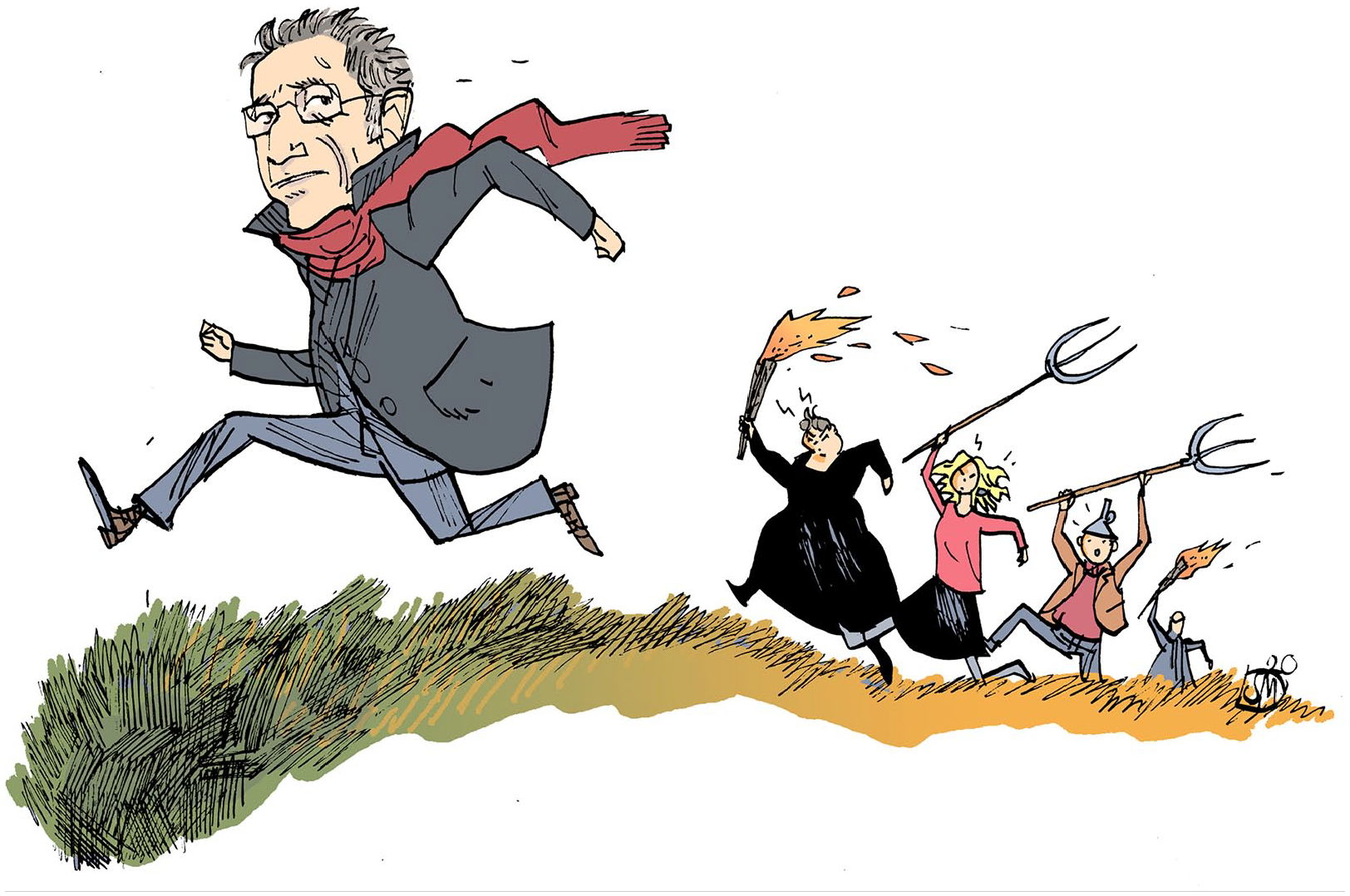
Illustration interpreted as representing Alison Howell, Melanie Richter-Montpetit, SD Editor-in-Chief Mark Salter and an unmarked figure chasing Ole Wæver, armed with torches and pitchforks, published in the Danish national newspaper Kristeligt Dagblad on 22 May 2020. (Image courtesy of Søren Glosimodt Mosdal.)
Narratives centring emotional and career costs for the House of IR’s newly established inheritor class activate novel ‘tender’ modes of paternal discipline beyond the punitivity of old-guard white masculinities, reflecting broader racial-imperial reconfigurations of masculinity (see Khalili, 2011; Niva, 1998). Such representations naturalize the racial-sexual political economies of the House of IR and simultaneously frame anti-racist critique as exceptionally damaging, perpetuating broader myths about the vulnerabilities of white people and institutions ‘accused’ of racism to cancellation or replacement. They also undermine basic scholarly principles: if the field finds critiques convincing, reviewers and editors will and should raise them. Scholarly exchange must be able to disrupt settled expectations.
Arendt’s work also became a flashpoint in the #SdScandal, illustrating the stakes of adopting a ‘cancellation’ framework when reckoning with international relations’ raciality and coloniality. According to conceptualizations of racism-as-personal-animus/anti-racism-as-personal-accusation, ISTR unfairly condemned classic securitization theory merely for citing Arendt, marking it ‘guilty’ solely by citational association. Following this logic, anyone citing Arendt – or any other Western canonical thinker – could stand accused of racism (see Wæver, Appendix B) and potentially be ‘cancelled’.
Other academic Twitter users, however, including some postcolonial scholars using Arendt, refuted the idea that anti-racist scholarship necessitates treating Arendt’s work as a poisoned chalice (see Gabay, Zhang, Appendix B). They argued that Arendt (herself a victim of a racist-fascist regime) can be a valuable resource for postcolonial theorizing (e.g. connecting colonialism and fascism). Simultaneously, racial-colonial logics underwrite her conceptualization of power. Eschewing logics of ‘cancellation’ and the reduction of systemic racism to personal animus, these perspectives insist that what matters is how concepts are taken up: has the racism of the theory been replicated or rigorously amended? We agree, and further argue that scholars may decide to abandon a concept in favour of others: this is normal scholarly practice, not a performative, nihilistic threat to ‘cancel’ all (Western) knowledge.
The following sections examine, first, the persistence of paternal discipline and, second, new modes of maternal discipline. Despite the underlying critical ethos of these gendered modes of parental discipline, both rely on knowledge-frames that underestimate the character and extent of the raciality and coloniality of the discipline. Thereby, they risk rehabilitating racial-colonial thought precisely under banners of criticality, feminism and diversity.
Paternal discipline: ‘Deepfake methodology’, epistemic authority and protecting white knowledge-frames
This section examines white paternal disciplinary techniques, focusing on a major #SdScandal flashpoint: the production and circulation of ‘deepfake methodology’, a term coined by Wæver and Buzan (2020a,b) in Rejoinder 2 and its online supplement.
As the #SdScandal erupted, ‘deepfake methodology’ quickly caught on, including as a dog whistle for white supremacists and for those seeking to intellectualize backlash against so-called ‘grievance studies’. Some participants distanced themselves from such uptake. As Wæver and Buzan (2020b: 4) anticipated: ‘These uninvited bedfellows will be counted as proof of our racism.’ Hayes (2020) blogged that their ‘side’ had been ‘infiltrated by a range of non-academics – fascists, racists, misogynists, and general misanthropes’ who ‘should crawl back into their cesspits’. When Wæver subsequently gave an interview to Quillette, this sparked debate about the intentions animating the interview, and more generally about such disclaimers, since the outlet is ‘a known source of White supremacist hatred and discredited, racist “science”’ (Ansell et al., 2022: 2). Yet it is imperative not to reduce discussion of (epistemic) racism, which is structural, to ‘proof’ of personal psychology, character or intentions.
Pressingly, the #SdScandal is one example of increasing political-intellectual overlaps and alliances between some right- and left-wing scholars and pundits in struggles over racism and transmisogyny. Quillette epitomizes these seemingly strange bedfellows (Minkowitz, 2019; Richards and Jones, 2021: 122) as the unofficial flagship publication of the Intellectual Dark Web (IDW), a loose collective of academics, journalists and tech entrepreneurs cohering around atheism and opposition to critical race theory and transgender-inclusive feminism. The IDW’s ethos pitches its proponents as brave renegades, espousing unpopular ‘truths’ in the face of ‘identity politics’, ‘political correctness’, ‘grievance studies’ and ‘cancel culture’. Many identify as feminist, leftist or liberal, claiming to defend the left from dogmatic excesses.
Notably, James Lindsay, a perpetrator of the ‘Sokal Squared’ hoax, 12 positively profiled the deepfake methodology concept in the IDW-associated online magazine New Discourses, promoting its potential for wider applications against ‘woke academia’. Overlaps between IDW ideology and international relations–based #SdScandal discourse include the portrayal of discussion of (anti-black) racism as performative virtue-signalling; the language of fakery and hoax; and the narrativization of powerful white men as victimized truth-tellers facing a destructively potent antiracist movement able to cancel scholars and eliminate Western knowledge. In Rejoinder 2 and its supplement, the authors are positioned as saving critical race analysis from the excesses of ‘H&RM’ (see Wæver and Buzan, 2020a: 392, 2020b: 16, 78–80, 89). This was echoed on international relations Twitter, for instance through (re)tweets asserting that discussion of racism may be fine, but ‘not like this’ (see Corry, Kitchen, Appendix B) or describing ISTR as opportunistic clickbait (see Piccolino, Appendix B).
Positioning senior scholars and established research programmes as reasonable and rigorous (as opposed to radical and fake) evokes earlier paternal gatekeeping. A famous example is Keohane’s (1989) article on feminist international relations, which, per Weber (1994), separated feminists into ‘good girls’ (feminist standpoint theory), ‘little girls’ (feminist empiricism) and ‘bad girls’ (feminist postmodernism) – to excise the last from the discipline. The concept of deepfake methodology similarly divides acceptable from unacceptable research. Yet claims of methodological fakery are distinct from claims to disagree, or even that one’s interlocutors lack rigour.
‘Deepfake’ is a portmanteau of ‘deep’ machine learning and ‘fake’ imagery, generally videos, originally associated with white geek masculinity, but increasingly produced by authoritarian states and right-wing actors. The term emerged in a 2017 subreddit dedicated to celebrity pornography, when a user known as ‘Deepfakes’ ‘bragged about AI’s potential for making fake pornography using the faces of celebrities’ (Wagner and Blewer, 2019: 33). Deepfakes are either marked (i.e. parodies) or unmarked (i.e. disinformation). The concept ‘deepfake methodology’ analogizes ISTR to an unmarked deepfake, of which two main types exist: ‘fake porn’ and ‘fake news’ (Gosse and Burkell, 2020: 498, 500), the latter being a term popularized by US President Donald Trump to discredit critics.
Referring to ‘H&RM’,
13
the following passage outlines the supposed analogy:
If there is a methodology at play, it is deepfake in the sense that if you break a corpus of text down into small fragments, you can reassemble it to say anything you want. Deepfake as analogy does not imply any claim about intentional falsehood. The analogy is to the technique: making somebody ‘speak’ by using splinters from them reassembled to produce meaning disconnected from the original texts (Wæver and Buzan, 2020a: 389, emphases in original).
More practically, the claim is that ‘[H&RM] don’t read’ (Wæver and Buzan, 2020a: 391, emphasis in original) and ‘only ctrl-f for “Hobbes”’, operating on ‘a totally superficial level of searching for words’ (Wæver and Buzan, 2020b: 42).
Assertions that ‘deepfake methodology’ does not imply intentional falsehood sit in tension with descriptions elsewhere of ‘H&RM’ or ISTR as ‘highly manipulative’, ‘abusive’, ‘disingenuous, tortured and bad-willed’, involving ‘malpractice displayed by fabricated quotes and false claims’, and having ‘the force of the totalitarian “big lie” technique’ (Wæver and Buzan, 2020b: 15, 68, 77, 78, 79). Furthermore, the analogy itself contains a tension: deepfakes definitionally involve intention. Words such as ‘collage’ or ‘pastiche’ could have asserted selective and/or misleading quotation without implying intentional fraudulence or evoking contemporaneous alt-right language.
These contradictions are illustrative of the broader disciplinary gulf over (anti)racism. Despite nominally acknowledging racism as systemic, Rejoinder 2 and its non-peer-reviewed supplement persistently treat racism as moral aberration that operates in the ‘emotive, normative’ (Wæver and Buzan, 2020a: 391) realm of individual ‘racists’. Therefore, to identify racist thought in academic texts is understood as personal accusation, dramatically different from other scholarly critiques, analogous to accusations of paedophilia (Wæver and Buzan, 2020b: 4), enabling a defensive retort that ‘non-racist colleagues’ (Wæver and Buzan, 2020a: 387) are victims of deepfakery.
Minimizing ISTR’s research to ‘ctrl-f’, the deepfake methodology concept can only theorize actual errors as ‘bad-willed’ malpractice. In ISTR, we made a citational error when we misattributed the precise term ‘state of nature’ to Wæver (2015) instead of Sbisà, who is cited in a lengthy epigraph to Wæver’s text. The attributional error was held up as proof of a deepfake: a linchpin in the claim that ‘the pyramid of misunderstandings, mis-quotes and omissions in H&RM is so vast that there seems little chance that this can be generated only by “honest mistakes”’ (Wæver and Buzan, 2020b: 79). The 11-line Sbisà epigraph is unusually formatted and lacks the in-text attribution typical of epigraphs. However, it is end-noted: we failed to register this as a paragraph-long direct quotation. We take full responsibility for our error.
Approaching this error as proof of deepfakery evades substantive engagement with whether the idea of the state of nature is foundational to securitization theory. That state of nature and anarchy concepts are grounded in racist ontologies, enabling the colonial division of the world, is well established in international relations (see Grovogui, 2006; Henderson, 2013; Jahn, 2000; Parasram, 2018; Sampson, 2002). This conceptual schema, implicit in the foundations of classic securitization theory, is expressed most explicitly when securitization theory ‘come[s] to Africa’ (Grovogui, 2001) in the later Copenhagen School book Regions and Powers (which applies and extends the securitization approach): ‘Africa is a pessimist’s paradise, a place where the Hobbesian hypothesis that in the absence of a political Leviathan life for individuals will be nasty, brutish, and short seems to be widely manifest in everyday life’ (Buzan and Wæver, 2003: 219). ‘Africa’, in this formulation, is a state of nature. Striking as such bald statements are, more pressing are persistent implicit logics.
Classic securitization theory was inspired as ‘mostly an unconventional mix of realism and post-structuralism’ (Wæver and Buzan, 2020b: 67), adapting realist concepts such as anarchy or weak/failed states to constructivist methodology without addressing their racism, thus rehabilitating them under the banner of criticality, post-positivism and disciplinary diversity.
Claims of ‘deepfake’ avoid reckoning with what Wæver’s 2015 text actually does: it agrees in detail with Sbisà that (illocutionary) speech is not mere communication but is productive of politics (e.g. rights and duties in a society). This is consistent with securitization theory’s uptake, in its conception of politics, of Arendt’s civilizationist and antiblack conceptualization of power as civilized communication. What remains implicit throughout the 2015 text, but gets expressed explicitly in the Sbisà epigraph, is that a racist state-of-nature imaginary is an integral part of classic securitization theory’s conceptualization of politics as civilized communication. The epigraph’s inclusion ‘says out loud’ what is hidden in plain sight. 14 This is one small example of how the deepfake methodology concept upholds disciplinary whiteness by authorizing disengagement from a deeper probing of racist epistemologies.
Adjudication of scholarly disagreement over explicit and implicit logics of a theory cannot be under the sole paternal authority of its authors. This is a basic principle of scholarly endeavour and should equally apply when disagreement concerns racial-colonial logics. Like other forms of textual analysis, anti-racist textual analysis involves examining a theory’s core texts alongside ‘peripheral’ sources to evaluate persistent explicit and implicit claims and concepts. Such readings shed light on what an intellectual project does (including implicitly, without scrutiny or contradictorily), rather than what an author/theoretical text says (it does) (Valdez, 2019: 24).
Decades ago, McSweeney (1996) coined the term ‘Copenhagen School’ and argued that internal contradictions sit at the heart of the School’s core concepts (e.g. security and society) and methods (e.g. stated constructivism but actual objectivism). For instance, despite claims that classic securitization theory has no substantive concept of politics (Wæver and Buzan, 2020a: 391), canonical texts contain both assertions that normal politics is whatever is normal in any given context and explicit conceptualizations of what normal politics entails, including conceiving of politics as Arendtian (see Wæver, 2011: 470, 478, 2015: 122). The concept of deepfake methodology forecloses disagreement over which position holds more true and/or whether racial-colonial logics permeate classic securitization theory. 15 By recasting disagreement as fraud, it offers a new tool for dismissing some scholarship as unacceptably radical.
This has serious intellectual consequences: core concepts of anti-racist scholarship such as antiblackness are dismissed as ‘jargon’ (Wæver and Buzan, 2020a: 392), while concepts like anarchy, long critiqued by postcolonial international relations scholars, are declared ‘empirical’ and therefore innocent of racial logics:
H&RM refer to the concept of ‘primal anarchy’ 19 times, characterizing it as ‘racial discourse’ . . . twisting its meaning away from an empirical differentiation of type, towards an emotive, normative classification of race hierarchy (Wæver and Buzan, 2020a: 391, emphasis added).
Elsewhere elaborating (Wæver and Buzan, 2020b: 20):
There are more contemporary examples of primal anarchy in Africa than in Europe because strong states consolidated early in Europe (for better and worse!), and have not currently consolidated effectively in some parts of Africa. That is just an empirical fact.
From this perspective, juxtaposing early European state formation to contemporary African primal anarchy, concepts of ‘state failure’ and ‘strong’ and ‘weak’ states are similarly declared as plain ‘empirical fact’ (Wæver and Buzan, 2020b: 68–69, 20); the extensive scholarship demonstrating their underlying racial-colonial logics is largely disengaged. It is precisely when treating such conceptualizations as mere empirics that critical security theories risk replicating their racism.
In sum, the deepfake methodology concept does more than superficially evoke contemporaneous alt-right/IDW discourse: it upholds disciplinary whiteness by constructing a paternal schema for limiting authority over analysis of canonical thought to its original authors, protecting white knowledge-frames.
Maternal discipline: White feminisms, femininities and civil victimhood
If both paternal old-guard ‘white man’s IR’ and new-guard tender masculinities may beget disciplinary whiteness, so can white feminine subject-positions and white feminisms, though they operate less through public aggression than by enforcing propriety within the household (of IR). To identify these harder-to-track maternal modes of discipline, our analysis connects affective workings of white femininities with intellectual operations of white feminist knowledge-frames in the #SdScandal. We use ‘white feminism’ to refer to knowledge-frames (not authors’ identities) that ‘secure whiteness and First Worldism as structures of privilege’ (Agathangelou and Turcotte, 2010: 2241).
Rejoinder 1 initially went little remarked. However, following the publication two months later of Wæver and Buzan’s rejoinder, it was retrospectively celebrated by international relations Twitter users from diverse perspectives as a masterclass and model for how to reckon with critiques of racism in international relations theory. This reception, we argue, is bound up in broad gendered dynamics of what have been theorized as white ignorance (Mills, 2007) and innocence (Wekker, 2016). We use both textual and ethnographic methods to examine this reception, the rejoinder and the text the latter defends (‘The Little Mermaid’s Silent Security Dilemma and the Absence of Gender in the Copenhagen School’ [Hansen, 2000], hereafter TLM).
Rejoinder 1 is written as a letter. Addressing us by name, delivered in a professional tone, both format and style suggest invitation to dialogue; its conclusion offers space for auto-critique. Doubtless this appealed to international relations Twitter users aghast at (masculine) mudslinging, who called it ‘restrained’, ‘professional’, ‘measured’, ‘inviting’ and ‘a model of civility’ (see Burke, Greaves, Hoogensen, Harris, Wæver, Appendix B), implicitly contrasting it not only to Wæver and Buzan’s rejoinder and (social) media activity, but also to ISTR. What remained unremarked (though doubtless not unnoticed) is that Rejoinder 1 broaches ‘the question of race’ while near-totally ignoring scholarship on race. To reckon with this reception, we revisit Tickner’s (1997: 629) diagnosis, amid the post-positivist turn, of ‘troubled engagements’ wherein power differentials in the discipline enabled ‘malestream’ international relations’ ‘ignorance of feminist approaches’. Our analysis extends the notion of troubled (dis)engagements to ongoing ignorance of postcolonial feminist approaches within feminist and non-feminist critical international relations.
Rejoinder 1 is framed through sources defending white masculine knowledge. It invokes Der Derian’s (1994) dismissal of Krishna’s (1993) postcolonial critique of postmodern international relations and adopts its letter format from Derrida’s defence against postcolonial critique of his writings on South African Apartheid, while ignoring notable exchanges of scholarly letters between feminists over feminist erasures of racism (e.g. Audre Lorde and Mary Daly). It refigures these white masculine sources in feminine registers: maternal and mentoring, vulnerable and victimized. ‘Dear Alison Howell and Melanie Richter-Montpetit’ seems dramatically different from the caricatured figure of ‘H&RM’. However, both phrasings risk reducing an opportunity for discipline-wide reflection to mere interpersonal dispute. The personal overture evokes intimacy, positions its author as vulnerable and personally aggrieved, gently scolding misbehaviour from a senior position, while setting up discussion of racism as a private conversation – exclusively among white women.
To analyse the troubled engagements and white ignorance undergirding the reception of Rejoinder 1, we need to assess its intellectual edifice, including its underlying conception of (anti)racism. As Hobson (2022: 5–6) recently noted, Rejoinder 1’s assumption of a ‘great divide’ between Eurocentrism/Orientalism and racism is illustrative of an egregious misunderstanding in the wider discipline of Eurocentrism as ‘an innocent and natural form of methodological bias that derives from merely living in the West’. In a context of moral panics about the destructive potency (‘cancel culture’) of anti-racist speech, Rejoinder 1 exceptionalizes the R-word as all-powerful and uncivil: ‘the negative connotations of “racist thought” are so profound that just one use of such a charge might stick’, and ‘one consequence might be that readers are deterred not only from drawing on those works but from reading them in the first place’ (Hansen, 2020: 378–379). Use of the R-word ‘resonates within public and politicized discourses in a way that many other academic terms – including Orientalism . . . do not’ (Hansen, 2020: 379), 16 a viewpoint echoed on international relations Twitter (see Hayes, Tallis, Appendix B). That such insistence on replacing the R-word with ostensibly more ‘civil’/less consequential terms remained (publicly) unchallenged during the #SdScandal speaks to broader dynamics of white ignorance in the field: as anti-racist feminists have long argued, registers of civility, motherliness, innocence and victimhood are powerful hallmarks of bourgeois white femininities, which work alongside white masculinities precisely through their contrast.
To more fully examine maternal discipline requires some background. We offer a brief substantive discussion of TLM, since the rejoinder’s primary purpose is to defend this classic text, one of the most widely taught and cited works of feminist security studies. 17 TLM sought to ‘grant theoretical recognition to subjects who would aggravate their insecurity if they were speaking’ (Hansen, 2020: 382), a situation that produces a silent security dilemma. It challenged classic securitization theory’s assumption that ‘normal politics’ is devoid of violence, questioning its stark division between international and social security. Rejoinder 1 rightly insists that TLM makes important departures from securitization theory, forming ‘a theoretical contribution in its own right’ (Hansen, 2020: 380). However, that included a particularly feminist form of epistemic racism. While eschewing securitization theory’s Arendtian conceptualization of normal politics as civilized communication, TLM replicated securitization theory’s reliance on civilizationist cartographies, modulating them through feminist racial-colonial geographies of ‘silenced women’.
To be clear, TLM marked a shift away from crudely racist representations of ‘Third World Difference’ identified by Mohanty (1984: 335) and others. It sought to unearth processes of silencing, cautioned against homogenizing representations of Pakistan, found agency and voice among ‘elite women who spoke on behalf of other Pakistani women’ (Hansen, 2020: 382), and held analytical space for silence as a strategic choice.
However, TLM’s post-structuralist feminist framework still mapped onto – indeed rehabilitated – longstanding racial-colonial cartographies of violence/modernity. TLM opened in Copenhagen, but with a historical and fictional example: the 19th-century ‘Little Mermaid’ fairy tale. It found real-world silent security dilemmas exclusively among Muslim women. 18 Its abrupt travel from Denmark to Pakistan (and, briefly, Bosnia) to find silenced/silent women remains embedded in a racial-colonial imaginary that Narayan (1997) theorizes as a ‘death by culture’ perspective. TLM briefly refers to the ‘(constructed) foundational essence of the religious community’ (Hansen, 2000: 299). Despite the nominal caveat that this ‘essence’ may be ‘constructed’, TLM maintained white feminist conceptions 19 of ‘[h]onour killing’ as rooted in the backwardness and exceptional sexual repressiveness of Muslim culture (Abu-Lughod, 2013; Alloula, 1987; Razack, 2004; Yeğenoğlu, 1998). For example, it theorized ‘honour killings . . . as a part of a rigid, patriarchal definition of female transgressive behaviour articulated and sustained by the legal-religious-political establishment’, which it quickly reduced to ‘the forces of Islamic conservatism’ (Hansen, 2000: 291). It treated ‘honour killings’ in isolation from, for example, Cold War US and Saudi support for Zia-ul-Huq’s ‘Islamization’ of Pakistan, complex interactions between British colonial law and Pakistani legal systems, and ongoing connections between ‘honour killings’ and the successive wars in Afghanistan (e.g. easy access to firearms) (see Khan, 2006; Warraich, 2005). Instead, TLM provided a footnote disclaimer that it ‘does not claim to present a detailed empirical analysis’ nor ‘pretend to engage the numerous and complex political, religious, and economic issues involved’ (Hansen, 2000: 291n22). Yet TLM’s empirics are not just partial, they are distorted by virtue of being grounded in a death-by-culture perspective. They then formed the basis of TLM’s theory-building, including around silence, which became a cause célèbre in the #SdScandal.
Echoing paternal ‘deepfake’ claims, Rejoinder 1 defends TLM by asserting that it found Pakistani women were ‘silenced’, not ‘silent’ (Hansen, 2020: 381), implying that ISTR erroneously elided this distinction. 20 Yet TLM did explicitly conceptualize poor Pakistani women as ‘the silent women’ (Hansen, 2000: 305). It also made the silent security dilemma its titular concept. Furthermore, as demonstrated above, its theorization of the process of silencing thoroughly, if implicitly, proceeded through race-making. Despite this, several international relations Twitter commenters critical of paternal discipline contrastingly applauded Rejoinder 1’s focus on the semantics of silence.
Further, international relations (social) media commentary generally failed to note the rejoinder’s disengagement from the rich bodies of scholarship debating how (and whether) to study gendered violence committed in the name of honour without replicating problematic constructions of ‘honour killings’ (see Abu-Lughod, 2013; Baxi et al., 2006; Grewal, 2013; Haque, 2016; Khan, 2006; Razack, 2004; Terman, 2010; Welchman and Hossain, 2005; Zia, 2019). Indicative of the power of maternal discipline, while being endorsed as a model of engagement, the rejoinder cites only one postcolonial feminist work as such. Expressing regret that TLM did not draw on Spivak’s ([1985] 1988) ‘Can the Subaltern Speak?’ 21 to acknowledge the ‘historicity and politics of constituting “subaltern” women – and “Muslim women” specifically – as subjects in need of saving’, it simultaneously insists that TLM enabled Samia Sarwar, a Pakistani Muslim woman murdered on her father’s initiative, ‘to speak, as it were, in the analysis’ (Hansen, 2020: 384, 382, emphasis in original). This nominal acknowledgement misses Spivak’s central argument: that speaking for the subaltern through the usurpation of her voice itself constitutes silencing.
Finally, similar to Rejoinder 2, Rejoinder 1 asserts that epistemological schemas are merely empirical, insisting they are matters of neutral ‘exploratory case study’ selection (Hansen, 2020: 383), especially as TLM was published prior to post-9/11 discourses about saving Afghan women. This disclaimer elides the historical fixation in racist anti-immigration and social welfare politics of 1990s Europe, especially Scandinavia, on ‘forced marriages’ and ‘honour killings’ (Keskinen et al., 2016; Razack, 2004). Moreover, it re-stages a racial-colonial mise-en-scène of ‘imperilled Muslim woman’ and ‘dangerous Muslim men’ (Razack, 2004). This is not just a matter of explicit slips (e.g. the rejoinder’s repetitions of TLM’s dehumanizing phrase ‘raped Muslim women’), but more importantly it is a matter of selectively making (almost positivist?) claims that these racial-colonial schemas are just an innocent matter of externally observable empirics.
That, 20 years after the publication of TLM, this reduplicated racial-colonial construction found such positive reception across international relations Twitter demonstrates the stubborn persistence of troubled (dis)engagements among both orthodox and critical scholars.
***
The above operations of paternal and maternal discipline in the #SdScandal illustrate disparate understandings of racism and anti-racism, including among critical scholars. At issue is how to effectively go about dealing with racial-colonial logics in international relations and security studies theories. A series of actions were proposed and widely discussed in the #SdScandal. They constitute, at best, quick fixes:
Avoiding the R-word: Using less ‘politicized’ language like ‘Orientalism’ and ‘Western-centrism’ (Hansen, 2020).
Centring authorial intentions and personal character: Accepting racist concepts as ‘innocent’ by virtue of authors’ intentions and ‘non-racist’ character.
Rephrasing: Rewording ‘sentences’ according to newly acquired ‘sensitivities or knowledge’ (Wæver and Buzan, 2020a: 390) in lieu of reworking underlying ideas.
Add-and-stir: Addressing the problem of a theory built on empirical examples grounded in racial logics merely by adding new empirics – for example, arguing that problems like uniquely locating ‘anarchy’ in racialized spaces can be solved by adding new ‘“white” examples’ (Wæver and Buzan, 2020a: 392) from Europe’s past (Thirty Years War) and its internal Other (post–Cold War Bosnia); or arguing that ethical questions about the coloniality of case selection can be resolved by expanding the pool of empirical sources (Hansen, 2020: 383), adding data to the same case study, rather than re-examining how case selection may be grounded in and constitutive of a racial-colonial framework.
Anachronism: Treating undeniable racism in classic texts as a product of their time, ignoring contemporaneous historical challenges to racial-colonial systems (of thought).
Automatic dissipation: Dissipating both the ‘degree of racism’ and an author’s responsibility for importing racist ideas from others (e.g. who are ‘3 steps removed’ [Wæver and Buzan, 2020b: 10]) by degrees of separation: Arendt’s sources may be racist, but her work contains only ‘tinges’ (Wæver and Buzan, 2020a: 387) of racism; securitization theory is ‘non-racist’.
These conceptualizations, based in logics of racism-as-personal-animus and/or of ‘cancellation’, underestimate the character and extent of (epistemic) racism. However, the problem here is not just that they do not go far enough, or even that they set restrictive rules of engagement for how anti-racist research can – and cannot – proceed.
More crucially, they provide a methodological roadmap for rehabilitating concepts and theories that have been critiqued for their epistemic racism without rigorously challenging, amending or dispensing with the racial-colonial imaginaries and logics that may underpin them. When this involves critical theory, it is all the more dangerous because it risks actively securing disciplinary whiteness not in the name of tradition, but through otherwise counterhegemonic thought. It is partly by such mechanisms, we argue, that disciplinary whiteness has been upheld not despite, but in part through, the critical turn.
However, disciplinary whiteness is not confined to ideational levels: it is also material and institutional.
Security Dialogue must be defended
As a matter of principle, we will not accept the targeting or bullying of [SD’s] community – our editors, our editorial board, our reviewers, or our authors – which prevents the full participation of all of our members (SD editorial team statement, July 2020 [see Appendix A])
Up to this point, we have discussed what the #SdScandal tells us about race, colonialism and the upholding of disciplinary whiteness in international relations primarily by focusing on intellectual cultures, formal and informal. However, it is also vital to examine material hierarchies and disciplinary institutions, and how they, in turn, shape the intellectual content of the discipline.
What the #SdScandal and other parallel cases discussed here demonstrate are the increasing pressures that publishing institutions (and especially editors) are being put under – sometimes through legal means – to establish both different, more stringent rules for research on race and exceptional rights for those purporting to have been personally attacked (or ‘cancelled’) by virtue of their work being subject to anti-racist critique. This raises urgent questions concerning editorial independence and academic freedom. Using auto-ethnographic methods, this section examines pressures placed on this journal and its editorial team both pre-dating and escalating through the public fracas, in part emerging from within the journal’s own board.
To begin, some material context: SD is both prestige- and revenue-generating for Sage Publications and PRIO, and is also a custodian of (career-making) academic currency: publications. The journal is one of the highest-ranking publication venues for critical security studies and specifically securitization theory, and a key publication venue of international relations’ critical turn. The #SdScandal happened as the journal was ‘in the process of transitioning the Editorial Board to better reflect the multiplicity of viewpoints, perspectives, and communities to which Security Dialogue speaks’ (SD editorial team statement, Appendix A).
Shortly after ISTR’s online pre-print publication in August 2019, SD informed us about several irregular demands jointly made by three complainants (Buzan, Hansen and Wæver). These included ISTR’s retraction and a series of special rights and procedures: a right of early warning (being notified of ISTR’s critique prior to its publication) and a right of reply involving a right of simultaneous rebuttal (delay of ISTR’s print publication to enable the publication of lengthy rejoinders in the same issue). Consonant with the more overt operations of paternal discipline, these demands were later publicly stated in Rejoinder 2, its online supplement and social media (see Wæver and Buzan 2020b: 43–47), as were demands that ISTR’s peer and editorial review process be investigated (potentially jeopardizing the anonymity of ISTR’s peer reviewers), and that the editorial leadership of the journal be potentially removed (see the first section above). The rationale: that ISTR was not just fraudulent, but libellous. The claim of libel rests on the logic of racism-as-personal-animus/anti-racism-as-personal-attack and associated threat of ‘cancellation’. The wider stakes of this logic were plainly stated: that SD (and other journals) should ‘acknowledge the difference between normal scholarly debate and cases involving charges like racism’ (Wæver and Buzan, 2020b: 45). Such demands were not only made by a small number of aggrieved scholars: they were later amplified by IDW publications, (social) media and even Times Higher Education (Grove, 2020).
The ‘mildest’ of these demands, the right of reply might be easily written off as normal scholarly practice, although it is a journalistic concept not generally recognized in academic publishing. Yet rejoinders are embedded in what sociologists Diefendorf and Bridges (2020) identify as ecologies of privilege. 22 Assertions of a right of reply (in this case, two standalone rejoinders) are primarily exercised by established scholars at the expense of publishing opportunities for others, reproducing inequality on intellectual and material levels. Such privileges can be activated disproportionately (in Rejoinder 1’s case extending to a half-article-length rejoinder to ISTR’s 167-word discussion of TLM). They may also potentially extend to influence on corrigenda. 23
Yet, as stated in the open letter to this journal spearheaded by several prominent scholars of racism and colonialism located mostly outside international relations (see Appendix A), the stakes of this case extend beyond one article or replies to it. Rather, they concern how ‘bullying’ and a ‘threat of retribution’ (i.e. boycott of the journal) were being used to pressure the journal to retract ISTR, remove its editor, and institute a ‘separate and more onerous review system specifically for scholarly work on race and racism’. ‘If Security Dialogue, a Sage journal, sets a precedent here and caves to these pressures this could have dangerous implications for research on racism and colonialism across academic disciplines of critical race and (settler) colonial studies, but more generally for all academic publishing and for academic freedom’ (see Appendix A).
This ‘threat of retribution’ was not limited to a potential boycott of the journal: it also involved legal threats that emerged while the special rights and procedures were being sought from the journal by the complainants. After the publication of the rejoinders and supplemental material, it is now a matter of public record that while Wæver and Buzan (2020b: 9) ‘do not want to make a legal case about whether the publication of the H&RM article is a crime or a tort’ (Wæver and Buzan, 2020b: 9), they do judge it to be legally punishable, asserting that ‘there seems to be a prima facie probability’ that ISTR is ‘unfounded’ (i.e. deepfake) and ‘damaging’ (i.e. ‘crossing the lines from normal debate into hurtful and harmful accusations of racism’ [Wæver and Buzan, 2020b: 44]): the two criteria for defamation.
Legal threats, even without merit, or by paralipsis, have effects.
As Sara Ahmed argues, using the language of libel while claiming not to pursue litigation may nevertheless threaten editorial independence and academic freedom. Examining the case of white British LGBT activist Peter Tatchell describing a book chapter (which treated his work as one example illustrating operations of gay imperialism) as false and libellous, Ahmed (2011: 120n2) argues that although Tatchell claims he did not threaten litigation, ‘the language of libel to describe the article constituted a threat’ even without further action. The small not-for-profit publisher subsequently pulled the entire edited volume.
Even evocation of the potential risk of libel lawsuits can prevent publication of antiracist research. Clive Gabay (2022) details how a manuscript he authored on anti-semitism, philosemitism and the British Labour Party, which had successfully passed peer review, was subject to a complex process resulting in substantive changes compelled by the journal legal team’s reading of the paper as ‘political’, not ‘objective’. Ultimately, the publisher withheld guarantees of legal cover to the journal’s editors, preventing its publication. As Gabay argues, at issue is not just legal overreach, but broader structural obstacles to anti-racist scholarship and academic freedom.
In the #SdScandal, after legal threats were evoked, Sage’s lawyers, editorial managers and, later, a crisis management team became involved, in a context where, structurally, academic and corporate publishers’ interests include protecting the reputation, averting a boycott of and ensuring the continued profitability of journals.
These asymmetrical struggles over whether SD should defend ‘settled expectations’ that ‘Rebel Sons’ and ‘Fallen Daughters’ are the rightful proprietors and stewards of the journal and should enjoy exceptional rights, or whether the journal’s regular peer review and editorial processes should be defended, produced ambivalent results. Certain demands were not acceded to: ISTR was investigated by the editorial team, deemed not fraudulent, and not retracted; SD’s editorial leadership was, ultimately, not removed; new formal procedures of (peer) review only for research on race were not formally instituted. Instead, the journal established a code of conduct.
However, the question remains whether the intellectual content of the journal was impacted. When the three complainants’ demands were brought to our attention, we cautioned against hosting a high-profile ‘debate’ on racism in international relations exclusively among white scholars (via rejoinders and an invited reply authored by us). Instead, on the advice of Olivia Rutazibwa, we proposed a peer-reviewed forum to which the complainants could contribute. This would create a venue for exchange among a more diverse set of scholars and postcolonial security studies work, decentring ISTR, and thus promise to more meaningfully advance scholarship on race and colonialism. Partly on this basis, the journal initially decided not to accede to standalone rejoinders and began work on a forum call for papers. Then, matters abruptly changed in ways that left us to infer that a legal threat had been issued against the journal (and, by extension, potentially us as authors), an inference later bolstered by the publication of assertions of libel and defamation. Simultaneously, we were informed of the three rejoinder authors’ joint refusal to participate in a more inclusive forum discussion. Then, while the original draft call for papers for the forum invited critiques of specific critical security studies schools, the final version was reframed to emphasize ‘reparative possibilities’. 24
The removal of an invitation to critique and its replacement with a call to read reparatively raises serious intellectual questions, not just for journals but for the discipline more broadly, about whether and how repair can materialize in the absence of meaningful accountability, especially in the context of growing attacks on editorial independence and academic freedom. Without rigorous stocktaking, repair might collapse into quick-fix projects of rescue or rehabilitation that uphold racist thought in the name of criticality.
Conclusion
Anti-colonial international relations theorizing is flourishing. And yet disciplinary whiteness stubbornly persists, and not solely through old-guard machinations. In the wake of the critical turn, some previously marginalized white knowledge-frames and subjects have undergone institutional ascension in the House of IR. These may more effectively secure the raciality and coloniality of international relations’ intellectual and professional cultures at the current juncture. Using our intimate, if partial, knowledge of the #SdScandal, this article has explored connections between the rehabilitation of racist concepts by post-positivist knowledge-frames and the defence of material-institutional hierarchies via gendered scripts shaped by broader shifts in white reconstruction. We argue that disciplinary whiteness is reproduced not just by old-guard ‘white man’s IR’, but through the growing power of white bourgeois femininities and tender white masculinities, and of critical white (feminist) knowledge-frames. As beneficiaries of ‘diversifying whiteness’ ourselves, we pursue this analysis of harder-to-track operations of disciplinary whiteness to contribute to their undoing.
‘Quick fixes’ may work contrary to such undoing. What is at stake is not who is ‘racist’ versus ‘non-racist’ – it is how to pursue anti-racism. At a minimum, on an intellectual level, analysis of the #SdScandal suggests the need for tackling head on ‘troubled engagements’ and dispensing with moral framings of racism-as-personal-animus/anti-racism-as-personal-attack and logics of ‘cancel culture’ (or ‘replacement’) that treat anti-racist critique as all-powerfully destructive. But this analysis also points to the need to challenge increasing attacks on anti-racist, anti-colonial, anticaste and (trans)feminist research and teaching; the need to shore up editorial independence in a context of private journal ownership; and the need to resist the mass casualization of academic work, perhaps the greatest barrier to academic freedom. From this perspective, challenging ‘the canon’ is one admittedly limited mode of anti-racist action that cannot be held separate from organizing efforts, across disciplines, to defend against such assaults, whether they emerge from beyond or within academia, and from ‘right’ or ‘left’.
Supplemental Material
sj-pdf-1-sdi-10.1177_09670106231182800 – Supplemental material for Upholding disciplinary whiteness: The #SdScandal, gender and international relations’ critical turn
Supplemental material, sj-pdf-1-sdi-10.1177_09670106231182800 for Upholding disciplinary whiteness: The #SdScandal, gender and international relations’ critical turn by Alison Howell and Melanie Richter-Montpetit in Security Dialogue
Supplemental Material
sj-pdf-2-sdi-10.1177_09670106231182800 – Supplemental material for Upholding disciplinary whiteness: The #SdScandal, gender and international relations’ critical turn
Supplemental material, sj-pdf-2-sdi-10.1177_09670106231182800 for Upholding disciplinary whiteness: The #SdScandal, gender and international relations’ critical turn by Alison Howell and Melanie Richter-Montpetit in Security Dialogue
Footnotes
Acknowledgements
The thinking presented in this article is, like all writing, grounded in communities of collective knowledge, even as we take responsibility for its final form. Many scholars generously provided feedback and critical engagement, reading drafts at various earlier and later stages and/or speaking with us to clarify the political and intellectual stakes of this work, including Anna Agathangelou, Paul Amar, Catherine Baker, Tarak Barkawi, Carol Baxter, Louisa Baxter, Colleen Bell, Catherine Charrette, Daniel Conway, Andrew Delatolla, Cat Fitzpatrick, Clive Gabay, Tom Gregory, Siba Grovogui, Toni Haastrup, Marsha Henry, Aida Hozić, Sankaran Krishna, Sumi Madhok, Nivi Manchanda, Cristina Masters, Himadeep Muppidi, Isis Nusair, Swati Parashar, Ajay Parasram, Randy Persaud, Spike Peterson, Pushi Prasad, Jasbir Puar, Rahul Rao, Cristina Rojas, Anne Runyan, Linda Tabar, Kyla Schuller, Jan Selby, Miriam Smith, Lisa Stampnitzky, Antonio Vázquez-Arroyo, Bob Vitalis, Cindy Weber, Sandy Whitworth and Maja Zehfuss, as well as three anonymous peer reviewers and the journal’s editorial team.
Funding
The author(s) received no financial support for the research, authorship, and/or publication of this article.

Supplemental material
Supplemental material for this article is available online.
Notes
References
Supplementary Material
Please find the following supplemental material available below.
For Open Access articles published under a Creative Commons License, all supplemental material carries the same license as the article it is associated with.
For non-Open Access articles published, all supplemental material carries a non-exclusive license, and permission requests for re-use of supplemental material or any part of supplemental material shall be sent directly to the copyright owner as specified in the copyright notice associated with the article.
