




Abstract
This article examines the technopolitics of prevention in postwar Guatemala. In the 2010s, experts and policymakers shifted security governance in Central America’s most populous country towards anticipation. Against the background of rising gang violence, they implemented a set of sociopolitical and techno-material measures – based on the latest crime-control technologies, new policing strategies and urban design methods – in Guatemala’s most violent municipalities. The stated goals were to reconstruct state sovereignty and to improve public security by strengthening community resilience and inducing positive behavioural change in ‘at-risk’ citizens. Zooming in on the case of Villa Nueva, the article examines the emergence and effects of Guatemala’s ‘prevention assemblage’. It demonstrates that this technopolitical project has failed, as prevention turned into a new layer of control that shifted responsibility to local communities, further securitized urban spaces and populations, and reproduced exclusionary and repressive security governance.
Introduction
On 3 March 2015, then US Vice President Joe Biden visited Guatemala’s second-largest city, Villa Nueva. After inspecting the US-sponsored Model Police Precinct and the municipality’s General Directorate of Integral Security, Biden acclaimed the crime- and violence-prevention strategy that Mayor Edwin Escobar had implemented and advised the presidents of Central America to follow Villa Nueva’s example. After less than three years in office, Mayor Escobar – the man who ‘dreams of turning Villa Nueva into the “next Bogotá”’ (Americas Quarterly, 2013) – had transformed an infamous crime hotspot into a blueprint for the world’s most violent region (Municipalidad de Villa Nueva, 2015).
Escobar went further than any other politician to advance Guatemala’s preventive turn. 1 After homicide rates had exploded in the late 2000s, with 48 homicides per 100,000 population in 2009 (Agencia Guatemalteca de Noticias, 2018), and attempts to gain back control through iron-fist policing (mano dura) and a reform of the national security apparatus had failed (see ICG, 2012), Guatemalan policymakers and international reform experts started to focus on prevention. They turned their attention to violent municipalities and neighbourhoods, where gangs were operating with impunity, in an attempt to reconstruct sovereignty from below.
As a result, in the early 2010s, ‘the word of the day in Central America [was] prevención’, as a senior USAID adviser claimed (Rosales, 2012). In 2014, prevention was elevated to the ranks of official state policy. The government of General (ret.) Otto Pérez Molina – elected on a law-and-order platform – launched the National Policy of Crime and Violence Prevention, Citizen Security and Pacific Cohabitation. The policy was a mix of international ‘best practices’ comprised of four components: (1) an evidence-based and technology-focused, decentralized and plural approach to risk management; (2) community resilience; (3) the municipalization of security governance; and (4) crime and violence prevention (see Ministry of the Interior, 2014). Building on social, situational and community prevention, the stated goal was to ‘modify types of behaviour . . . and deficiencies’ that could lead to problematic ‘future behaviour’ (Ministry of the Interior, 2014: 36). To achieve this, the government implemented a set of sociopolitical and techno-material measures to support the ‘construction of safer communities by developing their strengths’ (Ministry of the Interior, 2014: 17). This included educational programmes, local violence-prevention commissions, smartphone apps, anonymous tip-lines, surveys, heat maps and public infrastructure projects such as the remodelling of public spaces.
This article engages with Guatemala’s preventive turn from the vantage point of Villa Nueva, the model case of the government’s decentralized prevention policy (Interview 1). Developing and applying the heuristic device of the ‘prevention assemblage’, I approach prevention as a future-oriented technopolitical project. The article makes four contributions to security studies:
First, it focuses on the social, material, political and temporal dimensions of prevention, adding a technopolitical perspective to the scholarship on the role of expertise in security governance (see Berling and Bueger, 2015).
Second, by assessing what was assembled, by whom and how, I provide a new conceptual entry point for studying transnational security governance interventions that aim at strengthening state sovereignty. The analysis of the ‘modes of doing’ (see Lemke, 2018: 42) prevention puts emphasis on the relations between human and non-human actors, their transnational entanglements, and the local effects of their interaction. In an attempt to reconstruct sovereignty from below, experts and policymakers rescripted public spaces, infrastructures and technologies – as well as local communities – as agents of prevention. The experts altered the actor constellation and ascribed transformative agency to non-human matter. The agentic power of things such as sports grounds or parks produced unexpected sovereignty effects 2 that contributed to reshaping urban spaces and demarcating the lines of social and spatial in/exclusion. Approaching prevention as an assemblage thus allows us to ‘unbundle’ and ‘decentre’ sovereignty by bringing in a multi-scalar and temporal focus and carving out the complex interaction of its discursive and material components.
This leads to the third contribution this article offers, namely, a discussion of the competing temporalities of assemblages. In Guatemala, the rationale of anticipation overlapped with repressive security when locally translated. Further, the distinction between different types of anticipatory action – namely preemption, precaution and preparedness (Anderson, 2010) – became blurred. While preemption and precaution seek to ‘stop the occurrence of a future’, preparedness ‘does not aim to stop a future event from happening’ (Anderson, 2010: 791) – it is rather about a society coping with future insecurities. Resilience is one of the ‘preparedness techniques’ that have informed the turn to prevention in Guatemala. Resilience has also been the subject of controversial debates, including in this journal (see Security Dialogue, 2015). Adey and Anderson (2012: 101), following Aradau (2010), have shown that anticipatory action is essentially a combination of ‘discourses, practices, [and] technologies’. Tracing how new temporalities shape security governance and exploring the sociotechnical ‘configurations of urban futurity’ (Zeiderman, 2016: 192) – with an emphasis on expertise and local (human and non-human) agency – the present article provides original perspectives on the dynamics of security in postcolonial settings (see Hönke and Müller, 2012). It shows that expected futures are contingent, co-constructed and contested by local, national and international actors.
Finally, I engage with the negative externalities of reform processes, a dimension that the policy-oriented literature tends to overlook when acclaiming preventive policies (see, for example, Muggah et al., 2016). This is relevant for analysing the pitfalls of security interventions in highly unequal cities across the Global South.
The article draws on empirical data gathered between 2012 and 2016 in Guatemala, El Salvador, Spain, Israel and the USA. Fieldwork included site visits, participant observation of security workshops and interviews with municipal security staff, police, security and development advisers, politicians, and community leaders. This was complemented by an analysis of policy documents and programme evaluations.
The article begins by introducing its analytical framework, which is based on the concept of the prevention assemblage. The second section then traces the preventive turn in Guatemala. Next, the article zooms in on the case of Villa Nueva, exploring the emergence and effects of the prevention assemblage. The conclusion summarizes the main findings and discusses implications for urban security in Guatemala and beyond.
Assembling prevention
I define Guatemala’s prevention assemblage as a network of ordering ideas, practices, human actors (local and international, private and public) and ‘things’ (infrastructure and technology). Scholars such as Appel et al. (2018) and Mitchell (2002) have stressed the interdependency of governance, infrastructure, technology and expert knowledge. Recent research has approached urban politics as a ‘socio-material coproduction’, pointing out the central role materiality plays in ‘political subject formation’ and the ‘legitimization of political order’ (Pilo’ and Jaffe, 2020: 10). Building on this literature, I discuss how experts assembled different human and non-human actors in the name of prevention, how they mobilized materiality and spatiality to pursue their goals, and how technopolitical projects emerged and transformed in unexpected ways.
In the Guatemala of the 2010s, human and non-human elements were united and ordered (Deleuze and Guattari, [1987] 2018: 36) in the name of prevention. The emerging assemblage incorporated globally circulating actors and their expertise as well as practices and technologies of prevention. Tracing the relations and movements of ideas, people and things calls for an analytical move away ‘from temporal stability to uncertain periods of emergence and heterogeneous multiplicities’ (Legg, 2009: 238, emphasis in original). Transformations of assemblages can be explained by unexpected agential powers of humans and things. While humans steer material agency and organize assemblages, things also contribute to creating political realities such as ‘dangerous’ neighbourhoods (see Arfvidsson, 2016: 305). At times, the agency of objects and local actors ‘escape[s] the control of experts’ (Müller and Hochmüller, 2017: 397), which produces counterintuitive effects that fail to live up to the promises and expectations of experts and policymakers.
Taking these agential powers into consideration, prevention can be conceptualized as a technopolitical project that engenders unintended consequences. I draw on Hecht (2011: 3), who has pointed to the ‘unpredictable power effects’ of technopolitics and the ‘hybrid forms of power embedded in technological artefacts, systems, and practices’. As a future-oriented technopolitical project based on the ‘strategic practice of designing or using technology to enact political goals’ (Hecht, 2011: 3), prevention aims to change institutions and behaviours. The focus on human and non-human agency is crucial to unpack the ways in which new rationales materialize in urban settings – and how matter contributes to securitization and (spatial and social) ordering (see Aradau, 2010: 509).
Security in Latin American cities is about governing futures (see Zeiderman, 2016). Expert knowledge shapes anticipatory governance and the ways in which security is enacted, perceived and governed (see Berling and Bueger, 2015). As Mehos and Moon (2011: 43) have demonstrated, mobile experts can act as ‘valuable mediators of technopolitics’. This holds true also for the Guatemalan case, where politicians have often attracted external ‘resources for solving local problems’ (Müller and Hochmüller, 2017: 391). Unpacking expertise as the key organizing principle of the technopolitical project of prevention requires an approach ‘cognisant of structure, power, and agency’ (Mac Ginty, 2017: 874) that shows how (transnational) flows of ideas, practices and things shape assemblages in contingent ways.
As prevention builds on the idea of the legibility of spaces and of the population, international experts turned local actors, such as community leaders and mayors, into key actors of security governance. While, in the aftermath of the Guatemalan civil war that ended in 1996, security was understood as a problem of defective national institutions, experts redefined it as best approached preventively and from below. They turned security into a question of ‘dangerous’ urban spaces, opening new ‘site[s] of intervention’ (O’Neill, 2015: 46) both in a material and in a social sense. Communities became the concrete spaces where insecurity should be addressed as ‘non-human “stuff”’ – for instance, open-air gyms – ‘[were] socially mobilized [and] discursively scripted’ (Swyngedouw, 2019: 551) in the name of prevention.
Experts expected infrastructure, including public spaces, to have agentic power that could alter citizen behaviour (see also Larkin, 2018: 176). The underlying theory of change expected that city-dwellers equipped with sports grounds and social centres, mainly the urban youth, would turn away from gangs and violence. Once turned into law-abiding and productive citizens, those city-dwellers would then be able to contribute to policing their environment. While the empowerment of communities has been a declared goal of actors promoting prevention, interventions remained limited to the protection of rule-abiding citizens and further securitized urban governance in ‘unruly’ spaces and populations. However, the deeply political dynamic of the production of exclusionary spaces often escapes the critical scrutiny of policymakers and scholars alike, as the expert interventions in urban spaces tend to ‘separate . . . the technical from the political’ (Appel et al., 2018: 4). Contrary to the expectations of the expert interveners, in Guatemala urban asymmetries have been reproduced rather than reduced. This demonstrates that prevention is, ultimately, a mode of (social) control that does not escape local inequalities and historically grown patterns of authoritarian order-making.
Expert knowledge helps the state authorities to make urban spaces legible and more effectively governable (see Scott, 1998). Furthermore, in violent urban contexts, reforms of the ‘spatial order’ (Harvey, 2006: 11) and ‘social infrastructures’ also aim to contain unruliness and safeguard stability and productivity (Swyngedouw, 2019: 544–545). This shows a clear biopolitical dimension of anticipatory action (see Anderson, 2010: 792). Remodelled spaces, infrastructures, technologies and new security practices redefine the ‘possibilities of action of other people’ (Foucault, 1982: 790), which is simultaneously a repressive and a productive act. From this perspective, a seemingly benevolent security intervention can be detrimental for those representing ‘the “insecure” life lived in ungoverned, disorderly, “illiberal” spaces’ (Holmqvist et al., 2015: 7).
In Guatemala, entire neighbourhoods and their inhabitants were declared simultaneously at risk and a risk. However, violence-prevention projects also identified potentials and therefore aimed ‘to support the positive and let change come from within’ (USAID, 2015: 9). This turned citizens into the objects and subjects of intervention, as ‘govern[ing] through community’ (Li, 2007: 232) became a cornerstone of the technopolitical project of prevention. The aim was to regain control over areas contested by violent gangs with the help of local communities – both a political unit recognized by Guatemala’s municipal code 3 and a social construction of a group of people with a strong sense of belonging that external experts imagined to be ‘at risk’ and therefore in need of support – and their leaders – a designation based on informal authority, formal local functions or a combination of both. This gave prevention both a ‘temporal’ and a ‘sectoral’ dimension (see Zedner, 2007: 262), as anticipatory action was combined with the ‘responsibilization’ (Garland, 2001) of local communities.
The ‘technologies of agency’ (Abrahamsen, 2004), however, were not limited to communities. Inspired by experts promoting crime prevention through environmental design and situational prevention, local politicians ascribed a certain level of agency to materiality. Technologies such as cameras were imagined as deterrents of violence; infrastructures such as marketplaces and public spaces were expected to steer urban dwellers towards lawful conduct and turn their communities into resilient havens of order.
I now explore how interventions into the social and material infrastructure shaped perceptions of insecurity and a ‘good’ urban order as well as citizen behaviour in urban Guatemala.
The preventive turn and the making of secure cities in Guatemala
Latin America’s cities are infamous for high levels of violence and crime. In the 2010s, however, places like Bogotá (Berney, 2017) turned into internationally acclaimed success stories. While ‘best practices’ tested in these model cases – such as social prevention (ICG, 2015), crime prevention through urban design (USAID, n.d.), smart technologies and resilience (Berkowitz and Muggah, 2017) – have travelled widely across the region and were praised in the policy-oriented literature, critical scholarship has warned of contingent outcomes and negative externalities such as the securitization of urban spaces and populations (e.g. Melgaço and Arteaga Botello, 2015).
Anticipatory logics inform many of these reforms. As Zeiderman (2016: 191) argued, anticipation is ‘both a resource and a danger for the urban poor’: On the one hand, city-dwellers can refer to the new imaginaries of a safe future to formulate claims to the state. On the other, the latter may try to deny its responsibility by declaring the individual the sole architect of their future. Koonings and Kruijt (2015) have made similar observations for resilience-focused reforms.
The idea of the ‘social-engineering capacity of the built environment’ (López-Durán, 2018: 188) has informed imaginaries of urban modernization and progress in Central America (see Rodgers, 2012). In the world’s ‘second most rapidly urbanizing region’ (Castillo Cabrera and Haase, 2018: 379), policymakers were eager to learn from international showcases to get a grip on gang violence. One model is New York City, the cradle of broken windows theory, which assumes that even minor forms of disorder need to be removed to prevent further decline and crime (see Kelling and Wilson, 1982).
Over the past 25 years, security has become a main driver of urban reform in Guatemala (see O’Neill and Thomas, 2011). However, it has hitherto received limited scholarly attention. Many expertise-based reforms focused on the Metropolitan Area, a densely populated urban space with 3.2 million residents that comprises Guatemala City and municipalities such as Villa Nueva (Castillo Cabrera and Haase, 2018: 384). While the aftermath of civil war was dominated by institutional reforms and iron-fist policing, in the mid-2000s experts and politicians turned to prevention to improve public security. Local ‘communities’ were reimagined as the cornerstones of the Guatemalan polity. The preventive turn built on a set of decentralization laws passed in 2002. In the years thereafter, experts turned local development into an entry point for intervention: In 2004, advisers from the United Nations Development Programme (UNDP) supported the Ministry of Governance in rolling out the country’s first municipal security programme. Working with community development councils (COCODEs), this programme linked security to broader questions of ‘local development’ (Interview 2). From then on, the COCODEs were supposed not only to translate local demands into the policymaking process (Congreso de la República de Guatemala, 2002a), but also become security hubs.
The UNDP advisers advanced a neoliberal vision of communities as units that could be empowered to create a secure environment. Inspired by ideas of situational crime prevention, they suggested that reducing the opportunities for crime would translate into improved public security. A new constellation of public and private actors emerged around prevention, bringing together local and national police forces with ‘citizens, the private sector, civil society’ and other stakeholders, particularly mayors (Interview 3). In this context, the local security councils, until then the controversial ‘core of community policing work in Guatemala’ (WOLA, 2009: 37), were successively replaced by community prevention commissions. Meanwhile, and owing to limited ‘political will’ for reforms on the national level (Interview 4), the US embassy’s Narcotics Affairs Section started to intervene on the municipal level. In addition, USAID has expanded the preventive turn since the late 2000s by rolling out gang-prevention programmes. This has opened up local communities and potentially dangerous individuals as the new focus of security-driven interventions. The next section traces the emergence of an assemblage that aimed to transform both the social and the material infrastructures of Villa Nueva.
The Villa Nueva prevention assemblage
Most of Guatemala’s homicides are perpetrated in the Metropolitan Area (Dudley, 2016: 15). While statistics are contested, existing data suggest that violence and crime rates in Villa Nueva are among the highest in the country, with a homicide rate of 55 per 100,000 population in 2010 (USAID, 2015: 8). In the 2010s, the city became the country’s main ‘Crime Prevention Laboratory’ (Guatemala Human Rights Commission/USA, 2011). The International Crisis Group (2012) praised it as an island of hope in a sea of failed security reforms. Most observers ascribe this to the municipal government’s approach to crime and violence prevention, which I will examine in this section.
A Guatemalan broken windows approach? Interventions and expectations
In August 2014, Mayor Escobar outlined his security strategy at a workshop hosted by the Foundation for the Development of Guatemala. In Villa Nueva’s Mayan Golf Club, only a stone’s throw from Finca El Zarzal, an informal settlement (asentamiento) where the municipal government implemented its security programme, Escobar explained the hybrid strategy that combined repressive and preventive components. His strategy focused on re-establishing trust in the state so people would approach the authorities and actively report crimes. At the same time, community cohesion should be strengthened (to improve the cooperation between the law-abiding citizens, the police and municipal governments) and public spaces should be recuperated from gangs to re-establish state control. A number of material and social reform programmes were implemented with the assistance of the national government and international experts: technologies (e.g. CCTV surveillance, heat maps, apps), new infrastructures (such as sports grounds) and community-based violence-prevention committees were to play a decisive role 4 in transforming what then Vice Minister of Security Edi Juárez called a ‘culture of violence’ into a ‘culture of prevention’. 5
The workshop showed an elite consensus on explaining violence in terms of ‘anthropogenic factors’, 6 as Juárez labelled the failures of families and communities. Experts and politicians expected that citizen behaviour could be changed by inducing order, in both the spatial/material and the social sense, for instance by providing inhabitants of ‘dangerous’ neighbourhoods with opportunities for meaningful and productive activities such as sports. Similarly to other assemblages, prevention combined ‘a pre-existing set of entities’ (Buchanan, 2017: 458) and added an extra layer to Villa Nueva’s history of security governance reforms. In the late 1990s, police advisers had tested the country’s first community policing programme and assisted in creating local security councils (Interview 5). In order to fight gangs through the ‘recuperation of public space’ (Interview 6), in 2004, the USA had piloted a model police precinct (see Philips, 2014) that combined iron-fist with intelligence-led and community policing. US advisers created an anti-gang special force, set up an anonymous tip-line and cooperated with community leaders as sources of intelligence (Interview 7). These programmes informed Escobar’s hybrid strategy that aimed at driving criminal elements out of urban ‘red zones’ and reconstructing state sovereignty in violence-affected communities. The means were material – for instance, the remodelling of public spaces and the creation of new police stations – as well as symbolic – for example, the implementation of programmes that were intended to enhance the legitimacy of the state authorities through police-led education programmes in schools (see USAID, 2011).
The US-sponsored municipalization of security prepared the ground for the preventive turn that shifted the coordinates towards community-based interventions. Between 2010 and 2014, USAID implemented a Violence Prevention Project (VPP) that brought together social and material interventions to re-establish state control in contested neighbourhoods (Interview 8). The VPP focused on cooperation between citizens and police and promoted ‘preventive policing’ (Interview 9). It addressed violence in 11 municipalities, among them Villa Nueva, to deliver on two objectives of the US-sponsored Central America Regional Security Initiative, namely, to ‘create safe streets for the citizens of the region’ and to ‘re-establish effective state presence, services and security in communities at risk’. 7
The VPP aimed to work towards the ‘peaceful coexistence’ of different sectors. The project designers hoped to achieve this via social prevention, enhancing ‘opportunities for young people’ (Violence Prevention Project, 2015a), such as education, vocational training and scholarships. Situational prevention was also a key part of this project, providing an urban infrastructure (i.e. sports grounds) that would repopulate ‘dangerous’ spaces with decent citizens and drive down crime rates. Further, the VPP trained the police prevention officers and, in the spirit of community prevention, assisted communities to establish violence-prevention plans and commissions, all with the goal of driving gangs out of neighbourhoods and stimulating a law-abiding and productive citizenship (Violence Prevention Project, 2015b). VPP experts introduced a new – or, in their words, ‘demystified’ (USAID, 2015: 11) – understanding of prevention. At times, ‘[community] leaders were surprised to find that investments in areas such as street lighting, creation of parks, support of youth activities . . . all contributed to preventing violence’ (USAID, 2015: 11).
The VPP was modelled after USAID’s public health approach to security (Interview 10). Inspired by the Chicago School’s human ecology paradigm and a Putnamian perspective on social capital (see Putnam, 2000), this approach focuses on the idea that crime correlates with ‘social ills’ such as poverty and, hence, flourishes mainly in ‘socially disorganized communities’ with low levels of social control (Kubrin, 2009: 227). The human ecology approach made ‘social relations’ the focus of ‘qualitative, rigorous . . . data analysis, and focused on the city as a social laboratory’ (Lutters and Ackerman, 1996: 2) in order to support communities with their ‘progressing towards maturity’ (Lutters and Ackerman, 1996: 4). On the basis of these assumptions, USAID advisers sought to identify ‘geographic and demographic risk factors’ in order ‘to provide population-based interventions to individuals and communities at high risk of becoming victims or perpetrators of crime and violence’ (Seelke, 2016: 17, emphasis added). The idea of attacking the ‘root causes of crime’ (Berk-Seligson et al., 2014a: 1), mainly the ‘disenfranchised youth’ (Interview 11), was facilitated by new local partners whom USAID identified and who were expected to help tailor the interventions based on ‘a comprehensive look at that small micro-community’ (Interview 10).
Owing to security concerns, ‘in areas of extreme violence, such as Villa Nueva, the community preferred to work directly with the municipal structures’ (USAID, 2015: 30). This has given the Villa Nueva municipal government a more central and active role. Following Mayor Escobar’s instructions, the municipality translated the USAID ‘smart targeting’ approach that focused on ‘high-risk communities’ (Hogan, 2014) into an ‘integral’ security strategy informed by social, situational community prevention and crime prevention through environmental design. In order to recuperate public spaces and improve public security, the Escobar administration launched the ‘Security Strategy for Our Community’. The strategy was constructed around five pillars that approached prevention as a technopolitical project to reclaim state sovereignty. This involved increasing the legibility of space and the population through the improvement of public lighting, the implementation of camera surveillance, the recuperation of public spaces, a joint operations centre monitoring security and processing anonymous tips and crime reporting, and the municipal reaction forces comprised of the national and municipal police forces, the army and the firefighters. 8 In 2012, Mayor Escobar founded the General Directorate of Integral Security (DGSI), led by a former policeman turned municipal security expert. The DGSI coordinated the programme from the joint operations centre in City Hall and fed the municipal reaction forces with information gained through camera surveillance and with the intelligence gathered anonymously via tip-lines, a geo-tracking crime-reporting website and local community leaders. The task of the community development councils, the COCODEs, was successively reframed as security-relevant prevention work.
Prevention in Villa Nueva combined social and material interventions on the municipal and neighbourhood level; or, to put it in USAID’s terms, it was built on a ‘geographic’ and a ‘demographic’ component. 9 The geographic targeting was intended to modify Villa Nueva’s territorial order. The DGSI assumed a relation between vulnerability and violence: Discussing the El Zarzal settlement, a DGSI representative stated that ‘the people [living] in these conditions, obviously, will always be more violent’ (Interview 16). The local administration divided the municipality into seven development poles in which the COCODEs would stipulate local development initiatives, represent their neighbourhoods on the municipal level and contribute to establishing ‘order’ in their respective communities (Municipalidad de Villa Nueva, 2012). The latter was at the same time also the task of the new community violence-prevention committees that worked closely with the authorities to ‘improve their communities’ by identifying youth at/as risk, mediating conflicts or refurbishing their neighbourhoods (Interview 12).
This geographic component was closely related to the demographic dimension, as the municipal government regarded material and social infrastructure as being closely intertwined. From this perspective, recuperating and reordering public space involved making the complex urban spaces legible and thus more effectively governable. Consequently, the Villa Nueva government improved ‘natural surveillance’ by expanding public lighting and increasing the accessibility of public space through football pitches, a new public market and parks. This was informed by a pedagogical aspect towards citizen behaviour. While driving towards the Finca El Zarzal settlement together with ‘Miguel’, 10 a community leader and the former president of a local security council, we passed a newly created roundabout. These roundabouts were, he explained, expected to teach citizens the basic rules of mutual respect and create ‘social consciousness’. 11
As part of this approach of reforming urban spaces, international experts introduced the Villa Nueva government to the idea of community resilience. This paradigm assumes that communities, as natural and relevant political units, possess valuable local knowledge to stimulate the adaptation to violent environments. ‘Native Expert[s]’ (USAID, n.d.: 12) – mostly community leaders – were thus incorporated into the prevention assemblage.
The case of Miguel is illustrative of the new way of approaching urban security governance through the prevention lens. After assisting US advisers in building their first model police precinct, he became a municipal security staff member organizing community support for infrastructure projects in the asentamientos. He described his work in terms of a local variant of broken-windows order-making. He said that this is ‘what we have put into practice with the recuperation of public spaces’ (Interview 13).
Informed by the idea of reclaiming urban space from criminals promoted by experts that included USAID advisers, the municipality turned the Paseo del Lago, located at the shores of Lake Amatitlán, from a dumping ground for the bodies of murdered gang victims to a CCTV-monitored park with an open-air gym (see Figure 1). In El Zarzal, the municipal government remodelled pavements and set up ‘green streets’ (ornamented with plants) that should, according to Miguel, create an increased sense of ownership among law-abiding city-dwellers while pushing back youth gangs and re-establishing order.
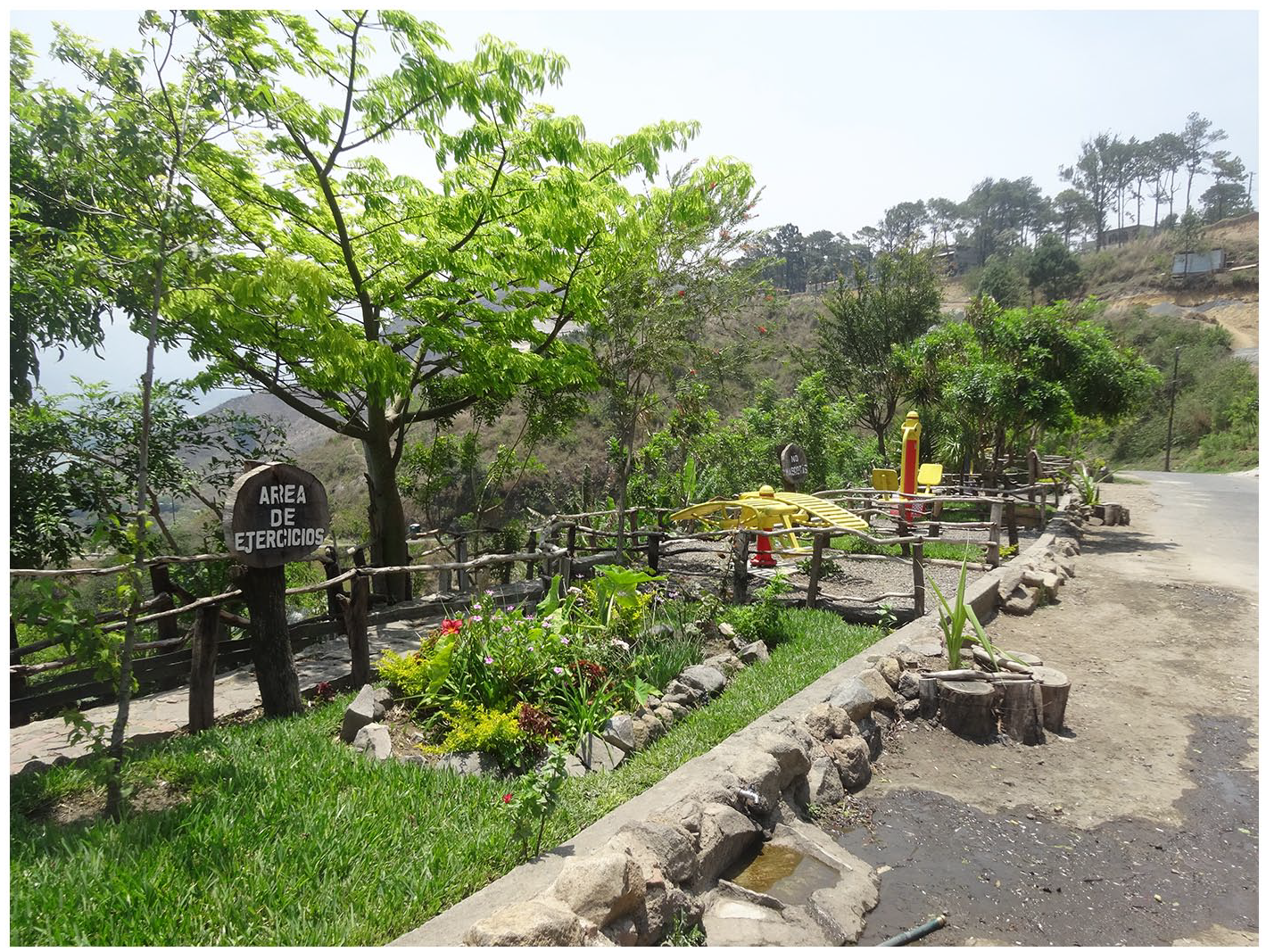
Open-air gym, Paseo del Lago, Villa Nueva (photo taken by the author).
The infrastructural projects, Miguel explained during a site visit, were key building blocks of a new ‘culture of lawfulness’. The open-air gyms and new sports grounds should turn young men – in particular the so-called ni-nis, those youths neither employed nor enrolled in the educational system – away from gangs and motivate them to lead healthy, productive and peaceful lives. In high-crime neighbourhood of Zona 4, the municipality built a football academy to ‘change the way of life of the inhabitant[s]’ (Interview 22). The sports grounds – like a basketball court and a football pitch we visited (see Figure 2) – were also ‘examples of recuperated state space’, as Miguel put it. Some youths, he said, would hang out there, surrounded by municipality-commissioned graffiti promoting human rights and the Escobar administration. And while the problem of gangs ‘marking their territory’ (for instance by spray painting) has not been solved, the municipal government ‘reached an agreement’ with those youths to keep their graffiti away from the sports grounds. As another DGSI staffer explained, the need to ‘patrol’ those spaces remains: ‘if one doesn’t control these areas, the gangs will take them to smoke weed or to drink’ (Interview 16). More than passive spaces in need of state protection, however, the recovered spaces also produced sovereignty effects, as they reinforced the social and material boundaries between the ‘decent’ and the ‘dangerous’ parts of the city (rather than acting as more inclusive spaces as originally intended).
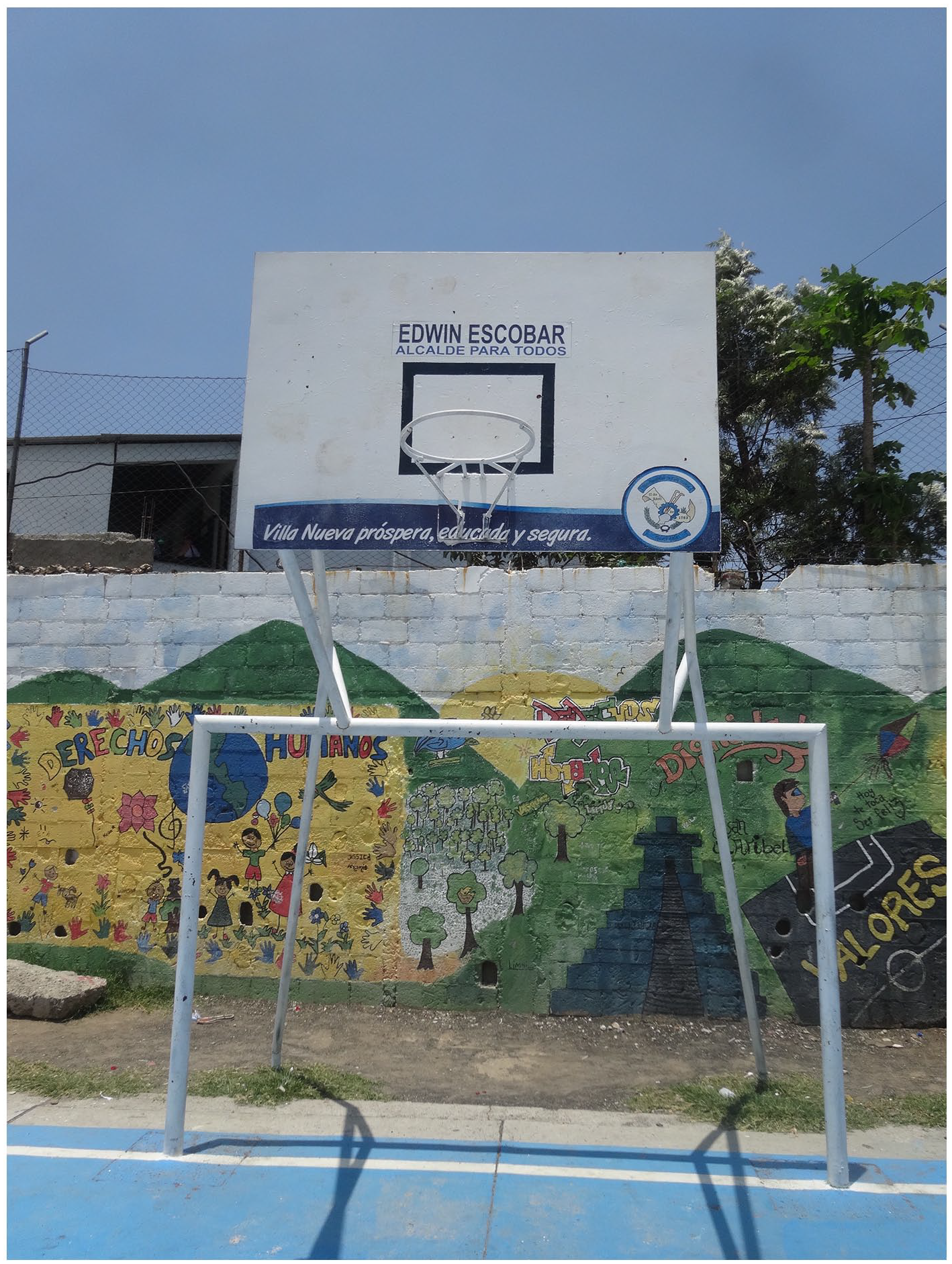
Sports ground, Villa Nueva (photo taken by the author).
These effects are also visible in the El Mezquital gang stronghold, where the municipality set up a new youth centre with USAID support after joint police and military special forces had rounded up gang leaders (see Baires Quezada, 2013). The centre was expected to run ‘under the supervision’ of the police and community leaders. 12 The security forces’ ‘prevention by deterrence’ (Baires Quezada, 2013) approach – in a setting where ‘the enemy could be anyone’, as one soldier has put it (Baires Quezada, 2013) – coexisted with an idea of bringing young people into ‘productive leisure’ (López-Durán, 2018: 117). In order to achieve the latter, the municipal youth coordinator provided a broad range of activities that aimed at inducing change among the city’s at-risk/risk youth, ‘to burn off their energy’ – for instance, in the newly created open-air gyms – to deter them from joining a gang (Interview 13).
This shows that Villa Nueva followed USAID’s Chicago School–inspired human ecology approach by fighting against ‘social ills’, mainly in ‘socially disorganized communities’ (Kubrin, 2009: 227) with limited social control. A senior USAID adviser explained that their approach builds on ‘having [the communities] feel like they’re part of the solution as well as part of the problem’ (Interview 14). This take transformed communities into ‘both objects and subjects of oversight’ (Comaroff and Comaroff, 2016: 46, emphasis in original), a perspective that Miguel was also introduced to during a ‘Police and Community’ workshop in Israel in 2014 (see Interview 15): He concluded that it was impossible to ‘leave the responsibility for security exclusively on the actors put in charge, like the National Civil Police’ (Interview 13). While, in the 2000s, community leaders like him had been regarded mainly as sources of intelligence, in particular for the model police precinct, they have since been successively turned into local security experts who were trained in policing strategies and gained significant ‘knowledge in security-related issues’ (Interview 13). In Miguel’s view, it was now the task of ‘every [community] leader [to] keep his street in order’ (Interview 13). As another municipal security staffer put it, the US and Israeli capacity-building programmes made the municipality ‘aware that the communities have to start organizing and empowering themselves [empoderarse]’ (Interview 16).
In the context of Villa Nueva, community empowerment thus had two intersecting meanings. First, citizens should not rely on government support but should rather become active agents of prevention who identify security problems and use local ‘potential within their communities’ to create ‘ways to move ahead’ (Interview 16). As a VPP adviser put it, they were expected to develop a ‘capacity to reorganize’ after ‘external shocks’ like gang violence (Interview 17), making them more resilient in a violent context that was unlikely to change. Second, community empowerment had a spatial dimension. By making use of the new open-air gyms plus football pitches and parks, the ‘citizen can claim back space’. 13 This shows that prevention in Guatemala aimed less at political empowerment than at community responsibilization, preparing citizens to better cope with insecurity.
The next subsection moves towards the agential effects of the interventions, tracing how the city-dwellers subjected prevention to negotiations and struggles, how prevention intersected with pre-existing perspectives of local dis/order, and how it reinforced, rather than replaced, exclusionary and repressive security governance.
‘They are the criminals – not us!’: Effects of prevention, local agency and in/exclusion
As the previous subsection has demonstrated, the prevention assemblage redefined spatial and social boundaries with the objective of re-establishing order in Villa Nueva. It framed ‘at-risk communities’ as a threat, while it cast ‘empowered’ communities as the forefront of reclaiming public spaces. Community leaders were thus declared key actors expected to take ownership and use their re-established agency to improve community self-policing and instil discipline – all to increase safety, improve quality of life and transform violent neighbourhoods into peaceful territories.
To prevent potentially dangerous individuals from turning violent, primary prevention programmes addressed school children. Social prevention, more generally, focused on two main social institutions, the family and the community, as an interviewee working with USAID explained (Interview 18). The Villa Nueva administration fully embraced USAID’s ‘community development approach’ (Interview 18) and the idea to ‘transform’ and ‘build social capital’ (Interview 6) in order to make communities less vulnerable to violence and to eventually turn them into safer places where ‘normative’ (law-abiding) citizens would police themselves.
In order to analyse how communities – the new ‘center of problem-solving action’ (Davis, 2012: 117, emphasis in original) – interact with the state and with the ‘things’ of the prevention assemblage, and how this transforms urban order-making, the research was extended to include the neighbourhood level (colonias).
The following discussion mainly draws on a group interview conducted with five community leaders of three colonias to explore the effects of the municipality’s prevention approach on the locals ‘recuperat[ing] the public spaces that belong to them’ (Municipalidad de Villa Nueva, 2020: 10). 14 Three of the interviewees held formal positions such as president of a COCODE or a community violence-prevention committee. The neighbourhoods they represented were among the most active ones cooperating with the municipal administration’s security team.
In a context perceived as violent and marked by gang activity, interviewees pointed to an increase in informal neighbourhood watches as fearful communities were dissatisfied with police performance. They showed both mistrust and high normative expectations towards the Guatemalan state. In their view, the legitimacy of the municipal authorities and their international supporters exceeded that of the central government: ‘only the municipal government can help us – and the activities of other countries’. In postwar Guatemala, mistrust in the government has always been high (see Corporación Latinobarómetro, 2018). In Villa Nueva, it was based on a perceived involvement of the police in illegal activities, the experience of police abuse and a general feeling of state absence. Rather than improving citizen confidence, the US-sponsored model police precinct contributed to undermining trust. ‘Initially’, a municipal staffer explained, the model police precinct ‘had a strong impact . . . it generated expectations in the population’. Over time, however, city-dwellers started to be disenchanted as sections of the police were suspected of forming alliances with gangs (Interview 16). Misconduct was often reported via the anonymous tip-line ‘Cuéntaselo a Waldemar’ (‘Tell it to Waldemar’). According to a former US police adviser, 1,386 complaints were received within the first year. However, none of those have been investigated owing to resistance on the part of the police internal affairs unit (Interview 7). One interviewee summarized a widespread sentiment:
I can’t trust the police anymore . . . because of what happened to my brother and my 14-year-old niece. A gang wanted [to recruit] her. . . . They [the gang] followed my brother for three days. When he saw a patrol car, he ran to the police to show them the house [the gang base]. . . . And imagine what the police did? They told them [the gang members] who had been talking, so that same night my brother [and my niece] had to go on the run . . . if they hadn’t left, they would’ve killed them all.
The disenchantment with the Guatemalan state has translated into community leaders more forcefully demanding the right to be protected and, at the same time, constructing themselves as legitimate state representatives. While some had observed improvements in police presence (mainly due to their own struggle for police attention), interviewees wanted the state to be more accessible and to intensify its cooperation with the COCODEs. They claimed that communities should play a role in securing state control and defending the existing order against criminals: ‘We’re all public servants. We should be united.’ This points to the internalization of the new active role of the citizens in their respective colonia, with the state being the actor slowing down more efficient forms of cooperative violence and crime prevention.
Many colonias had been historically neglected by the state. In order to address this problem, the municipal administration applied infrastructural reforms to increase state interventions and control. These measures aimed to make communities legible by, first, gathering information through empowered community leaders; second, reorganizing public space that should be revitalized by law-abiding citizens; and, third, bringing in new security technologies such as CCTV.
Security experts regarded illegibility as a main problem in the fight against gang crime (Interview 21) and considered the lack of knowledge of the local context to be an obstacle to the effective implementation of development and security programmes. This analysis transformed community leaders into crucial intermediaries for external experts. The preventive turn further provided them with a new role in governing security as the local multipliers of the violence-prevention programmes designed by experts. Further, the municipal security team engaged in ‘mapping’ the communities in cooperation with local leaders (Interview 16).
Infrastructure projects and new technologies were central to that turn towards communities. US advisers had contributed to building a ‘surveillance system’. As a US State Department official explained, this system was ‘not super high-tech’, but, rather, a key part of ‘the police knowing their communities’. The rationale behind this speaks to the logics of situational prevention: ‘A surveillance system doesn’t do all but it helps’, mainly by acting as a ‘deterrent . . . [that] might stop you from doing illicit activities’ (Interview 9).
City-dwellers welcomed these new technologies (see Quisque, 2017). ‘Thanks to God and the mayor’, a community leader stated, CCTV surveillance had now finally been set up in her colonia. City-dwellers expected technology to make their everyday life more secure. ‘Maybe more cameras would lead to increasing changes, [and would] give [the police] more control’, an interviewee speculated. While the cameras in this colonia were often not working, as another leader stressed, he still assumed that ‘if there were more cameras and someone really monitored them’, this might have a deterrent effect on criminals.
It was not only community leaders who became frustrated with failures such as defunct cameras; some of the experts did too. As a former US police adviser explained about the Waldemar tip-line:
They started passing out little cards to go out to the businesses . . . and there were big banners around Villa Nueva that we put up . . . but that’s what the community wanted. . . . So, you can imagine how many auto-thefts were prevented or reported, extortions and kidnappings and homicides. . . . It was good . . . but then you had other people that came in, other donors that set up other lines, tip-lines for drugs, for trafficking. (Interview 7)
In the view of this expert, the tip-line eventually failed through a lack of coordination and the resulting fragmentation of vital intelligence.
Despite frustrations over technical defects and a lack of police responsiveness, the new responsibilization of community leaders and technologies of control had tangible effects. First, they created new expectations of citizens in the state. The fact that community leaders demanded that the municipal government and the police provide ‘more security’ suggests that the ‘quest to recover a legible world’ (Comaroff and Comaroff, 2016: 162) in the name of security also originates from below. In Villa Nueva, community leaders built upon the prevention narrative to formulate claims to the state. The ‘bottom-up “demand” for criminal justice action’ (Sampson, 2014: 1735) that results from local agency remains somewhat neglected in critical research. It is, however, central for explaining the citizens’ role in the prevention assemblage. As Körling (2020: 42) has demonstrated, peripheral urban communities need to find ways to ‘legitimate the existence of their neighborhood vis-à-vis the state’. The following quote by a community leader in a working-class neighbourhood highlights how community leaders embody the prevention assemblage, implementing spatial practices to draw upon – and attempt to realize – the techno-promises made by international experts and the municipal government:
I tried to make our colonia known. I tried to make our colonia more visible, because, in the past, when there would be a robbery and we would call the police, they said, ‘So, how do I get in there?’ We called again, and they said, ‘I’m at this and that place’, and it turned out to be far away. So, we needed to guide the policeman . . . but by the time he arrived it was too late.
Second, community leaders pushed for further interventions and the provision of better technologies. As the final VPP report has summarized, ‘there were also requests for technology, increased police presence, radios, and even weapons, which were quickly eliminated because they would have been difficult or impossible to manage’. Furthermore, the VPP advisers also rejected these demands as they ‘would not have generated personal responsibility, and that is where the road begins and the story ends’ (USAID, 2015: 12).
Third, community leaders embodied prevention; and while they acknowledged their own ‘responsibility’, they demanded stronger military and police interventions, as the fine lines between prevention and the calls for a new round of iron-fist policing became blurred. Some approached the local military battalion ‘to let them know what’s going on in our colonia so they could take action’, helping authorities to navigate the complex web of local relations: ‘it’s us living there . . . we are the ones who know the problems’.
While aiming at prevention, it was the counterintuitive agency of community leaders, infrastructures and technologies that has turned the prevention assemblage into another layer of control that, ultimately, blamed the dangerous ‘Other’ for violence and crime. The community leaders were not only fighting for recognition and for their role in the prevention assemblage; they also renegotiated the boundaries of in/exclusion and citizenship. Community leaders’ portrayals of criminal young men as the ‘bad elements of the community’ – bored of life owing to economic and educational deprivation – attest to this. The gang member is not imagined as a rights-bearing citizen, but as a subject who cunningly manipulates the discourse of human rights:
As I told you, the laws do not educate us anymore. . . . I somewhat blame the family fathers. We should first educate the family fathers because, above all, everything is, like, very liberal, partly because human rights contribute a lot to all that violence because they are human rights for those who are essentially criminals. Because they are the criminals – not us!
This internalization of narratives on gangs and disorganized communities in the spirit of the Chicago School’s human ecology model reproduces the ‘dividing line . . . between “public order,” associated with a strong state, and “human rights,” associated with delinquency’ (Ungar, 2009: 95). As becomes apparent, interviewees welcomed both interventions to ‘create consciousness’ and more repressive policing, in particular when it came to crime allegedly committed by ‘intruders’ in an otherwise peaceful community. The main problems, in their view, were the marginalized newcomers living in the large informal asentamientos, whose right to the city they denied by invoking their very own ‘historically grown’ right to urban citizenship.
In similar terms, the Villa Nueva security staff described the situation of the asentamientos as a ‘huge vulnerability’ due to a lack of basic services, economic opportunities and security. This rendering entire neighbourhoods vulnerable led to a shift towards ‘risk management’ (Interview 16) that called for state control to be extended and for ‘decent’ neighbourhoods to be protected from a spillover of potential social ills such as violence and criminal behaviour.
The prevention assemblage played a decisive role in setting the boundaries between those being vulnerable – or at risk – and those representing a risk to law-abiding citizens: it demarcated lines of legitimate and illegitimate (use of) spaces through material infrastructure projects. ‘Recuperated’ public space, such as the parks or sports grounds discussed in this article, has unfolded a transformative agency that has contributed to a spatial and social divide. This material dimension intersected with the assemblage’s focus on remaking the city’s social infrastructure, by redrawing the line between the deserving and the undeserving in terms of civic attitude and individual behaviour, and it established the image of the law-abiding citizen willing to adapt and change. Thereby, the assemblage pre-charts the ways in which the local state authorities and external actors engage with those poor city-dwellers who have been turned into scapegoats for insecurity.
In the era of prevention, the Guatemalan nation is reimagined as a society constituted by local communities. These communities are framed either as potential spaces of solidarity and productive human interaction or as ‘failed’ communities from which (gang) violence emerges. The ordering effect of the prevention discourse and its material practice is here extended to the aggregated population in what experts have defined as communities at risk. As one interviewee put it, ‘[t]en years ago, there weren’t any asentamientos, so the majority of Villanovanos knew each other; nowadays, they come from all over the place, and this has been the point where crime began.’ A ‘community-level impact evaluation’ (Berk-Seligson et al., 2014b: 9, emphasis in original) of USAID’s VPP confirms my findings that point to an internalization of a depoliticized communitarian perspective. While the perception of disorder decreased, confidence in police and the overall ‘social control of disorder’ increased, mainly owing to improved community organization (Berk-Seligson et al., 2014b: 10–11). Overall, citizens reproduced the ideas of disorder and simplified perspectives on youth gangs – blaming families for the crimes of their children (Berk-Seligson et al., 2014b: 11) – as well as notions of community responsibility and the calls for communities to play a more active role in making everyday life safer. The framing of dangerous elements of society who jeopardize conviviality, reinforced by infrastructural reforms, such as the creation of parks and other spaces to be used exclusively by law-abiding citizens, ultimately reproduced social and spatial exclusion and stigmatization.
Conclusion
This article has examined the technopolitics of prevention in postwar Guatemala, where in the 2010s a prevention assemblage emerged with the objective of reconstructing state sovereignty from below and improving public security. Experts rescripted public spaces, infrastructures and technologies – as well as local communities – as agents of prevention. In order to analyse the ‘modes of doing’ prevention, the article has traced the changing constellation of human/non-human actors, the ideas and practices of anticipation on which the Guatemalan preventive turn had been built, and the concomitant sovereignty effects these human and non-human actors produced. Ascribing agential power to local communities and ‘things’, such as infrastructures and technologies, experts expected that human and non-human actors would instil positive change in the ‘unruly’ behaviour of populations oscillating between being at risk and representing a risk.
When measured against the declared goals, particularly that of changing the logics of security from repression to anticipation, the preventive turn has failed. In places like Villa Nueva, its effectiveness can be disputed. Human rights activists claimed that preventive interventions merely displaced the gang problem to Guatemala City (see Interview 20). An evaluation of the VPP found that the homicide rate in Villa Nueva never dropped below 50 per 100,000 population during the project’s implementation (USAID, 2015: 8). The police and municipal government argued over crime statistics and reform successes: the former complained that the ‘municipality still makes the same neglected appearance as before [Escobar’s] administration’ (Gamazo, 2015; see also La Hora, 2015). Also, neighbourhoods such as El Mezquital remained gang territory: Shortly after Escobar left office in early 2020, the Guatemalan government declared a state of alert, sending in the military and police to restore order (Barrientos Castañeda and Coronado, 2020).
Although future-oriented, prevention has reproduced repressive patterns of control and reinforced authoritarian demands and exclusionary divisions of urban space and community. The reproduction of patterns of inequality and repression is a consequence not only of the inherent socially conservative assumptions informing prevention, but also of the unexpected agential effects of humans and ‘things’ alike. First, objects such as parks and sports grounds have demarcated the line between ‘decent’ and ‘dangerous’ urban spaces and city-dwellers. Second, new technologies such as the Waldemar tip-line have raised – and eventually dispelled – expectations in the Guatemalan state. And, third, local actors – in our case local community leaders – have appropriated ideas of prevention beyond the intention of experts, thereby reinforcing exclusionary boundaries and demanding rather heavy-handed interventions by the state security forces.
In Guatemala, anticipatory action merged with repressive logics of urban order-making and also blurred the three ideal types of preemption and precaution (both aiming to save lives by reducing violence) and preparedness. Insofar as the prevention assemblage left the exclusionary and violent status quo largely unaltered and concentrated on strengthening resilience so that urban dwellers could cope with violence more effectively in the future, preparedness remained the implicit logic of choice.
This article, therefore, showed that secure futures are not the same for everyone. The empowerment of some locals was to the detriment of those communities at the (social and geographic) margins. Anderson (2010: 780) thus was right to assume that ‘anticipatory action will only provide relief, or promise to provide relief, to a valued life, not necessarily all of life’.
Ultimately, the technopolitics of prevention securitized urban governance, spaces and populations. The discursive and spatial reordering of the city has reproduced the idea of a potentially dangerous ‘Other’ whose deviance needs to be tamed (for instance, by providing better options for education or transformed public spaces where youth could engage in productive and civic behaviour) – or who, alternatively, should be excluded from the ‘legitimate’ and secure public spaces.
Experts and politicians alike ignored structural dimensions that could explain violence and crime in the city and advanced a narrative – selectively internalized by some community leaders – holding marginalized communities responsible for the ills of the city. While local powerholders interested in maintaining the social and political state of affairs welcomed the narrative blaming the urban poor, this outcome was not necessarily envisioned by external experts.
Nevertheless, Villa Nueva has become a model for reconstructing state sovereignty from below with the support of international experts. As a US State Department official put it, ‘we are working with about eight municipalities here in the central district. We have been working with them for several years, and so those are the ones that we consider graduated, those [that] are sustainable on their own’ (Interview 9). Consequently, the US advisers have taken the Villa Nueva model, including the model police precinct, to other violent municipalities. The assemblage perspective can be a powerful tool for subjecting acclaimed ‘best practices’ and ‘models’ to critical scrutiny before being further replicated. Without such a critical perspective, experts run the risk of becoming accomplices of the status quo, which ultimately strengthens the position of political elites by suppressing the emergence of any form of emancipatory subjectivity that would be necessary for cities to truly become safer places for everyone.
Footnotes
Acknowledgements
The author thanks Sina Birkholz, Markus-Michael Müller, Wil Pansters, Carlos Solar, Austin Zeiderman, the two anonymous reviewers, the editors of Security Dialogue and of this special issue, as well as the participants at the conference ‘Security and Criminality in the Americas’ (University of Oxford, June 2019) and the kick-off workshop of the Research Network ILLICITIES (University of Amsterdam, October 2019) for their helpful comments on earlier drafts of this article. The author also thanks Alejandro Gallardo, Birte Keller and Luis Kliche for their invaluable research assistance.
Funding
The author disclosed receipt of the following financial support for the research, authorship, and/or publication of this article: Research for this article was supported by the Collaborative Research Center 700 – ‘Governance in Areas of Limited Statehood’, funded by the German Research Foundation (DFG). Major parts of the manuscript were written in Spring 2019 during a research stay at the Latin American Centre (University of Oxford), with the support of a short-term postdoctoral scholarship from the German Academic Exchange Service (DAAD).

Notes
Markus Hochmüller is a Visiting Professor of Political Science at the Institute for Latin American Studies, Freie Universität Berlin. He is also affiliated with the Global Security Programme at Pembroke College, University of Oxford. His research focuses on security and development in Latin America, with an emphasis on peace- and statebuilding, policing and security sector reform. Email: