Abstract
This article centers Indigenous epistemologies to critique the United States oceanic security state, a modality of militarization and blue-washing conservation that extends beyond land borders to encompass federal conceptualizations of national security throughout the Pacific Ocean. Beginning with Indigenous perspectives from Oceania, it provides examples of Indigenous peoples’ continuing connections to ocean spaces and challenges to United States colonial geographic imaginaries and militarized destruction. Then, advancing the concept of the oceanic security state, it examines how United States assertions of sovereignty over Oceania are used to justify hyper-militarization while simultaneously destroying the environment and contributing to the climate crisis. These phenomena occur while the USA remains exempt from federal environmental conservation laws through ‘blue-washing’, and the United States government benefits from the exclusion of military emission data within international climate targets. The findings reveal how militarizing all ocean space in the name of United States national security operates within delineated borders of Exclusive Economic Zones, Marine National Monuments, and Marine Protected Areas. Guided by Indigenous epistemologies, the article concludes with alternative ways of understanding ocean spaces and constructing futures of genuine security.
Introduction
In summer 2016, Guåhan/Guam hosted the 12th Festival of Pacific Arts that opened with traditional navigators sailing canoes into the local harbor just as their seafaring ancestors had done before Spanish colonization outlawed the practice in the 1700s. This historic gathering of seafarers from across Oceania highlighted the legacy of traditional navigational practices that date back thousands of years. The ceremonial welcome displayed the resurgence of traditional canoes and shared cultural practices of navigation that continue today. Ancient navigational practices rely on the moon, stars, sun, water currents, wave patterns, smells of the air, and even cloud formations – it is an Indigenous knowledge form that orients ocean spaces as interconnected experiential pathways. Seafaring also requires deep knowledge of place-based ecologies and environments such as the reefs, wind currents, sea swells, whales, and shoals (Aguon, 2021). For peoples of the Pacific, this insight and intellect tells stories of their connection with the Earth but also highlights the dangers they are facing from climate injustice exacerbated by extractive industries, militaries, and nuclear experiments. Seafaring stories from Oceania’s frontline communities offer ways to expose the environmental effects of militarism and the connections between them. In May 2020, in the early weeks of the global coronavirus pandemic, a different vessel arrived at the shores of Guåhan. The USS Theodore Roosevelt, a nuclear-powered aircraft carrier with an outbreak of COVID-19 and a crew of 4779 personnel, docked in Guåhan without local consent, nor clear communication with local government. This scenario demonstrated United States (US) control over Guåhan, specifically by the Department of Defense, and the primacy of nation-state power over island territories. Invoking the ocean as a strategic site and sanctuary for militarism, the US government’s conceptualization of the Pacific Ocean and its islands sharply contrasts with Indigenous oceanic perspectives, practices, and stories. State-centric international security studies developed after World War II and during the Cold War established orientations to understanding threats to ‘national security’ and ideologies of the national security state that linked the defense of the nation-states’ borders through military strength. Understanding security of the nation-state has evolved through ‘securitization theory’ (Balzacq et al., 2015), which challenges traditional security approaches and exposes how ‘issues are not essentially threatening in themselves; rather, it is by referring to them as “security” issues that they become security problems’ (Eroukhmanoff, 2018: 1). The nation-state security approach privileges military responses across ocean spaces and archipelagos (Amar, 2013; Du Plessis et al., 2022; Na’puti, 2022). Contemporary security perspectives of ocean space discursively and materially construct Oceania as territory, specifically ‘national’ land for state building and intervention in the Pacific (Davis, 2020). These conceptualizations of space equate the ocean with nation-state claims to ‘territory’ to satisfy spreading and shifting colonial desires. Discursive representations of Oceania as ‘ocean nation’, ‘archipelagic state’, and ‘Insular Pacific America’ rhetorically function to territorialize the ocean (Rauzon, 2016: 3). This form of territoriality of aqueous regions is a vexed and complicated process that mirrors colonial concepts of terra nullius (empty land) couched in the language of manifest destiny as if the oceanic space of the Pacific – its cultures, ecosystems, and peoples – are empty space or aqua nullius designated for United States’ possession (Marshall, 2017; Perez, 2022). Indeed, US federal agencies also exert material power through various means of delineating boundaries, organizing forms of sovereignty or political status, and codifying control over oceanic spaces (Davis, 2020; Kuper and Bradley, 2021; Levine, 2012). These processes of ‘extraterritoriality, intraterritoriality, and the accumulation of old and new marine and submarine territorialisms’ transform the Pacific Ocean in the service of American empire (Perez, 2017: 106). As Brian Russell Roberts (2021) articulates, the continental national mythos must be dispelled to instead understand the USA as an archipelagic nation that has laid claim to more water space than land space compared to any other country on the planet. These claims are overwhelmingly executed through US military occupation of oceanic spaces that are rarely accessed or seen by its populations residing within the contiguous nation-state borders. For example, the ocean is poised as the next frontier for global resource extraction in the 21st century (Hunter et al., 2018) and has long been considered as a site for military bombing, testing, and training, from policies of nuclear testing ‘Pacific Proving Grounds’ (Dvorak, 2020; Genz, 2018) to the ever increasing ‘US militarization of oceanic borders’ (Camacho, 2012: 687). Kānaka Maoli scholar Noelani Goodyear-Ka‘ōpua articulates contradictions and problems inherent in an ‘imperialist and heavily armed vision for Oceanic and world futures . . . in which gunnery, missiles and warships secure the Pacific for rim countries to have open access over the ocean’ (2018: 85). Recognizing that Oceania and the ocean itself is not an apolitical environment, but a fluid and highly contested power-laden arena means accounting for the oceanic character of contemporary modes of militarism that radically challenge state-centric notions of security.
The concept of genuine security provides a necessary critique of these extant security paradigms. First articulated by the International Women’s Network Against Militarism (IWNAM), a group employing an archipelagic and international approach to counter-militarization activism, a world of genuine security is ‘based on justice, respect for others across national boundaries, and economic planning based on local people’s needs, especially the needs of women and children’ (Cachola et al., 2010: 168). Distinct from the term human security, genuine security reflects the ‘affective dimension of IWNAM’s feminist decolonial politics’ whereby connections are sustained over cultures, geographical distances, histories, and languages (Compoc et al., 2021: 206). Rather than focusing on the state as a central provider of security, collaborations of diverse women impacted by militarism and violence offer the conditions of possibility for healing and self-determination – genuine security works to construct alternative futures and undo systemic disconnections brought about by occupation (Cachola et al., 2010; Compoc et al., 2021). This article incorporates the concept of genuine security into Indigenous oceanic epistemologies that understand the ocean as connecting pathways in relation with lands, peoples, and skies. As detailed below, Indigenous perspectives function as decolonial praxis that challenges imperial and militarized orientations of control over ocean spaces. We illustrate how oceanic epistemologies challenge the existing geopolitical order exhibited by the US oceanic security state.
The concept of an oceanic security state refers to the phenomenon of how material and discursive elements of the security state reveal themselves to occupy oceanic space in ways that are markedly distinct from land-based locales. We argue that the oceanic security state is characterized by the interrelated and contradictory processes of: (a) militarization and (b) blue-washing conservation. Considering the USA as an empire of military bases on a global scale, the oceanic security state manifests itself through contemporary and ongoing iterations of militarization enacted and justified by the US federal government’s Department of Defense (DoD). The phenomenon of ‘hyper-militarization’ (DeLisle, 2016: 564) of ocean spaces is evidenced by the DoD’s increasing establishment and occupation of ocean waters as US military testing and training areas, defense transit corridors, weapons range complexes, and sites for maritime defense exercises such as the biennial Rim of the Pacific (RIMPAC) and Valiant Shield. Carried out in Hawaiʻi and Guåhan respectively, RIMPAC is the world’s largest international maritime war exercise and Valiant Shield is one of the largest US military ‘war games’ held in the Pacific Ocean (Bevacqua and Cruz, 2020). These actions reflect the DoD’s concept of securitization whereby issues are interpreted and referred to as ‘security’ issues that then become framed as nation-state security problems; ostensibly, the US military is the only possible solution prescribed. The framing and production of threats by the DoD maintain the primacy of state security perspectives while devaluing alternatives such as human or environmental security. As Compoc et al. (2021: 205) make clear, ‘the failure and injustice of US “national security” and “regional security” priorities that demand endless war and exorbitant military spending’ lay bare the continued need for decolonial feminist perspectives like genuine security. We articulate how Indigenous orientations to oceanic spaces combined with genuine security provide a framework for exposing and critiquing the USA as an empire of military bases, and for protecting Oceania from further militarization by the oceanic security state.
The oceanic security state also operates through blue-washing and conservation as control. As Chamoru scholar and poet Craig Santos Perez explains, ‘blue-washing’ refers to the phenomenon of government’s use of marine protection and environmentalism as a cover to protect its environmentally harmful military bases throughout the Pacific and the world (2014). Perez examines blue-washing of oceanic space to launch critiques of the Marine National Monument (MNM) creation process in relation to the DoD oversight and places it designates as ‘strategic territories’ in Oceania. Blue-washing also encompasses the power of governments and corporations to exploit ocean resources for profit, as particularly evident in the case of deep-sea mining and financial control through the world’s largest Exclusive Economic Zones (EEZs) that have impunity from legal jurisdictions on environmental regulations and federal protections on conservation (Belhabib, 2021; Campbell et al., 2021; Hunter et al., 2018; Villagomez, 2021). Thus, conservation-as-control connects with the larger framework of imperial security practices that prioritize toxic and harmful military activities in oceanic spaces despite their designations as sites for environmental protection. For example, the DoD maintains jurisdiction across the Pacific and throughout US MNM areas and marine protected areas (MPAs) that it simultaneously transforms into sites for militarization while remaining exempt from federal conservation laws (De Santo 2020; Duffy, 2014). As the world’s largest polluting entity, the US military is wreaking irreversible havoc on the oceanic environments it purports to protect (Belcher et al., 2020; Coates et al., 2011; Crawford, 2019; Harris, 2021; Mitchell, 2020; Na’puti, 2022).
To better understand these overlapping and contradictory characteristics (militarization and blue-washing conservation) comprising the oceanic security state, we provide examples from Oceania focusing on spaces under US nation-state colonial jurisdiction such as so-called territories or insular areas administered under US sovereignty, and freely associated states with a Compact of Free Association agreement with the US. 1 These oceanic spaces are occupied by the USA and bordered as US MNM areas, making them significant sites in revealing how assertions of nation-state security operate through hyper-militarization and conservation. Our analysis lays bare how the oceanic security state functions and the dangers of US federal control and military actions in Oceania that attempt to render aqueous regions as devoid of Indigenous lifeways and perspectives. Yet, we argue that Indigenous and genuine security perspectives work together to challenge these attempted erasures and damages brought about by the oceanic security state.
First, we provide Indigenous perspectives from Oceania that theorize and contribute to broader queries about oceanic space, resistance, and change. We spotlight Indigenous epistemologies that provide analytical heft and nuance to critiques of colonial geographic imaginaries of Oceania and offer examples of resistance to US militarism. These epistemologies also index articulations of voyaging and seafaring praxis that provide critical tools for orienting to oceanic spaces and framing genuine security in the Pacific. Second, we address colonial perspectives of oceanic spaces that explicitly maintain the oceanic security state through militarization and blue-washing. We discuss these overlapping and contradictory processes and how conservation as control operates to perpetuate US militarization of vast aqueous environments. Finally, we examine several cases of the oceanic security state that reveal themselves in the form of military testing and training areas and other seemingly bounded regions and spaces of US federal control. Analyzing these cases reveals the fissures and pitfalls of the structures of militarism and the phenomena of blue-washing and conservation as control in Oceania. In the section that follows, we begin by reviewing Indigenous perspectives of Oceania and articulations of genuine security as interconnected frames for understanding the region. Then we discuss colonial perspectives and politics of the oceanic security state before analyzing select instantiations of this phenomenon in Pacific Ocean spaces.
Indigenous perspectives of oceanic spaces: Connecting pathways and relationality
Indigenous oceanic perspectives theorize water in relation to land, arguing that place is archipelagic, fluid, dynamic, and moving. Many Indigenous epistemologies believe deeply in the interconnected characteristics of water, land, and sky while also relating to communities of Pacific Islanders as peoples who have been traversing the seas since time immemorial. These ways of knowing space and place resonate throughout Oceania. For example, I-Kiribati scholar Teresia K Teaiwa considers fluidity and constant flux to theorize relationality among ocean and Indigenous lands (2021). Challenging imperial naming processes and spatial conceptions of the Pacific region, Tongan scholar Epeli Hau’ofa enacts a holistic perspective to reconfigure Oceania as ‘a sea of islands’ comprising an enlarged vast network of power (1993). Indeed, Chamoru, Hawaiian, Māori, and other Indigenous orientations theorize ocean spaces as vibrant and interconnected areas of inquiry (Hokowhitu et al., 2021). In Hawaiian contexts, Ka Moana Nui (the great, expansive ocean) conceptualizes all the Pacific to be connected: oceanscapes, landscapes, and heavenscapes (Goodyear-Ka‘ōpua, 2018: 93). From the Mariana Archipelago and ‘for the Chamorro and Carolinian people’, the sea ‘shapes Indigenous cultural understandings over time and perpetuates life’ (McKinnon et al., 2014: 62). This connectivity involves dynamic place-based ways of knowing Oceania in relation to natural environments, ancestral and spiritual connections, time, and collective responsibilities that deepen Indigenous values and practices of resilience and sustainability (Na’puti, 2019; Bevacqua and Bowman, 2018; Ingersoll, 2016; McKinnon et al., 2014).
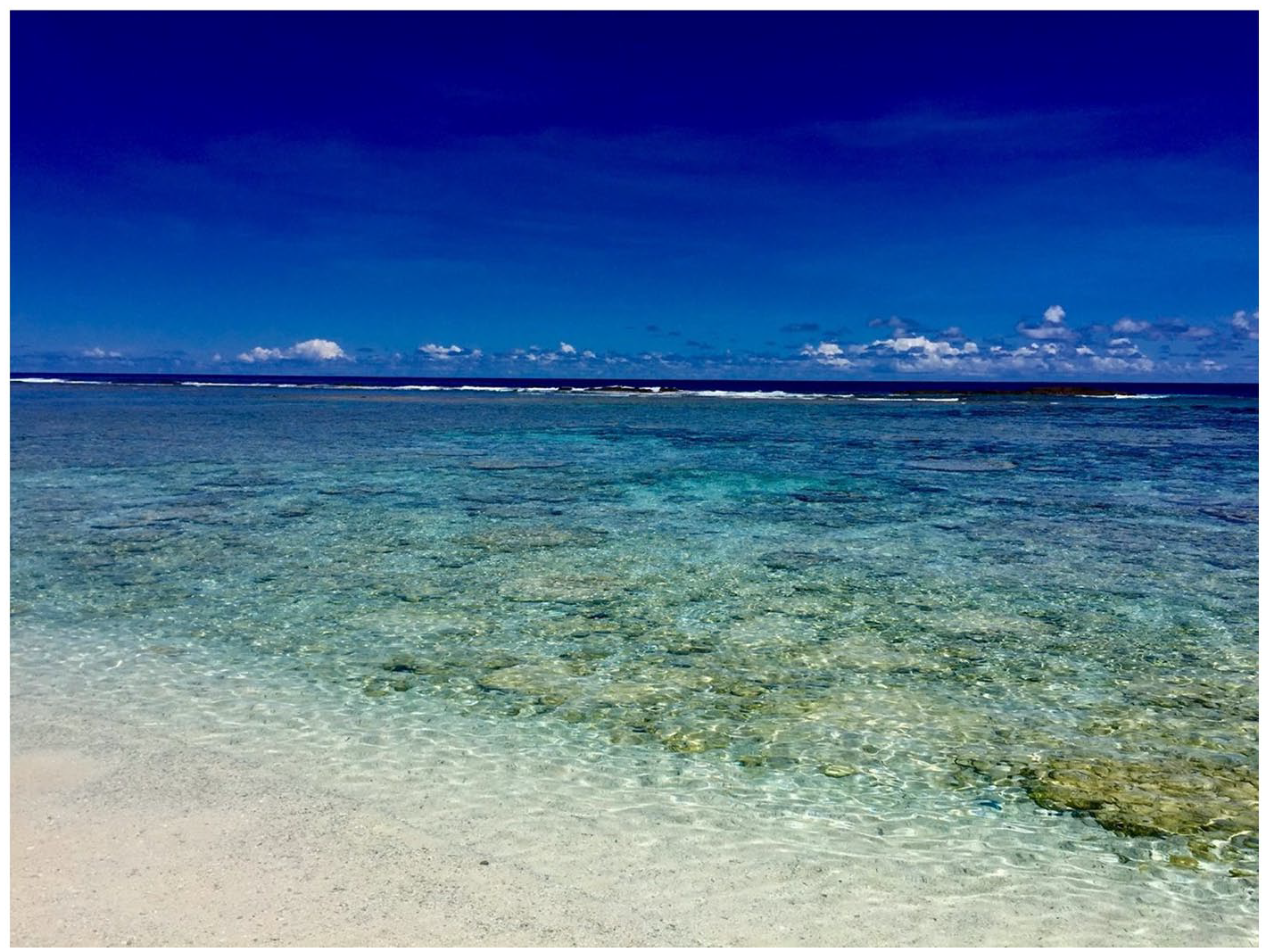
View from Guam National Wildlife Refuge, which is threatened by the DoD construction of a live-fire training range (LFTR) at Litekyan Guåhan (Ritidian, Guam). Image by Sylvia Frain.
These examples illustrate that the ocean is understood as a pathway connecting islands, rather than a divider separating landscapes or regions. Such ideas are foundational to Indigenous oceanic knowledge systems and expansive spatial geographies that conceptualize space in more holistic, relational, and archipelagic ways not exclusively tied to land (or distance from it) or control (Na’puti, 2019; Thompson, 2017). As Pohnpeian-Filipino scholar Vicente M. Diaz argues, these epistemological foundations center mobility and movement in theorizing moving islands, disrupting concepts of fixity and stability to land itself (2015).
In this sense, what happens in one area of the Pacific is understood to impact the entire ocean from continents to islands and archipelagos (Teaiwa, 2021). By imbuing space with complex and dynamic senses of relationality (often experienced through olfactory, tactile, and spiritual sensibilities) these epistemologies challenge colonial constructions of Oceania and frame decolonial theoretical engagements about the region (Diaz, 2015; Goodyear-Kaʻōpua, 2017). Embracing the ocean as part of a unifying common heritage, Indigenous struggles connect with regional identity and epistemologies of Oceania to imagine alternative realities beyond extensions of militarization (Arriola, 2020; Camacho and Ueunten, 2010; Na’puti and Bevacqua, 2015, Na’puti, 2019). Such oceanic epistemological foundations orient ongoing resistance to militarism.
The movement for a Nuclear Free and Independent Pacific (NFIP) comprised predominantly Indigenous islanders operating from the belief that what occurs in one area of the Pacific Ocean affects the entire ocean – including those living in the midst and on the edges of it. From this epistemological basis, the NFIP explicitly reframed the geographic imaginary of the region as a political strategy. Its work encompassed advocacy for independence and sovereignty movements throughout the Pacific and forged alliances with groups in Canada and Japan (Teaiwa, 2021). The NFIP organized protests of nuclear testing in the 1970s and gained momentum to connect with various islands through the early 1990s (Dé Ishtar, 1994; Teaiwa, 2021). Through conferences, lobbying, and women’s collectives, the NFIP advanced international anti-nuclear agreements and established a regional and global network of activists who continue to work for demilitarization in Oceania in the present day (Genz, 2018; Maclellan, 2005). This movement also laid the foundation for Aotearoa’s nuclear-free status and contributed to independence struggles in Guåhan, Hawaiʻi, Kanaky, Tahiti, Timor-Leste, and Vanuatu. Resistance to a nuclear Pacific continues to challenge powerful nation-states that assert economic and military rule throughout the ocean.
The USA’s story in Oceania is one of continued colonial control and expanding militarization, reminding us that the Pacific Ocean ‘still churns with its colonial and nuclear legacies’ (Teaiwa, 2021: 117) and is impacted by military activities, weapons testing, and exploitative resource extraction (Na’puti and Kuper, 2021). Such polluting activities and extractive industries accelerate the impacts of climate change and environmental destruction. The IWNAM addresses the environmental impact of the US military and is also concerned with the right of self-determination for island peoples (Compoc et al., 2021). In the face of militarism, the IWNAM articulates that protecting genuine security means focusing on collectives that redefine security for women, children, and the environment to create sustainable communities (Cachola et al., 2010: 165). These collectives de-emphasize individuals or even the state; instead, the IWNAM’s practices of decolonizing solidarity occurs through relationship building and sharing worldviews to address how colonialism and militarism impacts local and global communities (Cachola et al., 2010: 167). In 2017 the IWNAM meeting in Okinawa enacted these practices of resistance. Delegates shared strategies to: protect Oceania from more militarization; express solidarity for the peace movement in Okinawa including the campaigns to stop controversial US military construction in Henoko and Takae; and demand proper cleanup after withdrawal of military bases (Compoc et al., 2021; Na’puti, 2019). Rather than solely focus on challenges to state-centric power or resource extraction in terrestrial locales, here we concentrate on the oceanic registers of Indigenous resistance to occupation and militarism in aqueous places as they offer important but distinct forms of place-based opposition. Indeed, environmental threats, sovereignty, and decolonization are central fights for resistance activities in heavily militarized archipelagos, atolls, and islands such as Guåhan, Kaho‘olawe, Kalama, Kwajalein, Okinawa, and Puerto Rico (Davis, 2020; De Onís, 2021; Du Plessis et al., 2022; Dvorak, 2020; Ginoza, 2012; Na’puti and Bevacqua, 2015; Natividad and Leon Guerrero, 2010; Torres, 2020). From the Marianas, organizations such as I Hagan Famalåo’an Guåhan (IHFG) employ Indigenous Chamoru values that inform connections with lands, waters, and ancestors to ‘promote collective self-determination and the demilitarization of the island’s land and environmental resources by colonial powers’ (I Hagan Famalåo’an Guåhan, 2021). Through direct action campaigns, education and healing events, and practices that honor Indigenous knowledge and lifeways, IHFG shows how genuine security and oceanic epistemologies are employed as an interconnected framework that challenges colonial control and military occupation.
Another Guåhan community organization, Prutehi Litekyan: Save Ritidian (PLSR), protects Guåhan’s sacred lands and works to preserve cultural and oceanic resources from further US militarization. For example, the Guam National Wildlife Refuge (GNWR) is threatened by the DoD construction of a live-fire training range (LFTR) that is already clearing 315 acres of land, including 89 acres of native limestone forest and 110 acres of disturbed limestone forest; closing sections of the refuge and heavily restricting public access for a proposed 39 weeks while the training range complex is in use; and making parts of the area a Surface Danger Zone that threatens the island’s only freshwater aquifer (Na’puti, 2019). This area is a sacred site for the peoples of the Marianas. PLSR employs oceanic epistemologies by reclaiming Litekyan, the Indigenous place name that refers to the stirring ocean currents, to situate the vibrant histories existing in relation with the island’s contemporary cultural and environmental imprints. In March 2021, the United Nations’ Human Rights Council joined PLSR in a joint allegation letter to the US government concerning ongoing human rights violations suffered by the Chamorus of Guåhan, including the impacts of ‘the US military buildup’ and ‘the associated threats to Indigenous lands, resources, environmental and cultural rights’ (UNPO 2021: 2). In October 2021, a CODEPINK webinar, ‘US Militarization of Guam & the Marianas: Lived Impacts of the US War on China’ centered Indigenous voices from the Mariana Islands archipelago to address the impacts of US-escalated militarization that is actively contributing to the global climate crisis (Codepink.org, 2021). Representatives from PLSR (Monaeka ‘Naek’ Flores) and a Saipan-based community advocacy group Our Common Wealth 670 (Theresa ‘Isa’ Arriola) spoke about the environmental impacts of US militarization and the interconnected threats posed to Indigenous self-determination. Their stories shared strategies for confronting injustices of US ‘national security’ and expressed regional solidarity to stop the latest US military construction in Guåhan and the Commonwealth of the Northern Mariana Islands (CNMI) that residents have been opposing since 2009. These selected examples honor the specificities of Islander experience, recognize the generic effects of colonialism, and take seriously the commitment to political and cultural cooperation at the regional level (Teaiwa, 2021: 110). Starting from Indigenous perspectives of Oceania also shifts away from the primacy of the continental USA and exposes US colonial power as a global phenomenon that demands simultaneous critiques of militarism.
Oceanic epistemologies are also articulated through seafaring and voyaging practices that critique the compartmentalization of watery regions as bounded, partitioned, and/or static. Celestial navigation, canoe building, wayfinding, and voyaging are Indigenous knowledges and practices that orient oceanic space as pathways. Micronesia – itself an imaginary and misnamed region – articulates a sense of space that is perceived through stories about the place, genealogical and historical elements, and cultural conceptualizations and practices of caring for the ancestral significance of land in relation to fluid ocean (Bevacqua and Bowman, 2018; Camacho, 2012; DeLisle, 2021; Diaz, 2015; Na’puti, 2022; Olopai, 2005; Souder-Jaffery, 1992). Voyaging understandings challenge ‘conventional views of land, indeed, of place and space, and political and cultural subjectivities conceptualized in relation to them’ (Diaz, 2015: 90). These practices maintain Indigenous relationships, histories, and responsibilities beyond arbitrary nation-state political and colonial boundaries.
In the Marshall Islands, resistance to nuclear colonialism is rooted in local histories of vibrant peace movements. Since the 1960s, Kwajalein landowners have engaged in voyaging practices in the form of sail-ins to protest US militarization, the violence of ballistic missile testing, and their forced displacement from their island home (Dvorak, 2020). Marshallese groups, often predominantly women, navigated their canoes to various islands that the US military had declared off-limits. They disrupted missile tests, protested the forced removal from their lands, and challenged the free association agreement with the United States (Dvorak, 2020). Their resistance through sail-ins illustrates Indigenous understandings of oceanic spaces, and efforts to create genuine security for collective futures. In the late 1990s, Waan Aelōñ in Majel (WAM [Canoes of the Marshall Islands]) was established to perpetuate the teachings of wave navigation – navigating by understanding wave patterns. WAM carries forward this traditional knowledge and provides opportunities for embodied practices of navigation to Marshallese apprentices (Genz, 2018; Waan Aelõñ). These enactments of genuine security build alternative futures that address colonialism, militarism, and environmental challenges.
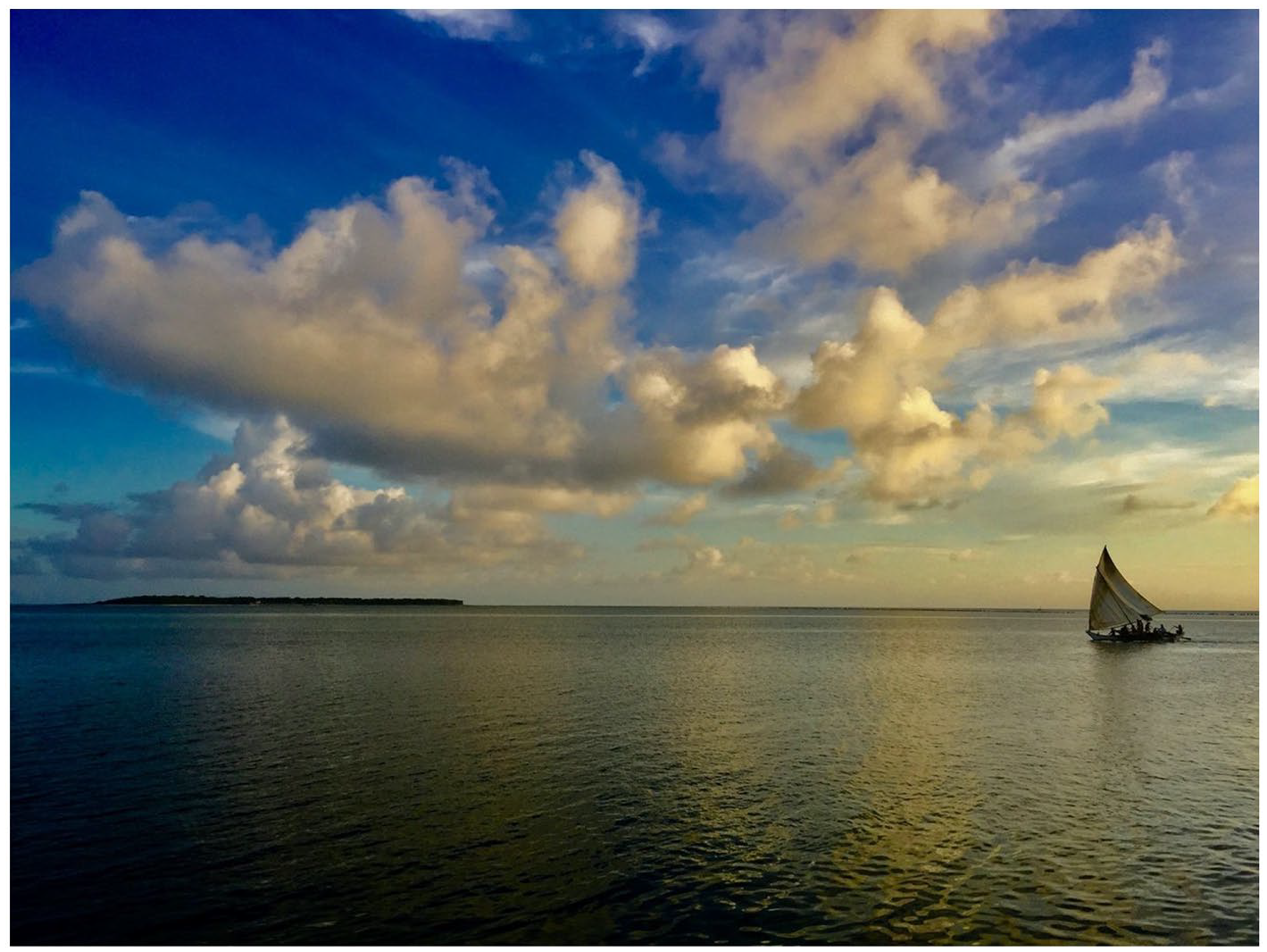
Micronesian voyaging canoe, Malesso Guåhan (Merizo, Guam). Image by Sylvia Frain.
Related to the tradition of seafaring and voyaging are the vessels used to carry out such oceanic journeys. The canoe, in its various forms, is a symbol of the seascape as central to life and identity throughout Oceania. More specifically, the canoe serves as a ‘symbol of cultural revitalization and identity in relation to their unique canoe cultures’ (Tu, 2017). Beyond this important symbolism, the canoe also represents voyaging values that are central to survival and sustainability. These values translate seamlessly from ocean to land. On the island of Saipan in the CNMI, the non-profit organization 500 Sails is restoring Micronesian maritime traditions through swimming, canoe building, and sailing education programs (500 Sails, 2021). Rob Limtiaco, mentored in Guåhan by Master Carver Tun Segundo Blas in Guåhan, and Tawa Tilimwar from Fanur School of Navigation and Rapwi Alwaich of Warrieng School of Navigation in Pulowot, explains that the canoe is revered as a teacher and sustainer of life. Using Indigenous perspectives to inform place-based education, Limtiaco teaches youth about sailing as an embodied practice that reflects responsibilities to the canoe, to our ocean, and to ourselves. Similarly, in the Mariana Islands, groups such as TASA, TASI, and Ulitao are reviving and sustaining seafaring skills. They build canoes using local wood and endeavor ‘to teach our people the seafaring ways of our ancestors, who navigated the ocean for hundreds of years’ (Ulitao, https://www.facebook.com/ulitaoincguam/). These groups are making canoe culture a daily facet of life in the Mariana Islands again.
The Te Toki Voyaging Trust (TTVT) Waka Ama club in Aotearoa operates its three waka hourua (Māori voyaging canoes) Pūmaiterangi, Haunui, and Aotearoa One while ‘sailing home across Te Moana Nui a Kiwa with a majority female crew’ (Dewes, 2018). The TTVT maintains relationships among people and sea. Other oceanic maritime projects from the Hawaiian Islands, such as the Hōkūle‘a and her sister canoe, Hikianalia, conduct regular voyages around the Hawaiian Islands and wider Oceania, to the continental USA, and in 2017 completed a three-year Mālama Honua Worldwide Voyage. In spring 2023, the Hōkūle‘a and Hikianalia are scheduled to sail on the Moananuiākea Voyage’s circumnavigation of the Pacific Ocean (Polynesian Voyaging Society, 2022). These canoes operate by celestial navigation practices, demonstrating the sustainability of Pacific ways of knowing and the revitalization efforts of navigation to represent oceanic futures (Aguon, 2021; Goodyear-Ka‘ōpua, 2018: 83). Contemporary voyaging praxis flows from and is rooted in Indigenous epistemologies that demonstrate the power of Pacific Island frameworks to construct knowledge rather than continuing to rely exclusively upon those of colonial powers and state-imposed political and territorial boundaries. Engaging in this critical praxis, Indigenous peoples enact their perspectives of oceanic pathways and relationality. And, in the process, they facilitate collaborations for genuine security across archipelagos, and transcend colonial borders and vexed political relationships to administering powers. Indigenous perspectives of oceanic spaces insist upon the centrality of connections among water, land, and sky, whereas US federal control orients itself towards contemporary ‘security’ concerns that reflect colonial geographic imaginaries of Oceania. To better understand hyper-militarization and territorialization of oceanic space by the USA, we examine the oceanic security state and its implications.
Politics of the oceanic security state: Militarized blue-washing of Pacific Ocean spaces
The concept of an oceanic security state specifically attunes to the dynamic and complex layers of how oceanic spaces are politically utilized as enclosed and easily governed areas – constructed as outposts of the land-based contiguous US nation-state which extends its power through militarization and blue-washing as a means of governance in Oceania. Often operating politically from a distance, the oceanic security state also contributes to understanding how the US nation-state’s militarization of oceanic spaces reflects colonial desires to use islands and ocean for war training on a global scale. These dynamics of militarism and colonialism simultaneously perpetuate, legitimate, and conceal one another; therefore, examining their confluence along with conservation divulges nuanced modalities of empire in oceanic places. These military politics operate ‘within the logics of settler colonialism intended to eradicate Indigenous stories of connection to land and assimilate Indigenous people’ (Caso, 2021: 1). Yet, militarization and the land it occupies cannot be disentangled from one another (Gandhi, 2022; Pearson, 2012), particularly as the toxicity of military bases remains and has devastating impacts on global climate change (Colgan, 2018; Crawford, 2019; Marzec, 2015).
Working in tandem with militarization, blue-washing occurs when governments protect their environmentally harmful military bases and activities in ocean spaces through assertions of environmental and marine protection policies and DoD oversight. Indeed, the United States’ military, the largest in the world, claims it is invested in environmental protection and preservation while being the largest consumer of fossil fuels and producer of emissions and generating enormous amounts of hazardous waste as part of routine operations especially on bases (Belcher et al., 2020; Crawford, 2019; Marzec, 2015; Parkinson, 2020; Vine, 2015). Blue-washing has been codified through the 2008 US Supreme Court case, Winter v. National Resources Defense Council, which ruled that ‘the military is “special” when it comes to the implementation of federal environmental law’ and compliance within the National Environmental Policy Act (NEPA) (Craig, 2009). The case established a legal precedent allowing military readiness to be valued above preserving marine life and different standards of compliance. Readiness and other national security interests are also used to justify exempting the DoD from meeting environmental protection requirements within the area that covers several million square miles (Craig, 2009). This prioritization of military over conservation continues in the present day (De Santo, 2020), with the DoD designating for military activities oceanic spaces that comprise existing MNMs, while declaring nearly exclusive jurisdiction over the preservation and protection of the area.
Blue-washing highlights the continuing legacy of US militarization throughout Oceania that dates to military overthrows and invasions in archipelagos and atolls, transforming islands such as Guåhan and the Pacific Ocean into a militarized space of empire (Camacho, 2012; Perez, 2014). The DoD considers Guåhan a ‘critical nexus’ for ‘command and control, logistics, and power projection across the Indo-Pacific and the Defense Department must continue to expand its investment and increase its footprint’ (Everstine, 2021). In 2021 a proposal was introduced to designate 230 square miles of critical habitat in American Sāmoa, Guåhan, CNMI, and other US Pacific Islands; these habitats would protect seven threatened coral species endangered by warming seas and ocean acidification fueled by climate change, but the proposal gives an exemption for military training areas (Clymer, 2021; Hofschneider, 2021). Throughout Oceania, the DoD has largely avoided legal scrutiny for its militarization of marine protected areas (MPAs) and critical habitats. This is largely due to the political and economic communities who stand to profit from military construction and environmental mitigation projects in the Pacific (Belcher et al., 2020; Camacho and Broudy, 2013; Mitchell, 2020). Beyond any financial benefits of the oceanic security state are the human and environmental costs of DoD control, which negatively impact NEPA enforcement throughout Oceania, and highlight the challenges of a political economic order rooted in colonial dependency.
Mapping US federal control and marine national monuments: Protected areas or defense assets?
The US nation-state perspectives demarcate and control oceanic spaces to continue economic primacy maintained through federal and commercial jurisdictions of the largest Exclusive Economic Zone (EEZ) in the world. Boundaries created for EEZs and their expansions hinge upon US state-based territorial histories and politics rather than on Indigenous cultural or ecological practices and beliefs (Acton et al., 2021). Controlled by the US Department of Commerce (DoC), the US EEZ maintains domination of the global economy with over 13,000 miles of coastline and 3.4 million square nautical miles of ocean. Reaching offshore of all US states and territories, the EEZ effectively extends US sovereignty in the Pacific to an area encompassing 200 miles around each island. The DoD and federal agencies oversee the EEZ, providing further justification for these zones as primary sites for military training, war exercises, and MNMs disguised as environmental protection. It is also a heavily securitized space with shipping lanes defended by the US military to ensure unfettered access and control between the continental USA and Asia (Lutz, 2019). Additionally, the National Oceanic Atmospheric Association (NOAA) is tasked with ‘positioning America’s coastal communities for the future’ through ‘science, service, and stewardship’ (Bamford, 2013). However, the NOAA is administered by the US DOC – the regulatory agency that oversees the EEZ – and thus, conservation is deferred while military and economic controls are prioritized to protect US ‘national security’. The EEZ highlights how seascapes and archipelagos are prized for maintaining the oceanic security state through the economic dimensions of blue-washing.
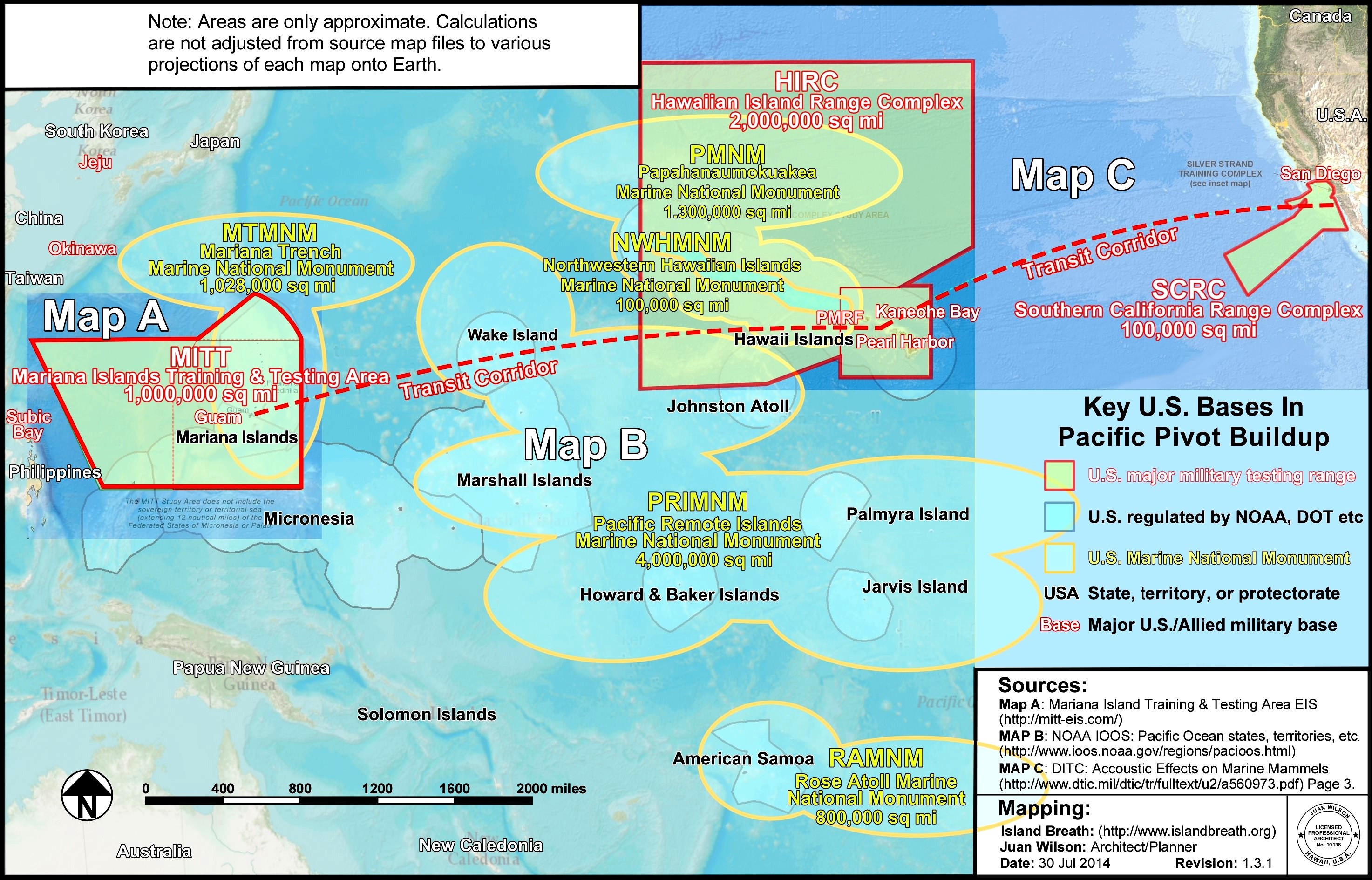
The case of Marine National Monuments (MNM) in the US Affiliated Pacific also reflects the oceanic security state. The creation of a MNM is unilaterally designated by the US president through the 1906 Antiquities Act and does not require – nor is it held accountable to – legislative or public comment, engagement, or approval (Perez, 2014). On 6 January 2009, former US President George W Bush created three MNMs: Pacific Remote Islands Marine National Monument, Rose Atoll MNM (near American Sāmoa), and the Mariana Trench Marine National Monument (MTMNM). In 2014, US President Barack Obama extended the MPA of the Pacific Remote Islands MNM to include the entire US EEZs, thus creating the largest contiguous marine protected area on the planet (Rauzon, 2016: 1, 3). The formation of MNMs is designated by both political parties with the intended purposes of economic benefit and the establishment of MPAs for conservation. This designation constructs an imaginative geography for ocean spaces as amenable to conservation yet eschews criticism of the US nation-state that simultaneously exerts power through unfettered military and economic access, movement, activities, and rule for MNMs in Oceania. The United States’ ‘Asia Pacific Rebalance’ policy makes clear that oceanic spaces from Japan to California are prioritized for overt military activities even within regions of purported MPA. In fact, the DoD weapons testing and war-training areas are situated in direct relation to, and often through, overlapping boundaries of MNMs (and their associated MPAs) in Oceania (see Figure 3). Dominant narratives articulate these oceanic spaces as progressing toward global marine conservation, yet these monuments are primarily utilized and transformed into ‘defense assets’ that offer ‘as much potential as strategic national security assets as environmental ones, and almost certainly more than as commercialized ocean’ (Hooper, 2017). This security orientation to MNMs is further illustrated by the established boundaries that are strategically located along US submarine operational areas. In tandem with such security approaches are economic investments to sustain ‘US undersea supremacy’ where billions of dollars are spent annually on weapons, undersea vehicles, and other specialized military equipment (Hooper, 2017). Unfortunately, MNMs and MPAs are not exempt from pollution or environmental degradation caused by military activities, equipment, and exercises. Throughout the Mariana Islands, Hawaiʻi and other sites, the military has caused devastating environmental impacts as evidenced by beached whales and dolphins due to sonar testing and war exercises (Letman, 2021). Demarcating of oceanic spaces as MNMs and MPAs while simultaneously rendering these sites as habitats for US military activities illustrates the confluence of blue-washing conservation-as-control and militarization. Below, we discuss several examples of the oceanic security state demonstrated by the cases of MNM, training and testing areas, island range complexes, defense transit corridors, and biennial military exercises in the Mariana Islands and Hawaiʻi. We ordered these cases through a regional focus beginning in the Marianas and then moving outward to Hawaiʻi; though our examination provides somewhat discrete details for each, we recognize the interconnected, complex, and overlapping nature of these examples. The US security perspectives and examples of the oceanic security state articulate these aqueous regions as disjoined and separate. However, our analysis reveals the significance of bringing critiques to bear on these cases as connected and interdependent. In doing so, we demonstrate contradictions at place-based sites and their relations to the broader politics of militarization and environmental impacts of the US military on global ocean resources.
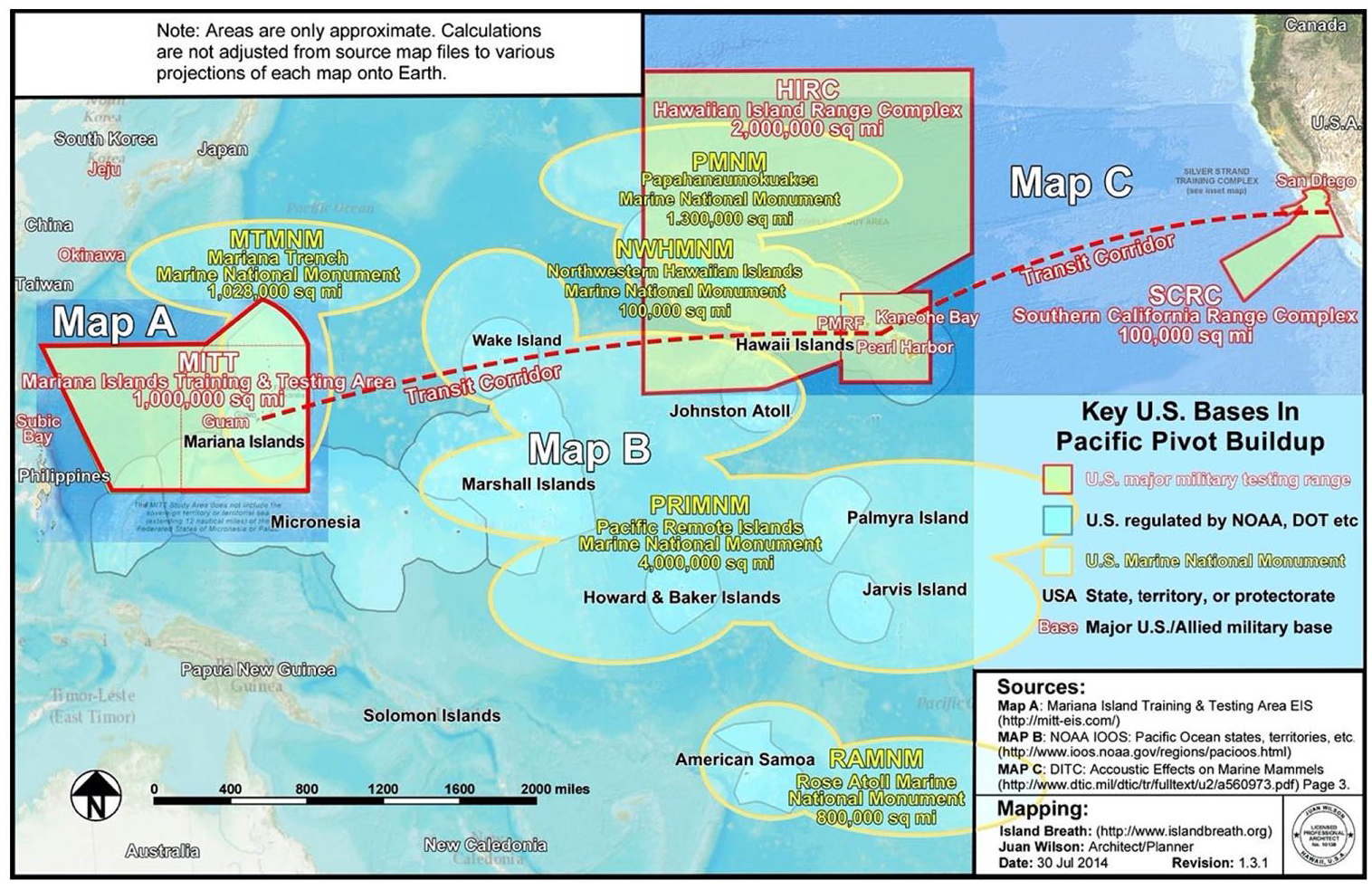
Map of key US bases in Pacific Pivot Buildup. DoD Training and Testing areas, range complexes,and transit corridors are indicated in red and US MNMs are in yellow (Wilson, 2014).
Marianas Trench Marine National Monument, MITT, and MIRC
The Marianas Trench Marine National Monument (MTMNM) is a federally controlled ocean space touted as emblematic progress toward marine conservation while also being designated by the DoD for militarization in the service of ‘national security’ and readiness. A presidential proclamation established the MTMNM in January 2009. It covers approximately 1,028,000 square miles of submerged land and waters and contains the Mariana Trench – the deepest place on earth. The US military conceives Guåhan as a ‘critical submarine territory, and the unique hydrological features protected by the nearby marine monument may help American submarines slip into striking positions off North Korea, Taiwan, or elsewhere’ (Hooper, 2017). This construction of the island as ‘submarine territory’ has material impacts borne out through militarization and blue-washing. For example, the US Virginia-class attack submarines and additional visiting submarines are stationed in the island’s Apra Harbor located near the monument. Reflecting the phenomenon of transforming monuments into ‘defense assets’, the MTMNM demonstrates how the oceanic security state operates through conservation as control. The MTMNM is controlled by the US Department of the Interior (US Fish and Wildlife Service), the Department of Commerce (NOAA), and the CNMI government – all acting ‘in consultation’ with the DoD and Department of State in a complicated matrix of cooperative ocean resource management (Rauzon, 2016: 223). By virtue of the DoD’s jurisdiction and ‘in consultation’ management role, the Marianas Trench MNM is embroiled in a complex legal and procedural net as dictated through the National Environmental Protection Agency (NEPA) and justified by US military protection (Frain, 2018).
Superimposed on the created borders of the MTMNM is the DoD’s Mariana Islands Training and Testing (MITT) area, which was established in 2015 by the US Navy. The MITT ‘study area’ expands to nearly 985,000 square nautical miles (Figure 4) (Terlaje, 2017). The MITT authorizes the Navy to conduct sonar and live-fire training and testing that includes active sonar and explosives, and provides exemptions for military compliance with marine conservation or federal environmental protection laws (Letman, 2021; Simonis et al., 2020). Permits obtained from the National Marine Fisheries Service authorize ‘12,580 detonations’, ‘81,962 takings [killings] of 26 different marine mammal species’, and damage of ‘over 6 square miles of endangered coral reefs’ per year for five years (Mariana Islands Training and Testing, 2020; Terlaje, 2017). The DoD also stakes a claim to the Mariana Islands of Pågan and Tinian as live-fire ranges and training areas for US forces on a ‘continuous and uninterrupted schedule’ (Rauzon, 2016: 231). Additionally, the MITT encompasses the entire ocean space that lies within the boundary lines of the Mariana Islands Range Complex (MIRC). Established by the US Navy in 2010, the MIRC is the largest live-fire training range in the world – covering a half-billion-square nautical miles surrounding the islands of Guåhan, Luta/Rota, Tinian, Saipan, and all but the islands furthest to the north. The MIRC authorizes live-fire use and ‘training activities to develop warfighting skills and maintain the constant state of readiness of military forces’ and is lauded for its ‘strategic location on a U.S. territory’ and ‘expansive airspace, expansive surface & subsurface seaspace’ (Joint Region Marianas, 2021). Considered altogether, the MTMNM, MITT, and MIRC exemplify the oceanic security state operations in the Marianas.
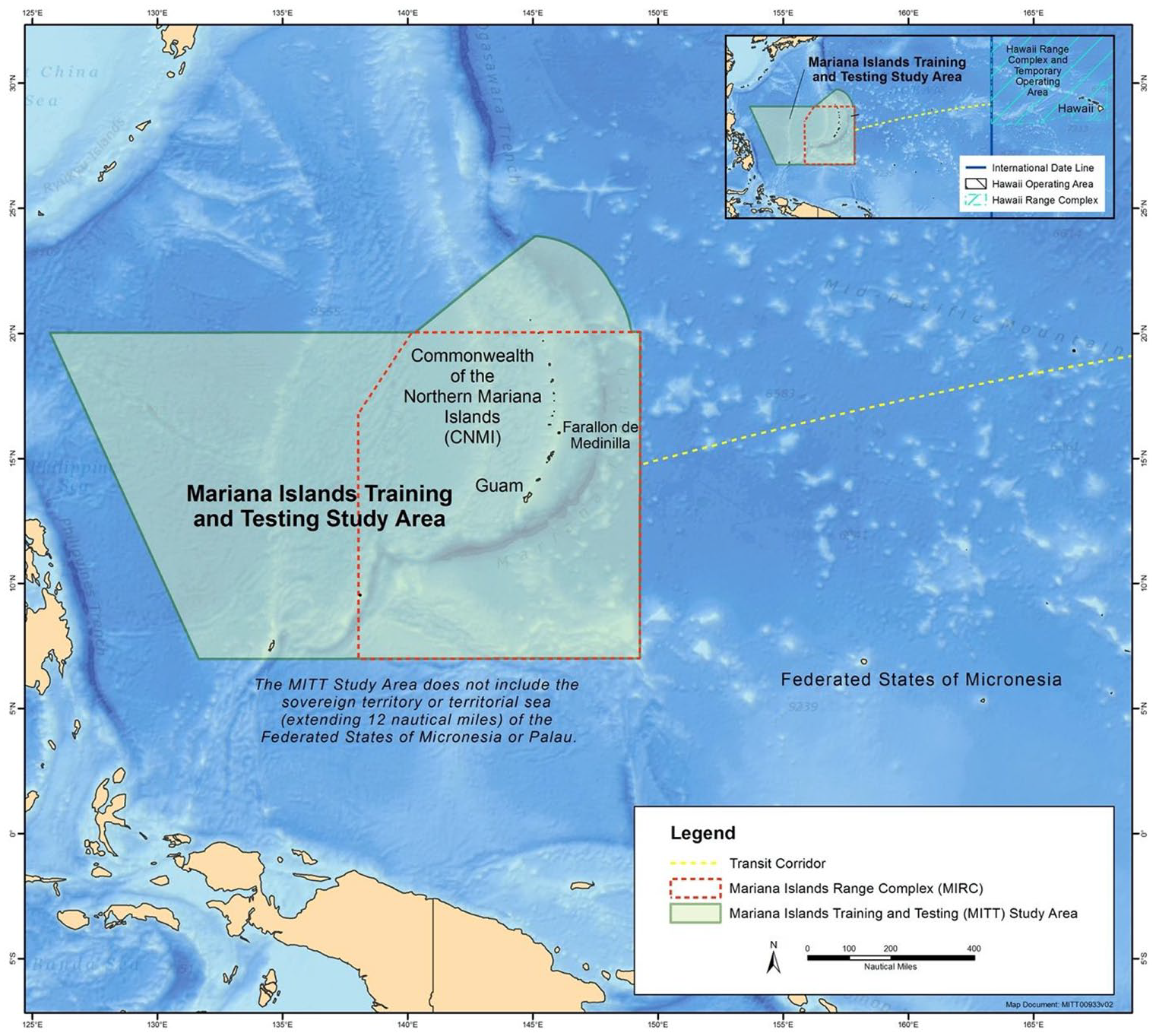
The Mariana Islands Training and Testing (MITT) Study Area. Available at: https://mitt-eis.com/About-the-MITT-Study-Area.
Papahānaumokuākea Marine National Monument, HRC, and RIMPAC
The boundaries of MNMs appear on maps and illustrate the process and performance of making ocean spaces for marine conservation and protected areas. As the examples of MITT and MIRC further illustrate, these spaces are also mapped as central to the DoD’s transformation of global oceans and ocean resources for military training, weapons testing, and war exercises. This phenomenon is reflected by the establishment of island range complexes and defense transit corridors. These seemingly delineated ocean boundaries reflect direct contradictions between US military activities and federal environmental protection measures. They evince the US oceanic security state and its continuously expanding claims to water space for its national security interests. For example, the US ‘defense transit corridors’ span the archipelagos of Hawaiʻi, the Marianas, the Philippines, and Ryukyus, and the continental USA at the Southern California Range Complex (Figure 3). The DoD has also established a ‘defense transit corridor’ between the MITT area and the Hawaii Range Complex (HRC) (Figure 3), creating ‘America’s largest training and weapon testing area in the world’ (Goodyear-Ka‘ōpua, 2018: 92). Areas like the HRC are considered defense assets for the Navy and of strategic importance as large training areas available for missile training, military systems, submarines, special use airspace, and other activities within ocean areas (Hawaii–Southern California Training and Testing, 2018). The HRC is demarcated as an area of 2,000,000 square miles. This huge swatch of space also overlaps the borders of another marine national monument, the Papahānaumokuākea Marine National Monument – once again illustrating that US militarization of ocean spaces is strategically occurring alongside areas of purported marine protection and conservation.
In 2006, US Presidential Proclamation 8031 established the Northwestern Hawaiian Islands Marine National Monument (NWHMNM) and one year later it was given its Hawaiian name the Papahānaumokuākea Marine National Monument (PMNM) (Figure 5). In 2022, the PMNM covers 1,300,000 square miles to the west of Hawaiʻi and is inscribed as a mixed (natural and cultural) United Nations Educational, Scientific and Cultural Organization (UNESCO) World Heritage Site. Although US military planners acknowledge these monument sites as ecological wonderlands, they continue to destroy the environment and ecosystems of these MPAs with impunity (De Santo, 2020). The PMNM is also circumscribed for military use to provide ‘sanctuary to America’s 18 Pearl Harbor-based subs, helping these high-tech “fish” train and make their stealthy way into the deep Pacific’ (Hooper, 2017). Blue-washing upholds prevailing security conceptions to protect military equipment over marine life.
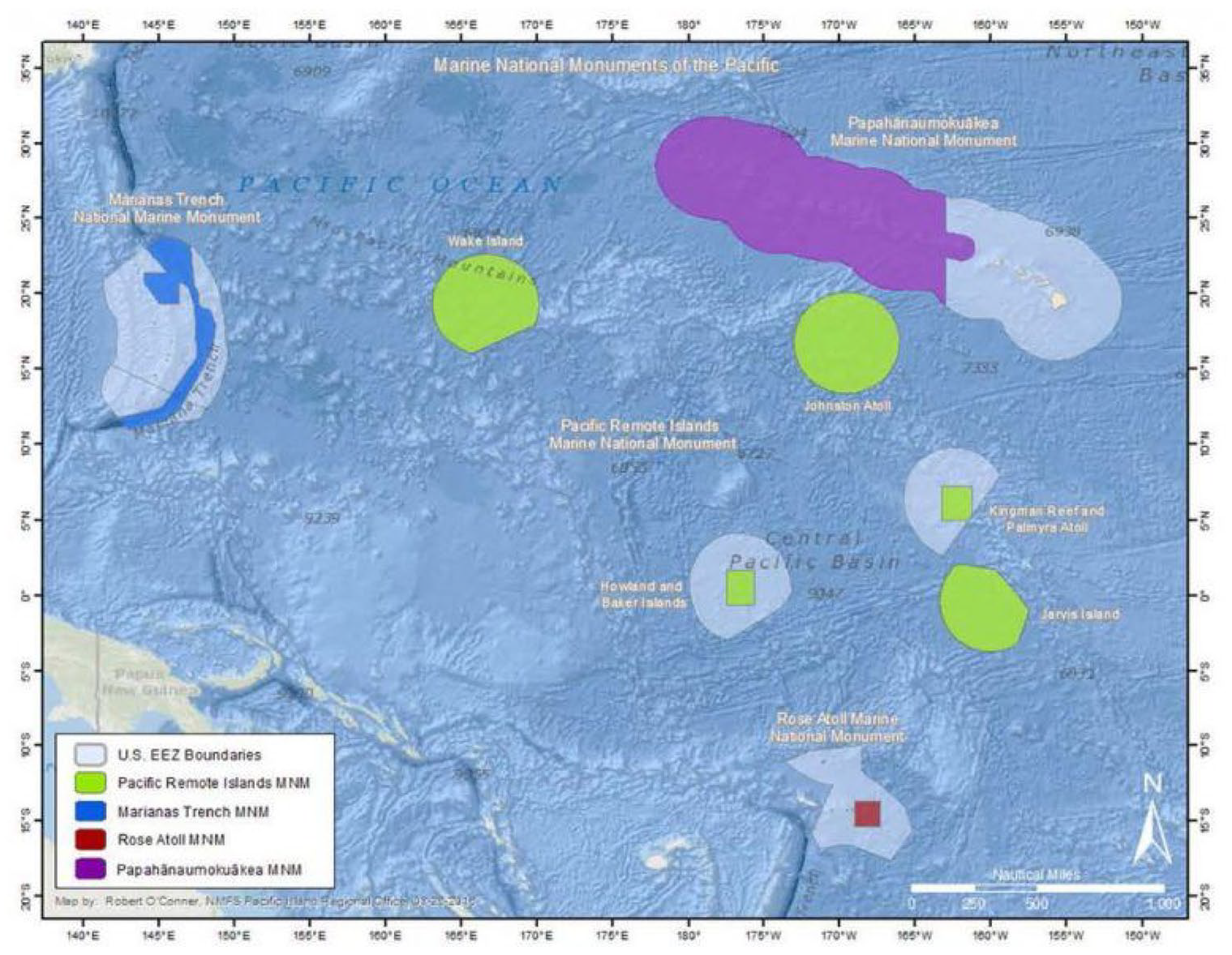
Papahānaumokuākea Marine National Monument. US MNMs now comprise 1.06 million square miles of US EEZ waters in the US Pacific Islands. (Western Pacific Regional Fishery Management Council, 2016).
This double-speak of US federal control is demonstrated further through military exercises – such as the Rim of the Pacific (RIMPAC) (Figure 6) – that occur across protected MNM areas, military training and testing ranges, and ‘defense transit corridors’. RIMPAC demonstrates inherent problems with the DoD defense boundaries. They are supposedly carved out in ocean spaces, though impossible to secure or maintain as discrete static borders. RIMPAC also highlights the deep connections among Hawaiʻi and the Mariana Islands as the two most heavily militarized archipelagos in Oceania. These exercises are carried out as the ‘world’s largest international military maritime training and display’ (Goodyear-Kaʻōpua, 2018: 84), and are emblematic of the oceanic security state. As one of the biggest gatherings of militaries, RIMPAC produces huge amounts of carbon emissions and weapon waste with online petitions outlining the local impacts including ‘irreparable damage to vulnerable sea life, reefs and shorelines, and [increasing] Hawai‘i’s economic dependence on US militarism’ (Compoc et al., 2021; World Can’t Wait – Hawaiʻi, 2018). Despite this opposition, exercises like RIMPAC and Valiant Shield continue unabated.
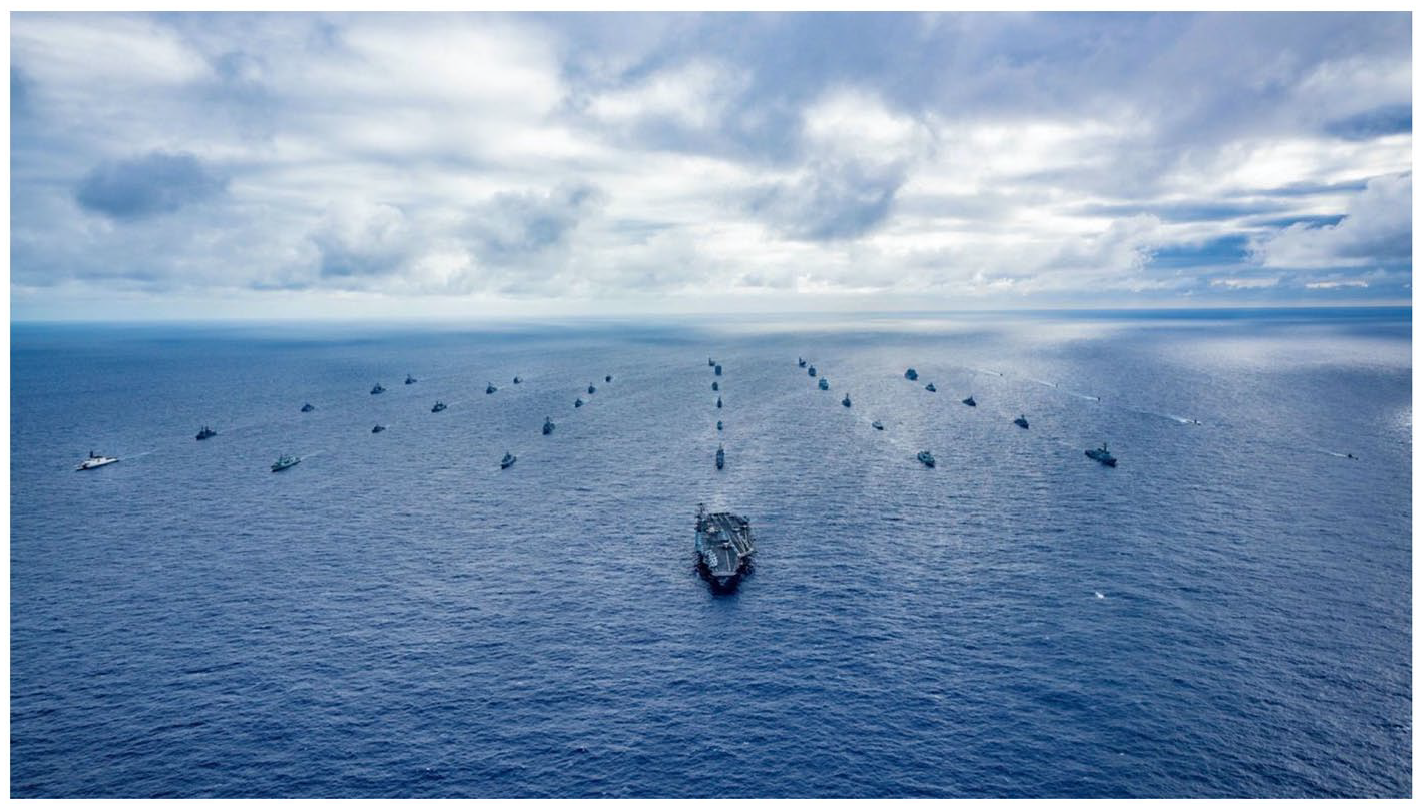
RIMPAC. Image by Arthurgwain L. Marquez https://www.flickr.com/photos/compacflt/29830537278/in/album-72157670619013048/.
Considering this mapping of cases in Oceania where the United States exerts its federal control through EEZs and MNMs illuminates how the confluence of militarization and blue-washing conservation are cornerstones of DoD operations in ocean spaces. The DoD also exerts power over communities by limiting and denying public access to MNM locales, which negatively impacts people’s ability to continue traditional practices and connect with place-based knowledges in these areas (Richmond and Kotowicz, 2015). Militarization and federal oversight do not represent Indigenous people’s interests nor align them equitably in decisionmaking or collective management of these ocean spaces. Our mapping of these various cases considers them in conjunction and as interrelated examples of the oceanic security state. They tell the story of MNMs and MPAs as subjected to colonial power operating under the auspices of global marine protection. These examples raise concerns that instead of environmental stewardship or conservation, the United States perpetuates injustices and destroys human connections to ocean spaces that they construct as MNMs (Acton et al., 2021; Campbell et al., 2021). The dominant security paradigm orients these sites as ‘defense assets’ and legitimizes their use for training and testing as ‘special’ activities exempt from compliance with federal environmental laws and marine conservation policies. These selected cases provide robust examples of the grave consequences of allowing ocean spaces to function as sanctuary for harmful military activities, supplies, and exercises. Sovereignty over these areas remains a serious issue for Indigenous peoples, as are the implications for communities of the closures created by MNMs and MPAs (Campbell et al., 2021; Davis, 2020). In July 2021, the Center for Biological Diversity filed a lawsuit against the US Fish and Wildlife Service for failing to designate critical habitats for plant and animal species, and for giving the US military a free pass in the Marianas. Combined with other grassroots actions, this lawsuit articulates the pressing demands to hold the nation-state accountable for militarization, climate change, and lack of protections on endangered species that are severely impacting oceanic environments. This example shows how Indigenous peoples mobilize various tools of resistance to the US military while continuing their traditional knowledge and voyaging praxis to protect ocean spaces. Still, MNMs and MPAs are laden with inequitable power dynamics through a US federal government management matrix that retains decisionmaking power ‘in consultation’ with the DoD. In the Mariana Islands context, MTMNM governance is dictated by US state authority and direct control through federal agencies (Richmond and Kotowicz, 2015). In contrast, native Hawaiians have been involved in PMNM management, which has been considered to reflect their Indigenous values and cultural practices and connections (Campbell et al., 2021). Yet, when Indigenous peoples are involved in collective management of MPAs, these situations are anomalous (Campbell et al., 2021; Richmond and Kotowicz, 2015). These cases show complex situations that bear opportunities to strengthen connections with ocean spaces and to push for genuine security and sovereignty over air, land, and sea. Indigenous perspectives of Oceania challenge these dominant discourses and the mapping of islands and ocean spaces as too small to be represented or as merely territories or sites for militarization.
Conclusion
Oceanic approaches recognize that imperial and militarized boundaries are imaginary – as ocean currents and winds as well as military weapons and toxins circulate across the globe. Indigenous epistemologies from Oceania provide alternative conceptual frameworks that inform our critique of these notions of protection, security, and border waters themselves. As Indigenous epistemologies theorize and articulate, these externally constructed ‘borders’ are fluid and interconnected pathways – thus, the impacts of military pollution cannot be contained or controlled within a seemingly static area of the ocean. This article centers Indigenous Pacific Oceanic epistemologies to critique structures of US militarism and federal control over oceanic spaces that become US military training and testing areas, weapon range complexes, and transit corridors. We highlight how Indigenous orientations to oceanic spaces – as relational pathways, as enacted through seafaring and voyaging praxis – challenge separated, and bordered concepts found in US militarized arrangements of Oceania. Our mapping of cases also exposes the US federal government and the DoD policies as an oceanic security state that asserts ‘security’ as justification for its contradictory approaches to ocean space – whereby militarization and subsequent blue-washing conservation endangers these locales and the entire planet. While the UN Framework Convention on Climate Change obliges some states to report on their greenhouse gas (GHG) emissions annually, military emissions reporting is voluntary with incomplete data creating the ‘military emissions gap’ (Military Emissions Gap, 2021). This ‘large loophole’ in the Paris Agreement is a result of the US government’s lobbying for militaries to be given an automatic exemption from CO2 targets, which removes military global emissions accountability (Ambrose, 2021). As massive energy consumers, the US military disproportionately contributes to the global climate crisis through its GHG emissions. Perpetuating ‘special’ exemptions for militaries and shielding military spending and emissions from climate summits and national reports lays bare contradictions of the oceanic security state. For Oceania, militarization is an ongoing routine experience reflecting the US nation-state’s dominance and resource extraction at all costs. However, ‘these resource-intensive exercises and the national security discourse that works to legitimize them fly in direct contrast to what Pacific Island leaders themselves deemed as the most pressing security threat . . . fossil fuel-burning induced climate change’ (Goodyear-Ka‘ōpua, 2018: 85). As many Indigenous peoples of Oceania continue to argue, military aggression fuels the dangerous impacts of climate change such as sea level rise; therefore, connecting with Indigenous-led struggle to protect sacred water and challenge the fossil fuel industry is of paramount importance (Compoc et al., 2021; Goodyear- Ka‘ōpua, 2017; Na’puti and Kuper, 2021; Niheu, 2019; Prutehi Litekyan, 2021).
Our analysis indicates that there is much that remains to be done to center Indigenous perspectives and foreground these critiques in security studies, particularly as they apply to the colonial geographic imaginaries of oceanic spaces. The global network of US military bases, particularly those formal and informal infrastructures that exist in aqueous regions of the world, are important sites for deeper inquiry to critique manifestations of the oceanic security state. Navigating imperialist currents necessitates strategies of resistance and resilience that foreground oceanic epistemologies, these ways of knowing that demonstrate possibilities for sailing toward decolonial and demilitarized futures.
Footnotes
Acknowledgements
We are grateful for the Indigenous organizations that we engage with in this article and their ongoing efforts toward genuine security. Si Yu’os Ma’åse’ to the community groups in the Mariana Islands that continue to promote demilitarization, Indigenous environmental justice, and self-determination in the Pacific. We also thank Jesi Lujan Bennett, Kenneth Gofigan Kuper, and the anonymous reviewers for their feedback and guidance as this work developed.
Funding
The author(s) disclosed receipt of the following financial support for the research, authorship, and/or publication of this article: Tiara R Na’puti was assisted by a Mellon/ACLS Scholar and Society Fellowship from the American Council of Learned Societies for this research.