




Abstract
This article reflects on the use of narrative interviews alongside participatory and remote-access visual methods to produce knowledge on and in conflict-affected settings. It details our iterative and reactive experiences of navigating transnational academic, policy and humanitarian networks to attempt to undertake ethical research on the security experiences of displaced people in Somali cities and facilitate their engagement with policymakers. We explore tensions in the combined use of increasingly accessible digital tools (camera-equipped smartphones and open-access satellite imagery) in facilitating a participatory, narrative-based approach to security research while also mitigating access limitations to research sites. We argue that a holistic and reflexive approach to everyday security within a technologically mediated data-collection process – for both researchers and research participants – not only is important for negotiations around ethical fieldwork, but also can be generative of findings about the research site itself. Methods are not brought into a context and deployed by researchers in ways that are fully under their control. In the case explored here, how the researchers and research participants engaged in dialogue about various methods, reflected their connections within networks of knowledge production dominated by humanitarian donors/partners, while also highlighting important aspects of displaced people’s everyday experiences of (in)security and marginalization in Somali cities.
Introduction
The generation of knowledge on ‘fragile states’ can be influenced by – and also reinforce – unequal relationships of power. Data gathered in conflict contexts are shaped by interactions between individuals and institutions working within transnational networks characterized by huge disparities in authority and resources (Stepputat, 2012). In places such as Somalia, scholarly knowledge production is dominated by external researchers, often working for international humanitarian organizations, foreign universities, or security-focused think-tanks producing conflict analyses that speak to (Western) state logics of threat management. Increasingly, the boundaries between the different types of knowledge generated on global ‘danger zones’, along with the standards applied to their processes of data collection, are blurred (Peter and Strazzari, 2017).
We approach this issue as a knowledge–power–security nexus, in which outside direction of research intersects with the potential physical detachment of external researchers from events ‘on the ground’. Although Covid-19 created new hindrances to ‘field’ presence and spurred conversations about digitally mediated remote access, conflict environments have long presented risks that prevent researchers from working in the contexts they study. In different ways, these affect both foreign researchers struggling to obtain approvals from their (external) institutions to conduct fieldwork and ‘local’ researchers who are often contracted to undertake in-country data collection. This latter categorization of researchers is itself reductive and can obscure various local inequalities – around gender, ethnicity, access to resources, education and diaspora/international connections – that affect how research is done and who does it. These different layers of inequality often prevent marginalized groups within conflict-affected societies from meaningfully engaging with the mechanisms through which they are represented to donors, diplomats, military planners and general (global) audiences.
Willingness to shift security research methods to attend to marginalized experiences and everyday practices has opened up explorative ways of generating knowledge of security through multiple narratives (Leander, 2016; Von Boemcken et al., 2020). Here, methods have become reconceptualized as devices for enacting knowledge about the world and its politics (Aradau and Huysmans, 2014). In this regard, Mac Ginty et al. (2021) draw attention to the need for honest disclosure and dialogue about what iterative processes of fieldwork look like in conflict-affected environments. In such contexts, researchers’ narratives of control through fixed research designs can obscure the reactions to disruptions that actually make methods work (Bliesemann de Guevara and Bøås, 2020: 5; see also Aradau et al., 2015). We contribute to these discussions, asking how the security dynamics of a research context and process (for the researchers and participants) affect knowledge generation and the ‘empowering’ potentials of digitally mediated participatory methods.
In research across different Somali cities, which each presented access challenges, we aimed to enhance the participation of marginalized displaced people in a research process, embed the research in their everyday narratives, and use digital technologies to integrate different kinds of visual data into comparative analysis. Our empirical interest in everyday security practices of displaced people in urban camps across these cities led us to develop and deploy research practices to learn about how people were displaced, their experiences of coping with urban insecurities, and structural and physical violence in their urban camps. We experimented with various technologies to expand research inclusiveness. Here, we reflect on how we made these methods and tools ‘work’ across the different urban contexts and in dissemination of research. We link our reflection to a relatively developed methodological literature on the promise and limitations of participant empowerment through photography (Evans-Agnew and Rosemberg, 2016; Hannes and Parylo, 2014; Harley, 2012; Liebenberg, 2018; Shankar, 2016) and critically explore research applications of open-access mapping and satellite imagery (Graham and Hewitt, 2013; Rothe, 2017). We also reflect on participants’ involvement in the process of dissemination and discussion of research results with policymakers.
In conducting the project on which this article is based, the authors were part of a larger team of both Somali and non-Somali researchers, operating across four cities under different political authorities and with varying security conditions. Accordingly, this research process was complex and multifaceted. We – the authors – were at times engaged directly in the cities with research participants and other stakeholders, while also using some of the remote-based methods we critically reflect on here. Our account of the iterative and often messy research process emphasizes how the research remained entangled in multiple distinct but cross-cutting power relations – between ‘local’ and ‘international’ researchers, between those researchers and research participants, between research participants themselves, and between those displaced people and the international or local policymakers in the direct engagements that we facilitated. Being reflexive about our connections with the humanitarian industry (and state-linked donors) requires us to consider how dynamics in that sector affect our processes of data collection/dissemination, along with the extent to which technologies and techniques of knowledge production blur across academic and policy boundaries. In our research, the lives of our research participants (displaced people) are directly and indirectly impacted by the work of the same institutions that also fund, facilitate and/or receive the knowledge we produce. Therefore, clearly separating an interrogation of the scientific utility of methods themselves from interpretation of the data they generate is untenable, in that both are conditioned by the securitized context of the research environment.
We argue that a holistic and reflexive approach to security within a data-collection process matters for assessing the ethics of research but can also be generative of findings about the research context itself. We develop this argument in three steps. First, we situate our narrative and visual methods within critical security studies’ concerns with everyday (in)securities and marginalized voices, alongside postcolonial calls for reflexivity on power relations in processes of knowledge production (Baaz and Verweijen, 2018; Hönke and Müller, 2012). Next, we provide background to issues of conflict and displacement in the Somali context, reflecting on how security dynamics affected how our research was undertaken by a diverse group of researchers and participants. Third, we outline three types of data collection, which we came to analyse as research ‘sites’ in their own right. The first comprises our engagement with research participants’ experiences in individual interviews followed by group interviews using photovoice methods. The second site consists of our use of open-access satellite imagery as a visual technology of remote access to the urban environments of the research participants. The third site concerns exhibitions where we observed how stakeholders and policymakers in the cities engaged with different types of images and narratives shared by participants.
Seeing security: Narrative, participatory and (digital) visual methods
In critical security research, several contributions have discussed strategies of knowing security through analysis of discourses, practices and narratives (Hansen, 2006; Pouliot, 2010; Villumsen, 2008; Wibben, 2011). These discussions reflect on the opening of security studies to people, places and things (Enloe, 1989; Wibben, 2008), re-engaging and subverting standard research sites, questions and formats of data collection (Leander, 2016: 470). Methods are thereby reconceptualized as devices for enacting knowledge about the world, its politics and power (Aradau and Huysmans, 2014). Researchers’ engagement and openness to new ways of seeing social reality is valued in such an approach to methods (Leander, 2016: 466). The quality of knowledge production does not pivot solely on criteria for ‘rigorous’ methods and systematic implementation of fixed research designs. It lies also in reflection on disruptions that affect the production of knowledge (see Salter, 2013a) and is related to the complexities of the terrain upon which methods are practised. With this outlook on security research, attention is directed to the practical sense (habitus) of doing research and the processes through which methods are enacted (Aradau and Huysmans, 2019: 53; Aradau et al., 2015).
The wider reconceptualization of methods pointed to above also requires explicit consideration of power relations and empirical illustrations of researchers’ engagement with ethical dilemmas as part of the research process. Rather than assuming that the subjective interests of researchers can be controlled through fixed procedures, dialogue is necessary around the research process and how data are gathered in practice. The power relations at play in the knowledge–security nexus are particularly contentious in research that attempts to make local security dynamics visible. Such research is typically based on ethnographic methods, participant observation and interviews, and draws on analyses of narratives (e.g. Salter, 2013b; Stern, 2005). Approaching people’s narratives of security is a strategy for engaging empirically with diverse experiences and underlies the development of ‘vernacular security studies’ (Jarvis, 2019: 110; Jarvis and Lister, 2012). This perspective also builds upon feminist and postcolonial approaches that foreground ‘bottom up’ paradigms. Such research strategies require interrogation of entanglements of ‘local’ and ‘external’ actors, practices, and underlying relations of power (Hönke and Müller, 2012: 384). Postcolonial critiques of security research in particular call for identifying and addressing power imbalances in academic knowledge production and inequalities between researchers based in the Global North and Global South (Baaz and Verweijen, 2018). The account that we provide here attempts to interrogate such multi-scalar inequalities within the multiple steps and tools of a particular – and often messy – research process.
The research we conducted in Somali cities focused on foregrounding people’s own understandings of security – risks that they identified, however narrowly or broadly defined, and how these impacted their daily lives (Crawford and Hutchinson, 2016). Insights from critical and feminist security studies assert that security cannot be reduced to military threats nor to the reduction of people’s fear of harms (negative security). Instead, security involves economic, social, political or cultural threats and includes practices that aim at ending, resisting, mitigating or adapting to risks (positive security) (Chin, 1998; Gjørv, 2012; Hansen, 2000; Hoogensen and Stuvøy, 2006; Jabri, 2013; Moser and McIlwaine, 2006; Stern, 2006). We studied such practices in narrative interviews with research participants who had experienced displacement. For marginalized experiences to form the basis of contextually sensitive security knowledge (Darby, 2006: 467), research methodologies must be attuned to people-centred perspectives that identify agencies amid insecurities (Ewan, 2007; Krause and Jütersonke, 2005; Vaughan-Williams and Stevens, 2016). We focused on activities that create a daily rhythm – that is, how people go about making a living by moving around and interacting with people and places.
This research strategy had to contend with challenges of distance. As Bliesemann de Guevara and Bøås (2020: 4) explain, increases in connectivity have changed fieldwork, since it is now possible for researchers to stay in touch almost continuously with the contexts in which they do research. In conflict-affected areas, connectivity can enable ongoing contact with local researchers, while not necessarily reducing the security risks they face. Connectivity also provides opportunities for incorporating new methods. Access to smartphones, network data, satellite imagery and practices of neo-geography, such as crowd-mapping, can allow researchers to remotely engage with ways of ‘seeing’ research contexts while remaining spatially distanced.
This brings us to (digital) visual methods. Discussions of the use of visual methods in security studies have interrogated the promise and limitations of photographic visibility to facilitate critical engagement with dominant (state) narratives. Andersen and Möller (2013: 203) focus on photographers who are neither photojournalists nor ‘artistic’ photographers, and whose images of militarized environments ‘function outside the discursive representational regime within which photojournalism . . . operates’. They argue that the conventions of the genre of (conflict) photography render meaning-making dependent on processes of ‘visual socialization’ and expectations of viewers (Andersen and Möller, 2013: 207; see also Mitchell, 2011; O’Loughlin, 2011). This, they conclude, contributes to the wider tendency in security theory to attend to the ‘extraordinary’ and neglect the ‘everyday’. As people displaced to Somali cities by conflict, economic hardship and/or ecological shock, the participants in our research would be more likely to be represented in pictures taken by photojournalists or humanitarian organizations. Such imagery tends to emphasize passivity, vulnerability and victim status, while often reinforcing ‘white saviour’ tropes of aid work (Ademolu and Warrington, 2019). We used photovoice – a participatory research method that emerged in the social sciences in the late 1990s (Wang and Burris, 1997) – and asked research participants to themselves take photographs to portray everyday routines in the urban camps and beyond. Photovoice was developed to alter traditional researcher–informant relationships, to empower participants within the research process and to engage people from marginalized communities (Denov et al., 2012; Green and Kloos, 2009; Johnsen et al., 2008; Wang and Burris, 1997). Following Wang and Burris (1997: 370), our objectives were to enable people and communities to articulate their strengths and concerns; to promote critical dialogue in group discussions of the pictures; and to ‘reach’ policymakers. However, the choice of method was also influenced by the fact that ethnographic ‘access’ to the research site – internally displaced people’s settlements in Somali cities – was highly limited for the researchers. Along with accompanying testimonies, participant-generated photography made these sites visible to us, but also to wider audiences through exhibitions as a platform for the (partial) self-representation of displaced people and a tool for advocacy aimed at policymakers.
These photographers produced visual representations of their everyday lives that were taken in the marginalized urban settings where they lived and worked. If these participants and their cameras operated as ‘eyes on the ground’ in this specific research process, then we came to consider their pictures in conjunction with other images generated by a different set of technologies that could be described as ‘eyes in the sky’. In urban settings where researchers may be unable to spend significant amounts of time, open-access satellite images can offer a novel perspective of the spatial development of cities over time. This form of visual data was incorporated into our research in three ways: first, for our understanding of the changing morphology of displaced people’s urban settlements; second, as a way to engage with the photovoice research participants who were living in those places; and, third, as a supplementary means of contextualizing the images taken from the ground in public dissemination of the research findings.
In theory, powerful applications like Google Earth are available to anyone with an internet-connected device and present new possibilities for democratization of research and citizens’ (co-)production of knowledge (Tulloch, 2007). At the same time, their roots in military techno-science (Graham and Hewitt, 2013) point to a detached engagement with securitized populations that is highly problematic, not least in Somalia – a live theatre of the ‘global war on terror’. Satellite imagery has become an important technology for external actors undertaking remote-control intervention and governance from a distance. Humanitarian workers increasingly rely on such technologies to observe movements and transformations in locations, and they are useful for working in difficult-to-access contexts. Remote imaging epitomizes Duffield’s (2013) conception of ‘cyber-humanitarianism’, where such technologies facilitate the increased bunkering of humanitarian action in ‘fortified aid compounds’ and the reduction of (‘international’) staff’s exposure to risk. For Duffield (2013: 15), ‘when geospatial technologies are successful in overcoming remoteness, they simultaneously reinforce the techno-discursive distance between the observer and observed’.
Other scholarship on crowd-sourced geolocation for humanitarian or human rights intervention illustrates how such ‘scopic engagement’ is imbued with a ‘knowledge of targeting’, which can reinforce particular forms of biopolitical ordering and representations of populations (Grove, 2015: 346; see also Parks, 2009). Rothe (2017) problematizes ‘seeing like a satellite’ in the context of environmental security, arguing that a ‘planetary gaze’ influences our epistemological horizons and leads to the disassembling of things out of local contexts. Through visual assemblages, forests, for example, become ‘storm defence infrastructures’, a conception that the users of satellite imagery imagine the people on the ground are too close to be able to see themselves (Rothe, 2017: 342–343). Rothe is sceptical that such technologies can empower communities (in rural African contexts, for example) by providing them with information to inform their adaptation or ‘resilience’. He highlights US-based lobbies for the civil application of satellite remote sensing and particular combinations of satellite imagery with pictures taken by external professional photographers working on the ground in the communities that these interventions are intended to help.
While our project did not involve the crowd-sourcing of mobile data (Grove, 2015), our use of satellite imagery should be understood in terms of its combination with participatory on-the-ground photovoice. Giving displaced people in urban camps cameras for photographic self-/community representation – and combining this with discussions of satellite imagery with participants and policymakers – was intended to disrupt commonplace security framings of these populations. However, we recognize that the possibilities here for genuine participant ‘empowerment’ are ambiguous, being shaped by a wider research and dissemination process that unfolds in a particular securitized context. Accordingly, we now explore dynamics of conflict and displacement across the four cities we worked in and highlight how these contexts shaped a research design and practice focused on marginalized people’s ‘everyday’ security.
Insecurity, displacement and (our) research in Somali cities
Since the collapse of central government in 1991, security in Somalia has been provided through locally specific forms of governance (Bakonyi, 2013; Menkhaus, 1997; Shire, 2022) and has been shaped by prolonged power struggles and periodic phases of violence that various international interventions have aimed to reduce. People flee to cities to escape combinations of violent conflict, war-exacerbated environmental degradation, drought or the authoritarian rule of Al-Shabaab. They also hope to gain access to services or the protection of international organizations, African Union forces or nascent Somali state institutions. Around the time of our research, 2,648,000 people were estimated to be internally displaced in Somalia (UNHCR, 2018). Many move into cities, where they live with relatives, erect makeshift shelters in unoccupied urban spaces or join peripheral camps. This in-migration increases population density and expands cities. Displaced people often live without access to basic services, including clean water, sanitation or waste management. People seek safety in cities but remain at risk from crime, sexual and gender-based violence, evictions, and other forms of physical and psychological harm (Bakonyi et al., 2019).
Examining urbanization processes from the viewpoint of in-migrants, our research investigated security perceptions and practices of people who had been displaced to Baidoa, Bosaso, Hargeisa and Mogadishu. Mogadishu is the capital of the Federal Republic of Somalia and home to its internationally recognized government. Baidoa and Bosaso are, respectively, capitals of the Southwest and Puntland federal member-states. Hargeisa is the capital of the de facto independent (but internationally unrecognized) Republic of Somaliland, which broke away from Somalia in 1991. All four cities have grown substantially in the 2000s, partly through mass in-migration caused by displacement. Each, however, has a distinctive history of violence, displacement and (re)settlement. Their economic profiles vary, and they are shaped by different forms of authority. These differences informed our research and became a salient point of discussion and controversy in the dissemination of our research data.
The differences in the security contexts of each city meant that risks varied for both Somali and non-Somali researchers. Much of the initial interview-based data collection was done by resident (Somali) researchers, each with specific links in the cities. The overall organization of data collection was designed by a European-based research team and involved a Somali research coordinator in the region (one of the authors) and additional Somali researchers in the cities. Preparatory sessions were held in neighbouring Kenya owing to security and travel concerns for the whole team. In these, the ‘local’ and ‘foreign’ researchers worked on fieldwork plans, including the identification of the phases where the international team would join the city-based partners for data collection. In general, risks relate to terrorist attacks, targeted assassinations of individuals associated with the government or international organizations, and kidnapping. The Somali researchers faced security threats, especially in Mogadishu and Baidoa, and had particular concerns around publicity for the project. The Baidoa-based researcher declined to be the master of ceremonies during the exhibition of research participants’ photographs and testimonies lest he appear on local television and become a target for Al-Shabaab. Many interviewees (displaced people and state/NGO informants) were equally concerned about their safety. Although they gave consent to be recorded, they frequently sought assurance from researchers that the audio would not be broadcast and often self-anonymized their identities. Similarly, local staff from international organizations were often unwilling to talk to the media about their perspectives on the exhibitions of research findings.
On top of the restrictions on movement mandated by the institutional risk assessments of the European universities involved, we were also, at times, subject to security protocols of UN agencies, including the one that the project collaborated with as a partner. This agency facilitated some of the activities in Somalia, and our relationship partially resembled what Peter and Strazzari (2017) describe as ‘embedded research’, where limited access can make collaboration with humanitarian agencies necessary. However, we entered into this partnership with the intention of maximizing opportunities for research ‘impact’ – for instance, through enabling dialogue between research participants and policymakers/humanitarian actors. Security concerns limited movements and time in research sites. It was impossible for the European researchers to visit camps in Mogadishu, and they were only able to conduct short visits with an armed escort to camps in Baidoa and Bosaso. In those cities, the photovoice sessions were conducted jointly (outside of the camps) by the authors and local researchers. Hargeisa is the most ‘secure’ of the four cities, and there the foreign team was also able to speak to people and move around freely.
Such security conditions often exacerbate power imbalances familiar elsewhere in Africa between local and external research institutions. The physical detachment of ‘experts’ has been one aspect of critiques levelled at the field of Somali studies by those questioning the ‘Whiteness’ and (neo)coloniality of scholarship on the region (Aidid, 2015). Berns-McGown (2016: 86) argues that influential scholars such as I. M. Lewis (the so-called father of Somali studies whose career spanned the colonial era to the 2000s) and his ‘essentializing pronouncements’ on the supposedly endemic violence of Somali tribalism still inform Western foreign policy in the Horn of Africa and the racialized policing of diaspora populations. While external – and allegedly ‘primordialist’ – representations of conflict in Somalia have been vigorously debated since the 1990s (Ahmed, 1995; Besteman, 1998; Lewis, 1998), scholars such as Al-Bulushi (2014) and Besteman (2017) point to a wider nexus of academic, policy and security studies research that has developed over recent decades, framed around the management or containment of risks – terrorism, undocumented migration, piracy – that the world’s most prolonged state ‘failure’ presents to powerful global interests. Elsewhere, we critique some of the interventions that stem from this nexus, insomuch as they govern the lives and futures of displaced people (Bakonyi et al., 2019). Nonetheless, our own research is implicated in these same institutional frameworks through links with funders, partners and other ‘stakeholders’. We had to navigate the tensions of working within this nexus to attempt to contribute to more nuanced understandings of displacement and urbanization to inform humanitarian engagement that will be beneficial to the people with whom we conducted the research. We also aimed to provide opportunities through the research process itself for the creation of avenues where these people could engage directly with policymakers. For the reader who may wish to judge the extent to which we have been successful, a reflection on our positionality is vital (Berns-McGown, 2016), as is the kind of detailed analysis of the research process itself that is provided here.
During fieldwork planning sessions in Kenya, much of the discussion among the team was centred on making the vocabulary of everyday security – encompassing physical and non-physical dimensions – relevant to the Somali-language context. Security protocols for the research team were clarified, instructing local researchers to prioritize their security at all times when conducting the research. The research experiences of the European and locally based researchers were different, with the former having backgrounds in qualitative social science methodologies and the latter in humanitarian/NGO data collection. Although the planning process was collaborative, the overall approach was often guided by the European-based team’s qualitative research training – for instance, in emphasizing the importance of attentiveness to the flow of informants’ stories as opposed to the identification of specific quantitative data points. In the first phase (December 2017–January 2018), 121 interviews were conducted across the four cities, mostly with displaced people. 1 Interviewees were invited to narrate their lives in their places of origin, their reasons for migration, routes taken, their selection of urban settlement and their current living conditions. Interviews were also conducted with local authorities, members of ‘host’ communities, and representatives of national and international organizations on the challenges of urban in-migration and the main factors that contribute to (in)security.
It was during the second stage of data collection – photovoice – that the European-based researchers joined the city-based researchers. The value of photovoice in cultural contexts that emphasize non-written forms of communications (Castleden et al., 2008; Maclean and Woodward, 2013) indicated its appropriateness for research in the Somali context, renowned for its rich oral culture. The method was initiated in sessions with ten participants in each city through explanations of objectives, basic photographic tips and equipment tests. Participants from Hargeisa were given compact digital cameras, whereas participants in the other cities were given smartphones. This choice related to security concerns and a desire to give participants a device with greater utility after the project finished. Unlike many other photovoice studies, we did not take back the equipment after data collection. Such an arrangement resembled an exchange of sorts: data (pictures and testimonies) for hardware. Many of the participants already had phones with basic features, but not smartphones. For participation in interviews and photovoice sessions, the participants’ expenses were paid and they were compensated for their time (USD 10 per session). Given local exchange rates/wages, this was deemed a fair incentive for participation. Questions about financial incentives are rarely discussed in the methodological literature on photovoice but are important for us to consider in the sense that they relate to our participants’ agency in choosing whether and how to participate. As became clear, this itself was affected by their own economic (in)security and related work/family commitments. The participants invariably lived hand-to-mouth through manual labour, and we needed to compensate them for their time.
Practical adjustments in response to difficulties in tracing people resulted in fewer photographers in Mogadishu and Baidoa who had participated in the first-round interviews. The selection of participants aimed at diversity and representation with respect to age, gender, lengths of settlement in the cities, camp location and clan affiliation, and was coordinated by the local interviewers. Our recruitment attempted to reach a diverse range of people across multiple camps, but in practice it was also influenced by the unavoidable interaction between the city-based researchers and the camp leaders who facilitated contact. Elsewhere, we examine the power that such gatekeepers hold and the ambiguous patron/client relationships they cultivate with camp dwellers (Bakonyi et al., 2019). While they played a role in identifying research participants, some of these leaders – who are often displaced people themselves – were also interviewed as part of the study.
As researchers, we struggled to overcome the structural and institutional factors that reinforced power imbalances between the multiple actors involved in the research process, namely, the external and city-based researchers and the different research participants living in and exercising authority within the urban camps. Our iterative and reactive experience of navigating through these relationships to attempt to undertake ethical research (Cronin-Furman and Lake, 2018) and deliver ‘impact’ highlighted both possibilities and limitations of participatory methods for the self-representation of the most marginalized in these contexts. We develop our analysis of these dynamics by focusing next on how participants engaged with our research, the data they generated and the role played by their pictures in the production of knowledge about everyday security.
Eyes on the ground: Everyday narratives and participant-generated visual data
Displaced people’s narratives of everyday experiences of urbanization and (in)security constituted the data on which our subsequent research has been based. Following individual biographical interviews, the use of photovoice was intended to further elicit narratives in different settings and to expand our contextual understanding of the spaces and relations of displacement-driven urbanization through the exchange of views on the photos in groups of participants and researchers. Like interviews or observations, photographs are not simply representations of a given reality. They are filtered through the ‘discursive and aesthetic assumptions of the camera holder’ (Hutcheon, 1993: 248). The photograph stimulates meaning-making processes that inform a dialogue that generates data and defines the knowledge aggregated by the researchers (see Andersen et al., 2015; Burawoy, 2009).
The photographs taken by research participants structured our group discussions and directed our attention towards important aspects of everyday security. As the participants shared their photographs, these prompted specific stories and reflections about individuals, their relationships to the photographers, and material aspects of their lives. Asha’s picture and testimony (Figure 1) show the types of reflection they elicited, in this case around domestic violence. Although the prevalence of such violence had been raised across the research sites in the earlier narrative interviews, the photograph here enabled a discussion that drew direct attention to how everyday experiences of economic precarity – lack of and disputes over food – were related to spousal violence, gendered forms of domestic labour, community mediation and (ambiguous) resolutions.
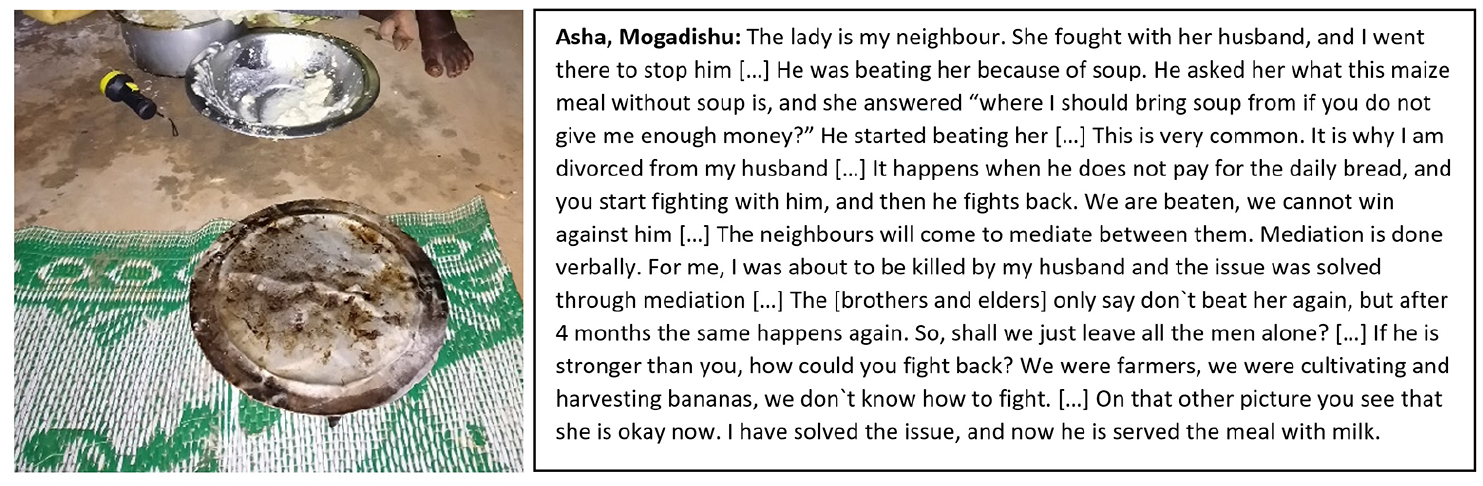
Mogadishu research participant’s photograph (edited), with accompanying interview testimony. Used in exhibition of findings in the research cities.
The photograph and testimony speak to extremely sensitive issues, and the subject of the image is covering her face. Although photovoice methods are designed to facilitate the self-representation of research participants, the images they took often (inevitably) focused on other people, albeit individuals who also lived in the camps in circumstances very similar to those of the photographers. While taking photos of neighbours allowed participants to frame their reflections on everyday experiences in relation to others (without having to speak directly about themselves), this raised questions about informed consent and the use of this material to engage wider audiences. We return to Asha’s photograph below in the context of the public exhibitions/debates we held and underscore how dialogue on the meaning of images can continue to unfold and influence data and their interpretation.
Documentary photography or photos of people (e.g. for billboard advertising) are not a major feature of visual culture in the Somali context. This relates, in part, to the influence of conservative interpretations of Islam on ideas of appropriate public cultural expression. Photo studios were once prominent features of high streets but have largely disappeared in many urban centres. At the same time, the increased prevalence of camera phones and social media has precipitated wider digital shifts in photography’s function, from the memorialization of events to modes of conversational communication (Carrier, 2019). These trends raise questions about how participants might engage with photovoice as a technique in societies where smartphone photography is playing a new role in communicative practices. During the briefing sessions with participants, it became clear that some younger participants had experience with smartphones. In a way that we had not anticipated, these younger people sometimes took photos on behalf of the older participants. In the initial interviews, the importance of mobile connectivity had been emphasized in relation to everyday experiences of (in)security. The ability to contact relatives shapes patterns of migration to (and within) cities, and, with SMS mobile money, phones are vital for buying/selling and accessing assistance from social networks (Chonka and Bakonyi, 2021). Following the project, some participants kept their new smartphones. A female participant in Baidoa remained in touch with one of the authors and explained how she uses the phone to video-call her relatives in Dadaab refugee camp in Kenya.
Phones also engender their own types of insecurity – for instance, as targets for robbers. As a routine activity, using a phone to take photos could be more discreet than using a camera and thus draw minimal attention. However, we were also concerned about whether their blending in could encourage participants to covertly take pictures without asking for informed consent from subjects and thus put themselves at risk. To varying degrees in each city, (in)securities impacted on displaced people’s lives, experiences of risks and conduct. In Mogadishu, participants spoke (and showed pictures) of people who had been injured by stray bullets from street clashes between state forces, local militias, foreign troops and Al-Shabaab. Despite being expelled from Mogadishu in 2011, Al-Shabaab maintains a clandestine presence (Mubarak, 2020). The group maintains a paranoid stance towards potential espionage as foreign and local security forces attempt to degrade the organization. According to Al-Shabaab propaganda, the capture/assassination of leaders has been the result of embedded spies’ use of mobile phones for geolocation and the targeting of drone strikes. In areas that it directly controls (not our research sites), the organization banned the use of camera/internet-equipped phones. In places where Al-Shabaab operates (and where displaced people also live), individuals taking pictures with phones could attract unwanted and potentially harmful attention. Government security forces are also averse to photo-taking, as they may consider this a security threat.
During the photovoice training sessions, we discussed with participants various themes that we were interested in but emphasized that they were under no obligation to take any particular types of photographs. Explaining that a selection of their pictures could be exhibited in public, we asked participants to consider images that they would want to show to relevant policymakers. This was a somewhat mixed message: participants were asked to take photographs of their own choosing, but they also knew that the photographs could – if they wanted – be used in exhibitions directed at policymakers who could have an impact on their lives. As researchers, some participants also associated us with these humanitarian and governmental power-holders – understandable in a context where more field research is conducted by aid organizations or UN agencies than by academic researchers. It became clear in some instances that our perceived identity as humanitarian actors influenced the choice of pictures taken by participants. For instance, some participants took pictures of individuals with specific vulnerabilities (illness or injury) and described these images to us in ways that suggested expectations that these people would be directly assisted by us or the policymakers we were engaging with.
However, this was not the case for the majority of participant photographers, whose choices of image were influenced by a wider range of factors. Nonetheless, their considerations also related to their status as marginalized urban populations and their understandings and experiences of everyday security. In Mogadishu and Baidoa, it became clear from the photos that the participants had generally only taken pictures inside their camps. Some asked others (‘locals’) to take photos outside for them (they were not instructed to do this) and articulated their general perceptions of insecurity on city streets (see Figures 2 and 3). These testimonies and (non-)photos spoke evocatively about many participants’ feelings of marginalization and fear.
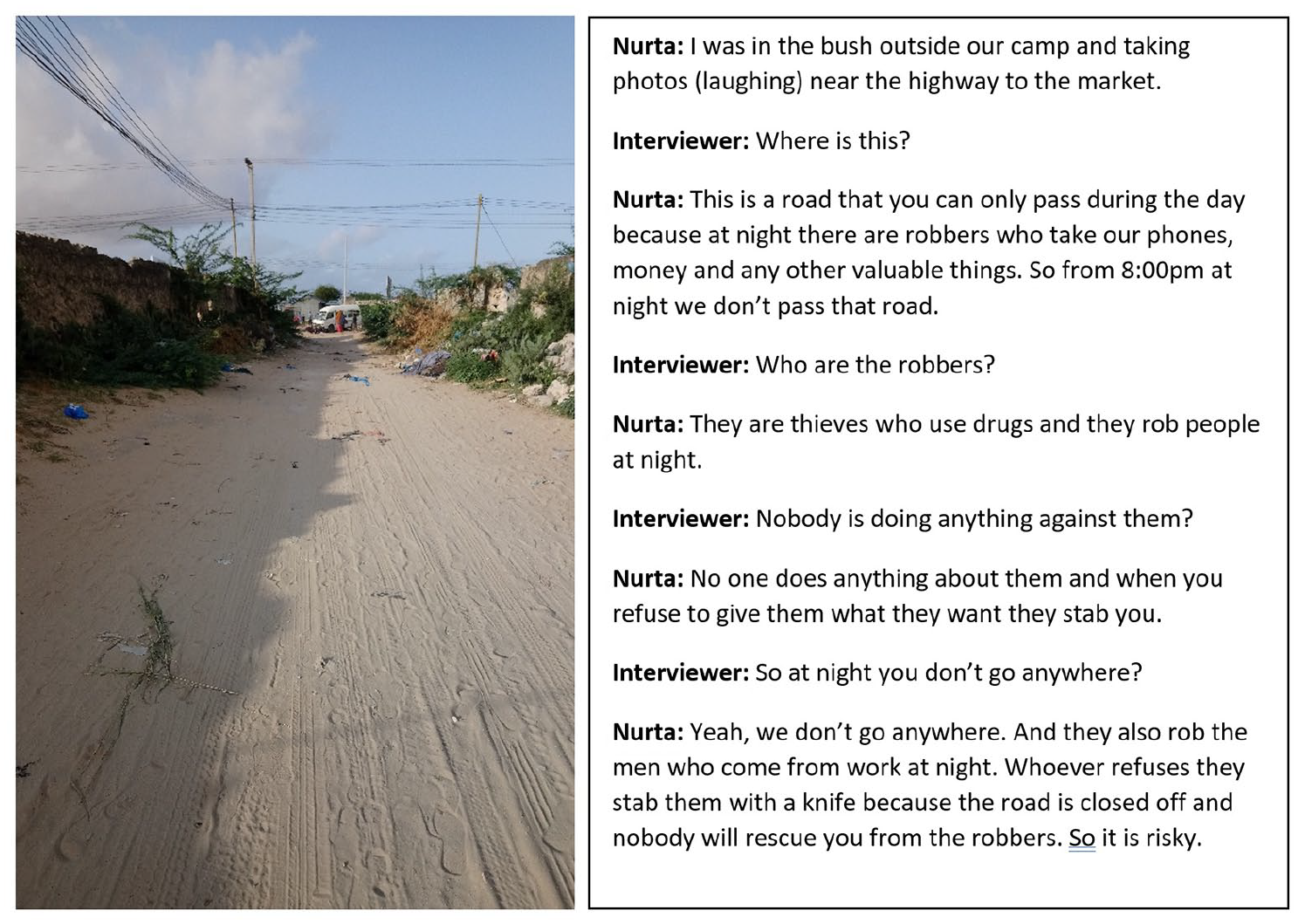
Mogadishu research participant’s photograph, with accompanying interview testimony. Used in exhibition of findings in the research cities.
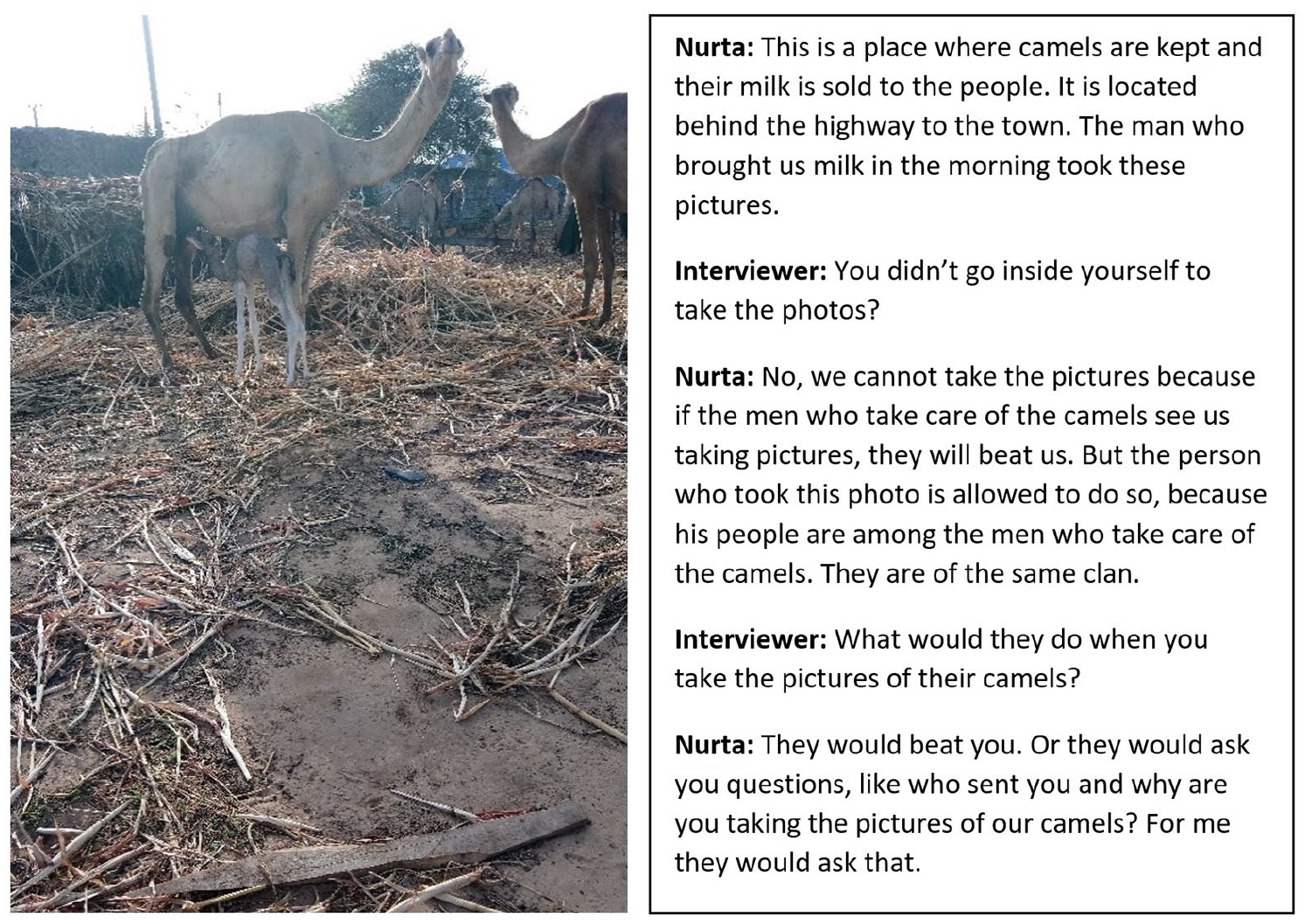
Mogadishu research participant’s photograph, with accompanying interview testimony. Used in exhibition of findings in the research cities.
Photovoice undertaken elsewhere has demonstrated how ethics training and individual or culturally conditioned norms may influence the photos taken (Hannes and Parylo, 2014). For example, shyness and an aversion to approaching strangers can lead to ‘avoidance behaviours’ among participants, a reluctance to use consent forms and a subsequent emphasis on producing photos without human subjects. The impact on the data is clear, but our examples show that we should also consider how participants’ approach to photovoice is itself indicative of their orientation or status within a particular context. In our research, we reflect on the everyday security of the participants through the pictures and testimonies and through the ways in which they described (or we discovered) how they had taken the pictures. In the following section, we continue this reflection on learning through visual methods as we consider our iterative incorporation of open-access satellite imagery as a different tool for making visible a research site for various audiences.
Eyes in the sky: Visual methods from above
In our research, we used certain digital tools, such as Google Maps/Earth and OpenStreetMap, that are broadly associated with ‘neo-geography’: the proliferation in ‘non-expert’ use of geographic information systems (Goodchild, 2007). In terms of technical training, we would consider ourselves to be such non-expert users, and we note that the accessibility of such tools has allowed for their use in a wider disciplinary range of studies. Accordingly, ‘open source’ investigation and ‘geolocation’ (processes that match other data with maps and satellite images) are increasingly applied in research on conflicts and urbanization (Pech et al., 2018). On one hand, technologies reflect and reinforce particular ideologies and power relationships entwined in the contexts of their development (Feenberg, 2010). On the other, the increased ubiquity and accessibility of networked digital tools – including for marginalized populations – could have the potential to redress existing power imbalances in processes of research (Marres, 2012). Although our use of these spatial tools was not particularly participatory (in that the displaced people we were working with did not undertake mapping/spatial imaging themselves), we sought to incorporate satellite imagery within the wider participatory framework of photovoice.
In practical terms, we used satellite imagery and mapping tools to ‘geolocate’ interviewees’ experiences and photographs and to track camp urbanization. Publicly available satellite imagery enabled a longitudinal view of urbanization patterns and new settlements over a period of 10–15 years. Given limitations on access, they allowed the research team to develop an understanding of the geographies of camps and their relationships with wider urban environments. We used satellite photographs (such as Figure 4) in some of the photovoice briefing sessions, presenting the participants with images (which they were unlikely to have previously seen) showing the expansion or densification of the settlements that they lived in and knew intimately. These images informed some of the themes we asked participants to explore in photovoice. This approach enabled participants to speak to the top-down satellite images we had shown them with on-the-ground representations of their experiences and perspectives of security in spatial processes of camp urbanization.
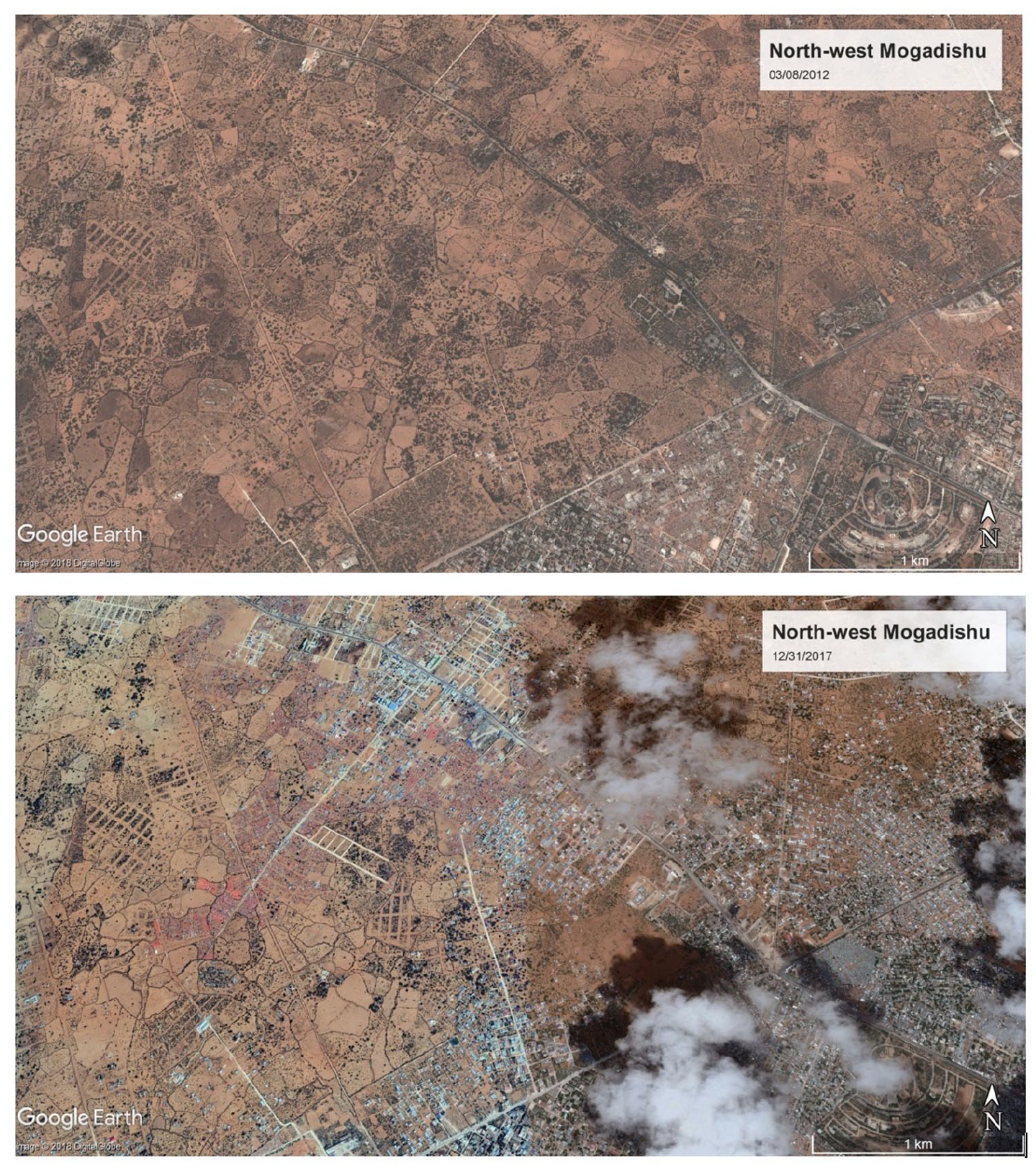
Google Earth satellite images showing expansion of northwestern outskirts of Mogadishu between 2012 and 2017. Displaced people’s settlements play an important role in this urbanization. Images used alongside participant photography in research exhibitions.
We also included satellite images in the eventual photo exhibitions and found that time-comparison images of cities and camps were of great interest to the local authorities that attended them. The mayor of Bosaso specifically requested that we send him copies of the images that illustrated rapid growth and displaced peoples’ resettlement. There was a sense in these interactions that local policymakers’ interest in the satellite images stemmed not only from their relative novelty, but also from the policymakers’ interpretations of these views as being somehow more ‘objective’ in terms of making visible broader processes of urban change.
Satellite images are, of course, no more ‘objective’ than the participants’ photography and were never presented by us as such. Critical reflection is again required on the representative potential of top-down imagery, the power relations that underpin mapping practices and the impact of these tools on the types of knowledge generated. Satellite imaging platforms have military origins and were later commercialized and released for public use. Shaped by security, geopolitical and commercial interests (Graham and Hewitt, 2013), the coverage of these technologies and the forms of visibility they generate varies considerably. A comparison between Google Earth satellite imagery and Google Maps data on Bosaso revealed a telling difference. While the satellite imagery (which we used in our exhibitions) shows displaced people’s settlements, these were invisible on Google Maps. Google Maps’ representations of space are also driven by commercial considerations (e.g. labelling of businesses or formal settlement zones), indicating the mapping platform’s power to render certain places and people legible (Bhagat and Mogel, 2008). In the case of sizeable displaced people’s camps on the edge of Bosaso, social marginalization was reflected in their cartographic invisibility, which we could respond to by exhibiting contrasting satellite images, alongside the on-the-ground photography of photovoice participants.
Remote surveillance and drone warfare are prominent features of Somalia’s internationalized conflict. The salience of militarized technological vantage points and the connections between such eyes in the sky (satellites) and the phones that formed eyes on the ground became another area of methodological reflection that only became apparent through our iterative adaptation of approaches. The intersection between remote surveillance/targeting and mobile phone use was noted in the previous section, and although our data did not speak directly to the conflict with Al-Shabaab, they require us to think about how such an array of digital technologies may be perceived by people involved in a research process, either as direct participants or as bystanders. The securitization of the wider aid sector is also relevant here and has precipitated (and been conditioned by) advances in networked digital technologies, as Duffield (2013) points out in his critique of ‘cyber-humanitarianism’.
Our methodological approach did not resolve this tension between the use of satellite imagery to visualize urban marginality and the securitized remoteness of these top-down technologies of seeing. However, it did point to ways in which different forms of digital image-making can potentially be combined in broader participatory methods that enable marginalized populations to engage with a research process through pictures. Although our iterative combination and ‘appropriation’ (Möller et al., 2021) of both participant-generated and externally-generated images could have pursued this further, one might argue that the very process of engaging marginalized populations through certain ways in which they are seen by humanitarian actors or policymakers (e.g. through remotely viewed satellite images) is important for enabling those communities to understand and speak back to the ‘techno-discursive’ distancing that Duffield (2013: 15) analyses.
Such potentials were not explicitly built into the research methodology and only became visible to us as we went through the process of treating our methods as sites. Again, a more holistic understanding of the security dimensions of the everyday research process – this time, for technologies of seeing – is necessary for a broader appreciation of the knowledge–security–power nexus that continues to influence the application (and potentials) of ostensibly more ‘participatory’ methods.
Exhibitions: Sites of dialogue and disruption
Narratives from the research (along with their visual prompts, the photographs) became the basis for public exhibitions both in the cities where the research was conducted and beyond. These exhibitions were designed to facilitate dialogue with policymakers and the active engagement of research participants in discussions about the situations of displaced people in the cities. Although this varied slightly across the different cities, most photographers wanted their images/testimonies to be attributed to them and actively participated in the debates. Others were anonymized and chose not to attend. Only through organizing these exhibitions did we come to see them as important research sites themselves. Dynamics of the knowledge–power–security nexus manifested here, generating dialogue and disruption around the meanings of the material and raising unanticipated dilemmas around the ethical representation and participation of those involved.
Discourses, practices and experiences of everyday security – for us as researchers, the research participants and other ‘stakeholders’ – influenced the facilitation of dialogue around research findings that brought participants into direct contact with local and international power-holders. These security dynamics were illustrative of displaced people’s status within the cities, further highlighting spatial segregations that characterize differences between camp settlement and ‘local’ urbanity. It was difficult to find exhibition venues that both were accessible for the research participants and could accommodate the security protocols of international organizations/government representatives. The differing city security conditions were reflected in venue choices. In Hargeisa (Somaliland), the exhibition was held at the national university, and in Bosaso at a private hotel deemed secure (despite being the target of previous militant attacks). In Baidoa, the headquarters of the regional government were used, whereas in Mogadishu the event was held at a hotel adjacent to the highly guarded international airport. In Mogadishu, a smaller number of the photographers wanted to take part in the exhibition owing to their broader security concerns. Those who did wish to participate were not able to easily access the venue. Even after the names of participants were provided to security, the hotel management were initially reluctant to allow ‘IDPs’ (particularly a breastfeeding mother) into the fortified hotel.
The mayor of Mogadishu, Abdirahman Omar Osman (a.k.a. ‘Engineer Yarisow’), participated in the exhibition event as the master of ceremonies. Seven months later, he died as a result of a suicide bombing at City Hall, which underscored the precarity of the security context in Mogadishu and the capacity of Al-Shabaab to infiltrate public and governmental spaces and institutions. Although this attack had no direct connection with our research, it highlights the complexities of assessing various types of risk affecting different participants in the process of facilitating ‘impactful’ dialogue around research. One might argue that holding such events in a conflict-affected context is simply untenable, and yet Mogadishu is not a war zone. The heat-map colour-coding of country-based risk maps has been critiqued for its production of ‘dualistic spatial demarcations of a (peaceful) here and a (violent) there’ (Namberger et al., 2019: 1196). These maps – which also influence institutional clearance for research travel, insurance, etc. – obscure the intricacies and specificities of conflict that manifest themselves in multiple ways for different participants in different locations within a broader research process. Attempting to manage risk and bring people together around research findings exposes these divergent experiences of urban security. Once again, the institutional context of our research (involving local and international power-holders) cannot be separated from the ‘field’ it studies – the lives of displaced people who are simultaneously connected to these networks of knowledge production and policymaking through aid and governance while also being securitized and spatially excluded.
The wider security context also played a significant role in influencing our curation of the exhibitions and the selection of pictures. We selected pictures that photographers said they wanted exhibited. Because they had given permission for the potential exhibition of all pictures (except those they deleted prior to or during the group discussions), we had scope to include more. We chose these images to represent themes that interviewees/photographers had collectively emphasized were most pressing to them – for instance, lack of school facilities. We also chose pictures for (what we considered to be) their aesthetic value and/or their potential affective impact on policymakers. We acted as cultural intermediaries with some understanding of the settings related to us by our participants, while also being familiar with the Western contexts and tastes of the humanitarian industry and policymaking fields with which we were engaging.
Image choice also related to ethical considerations and difficulties in fully verifying informed consent of the subjects of photographs. We decided to avoid using pictures where individuals (particularly children) were clearly identifiable. Nonetheless, there were ambiguities here, and we felt the need to foreground particular narratives emphasized by participants. Such dilemmas generated discussion in the exhibitions – for instance, about images such as that of Figure 1, which (in the uncropped original) shows a seated woman bowing her head and covering her face with her hand. In the accompanying caption, the photographer narrates a story about this unnamed and unidentified woman, domestic violence, and the photographer’s prior role in mediating. We were questioned by attendees from local civil society organizations about the subject of the photograph’s consent. We had chosen to use the picture because the photographer (the woman’s neighbour) had told us that verbal consent had been obtained, because the woman’s face was not visible, and because the testimony spoke clearly and poignantly about issues of domestic violence that were discussed by many participants. However, to some viewers, the woman’s gesture was taken as a sign of withheld consent. Our discussions with attendees about this question became a participatory part of the research process. The fact that people raised these questions with us showed their interest, concern and awareness around complicated questions of representation. Our organization of and participation in these dissemination/discussion events allowed for engagement with people ‘in the field’ about what may be considered appropriate, and subsequently influenced our approach to the use of this particular image (for instance, in its cropping for inclusion in this article to further anonymize the subject). What determines ‘ethical research’ should not be limited to (or dominated by) the institutional guidelines of our universities or debates in the pages of journals where ‘outputs’ are published, but should rather include interactions with people participating in (and being affected by) the research.
Panel discussions held as part of the exhibitions elicited heated debate among attendees. In Hargeisa, there were disputes around the nomenclature of displacement. One panellist – a senior public official specialized in migration – explained how the Somaliland government considers people from Somalia as ‘refugees’ rather than ‘IDPs’, as they are often labelled by international organizations. As Somaliland claims its independence, Somalia is considered a separate country. The research team was encouraged by members of the university administration hosting the event not to present research findings from Somalia. This dispute was only resolved with a compromise that pictures from Somalia would be displayed without accompanying texts, and that exhibition materials would more clearly emphasize that the research had been conducted in ‘Somaliland and Somalia’, as opposed to the more ambiguous original label of ‘Somali cities’. Such interactions reflected local power dynamics or areas of sensitivity that were relevant to the status of displaced people in the cities, itself the topic of our research.
Conclusion
This article has reflected on our attempts to make participatory research methods ‘work’ in variegated and complex security environments where research access is limited – places characteristically (and problematically) labelled on risk maps as ‘danger zones’. We analysed how we (as differentially positioned academic researchers) are connected – through the institutions that fund research and serve as our ‘partners’ – to those people that we do research ‘on’ or ‘with’: displaced people in Somali cities living in conditions of extreme marginality and precarity. We approached this knowledge–security–power nexus to contribute to emerging dialogue across security studies – reflective of postcolonial critiques – on field research in conflict-affected environments.
Our focus was on how the enactment of a variety of methods and the interaction between research participants and researchers affected the research process and the data generated across three sites. We characterized our adoption of an established qualitative, participatory and visual research method both as a means to generate insight into everyday (in)securities and as a way of circumventing access limitations in the study locations. We discussed the role images played for the researchers and the participants in the photovoice sessions, as well as the importance of considering the ways in which everyday security shaped how smartphones were used to take (or not take) photos. Using particular examples of images that generated discussions about gendered insecurity, we illustrated how the photovoice method elicited reflections on quotidian experiences of violence. However, the collaborative formation of these ‘eyes on the ground’ raised concerns about the ethics of representation and ambiguities pertaining to photographer/subject consent that only became fully clear as we undertook the research.
We identified a clear tension between the participatory nature of ‘bottom up’ photovoice and the securitized power structures immanent in ‘top down’ visualizations of space. After all, these satellite imagery ‘eyes in the sky’ are rooted in the securitized gaze of Western actors engaged politically and militarily in managing insecurity in the Horn of Africa. We argued that researchers need to reflect on how such ‘top down’ technologies of seeing are relevant to local security dynamics in order to assess their potential to be used in productive conjunction with ‘bottom up’ visualization approaches such as photovoice. In our case, the organization of photo exhibitions and the participation in these events of many of the photographers – a (possible) step in photovoice that is rarely discussed in the methodological literature – also revealed contradictions. We noted how facilitating open dialogue for ‘impact’ was constrained by the politicization of the research and our own role in curation, necessitated by ethical sensitivities and access limitations.
The iterative process of adaptation of methods within these sites was influenced by constraints and opportunities afforded by the environment in which the research was conducted. These included the securitized nature of that environment, the technologies that underpinned the various methods employed, and the everyday security experiences of both the participant photographers and us as researchers. Consideration of how the participants engaged with the process and technologies of photovoice can illuminate their positions within precarious socio-economic contexts. Our discussion noted how our use of participatory visual methods pushed against traditional (and unequal) relationships both between international and local researchers and between researchers and the researched. However, we are open about the limits of these approaches. We are mindful of the danger of researchers employing such methods to convince themselves that they are ‘doing things differently’ (Marchais, 2020). We have attempted to ground honest reflection on our practical and challenging use of these research methods in Somali cities within a wider, transnational field of knowledge production on global ‘danger zones’. We have learned from iterative adaptation of participatory methods that the process of contextual reaction to unexpected circumstances can offer new opportunities for meaningful engagement with research participants and local ‘stakeholders’. We believe that our critical reflections will be of use to other researchers considering how to adapt innovative and (more) participatory methods in contexts where research access is limited.
However, we would also echo Marchais’s (2020) warning against reinforcing the idea that the job of challenging (racial) inequalities along the ‘value chain’ of data production lies solely with individual researchers. Here, the impact of the academic funding environment and reliance on short-term competitive grants linked to aid funding should be recognized (Dodsworth and Cheeseman, 2018). Although beyond the scope of this article, we would note that our research fell into this category of project-based funding, and this undoubtedly had implications for its design, our work with the city-based researchers and the level of engagement with participants that could be sustained beyond the two-year timeframe of the research. Regardless of these project constraints, we also recognize that developing longer-term community-based participatory research (Bennett et al., 2019) is logistically challenging in complex conflict-affected environments, and we have detailed some of the difficulties above. Ultimately, there is much more practical and critical work to be done on the development of participatory research methods in such settings. Our auto-critique is a modest contribution towards such an endeavour. Nonetheless, we believe it shows how a focus on method as practice has desirable potentials for addressing research inequalities. Such a focus can also generate important data on and for marginalized peoples – and the networks that link ‘us’ to ‘them’ in a particular knowledge–power–security nexus. Moving forward, identifying power relations embedded in the interaction of methods with the ‘terrain’ across contexts can allow us to refine our vocabularies of reflexivity on research undertaken through ‘messy’ (albeit planned) strategies, but beyond an emphasis on researchers’ ‘control’ of the processes involved. Confronting the knowledge–power–security nexus is a multifaceted, ongoing and necessary practice of engaging with the methodological problematique of studying everyday securities of marginalized people.
Footnotes
Acknowledgements
The authors are grateful for Jutta Bakonyi’s comments on early drafts of this article, and for her collaboration in the wider research project (securityonthemove.co.uk) on which the article is based. The authors would also like to thank Ahmed Abdulahi Dualeh, Mohamed Abdiqadir Botan, Ahmed Takow Hassan, Ismail Abdullahi Moalim, Mohamed Yusuf Salah, Omar Dirie, Sagal Ali, Amun M. Osman, Mahad Wasuge, Ishaku Maitumbi and Teresa del Ministro for their various contributions to data collection and dissemination for this project. Sincere thanks are owed to the research participants who contributed their time and insights to the different phases of the project described in the article. The authors are also grateful to the editors of the journal and two anonymous peer-reviewers for their critical engagement with the piece.
Funding
The author(s) disclosed receipt of the following financial support for the research, authorship, and/or publication of this article: This article is based on a research project funded by a (UK) ESRC/DFID grant (ES/R002355/1), with Durham University as lead research organization.
