




Abstract
This article develops a novel analytical framework for capturing the multiple, competing configurations that the migration-security nexus invokes in discourse and practice, combining insights from critical migration and security scholarship. The framework’s application is illustrated with an empirical case study of the protection and relocation of Afghan and Iraqi former local interpreters and other locally employed civilians working for Western armies. The analysis demonstrates that locally employed civilians (LECs) are simultaneously considered security actors in the East and security risks in the West, the ‘best and brightest’ causing brain drain and potential terrorists when crossing borders, both ‘model migrants’ and threats to western values. By uncovering the nexus’s multiple configurations and its contradictions, the framework supports the project of denaturalizing the migration-security nexus, while also showing that the discourses and practices justified through its various configurations include the legitimation of border violence and the denial of protection to migrants.
Introduction
Dominant understandings of the migration-security nexus, which links ‘international migration, on the one hand, and human and state security, on the other hand’ (Faist, 2004: 4), posit that migration should be considered a security issue, following the assumption that the influx of migrants threatens a host state or host society’s security. In response, scholars in critical migration and security studies have argued that the migration-security nexus is a political frame that justifies certain border policies and practices (Bigo, 2002; Faist, 2004; Huysmans and Squire, 2010). In their justified interrogation of the hegemonic claim that migration constitutes a security risk to host countries, this work tends to limit its engagement with the migration-security nexus to the hegemonic constellation of the nexus, which considers migration the primary driver for insecurity. However, as Stern and Öjendal have argued regarding another prominent nexus, the development-security nexus, a nexus invokes multiple meanings of security, as well as a wide variety of ‘possible linkages and relations’ between the two terms (2010: 11). Indeed, a kaleidoscope of configurations appears when recognizing that security can have various referent objects and that migration can be linked to both security and insecurity. Security and migration can each be considered the primary driver in the relation: country of origin insecurity can drive migration, but migration can generate insecurities for the migrant in the host country. In the same way that each rotation of a kaleidoscope reveals a new image, any change to each of these dimensions offers a different picture, while simultaneously obscuring other representations. However, unlike a kaleidoscope, which offers a beautiful pattern at every turn, the invocation of the migration-security nexus frequently justifies violence against migrants.
This article will argue that the already rich engagement between critical migration and security scholarship can be enhanced by building a systematic framework for charting the multiple configurations that are contained in the migration-security nexus. This framework combines insights from security and migration studies, recognizing that ‘how the different established nexuses become differently imbued with meaning and ultimately employed needs further analysis’ (Sørensen, 2012: 63). The framework will enable critical migration and security scholars to unpack the assumptions underlying the invocation of certain configurations of the nexus and also helps bring into focus alternative configurations and counter-discourses. It provides tools to recognize competing understandings of the nexus, identify contradictions and pin down shifts in the meaning of and relation between migration and security. Identifying counter-framings of the nexus offers a route for alternative perspectives to contest violent border and migration management practices carried out in the name of the migration-security nexus. I will illustrate the multiple and competing configurations of the nexus with the empirical case of the protection of Afghan and Iraqi former local interpreters and other locally employed civilians (LECs), such as cultural advisers and security guards. With their association with Western forces exposing them to targeted threats, they have sought protection through migration. I will expose contradictions and demonstrate the political stakes involved when strategically foregrounding certain configurations of the (in)security-migration nexus over others.
An analytical framework for the migration-security nexus
Nazli Choucri calls the migration-security nexus ‘particularly challenging and problematic because migration, security and the linkage between the two, are inherently subjective concepts [since] they are dependent on who is defining the terms and who benefits by defining the terms in a given way’ (2002: 97). In a similar vein, Didier Bigo argues that ‘the relation between security and migration is fully and immediately political. The wording is never innocent’ (2002: 71). I will use the insights of both critical migration and security scholarship as a springboard for developing a framework that captures the various possible configurations of the migration-security nexus in discourse, practice and analysis.
‘Migration’ is used to describe various phenomena, from labour migration to the flight of refugees, from high-skilled to low-skilled migration and the associations attached to the distinctions between these phenomena are also not neutral but political. For instance, migration discourses in host countries tend to delineate categories of deserving from undeserving migrants in the context of a growing (problematic) political consensus that most asylum seekers are not genuine but ‘bogus’, because they flee for ‘opportunistic’ economic reasons, with a minority of claimants being considered ‘real’ refugees (Sales, 2002). In sending countries, migration may be positively associated with remittances, or negatively with brain drain (Lavenex and Kunz, 2008). Migration scholars have recognized that insecurity, such as conflict-driven violence and a lack of economic opportunities, is an important driver for migration (Van Hear et al., 2018). They have also drawn attention to migrants’ grassroots struggles and contestations of state-centred understandings of security and insecurity.
While the state has traditionally been the dominant referent object for declarations about security, Buzan and Wæver (1997) have argued that society could also be considered a referent object; societal insecurity denotes the declaration of a threat to national identity rather than to state sovereignty. Indeed, dominant understandings of the migration-security nexus have presented migration as both a threat to state and societal security. When changing the referent object – for instance from the state to the migrant – the understanding of what security entails also changes. As Adamson argues, ‘human security and national security paradigms need not necessarily be diametrically opposed, [but] each does suggest a particular analytical lens through which one can assess the security impacts of international migration flows’ (2006: 167).
Securitization theory, as developed by Ole Wæver, Barry Buzan and other scholars associated with what has become known as the Copenhagen School, proposed that the invocation of ‘security’ through a speech act creates a security issue (Buzan et al., 1998; Wæver, 1995). This is a useful insight for interrogating the migration-security nexus, since ‘viewing security as discourse [..] denaturalises the real, suggesting that what is said about self and other needs to be understood as a historical unfolding and enfolding within a process of political struggle [and] allows us to explore new [. . .] relations between security and its related discourses’ (Sovacool and Halfon, 2007: 229). Since its original inception, a rich literature has further extended and refined securitization theory in ways that are important for the argument developed here. While early securitization theory proposed that the effect of a securitizing speech act was to move the securitized issue out of normal politics into a space of exceptional measures, more recent work has broadened the understandings of securitizations as also encompassing practices that do not meet the threshold of exceptional politics (Stritzel, 2007). Moreover, following a sociological rather than philosophical model of securitization (Balzacq, 2010), Didier Bigo (2002) has gone beyond the focus on speech acts to draw attention to the significance of security practices for the securitization of migration. Perhaps most importantly, giving securitization ‘a stronger grounding in social theory’ has also brought focused attention to how securitizing actors vary in their positional power to influence collective meaning-making (Stritzel, 2007: 373). Finally, this second-generation literature on securitization theory has brought attention to resistance to securitizing moves, which in some cases can be considered ‘counter-securitization’ (Stritzel and Chang, 2015). By combining securitization through language with securitization through practice and focusing on how migration is framed as an everyday rather than exceptional (in)security threat, the framework developed here is firmly situated within second-generation approaches to securitization. It also complements existing approaches, by interrogating the dynamic interplay between migration and security. It highlights that the logic of the migration-security nexus not only frames migration as affecting (in)security, but also charts how (in)security of various referent objects is seen to impact migration.
To chart the shifting and competing interpretations of the migration-security nexus, I work with three axes: a) the referent object – is the security of the sending country, the receiving country or the migrant at stake?; b) the driver – is (in)security conceived as affecting migration, or migration as impacting (in)security; and c) the nature of the relation between the two terms – for example, does more migration lead to security or insecurity (and vice versa)? For instance, the most prominent combination is the securitization of migration (shaded grey in the table below), where migration is seen to cause insecurity for the receiving state (Referent: Receiving country; Driver: Migration; Relation: Insecurity).
An analytical framework for the migration-security nexus.
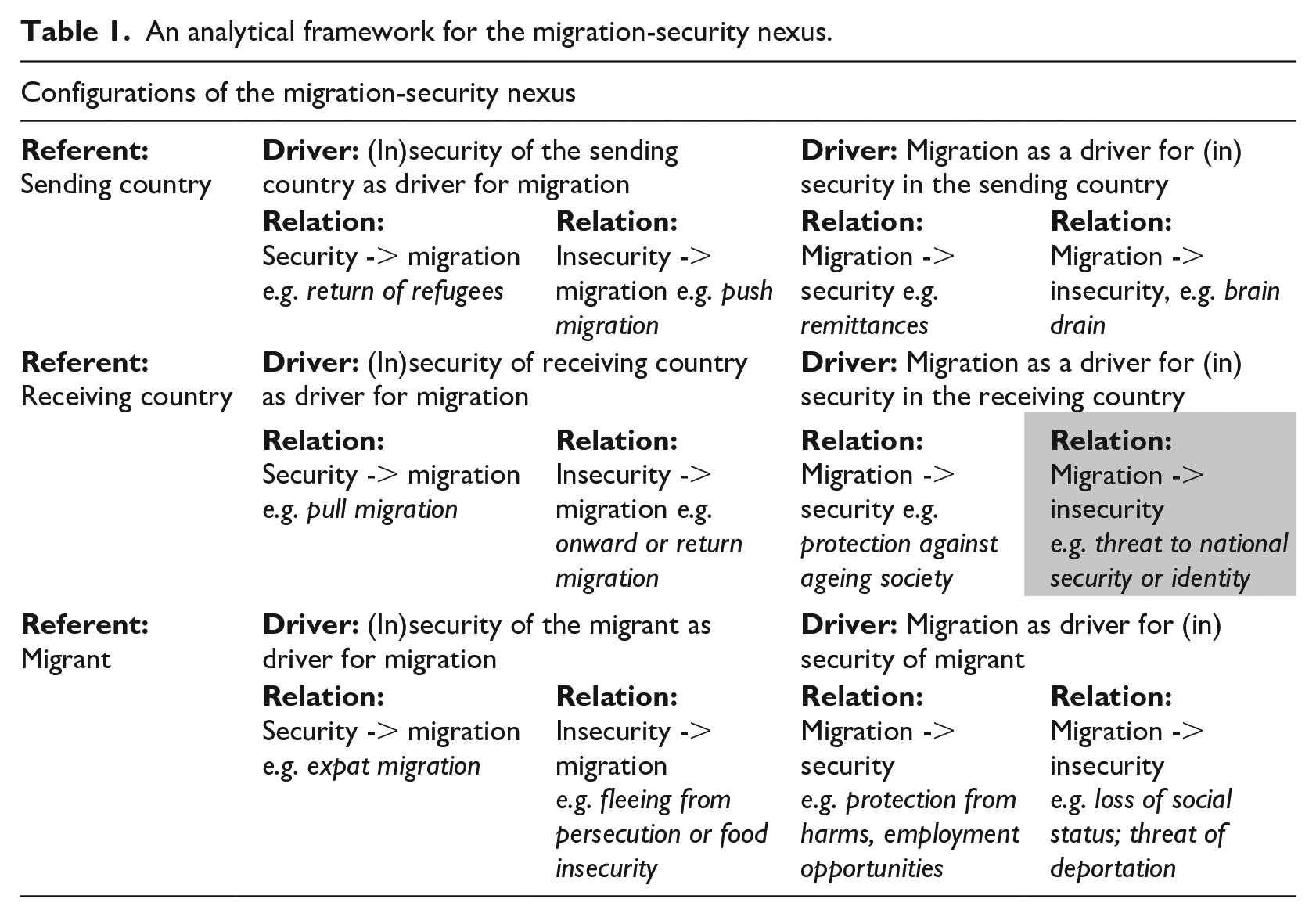
This framework charts the potential configurations of the migration-security nexus as it brings into view the kaleidoscope of potential connections and assumptions about the relation between ‘migration’ and ‘security’. Among the examples (in italics), one can distinguish different types of security, such as human security, social security and national security that get tagged onto migration in the so-called migration-security nexus. Configurations of the nexus can also interact with one another: for instance, if migrants are considered a threat to state security, migrants’ own security is more likely to be compromised by punitive measures (Wadia, 2015). This illustrates Buzan and Wæver’s argument against idealizing state security ‘as the sought for condition’ (1997: 246).
At the same time, the framework demonstrates that some configurations are radically incompatible as they are based on conflicting assumptions. Each formation of the nexus has different political implications, since each discourse explicitly or implicitly contains a diagnostic frame providing a ‘distinct description of the problem at stake and the threat involved’ and a prognostic frame which offers a solution to the identified problem (von Lucke et al., 2014: 863–864). If migration is seen to compromise the security of the receiving state, this implies a different political solution than if the focus is on the insecurity of the migrant as a result of the bordering practices of the receiving state.
The proposed framework can be used to analyse juxtaposing representations of empirical cases. For instance, recognizing the shifting meanings of the migration-security nexus, Christopher Browning refers to Trump’s border wall to halt Mexican migration and the image of drowned Syrian toddler Alan Kurdi on the Turkish shore as ‘two contrasting and polarized images of the nexus’ (2017: 39). Where the first constitutes a classical example of migration being considered a driver for the insecurity of the nation-state, with the walled border offering state security, the second example turns this around, underlining not only how insecurity (war) drives migration, but also how migration in turn produces insecurity for migrants. While Browning is right that the dominant associations attached to Alan Kurdi and the Mexican border wall may be contrasting, this framework alerts us to the multiple and simultaneous configurations of the migration-security nexus. For instance, Alan Kurdi was also notoriously depicted in a 2016 cartoon in the French magazine Charlie Hebdo as a grown-up man, who sexually harasses women in Germany. This representation of Kurdi as racialized migrant man forming a security threat to host country’s white women aligns with Trump’s justification of border walls through reference to Mexican rapists threatening the United States.
In the next sections I will therefore focus on the empirical case of the protection of LECs, to illustrate how competing configurations of the migration-security nexus can get attached to a single case, with profound political implications.
The protection of Iraqi and Afghan former locally employed civilians
The doctrinal focus in Afghanistan and Iraq on ‘winning hearts and minds’ for successful counter-insurgency operations made the role of linguistic and cultural mediators particularly pertinent. With insufficient linguistic skills present in Western militaries (Collin, 2009) and based on cost considerations (Bos and Soeters, 2006), a significant number of interpreters were recruited locally, either directly by states or through private contractors. Since LECs were often employed for years, in contrast to the international military who rotated on a yearly or six-monthly basis, they were also essential in providing institutional knowledge in a volatile environment. Despite extensive media interest in LECs and research in translation studies and anthropology about interpreters in conflict (Campbell, 2016; Collin, 2009; Footitt and Kelly, 2012; Inghilleri, 2010; Rafael, 2007; Rosendo and Muñoz, 2017), international relations scholarship has paid surprisingly scant interest to LECs as security actors or as migrants seeking protection (for an exception, see Baker, 2010: on locally recruited interpreters in Bosnia-Herzegovina, Baker, 2014; Kristensen, 2019).
Insurgents specifically target LECs and their families for their role in aiding foreign forces. In Afghanistan, for instance, where the Taliban has engaged in counter-securitization moves through night letters (shabnamah), presenting ‘“foreign sympathizers” as an existential threat’ to Afghan values and security (Stritzel and Chang, 2015: 556), LECs are considered traitors and ‘tongues of the infidel’. There was no overarching international protection scheme and the implementation of national schemes has been found wanting (De Jong, 2021). In the UK, for instance, the resettlement scheme for Iraqi LECs was conceived after law firm Leigh Day threatened a public litigation case, while in the United States the Special Immigrant Visa (SIV) scheme was set up after extensive lobbying led by former USAID worker Kirk Johnson (Johnson, 2013). Under this scheme, a set number of SIVs are reserved annually for Iraqi and Afghan interpreters working for the US military (since 2006), and two other programmes authorize SIVs for Iraqi and Afghan nationals who have worked for, or on behalf of, the US government in Iraq (established in 2008) and Afghanistan (established in 2009). In September 2019, a federal judge ruled that the visa delays faced by SIV applicants were ‘unreasonable and unlawful’ and ordered the government to expedite the processing of pending applications (International Refugee Assistance Project, 2019). However, when in April 2021 the United States announced the upcoming withdrawal of troops from Afghanistan, more than 18,000 applicants were still in Afghanistan, leading advocates to call for an urgent evacuation to a safe location for visa processing (Washington Post Live, 2021).
In the UK, the Ministry of Defence announced in April 2021 a new Afghan Relocation and Assistance Policy (ARAP) with an anticipated uptake of about 850 LECs. This replaced the previous Intimidation Scheme, which had been characterized in a Parliamentary Defence Select Committee Report as ‘hitherto useless’ (House of Commons Defence Committee, 2018). Thus far, fewer than 500 LECs had been relocated under the Redundancy (Ex-Gratia scheme), which restricted eligibility to LECs who were made redundant or resigned after serving at least a year on Helmand’s front line, a fraction of the total number of 7,000 LECs employed (House of Commons Defence Committee, 2018). The French resettlement scheme initially only accepted 73 LECs, and when it was reopened after pressure from lawyers, it accepted another 103. It still rejected a further 150 cases without providing a justification (Decroix and Baouz, 2015; Tallès, 2019), including multiple applications by Abdul Basir, a former LEC employed by the French army, who was assassinated in June 2021 (AFP, 2021). Some LECs who found themselves ineligible under the stringent criteria of the national resettlement programmes or who faced long waiting times, fled in the hope of claiming asylum, with several getting stranded in third countries, as the Dublin III Regulation stipulates that one must claim asylum in the first safe country (El-Enany, 2013). With some states refusing to take responsibility for LECs who worked for other nations, many were left in limbo.
The data that forms the basis for this article has been collected in the context of a research project that investigates the demands for protection by LECs and their advocates. The main source for the analysis offered here are 32 semi-structured interviews conducted between 2017 and 2020 with male Afghan and Iraqi interpreters who now live in the USA, UK, Canada, France, Germany, the Netherlands and Belgium. Some interpreters had worked for several different national armies (for instance, the US and French forces or US and Canadian armies) and some had claimed asylum in third countries (e.g. former interpreters for the US army living in Belgium, the Netherlands and Germany). In the same period, I also interviewed 36 advocates and service providers in the aforementioned countries, including veterans, lawyers, representatives of professional interpreting associations and refugee resettlement caseworkers. Additionally, I conducted document analysis of (social) media, policy reports and court cases, and carried out (participant) observations of national and international political meetings.
The next sections will chart the configurations of the migration-security nexus as they apply to the discourses and practices surrounding the protection of Iraqi and Afghan LECs. I will work through the framework in a structured way by discussing in turn the configurations linked to each of the three referent objects: firstly, the sending country; secondly, the receiving country; and thirdly, migrants themselves. I will make visible the impacts of considering either migration or (in)security as the driver of the relation, and what changes when the migration-security nexus is invoked to imply either a relation between migration and security or insecurity.
Charting the configurations of the migration-security nexus
Referent sending country: The migration-(in)security nexus
A kaleidoscope of configurations of the migration-security nexus can be identified when the referent object, i.e. who is secured, is the sending country. Firstly, in some cases (the promise of) security is presented as a driver for return migration and, secondly, insecurity is presented as driving emigration. The stories of some Afghan LECs whom I interviewed started with their return migration from Pakistan back to Afghanistan. I define return migrants here broadly as ‘migrants who travel back to their country of birth to live there, regardless of the circumstances and motivation to do so and regardless of length of stay’, following Van Houte, Siegel and Davids’ critique that the bureaucratic differentiation of dichotomies of voluntary and involuntary return does not capture the complex realities (2016: 3). Some of these returning migrants had been part of the earlier wave of emigration from Afghanistan to Pakistan in the 1990s. Now young adults, they were lured back by the promise of a different, safer Afghanistan and were part of the ‘unprecedented wave of returns’ of around 3.5 million Afghan refugees (of whom more than 3 million are estimated to have received UNHCR’s assistance) following the 2001 Western military intervention and the establishment of a new government (Monsutti, 2007: 168).
Return migration also served a political function as it ‘is often viewed by the International community as a signifier of peace and stability in origin countries, and in the case of Afghanistan thus a demonstration that US and NATO tactics are succeeding’ (Koser, 2011: 134). The young men did not necessarily consider their return a confirmation that Afghanistan was now safe, but rather considered it their duty to rebuild the nation. As one LEC who currently lives in the United States explained to me, We were 100 students who came from Pakistan and we had one call, we were going to help our country. [. . .] Our grandfathers and fathers had been helping the country as soldiers, so what the hell are we doing? We used to be ashamed and embarrassed that we should let American or UK soldiers come and take care of us, but as Afghans we should sit at home and let them do whatever they want. (Interview 1)
However, enduring insecurity of the Afghan state has also led to mass emigration. This foregrounds another configuration of the migration-security nexus: not the promise of security, but rather insecurity driving migration. Return migration happened alongside ‘one of the world’s largest and most enduring protracted refugee situations’ (Koser, 2011: 131). Those I interviewed who had returned to Afghanistan post-2001 and who undertook employment with Western military forces emigrated again after a few years, when their association with Western forces became a security risk. Whether Afghanistan is a sovereign state that can protect its own citizens, or an insecure state whose citizens require international protection is a deeply contested issue. The declaration by many European countries that Afghanistan is safe has justified their deportations and rejections of asylum claims, demonstrating the political impact of such speech acts.
A 2017 Amnesty International report quotes a leaked EU document, in which ‘EU agencies acknowledged Afghanistan’s “worsening security situation and threats to which people are exposed”, as well as the likelihood that “record levels of terrorist attacks and civilian casualties” will increase, but nevertheless stated that “more than 80,000 persons could potentially need to be returned in the near future”’ (2017: 35). Amnesty International hence argued that ‘to effect [. . .] returns, European countries have arbitrarily called some areas of Afghanistan “safe”’ (2017: 41). As a UK immigration solicitor explained to me, ‘in 2015 we spent a good year challenging the country guidance 2012 [which forms the basis for asylum decisions], saying it needs to be revisited and that most of the [. . .] the evidence we have shows that it’s unsafe and that you can’t just relocate to Kabul’ (Interview 2). An Afghan former interpreter, who had lived for four years as an unaccompanied minor in the UK and who took up a job as an interpreter after he was deported to Afghanistan, explained that they know the reality in Afghanistan. Afghanistan is not a safe country. They try to always say “if Nigrahar is not safe, go to Kabul”, [. . .] but to the person that says “Kabul is safe”, I will tell him “go there for a week, you will see for yourself”. (Interview 3)
The migration-security nexus reveals itself here as one in which anti-migration sentiments and the pressure to keep refugee numbers low encourages the declaration that states are secure. Once states are declared safe, this legitimizes the rejection of asylum claims. The contradicting claims about general (in)security in Afghanistan play out in specific ways in relation to the resettlement of LECs. Reports by the United Nations High Commissioner for Refugees (UNHCR) and the European Asylum Support Office (EASO) have identified LECs among those with potential risk profiles, since they face targeted threats from insurgents in addition to the indiscriminate violence endemic to conflict zones (European Asylum Support Office, 2019: 43; UNHCR, 2018). This demonstrates that when (in)security gets connected to migration by means of claims to or denials of protection, there is a propensity to make reductionist claims about security. These do not only fail to capture complex realities on the ground, but also conceal the political contentions underlying proclamations about security.
One only has to scratch the surface before the contradictions become apparent. The UK Intimidation Scheme for former Afghan interpreters considered none of the threats described by a total of 570 applicants severe enough to categorize them as ‘red’ (highest level) and therefore warranting international relocation. Instead, they offered ‘bespoke security advice’ (to which I will return below) and internal relocation within Afghanistan (House of Lords, 25 February 2020). Remarkably, the Intimidation Investigation Unit that assesses the claims operates from Hamid Karzai International Airport in Kabul and, as the MoD explained, the security situation in Afghanistan means that ‘investigating officers are unable to move outside of secure NATO bases to conduct investigations’ (quoted in House of Commons Defence Committee, 2018: 18).
Claims about migration and security also revolve around the question of who is responsible for providing security, and hence by implication for the protection of the LECs who have been employed in the name of making Afghanistan and Iraq secure states. Are Iraq and Afghanistan failed states whose inability to guarantee the security of their citizens produces migrants, or is the insecurity of these states linked to the protracted Western interventions? Some LECs and their advocates, who tried to make sense of why many states were not very forthcoming with resettlement, despite the relatively small number of former LECs and the broad public support they receive, suspected that providing LECs with protection would amount to conceding that the mission had failed. As a UK-based LEC explained, if they do accept [that Afghanistan is still not safe], then citizens in the UK will question [the government]: “Ok, you have to spend that amount of money, 17 years, and our sons, our brothers, they have lost their lives, what was the achievement?” (Interview 4)
This is echoed by findings from Denmark, where Kristensen observed that ‘issuing asylum [to former interpreters supporting Danish forces] [. . .] would amount to accepting a Danish defeat in Afghanistan’ (2019: 80). In contrast, a report on the Afghan LEC relocation scheme by the UK House of Commons Defence Select Committee shifted responsibility to the Afghan government: ‘We strongly suspect that the Afghan Government is reluctant to acknowledge that the country is too dangerous to guarantee the safety of local people who helped the NATO mission to combat the Taliban’ (2018: 21). It accused Afghanistan of a vested interest in denying the continued insecurity, which would threaten their existential claim to sovereignty and thus statehood (Buzan and Wæver, 1997).
The above examples have presented two configurations of the nexus in which, respectively, security and insecurity of the sending state are the driver for migration: first, the promise of the renewed security of Afghanistan as a driver for return migration, and secondly, the insecurity of Afghanistan as driving emigration. However, the migration-security nexus with the sending country as the referent was completely reversed in other instances. Instead of (in)security driving migration, migration was considered the driver of (in)security for the migrants’ country of origin. This configuration, which links migration with the brain drain of those deemed most suitable to build a future secure state, again gives political salience to arguments against migration. However, in contrast to the earlier presented anti-migration arguments, in which Iraq and Afghanistan are presented as states which can guarantee the security of their own citizens (thereby making international protection through migration redundant), in this configuration Iraq and Afghanistan suddenly appear as states whose future security depends on preventing an exodus of highly skilled migrants.
A good example is a report by the United States non-profit organization Hollings Center for International Dialogue, which states that Afghan civil society leaders feared that the SIV programme ‘contributed to the shrinking of the educated middle class, [who are] considered some of the most effective advocates of democracy and human rights in Afghanistan [making the country] more vulnerable to traditional and radical religious forces’ (Coburn and Sharan, 2016: 11). It quotes an Afghan informant claiming that ‘the SIV has reinforced uncertainty . . . a mixed feeling that the country is not moving in the right direction, that the country is not safe and that the US is taking its people, the best and brightest’ (Coburn and Sharan, 2016: 7). This configuration of the migration-security nexus is once again not without its contestations. The UK House of Commons Defence Committee’s report, for instance, condemned the UK government for instrumentalizing brain drain arguments: ‘This is completely disingenuous. If the “brightest and the best” have to go into hiding, their brains will hardly be available for the advancement of Afghan national development’ (House of Commons Defence Committee, 2018).
This section has mapped competing claims about the security and insecurity of Afghanistan and Iraq in relation to migration, and demonstrates that (in)security is invoked as a driver of migration, but conversely migration also appears as a driver for the insecurity of the sending state. The next section will continue to chart the configurations of the migration-security nexus and its political ramifications, focusing on receiving countries as the referent object.
Referent receiving country: The migration-(in)security nexus
In the wake of 9/11, associations between migration and Islamic terrorism gained new currency (Faist, 2004). In the claim about migration producing insecurity for Western host countries, ironically, those presented as the ‘best and brightest’ in the brain drain argument now figure as potential terrorists. The military missions in Iraq and Afghanistan were framed around combatting Islamic terrorism. Western states’ reluctance to accept male Muslim refugees in general hence also needs to be understood in the context of this vilification of the figure of the (predominantly male) barbaric Islamic terrorist.
A US Marine Corps veteran, who now works for a non-profit human rights organization and campaigns for the protection of former LECs, told me that ‘we have some politicians who cynically have seen an advantage in creating a bogeyman, painting people from the Middle East in this broad brush of potential terrorist’ (Interview 5). While he personally disagrees with the association between Muslim migrants and security risks, he told me that he uses a pragmatic strategy in his lobbying work rather than the principled approach commonly adopted by migrant and human rights organizations. Strategically, he told me, in a campaign you present ‘a retired general [. . .] to say “they [SIV holders] are the most thoroughly vetted of any category of traveler”’ (Interview 5). His argument does not challenge the link made between migration and potential insecurity for the host country, but carves out an exceptional position for former LECs as a category of migrants who are ‘security-cleared’. His strategy can be understood alongside Stritzel’s observation that ‘the better the compatibility of the articulated text [. . .] and the existing discourse [. . .] and the better the positional power of securitizing actors, the easier it is for them to establish their preferred individual text as a dominant narrative’ (2007: 370).
In instances which exempt LECs from negative migration discourses or policies, the overall logic of the migration-security nexus in which migrants are presented as threats to the security of Western host nations remains intact. Soon after Trump announced Executive Order 13769, ‘Protecting the Nation from Foreign Terrorist Entry into the United States’, known colloquially as the ‘Muslim ban’, following political pressure, he exempted Iraqi SIV holders (Scribner, 2017). As The New York Times reported, ‘Mr. Trump said when he issued the executive order that it was intended to allow American officials to vet Iraqis and others more thoroughly. But the interpreters had extensive security vetting before they were permitted to accompany American forces. They spent years clearing more background security checks while applying for the special visas’ (Zucchino, 2017). Trump’s ‘Muslim ban’ is a classic instance of a securitization process in which migration and mobility were moved to the realm of exceptional politics, justifying security measures that restrict freedoms (Newman, 2010).
The configuration of the migration-security nexus in which migration is considered the driver of insecurity for the host country has particular currency in the global North. As noted by Collyer, ‘migration is not universally considered as a security risk, but most frequently associated with terrorism in wealthier parts of the world. [. . .] This distinction can be explained by the dominant European vision of surrounding areas as innately insecure, in contrast to the safety of Europe’ (2006: 256). This demarcation between the ‘unsafe East’ and the ‘secure West’ explains the paradoxical situation in which LECs have the role of security actor in war zones, but are subsequently considered potential security threats when they become migrants to Western nations. This was the case with one Afghan LEC who had found employment with the British army as an interpreter after he was deported from the UK. While the British army considered his previous deportation no obstacle to employing him in Afghanistan – and likely his English fluency built during his young years in England was considered a major asset – his deportation was held against him when he reapplied for asylum in the UK based on the threats he faced.
It is also illustrated by the case of an Afghan interpreter whose SIV application was rejected by the State Department because ‘he “may be a terrorist or may have provided material support to a terrorist organization”’. Intriguingly, the same Afghan interpreter continued to be employed by the US military. The Washington Post quotes him wondering: ‘My question is, if I am involved in terrorist activities, why am I still working for the US Army?’ (Sieff, 2013). Another former interpreter for the British army also highlighted this contradiction to me. Listening to him helps to recognize that ‘the subjects of securitization in this case are agency-rich political actors within the political unit seeking to securitize them’ (Glover, 2011: 92–93). He recounted that he told the UK Minister of Defence, whom he once had the occasion to meet, that before an interpreter is hired, there is a procedure [. . .] that we go through – a screening test. That screening test clears an interpreter that he is good to go, which means that he is safe, you can rely on him, you can trust your life on him and he is the safest and closest friend you’ve got in the country. Now how come that the same interpreter who has been with you on the front line was safe, would not be safe when he is here [in the UK]? (Interview 6)
I have presented here how migration is framed as driving traditional security threats to the receiving state and the contestations in response to this. As securitization scholars have shown, migration is also presented as posing non-traditional security threats to the ‘cultural identity and social stability’ of the host nation (Sørensen, 2012: 66). This alleged symbolic threat by migrants has also been described in terms of ‘societal security’, which ‘can be threatened by whatever puts its “we” identity into jeopardy’ (Buzan quoted in Collyer, 2006: 259; see also Buzan and Wæver, 1997). Changing from physical to societal security brings into view a new configuration of the migration-security nexus, in which LECs occupy an intriguing position. For instance, in a statement by Major Driscoll, the initiator of a 2015 Change.org petition, addressed to the then UK prime minister, LECs are singled out as exceptional for their contribution to societal security and therefore as deserving of protection: ‘It is my belief that any man, who is courageous enough to fight alongside the British Army in the defence of our British values and standards, when threatened, is entitled to live under the protection of this country’ (Driscoll, 2015).
While the migration-security nexus can form the basis for refugee protection when it is recognized that the insecurity of the country of origin or of the migrant drives migration, asylum claims are jeopardized when the opposite configuration takes precedence and asylum claims are assessed on the basis of the anticipated impact of the migrant on host state or societal security. This reversal became obvious when a French activist lawyer shared with me (Interview 7) examples of assessments written by French soldiers stationed in Afghanistan, which were included in the case files of LECs’ rejected resettlement applications. One of the questions on the assessment form concerns the ‘expected ability to integrate into the French nation’. One soldier replied to this question: ‘As a practising Muslim, he has a rather religious vision of life and society, which is not very compatible with an integration project in France’ (Task Force La Fayette VI – translation by the author). As Didier Bigo argues, ‘the political game in each country delineates the figure of the migrant by inverting the image of the good citizen. In France, laicity and centralization create the migrant image as that of a religious fanatic – a member of a community committed to destroying the principles of republicanism’ (2002: 70).
In a similar vein, Thomas Faist has noted that ‘after 9/11 postmodern ambiguities [. . .] have been replaced by a clear trench line between liberalism vs. terrorism’ (2004: 11). Hence for a (Muslim) migrant not to be considered a security threat to the receiving state or society, they should not only pass security screenings, but also espouse the presumed liberal values of Western states. Allegiance to Western liberal values is often evaluated by reference to views on gender and sexuality, against the backdrop of the war in Afghanistan also being justified in the name of saving women (Shepherd, 2006). This is illustrated by the statement of a German reservist soldier, who is a voluntary mentor for Mohammed, an Afghan former employee of the Swedish and German NATO forces, whom he describes as follows: Mohammed is very open, much more than I expected maybe. This is due maybe to his family background and maybe due to his education and to the fact that he has been in contact with people from Western countries for a very long time. [. . .] He met my [male] partner very soon after we got together [as mentor-mentee]. (Interview 8)
While he does not explicitly link homophobia to Islam, this assumption forms the backdrop of his description of Mohammed as more ‘open’ than he expected. Indeed to ‘embody the dominant identity and concomitant set of values’ is considered by some LECs and their advocates to be the ‘only strategy to garner success in fighting the most recent wave of securitized discourse around migration’ (Glover, 2011: 90). Mohammed’s response to his mentor serves to reinforce his position as non-threatening migrant: ‘For me, [their gay relationship is] totally OK, although I am a Muslim; I am not an extremist Muslim, I am not praying usually’ (Interview 9). Arguably, this strategy leaves intact the dominant national identity to be secured and only exempts model migrants who adopt an assimilationist approach. Other LECs I interviewed considered this an ‘unacceptable and unjust instruction upon their previously held identities and belief-systems’ (Glover, 2011: 90), and for instance resisted Western resettlement workers’ ‘civilizing’ efforts to reorganize gender roles within their families.
The above examples have shown what the migration-security nexus can look like when migration is negatively linked to security, being considered a traditional or non-traditional threat to the host nation. I will stay with the host country as referent object, and chart the alternative configuration in which the relation between migration and security is suddenly viewed positively, ‘since migration may itself be viewed as being a benefit to security as much as a threat to it’ (Browning, 2017: 48–49). For instance, in a statement about the amendment of the travel ban, a United States Embassy official in Baghdad claimed that ‘the US government has determined that it is in the national interest to allow Iraqi Special Immigrant Visa (SIV) holders to continue to travel to the United States’ (Zucchino, 2017: emphasis added). In a full-page newspaper advert 1 , a collective of advocates, including a Dutch refugee NGO, trade unions, the Dutch branch of Amnesty International and the International Association of Conference Interpreters, appealed to the Dutch Minister of Defence to accept the asylum claim of a former Afghan local interpreter for the US army, reminding her that ‘while risking his own life, he committed himself to our peace and security’ (18 October 2019, Telegraaf; emphasis added). In this configuration, LECs’ migration is framed as explicitly contributing to the security of host countries.
Bigo has observed that the meaning of security has expanded in recent years, which ‘effectively results in a convergence between the meaning of international and internal security’ (2002: 63). If this insight is taken seriously, this in turn affects the way security is framed as interacting with migration in the nexus. Here LECs are considered not only as contributing to the safety of Western nations during conflict; also, as migrants they are recognized as contributing to the security of host nations. This reasoning takes at least two forms. First, welcoming former LECs as migrants signals the reliability of Western nations to prospective LECs and hence furthers the future security of Western armies. As General David Petraeus, former commander of the International Security Assistance Force in Afghanistan, stated: ‘if others around the world see that we don’t live up to our obligations to these individuals [. . .] then we’re going to find it very hard to recruit that kind of assistance in other situations’ (Washington Post Live, 2021). Secondly, LECs can symbolically protect the nation as model migrants, Westernized and liberal, and proud patriots of the adopted nation, as expressed in the many media stories documenting resettled LECs’ eagerness to naturalize and enlist in the army and police force (DuVernay, 2018).
Referent migrants: The migration-(in)security nexus
The first two sections have charted the multiple configurations of the nexus following a traditional approach that foregrounds (sending and receiving) nation-states as the referent objects. The concept of human security shifts attention to the individual as the main referent and beneficiary of security politics. One way in which policymakers have worked with this configuration of the migration-security nexus is by promoting interventions that address the insecurity of aspiring migrants inside their countries of origin to prevent migration. Potential migrant host countries seek to ameliorate the human security of aspiring migrants, for instance through development aid, tapping into the links with the other rising policy frames of the security-development nexus and the migration-development nexus (Lavenex and Kunz, 2008).
This provides the context for the UK’s ex-gratia (redundancy) scheme for local interpreters, which treats the matter largely as an issue of (loss of) job security. Two of the three options offered under the scheme (a redundancy payment and training and education) ‘must be undertaken in Afghanistan’. Despite this, the refusal letter of admission to Britain to a former LEC who applied for relocation under the ex-gratia scheme nevertheless reverts back to the earlier configuration of the migration-security nexus in which the prospective migrant is considered a threat to the receiving nation: ‘There are serious reasons for considering that you constitute a danger to the community or to the security of the United Kingdom’ (Notice of Immigration Decision: Refusal of Entrance Clearance 2017 obtained through private communication with a former LEC).
Simultaneously, the refusal letter expresses concern with the insecurity of the applicant, as it also contains an attached ‘Security brief’ to ‘assist in keeping yourself and family safe’, now that his quest to find protection through migration to Britain has been denied. In this brief, the Foreign and Commonwealth Office offers two and a half pages of advice under the heading ‘Think Safety First’. It includes the recommendations to ‘not wear expensive or “loud” clothes’, ‘not have western names or job titles on [your phone] that link you to your job – create codenames instead – for example, instead of “Bill” stored on your phone have “Ali”’ and ‘discreetly check for IEDs (car bombs) before driving away’ (2017 security advice obtained through private communication with a former LEC). Here the responsibility for security is delegated from the state (either Afghanistan or Britain) to the individual. Studying these configurations of the migration-security nexus side by side shows that ‘human security approaches [. . .] shift attention beyond the state, but do not go far enough in considering how framing migration in terms of two conflicting security claims – human versus national security – produces particular effects’ (Huysmans and Squire, 2010: 172). These particular effects will become visible in the subsequent examples.
As Newman summarizes, ‘in broad terms human security is “freedom from want” and “freedom from fear”’ (2010: 78). As the experiences of some LECs highlight, migration can offer security for those fleeing from conflict, producing a configuration of the migration-security nexus in which migration drives human security and the two terms are positively associated. Migration can, however, also be negatively linked, ‘lead[ing] to human insecurity’ (Vietti and Scribner, 2013: 22) with state security measures often restricting legal escape routes for migrants, leaving migrants vulnerable to ‘abuses [. . .] in transit’ (Vietti and Scribner, 2013: 26). For instance, UK newspapers reported the story of one former Afghan interpreter trapped in the notorious Moria refugee camp on Lesvos, Greece (Williams and Brown, 2020). The insecurity of a former LEC whom I met in the UK continued beyond his transit when his asylum claim was rejected and he found himself homeless, while another LEC whom I met in Belgium returned to Afghanistan after failing to obtain secure legal status. At least one former Afghan interpreter took his own life after time in UK immigration detention and facing deportation (Bonnici, 2016). Since detention and deportation are measures introduced ‘in the name of securitizing states’ (Wadia, 2015: 92), these examples demonstrate the effects of framing national security paradigms and human security paradigms as conflicting and basing (anti-)migration policy on this logic. Hence, as Huysmans and Squire (2010) suggest, analysis of the migration-security nexus raises broader critical questions around the production of the political legitimacy of forms of violence against migrants.
The analytical framework of the nexus makes visible how people move from one to another configuration: insecurity can drive their migration, but migration subsequently generates insecurities for migrants in the host country. Many resettled former LECs struggle with insecure (temporary) legal status, un- and under-employment, family separation and lack of access to psychological care. Also, one configuration can lead to another, with ‘the upshot of treating migration as a security threat [being] the increased insecurity amongst migrant [. . .] populations in the West, and particularly among those from Muslim majority countries’ (Lazaridis and Wadia, 2015: 2). Indeed, many resettled LECs reported racist abuse in the host countries. In addition to ‘insecurities engendered by restrictive migration control practices’, there are ‘those created as a result of poor integration/inclusionary politics’ (Lazaridis and Wadia, 2015: 3). One Iraqi LEC explained to me how he weighed two types of insecurity and risk against one another before his migration: the physical insecurity he experienced in Iraq versus the social insecurity in the United States: The trade-off here is, I was making good money in Iraq, I was in a very high position [. . .]. On the other hand, in one moment, you can lose everything. I’d leave my home every day with the fear of never coming back to the kids, [. . .] so between this and that, I chose to come here and take a risk. To me it’s a new life, a new challenge. I would say I’m lucky to get a job, and to be able to integrate into society and to make a good living compared to others [less] fortunate than I am. (Interview 10)
When analysing configurations of the migration-security nexus that foreground the migrant as referent, it is important to be attentive to migrants’ own definitions of (in)security, while at the same time recognizing that ‘their positional power’ as a securitizing actor is limited (Stritzel, 2007: 370). As Innes argues, ‘the migrant agent theorizes security in the performance of seeking it’ (2014: 571). One of my informants, for instance, went underground when he faced deportation after his asylum claim in Norway was refused and eventually made his way to Germany to seek protection. He had worked as a translator for US forces and was involved in the translation of new law decrees sent to every court in Afghanistan. In the Norwegian court papers, summarizing the negative decision on his case, his testimony about the security threats is questioned: ‘Afghanistan is not a society of documents, and half the population are illiterate. The significance of [the applicant]’s name being on the nine decrees, [. . .] must be valued on this basis.’ His question ‘Do you expect me to carry my dead body, and say, “I need protection”?’ raises the issue of who is entrusted with defining (in)security in the different configurations of the security-migration nexus (Interview 11).
In contrast to the earlier-mentioned system of assessment of intimidation claims made by Afghan LECs, done remotely by the UK Intimidation Investigation Unit from Hamid Karzai International Airport in Kabul, former Iraqi LEC ‘were entitled to relocate to the United Kingdom if they considered themselves to be in danger’, because ‘conditions on the ground in Iraq made it nigh on impossible to assess or verify claims of alleged intimidation’ (UK court case Hottak & Another, R (On the Application Of) v The Secretary of State for Foreign and Commonwealth Affairs & Another [2016] EWCA Civ 438 – italics added).
LECs who flee the country through asylum routes refuse to accept that they do not meet state-sanctioned criteria and follow their own assessment of (in)security. Consequently, if migration fails to offer them the security that they set out to find, because the host state’s ‘immigration procedures [. . .] do not coincide with [their] subjective determination of [their] own security’, they may ‘see[k] an alternative security’ (Innes, 2014: 571). My informant, for instance, managed to obtain church sanctuary when again faced with deportation, and successfully mobilized his political, religious, military and academic advocacy contacts to challenge his deportation back to Norway, eventually obtaining temporary protection in Germany. Such alternative security should not be romanticized, since it is ‘tenuous’ and does not gain full autonomy from state definitions of security as it is constructed in response to state measures (Innes, 2014: 574). However, it shows that ‘the state does not have the final word on security’ (Innes, 2014: 574) and hence such counter-hegemonic securities need to be recognized when identifying the kaleidoscope of configurations of the migration-security nexus.
Conclusion
The ascendancy of the specific configuration of the migration-security nexus that links migration with security threats to host nations and legitimizes bordering practices has been well documented. However, this focus on one dominant configuration of the nexus has neglected the variety of configurations that the migration-security nexus invokes in discourse, practice and analysis. In this article, I have proposed an analytical framework that allows a more comprehensive engagement with the range of associations that the security-migration nexus invokes, and have illustrated the use of this framework with the under-researched case of Afghan and Iraqi former LECs seeking protection through migration. The framework categorizes the various forms of the nexus through three axes and their combinations, which emerge in the struggles over the meaning of security and its relation to migration: 1) the referent object; 2) the primary driver or the affected phenomenon; and 3) the relation established between the terms.
Mapping and interrogating the ways in which migration and security get linked has both analytical and normative value. Applying the framework to other empirical cases, such as refugee rescuers, also framed as ‘people smugglers’, or the practices and discourses associated with the ‘refugee crisis’ (also considered ‘solidarity crisis’ (De Jong and Ataç, 2017: 28) will help reveal which configurations have political salience and which configurations evoke marginalized counter-discourses and practices by actors lacking positional power. With the framework, I have laid bare contradictions within the kaleidoscope of configurations, as a result of opportunistic policy framing, or struggles over meaning between different actors, such as the same LECs being considered security actors in the East and security threats in the West, or the ‘best and brightest’ causing both brain drain and being potential terrorists. The framework and the analysis of the protection of LECs have sought to capture some of the insights offered by second-generation literature on securitization theory, highlighting securitizing practices, positional power and resistance; however, further work is needed to fully integrate the typologies developed in this body of literature (e.g. Stritzel and Chang, 2015: 553) into the framework proposed here, charting the configurations of the migration-security nexus.
Uncovering the nexus’s multiple configurations, contradictions and tensions supports the scholarly and political project of denaturalizing the migration-security nexus, and hence of the desecuritization of migration. Reiterating the words of the Afghan LEC who asked ‘Do you expect me to carry my dead body, and say, “I need protection”?’, denaturalizing the nexus is needed to challenge the perversity of security practices which force people seeking refuge to risk their lives in order to save their lives.
Footnotes
Acknowledgements
Earlier versions of this article were presented at the BISA IPMRD working group workshop on the ‘Migration-Security Nexus from a Transnational Perspective’ (2019) at the University of Oxford and at the University of York’s Critical Security draft reading group (2020), and I have greatly benefited from feedback from colleagues provided in these fora. I also want to thank the anonymous reviewers and the editor for the constructive and insightful feedback. This article could not have been written without the cooperation of the former locally employed civilians and the advocates who have so generously given me their time and stories.
Funding
The author disclosed receipt of the following financial support for the research, authorship, and/or publication of this article: The author received seedcorn funding from the Open University’s ‘Citizenship & Governance’ Strategic Research Area as well as funding from the Higher Education Innovation Fund (HEIF) for the knowledge exchange project ‘Resettling Afghan Former Military Interpreters to the UK: Addressing Challenges, Sharing Best Practices’ (2019).
