




Abstract
In 2012, 2016 and 2018–2019, Pakistan threatened to expel Afghan refugees and in 2015, 2016 and 2019, Kenya threatened to demolish the Dadaab camp and expel Somali refugees. Following the threats, the governments extracted more than $300 million aid, combined. Why did these states succeed in extracting aid despite their relatively weak status and not bordering the target of their blackmail? This article first situates refugee expulsion within the literature on refugee policies, migration diplomacy and refugee rentier states. Second, in two cases – Somalis in Kenya and Afghans in Pakistan – I show how states used the threat of expulsion to construct and leverage the deportability of their refugee communities as a foreign policy tool. States used the legal uncertainty around deportability to channel threats and violence toward refugees, but the primary audience of the threats were not refugees, but the international community. Officials in Kenya and Pakistan used threats paired with six-month or one-year delays as negotiation tactics to extract aid. Surprisingly, states that were generous hosts to refugees become strategically important because of their role in providing regional stability, which turned otherwise weak states into important allies that could threaten expulsion and extract aid from superpowers.
Introduction
Why do states threaten the mass expulsion of refugees? The academic literature highlights five analytic frameworks – culture, economy, security, political institutions and foreign policy – that explain why states expel refugees. One of these frameworks puts forward the model of refugee rentier states: states that host large refugee communities can use their geographic proximity to superpowers to threaten expulsion in order to extract aid (Tsourapas, 2019). This article puts forward a modified model of refugee rentier states that provides a more nuanced understanding of the politics of neighbours and can be applied to a wider range of cases not explained by geographic proximity. I theorize that states strategically host and threaten to expel refugees to pursue their foreign policy goals within their neighbourhood and within clientelist relationships with superpowers interested in regional stability. Weak states that are generous hosts for refugees become more strategically important to superpowers because they provide regional stability as proxies. Because of this newfound strategic importance, refugee rentier states are able to threaten refugee expulsion to extract aid from superpowers. States used the legal uncertainty around deportability to channel threats and violence toward undesirable refugees, but the primary audiences of the threats were not refugees; instead, the threats were aimed at the international community. This article adds additional layers of complexity to the refugee rentier model by incorporating the historic intraregional dynamics, the proxy state’s contribution to regional stability and clientelist relationships with superpowers that do not rely on geographic proximity. I also join the other contributions in this special issue that problematize the production of deportability by showing that deportability is not only a by-product of global capitalism but also a strategic tool used by states within their foreign policies.
In this article, I examine two cases – Kenya and Pakistan – that do not fit the model of a refugee rentier state because they do not share a border with a superpower, but nevertheless were successful at blackmail. In 2012, 2016 and 2018–2019, Pakistan threatened to expel Afghan refugees and in 2015, 2016 and 2019, Kenya threatened to demolish the Dadaab camp and expel Somali refugees. Following the threats, the governments extracted more than $300 million aid, combined. Why did these states succeed at extracting additional aid despite their relatively weak status and no shared border with the target of their blackmail? I find that states leveraged their clientelist relationships with superpowers and their strategic importance to regional stability to threaten refugee expulsion and extract more aid. Host states increased the deportability and vulnerability of refugee communities – by repeating threats, harassing refugees and using six-month or year delays to create uncertainty about the status of refugees – in order to make their threats more credible.
This article first situates refugee expulsion within the literature on refugee policies, migration diplomacy and refugee rentier states. Second, I develop a modified version of the refugee rentier state model and apply this model to two cases studies in Kenya and Pakistan. I conclude that states that were generous hosts to refugees become strategically important because of their role in providing regional stability. This turned otherwise weak states into important strategic allies that could threaten expulsion and extract aid from superpowers. To put it a different way, hospitality can make states important and when states become more important, they can demand more from their friends. As such, foreign policy goals are an important part of why states threaten refugee expulsion, in addition to cultural, economic, security and political factors.
Why threaten refugee expulsion?
In order to understand why states threaten expulsion, we must first begin with a few definitions. Deportation (another term for expulsion) is the forced removal, typically by the national police or immigration authorities, of an individual from the territory of a state. 1 Deportation is often used to remove irregular migrants who entered the country without proper travel documents or who overstayed visas, refused asylum seekers or foreign nationals convicted of crimes. In contrast, voluntary repatriation means to return to one’s country of origin of one’s own volition. Assisted voluntary repatriation (AVR) programmes are facilitated by an international organization and often include a free flight and reintegration assistance. The key difference between deportation and voluntary repatriation is the use of force by the state. Mass expulsion is the collective deportation of more than one individual in a single instance without individual deportation orders. Mass expulsion is a violation of international law, because it does not provide due process with the separate review of individuals’ claims to be in a country. 2 Refugee expulsion is a special case of mass expulsion because it involves expelling individuals who were designated as needing international protection. Because of this, refugee expulsion violates the principle of non-refoulement, which prohibits the return of anyone to a place where they are in danger of being tortured, persecuted or killed. 3
The literature points to five analytic frameworks – culture, economy, security, political institutions and foreign policy – that explain why states expel refugees, but also notes that refugee policies result from a combination of multiple factors. Scholars who focus on cultural factors posit that states are more hospitable to refugees who share a common ethnic, religious or cultural background, while host states with more closed societies and ethnic rivalries with refugees are more likely to expel or threaten to expel refugees who are not co-ethnics. McGarry (1998) shows how ethno-nationalist regimes expelled those groups who were perceived as enemies as a form of ‘demographic engineering’ to consolidate control of territory and to construct an ethnically homogenous nation. History is scattered with tragic examples of ‘population transfers’ (another euphemism for expulsions) with the aim of removing minority communities: for example, the expulsion of Spanish Jews (1492), French Huguenots (1685), Salzburg Protestants (1731), Armenians in Turkey (1915) and ethnic Germans in Eastern Europe (1944–1950) to name a few. These population transfers were often justified through ethnic, religious or cultural ideologies as part of the formation of modern nation-states (Zolberg, 1983).
Domestic interest groups – often concerned about cultural or economic competition – also influence how states approach refugee policies. For example, business associations and diaspora groups lobby governments for more generous refugee policies, while labour unions have sometimes pushed for more restrictive policies (Cornelius and Rosenblum, 2005: 106–107). Political elites respond to pressure from domestic constituencies who sometimes demand expulsions based on xenophobia or fears of economic competition (Hayduk and García-Castañon, 2018; Kanstroom, 2007; Moloney, 2012; Wright and Esses, 2019). Some scholars argue that refugees depress local economies, making governments more likely to threaten expulsion during economic recessions (Tumen, 2016). In other contexts, refugees are viewed as an economic resource, bringing refugee entrepreneurs, investment and international aid (Alix-Garcia et al., 2018).
Perhaps the most frequently cited reason for mass expulsions of refugees is national security (Loescher, 1992; Teitelbaum, 1984; Weiner and Münz, 1997). Teitelbaum and Weiner (1995: 31) explain that refugees are viewed by the United States through a humanitarian lens when they are abroad but are viewed as a security issue when they enter the country. Zolberg, Suhrke and Aguayo (1989: 275–278) identify ‘refugee warriors’ as a key security issue to both the sending and receiving countries. Lischer (2005) finds that receiving states could prevent the spread of violence and civil war by demilitarizing camps, securing borders and taking other measures to prevent the emergence of refugee ‘states-in-exile’. Other studies have shown that refugee flows increase the likelihood of spreading civil war because they expand networks of rebel groups, facilitate transnational flows of weapons and soldiers and shift the ethnic makeup of a host country (Salehyan and Gleditsch, 2006). Rebel groups who use external bases in neighbouring states also increase the length of conflicts (Salehyan, 2007). In addition, refugee flows increase the probability that receiving states will initiate military conflict, presumably to stop further refugees and the spread of violence from their neighbours (Salehyan, 2008). These dynamic relationships between refugee flows, rebel groups and civil war are used by states to justify refugee expulsion because of their security concerns.
Another group of scholars highlight the role of political institutions in refugee policies. For example, US presidents, rather than Congress, are in charge of setting refugee resettlement and deportation priorities (Fitzgerald, 1996). Ellermann (2009: 14–16) found that politicians favoured deportation during elections and the legislative stage, but because of pressure from impacted communities, the elected officials changed to more lenient positions during implementation. How and when mass expulsions take place can also depend on which political institutions order the expulsions. Fitzpatrick (2015: 15) found three types of expulsions: democratic expulsions ordered by the legislature, state-based expulsions ordered by local governments responding to local contexts and extraconstitutional expulsions ordered by local officials on the frontier. Still other scholars point to the strong role of courts in the European Union and the United States in blocking mass expulsions and other restrictive migration policies (Joppke, 1998; Hollifield, 1992).
A growing body of literature examines how states use refugees as a foreign policy tool. Teitelbaum (1984: 438) points out that expulsions are used to destabilize neighbouring adversaries. Adamson (2006: 185) writes: ‘Migration policy can be a tool for states to exercise their national interests’ and Stedman and Tanner (2003: 8) show how refugees are viewed as ‘pawns in larger geopolitical conflicts’. Adamson and Tsourapas (2019) define ‘migration diplomacy’ as when states use diplomatic tools to manage migration flows. They identify how states’ relative interests and power are influenced by their position as migrant-sending, migrant-receiving or transit states. Migration diplomacy can be cooperative (actions to prevent migration flows as a reward) or coercive (threats to create migration flows as a punishment) (Tsourapas, 2017: 2371). Importantly, migration diplomacy can be used to pursue the states’ economic, security or soft power goals (Adamson and Tsourapas, 2019: 120–121). For example, Norman (2020) shows how states in the Middle East strategically chose to liberalize their refugee policies based on economic and diplomatic benefits or chose more repressive policies when the domestic discourse on migration was securitized and politicized.
Within this literature on refugees in foreign policy, scholars have shown how the threat of mass expulsion is used in diplomacy. Greenhill’s landmark study, Weapons of Mass Migration (2010), identified 64 cases between 1951 and 2006 when states used ‘coercive engineered migration’ to either overwhelm the capacity or instigate political backlash in a target state. Liberal democracies were more susceptible to political backlash because of the hypocrisy costs associated with responding to migrant influxes in ways that could violate their commitments to migrant rights. Weaker states were also more likely to use coercive migration because they did not have other means of coercion. Greenhill’s framework goes a long way to helping explain why states threaten to expel refugees, but with a few caveats: first, less than one third of Greenhill’s cases include the threat to expel refugees; rather the majority of the cases are threats to expel minority groups or other domestic populations. 4 However, refugee expulsion is different from expelling other minority groups because refugees are specifically protected from deportation back to their country of persecution by the 1951 Refugee Convention and the principle of non-refoulement (Henckaerts 1995: 99). As such, the hypocrisy costs of refugee expulsion impact the sending country, not the target country, for violating international law. The sending country’s reputation is damaged when UNHCR publicly condemns the state or the deportations are blocked in national or international courts. Second, because most refugees flee to neighbouring countries, the threat of refugee expulsion is necessarily a neighbourhood issue. Weiner (1996) suggests that refugees are an externality of ‘bad neighbors, bad neighborhoods’ whereby weapons cross porous borders and ethnic groups are split by international boundaries. Refugee expulsion plays upon existing bilateral and regional relationships, co-ethnic groups that span borders and rivalries between states. Greenhill’s account focuses primarily on dyadic relationships between challenger and target states but would benefit from a wider analysis of neighbourhood politics and regional stability. As such, Micinski (2018) found that US refugee resettlement policy was influenced primarily by US relationships with the neighbours of refugee-producing countries. The United States resettled more refugees when they fled to neighbouring allies than when they fled to neighbours who were not allies. Micinski proposed the analytic framework of the politics of neighbours, namely that the origin of displacement, intraregional dynamics and strategic interests of superpowers in neighbours are key factors to understanding how states use refugee policy within their foreign policy. This builds on a larger literature on the role of patron–client relationships that prioritize stability in regional neighbourhoods (Efrat and Bercovitch, 1991; Handel, 1990; Kinsella, 1995; Widgren, 1990).
Tsourapas (2019) introduced the model of ‘refugee rentier states’ as states that host large refugee populations and can leverage their geographic position to extract rents through blackmail or backscratching. Tsourapas finds that states like Turkey consider themselves geopolitically important because they are located on the EU’s external border and as a result are able to blackmail the EU, while states that are not geographically contiguous with a superpower (Jordan and Lebanon, for example) must use backscratching to increase rents. While this is a compelling explanation for refugee rents in Jordan, Lebanon and Turkey, it does not explain a wider set of cases that do not share a border with a superpower but still blackmail. Tsourapas acknowledges that this is ‘not a structural variable based on geography alone’, but all of his country cases rely on shared borders with superpowers (Tsourapas, 2019: 468). In addition, Tsourapas’s model does not theorize how ‘geopolitical importance’ could be defined. This article further refines the refugee rentier state model by theorizing how geopolitical importance works when refugee-hosting states do not share a border with a superpower.
While the existing literature shows that refugee policies are motivated by a web of cultural, economic, security and political factors, this article contributes to the foreign policy framework for analysing the mass expulsion of refugees. I theorize that states strategically host and threaten to expel refugees to pursue their foreign policy goals within their neighbourhood and in clientelist relationships with superpowers. Refugee-hosting states that are strategic allies or superpower proxies can leverage their importance to regional stability by threatening refugee expulsion to extract additional aid from the international community. Hospitality is traditionally viewed as the generous reception of visitors – in this case refugees – but is overlooked for its strategic value to regional stability. Some states recognize the strategic value of the deportability of refugee communities and deliberately exploit deportability as a resource to be leveraged in their foreign policy. Less powerful states can increase their strategic importance by hosting refugees and providing the global public good of regional stability. As a result, the previously weak states leverage their newfound importance by threatening to expel refugees and extracting aid from superpowers. Figure 1 illustrates the dynamic in which less powerful states host refugees, in part, to gain leverage in negotiations, threaten expulsion and extract aid.
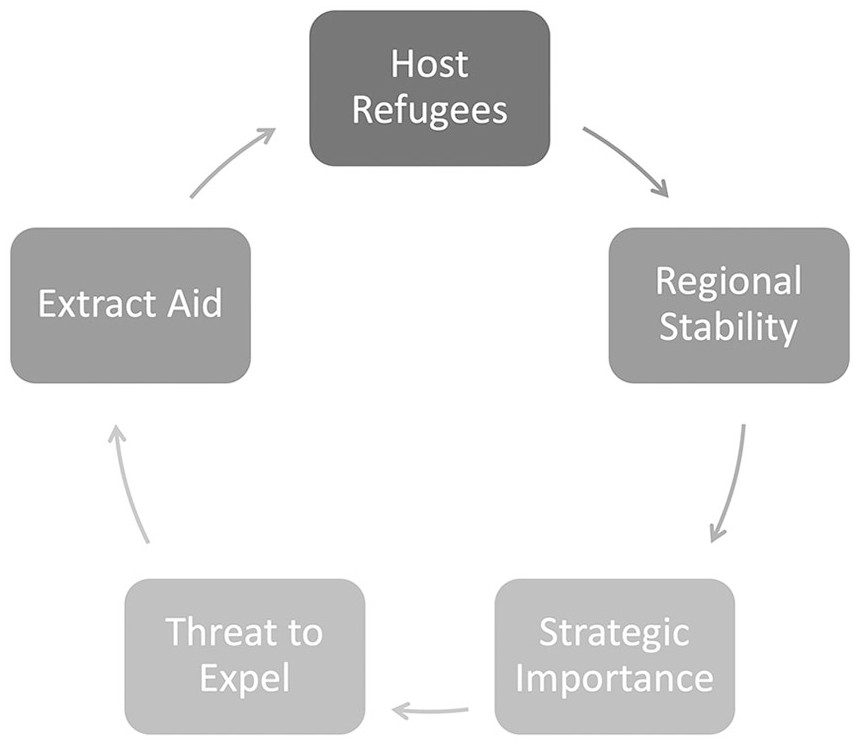
Cycle of regional stability, threats and extraction.
Large refugee movements are both an issue for neighbourhoods and for superpowers interested in maintaining regional stability. Neighbourhoods must find ways of coping with mass movements of people and balancing the concerns of their local communities. Refugee flows play on historic intraregional dynamics, such as ethnic groups split by borders, rivalries for regional dominance and strategic alliances both in and out of the region. One major concern is the spread of civil wars from one state in the neighbourhood to others, which could lead to widespread instability in the region. Superpowers are concerned about regional stability because they want to maintain and pursue their interests in the region. Superpowers – like the United States and the EU – also view regional instability as a source of security threats, particularly terrorist groups in ‘failed’ states.
States host refugees in order to increase their strategic importance in their neighbourhood, in addition to other factors like cultural similarities, economic gains or domestic incentives. A state is more strategically important when a superpower is reliant on the regional ally to shoulder the immediate costs of hosting refugees and prevent the spread of violence in a region. In addition, the regional ally becomes a buffer by absorbing refugees from neighbouring states who could be considered a security threat. A state is strategically important when the international community or superpower could not maintain regional stability without the assistance of the regional ally.
Threats of refugee expulsion take advantage of clientelist relationships between superpowers and regional allies that are usually viewed as controlled by the superpower to pursue its goals. Instead, regional allies can use their strategic importance (not necessarily proximity to superpowers) to threaten refugee expulsion, reversing the power dynamic and pursuing the refugee-hosting state’s goals. In this scenario, the clientelist relationship serves both superpowers and regional allies because the superpowers want a pliable ally in the region to pursue their interests, and regional allies host refugees in exchange for aid and international legitimacy. When the relationship between host countries and superpowers is off balance, host countries can use the threat of refugee expulsion to force a rebalancing.
But threats are only as effective as their credibility. Refugee rentier states can enhance their negotiating position by repeating threats, harassing and in some cases, using violence toward refugees – all in service of increasing the credibility of their threat to expel. The superpower must believe the threat to expel is credible for the regional ally to gain negotiating leverage and extract more aid. States can increase the credibility of the threat by exploiting the deportability of refugees. Deportability is not deportation but ‘the possibility of deportation’ and subject to lawful violence (De Genova, 2002: 438). States construct the ‘illegality’ of undocumented migrants, which results in vulnerable communities that are exploited for their cheap labour. Undocumented migrants live in fear of deportation and are subject to intimidation and harassment because of their precarious status. Deportability is constructed by passing laws defining ‘illegality’ and active harassment by the state through road blocks, workplace raids and home arrests. It is logistically impractical and expensive to attempt to deport entire undocumented communities; rather, a few deportations serve as a spectacle to inspire fear and submission in ‘illegal’ migrants (Peutz and De Genova, 2010).
While De Genova applies deportability to undocumented migrants, the concept has also been applied to temporary workers or refused asylum seekers who also live in fear of deportation (Basok, Bélanger and Rivas, 2014; Lentin and Moreo, 2015: 898; Vosko, 2019). Refugees are not usually a deportable population en masse because they are protected by international law, but states can deport individual refugees if they are a threat to national security. As a result, states actively construct refugees as a security threat, especially after terrorist attacks, to increase their deportability and subsequently increase the credibility of their threat to expel. The construction of refugees as a security threat is part of creating a deportable refugee population and thus more leverage in negotiations. For De Genova, ‘illegality’ is produced to create a vulnerable, deportable and exploitable labour force; in contrast, refugees are constructed as dangerous to the state, not necessarily to exploit refugees for their labour but instead to exploit refugees for leverage in international negotiations. States use the legal uncertainty around deportability to channel harassment and violence toward refugees, but the primary audiences of the threats are not refugees; instead, the threats are aimed at the international community.
While traditional accounts highlight the structural effects of class and race on deportability, this article and others in this special issue consider the role of agency and specific actors who construct deportability to achieve their strategic goals. Kalir (this issue) shows that Spanish police were meant to deport a narrow category of criminal foreigners but the deportations were implemented through the discretion of police officers, who relied on racist and anti-immigrant attitudes. Similarly, this article details how police in Kenya and Afghanistan took advantage of legal uncertainty to threaten and harass refugees based on their biases. Both articles reveal the agency of police officers on the ground within the context of structural racism and discrimination. In addition, Rosenberg’s article (this issue) shows that policymakers are active agents who construct deportability in response to incentives from the public; his findings parallel the incentives described in this article that encourage policymakers to threaten refugee expulsion to extract more aid. Furthermore, this article identifies specific mechanisms for creating deportability beyond the underlying structural causes, namely policymakers in state agencies who make repeated threats of expulsion, harass refugees and impose six-month or year delays that create legal uncertainty for refugees. These mechanisms highlight the role of agency in deportability: while the international refugee regime incentivizes states to threaten expulsion in order to extort more aid, it also takes politicians and policymakers to act on those incentives. Moreover, while Franck and Vigneswaran (this issue) show how migrants strategically navigate deportability, this article shows how state actors like politicians, government leaders and police strategically use deportability for their own ends.
Methodology
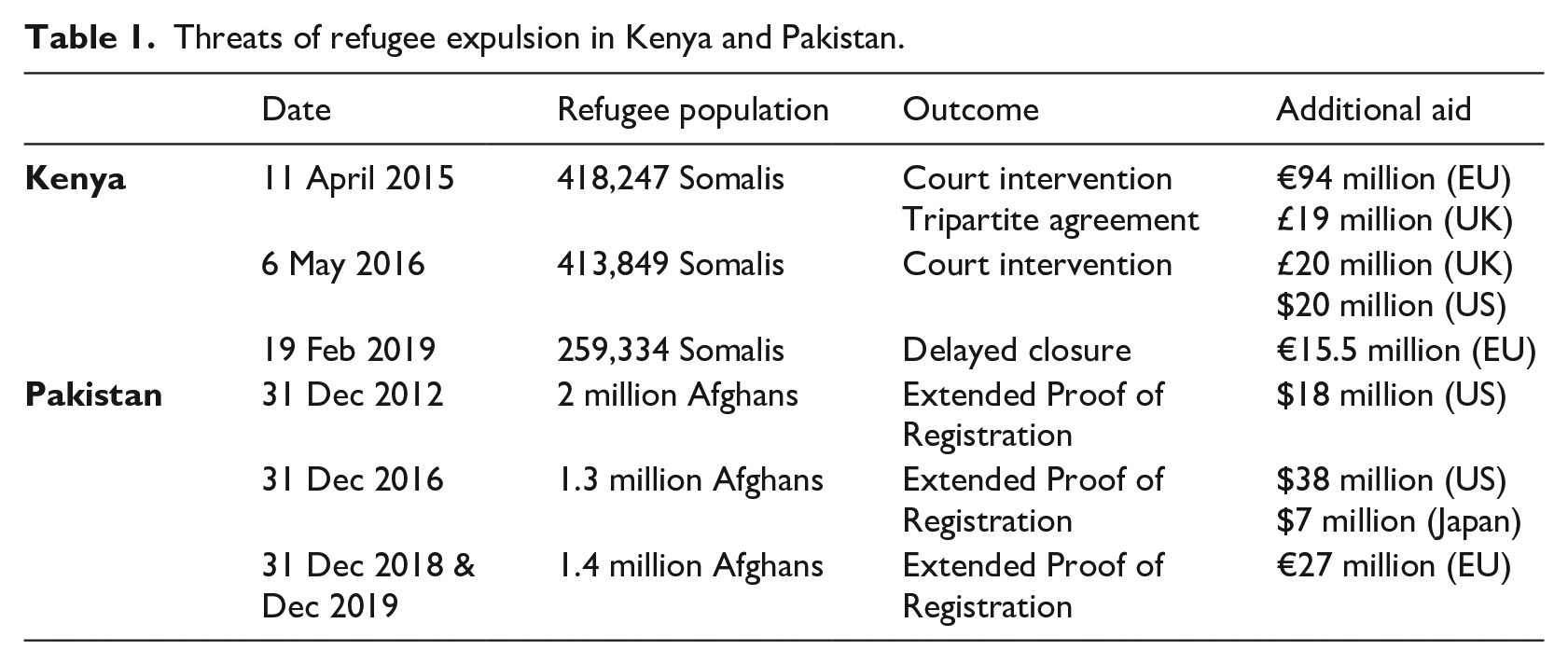
The aim of this article is to present an elaboration of the refugee rentier state model, in order to enable the concept to travel to neighbourhoods with no superpower or to countries that are not contiguous with superpowers. As such, I have selected two deviant cases – Kenya and Pakistan –that are not explained by the Tsourapas (2019) model. 5 Kenya and Pakistan were selected as deviant cases because they host large refugee populations and do not border a superpower but still attempted blackmail. Both countries provide variation on the type and origin of the refugee communities, intraneighbourhood politics and strategic interests of superpowers. Table 1 describes the basic characteristics of the refugee communities, the dates of the threats and the outcome. Both countries have used the strategy of threatening expulsion at least three times, which allows for intra- and cross-case comparisons.
Threats of refugee expulsion in Kenya and Pakistan.
I relied on process tracing to identify the micro-foundations of when and why the deviant cases threatened to expel refugees even though they are not geographically contiguous with a superpower. The case studies were also used to identify additional mechanisms – specifically the superpower’s interest in regional stability and the six-month or year delay as negotiation tactics –that influence how threats to expel refugees work. Each case study is based on the qualitative analysis of government documents and reports, official policies, public statements and confidential memos acquired through WikiLeaks or FOIA requests, in addition to data on foreign aid, refugee flows and deportations from the United Nations. The comparison of two countries and six instances of threats allows for a fine-tuning of the model of refugee rentier states to better apply to deviant cases that do not fit the scope conditions of the original theory. This revised theory incorporates neighbourhood politics and regional stability, which should be explored in future studies with a larger set of cases.
Kenya
The Kenyan government has repeatedly used the threat of mass refugee expulsion alongside documented instances of forced repatriation of Somalis. The threats in 2015, 2016 and 2019 followed terrorist attacks, of which the first two were not directly linked to refugees or refugee camps. Kenyan officials capitalized on the political opportunity after the attacks and before elections to threaten refugee expulsion to extract nearly $200 million in additional aid from the United States, United Kingdom and European Union, and to galvanize voters using xenophobic rhetoric.
Since 1991, Kenya has hosted hundreds of thousands of refugees and asylum seekers, peaking at 517,000 Somalis in 2011 (UNHCR, 2020b). In 2018, 54% of refugees in Kenya were from Somalia, 24% from South Sudan and 8% from the Democratic Republic of the Congo (UNHCR, 2018b). The Kenyan government has long perceived Somali refugees as a threat to security, particularly since the bombing of the United States embassy in Nairobi in 1998 and attacks in Mombasa in 2002 (Adelman and Abdi, 2003). One US diplomatic cable noted: ‘The GOK [Government of Kenya] sees Somalia as a security problem not just for Kenya but for the entire region . . . The GOK is particularly worried that at least some of those entering Kenya are extremists rather than refugees’ (State Department, 2010). While the presence of Somali refugees initially resulted in competition and conflict with local communities and an increase in violent crime, UNHCR funded a security package for local Kenyan police that led to the Dadaab region becoming more secure than Nairobi (Milner, 2009: 99). Nevertheless, the Refugee Consortium of Kenya argued that . . . in the run-up to elections many politicians will not hesitate to manipulate the refugee situation as an electioneering gimmick. Members of Parliament have been known to distort facts and stereotypes and vilify refugees as the sole source of increased crime and insecurity, proliferation of illegal arms and scarcity of resources . . . Blaming refugees detracts attention from their own responsibilities towards their constituents. (2003: 17)
Domestic political actors constructed Somalis as a security threat before elections, while also becoming an important regional ally in the US ‘war on terror’ (Milner, 2009: 105).
The Kenyan government began to shift away from a relatively hospitable and generous reception for refugees to a more restrictive policy in 2012 when the Department for Refugee Affairs ordered all refugees living in cities to move to camps. The High Court of Kenya (2013) overturned the forced encampment policy on the grounds that it violated the Kenyan constitution. But in 2013, Al-Shabaab attacked the Westgate shopping mall, killing 67 people. In response, a joint parliamentary committee recommended that ‘Dadaab (Daghale, Ifo, Ifo II, Hagdera, Kambios) and Kakuma Refugee Camps should be closed and resident refugees repatriated to their country of origin’ because of fears that refugee camps were safe havens for terrorist groups (Kenya National Assembly, 2013: 54). UNHCR stepped in to negotiate a tripartite agreement between the UN and the Kenyan and Somali governments to facilitate voluntary repatriation of Somali refugees. UNHCR’s representative in Kenya said: ‘It’s very important to underline that no one is forcing Somalis to leave Kenya. The government and people of Kenya have tirelessly provided protection and assistance to Somali refugees for two decades. The agreement we signed on Sunday does not mean Kenya is no longer willing to do so’ (UNHCR, 2013). The tripartite agreement set the ambitious goal of 135,000 voluntary repatriations by December 2017, but returns fluctuated drastically: for example, 33,737 people returned via the UN scheme in 2016, while only 485 returned in 2014. By 2019, a total of 85,067 Somalis had returned under the same scheme and only 2,142 people returned in 2019 – a reflection of the vacillating security situation in Somalia (UNHCR, 2021).
On 2 April 2015, Al-Shabaab attacked and killed 148 students at Garissa University College in eastern Kenya. This second terrorist attack created widespread panic and xenophobia about the presence of Somali refugees in Kenya. Nine days later, Kenyan Deputy President William Ruto told UNHCR to close Dadaab camp within three months or else ‘we shall relocate them ourselves’ (Botelho and Leposo, 2015). This first threat was justified in terms of national security, but no concrete steps to close the camp or expel Somalis followed. But the resulting pressure on the international community led to the Ministerial Pledging Conference on Somali Refugees in October 2015 at which 50 countries raised €94 million toward the tripartite agreement, to add to £19 million received from the UK in July 2015 (British High Commission Nairobi, 2015; UNHCR, 2015).
The second threat came on 6 May 2016 from the Ministry of Interior to disband the Department of Refugee Affairs and close the Dadaab camp. Karanja Kibicho, Principal Secretary of the Ministry of Interior, issued a directive stating that ‘having taken into consideration its national security interests, [the government of Kenya] has decided that hosting of refugees has to come to an end’ (Government of Kenya, 2016). The Kenyan government hoped that the threat would lead to more aid, stating ‘the international community must collectively take responsibility on humanitarian needs that will arise out of this action’ (Government of Kenya, 2016). The official statement was aimed at the international community rather than at Somalia or domestic audiences, which reiterates Kenya’s strategic use of threats to expel refugees, with the aim of extracting more aid rather than actually expelling refugees. By September 2016, the UK committed to an additional £20 million and the United States added $20 million from the State Department’s Emergency Refugee and Migration Assistance Fund (British High Commission Nairobi, 2016). While the deadline to close Dadaab elapsed on 30 November 2016, the Ministry of Interior continued to insist that the closure and repatriation would continue in a ‘humane way’. But on 9 February, the High Court of Kenya (2017) blocked the attempt to close Dadaab because it amounted to ‘an act of group persecution’.
On 15 January 2019, Al-Shabaab attacked the DusitD2 hotel complex in Nairobi, killing 21 people (BBC, 2019). Later, 12 suspects were arrested in the Dadaab camp (Kamau, 2019). Again, the Kenyan government blamed Somali refugees for the insecurity. The third threat came on 19 February 2019 when the government wrote a letter to UNHCR with plans to close the Dadaab camp within six months (AFP, 2019). The government called on UNHCR ‘to expedite relocation of the refugees and asylum-seekers residing therein’ (AFP, 2019).
Since 2015, the Kenyan government has intensified the deportability of Somali refugees – making Somali refugees more vulnerable to harassment, violence and extortion. Since 2011, refugees in Dadaab have reported excessive force by police, destruction of property and beatings (New Humanitarian, 2011). The repeated threats to close Dabaab created an atmosphere in which police could harass refugees in the name of state policy. Government and UN officials claimed repatriations were strictly voluntary but Amnesty International contested this characterization on the grounds that the government did not provide any alternatives to ‘voluntary’ repatriation and camp closures (Amnesty International, 2016: 16–18). Amnesty International asserted that the security conditions in Somalia were too dangerous and unstable for return. In camp surveys, the vast majority of Somali refugees did not want to return to Somalia (Amnesty International, 2016: 19). Amnesty also found that the information provided to refugees about security conditions in Somalia were out of date or inaccurate. Some refugees reported returning to Somalia only to be targeted by Al-Shabaab, forcing them to flee again to Kenya (Hujale, 2019). Other refugees in Dadaab reported harassment and being forced to pay bribes to UNHCR staff and other middlemen to repatriate (Hayden, 2019). While Dadaab was not closed, the conditions in Kenya’s refugee camps worsened in 2018–2019, as the World Food Programme cut rations and the Kenyan government increased restrictions on movement (REACH, 2018). One refugee said: ‘Basically, we are in an open jail’ (Hayden, 2019). In April 2019, the government removed the legal status of the IFO-2 and Kambioos camps (two of the five camps that were previously part of the Dadaab complex), ‘which had been emptied of refugees, who voluntarily returned home’ (Mutambo, 2019).
In short, the Kenyan government pressured Somali refugees by threatening to close Dadaab and expel refugees, and restricting their movement. These policies increased their deportability and created an environment of intimidation, harassment and violence toward Somali refugees in Kenya. The government played on the precariousness of the refugees to make increasingly urgent demands for more aid from the international community.
Despite the threats to close Dadaab, the Kenyan government acknowledged that it could not completely close the camp. Cleopa Mailu, the Permanent Representative of Kenya to the UN in Geneva, said: ‘The Government of Kenya remains fully aware of the solutions required for the various categories of persons in the remaining camps in Daadab’ (Mutambo, 2019). Instead, the government increased the deportability of Somali refugees by squeezing food rations, closing adjacent camps and harassing Somalis with police raids. This increased the government’s leverage in negotiations for aid.
After Kenya’s repeated threats and delays, the EU pledged in July 2019 an additional €13.5 million for Somali refugees in Kenya (European Commission, 2019a) and another €2.025 million in September 2019 to support UNICEF programmes with children in Dadaab and Kakuma camps (UNICEF, 2019). Overall, humanitarian funding for refugees in 2019 reduced as a result of the Trump administration’s cuts to the US State Department and to foreign aid more generally. For example, the United States contributed $177 million in 2018 to UNHCR’s Kenya operations but cut that to $54 million in 2019 (UNHCR, 2018a, 2019a). While the Trump administration cut funding to refugees around the world, the EU and other institutions stepped up their funding for refugees in Kenya.
After years of more restrictive refugee policies and direct threats of expulsion, Kenya achieved through threats what it could not through multilateral appeals: the international community pledged more aid for Somali refugees. Kenya’s threats of refugee expulsion can be viewed as a foreign policy tool that was used for extracting additional aid. Kenya became a refugee rentier state and began blackmailing the international community for higher refugee rents, but it was not Kenya’s geographic location near a superpower that created its leverage. Instead, Kenya was strategically important to the stability of the neighbourhood: a mass repatriation of Somalis would destabilize and further exacerbate conflict in the Horn of Africa.
Pakistan
The Pakistani government repeatedly threatened refugee expulsion, most notably in 2012, 2016 and 2018–2019. Pakistan used the expiry of all Afghan refugees’ proof of registration (PoR) cards to extort $85.5 million in additional aid from the international community and concessions from Afghanistan. While Pakistan previously armed Afghan refugees to challenge its neighbour, the recent threats aimed to extort rents from the international community, capitalizing on the regional stability provided by hosting two million displaced Afghans.
The Afghan population in Pakistan dates back to their original displacement in the 1970s during the Afghan civil war and Soviet invasion. Oberoi (2006: 140) argues that Pakistan ‘welcomed these refugees with open arms’ because of ethnic solidarity between Pashtuns on both sides of the border and to ‘provide hospitality to Muslim brethren fleeing a perceived un-Islamic regime’. The Pakistani government armed refugees to fight subsequent Afghan regimes, particularly in disputed territory along the border. Oberoi also notes that co-ethnic refugee communities influenced political parties in provincial and national elections (2006: 146). After the fall of the Taliban in 2002, the UN negotiated a tripartite agreement to voluntarily repatriate most Afghan refugees by 2009. In 2006, the UN assisted in an extensive registration exercise, helping the Pakistani government to issue each Afghan refugee a PoR card that would expire on 31 December 2009 (UNHCR, 2009). As the deadline approached, UNHCR worried that some 1.7 million Afghans would become undocumented and vulnerable to abuse or forcibly expelled. One US diplomatic cable in 2009 reported that the Pakistani Minister of Interior claimed in a meeting that Afghan refugees were a ‘menace’ and there must be ‘a way forward to voluntary, dignified, yet expeditious departure of Afghan refugees from Pakistan’ (State Department, 2009). Both the United States and UNHCR reported that mass deportation would likely just result in the return of the deported as undocumented aliens. Similarly, camp closures would not resolve security issues but would just disperse the refugees and might leave disgruntled and/or radicalized former camp residents . . . [and] forced repatriation would further destabilize the region and be a waste of good will with Afghanistan. (State Department, 2009)
It was not until late December 2009 that Pakistan agreed to extend the PoR cards until the end of 2012.
As the 31 December 2012 deadline approached, it was unclear what would happen to Afghan refugees when their legal residency documents expired. Habibullah Khan, the Minister of States and Frontier Regions, explained the Pakistani government’s position: The international community desires us to review this policy but we are clear on this point. The refugees have become a threat to law and order, security, demography, economy and local culture. Enough is enough. If the international community is so concerned, they should open the doors of their countries to these refugees. Afghans will be more than happy to be absorbed by the developed countries, like western Europe, USA, Canada, Australia. (Shah, 2012)
Again, as with Kenya’s threats, the Pakistani government aimed its message at the international community, not its neighbour. The goal was not to overwhelm Afghanistan, but to extract higher refugee rents from the international community. For six months, Afghan refugees in Pakistan waited in legal limbo until the government decided that Afghans had until December 2014 to renew their PoR cards, which would then expire in December 2015 (UNHCR, 2014).
On 16 December 2014, gunman from the Pakistani Taliban attacked a school in Peshawar, killing 145 people (BBC, 2014). Local authorities initially blamed the attack on Afghan refugees, leading to harassment by police. The Minister of States and Frontier Regions described the situation: [The] provincial government of K-P [Khyber Pakhtunkhwa] wanted to oust the Afghan refugees immediately post-the December 16 attack . . . The K-P government has become really aggressive [towards Afghan refugees] and we also have reports of harassment from . . . Peshawar and other areas of the K-P. We have taken [up] the matter of harassment with the K-P government [but] the K-P government is not maintaining as much oversight over the police on the issue of harassment of Afghans as it should. (Human Rights Watch, 2015a: 14)
Police used the uncertainty – and thus deportability – surrounding the PoR cards to harass and intimidate Afghans. Human Rights Watch documented police harassment of Afghan refugees in relation to the massacre and their paperwork, and extorted bribes (Human Rights Watch, 2015a, 2015b, 2017). In addition, police continued to raid refugee communities and threaten refugees with deportation (Najafizada and Maroof, 2015). This campaign of harassment instrumentalized the Afghan refugees’ vulnerability because of their lack of status – a type of ‘illegality’ that was created by the state and impossible for Afghan refugees to resolve without state action – to pressure refugees to repatriate. UNHCR registered nine times more Afghans returning in January 2015 following the Peshawar attack than in the month before (Human Rights Watch, 2015b).
Pakistani officials extended the validity of Afghan PoR cards in January 2016 and once again in June 2016, each time adding only six months and refusing to issue new cards (Ali, 2016). This created a persistent state of uncertainty and deportability in which police abused, extorted and illegally detained Afghan refugees because all PoR cards in the country had technically expired. Facing this uncertainty and violence, many refugees fled Pakistan in conditions between voluntary and forced repatriation. Human Rights Watch condemned UNHCR’s ‘voluntary’ repatriation programme because the UN’s participation legitimized both the myth that Afghanistan was safe for return and the violence aimed at convincing Afghan refugees to leave (Human Rights Watch, 2017).
From 2012 to 2016, Pakistan played a cat-and-mouse game with the Afghan refugees; during the same time period, the United States nearly doubled aid for refugees in Pakistan from $18 million (2012) to $37 million (2016), 6 while Japan contributed an additional $7 million in emergency aid for Afghan refugees in Pakistan (Ministry of Foreign Affairs of Japan, 2017). While it is clear that many Afghans were expelled (as well as coerced into repatriating), Pakistan’s larger foreign policy goal was largely successful. By threatening mass expulsion, creating legal uncertainty and deportability, Pakistan was able to capture the world’s attention on their refugee problem and create regular moments for extortion every six months.
In July 2018, Imran Khan and his political party Pakistan Tehreek-e-Insaf (PTI) won the elections. Khan became the first ethnic Pashtun to become Prime Minister, shifting political power away from the Pakistan Muslim League, which had historically led the discrimination and repression of Afghan refugees. On 17 September 2018, Khan made a surprise proposal to grant Pakistani citizenship to all Afghan refugees. Khan said: ‘We will inshallah [god willing] give passports to those Afghans whose children were born here and grew up in Pakistan. When you are born in America, you get the American passport. Why are we so cruel to these people?’ (Wilkinson, 2018). Some analysts suggested that Khan’s proposal was a strategic move to naturalize Afghan refugees – many of whom are also Pashtuns living in the Khyber Pakhtunkhwa region – to secure his future electoral base (Barker, 2018). But both opposition parties and his own party baulked at the proposal and Khan backtracked on his statement, suggesting they were only meant to spark a debate.
Yet again, in 2018 and 2019, the Pakistan government used the delay tactic by extended the PoR cards by only one year and demanding more aid (Government of Pakistan, 2019). In January 2018, the ambassador of Pakistan in the US, Aizaz Ahmad Chaudhry, threatened Afghan refugees, saying ‘Their youths are rented by terrorist groups . . . We will deport both Haqqanis and Taleban to their own country including the Afghan refugees living in Pakistan’ (Bjelica and Sabawoon, 2018). Soon after, in March 2019, the European Commission announced a new €27 million aid package to help Afghan refugees (Saleem, 2019) and an additional €2.8 million to UNHCR in Pakistan from the EU (European Commission, 2019b). While previously Pakistan would have looked to the United States to extort aid, the Trump administration was already signalling an aggressive strategy toward Pakistan and Afghanistan, including the possible withdrawal of US troops (White House, 2017).
At the time of writing, the PoR expiration date for Afghan refugees is 30 June 2020, and processing was suspended in March 2020 because of the COVID-19 pandemic. The UNHCR representative in Pakistan, Ruvendrini Menikdiwela, said: ‘The decision will provide relief and predictability to Afghan refugees who were facing uncertainty and anxiety’ (UNHCR, 2018c). Menikdiwela’s statement points to the anxiety and psychological state of many Afghan refugees with expired PoR cards with unpredictable (and deportable) futures. UNHCR has advocated for structural reforms to make Afghan refugees less vulnerable: the State Bank of Pakistan announced in March 2019 that Afghan refugees can open bank accounts using the PoR cards (Imaduddin, 2019). In addition, UNHCR negotiated with the government a new policy starting in 2020 whereby refugees can renew and collect their PoR cards from modification centres and mobile registration vans around the country, in addition to being able to check their status via SMS (UNHCR, 2020a). It remains to be seen if the new policy will significantly decrease the deportability of Afghan refugee communities.
Conclusion
This article has looked at how refugee rentier states that do not share a border with a superpower are able to use threats of refugee expulsion for blackmail. By examining two cases – Kenya and Pakistan – I found that refugee-hosting states become strategically important to the international community because they provide stability in a conflict region. Because of this newfound importance to regional stability and intraneighbourhood politics, refugee-hosting states can threaten expulsion to extract additional aid and obtain international legitimacy.
Both Kenya and Pakistan justified their threats to expel refugees because of terrorism and national security. Often the threats came after a terrorist attack, despite the paltry evidence that the attacks were associated with refugees. But refugees in both Kenya and Pakistan had been displaced for decades, so host states had to portray refugees as a new security threat and to construct their deportability to make the threats of expulsion credible to the international community. Threats of refugee expulsions were not primarily about the refugees themselves, but were rather a tool for pursuing the political interests of domestic, regional and international actors. Both Kenya and Pakistan used six-month or year delays as negotiation tactics to extract more aid. For Kenya, the Deputy President delivered the first threat verbally, which was followed one year and one month later by a formal directive to close the Dadaab camp. The international community took the second threat more seriously because it was more formal and set a clear deadline. Once the November 2016 deadline had passed, Kenyan officials continued to push their policy of camp closure and expulsion as a negotiation tactic. The third threat in 2019 was poorly timed because the Trump administration had already cut his foreign aid budget. In Pakistan, officials repeatedly created artificial emergencies by generating uncertainty and confusion about the extension of the PoR cards. The pressure from these ‘emergencies’ pushed international donors to increase their support for Afghan refugees in Pakistan. These manufactured emergencies created recurring opportunities to pressure the international community for more aid. This negotiation tactic, i.e. manufacturing migration emergencies, can be seen in other places such as when President Trump provided only six months’ notice that the Deferred Action for Childhood Arrivals (DACA) protections would be annulled in March 2018. In Pakistan, Kenya and the US, threats of deportation had little to do with refugees. Rather, refugees were pawns in political games pursuing domestic, regional and international interests.
This study has found that the threat of refugee expulsion was surprisingly successful at extracting additional aid from the international community. These two cases show how refugee-hosting states can leverage their strategic importance to regional stability as a foreign policy tool. While some states view the hosting of large refugee populations as a burden, Kenya and Pakistan found that by virtue of their initial hospitality to refugees, they became more important to the international community because they provided stability to their neighbourhood. Once they became strategically important to the region, Kenya and Pakistan used the deportability of refugees and the threat of refugee expulsion as foreign policy tools to extract more aid and international legitimacy.
Footnotes
Acknowledgements
Thank you to the editors of the special issue. In addition, this article benefited from excellent feedback from the participants of the ‘Migration and Security: A new agenda of research’ workshop at Université Laval (March 2019) and the International Studies Association (April 2018).
Funding
The author received no financial support for the research, authorship, and/or publication of this article.
