




Abstract
Discussions about the legitimacy of private security companies (PSCs) in multilateral military interventions abound. This article looks at how the United States has sought to legitimize the outsourcing of security services to PSCs through performance-based contracting and performance assessments. Both mechanisms aim to demonstrate the effective provision of publicly desirable outcomes. However, the immaterial and socially constructed nature of security presents major problems for performance assessments in terms of observable and measurable outcomes. Performance has therefore given way to performativity – that is, the repetitive enactment of particular forms of behaviour and capabilities that are simply equated with security as an outcome. The implications of this development for the ways in which security has been conceptualized, implemented and experienced within US interventions have been profound. Ironically, the concern with performance has not encouraged PSCs to pay increased attention to their impacts on security environments and civilian populations, but has fostered a preoccupation with activities and measurable capabilities that can be easily assessed by government auditors.
Introduction
Concerns about the legitimacy, accountability and control of private security companies (PSCs) involved in international military interventions have figured prominently in public and academic debates (Avant, 2005; Krahmann, 2010; Leander, 2013; Percy, 2007). 1 They have been fuelled by reports of contractor fraud, waste and human rights abuses in Iraq and Afghanistan (Commission on Wartime Contracting, 2011; House of Representatives, 2010). Nevertheless, a growing number of clients, including not only the United States, Canada, Britain and Germany, but also the United Nations, NATO and the European Union, consider PSCs to be legitimate actors who contribute significantly to global governance in regions of conflict (Krahmann, 2016; Leander, 2013; Østensen, 2011a; Spearin, 2008).
Academic research has identified several strategies by means of which governments, international organizations and the security industry have sought to legitimize the outsourcing of security services to PSCs in the face of public scepticism. These strategies include national and voluntary regulation, international legal discourses, the framing of PSCs as humanitarian actors and their authority as recognized ‘security experts’ (Joachim and Schneiker, 2012; Krahmann, 2012; Leander, 2010; Leander and Van Munster, 2007; Østensen, 2011b). So far, however, one important legitimizing strategy and its consequences have not been investigated: performance-based contracting and performance assessments (Ng et al., 2009; Perry, 2009; Spearin, 2014). Performance, defined in terms of publicly beneficial outcomes, has emerged as a central legitimizing paradigm for states, international organizations and NGOs following the rise of neoliberalism and New Public Management approaches (Lewis, 2015; Radin, 2007). These approaches argue that performance measures help demonstrate effectiveness, ensure public accountability and generate legitimacy (Sondorp et al., 2009: 141). In international military interventions, governments have thus used performance-based contracting and performance measurements to manage and justify the contracting out of security services vis-à-vis primary national constituencies and audiences, such as auditors, parliaments and electorates. Yet we know little about the practical implications of this legitimization strategy for the ways in which commercial suppliers provide security in the field. How do performance-based contracting and performance assessments shape the conceptualization, implementation and experience of security in multilateral military interventions?
The present article aims to address this question through a critical investigation of US Department of Defense (DoD) security contracting in Iraq and Afghanistan. It contends that the immaterial and socially constructed nature of security presents major problems for the measurement of performance in terms of results. Specifically, performance assessments must determine how to define security as an outcome and how to measure the performance of individual contractors. US contracting officials have responded to the demand for observable, quantifiable and attributable performance tasks and criteria by conceptualizing security in terms of performative acts – that is, the repetitive enactment of activities and capabilities that are equated with security as an outcome (Butler, 1988).
The following discussion problematizes the social construction of security as performative acts by drawing on the work on performativity by Judith Butler (1988) and Paul Higate and Marsha Henry (2009, 2010). It contends that the definition of security as performative activities and capabilities not only moves to the margins alternative (conceptions of) security outcomes, such as the frequency and impact of hostile attacks or the subjective perceptions of security among mission staff and local populations, but also neglects the socially and culturally constructed relationship between security services and their outcomes. As US performance-based security contracting in Afghanistan and Iraq demonstrates, the consequences both for a particular mission and for the local populations who are the purported beneficiaries of security governance interventions are considerable.
By providing a theoretical explanation and empirical illustration of the potential implications of performance-based contracting and performance assessments, this article seeks to contribute to two academic debates. The first debate concerns the consequences of the commodification and marketization of security. According to the critical security studies literature, the implications of these developments go far beyond the ‘simple’ delegation of security functions to firms. New hybrid forms and assemblages of state and non-state security providers transform how security is understood and governed (Williams and Abrahamsen, 2010; Berndtsson and Stern, 2011). On the one hand, these new modes of security governance are associated with a depoliticization of security – for instance, by making non-state actors responsible for their own safety and by delegating security decisions to a narrow technocratic set of commercial security professionals (Leander, 2005; Leander and Van Munster, 2007). On the other hand, these modes are inherently political and characterized by underlying ‘power struggles’ among clients, firms, employees and third parties (Bures, 2014). Contracted security is thus deeply involved in the reproduction of gendered or racial power relations, including the attribution of security roles, knowledge and capabilities to specific groups, such as the Gurkhas or male, White American ex-special forces personnel (Chisholm, 2014; Eichler, 2015; Higate, 2012a, 2012b). In addition, commodification has led to the definition and provision of security as an excludable and divisible property of paying clients rather than a public good (Krahmann, 2008, 2012; Schouten, 2014). The following analysis adds to these critiques by investigating the ways in which contractual performance criteria contribute to (re)shaping the definition, implementation and experience of security in international military interventions.
Second, this article engages with the debate about the practices, limits and consequences of performance measurement more generally. While the mainstream literature on organizational and public management has investigated performance assessments mainly with a view towards developing ‘better’ performance indicators and verification mechanisms (see e.g. Buchanan and Klingner, 2007), the following analysis offers a fundamental critique of these practices. This critique goes beyond existing studies, which have pointed towards the ambiguity or (de)politicization of performance criteria (Fowler, 1996; Lewis, 2015; Lipson, 2010; Terman and Yang, 2010). It contends that performance outcomes such as security, health and development are not only politically contested but also socially constructed in ways that reflect the specific understandings and interests of officials, managers and professional experts involved in the contracting, provision and auditing of these services (Leander, 2005). Performance assessments and performance-based legitimization are inherently problematic, especially when applied to global governance actors who engage across cultural boundaries or in contexts where narrow technocratic elites and epistemic communities, rather than the affected audiences or stakeholders, define ‘appropriate’ performative acts, processes and outcomes.
Owing to its focus on the consequences of performance-based contracting and assessments for security, a systematic analysis of the success of these methods in legitimizing PSCs in the eyes of national and international constituencies and audiences, such as the US Congress, the American public or host populations, is beyond the scope of this article. Research on military and security contracting in different countries suggests that the legitimizing effects are likely to vary, depending on the respective national, organizational and societal contexts (Bures, 2015; Krahmann, 2010; Leander, 2013).
The article’s findings on performance assessments as a legitimizing strategy and the broader implications of performance-based contracting, however, have a wider relevance, since the use of performance measurements is by no means limited to the US DoD and commercial security contractors in international interventions. Other states and organizations, such as the Canadian armed forces, also legitimize their employment of PSCs through performance-based contracting and performance criteria (Perry, 2009; Spearin, 2014). In fact, a growing range of state and non-state actors, including the United Nations, the World Bank, the International Monetary Fund, the United States Agency for International Development and various nongovernmental organizations, have embraced performance assessments as a standard for legitimacy in many fields of global governance, ranging from finance and development to health (Fowler, 1996; Lipson, 2010; Lynch-Cerullo and Cooney, 2011; Radin, 2007; Spar and Dail, 2002; Weaver, 2010). While this article focuses on security, its arguments and findings thus have potential implications for other areas and actors engaged in global governance that require further research.
The article is divided into four main sections. The first outlines the rise and critique of performance assessments as a neoliberal legitimization strategy. The second section explains why security presents significant difficulties for performance measurement and why the substitution of outcomes with performative acts is problematic. The third section illustrates these problems in the example of US DoD security contracting in Iraq and Afghanistan, while the fourth section looks at the implications for the provision of security in international military interventions. The article concludes that the performative turn in security contracting has profound consequences not only for the legitimization of global and security governance actors, but also for the ways in which security is conceptualized, implemented and, ultimately, experienced in regions of conflict.
Legitimization through performance assessment
Whether and under what circumstances actors, behaviours, policies and outcomes are legitimate have been important concerns in social science (Gilley, 2006). Legitimacy seems to be essential for the creation as well as for the survival and operation of an organization. Among other things, legitimacy helps to reduce implementation costs because citizens, clients and employees are more likely to comply if they consider an actor and its requests as legitimate. Conversely, ‘organizations that … lack acceptable legitimacy accounts of their activities … are more vulnerable to claims that they are negligent, irrational or unnecessary’ (Meyer and Rowan, 1991: 50, cited in Suchman, 1995: 575).
But what do we mean by legitimacy? According to Mark Suchman (1995: 574), legitimacy refers to ‘a generalized perception or assumption that an entity or the actions of an entity are desirable, proper or appropriate within some socially constructed system of norms, values, beliefs and definitions’. Since legitimacy is usually contested, it is best analysed in terms of social processes, including the use of specific strategies for gaining, maintaining and repairing legitimacy. Legitimization strategies can build on a plethora of measures and resources, including status, authority, institutions, norms, habit and outputs (Andersen, 2012; Johnson et al., 2006; Scharpf, 1998). Frequently, they simultaneously address multiple audiences and constituencies, ranging from employees to clients and from citizens to international stakeholders.
The contemporary popularity of performance-based contracting and performance assessment as legitimization strategies has been connected to the advance of neoliberalism and New Public Management approaches since the 1970s (Lewis, 2015; Martin and Kettner, 1997). These approaches argue that performance measurement can help resolve public distrust over whether governments and ‘the organisations and individuals that they fund and manage, even at one or more steps removed, are doing what they are mandated to do’ (Lewis, 2015: 1). In its early years, New Public Management defined performance as improved effectiveness and cost-efficiency (Martin and Kettner, 1997: 17). However, cost-efficiency has often been difficult to demonstrate, and sometimes it has clashed with other goals. Since the 1990s, public governance discourses have therefore increasingly associated performance with the achievement of ‘results’ or ‘publicly beneficial outcomes’. The utility of performance assessments as a legitimization strategy has been explained through the work of mainstream scholars such as Fritz Scharpf (1998, 2009). Scharpf (1998: 2) has argued that a lack of input legitimacy – that is, ‘government by the people’ through democratic decisionmaking processes and public participation – can be addressed through a focus on ‘output legitimacy’ 2 – ‘government for the people’ through decisions leading to outcomes that serve the ‘common interest’.
Owing to the global diffusion of neoliberal thinking, many state and non-state actors have embraced performance assessments to claim output legitimacy for national and international activities (Fowler, 1996; Lipson, 2010; Lynch-Cerullo and Cooney, 2011; Radin, 2007; Spar and Dail, 2002; Weaver, 2010). In the USA, the 1993 Government Performance and Results Act was instrumental in introducing results-based performance assessment as a means of demonstrating the output legitimacy of US government agencies and contractors. Successive US governments have continued and expanded this practice, including through the passing of the 2010 Government Performance and Results Modernization Act by the Obama administration. Within the prevailing neoliberal discourse, performance has come to constitute a major framework of belief by means of which the US government seeks to justify and legitimize its actions, including the contracting out of a growing range of security functions within international military interventions.
Despite the international proliferation of performance assessments as a legitimizing mechanism, they have been criticized for a variety of reasons. The mainstream academic literature has concentrated on the practical difficulties of measuring results-based performance in an objective, comparable and unambiguous manner (Fowler, 1996; Lipson, 2010). Representative of this literature is Alan Fowler (1996: 58–59), who identifies five major obstacles to performance measurement. First, the more actors are interested or involved in the provision of a service, the greater the diversity of opinions on what is needed and how a service should be supplied. Who decides what kinds of security services are necessary in international military interventions? Second, external influences and intervening factors frequently influence service outcomes in such a way that they cannot be exclusively attributed to the provision or provider. The absence of enemy attacks, for instance, may be due not to increased security guarding, but because of simple factors such as a change in weather conditions. Third, ‘the time scales over which results can be seen or measured tend to increase when moving from outputs to outcomes and then to impacts’ (Fowler, 1996: 59). The outcomes or impacts of security services may sometimes only become apparent after the end of a contract. Fourth, whether a service is relevant and suitable for attaining specific results often rests on assumptions about linear causal relationships between services (outputs) and outcomes that contradict the complexity of many issues (Fowler, 1996: 59; Lipson, 2010). Finally, the further one moves from tangible service outputs towards outcomes, the greater the role of intangible intervening factors.
Other authors have moved beyond the issue of measurement towards the broader implications of performance assessments for the ways in which governance is practised (Everett and Friesen, 2010; Lewis, 2015). They have highlighted the depoliticizing effects of performance measurements, which ‘adopt largely technical and hierarchical forms of accountability’ (Everett and Friesen, 2010: 482). The next section expands upon these criticisms by arguing that the social construction of performance outcomes, targets and indicators reflects the specific understandings and interests of the professional elites involved in this process. Their conceptions of what is to be measured and how shape performance assessments in ways that systematically exclude alternative meanings, results and governance practices from consideration.
Security as performative act
The debates over the meaning and measurement of security illustrate in an exemplary manner the problems of performance assessment. Security can be conceptualized in many ways, including as the fight against known and unknown risks, as speech act, as ‘thick signifier’ and as an ontological condition (Daase and Kessler, 2007; Huysmans, 1998; McSweeney, 1999; Wæver, 1995). Three mainstream understandings dominate the discourses and publications of the armed forces and security professionals that are the focus of the present article. Their most common definition of security is as a condition, involving a low probability or frequency of damage (Baldwin, 1997: 13; Ullman, 1983: 130; Williams, 2008: 6). Another conceptualization refers to subjective perceptions of safety or the emotional state of freedom from anxiety (Rothschild, 1995: 61). Finally, security is frequently defined in terms of activities and capabilities, such as prevention, deterrence, protection, resilience, preemption and avoidance (Krahmann, 2008: 383, 2011: 368–371).
Each of these three conceptualizations suggests a different security outcome, and each outcome faces distinct assessment problems. The statistical measurement of security as low levels of risk or harm is the most problematic for performance assessment, according to the obstacles identified in the managerial literature. For one thing, frequencies and probabilities of injury can only be established over a long time period, which, as suggested earlier, may go beyond individual contracts. In addition, it appears unrealistic to demand that service providers achieve predefined levels of protection from harm when many extraneous factors beyond their control influence the frequency and impact of hostile assaults. Can one blame a PSC for poor performance when attacks on a military base or local populations increase in number and impact if these developments match a general trend such as increased insurgency due to an influx of foreign fighters? For the same reason, it is difficult to attribute conditions of security to specific actors. If the frequency of hostile incidents decreases, this may be as much due to the security provider’s interventions as to an aggressor’s change of strategy.
The definition and assessment of security in terms of clients’ or public perceptions seems to be able to overcome some of these problems. It appears possible to measure and set specific targets for popular security perceptions, which providers could achieve within the timeframe of their contracts. A government or international organization could, for instance, require that 80% of local citizens feel safe. Citizens could also be asked whether and to what degree they believe specific security services, such as guarding and security checks at airports, to be effective in order to attribute lower levels of anxiety to the provider of these services. The main problem with this definition and measure is that perceptions can vary independently of, or even seemingly in contradiction to, the provision of security services. The increased presence of security guards, for example, may contribute to feelings of insecurity instead of alleviating them.
The definition of security as activities and capabilities, such as prevention, deterrence, protection, resilience, preemption and avoidance, appears to fit best the demands of attributable and measurable performance results. Security activities and capabilities can be easily specified, observed and counted – for example, ‘carry out regular security checks’ or ‘provide guards for personnel in transit’. Specific activities and capabilities can also be directly and exclusively attributed to individual security contractors. However, this conceptualization is premised on a deterministic causal relationship between activities or capabilities and specific security outcomes (see Table I). Protective actions and capabilities, such as the provision of bodyguards or the building of fences, (are believed to) ensure a client’s survival. Deterrence mechanisms, including the installation of CCTV surveillance and regular security patrols, are (equated with) the permanent suspension of security threats.
Equation of activities and capabilities with security outcomes.
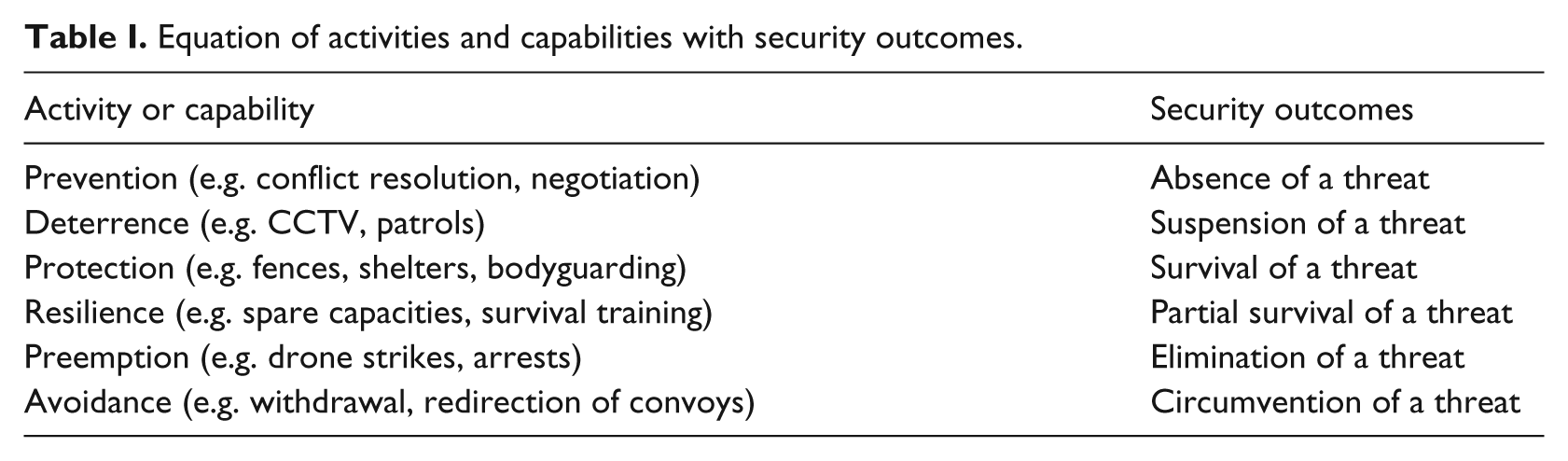
While the reader may argue that activities and capabilities may indeed be linked to outcomes, this is not how security professionals understand the relationships between these factors. Their conceptualizations and definitions of performance targets directly equate activities and capabilities with security as an outcome. Deterrence is the suspension of insecurity, protection means survival, and preemption signifies the elimination of a threat. In short, this conception of security replaces the assessments of security outcomes as separate from, but connected to, specific activities and capabilities with a focus on the repetitive execution of ‘performative acts’ (Butler, 1988).
The concept of performativity, developed especially by Judith Butler (1988, 1993), provides a theoretical framework that makes it possible to understand this equation of performative acts with outcomes and its implications. Butler (1988) has argued that gender is constituted through repetitive performative acts, such as the daily wearing of corsets in Victorian times or that of makeup today. While these performative acts may have material effects on the body of the performer, they primarily work through and on the perceptions of the audience by (re)producing understandings of gender, generally, and a specific person’s gender, specifically. However, performative acts do not only shape gender identities. Within international relations, the concept of performativity has been used to explain the construction of states, national borders, militarized spaces and security (Bialasiewicz et al., 2007; Brassett and Vaughan-Williams, 2015; Laffey, 2000; Higate and Henry, 2009, 2010; Weber, 1998; Williams, 2011). In their analysis of US security policies, Bialasiewicz et al. (2007: 407) observe that the state does not exist prior to performative acts, but is constituted through the repetitive enactment of specific discourses and practices.
The most comprehensive application of the concept of performativity to security can be found in Higate and Henry’s (2009, 2010) analysis of UN peacekeeping. They note two components that determine the ‘success’ of performative acts in creating perceptions and experiences of security. The first component is the ‘choreographed drama’ and theatre-like performances of peacekeeping forces, based on the repetitive re-enactment of specific activities (Higate and Henry, 2010: 42). They write that ‘audiences express perceptions of security and insecurity as they appraise the credibility of security performance played out before them’ (Higate and Henry, 2009: 99). The persuasiveness of these performances in the eyes of clients, the public or potential assailants rests on the repetitive re-enactment of military expertise and prowess in the form of security practices such as regular drills, patrols and security checks. The second component of security as a performative act is the presentation and use of certain capabilities as ‘props’ to lend persuasiveness and legitimacy to a performance. In the UN peacekeeping mission in Liberia, the authors observed that ‘equipment was often used as the key criterion for security performance and, in turn, the creation of safe space’ (Higate and Henry, 2009: 114, emphasis in the original). Ruben Zaiotti (2011: 543) adds a third condition for the success of performative acts by arguing that cultural and historical practices influence which activities are associated with distinctive identities, materialities and experiences. Audiences interpret certain practices as providing security only if they conform to pre-existing sociocultural ideas of ‘suitable’ security activities and capabilities. Performativity works within ideational and normative contexts that ‘precede, constrain, and exceed the performer’ (Butler, 1990: 24, cited in Zaiotti, 2011: 543).
The concept of performativity thus contributes in two ways to our understanding of what happens when security is defined in terms of performative acts. First, it suggests that a performative definition of security embraces the notion that activities, capabilities or interventions are already what they seek to achieve. As Butler (1990: 25) writes, ‘There is no gender identity behind the expressions of gender … identity is performatively constituted by the very “expressions” that are said to be its results’. According to a performative definition, deterrence, protective, preventive or preemptive activities and capabilities are already security. Consequently, the government officials and security experts who make performative definitions of security the basis of their performance tasks and assessments fail to see the contingent and socially constructed relationship between repetitive performative acts and their ideational and material effects on security outcomes.
Second, and related to the above, the observation that performative acts function (only) within pre-existing ideas and norms about ‘appropriate’ security activities suggests the possibility of a problematic disconnect between the international military, contracting and private security professionals who define performance tasks and the local populations who are the intended beneficiaries of these interventions. The administrators and security experts who select specific security activities, capabilities and interventions may have little understanding of how these performative acts will be interpreted and understood within foreign contexts, with potentially detrimental consequences for outcomes and legitimacy. The next section looks at how the move from performance to performativity has shaped the US Department of Defense’s performance measurement and performance-based contracting in Iraq and Afghanistan by examining PSC task orders and performance measures published on US government websites, in DoD handbooks and Government Accountability Office (GAO) reports. 3
Performance-based contracting by the US Department of Defense
Performance assessments are a major preoccupation of US national and global security governance (Deputy Chief Management Officer [DCMO], 2013). The US Army handbook Developing a Performance Work Statement in a Deployed Environment (hereafter, ‘PWS Handbook’) praises the benefits of performance measurements, arguing that they ensure that the ‘government pays for results, not activity’ (US Army, 2009: 4). Owing to the guidelines set out in the PWS Handbook, however, many DoD performance criteria are characterized by a focus on quantifiable and directly attributable targets. This is very problematic with regard to security, because the outcome is not a material product. For instance, the PWS Handbook instructs contracting units to ‘develop a performance standard for each element of the lowest level of work breakdown…. Once you have identified your set of performance standards, apply the SMART test by asking, are these performance measures: Specific? Measurable? Attainable? Relevant? Timely?’ (US Army, 2009: 22). In addition, the achievement of performance tasks and standards must be observable in order to be measured. The PWS Handbook identifies five ‘methods of surveillance’ for the monitoring of performance by government auditors: (1) random sampling, (2) periodic sampling, (3) 100% inspection, (4) trend analysis and (5) customer feedback (US Army, 2009: 26). All but the last of these methods require PSCs to continuously demonstrate their capabilities or to carry out security activities repeatedly to demonstrate performance. In sum, DoD guidelines suggest that PSCs must provide security capabilities and services that are quantifiable, visible and repetitive.
The conceptualization of security in terms of performative acts meets all these criteria and can be found widely in DoD performance-based contracts and measurements. Nevertheless, it can be argued that the DoD embraces a performative definition of security not only for practical reasons – that is, because performative acts are easily measured and observed. The ways in which the DoD specifies performance tasks for PSCs during the US interventions in Iraq and Afghanistan suggest that performative acts and capabilities are also inherently equated with security as an outcome. Three elements illustrate the performative conception of security in DoD contracts and performance assessments.
First, performance tasks are stated in terms of performative security activities and capabilities. The ‘Performance Work Statement’ (PWS) for worldwide counter-narcoterrorism support services between the US Army and DynCorp International, for instance, determines that the company shall provide ‘support for training operations, and logistic[s] for military and civilian missions (including conveyances, weapons, security services, etc.)’ (GAO, 2010: 2). The first part of this performance task refers to actions – that is, ‘training’ and ‘logistics’ support – that may have a security component. The second part lists the required technical equipment – that is, ‘conveyances’ and ‘weapons’. The security guarding contract PWS task order issued to the company Aegis under contract W52P1J-11-D-0082 Task Order 0002 provides more detail but confirms that performance targets are usually set in terms of performative activities and capabilities. The task order specifically requires that ‘Aegis shall provide 360 degrees of security, to include all protective and defensive actions required to counter, deter, detect, and respond to threats’, that ‘Aegis is responsible for staffing personnel that are capable of rapid response to developing situations’ and that ‘Aegis shall have equipment ready to respond to any type of emergency’ (Office of Security Cooperation–Iraq, 2011).
Second, DoD performance tasks demand the repetitive re-enactment of security activities and capabilities, which is typical of performative acts. A US Central Command solicitation for ‘Armed Security Guards/Private Security Providers’ in Afghanistan dated 10 July 2009 illustrates this feature by specifying that ‘contractor(s) must be available 24 hours a day, 7 days a week’. 4
Finally, PWSs equate the performance of activities such as deterring, detecting and responding, as well as the availability of capable personnel and equipment, with security as an outcome. Individual tasks included in the contract specifications are thus phrased in terms that inherently connect activities to outcomes, such as to ‘train Afghan Border Police to perform functions necessary to deny the flow of illegal persons, drugs, and weapons across borders’ (GAO, 2010: 3). Although the reference to denying the flow of illegal persons, drugs and weapons implies an outcome, the contractor’s performance task is not formulated in terms of an intended security result. Instead, the PWS stipulates that the company shall train the Afghan Border Police to ‘perform functions’. The underlying assumption that these, unspecified, functions are necessary and sufficient to prevent illegal transborder interactions rests on a performative understanding of security that substitutes acts for outcomes.
These and other PWSs illustrate that, contrary to the objectives of the SMART test, DoD performance tasks do not conceptualize security outcomes as the (contingent) effects of specific services. PWSs instead demand the repetitive execution of certain activities and evidence of capabilities in ways consistent with a performative notion of security that equates security with performative acts. Other meanings of security as outcome, such as achieving consistently low levels of damage from enemy attacks or generating feelings of safety and security among staff, cannot be found in PWSs.
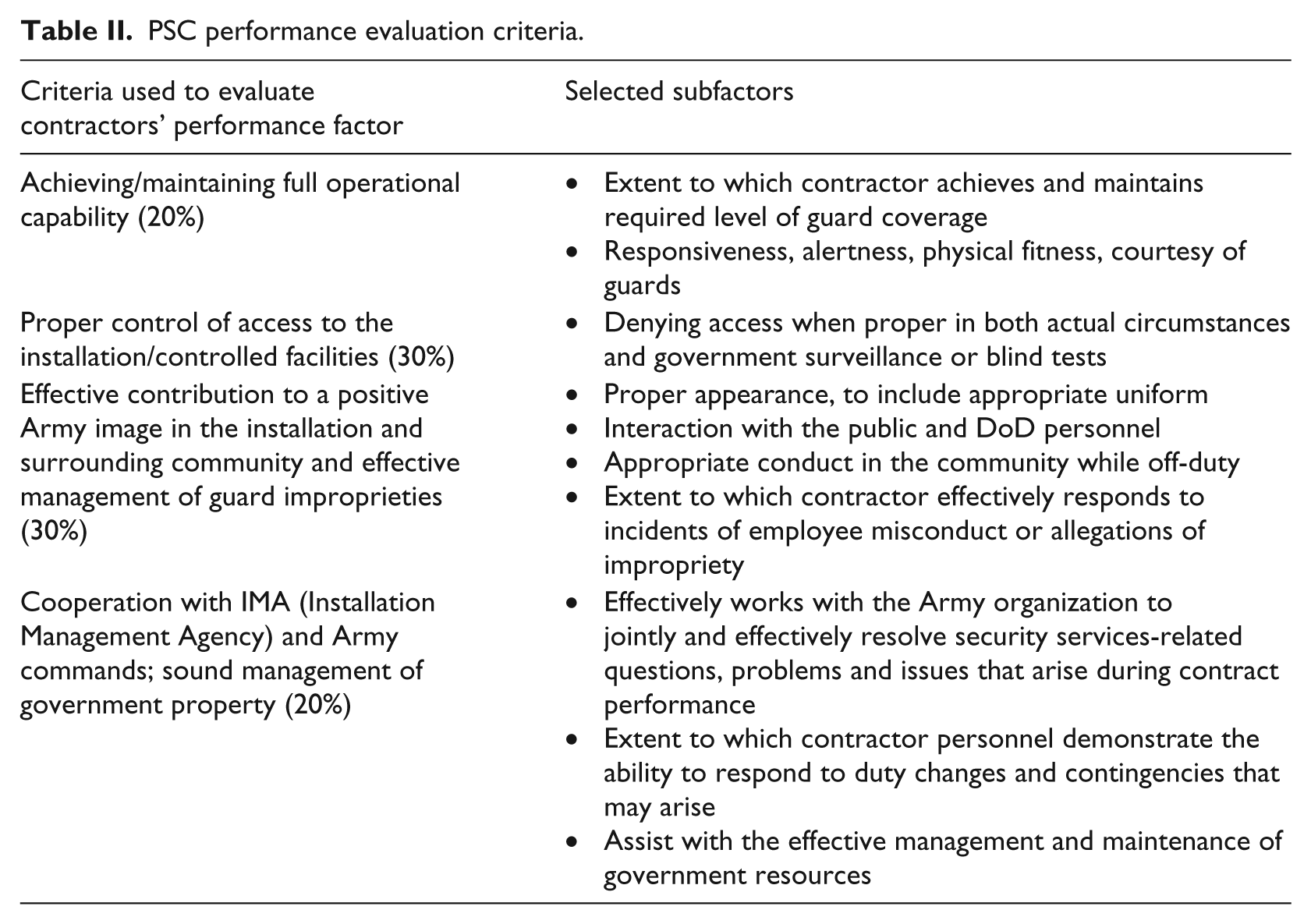
US Army criteria for evaluating contractors’ performance of security guarding services provide further evidence for a link between performance measurements and the conceptualization of security as performative acts (see Table II, taken from GAO, 2006: 25). These criteria measure performance in terms of (1) activities, such as ‘denying access’, ‘appropriate conduct’, ‘response to incidents of employee misconduct’, ‘working with the Army organization’; (2) capabilities, such as ‘required level of guard coverage’ and ‘ability to respond to duty changes’; and (3) the characteristics of contractors, such as ‘responsiveness, alertness, physical fitness, courtesy’ and ‘proper appearance’ (GAO, 2006: 25). They only refer to an outcome or desired result in relation to the US Army’s public perception, namely, by specifying that contractors should contribute to a ‘positive image’. None of these performance criteria assess whether contractors contribute to security outcomes, such as fewer attacks on protected personnel or installations.
PSC performance evaluation criteria.
In sum, the empirical evidence demonstrates that DoD performance-based contracts and performance measurements embrace a performative conception of security. As the next section argues, this approach has significant implications not only for the societies and situations in which security contractors operate, but also for the US government’s attempt to legitimize its use of PSCs in global governance.
Implications of the performative turn in security contracting
The DoD’s definition and assessment of security in terms of performative acts impacts on US military interventions in three important ways. First, the specification and measurement of performance as performative acts shapes in a very particular way the conceptualization and implementation of security. Second, it affects the assessment of security both for a mission and among the host societies that are frequently the intended beneficiaries of global security governance interventions. Third, the focus on performative acts logically undermines the legitimization of the use of commercial security providers in global security governance by reference to results.
Conceptualization and implementation
The most profound implications of performance-based contracting are those related to the conceptualization and implementation of security in US military interventions. As has been argued earlier, the definition of commercial security as performative acts is closely connected to the requirements of DoD performance assessments. In contrast to other conceptualizations of security, performative activities, capabilities and characteristics are observable and directly attributable to DoD contractors. Performative acts also comply easily with the demands of the SMART test, according to which contracted security services must be outlined in specific, measurable, attainable, relevant and timely work statements.
Three major consequences emerge from the DoD’s performative conception of security. Foremost, the conception determines how commercial security is and is not provided in US military interventions. It shapes in a very particular and explicit way how PSCs have operated, looked and interacted in conflict environments such as Iraq and Afghanistan. The Statement of Work for the private security contractor at Camp Bravo at the Forward Operating Base Heredia in Afghanistan, for example, stipulates exactly who should be employed (‘indigenous personnel’), what kinds of weapons must be used (‘M9, M4, M16, or equivalent’), what equipment the contractor must carry (e.g. ‘protective body armor, helmets, uniforms, secure communications’) and what activities they must carry out (e.g. ‘searching personnel and vehicles entering and leaving the installations’, ‘manning guard towers, checkpoints and other static positions 24 hours a day, 7-days a week’, ‘checking of the interior perimeter defenses’). 5 Contrary to the original aim of performance-based contracting to give contractors significant freedom in defining how they can achieve the desired security outcomes, the performative definition of security thus leads to detailed lists of services, capabilities and characteristics that must be supplied by the contractor. Since alternative ways of increasing security will not be considered in performance assessments, this conception essentially discourages PSCs from considering other, potentially more effective, methods.
In addition, DoD PWSs illustrate a specific cultural and organizational conception of what an appropriate security performance entails, which reflects the identities and interests of the US military and professional security experts. Characteristic of this conception is that DoD-contracted security activities and capabilities relate primarily to deterrence, protection and preemption. They include denying suspects access to military bases, providing intelligence on perceived local threats, and guarding compounds with patrols and canine services (DoD, 2007: 19). It is not a coincidence that deterrence, protection and preemption are excludable security services – that is, they can be made to benefit only the paying client (Krahmann, 2008, 2011). In the identification of deterrence, protection and preemption as ‘suitable’ security services for military interventions, the requirements of the SMART test thus conjoin with US military training, which prioritizes force protection, and PSC interests in selling security. The consequence is a systematic disregard for alternative ways of achieving security, such as activities directed at increasing public security more generally. Organizational and cultural preconceptions of which performative acts represent security, together with the SMART test’s demand for specific, measurable, attainable, relevant and timely security tasks, exclude in particular preventative measures, including de-escalation and engagement. US military training, culture and doctrine also have little room for avoidance or resilience strategies because they traditionally focus on the protection of US soldiers in war rather than peacekeeping environments, whereas PSCs recommend deterrence and protective services, not least because these types of security services increase company profits since they must be supplied 24/7 and adjusted to a learning enemy (Krahmann, 2011; Leander, 2005).
In Iraq and Afghanistan, the DoD accordingly rarely demanded security activities contributing to positive security outcomes at large, such as preventing or reducing levels of violence by establishing close relations with the local populations, enhancing resilience through buying in surplus capacities or simply avoiding confrontation through relocation. Instead, contracts and PSCs focused on safeguarding US military installations through extensive fortification, security guarding and closely regulating any interaction with local civilians. In short, DoD and PSC notions of suitable security performances shape which activities and capabilities are provided and which are excluded from contracts, performance measurements and implementation strategies despite their potentially beneficial effects for the security perceptions, risk levels and relationships of the mission and host societies.
A third consequence of the DoD’s equation of security with performative acts has been a disregard for the socially constructed and contextually contingent nature of the correlations between specific activities, capabilities and characteristics and various security outcomes. How an audience interprets and reacts to performative acts depends on pre-existing sociocultural ideas. Actions and contractor characteristics that in some social situations and environments contribute to lower levels of harm or subjective feelings of security can lead to increased violence or perceptions of insecurity in others. In Iraq, for example, it was reported that ‘far from providing insurance against sudden death, the easily identifiable, surprisingly vulnerable pickup trucks and S.U.V.’s driven by the security companies were magnets for insurgents, militias, disgruntled Iraqis and anyone else in search of a target’ (Glanz and Lehren, 2010). By attempting to make performance measurable through ex ante specifications of contractor activities and capabilities, DoD PWSs can misjudge socially constructed correlations and paradoxically undermine ‘security’ as it is conceptualized, practised and experienced by various actors, including insurgents, PSC employees, soldiers, civilian mission staff and host populations.
Finally, the DoD’s focus on performative acts excludes conceptualizations of security that are more sensitive to the socially constructed nature of security and that encourage learning and adaptation, such as low probability of harm or subjective perceptions of security. According to these concepts, security is not an instantaneous product of the activities, capabilities and characteristics of a PSC, but emerges through social interactions among the security contractor, the potential ‘enemy’, the client and the broader social environment. By examining the frequency of hostile attacks, the concept of probabilities of harm acknowledges that insurgents can respond in various ways to the actions of PSCs, ranging from an escalation of force to withdrawal. The analysis of security in terms of subjective perceptions recognizes that the beneficiaries of commercial security services can be intimidated rather than reassured by the presence of heavily armed contractor personnel. The conceptualization of security as performative acts, by contrast, derives from and reinforces a military culture among DoD-contracted PSCs such as Blackwater, Triple Canopy and Aegis that is strongly influenced by the US special forces and directs private security guards ‘to exercise personal initiative, proactive use of force, and an exclusive approach to security’ (Fitzsimmons, 2013: 716).
In Iraq and Afghanistan, the conceptualization and implementation of security as performative acts has thus gone hand in hand with a systematic neglect of the contextual and socially constructed nature of security. Since DoD contracts and PWSs entail lists of activities, capabilities and characteristics rather than security outcomes, PSCs have little incentive to learn and adapt to their social environments.
Security consequences
The performative turn in US security contracting not only impacts on the conception and implementation of security, but also shapes the evaluation of whether and to what degree security has been achieved by PSCs. Specifically, the DoD’s preoccupation with measurable security activities, capabilities and characteristics disregards their impact on alternative security outcomes and the social environment more broadly. In fact, it can be argued that owing to the conceptual equation ‘performative act = security’ the DoD fails to have any understanding of security as a socially constructed and variable result of these acts. This limitation applies irrespectively of whether security outcomes are defined, for instance, as the frequency of attacks on a mission, the severity of damage caused by insurgents, or levels of anxiety among mission personnel or local civilian populations. None of the preceding PWS or DoD performance criteria evaluates PSC performance in the light of statistical information about harm that has been prevented or attacks on military bases and convoys that have been repelled by PSCs. Nor do performance measurements assess whether security contractors have reduced subjective feelings of insecurity among international staff or local populations. The only indicators approaching a measure of outcomes are spot checks, carried out to test whether contract guards deny access to locals who have been singled out as suspects on the basis of predefined criteria (GAO, 2006: 25).
Moreover, the DoD does not include any measure of the societal harm and insecurity caused by PSCs in its performance evaluations, despite having begun to collect information about PSC ‘incidents’ with local civilians (Special Inspector General for Iraq Reconstruction [SIGIR], 2009). There are no formal prohibitions on the rehiring of companies with a reputation for undermining public security in host societies. Blackwater, later renamed Xe and then Academi, became infamous for its involvement in the shooting of 17 civilians at Nisour Square in Baghdad in 2007 (Risen, 2011). In the two years leading up to this event, Blackwater was involved in 195 escalation-of-force incidents – that is, an average of 1.4 per week (Congress, 2007: 6). Although their contract permitted only a defensive use of force, Blackwater employees fired the first shots in 84% of these cases, causing either property damage or casualties (pp. 6–7). Nevertheless, Blackwater/Xe/Academi was repeatedly reselected as a DoD contractor, including through the issuing of new contracts for the provision of ‘security services in support of Forward Operating Base (FOB) Dwyer, and an option for FOB Delaram II’ in Afghanistan until 2016 (DoD, 2012). Aegis, another DoD security contractor, topped the list of PSCs with the greatest number of serious incidents in Iraq between 2008 and 2009 with 224 cases (SIGIR, 2009: 16). Yet Aegis won altogether ten US government contracts in Iraq until 2011, with a total value of $1 billion (SIGIR, 2011).
Owing to the demand for excludable and measurable security activities, DoD contractor performance reviews also fail to evaluate how PSCs impact on subjective security perceptions within host societies. Public complaints about the ‘bad behaviour’ of PSCs in Afghanistan, such as harassment of civilians, drug use and a general lack of professionalism, were often ignored by the US military (Schmeidl, 2008: 34; Schwartz, 2009: 19). Moreover, the DoD’s conceptions of appropriate and convincing security performances do not necessarily conform to those of local populations. DoD security contractors at roadblocks, entrances to bases and escorting convoys have caused fear rather than goodwill among locals in Iraq and Afghanistan. The ostentatious display of DoD-required security capabilities, such as body armour and weapons, can further contribute to societal perceptions of insecurity. The ‘hard profile, hard stance’ approach favoured by the American PSCs contracted by the DoD aims to intimidate potential aggressors, but it can also frighten innocent civilians in conflict regions (Higate, 2012a: 365, 2012b: 336; Norton-Taylor and McCarthy, 2003). Many Afghan citizens believed that, at their best, PSCs had no positive impact on their own security because the organizations were only concerned about protecting their customers. At their worst, PSCs were considered a threat to public security (Schmeidl, 2008: 27). This is partially due to the negative public image of PSCs in Afghanistan, where they were associated with illegal activities such as ‘violent assault, petty theft, extortion, looting, drug trafficking, kidnapping, rape, prostitution, and illegal arms trade’ (Schmeidl, 2008: 29; see also Krahmann, 2016).
The DoD’s conception and assessment of security in terms of performative acts thus systematically neglects not only the achievement of intended security outcomes, as defined in mission mandates, but also the unintended effects on security experiences and perceptions that derive from the actions of PSCs employed in military interventions.
Legitimization
The preceding analysis raises critical questions about the US government’s attempt to legitimize the use of PSCs in global security governance through performance assessments. First, how can the DoD claim results-based legitimacy for PSCs if it equates contractor performance with activities and capabilities and systematically fails to investigate security outcomes? Congressional inquiries into the unintended consequences of contracting PSCs in global security governance interventions illustrate that even members of the DoD’s national constituency are increasingly unconvinced by a legitimization strategy that looks only at performative acts. The House of Representatives Subcommittee on National Security and Foreign Affairs has expressed the view that ‘the Department of Defense has been largely blind to the potential strategic consequences of its supply chain contingency contracting’ (House of Representatives, 2010: 2). Owing to this failure, DoD security contractors along the logistic chain in Afghanistan have collaborated with ‘warlords, strongmen, commanders, and militia leaders who compete with the Afghan central government for power and authority. Providing “protection” services for the U.S. supply chain empowers these warlords with money, legitimacy, and a raison d’etre for their private armies’ (House of Representatives, 2010: 2; see also Senate, 2010). In sum, some contractual security practices have contributed to reproducing insecurity in Afghanistan.
The disjunction between the DoD’s goal of measuring performance in terms of ‘results, not activity’ and the criteria of the SMART test explains the weakness of its legitimization strategy (US Army, 2009: 4). The SMART criteria may be suitable for the assessment of contractor services that lead to material outcomes or products, such as weapons maintenance and repair, the transport of military supplies and equipment, or the building of military bases. However, they are less appropriate for intangible outcomes such as security. The DoD’s attempt to conceptualize security ‘outcomes’ in a way that meets the requirements of specific, measurable, attainable, relevant and timely performance tasks and measures has instead supported the equation of performance with performative acts carried out by its contractors. The preceding section has shown that this need not be the case. Other conceptualizations of security are more amenable to the development of performance measures that assess some of the socially constructed and culturally mediated outcomes of security services.
A more fundamental critique of the DoD’s legitimization strategy regards its limited perception of the armed forces, Congress and the American public as primary constituencies who should see the benefits of contracted security in international military interventions. This perception is illustrated by the DoD’s failure to include performance tasks designed to improve the general security environment and thus the security of the host population in its security contracts. Drawing on the sociological distinction between organizational fields (i.e. the immediate audience) and societal fields (i.e. the general audience), it can be argued that the societies at the receiving end of global security governance interventions and commercial security services have a ‘less direct but equally important role in granting legitimacy’ (Cashore, 2002: 511). DoD performance statements and assessments systematically neglect the potential outcomes of contracted security services for local societies. Instead, the few results-focused performance targets and criteria found in DoD security contracts relate exclusively to US interests and the security of US armed forces.
Unsurprisingly, many members of the Afghan government and population have questioned the legitimacy of DoD-employed PSCs. Former President Hamid Karzai repeatedly expressed his frustration over the fact that he could not control ‘who his international partners [were] employing, arming or empowering (e.g. PSCs)’ (Checcia, 2011: 3). In 2010, the President therefore decreed the dissolution of all armed PSCs in Afghanistan. Parts of Afghan society also remained unconvinced of the legitimacy of PSCs. Many citizens believed that their government should have sole responsibility for the provision of security in their country and that private military and security companies ‘were sending a strong message that security is not a public good, but a commodity of foreigners and wealthy Afghans’ (Schmeidl, 2008: 26).
Conclusion
Many strategies have been applied to legitimize the growing role of PSCs in global security governance, yet little is known about the consequences of these strategies for the provision of security in international military interventions. This article has sought to address this gap by examining the US government’s attempt to enhance the legitimacy of PSCs through the use of performance contracts and assessments that seek to demonstrate the provision of publicly beneficial outcomes. In contrast to these aims, the analysis has observed that the demand for observable, measurable and attributable performance tasks and indicators has led the US DoD to assess PSC performance not in terms of the outcomes of commercial security services, but as performative acts – that is, contractors’ capabilities, characteristics and repetitive enactments of specific security activities.
The implications of this performative definition of security for the critical security studies literature on PSCs are considerable. Specifically, this article adds to the observation that PSCs provide distinct forms of security. These forms are not only shaped by markets and profit motives, but also by the US government’s attempts to bring these very factors under control and to legitimize the outsourcing of security services to commercial contractors. As the preceding examples from DoD security contracting in Iraq and Afghanistan have illustrated, the assessment of security ‘outcomes’ in terms of performative acts has led to a range of unintended negative consequences. First, the demand for specific, measurable, attainable, relevant and timely (SMART) performance targets and their monitoring by sampling and inspections has meant that DoD contracts and contractor work statements have conceptualized security in terms of detailed lists of performative activities and capabilities that neglect the socially contingent and constructed nature of their effects. Second, these lists have systematically excluded other ways of enhancing security from performance-based contracts and their assessments. Since DoD performance assessments have equated performative acts with the outcomes that they are meant to achieve, they have disregarded the intentional or unintentional consequences of commercial security service provision for the mission, its personnel and the host populations in Iraq and Afghanistan. Third, the performative definition of security logically undermines the US government’s ability to legitimize PSCs with reference to publicly beneficial outcomes, because these measures fail to grasp whether commercial security provision indeed results in security ‘for the people’ (Scharpf, 1998: 2). Based on a managerial and depoliticized approach in which military contract managers and commercial security experts define the terms of security performances in international military interventions, US government criteria for PSC performance may meet the requirements of the SMART test, but they do not assess the impacts of commercial security services on the ways in which security is experienced or, ultimately, whether these outcomes are in the public interest of the home- and host-state populations.
In terms of further research and practical application, these findings suggest that the discussion about performance, good governance and the legitimacy of global governance actors should move beyond the question of how to develop ‘better’ criteria for performance assessments. They rather imply that the measurement of outcomes for some collective goods, such as security, health and development, may be inherently problematic. The problems arise not only from the contested nature of performance criteria, but also from the fact that concepts like ‘security’, ‘health’ and ‘development’ are socially constructed and culturally contingent. The growing number of governments, international organizations, NGOs and private businesses who employ performance measures as a legitimizing strategy in global governance thus need to ask themselves how these goods are conceptualized and understood by the populations who are ultimately the intended beneficiaries of their interventions.
Footnotes
Funding
This research received no specific grant from any funding agency in the public, commercial or not-for-profit sectors.