




Abstract
Various reflections on the ‘Arab Spring’ evince a common view of the relationship between change and time that imbues events with a sense of intrinsic peril. Based on a framework developed from Norbert Elias’s concept of timing, this article elaborates the relationship between time and the ‘Arab Spring’ by unpacking and explaining three rhetorical tropes prevalent in academic responses to the revolts. The first two construct a problem to which the third proffers a solution. First, analysts treat time itself as a problematic force confounding stability and progress. Second, they deploy fluvial metaphors to present dynamic events as inherently insecure. Third, they use temporal Othering to retrofit the ‘Arab Spring’ to the familiar arc of liberal democracy, which renders the revolts intelligible and amenable to external intervention. These moves prioritize certainty and order over other considerations and constrain open-ended transformations within a familiar rubric of political progress. They also constitute an active timing effort based on a conservative standard, with important implications for our understanding of security and for scholarly reflexivity. The article concludes with three temporal alternatives for engaging novel changes like the ‘Arab Spring’.
Introduction
After unprecedented changes, scholars often grapple with questions about how they happened, what they mean, and their future implications. After the ‘Arab Spring’, such responses expressed prominent themes. Initially, the revolutions shocked analysts 1 but were also lauded for deposing longstanding autocrats. However, many assessments also expressed concerns about insecurity. This anxiety surfaced openly in discussions about instability, terrorism, or state failure, but it also worked more subtly through recurrent tropes interpreting the ‘Arab Spring’ as a new and uncertain time; a highly fluid situation; or the belated arrival of progress in heretofore-backward locales. These tropes provided a rhetorical common sense of the transformations, making them seem like mere discursive relics of little substantive import. However, much more than idiomatic asides or stylistic flourishes, these symbols constitute a common temporality – a particular, shared relationship to time that enables and constrains thinking about the ‘Arab Spring’: problematic figurations of time tinge references to a new era with elements of danger, fluvial metaphors apprehend unprecedented changes as perilous, and temporal Othering renders ambiguous processes intelligible, manageable, and ultimately securable under the rubric of democratization. We can understand this common temporality using Norbert Elias’s idea of timing, which explains such temporal tropes, demonstrates their influence on thinking about the ‘Arab Spring’, and shows how the necessities of theorizing constrain a variety of assessments within liberal-democratic limits.
While the ‘Arab Spring’ is not the first instance of Western referents governing the analysis of global politics (see e.g. Inayatullah and Blaney, 2004), there is much we can gain from unpacking it. Precisely because Western frames are so pervasive it is necessary to call out their influence in each new instance, especially during pivotal transformations. Additionally, the ‘Arab Spring’ highlights three neglected puzzles about the relationship between social science and time. First, why are temporal symbols so prevalent after surprising changes? Second, why do these symbols have a principally malign inclination? Third, what are their connections to the dominant, liberal-democratic frame – how does the particular temporality assigned to the ‘Arab Spring’ inflect efforts to understand and manage it? To address these issues, I introduce a novel theoretical framework showing how temporal tropes prefigure important explanatory and normative choices. Although purportedly describing time per se, tropes actually indicate attempts at timing events in a way that renders them more intelligible and secure. In addition to clarifying temporal symbols, this explanation raises intriguing issues for scholarly practice. The first two tropes – the problem of time and fluvial metaphors – construct a problem to which the third – temporal Othering – proffers a ready solution, reinforcing conservative theorizing and the hegemony of the Western political imagination. So in addition to using the ‘Arab Spring’ to develop a different understanding of time via timing, I thereby add an explicitly temporalized element missing from other critiques of the ‘Arab Spring’. These have focused on its innovative sexual politics (Agathangelou, 2011), its ironic roots in ‘neoliberal governmentality’ (Tagma et al., 2013), its gender-based insecurities (Johansson-Nogués, 2013) and its regional particularity (Grovogui, 2013). But while they complement certain points developed below, none foreground time or timing. This is somewhat curious given the pervasiveness of temporal descriptors in ‘Arab Spring’ discussions.
To draw out time and timing, I zoom in on the academic aftermath of the ‘Arab Spring’, when scholars were formulating initial responses to novel changes. By ‘academic aftermath’ I mean monographs published between 2011 and 2013 and shorter pieces published between 2011 and 2012, including those either penned by academics or appearing in academic outlets. 2 I focus on a variety of analyses in mainstream international studies, neopositivist social science, area studies, and critical and cultural theory. This diversity is intentional – rather than a particular, closed discourse, I identify three conspicuous temporal threads running through a range of responses and use timing to show how they are interrelated in a pervasive and influential rhetorical framework that casts the ‘Arab Spring’ as a novel problem with security implications. Because this early ‘Arab Spring’ scholarship comprises my empirical and critical object rather than a set of interlocutors, I position the analysis relative to works on time and international politics. 3
These choices clarify the academic aftermath of the ‘Arab Spring’ as a matter of timing but they also entail trade-offs. I do not provide a comprehensive view of the literature, omitting social movement, contentious politics, and autocratic stability research. Such literatures, which highlight differences in the ‘Arab Spring’ between violent and nonviolent protests, different forms of representative politics (Della Porta, 2013), and monarchic-versus republican–autocratic revolutionary contexts (Yom and Gause, 2012), admittedly overlap with the responses scrutinized here. 4 However, in our chronological window they do not emphasize security and temporality as clearly – although subsequent inquiry might uncover their timing and security implications. Relatedly, it would be interesting to examine more recent ‘Arab Spring’ analyses of newer developments: As scholars’ initial surprise wanes, does time seem less malicious? Or do prolonged contestation and/or further shocks (e.g. the Benghazi embassy attack in 2012) reaffirm time as a problem? Have authoritarian reversals reduced the prevalence of fluvial metaphors or have protracted crises (e.g. Syria) perpetuated the image of insecurity spilling over state borders? How does the mixed record of revolutionary outcomes impact temporal Othering? Clearly, much further work is possible, and the current discussion hopes to provoke interest along these lines.
The argument unfolds over six sections. The first discusses cognate works on time and security, which provide useful insights but do not consider timing or the tropes found in the ‘Arab Spring’. The second develops Elias’s concept of timing, paying special attention to its holistic power, its active and passive modes, and its implications for novel change. The next three sections use this timing framework to understand three temporal tropes of the ‘Arab Spring’. The problem of time and fluvial metaphors indicate that surprising developments threw off working models of the Middle East and North Africa (MENA), engendering anxiety and attempts to render events more familiar and manageable. A predominant example of this is temporal Othering, which uses the standard of Western democracy to imbue the ‘Arab Spring’ with intelligibility, order, and a predictable future. Temporal Othering also shows how efforts to manage novelty may severely constrain our imagination about politics and security. The conclusion reflects on the implications of the ‘Arab Spring’ for time, timing, and security as well as for scholarly reflexivity and poses three alternative temporalities for grappling with surprising events.
Time, international politics, and security
The relationship among time, international politics, and security has already received some attention in critical scholarship. James der Derian (1995: 34) argues that the search for security represents a ‘fear-driven desire for protection from the unknown’ based on the premise that a ‘safe life requires safe truths’. Similarly, J Peter Burgess (2012: 711–712) examines how the modern episteme treats affronts to ‘the certainty of knowledge’ as ‘metathreats’ against ‘the stability of authentic reality’ auguring existential danger. Michael Dillon (2008: 313) underscores the temporal implications of this orientation: ‘Tame the future and you may, finally, secure a [human being] whose very existence is temporal.’ Having denied the possibility of spiritual transcendence, modern humanity is ‘doomed to time’, rendering security ‘eschatological’ inasmuch as the ‘catastrophic threat of the dissolution of the [extant] order’ establishes a ‘katechontic’ or restraining interest in stability as such (Dillon, 2011: 781–782, 784). Although less concerned with time, Christopher Daase and Oliver Kessler’s typology of danger bears closely on these concerns. Threat refers to known knowns, a ‘realm of available secured knowledge’ and ‘recursive patterns’ (Daase and Kessler, 2007: 415). Risk describes known unknowns by delineating uncertainty via probabilistic trend calculations (p. 424). Disaster characterizes unknown unknowns, when there is ‘no measure to tame uncertainty’ or ‘sudden qualitative change’ (p. 427). Although it fades in and out of these discussions, time is never far from their reflections on modern security logics, which consistently associate certitude and delimited futures with protection, on the one hand, and uncertainty, novelty, and open futures with peril, on the other.
These issues resonate in RBJ Walker’s (1993: 106) seminal discussion of how modern sovereignty treats ‘stasis and change, being and becoming, or structure and history as mutually exclusive oppositions’. To overcome the vicissitudes of temporal existence, we must first fix an order in space, usually in the form of a territorial state enabling unilinear progress by exporting cycles of violence beyond its borders (Walker, 1993: 62–63). Relatedly, Kimberly Hutchings (2008) uncovers variations of unified political time subordinating multiplicity and political possibility in accounts of world politics. Political time arises from different combinations of two primary temporalities: chronos, understood as homogeneous, predictable and deterministic flow; and kairos, a moment of opportunity for transformative action (Hutchings, 2008: 5–8, 30–34). In theories, these combinations produce a single, determinate vision of how political time unfolds and what can be accomplished by intervening in it. Buttressed by invocations of privileged scientific knowledge, such visions effectively deny the ‘heterotemporality’ of world politics (Hutchings, 2008: 154–177).
These works highlight important temporal considerations relevant to the academic aftermath of the ‘Arab Spring’, where commentators draw distinctly modern links between surprise, uncertainty, and peril, and manifest an eschatological approach to security that treats instability as intrinsically dangerous. They also work to transform the unknown unknowns of the ‘Arab Spring’ into risks or threats, often by subsuming them under a single, closed account of political progress authorized by privileged knowledge. In this way, academic responses ‘tame the future’ in order to secure a changing present. 5
However, the literature on time and international politics remains incomplete for our purposes in three respects. First, it does not treat any of the specific temporal tropes running through the ‘Arab Spring’ – the problem of time, 6 fluvial metaphors, and temporal Othering – and as such cannot delineate their implications for understanding security. Second, partly because of this gap and partly because most works do not elaborate the internal links between temporal assumptions and theoretical outcomes (although see Hutchings, 2008), it cannot address how our tropes inflect analyses. Third, it does not provide a synoptic framework for connecting various temporalities to political phenomena. Scholars have criticized particular temporalities (e.g. linear versus cyclical; see Walker, 1993) or forwarded poly-temporal arguments for purposes of political critique (e.g. Hutchings, 2008), but have not sought to systematically comprehend the many temporalities of international life. Taken together, these issues leave us insufficiently prepared to explain why particular temporalities emerge in the ‘Arab Spring’, how they impact scholarly responses, and their implications for politics and security.
From time to timing and back
Norbert Elias’s theory of timing is especially apt for comprehending time in a way that foregrounds these issues. 7 With some elaboration, his account allows us to unpack and understand the problem of time, fluvial metaphors, and temporal Othering. Timing thereby helps explicate time in the ‘Arab Spring’, which in turn illustrates what happens when timing breaks down, how scholars respond to such a situation and how security assessments depend on events being well timed. 8 As will become clear, Elias overlaps with several points just discussed but advances them further toward an overarching explanation.
Elias (2007: 38–39, 61) contends that the objective noun ‘time’ and related temporal images emerge in language to symbolize various features of a dynamic and practical timing activity, a creative synthesis of two or more continua of change where one continuum acts as the timing standard for the others. 9 Change continua can be natural cycles, physical motion, or any variations we can relate (p. 110). We engage in timing by using the chosen standard to integrate and coordinate them so that the ‘when-aspects’ of the resulting synthesis produce a well-ordered sequence conducive to our purposes (pp. 43–44, 85). Timing thus works by comprehending otherwise discordant changes in an intelligible and useful way. When we have timed them successfully, we understand their relations and import and can decide how and when to act upon them. Thus, a ‘good sense of timing’ not only indicates a kairotic sense of when to act decisively (Hutchings, 2008), but also that we occupy an intelligible realm in which to do so, as in chronos. 10 Likewise, a breakdown in timing or ‘bad sense of timing’ vitiates our capacity for effective intervention but also destabilizes our broader sense that things hang together in an orderly, secure fashion.
Timing can be active or passive (Elias, 2007: 41–43). Active timing requires effortful reflection and explicit decisions about which changes matter, how to relate them, and by what standard. It can arise because an entirely novel event occurs or when extant modes become inadequate owing to unintended effects or proliferating complexity. By contrast, passive timing requires no decision and so little effort that it proceeds almost subconsciously. It results when change continua are easy to synthesize or once active timing has, through success and repetition, become ‘second nature’. It is important to note that active and passive are not fixed attributes – timing is always an ongoing, practical activity. An active timing project becomes passive as it repeatedly succeeds; a previously passive timing mode becomes active whenever it falters. The tension in this dynamic elaborates several ideas introduced in the time literature, for it is precisely surprising change that introduces uncertainty and the unknown or instability, all of which throw off passive timing, confound active timing, and often herald insecurity.
When passive timing becomes inadequate, three options are available. Novel events can be retrofitted to extant modes of synthesis, used to revise them, or taken as an opportunity for imagining new alternatives. These options trace a spectrum of increasing difficulty: retrofitting requires some interpretive effort to index developments to an existing model; revision significantly alters that model but also remains delimited by it; genuine alternatives reconsider everything and entail fundamental questions about understanding and being in the world. This spectrum also tracks from passive to increasingly active timing: retrofitting marks the move from passive to minimally active effort; revision is more active; new alternatives require new timing standards, different modes of combination, and may confront a genuine timing crisis – the possibility that no timing standards or modes are adequate to a developing situation (see Table 1). Finally, this spectrum tracks from a mostly assured sense of security, stability, and order to a threshold of radical doubt about all three.
Timing responses to novelty, temporal references, and security.
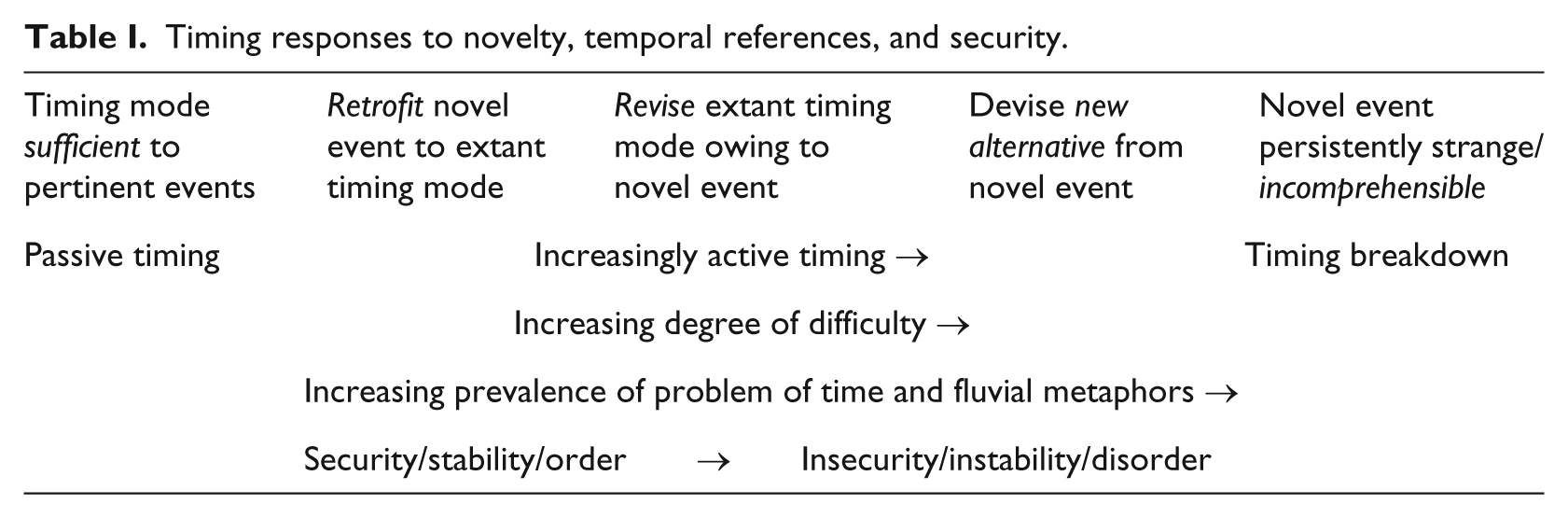
Whether active or passive, difficult or easy, the more we engage in timing, the more we describe it with a symbolic language whose figural qualities encourage us to think and speak ‘in terms of reifying substantives’ and ‘static conditions’ rather than active processes or dynamic relations (Elias, 2007: 43) – that is, to talk about ‘time’ rather than ‘timing’. Through linguistic reification, experiences with timing inform objectified, substantive ‘time’ utterances, which are therefore best understood as timing indexicals describing ongoing timing activities and signaling those activities’ in/effectiveness. So, whenever we encounter temporal artefacts in language, we should ask what timing efforts are behind them and take their positive or negative imagery as indicative of how well such efforts are going. Negative temporal references indicate that timing requires increasingly active effort verging on failure and catastrophe – troubling ‘times’ point to a troubled or bad ‘sense of timing’. Positive or neutral evocations indicate a good and perhaps passive sense of timing. Combined with the active/passive distinction, treating temporal tropes and utterances as timing indexicals also addresses the second and third issues identified in the time and security literature. In Elias, all temporal references refer to dynamic timing activities, which can be unpacked by focusing on their modes of relation and standard of synthesis. Furthermore, the status of timing activities is implicit in the temporal references themselves.
In addition to addressing several themes from the works already covered, Eliasian timing provides a synoptic framework for interpreting time. It not only accommodates multiple and diverse temporal references, but connects them to the substantive outcomes that timing produces and explains why we tend to conflate safety with certainty – we feel safer in well-timed environments – and to treat affronts to stable knowledge with eschatological unease – uncertainty confounds timing and thereby attaches danger and insecurity to time itself. Elias thus shifts focus from time to timing, but in a way that also makes sense of time. A prevalence of ‘time’ utterances or temporal tropes in language like that found in the academic aftermath of the ‘Arab Spring’ marks an opportunity to discover prevalent modes and standards of timing and to assess their effectiveness with regard to ongoing changes. As we will see, this question of effective timing also holds express implications for security. The next two sections track threatening figurations of time and abstract yet dangerous symbols of temporal fluidity in early ‘Arab Spring’ responses. These references disclose active challenges in timing the MENA region, which make the continued passage of time seem naturally dangerous. They also impel efforts to restore a good sense of timing and thereby some semblance of order and security. The third section shows how temporal Othering accomplishes this.
The problem of time
The ‘Arab Spring’ produced surprise and uncertainty coupled with generalized anxiety about security (see e.g. Anderson, 2011: 3). An important assumption about time undergirds such responses, namely, that it is an agent or force naturally opposed to human affairs. I call this the problem of time because it understands uncertainty, instability, and insecurity as features intrinsic to time itself. This flows from ancient figurations of time as a capricious god whose dominion over human affairs brought only decay, danger and death (see Brandon, 1965: 31–64). Such images influenced Greek and Judeo-Christian systems, which both identified mutability with imperfection and contrasted it to the ideal of eternity and its earthly counterpart: stability (see Brandon, 1965: 106–205; Gunnell, 1987). These factors imbued Western thought with the idea that things that are temporal or ‘in time’ are vulnerable to negative change – they pass as time passes and eventually they pass away.
By and large, change and dynamism are still subordinate to eternity and stability, while time itself is presumed to run counter to positive possibilities (Smith, 2008: 53). Despite the modern development of standardized clocks and their image of time as a homogeneous and neutral dimension, we still have recourse to the problem of time. When invoked, the problem of time signals that time’s passage brings change and danger unless some human elements – for example, democracy, sturdy institutions, or security apparatuses – check its disposition toward dissolution (see Der Derian, 1995: 30). In this way, the problem of time further signals challenges with extant timing.
Initial academic responses to the ‘Arab Spring’ evoked the problem of time. In remarks about uncertainty, chaos, and unpredictability, they apprehended extraordinary political events as intrinsically insecure and dangerous. Though the end of autocracy is welcome, if ‘political uncertainty hangs in the air’ then such changes remain fraught with peril for analysts and actors alike (Wilner, 2011: 50). This is because uncertainty augurs a limited spectrum of possibilities – at best a difficult return to stability, at worst volatility (Cook and Stathis, 2012: 184; Mabrouk, 2011: 144), instability and chaos (Lynch, 2013: 189), disruptions and continuing violence (Sorenson, 2011: 44; Miller et al., 2012: 15; Zgurić, 2012: 418–19), or further unknowns harkening some combination of the rest (Bamyeh, 2012: 37; cf. Burgess, 2012: 699–700). Such a narrow range orients us toward possibilities such as a negative ‘Arab Winter’ (Wiarda, 2012) following the ‘spring’, authoritarian reversals (Wilner, 2011: 56) or the rise of terrorism, which (unlike institutionalized government) finds ‘new opportunit[ies]’ in ‘political upheaval’ (Wilner, 2011: 60; see also Gartenstein-Ross and Vassefi, 2012: 839, 841; Magen, 2012: 10). These problematic assumptions tinge seemingly value-neutral observations like ‘parts of the Arab world are in transition, leaving important questions about the future’ (Sorenson, 2011: 25; see also Walt, 2011a) with the sense that change and uncertainty signal ‘times’ of ‘turbulence’ on the near horizon (Kneissl, 2011: 16) or ‘a mix of hope, sadness, and foreboding for the future’ (Sorenson, 2011: 22).
Absent reliable ordering mechanisms and sources of stability, these temporal tropes cast the ‘Arab Spring’ as intrinsically dangerous. They also recall Dillon’s (2011: 784) katechontic security, in which we view any stability as preferable to disorder. In this way of thinking, positive changes are suspect unless they guarantee a ‘predictable, efficient and measurable’ transition to even more secure outcomes (see Tagma et al., 2013: 386). Without such safeguards, uncertainty about the continued flow of events portends only a chaos diametrically opposed to political progress (see Wiarda, 2012: 137). There are any number of references to the ‘Arab Spring’ as a ‘historical’ moment, which often indicates its momentousness. But this also hints that the future itself is in doubt, which almost automatically opens the door to the unknown along with chaos and violence (Haseeb, 2012: 189). These temporal tropes illustrate Elias’s relationship between ‘time’ references and timing activities. Their combined negative weight suggests no one expected the changes of 2011, which refuted working models of the region; as a result of both surprise and refutation, scholars came to speak about the flow of time as naturally malign. This breakdown in timing manifested through comments raising a time of insecurity as the spectre at the feast of Arab revolutions.
Flood myths
In addition to the problem of time, fluvial metaphors highlight scholars’ struggles to incorporate discordant changes in extant modes of timing. It is commonplace to say time ‘flows’ like a river and to note that both destabilize everything in their path (see Newton-Smith, 1980: 4–5). The bond between fluidity and danger traces back to ancient flood myths, in which a deluge destroys all life on earth (see Dundes, 1988). Such stories are prevalent in most traditions, and prominent thinkers have long identified fluidity with chaos and danger (see Gunnell, 1987; Walker, 1993). Although the flood myth has receded somewhat in contemporary discourses, its suggestive links among fluidity, temporality, and insecurity persist. References to ‘fluid situations’, the ‘flow of events’ or a ‘flood of’ action indicate dynamic phenomena, but also signal unruliness and peril. In responses to the ‘Arab Spring’, metaphors like wave, flood, surge, spill, fluid, and flux describe not only surprise at vigorous changes, but also a more normatively weighted sense of insecurity.
Waves
Many scholars identify the ‘Arab Spring’ as the ‘fourth wave’ of democratization (e.g. Joshi, 2011: 64; Magen, 2012: 10–13). Such ‘waves’ depend on collective engagement and thus seem a positive development. Other seemingly impartial metaphorical deployments include references to ‘waves’ of ‘revolution’ or ‘revolutionary change’ (Haseeb, 2011: 113; Walt, 2011b; see also Butler and Khoury, 2013: 76) 11 or ‘protests’ (Chaney, 2012: 391; Haseeb, 2012: 190).
Yet wave metaphors also evoke surprise and insecurity. Rather than predictive recurrence, ‘wave’ signals uneasy arrivals, as in the ‘sudden wave’ of uprisings (Haseeb, 2011: 113–114) emerging from wild locales like the ‘Arab street’ 12 that are naturally incapable of clean, ‘linear transitions’ from autocracy to democracy (Pace and Cavatorta, 2012: 135). Such ‘waves’ are distinctly unmanageable. Without some decisive intervention, they threaten to sweep away not only despots but also wider political arrangements (Kamrava, 2012) and even ‘tranquility’ per se (Walt, 2011c). Nor are they mere surface perturbations – rather, they are ‘wide and deep’ (Lynch, 2013: 14) and therefore unfathomable and uncontrollable (Sakbani, 2011: 141). Additionally, they might be followed by more dangerous breakers, including regime repression, refugee flows (Lynch, 2013: 189; Saideman, 2012: 714) or Islamist takeovers (Chaney, 2012: 363, 394). After all, the problem with deep waters is that just when they seem safe, something unsafe may be lurking below. 13
Surge, flood, spill
Similarly, ‘surge’ denotes surprise and speed, as when the unexpected act of one street vendor initiated a ‘sudden surge of protest’ in two previously stable autocracies (Schneider, 2011: 481). As with waves, humans provide the constitutive material – ‘the popular upsurge of 2011’ – yet this also suggests disorderly ‘surging masses of people’ (Weyland, 2012: 923). It also shares metaphorical space with insurgents, those violent exemplars of political disorder. 14 Although this may appear a rhetorical accident, popular upsurges and ‘Islamist surges’ (Zgurić, 2012: 417) both signal the idea that unpredictable action in the absence of political constraints holds dangerous potential.
‘Flood’ describes a previously stable, passive body turned disruptive. For example, the ‘Arab Spring’ was an ‘emotional flood that had nowhere to channel its expression’ (Mabrouk, 2011: 143) and so breached standing ‘floodgates’ (Weyland, 2012: 917) or several ‘dams at the same time’ (in Butler and Khoury, 2013: 74). Once again, humans are hydro-molecular: ‘tens of thousands of young Egyptians flooded Tahrir Square, spilling out onto Cairo’s streets’ (Schneider, 2011: 481; see also Sorenson, 2011: 24). As such, they are potentially dangerous by virtue of sheer numbers, but also because these particular political particles are ‘spontaneous, leaderless’, ‘amorphous’ (Weyland, 2012: 924), ‘emotional’ and conflicted (in Goodwin, 2011: 453), and therefore more likely to choose violent or unwelcome alternatives. Furthermore, they are unused ‘to the idea of not having a dictator to tell them what to do’ (in Butler and Khoury, 2013: 74, emphasis added) and may cause others to falsify their preferences, making accurate data collection and prediction impossible (see Goodwin, 2011: 453–454). 15 Whether because scholars cannot get traction on them or because they are naturally dangerous, such ‘floods’ pose a security problem even as they inaugurate political change.
When waters ‘spill over’, they menace surrounding areas. ‘Spill’ invokes surprise and uncertainty, but also disorder, insecurity and crisis (Sawani, 2012: 392; Zgurić, 2012: 418; Lynch, 2013: 123, 166) – all close companions of the problem of time. At their limit, such ‘dire spill-over effects’ portend an even more troubling ‘cascade of failures across the region’ (Magen, 2012: 18). Spill-over also overwhelms geographic distance thanks to contemporary information technologies, as when China blocked web searches for ‘jasmine’ to ‘avert any potential spill-over of the virus of the Jasmine revolution’ from Tunisia (Kneissl, 2011: 1). The combination of fluvial and contagion metaphors here is noteworthy because although scholars have reflected critically on the latter, they continue to deploy the former to describe the ‘Arab Spring’ without acknowledging its normative weight (see Saideman, 2012: 714n2, 719). 16
Fluid and flux
Even at their most abstract, fluvial metaphors indicate surprise and intimate menace in an open future. Owing to unprecedented transformations, the Middle East has never ‘appeared more politically fluid and uncertain’, which is to say its ordering principles have been severely destabilized (Cook and Stathis, 2012: 184). Beyond acknowledging novel change (as in Sawani, 2012: 383), ‘fluid’ further signals spontaneity and irrationality (Weyland, 2012: 920, 924), unpredictability (Joshi, 2011: 63), an opening for unwelcome actors (see Kamrava, 2012: 102) and direct peril (Adib-Moghhaddam, 2012: 23; Kamrava, 2012: 99). ‘Flux’ is similarly pitched, announcing not only a dynamic situation but also little hope for predictable early outcomes (Gartenstein-Ross and Vassefi, 2012: 840), much less long-term goals like fully functioning democracy or regional stability and security.
Through their references to waves and more abstract fluvial descriptors, ‘Arab Spring’ scholars readily evoke the frightening dynamism passed down from flood myths. Combined with invocations of the problem of time, fluvial metaphors implicitly affirm the idea that surprising and uncertain events render knowledge and politics insecure. They also suggest that as our sense of timing in the region has faltered (i.e. as extant modes of intellectually synthesizing MENA politics have faltered), our sense of the region’s security has gone with it.
Emancipated minors
As timing becomes more challenging, symbolic temporal references become more negative, casting time itself as intrinsically treacherous. Such a situation calls for attempts at redressing our sense of timing and thereby our sense of security by proposing how events can be either retrofitted to prior models, used to revise them, or taken as an opportunity for new thinking. Recall that these options map onto spectra of increasingly active and difficult timing (see outlined earlier), including the possibility of a complete breakdown in our comprehension of events. These spectra highlight an intrinsic conservatism: retrofitting and minimal revisions are preferable to genuine alternatives because they require less conceptual work and because they remain some distance from the spectre of a timing failure. Insofar as such a failure engenders a sense of catastrophe, in/security can be understood as an emotional facet of timing. Recalling Daase and Kessler’s (2007: 419–427) typology of danger, a key security benefit of timing is to move unknown unknowns away from the unnerving void of comprehension toward less frightful realms of risky but known unknowns or threatening but tangibly familiar known knowns, both of which admit to some integration and coordination and thus delimit future possibilities. Or, in Dillon’s (2008: 313) eschatological formulation, we might say that to secure human beings we must ‘tame the future’ by timing it.
This section demonstrates that numerous ‘Arab Spring’ responses opted for the most conservative option of retrofitting events to extant understandings of liberal democratization. Confronting an uncertain, dynamic and seemingly fraught situation, they quickly reinscribed the novel present and open future of the ‘Arab Spring’ in an intelligible, democratic trajectory through temporal Othering, the practice of linking currently strange phenomena to earlier, more familiar periods of a known history culminating in a secure endpoint. The primary benefit of temporal Othering is to render contemporary difference homogeneous and thus more amenable to comprehension and intervention. Although Othering has been a longstanding concern in international relations, its temporal aspects have only recently come into view (see Inayatullah and Blaney, 2004). Brent Steele and I elsewhere identify four moves producing a temporal Other: cleaving time into a present distinct from the past, composing a unified history of humanity, differentiating Self and Other along that trajectory, and indexing sociopolitical development to biological maturation (Hom and Steele, forthcoming). 17 I take these in pairs.
Cleaving time, unifying history
Cleaving time severs the past from the present by establishing some break-point in a chronology and treating its ‘before’ and ‘after’ as qualitatively distinct. Once normative valuations attach to this cleavage, we can posit a linear-progressive vision in which time is flowing further away from the subordinate past and ever closer to a superior future. If this future is treated as a universal endpoint, we have a unilinear-progressive vision posing a single criterion for comparing diverse cultures, confirming the present Self’s superiority, and indicating how and when any other society should ‘necessarily and appropriately go’ (Blaney and Inayatullah, 2010: 38).
‘Arab Spring’ scholars cleave time quite readily. The ‘Arab world lies at the cusp of a new era’ (Malik and Awadallah, 2013: 309), ‘there is no going back’ (Haseeb, 2011: 121), a ‘paradigmatic shift’ is underway toward an era of ‘postmodern revolutions’ (i.e. struggles for modern values like ‘freedom, dignity, and individualism’ using new media and ‘narrativity’; see Sabry, 2012: 81, 83), a ‘new Arab dawn’ is rising (Sakbani, 2011: 144), or we are witnessing the ‘birth of a new Arabism’ (Sawani, 2012: 388). Once welded to the idea that Arab polities are moving toward positive goals, such comments inscribe diverse occurrences within a unilinear-progressive trajectory. This can be nebulous: ‘What is occurring illustrates the universal desire for dignity and for political participation’ (Cook and Stathis, 2012: 184), marks steps in ‘Freedom’s March’ (Magen, 2012: 10), or reveals ‘ideas and practices … at the heart of liberalism’ as if the revolts were ‘premised on a deep, direct and intuitive knowledge of major currents of modern political philosophy’ (Bamyeh, 2012: 33). It can also be more formalized: the revolts were a ‘tidal wave’ rushing toward ‘democracy according to its primary concepts’ (Haseeb, 2011: 113–114) or a ‘post-ideological’ move toward a ‘universal’ democratic endpoint (Adib-Moghhaddam, 2012: 23–24). Thus the ‘Arab Spring of 2011’ becomes the ‘Arab democratic summer of 2012’ (Owen, 2012: 380, emphasis added). Such claims entail a scientific search for historical comparisons. Which democratic revolution is best for indexing the ‘Arab Spring’: ‘1789, 1848, 1968 or/and 1989’ (Kneissl, 2011: 1; see variously Miller et al., 2012; Weyland, 2012), Latin America (Zgurić, 2012: 418) or Tiananmen Square (Joshi, 2011: 62–63)?
Some sceptics question democratic gains without scrutinizing democratization itself. Although the ‘future is yet uncertain about how this great democratic experiment will play itself out’ (Cook and Stathis, 2012: 185; see also Chaney, 2012: 363, 391; Mansfield and Snyder, 2012: 725–732), the question is not if but how the revolts fit in the democratic saga, or ‘which paths [‘Arab Spring’] democratization … will follow’ (Zgurić, 2012: 419, emphasis added). Or, as one agenda-setting piece concludes, although the ‘Arab Spring’ poses a ‘severe test’ for the ‘democratization paradigm … it is clear that the end product of the MENA peoples’ demands will be a more accountable political system’ (Pace and Cavatorta, 2012: 135). Even though such questions do not completely determine the ‘Arab Spring’ future, they have already moved it from uncharted and dangerous waters into the familiar slipstream of Western political progress toward stability and security. For those more sanguine, the revolts are already a political success story: they mark ‘the completion of the 1989 revolutions’ (Kaldor, 2011) or a ‘peaceful, civilized and non-ideological’ process whose sole aim is to ‘free man and better his conditions’ in service of his ‘joint destiny’ in ‘salvation’ qua ‘democracy in the Arab World’ (Sakbani, 2011: 144–145). Proponents of this singular endpoint find no ideological taint in ‘liberal democracy’, ‘civilization’ or ‘modernity’; these outcomes are simply characteristic of what happens everywhere eventually.
In these ways, the idea of liberal democracy facilitates the synthesis of novel, unique and particular changes in a more intelligible account with a known endpoint. It reassures us that even if the Arab world is changing in surprising ways, it is at least becoming more like previous iterations of political transformation which provide a more secure vision of what will ultimately happen and how and when we can do something about it. Put differently, this way of thinking uses the change continuum of liberal democratization as a standard for timing the ‘Arab Spring’ in a way that re-secures it.
Times of the Self and Other, and a human development metaphor
By synthesizing contemporary changes within a unilinear-progressive trajectory, democratization denies incommensurable differences – there is only one arc that humanity follows toward a common endpoint. This arc can, however, be subdivided into a ‘set of developmental sequences’ locating contemporary Others behind the present Self (Inayatullah and Blaney, 2004: 98), which is affirmed as a ‘chronocratic elite’ (Blaney and Inayatullah, 2010: 46). Furthermore, Others become examples of a ‘temporally prior Self’ (Inayatullah and Blaney, 2004: 56–58). This renders contemporary strangeness more intelligible and manageable by moving it ‘backward’ along a singular trajectory secured by familiar logics within known parameters.
The metaphor of human development complements temporal Othering. We know human children will mature into adults, as identified by certain characteristics (e.g. body hair, lower voice). This allows an elite Self to compare Others with its own history and assess how developed or ‘mature’ they are by common characteristics. It has an air of inclusivity (all children possess natural developmental potential), but for Others the price of inclusion is a retrograde position in a foreign history. This return to the womb also makes Others eligible for discipline – because children can mature, they should ‘grow up’ (Hom and Steele, forthcoming).
Such interpretations pepper ‘Arab Spring’ scholarship, as seen in references to the region’s lag in political progress, equations of political maturity with liberal democracy, and developmental prescriptions for the Arab world’s ‘emancipated minors’. As the ‘fourth wave’ of democratization, the ‘Arab Spring’ is also the ‘belated arrival of democracy’ (Magen, 2012: 10) in a place hitherto ‘left behind’ (Joshi, 2011: 64), which had ‘somehow missed its rendezvous with modernity’ (Pace and Cavatorta, 2012: 130). Or the revolts redress a ‘democratic deficit’ (Chaney, 2012: 365) and prove that – finally – a good idea’s ‘time has come’ (Kneissl, 2011: 1–2). So go remarks about the ‘fledgling’ status of ‘Arab Spring’ states (Kamrava, 2012: 99; Miller et al., 2012: xvi), for only on a known and shared trajectory can we determine that revolts signal ‘an arrival at maturity’ (Sawani, 2012: 388; Adib-Moghhaddam, 2012: 24) or that missteps signal persistent immaturity (Joshi, 2011: 65). Both assessments equate political maturity with institutionalized democracy (see Miller et al., 2012: 224) and thereby synthesize multiple experiences into a singular continuum prescribing when specific changes can and should take place in order to reach a common endpoint.
Why have ‘Arab Spring’ polities straggled toward adulthood? Perhaps because of particular groups’ political immaturity and inexperience (Miller et al., 2012: 298). Or because it is simply too soon to expect sophistication from ‘instant states’ (Magen, 2012: 17) or ‘inchoate’ (i.e. non-institutionalized; see Weyland, 2012: 922–223) polities. The problem is that though they have exited the ‘womb of revolution’ (Mabrouk, 2011: 144), protestors still do not realize (as academic experts do) how lengthy and difficult is their remaining development, so they may try to run before they can walk. 18
In addition to bringing Arab publics within a Western ambit, temporal Othering also moves novel phenomena onto more familiar terrain, where risk or threat pose tractable security challenges in place of unintelligible danger. Once surprising changes become democratic developments, they no longer pose the spectre of catastrophe linked to unknown unknowns. Instead, ‘“immature” or “illiberal” democracies are at increased risk of conflict’ (Miller et al., 2012: 253) or ‘botched democratizations … could give rise to grave threats to international peace and security’ (Sorenson, 2011: 41). Compared to unmitigated incomprehensibility, conflict risks and security threats are understandable and actionable. International conflict is a particular type of danger linked to indicators like economic development, freedom scores and good governance criteria (Mansfield and Snyder, 2012: 727–728; see Tagma et al., 2013: 386) and addressed by a range of options, including stability enforcement. Similarly, international security is a particular sort of value linked to strategic and theoretical traditions like realism, which offers interpretive and policy recourses about transforming ‘Arab Spring’ countries even as they remain in their ‘birth pangs’ (Walt, 2011a).
According to this way of thinking, scholars can promote security and stability by offering didactic assistance to immature but promising ‘Arab Spring’ groups. The USA ‘must encourage and rein in various constituencies and institutions’ across the region (Anderson, 2011: 7; see also Kaldor, 2011). Or policymakers should distinguish between durably autocratic states, developmentally ‘hopeless’ ones and those ‘worth putting resources into’ – otherwise, ‘full-fledged democracy, if it is attained, will be premature and likely stillborn’ (Wiarda, 2012: 137; see also Joshi, 2011: 61). Worthwhile states will need to be shown how the ‘preliminary’ stage of ‘expanding literacy, supporting economic development, enhancing civil society, and building institutions’ must be followed by an ‘intermediary’ stage of ‘economic development, a growing middle class, an educated population, [and] civil society’ to eventually produce liberal-democratic adulthood (Wiarda, 2012: 137). Or they must develop a ‘notion of citizenship combined with a well-protected human rights regime’ (Owen, 2012: 380). Or ‘full-fledged democracy’ depends ‘first and foremost’ on ‘establishing security’ (Cook and Stathis, 2012: 182). In any case, the ‘Arab Spring’ calls for good mentoring: demonstrators will need to be ‘taught’ parliamentary politics (Lynch, 2013: 122) so as to turn a ‘youthful transition’ into a ‘productive’ one (Malik and Awadallah, 2013: 309). 19 This presumption overwhelms any novelty in the revolts: even if they ‘call for a total rethinking of western security, foreign, and economic policies’, the consequence is that ‘western countries and institutions should consult the people of the Middle East about how they can help’ re/construct the MENA region along Western political lines (Kaldor, 2011, emphasis added). By rising up against tyranny, the emancipated minors of the ‘Arab Spring’ have shown potential; now if they will just heed adult advice. This didactic framework includes a clear normative element. Precisely because other, less progressive states are watching, and while democracy is ‘in such a fledgling state in the Arab world, those countries attempting to practice it have the great responsibility of demonstrating how to do so well’ (Owen, 2012: 381, emphasis added).
Some scholars disagree, claiming that Arab states have not yet demonstrated democratic bona fides. Therefore, Western states should choose a ‘policy of “benevolent neglect”’ or simply get out (Walt, 2011c). However, this dispute falls between two possibilities: either ‘Arab Spring’ states are intelligible by the common standard of liberal-democratic maturation, eligible for assistance, and representative of a known threat to security and stability owing to their all-too-recent ‘birth’; or they are an unknown unknown incommensurable with extant indices of political progress and should be given a wide berth by all who would avoid catastrophe (as in Wiarda, 2012: 137). While nearly diametric, both conclusions flow from temporal Othering’s presumptive links among security, democracy, progress, and intelligibility, on the one hand, and unmitigated danger, chaos, regress, and the unknown, on the other. They also highlight its timing function: the former conclusion moves forward by retrofitting novel events to an extant timing standard; the latter confronts a categorical timing failure, infers disaster and decamps altogether.
Conclusion: The vagaries of timing political change
In the academic aftermath of the ‘Arab Spring’, time figures as a malevolent force. Similarly, fluvial metaphors qualify political transformations as dynamic and dangerous. Finally, temporal Othering situates Arab polities as backwards, mostly helpless and occasionally hopeless, but always rehearsing the democratic experience. These symbolic references to time trace an arc from surprise through anxiety to the active synthesis of present and future possibilities according to a particular standard, with the first two announcing a timing problem and the third providing the solution. Thinking through timing in this way gathers the otherwise disparate rhetorical tropes of the ‘Arab Spring’ in a synoptic explanation that deepens our understanding of the connections among international politics, change, and time. Prior to 2011, the MENA region was capably situated in theoretical models that did not anticipate sudden and important changes. 20 Widespread revolts threw off this sense of timing, engendering temporalized expressions of anxiety and efforts to move the revolts from a void of incomprehensibility to the more tractable terrain of democratization, replete with threats, risks and avenues to intervention.
This arc also shows how timing is important to security. Inasmuch as they signal ‘metathreats’ (Burgess, 2012: 711–712) such as uncertainty, instability, and the sheer unknown, negative temporal tropes designate a security issue, while less malign tropes signal some modicum of order and security achieved through successful timing. Indeed, timing is a securing move in its own right: a phenomenon seems more or less secure depending on our sense of timing – more so when it is timed successfully and, especially, passively; less so when timing requires active effort, falters, or confronts failure.
‘Arab Spring’ scholars occasionally corroborate timing’s import by admitting surprise at the ‘speed, scope and intensity’ of events (Walt, 2011a) compared with expectations of ‘a slower, generational transformation’ (Lynch, 2013: 5). Others emphasize the different paces of protests and institutional change (Mansfield and Snyder, 2012: 727). Sceptics also mention the importance attached by neoliberal actors to the ‘sequencing of actions … expected to set the political pace’ (Tagma et al., 2013: 386). Closest of all, confounded expectations cause some to question ‘the timing of the “Spring”’ (Pace and Cavatorta, 2012: 129). Yet these observations have not generated further reflection on timing per se. Similarly, our three temporal tropes pass without comment or critique in other ‘Arab Spring’ treatments. Given the centrality of timing practices to negotiating novel change and the important work temporal tropes perform in ‘Arab Spring’ analyses, this blind spot is somewhat surprising. It also holds important implications for scholarly reflexivity.
First, treating temporal references as timing indexicals highlights an attribution error in ‘Arab Spring’ scholarship. Rather than quickly assessing MENA publics as immature or passive prior to 2011, we should first ask whether extant theory was adequate to the region’s dynamics. Inasmuch as changes never emerge ex nihilo (an implicit assumption of any research making causal, ideational or historical claims), it is spurious to appraise transforming publics as formerly passive but now active or growing up (relatedly, see Della Porta, 2013). Rather, collective surprise indicates that it was scholars who were ‘behind the times’ because their timing modes were too passive and thus thrown off by the transformative capacity of Arab peoples. Challenging this imputation of abrupt initiative also undermines the connection between ‘Arab Spring’ dynamism and intrinsic danger, which relies on the contrast between stable bulwarks of order and security and the eruptive imagery of fluvial metaphors.
Second, the ‘Arab Spring’ illustrates a conservative tension in scholarly timing practices. Democratization provided theoretical traction in the aftermath of the ‘Arab Spring’ and thereby took the anxious edge off the present and future. It did so without requiring substantial revisions or wholesale conceptual change, the latter of which might have vitiated our sense of timing altogether. But, while democratization offers immediate benefits by quelling anxiety and connecting uncertain developments to more secure outcomes, retrofitting the ‘Arab Spring’ to liberal democracy also delimits further possibilities by predetermining the political terms and stakes of an ambiguous, unfolding situation.
As shown earlier, this conservatism crosses a wide range of responses. It is unsurprising to find mainstream security, foreign policy and social scientific work deploying a democratic timing standard to replace fluid ‘times’ with stable, predictable, security proposals. 21 However, liberal-democratic timing also prevails in less orthodox scholarship. The problem of time and fluvial metaphors resound in critiques of old understandings of the Arab world (Sawani, 2012: 392), as well as postmodern and anarchist philosophical responses (Adib-Moghhaddam, 2012: 23; Bamyeh, 2012: 37). So do variations on temporal Othering (Sawani, 2012: 388; Adib-Moghhaddam, 2012: 23–24; Bamyeh, 2012: 33, see earlier). Even an argument that the ‘Arab Spring’ represents an ‘aporia of time’ (Sabry, 2012: 84), which would seem close to my own, persists with liberal-democratic timing: the ‘Arab Spring’ calls for new thinking, yet it is also (already) a struggle for the Western values of ‘freedom, dignity, and individualism’ (Sabry, 2012: 81–84). Even if we must ‘stammer in a new language’ owing to momentous changes, a liberal-democratic standard helps interpret and valorize seemingly incomprehensible events – ‘the subaltern: a mother waving her dead child’s body with extraordinary courage and dignity; young women and men marching, their chests inviting bullets, their dignity worth dying for’ (Sabry, 2012: 81, emphasis in original). Such responses diverge from mainstream scholarship in many ways but not in terms of their timing standards.
Third, the connections between ‘time’ utterances and timing practices suggest that theoretical conservatism also results from the ordinary language with which scholars appraise change, which in turn implicates the wider ‘Arab Spring’ scholarship. Even if not emphasizing security concerns or concluding with temporal Othering, evocations of the problem of time and flood myths help prefigure the revolutions as problems requiring a timing solution that clarifies and perhaps resolves their security ramifications. 22 Describing the revolts as ‘waves’, ‘uprisings’ or ‘in flux’ exerts a normative bias against indeterminate, laissez faire, or ‘wait and see’ conclusions. In our rhetorical common sense, these tropes oblige a decisive response restoring our sense of timing and capacity for action. Furthermore, as matters of common sense they comprise a deracinated vernacular, seemingly anodyne terms that obscure their own productive and constrictive influence on our theoretical imagination. In cases like the ‘Arab Spring’, they discourage scholars from taking surprising events on their own terms – as unique developments broaching entirely different ways of engaging political transformation – and encourage us to relate to them as instantiating times of insecurity. 23
Three alternative temporal responses
Given the prevalence and power of these three tropes to discipline responses to the ‘Arab Spring’, what is to be done? Are we simply resigned to a trite, Western democratic timing standard and the security politics it engenders, or are there other ways to proceed? To close, I want to briefly propose three alternative temporalities that work toward the possibility of negotiating novel change differently. The first two correspond to the remaining columns of the table earlier, while the third departs from that range of options altogether.
First, we can use the ‘Arab Spring’ to critically revise extant theories. Rather than small tweaks to liberal-democratic mechanisms, 24 this involves inverting the logic of temporal Othering by holding up the ‘Arab Spring’ as a sceptical rather than a congratulatory mirror on liberal democracy. 25 For example, it might show how the ‘Arab Street’ was produced by the policies of the same neoliberal institutions now worrying about the Arab Street’s ‘radical pluralism’ (Tagma et al., 2013). Or it might temper democracy promotion in the region so that a locally constructed and potentially distinct form of ‘democratic solidarity’ might emerge (Banai, 2013). These arguments refute temporal Othering’s implicit assertion that ‘our’ present is so successful as to encompass all the hopes of others’ future possibilities. Or it might challenge ‘negative Western’ assessments by exposing democracy’s messy iterations in North America and Europe as ‘wounds’ later ‘dressed’ in heroic and teleological origin stories (Sadiki, 2012; Blaney and Inayatullah, 2010: 35). Finally, it highlights related wounds in modern security logics, which elevate uncertainty and surprise to existential dangers requiring Western oversight and intervention. In these ways, critical revision subjects dominant timing modes to intense scrutiny in hopes of reducing further theoretical and policy overreaches.
Second, we can engage the ‘Arab Spring’ as an opportunity to develop entirely new timing standards. Here we consider the ‘Arab Spring’ revolts as events sui generis and explore what different theories, practices and policies they enable. This alternative connects to more thoroughgoing critical appraisals, such as those showing how the protests’ sexual politics refuse imperialist logics (Agathangelou, 2011) or attempting a resolutely ‘African reading’ of the revolts (Grovogui, 2013). It is likely to be challenging in two respects. First, by jettisoning known timing standards, wholesale reconstruction involves maximal effort. Second, because our common-sense rhetoric implicates established timing modes, it also calls ordinary language into question. In order to develop genuinely new ideas about novel change that resist extant security logics, we may need to first establish different ways of speaking and thinking altogether.
Third, we could explicitly refuse to draw conclusions about events still unfolding in ‘real time’. This involves much more than genuflections to prudence authorizing self-assured prognostications. 26 It is also most difficult because it contravenes prevailing habits of scholarship. International politics scholars are professionally and institutionally conditioned to understand situations in order to improve them (Levine, 2012: 1–13). Cases of novel change – which tend to provoke our existential desire to inhabit a manageable, secure world where we can successfully time important processes – only exacerbate this situation (see Hom, 2013: 27–64). Yet, while such efforts enable some action, this has no necessary link to improvement, or to security for that matter. If our vocational commitment is to understanding and bettering international affairs, we should also consider active withholding, when scholars not only refuse to render assured interpretations of unfolding events, but also vigorously interrogate such responses.
This may seem like doing nothing just when something must be done. 27 However, active withholding is important for scholarly timing because it resists quick and dirty explanations that reinforce tired policies. It also serves a ‘constellar’ function in scholarly dialogue (Levine, 2012: 225–239), tempering conclusions and balancing various proposals to create room for dissent and genuine alternatives. Active withholding entails understated timing standards, authorizing only what is minimally necessary to go on without precluding other options. It thereby constructs a deliberately open time (see Hom and Steele, 2010: 278–292), refusing both overly sure and excessively anxious conclusions, which both end up reinforcing extant knowledge and modern security logics associated with Western intervention.
At most, active withholding allows actual participants in transformative change to set the terms of politics free from assertive and strident external judgements about their present meaning, future consequences, and security repercussions. At the very least, it resists the urge to glibly restore a sense of timing – and through timing the veneer of security – through the use of commonplace standards like liberal democracy, which ‘rescues’ the newly emancipated minors of the ‘Arab Spring’ from deep, dark waters only to strand them on the allegedly stable, secure future of someone else’s present. Instead, the open time of active withholding acknowledges our most basic vocational requirement: it is precisely in uncertain, fluid situations of surprising change that scholars most need a flexible, unfettered time to think. Until we actively restore that sense of timing, our theories are liable to remain passive, inadequate and behind the times of revolutionary changes.
Footnotes
Acknowledgements
I would like to thank Daniel Levine and Daniel Bertrand Monk for the invitation and encouragement to develop this article; Patrick Thaddeus Jackson, Daniel Nexon, Cian O’Driscoll, Halle O’Neal and Marci Washington for helpful comments at various stages; and the editorial team and anonymous reviewers at Security Dialogue for their responses and suggestions.
Funding
I gratefully acknowledge the support of Vanderbilt University’s Department of Political Science and the ESRC-funded project ‘Moral Victories: Ethics, Exit Strategies, and the Ending of Wars’ (ES/L013363/1).