




Abstract
The idea of the female body as a site of oppression often can seem lost in the unconscious of many women. Even now in the twenty-first century, we still live in a system that has fostered this way of thinking and acting throughout Christianity and beyond. Bringing new ways of thinking and being can prove difficult to many women who think that they are now both equal and free. Yet for those women who are aware of these challenges continue the revolution in ways that are understood by them both personally and politically. Feminist liberation theologies have long been seeking and finding tools to liberate and change the way women are seen, heard and more importantly how they see themselves. I argue that visual art is another way of giving voice to the female body and as a feminist liberation theologian and visual artist, I propose visual art and body theology are fitting companions for this venture. Bodies of knowledge are bursting to speak and relate through creative practice; this is another way of speaking and all of the arts come under this umbrella. The fluid boundaries of the arts and the use of the somatic practice of psychology will enable me to look at how bodies see, hear and remember experience through movement and dance. The new cosmology, a branch of science that has at its heart creative praxis, will help the conversation further, as it looks at fields of energy in all sentient beings including the planet itself. Thus, holding a relational quality within all of creation. I see that enabling women’s voices to communicate through the language of the visual arts opens the door to knowledge behind which has hidden the incarnational value of women’s divine being.
Keywords
Hearing the Body Into Speech
My art always begins through my personal experience; from then on I move into self-reflection, a process that will lead to a reflective praxis on the world about me. This is the basis of a feminist theological praxis, and for me, it is important to express through art and theological language, how I view the world as a woman. Creative praxis, no matter what medium is used, in my view, is intertwined with the personal and political what is learnt, felt and imagined, because of the very nature of experience whether it is external or internal to what is breathed in and what is breathed out, how we are affected on an emotional level, which at times can be quite visceral. Throughout our lives all of this can be used as an expressive language and imagined through symbolism motifs colour, shape and form. Somatic psychology through contemporary dance demonstrates what effect movement has on the bodies experience through life. To visualise bodies of experience in this way illustrates all incarnational possibilities of becoming.
I talk of incarnational possibilities in a theological light because it opens up the Christological possibilities for women to reflect on their divine enfleshment because throughout ecclesiastical history they have not been seen as whole enough (by some of the Church fathers), to be holy let alone divine, the latter being mostly a concept of the twentieth and twenty-first century. The female body has been side-lined and made at times invisible by patriarchy to be seen less than in the eyes of masculine Christian thought. It is easier to side-line than to have to see what a woman is, through those same eyes. The female body has been seen as chaotic, troublesome, full of seductive qualities, for example, Tertullian is claimed to have said with regard to how women should dress and what they should remember about themselves: ‘And do you not know that you are each an Eve? The sentence of God on this sex of your lives in this age: the guilt must of necessity live too. You are the Devils Gateway: you are the unsealer of (that) forbidden tree: you are the first deserter of the divine law . . . ’.
1
This is just one of many statements made about women, which many have embodied and so had become a lived reality for hundreds if not thousands of years maintained by the system of patriarchy.
It is through the imagination of art making as well as other creative mediums, such as somatic practice in dance, we can re-make and re-member embodied lives of women. Elizabeth Schüssler Fiorenza does this within her hermeneutics of suspicion. She locates the space within biblical text to recreate stories that are to include women within that text. The language of the arts allows the artists to locate the socio/political problems of exclusion of women to reveal fully their lives within a feminist theological framework and so in this way is remembering and re-making. Catherine Keller’s writing led me to imagine the feminine in the chaotic depths of the void full of energy waiting to burst forth, an exciting unknowable beginning as knowledge awaiting to be unfolded. ‘The darkness before the light, the chaos and the void, ‘Tohu va-bohu’, 2 the Hebrew creation stories 3 that Keller uses in her retelling of Genesis 1:2. This is opposed to ‘creatio ex nihilo’ 4 creation out of nothing, which is often referred to and has ruled a Christian way of thinking across the last two millennium. Keller’s work Face of the Deep and the ‘Tehomic’ beginnings, where nothing is full of something not yet revealed or known became a starting point for me. This enabled me to re-imagine through my art 5 the body of the feminine in a holistic way rather than in the fragmented blameful way women have had to endure and still do in the evangelical circuit of Christianity and the secular world. I re-imagined the chaotic beginning of time as a birthing process where all future living things in creation are awaiting to be born and it is the female that gives birth. Scientist Rupert Sheldrake puts this eloquently ‘one thing that’s clear is that chaos is feminine and creation out of chaos is like creation out of the womb, an all-containing potentiality emerging out of darkness’. 6
The new Cosmology tells us the evolutionary story, 7 which gives a new face to the divine/God showing us that everything in creation is part of an evolutionary process; we and other sentient beings are further down the evolutionary line, a branching of this process. The atoms within us, the bacteria that lives within and on our bodies were all made in the stars and before them the cosmic dust of which galaxies are made. This immediately challenges the idea of a male monotheistic God of which Laurel C. Schneider speaks. 8 In this process, humanity and all of creation are divinely becoming, thus opening the door for the voice and expression of the divine feminine.
The enactment of making the divine feminine visible connects to Schüssler Fiorenza’s fourth principle of her hermeneutics of suspicion, 9 which is creative actualisation. This gives a visualisation and liturgical value of the feminine through ritual practice. This is where I place the images I paint, they are my prayer, my liturgy, my expression of the female divine looking to relate with those who witness my art. In this way, I see visual art as intercessional, interconnective and performative with both the personal environment and the living environment of the earth, which produces a cosmological knowledge making experience, inside a fluid, energised process. As I have already mentioned, we are after all energised matter if we think of the unfolding evolutional journey of the universe, from the creation of the stars to galaxies and planets and to life on earth. 10 It is we as humans, mostly male of our species laying down laws in the name of their God. Creating tightly bounded space, which include dividing land into territory, women and children as property, colonising societies and cultures as a way to control. It is important to mine for sources that will heal the damage caused by dualisms created by the system of patriarchy, body theologian James Nelson writes ‘ . . . any dualism is the radical breaking apart of two elements that essentially belong together, a rupture which sees the two coexisting in uneasy truce or in open warfare’. 11 Embracing the flesh and engaging with our lived experiences from an incarnational point of view that body theologian Lisa Isherwood, argues is that, ‘The Christ of history enables the flesh to become word and is not the word made flesh. The colonisation of Sophia (wisdom) into Logos (word) by the Christian tradition was a regrettable step. Not only did it deny the Divine a female face, but it also made heady a reality that was embodied’. 12 I use this argument of Isherwood’s because Christianity and the traditional theology it holds are constantly challenged by the many stories bodies have to tell because being human/divine is not just one thing and not just male. Isherwood tells us that, ‘Becoming Flesh is risky because it leaves behind all the certainty of metaphysical absolutes’. 13 Bodies can be somatised by rigorous teaching of a sanitised theology that has restricted and therefore robbed bodies of their lived realities. What then of wisdom and from whence does the spirit blow? Throughout proverbs, the protagonist talks about the elusiveness of Wisdom and where she can be found. 1 ‘Does not Wisdom call. And does not understanding raise her voice?’ 2 On the heights, at the crossroads she takes her stand 14 (Proverbs 8: 1–2).
From a theological body perspective, I see the body of women as the crossroads where wisdom is found, and it is the site where the possibility of flourishing can begin and therefore this body holds the ability of finding new ways of speaking itself into being and becoming.
Somatic psychology is just one of many helpful disciplines and practices that builds a bigger picture of how intricately made our bodies are and also the sensitivity they hold. Dualistic living, body–mind connection, is also addressed in Somatic psychology and shows us that, through our memory our bodies hold, we can discover through the language of movement and dance how to communicate with ourselves and others. We can learn through our senses what we think and feel, our emotional worlds are stirred, and language rises and is formed through these movements. This is why dancers use it, in particular contemporary dancers, in their dancing practice as it informs how they move across their dance space. This way of dancing helps them grow in knowledge of themselves and who they are in relation to others, and the energy created can have a profound effect on the audience and helps them to connect to the performance and themselves. This gave me an insight to the way my own art spoke to people because I had a similar process while painting and exhibiting my work (there are other artists that relate to this experience, which I will address further on). It is by listening to these movements and the process they create and the internal journey of discovery the process takes us on that we are able to find ways to heal the rupture that these dualisms have created, enabling the reconnection of body and mind by listening and feeling sensations that speak to us. It is important to remember that memory is not just in the mind or the head; it goes much deeper than this: it goes deep down into the very cells of our being, deep into our cellular memory. Our bodies experience life through our skin, whether through direct physical impact or just being present to whatever is going on around us, which actually is also physical: we are like sponges, our skin breathes in whatever we experience, we are touched; this creates an internal dialogue of whatever we may need to speak. Finding that wisdom, Linda Hartley tells us, is a journey of self-reflection that is also physical so is fully embodied: Our search for wisdom that we all possess within us, the awareness of who we are on this earth, by journeying both deep inside our own experience and out through our own perceptions to the world we live in, we can begin to see who we can truly be, beyond conditioned self-images and habitual patterns of thinking, moving and living . . . All that lives has the ability to move based on some personal motivation, whether conscious or unconscious, organic, instinctual or volitional. Even a plant, as it grows, adapts its shape so as to be touched by the light of the sun. Movement in its variety of forms is an expression of life and is essential to the continuation of life . . . this life force moves through us and expresses itself in the breathing of the smallest cell, the unconscious and the conscious, subtle and gross movements of the body, as well as in the sounds we voice and the thoughts we think. Where movement is both free and integrated, there life will be able to flow freely and strongly.
15
So, if, as suggested by Linda Hartley, wisdom is contextual, our evolving lives must hold many possibilities of being and becoming. This made me immediately think of (Psalm 139:13–15) about how wonderful and beautifully made we are and how we are knitted together deep in that secret place in the earth indicating, I would argue, that interconnectivity makes us not only an earth community, 16 of which Thomas Berry speaks, in relationship to all living beings both sentient and non-sentient. We are also part of a bigger picture: we are earth/cosmic beings, which makes us a cosmic community travelling on this planet earth, through space, the ‘Sacred Universe’ 17 and the energy that we have materialised out of. That energised matter of our bodies takes us through life, and we engage with other fields of energy 18 on that interrelational journey looking for a language that we have not yet found words for to express the wonder and sadness of all life’s encounters.
Artists’ Bodies, Process and Language
The following female artists touch me theologically through how they engaged with their process of art making and their performative quality that communicates with their audience in a relational way. For me, as an artist and theologian, every act, where there is an exchange, is relational; here the exchange is between performer and audience. The enfleshment through the drawing of a subject or acting out through the body, which I will address later, I suggest, has an incarnational 19 quality. This illustrates the importance of touch and the body’s sensuous nature/response enabling the body to speak through this creative channel.
Maggie Hambling Visual Artist and Sculptor (1945)
Maggie Hambling is a British artist born in Sudbury, Suffolk, England and is renowned for her visceral portraits of friends and muses. 20 Her paintings of ‘walls of water’ 21 and seascapes influenced by the witnessing of a great storm just up the coast from where she was born. They all show that same intensity alongside sculptures she has made such as ‘laughing with Oscar Wilde’, ‘Scallop,’ 22 which sits on the North end of Aldeburgh beach, Suffolk, and in 2020 she created a statue, which caused a public uproar, of the mother of feminism ‘Mary Wollstonecraft’. 23
Hambling’s art presents a series of scumbled images
24
that produce incredibly beautiful, structured form which, in my view, have a mystical quality. They speak to me through their rawness and honesty, which she fully embodies when she engages with and connects to the subject she is drawing. As noted by Hartwig Fischer Director of the British Museum ‘Drawing is at the very Heart of Maggi Hambling’s artistic practice’.
25
Hambling talks about her sensuous engagement while drawing her subject, she ‘ . . . reveals the elusive qualities of her subjects through the senses of sight and touch saying, “Drawing is an artist’s most direct and intimate response to the world. The touch of charcoal, graphite or ink is full of endless possibilities. I try to distil the essence of a subject and capture the life force of the moment. The challenge is to touch the subject with All the desire of a lover”. For Hambling, this expressive and sensual concept of “touch” derives from a deep connection with the subject being drawn, through fluid graphite lines, forceful strokes of charcoal or delicate ink wash’.
26
Even though Hambling is seated and seemingly static, her description of her process is full of movement. The marks she makes on paper are a form of communication that speak to her audience. To illustrate she describes her thoughts on the importance of mark making on paper and her thoughts on how she relates this to stone age carvings and cave paintings.
‘I think that making marks – whether on stone, bone or paper – is one of the most natural and instinctive ways of communicating.
27
She continues . . . ‘If the marks on the paper aren’t sensual, then what is the point? It’s the sensual touch of the instrument on paper’ 28 It is these marks, tones and shapes made by the artist that hold emotionally the ability to make those connections that move their audience.
Hambling also painted from life and memory the dead subjects of her father, mother and a female sitter called Henrietta. She says she continued painting them for weeks and months afterwards, which showed the power of memory, in this case, the deceased images of her subjects, which the body holds. It is possible that perhaps it was her way of processing her grief. Nevertheless, on reflection, it is an incredible feat to remember in their physical absence to draw with such accuracy those she had been close to in life.
Leonora Carrington Surrealist Painter and Novelist (1917–2011)
British artist Leonora Carrington who came from a wealthy background with a northern father who was a textile tycoon and an Irish mother. Carrington quite deliberately changed the face of surrealist art in support of the feminist movement in Mexico where she was an advocate for women’s rights for both women’s difficulties within the home setting and being taken seriously by the art world. ‘A staunch feminist, Carrington has repeatedly and adamantly voiced what she perceived as the difficulties and challenges facing women pursuing a career in the arts in terms of securing shows, finding the time to work while raising children and running a household and in being taken seriously by a patriarchal art world.
29
She thought that all of this along with the lack of opportunities helped stifle women’s talents. Her work and reputation grew in Mexico where she eventually settled and lived until she died. Her art has a story-telling quality that she demonstrates through mythical, catholic religious and alchemical motifs. The symbolic dreamlike quality of her work gives us an insight to her internal world influenced by her early life experience. The inheritance of catholic mysticism from her Irish background and stories of fairies and ghosts and of the little people that her Irish grandmother used to tell her about, Carrington divulges, ‘My love for the soil, nature, the gods were given to me by my mother’s mother who was Irish from Westmeath where there is a myth about men who live underground inside the mountains, called the little people who belong to the race of the ‘Sidhe’. My grandmother used to tell me we were descendants of that ancient race that magically started to live underground when their land was taken by invaders with different political and religious ideas. They preferred to retire underground where they are dedicated to magic and alchemy, knowing how to change gold’.
30
Her vivid imagination grew from what she says was paranormal activity she experienced as a child, the house she lived in was renowned for its haunting qualities. All of this fed her imagination as a young artist further, encouraging her to begin drawing strange creatures that would fill the pictures that she would later paint as an adult. 31 Her paintings were multidimensional constructing ‘alternate worlds, both fantastical and believable. It is this perpetual tension between the real and imagined that lends her work its compelling nature and is an idiom she shares with other surrealists’. 32 Her famous work ‘Down Below’ painted in 1941 signified the triumphant return for Carrington to surrealism after being ill and at last being free of her first love, surrealist painter Max Ernst. 33
The Physical Body as a Platform
Visual art is not always expressed on canvas as suggested by Tracey Warr editor of The Artists Body.
34
Artists’ bodies are being used not simply as the content of the work, but also as canvas, brush, frame and platform’.
35
In the preface of this book, it describes a plethoric outpouring of art showing the body in its multiple identifications and sociopolitical stances: the body over the course of the last hundred years artists and others have interrogated the way the body has been depicted, and how it has been conceived. The idea of the mental self as stable and finite form has eroded, echoing influential twentieth-century developments in the fields of psychoanalysis, philosophy, anthropology, medicine and science. Artists have investigated temporality, contingency and instability of the body, and have explored the notion that that identity is ‘acted out’ within and beyond cultural boundaries, rather than being an inherent quality.
36
Between the 1910s and 1920s, Dada artists such as Tristan Tzara and Kurt Schwitters used irreverent, performative and multidisciplinary tactics in order to incorporate physical body realities as a challenge to the ‘pretence’ of traditional representation in art. 37 The 1960s, 1970s and 1980s saw a huge surge in this way of expressing the way bodies are treated through their creative expression. This way of visualising what is going on in the world in relation to the body and culture has a shamanic quality. These thought-provoking images shake the sociopolitical art world stage and beyond. This is the interface where one can see visual art as performative. Everything we have thought and perceived is shaken when we are faced with the realities that these artists portray.
The art within this book shows, with equal importance, both male and female artists. My focus on female artists and the body is the imperative here. Most of these women artists have a feminist stance within their art works and are always personally and socially entwined. There are too many to speak about in this article but there are two or three that have struck me as quite prevalent that demonstrate the abject role women play in the social landscape that force them to use their bodies in this way as artists, to tell their story. Their embodied and disembodied voice shout out the portrayal of women as objects and women as artists throughout the book. We see the 1980s introducing us to the Guerrilla Girls, the American feminist action group whose advert depicts an image of a woman with a gorilla head with the slogan, ‘Do women have to be naked to get into the Met Museum? – Less than 5% of the artists in the Modern art sections are women, but 85% of the nudes are female’. 38
Marina Abramovic Performance Artist (1946)
This is just a very brief window looking through into an extensive body of Marina Abramovic’s work spanning 50 years or more as with all the artists I have identified in this article.
Abramovic is the most prolific and influential performance artist of the twentieth and twenty-first century, her career began in the early 1970s. She was born in Belgrade, Yugoslavia to communist parents and her childhood memories speak of the harsh cruel environment 39 she was brought up in, which echo throughout her performances. Her early performances were based on collision and the energy exchange 40 that this impact created. The birth of these performances lay in her paintings of trucks colliding and crashing at high speed, and in creating drawings, which she memorised from real crash scenes she had observed. 41 She painted many of these paintings before actually performing the idea with human bodies. Although seemingly violent to the audiences she drew, it was human voyeurism that interested her and as aforementioned the energy exchange. She was interested in raising consciousness and provoking thought and reflection on human behaviour; she saw that humanity was disconnected to nature and that relationships and communities were disassociated with one another. Her performances were about engaging the senses, and they changed from the crashing of bodies to more intense ritualistic performances of being present in different ways with the aim of raising awareness in her audience. There was also a spiritual component to each performance: she says, ‘I am not particularly religious; I dislike religion because it is like an institution to me. What I do believe in is spirituality. I also believe that one of a components of a work of art should be spiritual, and this aspect is very clear in my performances’. 42 Her most recent big performance was in New York at the Museum of Modern Art (MoMA) in 2010, which was called ‘The Artist is Present’. 43 This performance was an installation of Abramovic seated on a chair, in the middle of a gallery, for 8 hours a day inviting strangers to come and just sit on another chair opposite and gaze into her eyes.
Below is a description of just one of five of the Rhythm series, which were created and performed over a time period of a year (1973–1974). This was a moving away from traditional mainstream art by using her body as the site for her art. Each series sees Abramovic testing her own strength and endurance; she is at the centre of each piece, as the object to be seen, observed and for the audience’s response depending on how long each performance lasts. Each performance is challenging if not dangerous for Abramovic. ‘Rhythm 2’, ‘Rhythm 5’, ‘Rhythm 4’ and ‘Rhythm 10’
44
demonstrate this. ‘Rhythm 0’ is a performance that involves audience participation; it is based on the audience’s response, action to and against the body of Abramovic. She is, as I have said, interested in the voyeuristic response and of the audience’s limits with regard to how far they will go. The ethical response regarding social behaviour and concern for another human being in this performance are highlighted and begs the question, what are their relational values? This particular performance continued for six hours before someone became aware of what was going on with Abramovic’s body: ‘In an evening exploring the dynamics of passive aggression. Abramovich stood by a table and offered herself passively to spectators, who could do what they liked with the objects and her body. A text on the wall read, “There are seventy two objects on the table that can be used on me as desired I am the object”. The objects included a gun, a bullet, an axe, a fork, a comb, a whip, a lipstick, a bottle of perfume, paint, knives, matches, a feather, a rose, a candle, water, chains, nails, needles, scissors honey, grapes, plasters sulphur and olive oil. By the end of the performance all her clothes had been sliced off her body with razor blades, she had been cut, painted, cleaned, decorated crowned with thorns and had had the loaded gun pressed to her head. After six hours the performance was halted by concerned spectators. Abramovic described this piece as the conclusion of her research on the body.
45
Abramovic holds courses around this type of research for students to stretch the imagination and raise their consciousness using the ‘Abramovic Method’. It is students and the general public who usually take part in Abramovic’s performances, 46 but artists in training worldwide for performance art also use her method. 47 The courses challenge each person present physically and emotionally preparing them for this type of performing art or body art. Before training begins, those taking part have to leave personal property at the door, for example, mobile phones, laptops anything that will take attention away from the task in hand and the meditative practice they will shortly be engaged in. They will fast, be in total silence throughout, meditate, just drink water, do certain exercises that are extreme such as finding their way back to the course centre blindfolded and on their own through nearby woods with dense undergrowth, and plunge into ice cold water on a daily basis. 48 Abramovic says she would not put these young people in any danger and these tasks are closely monitored, and that the aim is to raise consciousness and psychically transform through both training and performing experience. She says that it is her duty as an experienced artist to teach students the knowledge she has gained, that ‘at a certain point, an artist has gained invaluable experience and wants to pass it on to a younger generation, I think this is a very important task of an artist, I have often said the artist is a servant of society’. 49 Through these performances Abramovic experiences the public ‘audience becoming the artist’. ‘This is a relationship’ she says, ‘performance cannot happen without the audience’. 50
This physically challenging process is what Abramovic has engaged with for most of her adult life in order to make the body art that she performs. This is the method she has created and developed since she was a young woman, and which she performed first together with her then partner German body artist Ulay. 51 Abramovic has used the Ayurvedic tradition to strengthen her body and transform her spiritually. She is also interested in the indigenous people of Australia, 52 Brazil, 53 and Sri Lanka 54 and connects with various other spiritual pathways, alongside other performances for example, the Mysticism of St Theresa of Avila. 55 Her work/research on this intense level are social inquiries, a way to raise awareness both collectively and individually.
Carolee Schneemann Performance and Visual Artist (1939–2019)
Carolee Schneemann’s art depicts the interior knowledge of the female body. A piece called ‘the interior scroll’, was a very challenging performative piece for its time (1975), and indeed in the present. Her performance begins with seeing her wrapped in a sheet announcing that she would read from her book, she says in a dramatic voice ‘Cezanne. She was a great Painter’.
56
Slowly unwrapping herself, she daubs her face and neck with mud. She then climbs onto a table to read the text posing in a series of life-model poses: ‘She holds the book in one hand. Dropping the book, she slowly extracted the scroll from her vagina and read the text inscribed on it, which were feminist texts she had written for her previous work . . .’ Interior scroll was a culmination of Schneeman’s research on vulvic space and its connection with the serpent forms as goddess attributes in ancient cults. ‘ I thought of the vagina in many ways-physically conceptually, as a sculptural form, transformation . . . a translucent chamber of which the serpent was the outward model enlivened by its passage from the visible to the invisible. A spiralled coil ringed with the shape of desire and generative mysteries. Attributes of both female and male sexual powers. This source of ‘interior knowledge’ would be symbolised as the primary index unifying spirit and flesh in Goddess worship.
57
This Performance and Visual Artist (1948–1985)
Cuban artist Ana Mendieta’s powerful landscape-based image depicts her dug out silhouette in the earth, with the lower part of her body filled in with red pigment that splashes into the upper body. This piece is untitled and is one of a series of art works from a 1976 exhibition (from the ‘Silueta series’). 58
Mendieta’s earth action art is about conversations with the landscape.
59
This particular piece demonstrates movement from one space inside herself to another in connection with the earth, so it is both transitional and transforming. This is death and resurrection, I see it as an acceptance of knowing as she makes this impression, this mark on the earth, making that connection and reintegrating herself. She is working through grief and loss, and embracing the maternal earth as her home no matter where she finds herself: ‘I have been carrying out a dialogue between the landscape and the female body (based on my own silhouette). I believe this has been a direct result of my having been torn from my homeland (Cuba) during my adolescence. I am overwhelmed by the feeling of being cast from the womb (nature). My art is a way I reestablish the bonds that reunite me to the universe. It is a return to the maternal source. Through my earth/body sculptures I become one with the earth . . . I become an extension of nature and nature becomes an extension of my body. This obsessive act of reasserting my ties with the earth is really a reactivation of primeval beliefs . . . [in] an omnipresent female force, the after image of being encompassed within the womb, is a manifestation of my thirst for being’.
60
Feminist Theology and Art Forum
My own research project is the Feminist Theology and Art Forum, which is a platform from which theologian/artists can speak. We have held four exhibitions to date, all of which look at embodiment and the divine experience of women and how they relate to each topic of the theme chosen to exhibit under. Each artist is given the main feminist theological readings based on the exhibition’s theme as well as their own research material that will inform each piece of art created. Although it is a theological group, secular artists are also made welcome; how else can we as women make theology? The title of the exhibitions so far are: ‘Celebrating Images of Christa’, 2015; ‘Feminist Images of Mary/Miriam’, 2016; ‘Women Dancing with Gaia: Feminist Theological Visions’, 2017; and ‘Feminist Imaginings: Enfleshing the Unconscious’, 2019. For the latter, as well as exhibiting, we had a seminar and the articles given were made into a book for publication called Enfleshing the unconscious: Feminist Imaginings. Each artist showed their own process of painting a single painting, using journalling as a way to validate that process. Alongside this, each artist chose a meditation to be part of that process. This was not only a very personal project, but also visual art and feminist theology as art-based research in the making.
Silvia Martinez Cano coined the phrase ART/THEO/LOGY 61 in her seminar essay, published in the above-mentioned book, as a way of combining art and theology as a theological teaching tool. This was based on secular art-based research, A/R/TOGRAPHY. This is an autobiographical way of teaching through the arts and knowledge exchange, which is the principle the feminist theology and art forum is based in. A/R/TOGRAPHY also enables both teacher and pupils enter into mutual learning process by the teacher sharing their creative practice as an expression to learn through, and from enabling the student to engage in their own creative process. This opens the door for an embodied way of knowing and speaking, giving voice to bodies that perhaps have no other platform to speak from. The arts are a powerful conduit that enable the body to speak and learn from experience. This cross-pollination of feminist theology and visual art has opened the door so far for women within our group to visualise themselves as part of that divine process of becoming inclusively within a much larger vista.
The article and painting I contributed to the 2019 exhibition was called ‘Holes in the Landscape’, 62 which did take me on a journey of unravelling and re-making. My creative travels took me to a place of understanding that not only was my environment, the earth made up of multiple landscapes, but my body was also a landscape in all its fluid identifications through the time and space of my life. This was an ongoing relationship with others, the rest of nature, the earth and an even bigger vista of the universe and the whole cosmos. My scribbled drawings and painted images in my journal reflected these connections.
The greenspirit Shamanic body prayer is an eco-based meditation, 63 which I chose alongside my journalling process that embraced all of creation. The shamanic body prayer, I recently discovered, was possibly a derivative of Julian of Norwich’s body prayer, 64 which only has 4 components to it whereas the greenspirit body prayer has at least 17. What makes it shamanic, in my view, is that it is telling a story of all creation to be remembered in prayer, and humanities need to embrace that.
While on this journey, it felt like I had disappeared down into the earth, a place of refuge from the busyness of life; the disappearing points were depicted as holes in the landscape in my illustrations. Within these imaginings I seemed invisible to others, but visible to myself in those vanishing moments. It was a very personal piece where I looked deep inside myself into spaces that looked at identity, loss, pain, consciousness and liberation.
The first part of my journaling imagined me falling down a hole and laying in darkness with a shaft of light coming from the hole above (see Figure 1). 65
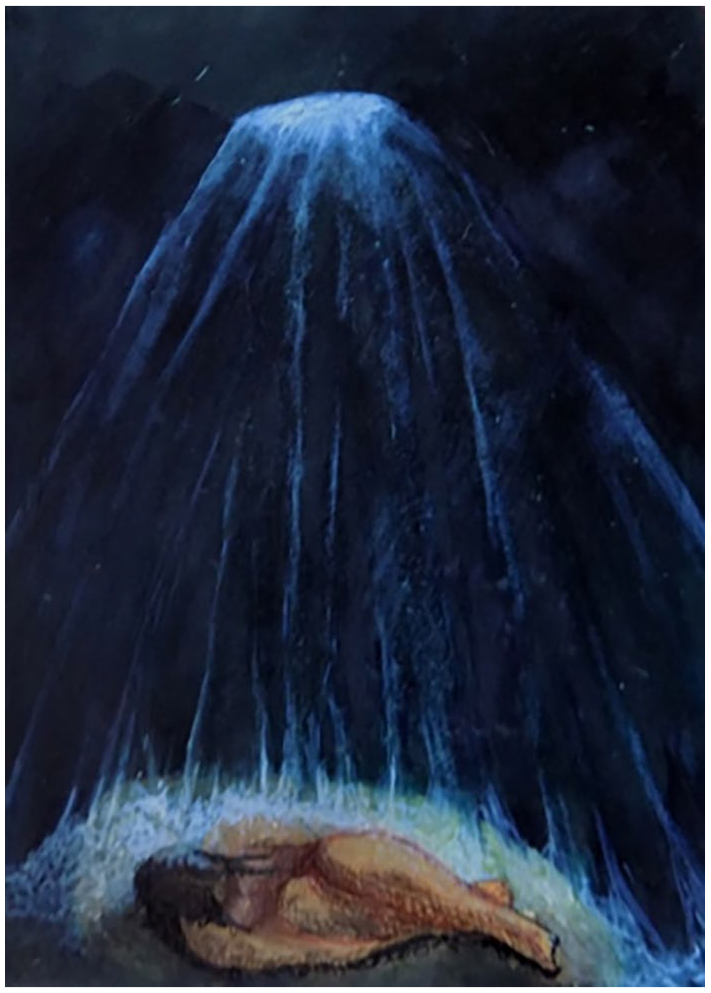
‘Falling into the Landscape’.
Other images were of bodies with names written all over them, showing that names do hurt; we take them in and they stick, we are wounded by them and crucified 66 by them. It takes a lifetime to discard them and try to understand why it matters what people think and say. Once wounded then it takes time, help and empowerment to loosen the Velcro on which they stick. My paintings imaged those Velcro-stuck bodies and fragmented bodies finishing with the same posing image of a liberated cosmic body 67 (see Figures 2 –4).
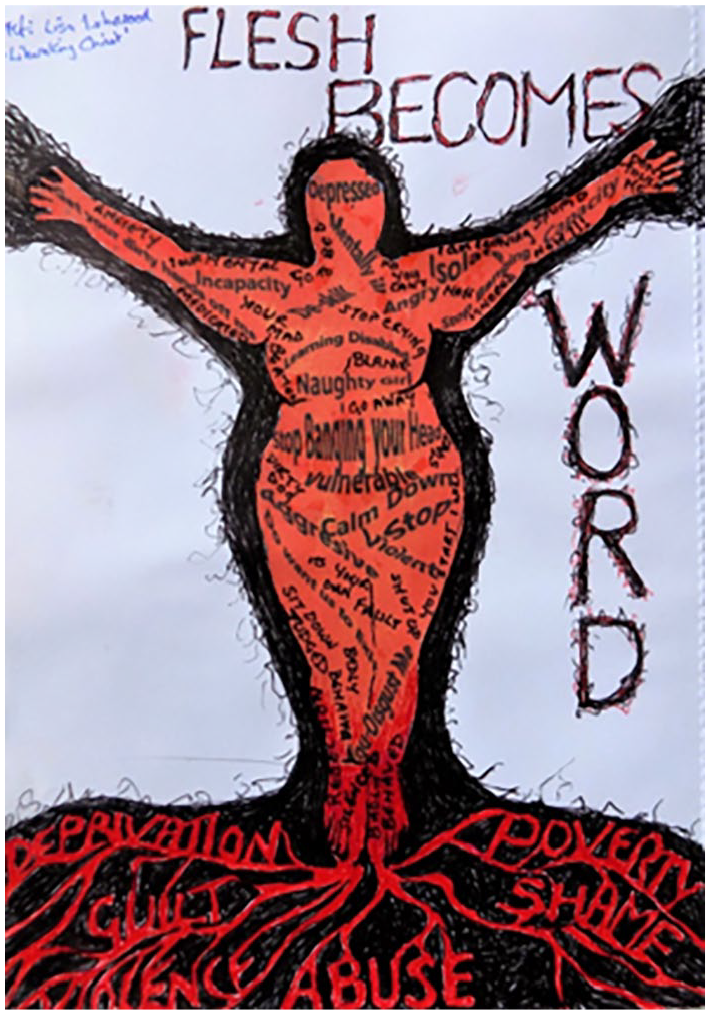
‘Crucified’.
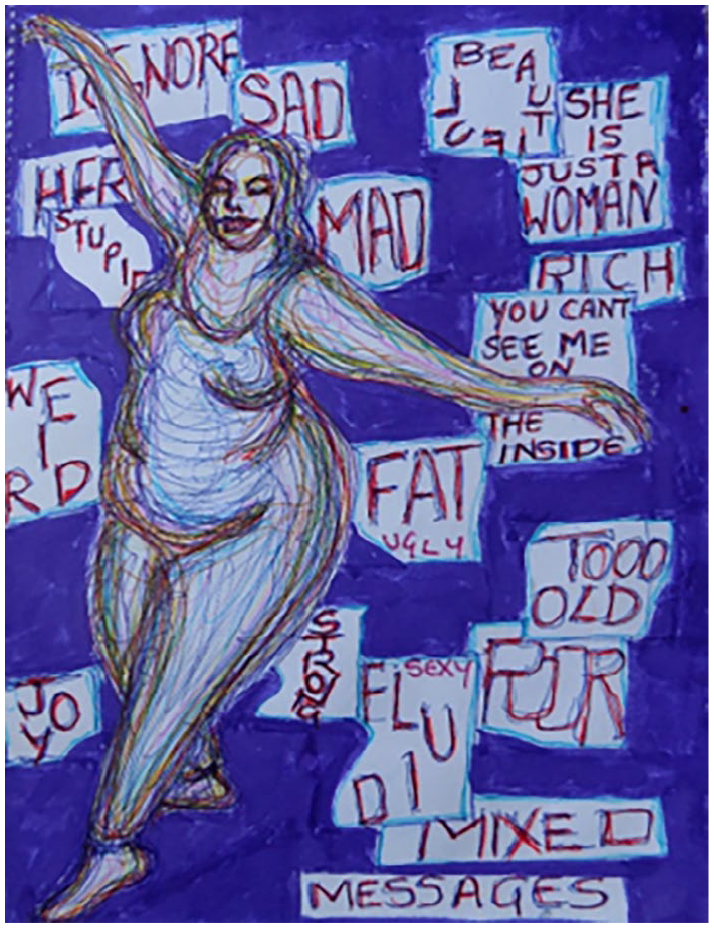
‘Velcroed body’.
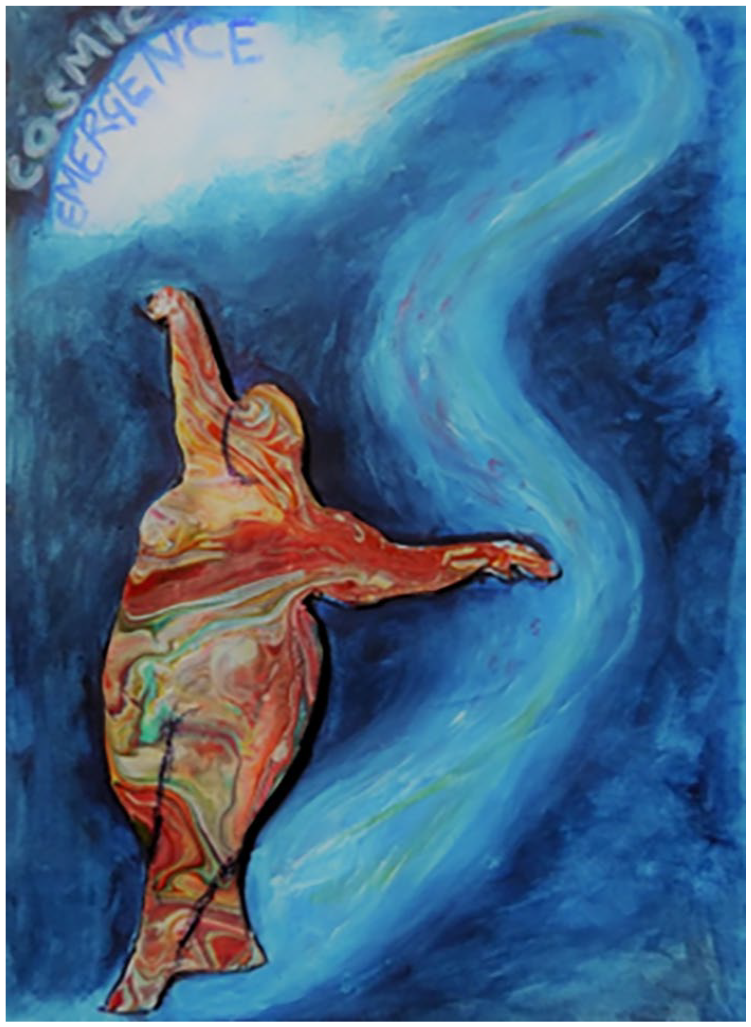
‘Cosmic Emergence’.
The process of painting my exhibited piece began with a black canvas created with blues, greens, red, purple, brown and a tiny touch of black this created a density of colour giving more depth than black would be on its own. I taped up six different size holes covering each one carefully with a lip around the edge so the paint would not leak into them. The fluid paint pour that I then used to create my main piece which depicted the landscape of the earth created with a pouring of greens, blues, white and a touch of red over the surface of the canvas. When the paint was dry I removed the taped up circles (see Figures 5 –7) 68
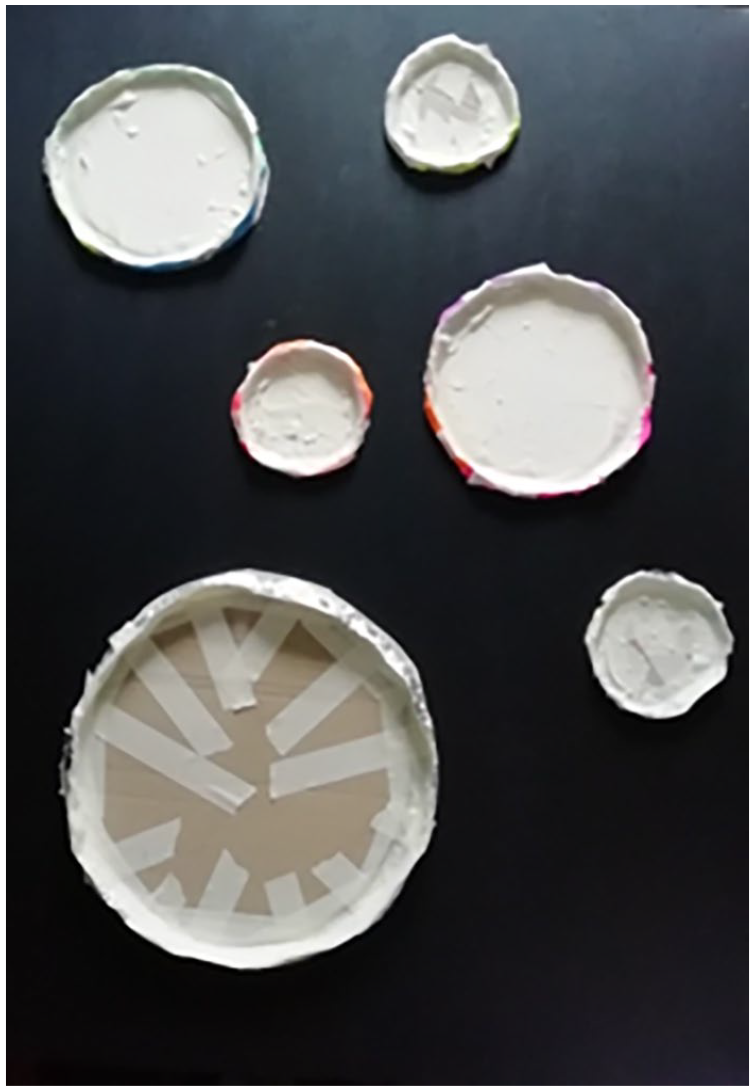
‘Preparing the Canvas 1’.
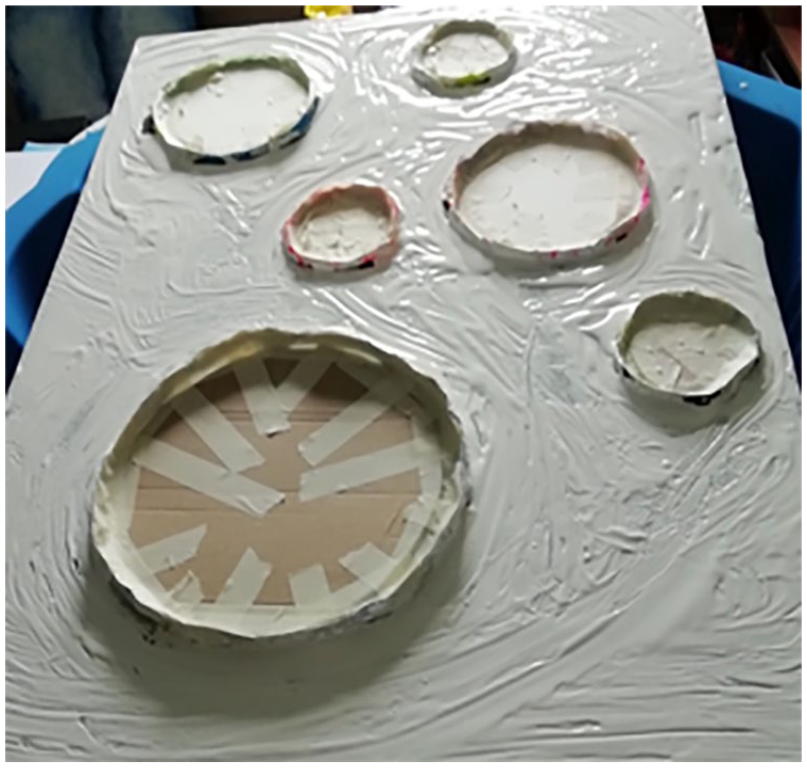
‘Peparing the Canvas 2’.
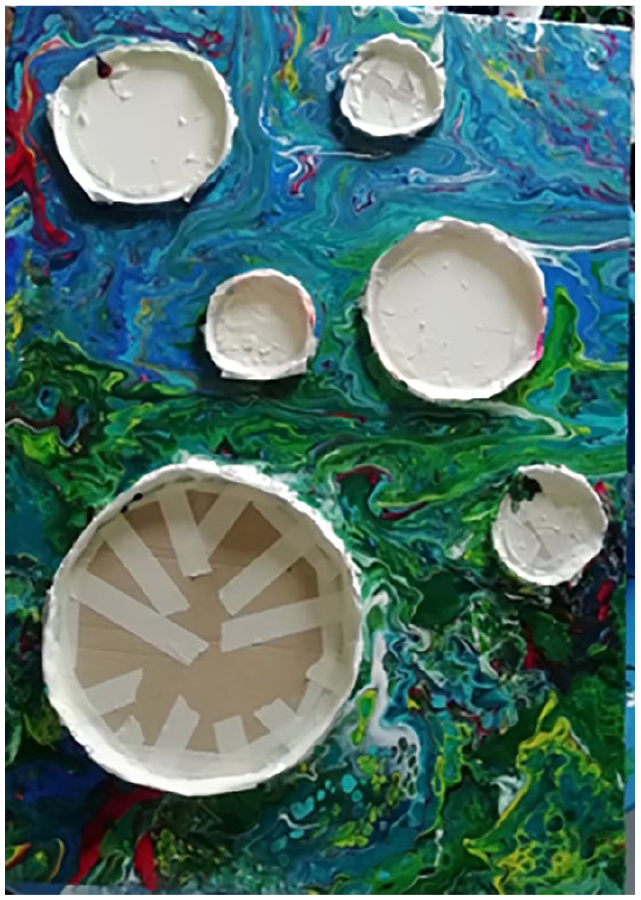
‘Preparing the Canvas 3’.
The Final Piece – Holes in the Landscape
This work reflects different selves emerging and those selves that have not yet emerged from my unconscious, and looking to see how they have, and still do, interplay with different parts of my life. Although these selves have been present in the landscape, in the spaces between myself and time in relation to others, there is an aspect of invisibility of the full presence of my being and identity. My process in this project has been about what is seen and unseen, imagined and valued, to who one is as a person/woman in the world, in the landscape and the interconnection and relationship one has with all of that. Holes in the landscape, in this scenario, is a psycho/theological reference point to the deep mystery of the divine. The holes represent the emergent spaces that are the unconscious awaiting the unknown to come into the light. This psycho drama represents the sacred unfolding of divine flesh 69 (see Figure 8).
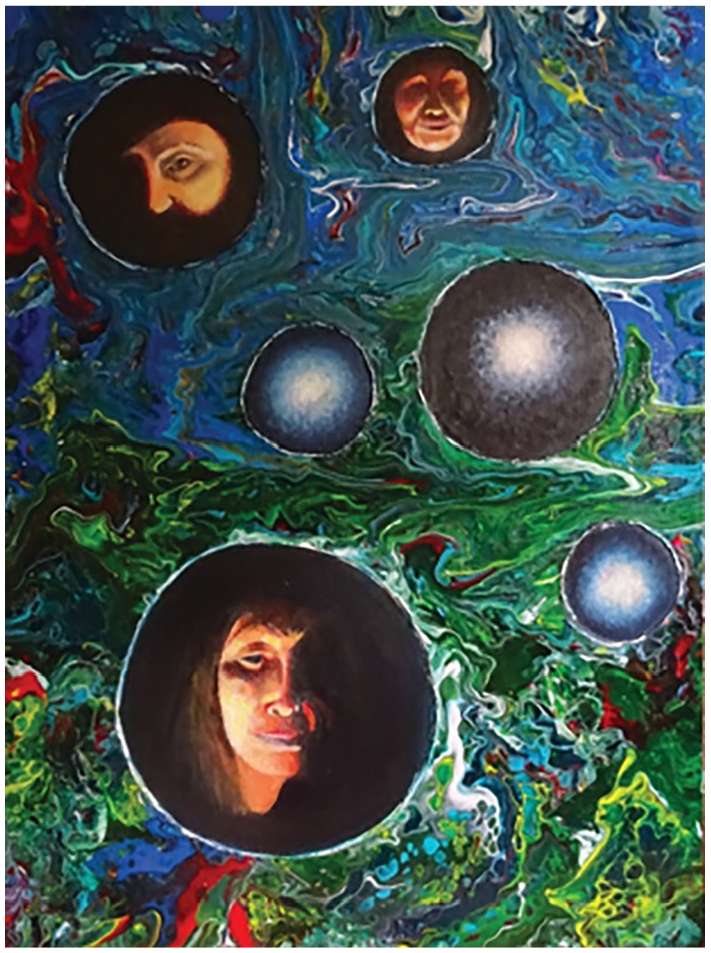
‘Holes in the Landscape’.
Holes in the Landscape hung with five other artists’ paintings. 70 In that space a somatic dance practitioner improvised a dance around the exhibited pieces. 71 This showed that the relationship between the artist, the dancer and the theological input was performative, witnessed by the people who came to the exhibition.
The conclusion to my process was that this was the divine energy within every imagined action and movement, in every step, every part of the journalling, the seminar, to the production of the single painting of each artist. This was all one outpouring: it was the whole thing talking about how the body speaks through the language of art.
Conclusion
‘If you are not moved then it isnt art’. I remember seeing this quote on a screen outside the art department at the University College of St Marks and St Johns in Plymouth, (Marjons) 72 where I was an undergraduate Theology/philosophy student in the 1990s, and I thought, yeah that’s it!!! As an artist, I understood immediately the visceral experience I was having in my own body, after seeing many live performances of dance and drama and visiting art exhibitions. The embodied way that artists present, paint and live can enable us to get back to a more enfleshed way of living; a way of looking after ourselves and discovering who we are as women in relation to our own experience, others and beyond into the wider world about us. I think that, in order to care for others, we need to know ourselves or at least be present to what is going on in our own bodies first: Bodies that are born, live through childhood, bodies that bleed, some that give birth to children, some that do not, creative bodies, ageing bodies and bodies that get sick and die. I have shown that the female artist’s body speaks what it sees, what it seeks to discover, and what it desires. Throughout history, female artists’ bodies have always spoken environmentally about how they see and experience life in what is done unto them, and how they are positioned within it. Visual art enables knowledge through a spiralling incarnation 73 of which Isherwood speaks, through which it is brought into a process of becoming through the sensory world of seeing, tasting, hearing, feeling and touch.
Footnotes
Funding
The author(s) received no financial support for the research, authorship, and/or publication of this article.
1.

2.
Keller C (2003) The Face of the Deep: A Theology of Becoming. London; New York: Routledge, 4.
3.
Keller C (2003) The Face of the Deep, xv–xx.
4.
Ex nihilo Definition & Meaning - Merriam-Webster
5.
Clay M (2013) Dancing in the Cosmos: Looking Toward Liberating Theological Models for Children’s Spirituality and Sexuality. Saarbrücken: Lap Lambert Academic Publishing, Fig. 26 – Fig. 53, 177–205.
6.
Sheldrake R (2001) Terence McKenna and Ralph Abraham, Creativity and Cosmic Consciousness. Rochester, VT: Park Street Press, 40.
7.
Swimme B and Berry T (1992) The Universe Story: From the Primordial Flaring Forth to the Ecozoic Era, A Celebration of the Unfolding of the Cosmos. New York: HarperCollins Publishers.
8.
Schneider LC (2008) Beyond Monotheism: A Theology of Multiplicity. New York: Routledge, 17–27.
9.
Fiorenza S (1995) Bread Not Stone, xxiv.
10.
Swimme B and Berry T (1992) The Universe Story, 30–46.
11.
Nelson JB (1992) Body Theology. Louisville, KY: John Knox Press, 30.
12.
Isherwood L (1999) Liberating Christ: Exploring the Christologies of Contemporary Liberation Movements. Cleveland, OH: Pilgrim Press, 143.
13.
Isherwood L (1999) Liberating Christ, 148.
14.
Proverbs 8:1-2, The New Revised Standard Version Bible.
15.
Hartley L (1995) Wisdom of the Body Moving: An Introduction to Body-Mind Centering. Berkeley, CA: North Atlantic Books, xix.
16.
Tucker ME and Grim J (eds) (2009) Thomas Berry: The Christian Future and the Fate of the Earth. Maryknoll, NY: Orbis Books, 29.
17.
Tucker ME and Grim J (eds) (2009) Thomas Berry, 96–123.
18.
Sheldrake R (2009) Morphic Resonance: The Nature of Formative Causation. Rochester, VT: Toronto, ON, Canada: Park Street Press, 65–80. Cannato J (2010) Field of Compassion: How the New Cosmology Is Transforming Spiritual Life. Notre Dame, IN: Sorin Books, 25–40, 112.
19.
Isherwood L (1999) Liberating Christ.
20.
‘Maggie Hambling: Touching the Void’ in Ramkalawon J (2016) Maggi Hambling Touch: Works on Paper. London: Lund Humphries in Collaboration with The British Museum, 8–36.
21.
Ramkalawon J (2016) Maggi Hambling Touch, 121.
22.
The Scallop Sculpture by Maggi Hambling - Chris Newson, Suffolk (artistchris.co.uk)
23.
25.
Ramkalawon J (2016) Maggi Hambling Touch, 7.
26.
Ramkalawon J (2016) Maggi Hambling Touch, 9.
27.
Ramkalawon J (2016) Maggi Hambling Touch, 9.
28.
Ramkalawon J (2016) Maggi Hambling Touch, 28.
29.
Aberth SL (2010) Leonora Carrington: Surrelaism, Alchemy and Art. London: Lund Humphries, 63.
30.
Aberth SL (2010) Leonora Carrington, 12.
31.
Leonora Carrington 1917–2011 | Tate
32.
Aberth SL (2010) Leonora Carrington, 7.
33.
Aberth SL (2010) Leonora Carrington, 47
34.
Warr T (2012) The Artists Body. London: Phaidon Press.
35.
Warr T (2012) The Artists Body, 11.
36.
Warr T (2012) The Artists Body 11.
37.
Warr T (2012) The Artists Body, 11.
38.
Gorilla Girls’ in Warr T (2012) The Artists Body, 22.
39.
Abramovic M (2016) A Memoir: Walk Through Walls. London: Penguin Random House UK, 1–26.
40.
Essling L (ed.) (2017) The Cleaner: Marina Abramovic. Berlin: Hatje Cantz Pub, 22.
41.
Essling L (ed.) (2017) The Cleaner, 47–49.
42.
Essling L (ed.) (2017) The Cleaner, 252.
43.
Abramovic M (2013) The Artist Is Present. New York: Publishers Museum of Modern Art, 204–208.
44.
Abramovic M (2013) The Artist Is Present, 60–76.
45.
46.
Essling L (ed.) (2017) The Cleaner, 222–239.
47.
Essling L (ed.) (2017) The Cleaner, 30–31.
48.
Abramovic M (2013) The Artist Is Present, 21.
49.
Essling L (ed.) (2017) The Cleaner, 30–31.
50.
Abramovic M (2013) The Artist Is Present, 212.
51.
Stiles K, Bisenbach K and Isles C (2010) Marina Abramovic. New York: Phaidon Press, 72–73.
52.
Stiles K, Bisenbach K and Isles C (2010) Marina Abramovic, 130.
53.
Essling L (ed.) (2017) The Cleaner, 26.
54.
Essling L (ed.) (2017) The Cleaner, 26.
55.
Essling L (ed.) (2017) The Cleaner, 252–259.
56.
Carolee Schneemann ‘Interior scroll’ in Warr T (2012) The Artists Body, 144–145.
57.
Schneemann C, ‘Interior scroll’ in Warr T (2012) The Artists Body, 144–145.
58.
Ana Mendieta, ‘Silueta Series’ in Warr T (2012) The Artists Body, 169.
59.
Mendieta A (1976) Untitled (Silueta Series, Mexico) | Tate.
60.
Horsfield K, Miller B and Garcia N, Ana Mendieta: Fuego de Tierra, 1988 quoted in Warr T (2012) The Artists Body, 168–169.
61.
Cano SM (2019) ‘Art/Theo/Logy: Theological-Art-Based-Research’. In: Clay M (ed.) Enfleshing the Unconscious: Feminist Imaginings. Hampshire: (ITP) Pub, 12–37.
62.
Clay M (2019) ‘Holes in the Landscape’. In: Clay M (ed.) Enfleshing the Unconscious: Feminist Imaginings. Hampshire: ITP Pub, 38–63.
64.
Body Prayer - Julian of Norwich — Cascadia Living Wisdom.
65.
Clay M (2019) Falling into the Landscape. In: Clay M (ed.) Enfleshing the Unconscious, 45.
66.
Clay M (2019) Crucified. In: Clay M (ed.) Enfleshing the Unconscious, 50.
67.
Clay M (2019) Velcroed body, cosmic emergence. In: Clay M (ed.) Enfleshing the Unconscious, 55, 61.
68.
Clay M (2019) ‘Preparing the Canvas 1’. In: Clay M (ed.) Enfleshing the Unconscious, 59.
69.
Clay M (2019) ‘Holes in the Landscape’. In: Clay M (ed.) Enfleshing the Unconscious, 62.
70.
Cano SM (2019) ‘Art/Theo/Logy-Theological-Arts-Based-Research’, Ireland D, ‘Meditations on Prose: Fostering Feminist Theological Visions’, Kinsey C, ‘Imagining the Imagination: A Journey of Becoming’, Knops H, ‘Half Woman: Longing for Abundance’, Noel R, ‘Becoming I: Enfleshing the Unconscious’. In: Clay M (ed.) Enfleshing the Unconscious: Feminist Imaginings. Hampshire: ITP Pub, 12–37, 64–85, 86–107, 108–121.
71.
James MB (2019) ‘Art-Based-Research in Dance: Somatic Practice, Philosophy and Facilitation’. In: Clay M (ed.) Enfleshing the Unconscious: Feminist Imaginings. Hampshire: ITP Pub, 142–160.
72.
The University College of St Mark and St Johns in Plymouth, Devon.
73.
Isherwood L (2004) The embodiment of feminist liberation theologies: the spiralling of incarnation. Feminist Theology Journal 12(2): 140–156.