




Abstract
This article deliberately selects findings from a feminist, cross-cultural, multi-faith ethnographic study of women’s religious identities, interpretations and practices in Malaysia and Britain. Findings pertaining to the embodied sacred are examined in terms of religious significance towards a sacralised female iconography. Focusing on sacred female representations, three distinct domains emerge relating to symbolic, sacred regenerative powers and the potency of a gendered infecund deification, where each domain relates to aspects of religious and ritualistic aspects loosely conforming to goddess typology. A nuanced account is offered privileging the experiential regarding how participants reconcile subordinated spiritual positions within patriarchal structures and discourses in seeking responsive woman-centric faiths.
Introduction
This article draws on selected findings from an extensive feminist, cross-cultural, cross-faith study into faith and gender in Britain and Malaysia, gathering women participants from Buddhist, Muslim, Christian, Jewish and Hindu traditions, together with Pagan pathways and Western Esotericism.
The conceptual parameters of the study interrogate intersecting influences of socio-politico-cultural contexts shaping individual lives and lived religion within a psychosocial framework. 1 A working supposition of the study was that women bring unique gendered perspectives to beliefs and observance, connected with their understandings of biological and gender normative expectations, negotiated by individual life histories, priorities, values and aspirations. The scope of the study is acknowledged to have been implicit to a research design privileging the subjective and experiential, amplifying women’s voices from across faith communities, where difference, divergence, commonality and communality productively intersect.
For the purposes of this article, an exploration of comparative faith practices is put to one side in favour of a discursive analysis of emergent models of feminine sacralisation arising in participant narratives where Sacred Female constructions were discernible. Although participant interpretations of goddess iconography were diverse and bounded by faith identities and doctrinal parameters, nonetheless, analysis indicates divine attributes associated with female deification leading to a faceted Sacred Female schema.
Gender, Religion and Women’s Faith
Feminism and faith remains a continuing contested ground, claims Christ 2 returning to her former polemic to argue for the necessity of female divinities at this perilous time of human history and planetary jeopardy. Penny et al. 3 and Long Marler 4 attest to women’s religious attunement or ‘musicality’; and strong leanings towards the spiritual. 5 In connection, Sointu and Woodhead 6 posit a strong rise in spirituality, as noted in the World Values Survey 7 and implicating changing gendered social mores and trends.
As Ruether 8 points out, feminist theologies have arisen from many traditions. For example, we may look to Black ‘womanist’ and Mujerista critiques subjecting patriarchal assumptions of monotheistic Abrahamic religions to sharp scrutiny. 9 This is not solely a twentieth-century phenomenon, for male theological pretensions were subjected to profound, critical examination by Victorian ‘feminist’ scholars. 10 A corollary of Christ’s argument is that the formation of an extensive, critical corpus of feminist scholarship regarding the significance of women’s faith has been largely overlooked by mainstream feminist movements in the West. Instead, feminist polemics have focused on structural, material and relational patriarchal oppressions, rather than those that concern religious, transcendent domains, regardless that these dictate gendered hierarchies on Earth. 11
Nonetheless, a strong interest in goddess-orientated faiths has been nurtured within the wider woman-centric ecology of feminism, such as through eco-feminist arguments. These make direct associations between the patriarchal exploitation and destruction of nature (a feminised construct in itself) and exploitation and abuse of women. 12 An abiding interest in female divinities has been regularly revisited in discursive feminist theologies 13 to which the findings from this study make a contribution.
Neo-paganism flourished within new feminist cultural milieux, generating innovative artistic interpretations such as the well-known Second Wave painting, ‘God giving birth’ by Monica Sjöö, 1968. Depicting a symbolic birthing female, it visually connected foundational precepts of neo-Paganism, feminist theology and eco-feminism in the portrayed interconnectedness of all creation, 14 reminiscent somewhat of Sheldrake’s 15 concept of ‘morphic resonance’. Goddess-orientated faiths continue to enjoy a contemporary renaissance in feminism’s Third Wave, holding promises of renewal of the disrupted human connections with nature through worship of the Sacred Female. 16 That said, not all such goddess worship carries overt feminist connotations, as will be discussed further.
Neo-pagan pathways, however, are eclectic and adaptive, 17 with a proliferation of morphologies spawning new forms. Wicca, one of the most prominent, is credited with being dominated by women adherents, whereas Druidism and Celtic Paganism, by contrast, attract more men. 18 Ruether’s caveat 19 warns that neo-Pagan faiths are reconstructive, being unable to claim any authentically direct, lineal descent from ancient goddess religions. She notes that these early religions positioned ancient goddesses with a male consort deity of some form or status, whether subordinated or equal, a balanced binary that features in contemporary Wicca as well.
Although neo-Paganism came overtly to the fore during Second Wave feminism, 20 it had an early advocate in the poet and novelist, Robert Graves 21 excavating buried mutations of the ‘White Goddess’, revealed as embedded across ancient European culture. Earlier in the twentieth century, the syncretic, elitist, male-dominated new religious form of Thelema, otherwise known as Western Esotericism, was also resurrecting goddess-type symbolisation, drawn from diverse arcane sources. 22 A more obviously prevailing and well-known goddess is to be found in the Virgin Mary, the sky goddess, Queen of Heaven 23 although for Porterfield, 24 Mary is but a ‘weak and perverted’ usurper of the authentic potent Mother Goddess dais.
Hinduism alone is credited with the longest, continuous tradition of goddess worship, where Sākti the Sacred Female principle represents feminine spiritual power, as well as endurance over the epochs.
Nonetheless, Sākti has been subject to suppression and obscurity, mirroring the patriarchal oppression of mortal woman. 25 From Sākti, two contrasting goddesses emanate, the consort goddess, Lakşmi and the warrior goddess of prosperity, Durgā. From the latter comes the ambiguous and frightening figure of Kālī, naked and be-garlanded with skulls, whose role is birthing and destroying worlds. 26 Kālī’s characteristics share some commonalities with the popular Hawaiian volcano goddess, Pale, whose fiery passions create new land while consuming others. 27
Pale, probably owing to the existential precarity of volcanic landscapes, successfully survived Christian displacement of other Hawaiian deities. Elsewhere Christianity’s deep ambivalence towards sexuality and its symbolisations generated prurience and misconception towards such depictions in other cultures, typified by the Hindu images of tantric sex together with representations of the female yoni and male lingam. Yet, these retain their cultural potency, where a recent study of a pilgrimage site of the Hindu goddess, Kamakhya’s disembodied but sacred yoni is viewed as worship strongly and positively affirming women’s sexuality and identity, through this visceral connection with female divinities. 28
Correspondingly, only recently has there been a more mature appreciation of and interest in the curious, medieval carvings known as sheela-na-gig, usually depicting a naked female figure, normally an older woman or crone, legs akimbo, displaying an exaggerated vulva. Across the British Isles and Ireland, these intriguing representations are found on Norman ecclesiastical buildings and liminal spaces such as bridges, doorways, lintels where Freitag 29 associates sheela-na-gig with folk fertility cults. Goode 30 asserts these as part of wider, age-old cultural representations of the intimidating/instructive power displays of women’s unique life-giving capacity. However, Caputti 31 argues that the enforced marginalisation of societal ‘gynocracies’ recast the potent vulvic display into the pornographic bonds of female subjugation rather than agentic female potency.
The aspects of the Sacred Female examined here convey complexity, ambiguity, contradiction and subversion. Such divine roles are far from simplistic, containable and innocuous. Nor are these goddess symbolisations uncontaminated by masculine constructions and interventions, where Durgā is brought into being by the will of male gods, 32 while an incongruous English civil servant, Gerald Gardner, is credited with the Wicca revival, 33 and the English occultist, Aleister Crowley, founded Thelema. 34 Finally, resonating with this article, Reid-Bowen 35 identifies three coherent conceptualisations prevalent in predominantly pantheistic goddess sacralisation: a personal, loving goddess; an impersonal generative one; and, finally, the goddess as maternal process.
Methodology
The overall research question underpinning the study focused on an examination of the pathways by which women construct personal religious meanings and practices, considered personally germane or authentic to their perspectives, concerns and priorities.
Three research aims supported the research question:
Developing insights into participants’ religious commitments and daily practice.
Exploring personally constructed meanings of faith in conjunction with the participant’s life narrative
Examining how a spiritual vision interacts with the lived experiences of life in wider society at a relational, community and social level.
In a study engaged with clustered cultural forms describing the psychosocial ecology of the lives of participants, ethnographic methodology was a particularly appropriate choice, with gender as the primary framework of analysis. 36 However, despite the use of ethnographic methods, this study did not conform fully to all the hallmarks of an ethnographic study in respect of close critical observational or an immersion into the deep ‘soundscape’ of the phenomenon under inquiry. 37 Critical observation of faith practices was confined of necessity to four main geographical places of worship only: a Malaysian Buddhist temple, an Indigenous evangelical congregation in Malaysia, a British Anglican church and a British Pagan moot. This limitation, owing to ethical and logistical reasons, is acknowledged. However, it is also the case that since many participants wished to be interviewed at home, and this was also where some, like Soka Gakai Buddhists, also worshipped, I had the opportunity to learn more about their faith practices in the context of sacralised and personal spaces. Irrespective of this, the political or ideological positioning defining a critical ethnography, 38 in this case a feminist personal-political positionality, foregrounded the study.
The number of participants recruited exceeded the conventional, smaller ethnographic sample to form a larger data set for comparative analysis. Owing to the scale of the sample, data gathering took place over 3 years. Recruitment was conducted through the use ‘snowballing’ convenience sampling strategies, 39 where participants introduced me to others in their network who met the basic criteria of adult female volunteers with mental capacity, self-identifying as holding a religion or faith. Following Gross, 40 Buddhists and eco-religious adherents were included in recruitment.
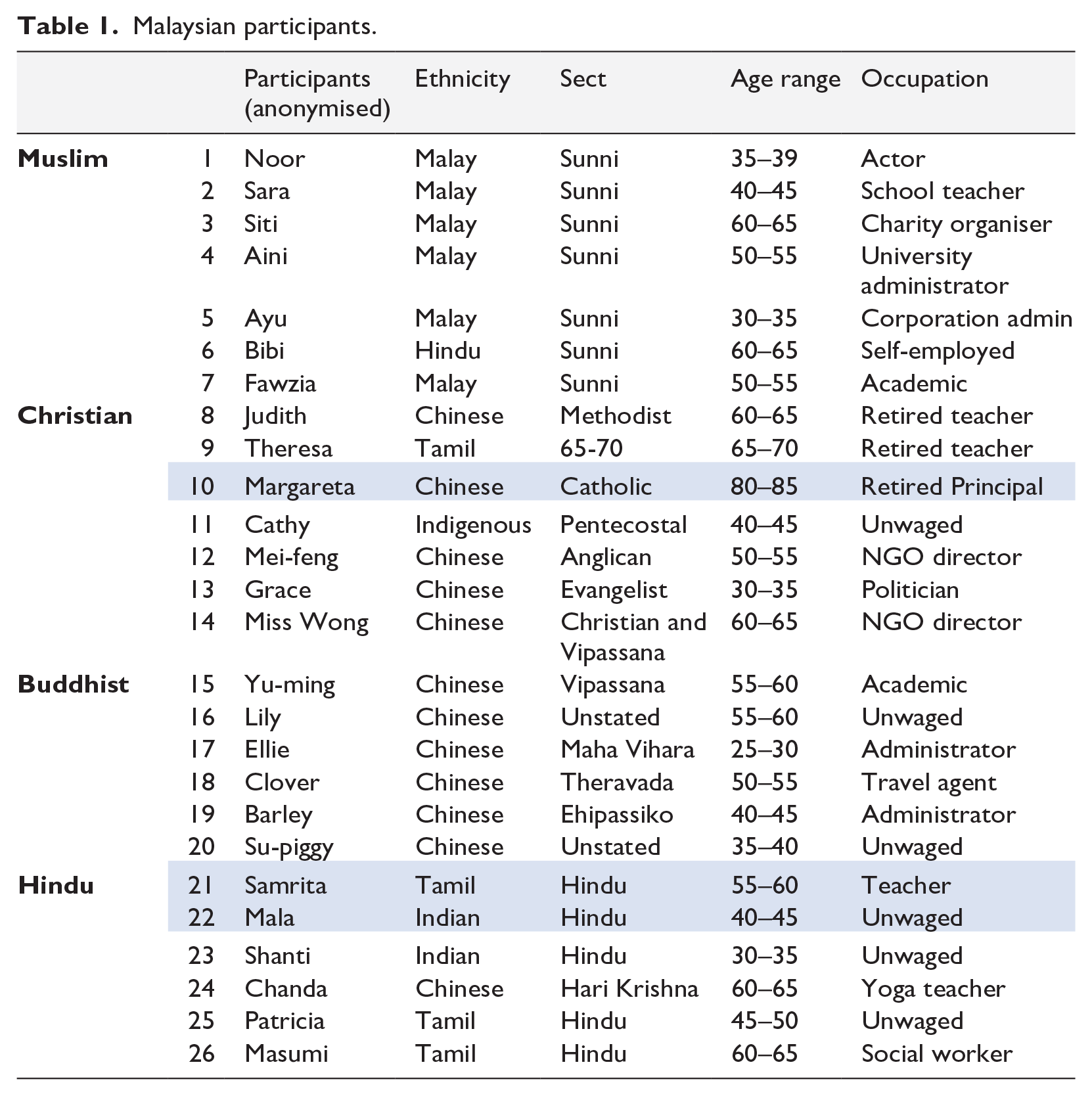
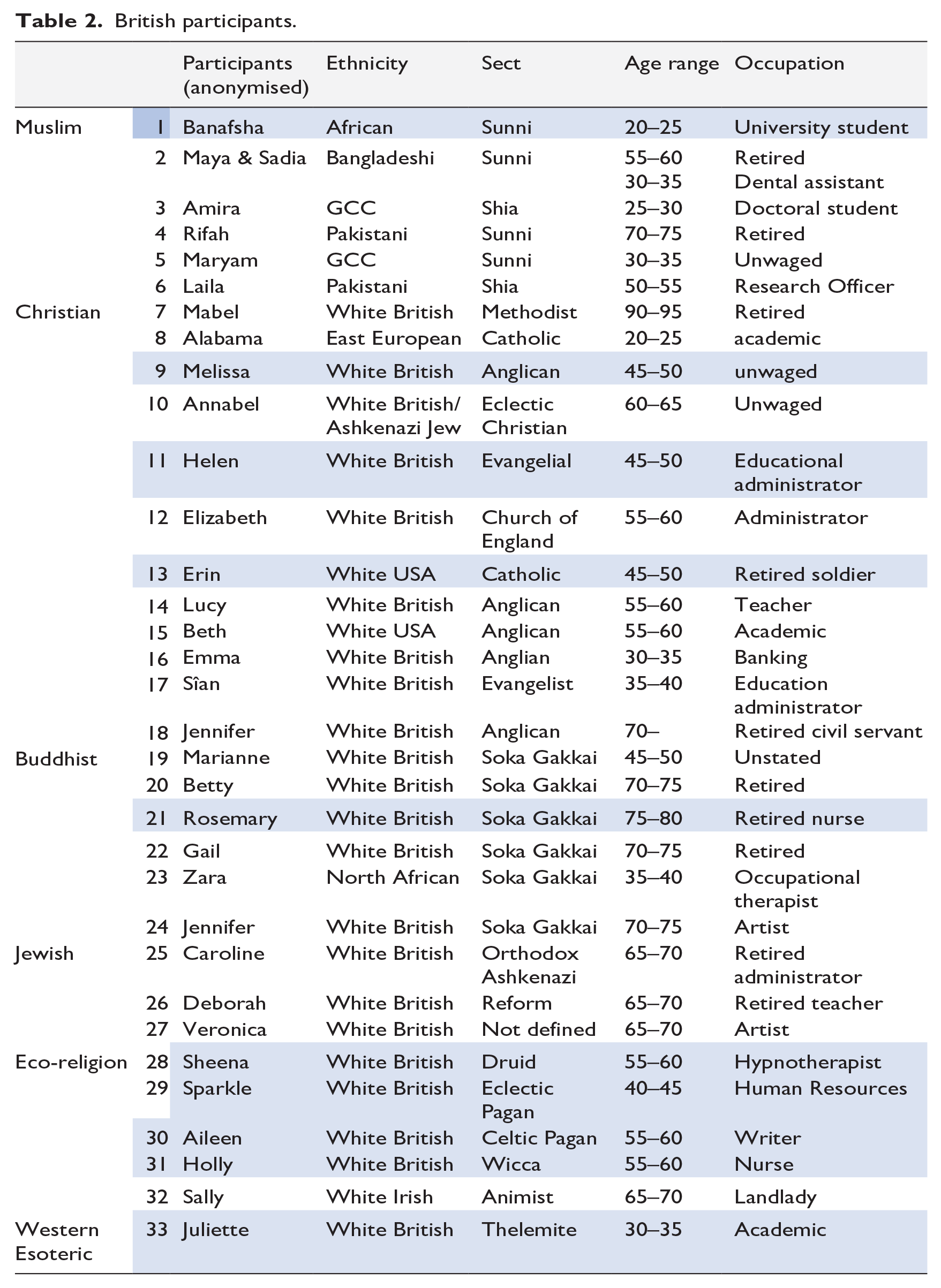
Overall, 63 participants were recruited to the study, of which a final total of 59 anonymised narratives were included for analysis. In the following table, participant narratives referred to in this article are highlighted.
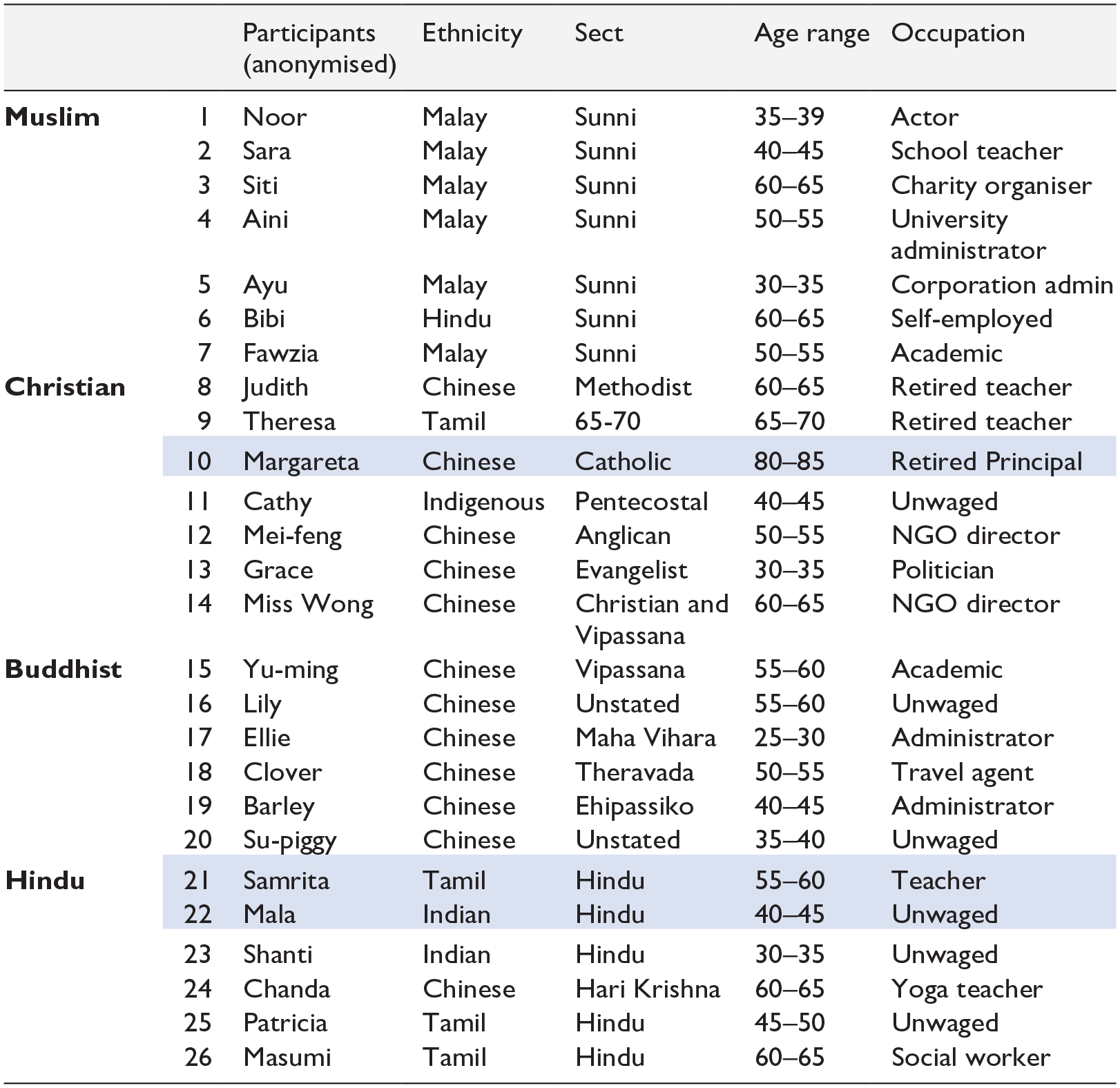
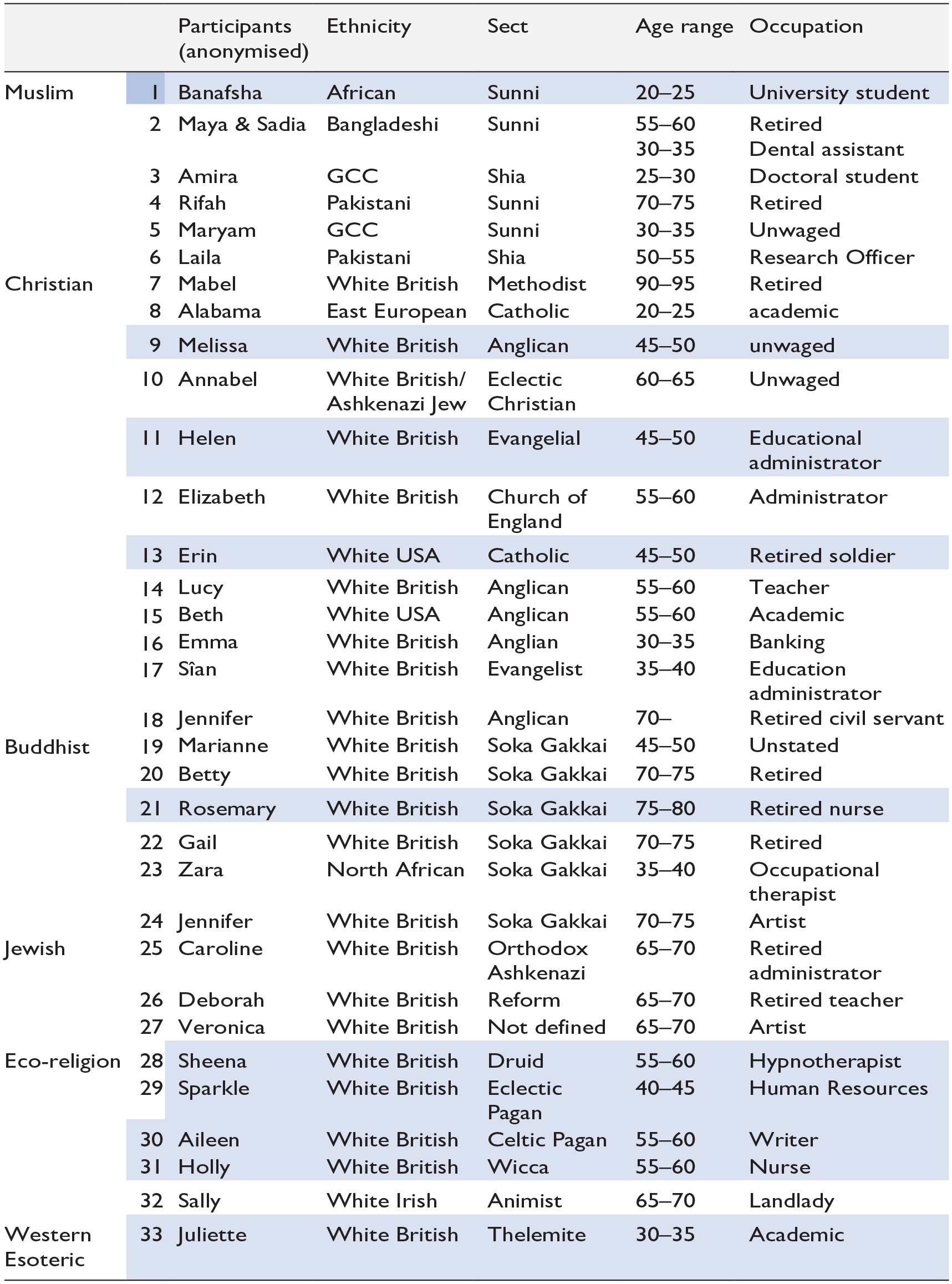
The wider findings of the study are discussed elsewhere and thus the scope of this article is confined to specific themes relating to the sacred female arising from the narratives of 13 Malaysian and British participants drawn from the participant sample with those self-identifying variously as Buddhists, Muslims, Christians, Hindus and diverse Pagan pathways. These are highlighted in Tables 1 and 2.
Malaysian participants.
British participants.
Participant narratives were gathered via qualitative semi-structured interviews and subject to thematic coding, 41 in which themes, as the study’s findings, are formed through the repetition of coded markers denoting noteworthy utterances and instances identified through close reading of the interviews. While this condensing of coded repetition forms the basis of the thematic findings, single instances are not ignored but comprise reflexive points of contradiction for further reflection that challenges a uniform consensus in theory generation. 42 This was particularly important in such a diverse participant sample.
Compared to more formalised, structured narrative methodologies, participant narratives were treated as fluid and iterative. 43 A social constructionist position 44 was employed, enabling the social worlds of participants to be explored, within an interpretivist meaning-making epistemology. 45 A dialectic tension was produced through the narrative process when participants reviewed their own positionality and beliefs, enabling the structural-cultural architecture of lives to become porous to new layers of co-constructed understanding. 46
Finally, this study conformed to all conventional university ethical safeguards, including consent, confidentiality, right to withdraw and data protection compliance. An in-depth self-reflexive approach permitted me to reflect on my positionality as a White, British, middle-class professional woman of unfolding no faith/faith convictions. My academic knowledge of both countries and faith plurality shaped and contextualised the study. Research ethics as a process of moral engagement demanded congruence with a feminist positionality; accordingly, I avoided substituting participant names for depersonalised, objectified numerical codes (see Tables 1 and 2), with appropriate pseudonyms being provided.
Thematic Findings
References to sacred female conceptualisations were less prevalent than those pertaining to a male creator, while woman as othered and peripherised formed the subtext of several narratives. The idealisation of archetypal masculinised potency frequently took centre stage in women’s faith, particularly in Malaysia across faith groups, through the personification of the Sacred Patriarch from whom the familial/clan patriarch takes authority. Often woman emerged blurrily into some definitional relief through an apophatic realisation: being defined by what she was not.
Yet, the female in both her transcendent and earth-bound roles was alluded to repeatedly by many participants across faith groups, and in this guise the primary role as mother was a dominant motif demonstrating a sanctified order, both prescriptive and descriptive. However, the female as sacred was also revealed as multidimensional, bearing merits and attributes that were subtly overlapping, complementary and also overtly contradictory.
The kataphatic, 47 those definitional representations of the duality of woman, both divine/holy and mortal, which arose from participant narratives, structure the discursive critique here interrogating these different characteristics of the sacred female. Such representations form overlapping, merging, but nonetheless, identifiably distinctive thematic domains shaping Sacred Female/goddess iconographies, being pregnant with meaning and immanent in the faith practices of believers. The three broad domains under discussion do not purport to be concrete, comprehensive or conclusive goddess constructions. Porous boundaries and ambiguities exist, such as how far a holy female seer connects to female deification, but irrespective of this, it is argued that participant narratives appear to coalesce into identifiable goddess/Sacred Female morphologies, duly explored in the following discussion.
The Fecund Goddess
A visual metaphor for the Sacred Female as Great Mother, Sjöö’s childbearing Creator is seen in her maternal, reproductive role as life giver to all creation 48 . These images, explicitly direct, symbolised or abstract, have been replicated diachronically across cultures from the Cretan Great Mother to the Celtic Ceridwen 49 as well as multiply reproduced in ancient artefacts since the ‘Venuses’ of Ice Age craft.
A maternal goddess remains a familiar one to many transglobally across faiths, where such may appear in connection with uxorial ties, subordinated to or removed from the symbolisation of dominant patriarchy. Contemporary goddess typologies speak to faith constructions certainly, but also the perceived shifting status, attitudes and experiences of women. For example, Rosemary, an older member of the Soka Gakkai Buddhist community in the United Kingdom, had little good to say of family life, being a jaundiced veteran of disappointing intimate relationships over the years. Yet, nonetheless, despite showing little maternal passion herself, the significance of the emblematic maternal figure within religious discourse remained untarnished, portraying perhaps a mythological functionality, which ordinary life sapped:
It (Buddhism) is pro-women, it honours women. Women are on par (with men) and really valued because of mothering, although not in my case. The qualities of womanhood: nurturing, compassion, standing up for . . . you only have to see a woman fight for her children–the dominant spirit of women.
Women’s ontological and symbolic potency is an aspect we shall return to. The sacramental regenerative power of the female was one that this follower of Celtic Paganism equally regarded as both elemental and central to her womanly being and purpose:
I am a mother and grandmother – the water flowing down, watching the chain of ancestors. If you stand in a river, you see which way the water is flowing: upstream the children are there, downstream the ancestors. I do believe in pantheons. I believe in many gods not just one. It’s not a duality like Wiccans believe: a Lord and Lady, but I see what they see too.
The regenerative female body is the primary conduit of life, within and beyond the individual in a flowing chain of generational being within a pantheistic and nature-embracing context.
Motherhood–the fecund goddess upon whom all life depends, is a nuanced, pluralistic construct in trait and potential, where this fertile, sustainer figure is exemplified in the cult of Mariology. 50 Madonna/Virgin Mary’s sanctified image (with Child) can be found in cathedrals and churches globally, to the extent that the untutored might imagine that Christianity was in fact, fundamentally, Marian worship. Yet regardless that Mary is the θεοτόκος (the Theotokos): the ‘Mother of God’, theologically she is not included in the exclusive Sacred Patriarchal club of the Holy Trinity. 51 In Protestantism, Mary’s role is diminished still further to almost complete exclusion symbolising a wounding banishment and rejection of woman, prompting gendered, spiritual resistance in this former Christian-turned-Druid, explaining disgustedly why she had left Anglicanism:
No women! Especially (me) being Protestant, there wasn’t even Mary. It wasn’t fulfilling spirituality
Lapsed Catholic turned eclectic Pagan, Sparkle was dismissive of Mary’s subaltern status and the drily dismissive ‘yeah, right!’ of the theological paradoxes of the Virgin as ‘Maiden and Mother’, as sexist and absurd.
The paradigm of Mary, chaste, suffering and self-sacrificing, the ‘matchless maiden’, is of course a cliché and has been a much mocked one too. Yet, Islam also venerates the holy handmaiden, where Mary(am) equally represents sublime holy motherhood and the virgin birth of Jesus (Issa) is reaffirmed (Holy Qur’an Chapter 66: 12). Correspondingly, Muslim participants, like Banafsha, a young British woman of African heritage, strongly connected woman’s faith and her familial and reproductive roles as those mandated by heaven and informed by hadith, where virtuous women complied with their God-given gendered role:
We understand that women have higher rights than men: when a daughter is born she is like the gates to paradise for her father. When she is a mother, heaven is under her feet.
The Holy Qu’ran lauds women’s maternal role in a number of verses. Yet, Wadud 52 argues that while Muslim motherhood is revered in the abstract, it does not overturn structural oppressions or translate into gendered equalities in the material ontology of inter-personal relations. Moreover, Mernissi’s argument cuts through the question of earthly power and feminine sacrality, saying, ‘Islam is crystal-clear about principles. So, if one acknowledges a priori that women effectively have no power, then one cannot directly transmit any divine mission to them’. 53
One participant who ultimately rejected the Christianity of her upbringing argued that there were few strong women in its pantheon and thus few role models to emulate.
Troubling Mariology is gendered resistance, given Ashe’s 54 observation of the politicisation of Marian symbolism by sectarian groups in the ‘Troubles’ of Northern Ireland, implicating gendered boundaries valorising men’s roles as defenders, active in the external world, with women relegated to home and hearth. Masculinist exploitation of Marian imagery abounds where the Catholic Church recently had to rescue the Virgin Mary from the manipulative clutches of the local Mafia, and their prostitution of her sacred image for corrupt, impious gain. Rome has subsequently declared its mission to re-educate a gullible or populace into approved Mariology. 55
Yet, the ‘soft power’ of the ultimate exemplar of maternal virtue and unconditional love, the Madonna, is also the world’s conscience, ‘guilting’, Erin, a robust, retired soldier and observant Catholic into being a better mother to her young daughter:
In Christianity, Mary is the Mother of God. She is a main character and there are a lot of female saints. Look at St Teresa. I can name more of them than the male ones. In images it’s the poor suffering woman. If you are always looking over the sacrifice of the woman nurturing, then you think uh-oh! Maybe I need to give my child a hug.
Marian iconography remains deeply contested: as the example of womanly virtue, par excellence, it is revered, re-interpreted, resisted and rejected. For Porterfield, 56 Mary is demoted in Christianity from a supreme goddess to a fleshly, subordinated vessel inscribing and reinforcing the polarities of status in the hierarchical structuration of gender. Mary’s positionality, for Porterfield, is not even that of the equal third strut in the reproductive triangle but further degraded.
By contrast to conventional Marian critiques, 57 Daly before abandoning Christianity offered a radically different interpretation of Mary, into an amoebic, self-sustaining, self-reproducer – distanced from the Holy Patriarchal Trinity, and denoting transcendent, subversive, creative power through reproduction without male involvement. She, the Virgin, is pure, complete and enclosed as an uncracked egg, to borrow a metaphor from the late, feminist reinterpret of myths and legends, the novelist, Angela Carter: 58 and like the egg is integrally her own germ and sanctum of regeneration.
Constructive fissures fracture the attempt to create single, static images of Mary and have influenced Sacred Female tourism industry across goddess faiths. 59 In respect of Marian imagery dichotomised into types, an iconographic bifurcation occurs. While the supremacy of the Christian God Father is affirmed by the positioning of the White Madonna’s handmaiden servility, 60 the ‘Black Madonna’ has come to denote ancient, woman-centric Mother Earth, goddess potency.
Crucially, both Madonnas are essentially regenerative, betokening renewal, as is the so-called Indigenous ‘Mary of the Third World’. 61 This Latin American Indigenised personification is not sky-pinned, but keeps feet rooted in the earth, symbolising renewal through ‘respair’: hope revived through re-commitment in full, painful acknowledgement of extant damage and suffering. 62 The Indigenous Mary with Child is derived from the mothered oppressed: ‘They have seen in her a woman of the people, poor and united with their aspirations. They have gone beyond the sociological poverty of Mary to see her radical interior poverty. . . For them, Mary means: “a new human being is possible”’. 63
This new possibility is illuminated in cast bronze in Elizabeth Frink’s 1981 statue ‘Walking Madonna’, depicting an elemental, purposeful and dynamic female form, unpinned from static passivity as she strides forth unhampered by the holy Child. Here, perhaps, is a portrayal of Mary that combines the qualities of resolution, strength and tenderness that some participants valued and not infrequently sought in vain.
Sacred Protectors and Warriors
In fetishizing the holy fecundity of the young, untouched maiden, Mary, and by extension that of socio-religiously mandated (youthful) motherhood, the legitimacy of all other women outside of these circumstances becomes questionable. Melissa, a mother of adult children and active in her Church, was critical of this exclusion:
I remember Shylock’s speech, ‘do you not think we have thoughts and feelings as well?’ I feel that that is something that women could say in parts of the Church . . . which have a very exalted view of Mary, but that’s because they put women out of reach and so women are safe. If you expect women to fit into the role of Mary then the bit that is most emphasised is ‘I am the handmaiden of the Lord’–referring to 16-,17-,18-year-olds that fit the frame. But what use have you got for women from 21 onwards; and those who can no longer be called handmaiden: single women, older single women, barrenness?
Melissa’s comments underline once again the patriarchal fetishization of Marian imagery combining the nubile, virginal and fertile. For many Christian women without the respectable, legitimised status of matron, it can be difficult to find substantive and meaningful recognition of their value within their churches. Helen, for instance, is a dedicated member of her evangelical church, but like other single women could not entirely fit in owing to her perceived incongruous status:
My issue with the woman is more about my position as a woman in Church. If you read about women and faith, I don’t fit into the norms in the structure I am part of. I am single person, never been married. . . It’s about trying to find your own identity as a woman. It’s almost as though I don’t have a gender. . . Am I less of a female because I haven’t had children? But sometimes the Church environment makes you feel like that–less of a female.
Aune 64 notes that such heteronormative gendered marginalisation results in women like Helen leaving congregations. Helen is positioned as an uncomfortable contradiction, a ‘subordinated’ femininity if one pleases, to paraphrase Connell. 65 However, far deeper than any sexist, gender normativity in modern evangelism lies a far deeper tradition of women’s voice of authority whose mandate, like that of Sophia/Wisdom in Prov. 8.22–31 comes directly from Omniscient Supremacy. It was into this older tradition that Helen delved for affirmation:
I have again looked at the Bible. I have looked at the Old and New Testaments where there are strong women figures, female judges -Deborah was a judge–and the Prophetesses, Huldah and Anna.
Praetorius 66 explores both the power and the limitations of the authority of the spoken word for women as well as men, in a posited post-patriarchal society, which readers might well argue is a far more remote possibility than the current extreme relativism of a ‘post-truth’ one. The burying of women’s prophecies under sediments of male scripture, however, does not entirely overshadow their significance. Women, like Esther, Anna and Miriam, irrespective of any other role or status they may have borne in their lives, were viewed as genuine prophets, duly carrying the authority of God-given charisma to speak fearlessly their respected, inspired truths and warnings in the public space. The scriptural references may be insultingly brief, but nevertheless speak volumes of female holy authority important to emerging Christianity.
Goddess worship, where venerating regenerative female powers, is based on direct transference of human (and mammalian) reproduction. These ‘Mother Earth’-type depictions flatten the complexities of the multiple dimensions of the Sacred Female, where the explicit, implicit and liminal aspects of goddess constructs are open to simplistic misunderstandings. For example, Robinson 67 argues that the Hindu Devi (primary goddess) Sākti resists any easy Mother Goddess classification, going far beyond the uxorial or maternal. Sākti is said to be the female principle incarnate from whom other goddesses manifest, 68 whereby Sākti’s feminine energy represents the primal creative principle underlying the very cosmos.
Yet, if far more than a sum of parts, Sākti is still understood and experienced as the support of women occupying biological and culturally normative roles. Somewhat akin to the Mary of the Third World, Sākti was viewed by Samrita, a Malaysian Hindu participant, as a force of social, gendered restitution in extending her divine protection to those who need it the most: women and their children.
In mythology, from what I gather, there is the divine Him and Her, and when there is some kind of turbulence or disaster and when someone approaches them they cannot be at all places so they manifest in different forms. For me, I follow my parents (worshipping) Goddess Sākti, because she is a lady and I am always for women. . . Because usually when there is injustice turned to women, they (avatars) do manifest and they destroy the evil force. And when women are going through a very hard time in sickness and poverty, with children, then they really need divine power to go through that.
Sākti’s goddess emanations represent two contrasting aspects of the feminine, the ideal consort Lakshmi and the female warrior Durgā. This latter eight-armed, weapon-wielding warrior goddess, slaughterer of demons, was Samrita’s chosen defender of womankind.
Mala adopted pragmatic kathenotheistic choices of favouring particular Hindu deities according to circumstances, and also offered reverence to Durgā. For Mala, Durgā occupied a comfortable familial deistic, domestic trio. Reflective of traditional values, this construction carried an orderly, divine and harmonious reflection of ideal Hindu family life:
Durgā, Murugan and Vinayagar. They are like a family: father, mother and children. Durgā is the mother, Murga the second son and Vinayagar (Ganesha) is the elder son. Normally women pray to Durgā. Sometimes you feel she answers your call, because she is also a mother.
Durgā’s position is ambiguous; some like Mala like to place her in an uxorial, maternal construct as protector of hearth and home, but the goddess is also well known as a celibate divinity, and in this role is domestically unfettered to be more clearly the opponent of evil and defender of the vulnerable. The warrior goddess emerges from other traditions as well:
I am not a warrior queen although I do fight for what I want. I use Frigga, Freya and Thor – you call on the symbolic strength. . . Male and female are equal in craft. . . The sword going into the cup – symbolic. Male and female, winter and summer, up and down, in and out, earth spirits.
The warpath of the Valkyrie, with her ideologically reformed appeal in the age of Marvel movies, may be an inspiring wellspring of latent possibility. Holly, a Wiccan participant, drew her strength from summoning the atavistic powers of the Norse pantheon.
The balancing of the symbolic sacred female with the male was one favoured in narratives from Pagan pathfinding participants. The ‘polarity’ of divine dimorphism embodied in the ‘High Priest and the High Priestess in Wicca’, as one participant described it, grounded, elemental, balancing forces ritually harnessed for religious ends.
This resonates with Ruether’s 69 observation of the eternal female–male dyad in mythologies of female goddess and their male consort. We should be wary of assuming an unequal positioning of superiority-inferiority in these gendered deity constructions, although the characteristics of deities may be peculiarly specific to their gendered manifestation.
These sources of power do not necessarily equate with reproductive female energies but with other qualities considered essential to the well-being of humanity. Thus, the pagan duality of the ‘Lord’ and ‘Lady’ is often associated with the Celtic goddess, Brige and her consort, Angus, both being divinities of multiple traits and virtues. Of Brige herself,
She is a fire goddess – fire of the heart: home, family and healing. Fire of the forge – old crafts and the fire of the head – inspiration of poetry and invention. Her name means ‘Bright Arrow’.
Brige/Brigid/Brigit bears an inchoate, obscure but pervasive heritage, after which many British rivers are named, such as the Brent and the Braint. Associated with the tribal Celtic Brigantes of Northern England, she is possibly a Romanised construct rather than authentically Celtic. Brige was adopted by the invading Romans, where eventually her Roman consort was a derivation of the supreme god, Jupiter/Jove. 70 Her metamorphosis was later absorbed into Christianity, according to this teacher of Druid pathways:
Being brought up on the West Coast of Scotland – my own female figure was Bridget (St Bride) and all the holy wells are Bride’s Well. As a child she was just ‘Bridie’ and you left flowers at the well. But the Catholics identified her with St Bridget of Kildare. Bridget was the one who was watching and she looked after children . . . this was the goddess Brige. When they changed to Christianity the goddess was so beloved, they could not give her up so turned her into a saint.
Brige’s camouflage preserved her legacy from expulsion, serving to form another mythological layer. In her Christian guise, she became a renewed figure of great holy importance, one that carried strong, Gallic ethno-cultural significance revolving around the importance of the foster parent. As Mary’s midwife and the foster mother of Christ, St Bridget holy role was secured, her métier revolving around family, hearth and healing, adapted to protector of women and children. 71
In this vein, the example of the Buddhist bodhisattvas is illuminating. Construed as sub-divinities, bodhisattvas delay their own attainment of Nirvana in order to assist humankind to escape the wheel of rebirth and the inevitable human condition of suffering. Those of Tibet are deified, portrayed and worshipped as goddesses through the devotional practices of bhakti, which Armstrong 72 interprets as a normal ‘yearning for a humanised religion’ in a faith that relinquishes creator gods.
Margareta, a committed Roman Catholic, and convert from Taoism, drew inspiration from two goddess traditions, finding in Mary and Kwan Yin analogous virtues:
I feel that Mother Mary and Kwan Yin appear to me because they are good in themselves, not particularly because they are women, because they are literally mothers or could have been.
While Mary is holy maternity embodied, Kwan Yin, a bodhisattava, does not bear such characteristics. Both are united, however, in being associated with unconditional love, charity and compassion for troubled humankind and the comforter of its sorrows. Correspondingly the feminised, motherly Christ of Julian of Norwich’s visions is far more attuned to the Sacred Female oeuvre than the lingering traits of the Old Testament Patriarch.
Thus, in these manifestations of the goddess, we can trace a new theme emerging where the Sacred Female is either specifically not fertile or, more precisely, dis-associated with the procreative act of birth. She aids, defends and promotes regeneration and the nurturance of life, ensuring the physical, moral and spiritual survival of her people.
The Sexual, Fallow Goddess
Subtracting sexuality from procreativity is an intriguing, counter-intuitive aspect of goddess worship emerging very strongly from a small number of narratives. Given that women’s frank sexuality remains a compromising, indeed stigmatising issue in Western society at least, the scarcity of such accounts may be unsurprising. Here again, certain overlaps can be found with other typologies in which certain traits connect goddess symbolisation tangentially to the fecund or nurturing. Moreover, ambiguities arise in terms of female divinities that may or may not be directly and overtly empowering to women, and when they are these are embedded in contested if nuanced symbolisms.
Sparkle scorned the impossible paradox of Christian fetishisation of virgin births, and instead this was replaced with a different goddess paradigm that she felt was much more affirmative of and authentic to women as invigorated, agentic sexual beings:
I have a goddess that I have more of an affinity (with). Goddess Baubo–vulva, belly, laughter, mirth and sexuality and belly dancing. A Greek goddess. She will flash her vulva. She is one of the muses – all to do with woman’s sexual energy. She would be the midwife as well, but not the mother. . . She brings the sexual energy to new couples.
In mythology, Baubo carries divine traits but is no deity, being cast as the goddess Demeter’s aging servant. Prostrated with grief at the loss of her daughter, Persephone, to Hades, Demeter, goddess of the harvest, plunges the world into winter mourning. It is ribald Baubo who helps to restore the balance of the Earth’s cycles by mischievously lifting off her skirts to reveal her genitals, restoring Demeter to humour and spring. In carvings, Baubo is often represented as a squatting woman with exposed vulva balancing acrobatically on a swine, and thus carries an older lineage later connected to the ‘flashing crones’ of the sheela-na-gig cult. 73 However, Baubo has another interesting reputation; her name means ‘belly’ or ‘womb’ and she is associated, like Bridget, with midwifery.
Symbolisations of the womb and the E/earth, are equally indelibly associated with death/grave; thus, aged Baubo carries these darker associations as well. Her nude, non-reproductive vulva is ambiguous, representing female regeneration and life force, albeit as facilitative, enabling life to come into being, rather than the act of procreation itself. Moreover, Baubo’s vulva is also a portal to death and the womb of dust, signifying circular resurrection associations 74 .
Baubo and Kālī, although so different, carry similar plural associations in deliberately nude representational forms. Kālī’s métier as destroyer is evident through her fearsome, seemingly diabolic imagery – misunderstood in the West. 75 Yet, Kālī is simultaneously the tender, reproductive creator, bringing her more in line with fecund, nurturing goddess imagery. However, the dissolution of mortal human life forms part of her personification, as in Baubo’s subtle symbolisation. Kālī bears the dual powers over birth and death, expanding the parameters of her enigmatic divinity further than the role of attendant and enabler.
Caputti 76 argues that phallic domination in kyriarchial patriarchy 77 has degraded sacred vulva imagery, reducing Great Goddess iconography to that of the Great Whore. A practitioner of Western Esotericism (Thelema) warmed to the topic of goddess worship, identified in her faith as ‘Nuit’ (derived from Nut, the ancient Egyptian sky goddess) and Nuit’s eclectic counterpart, the Great Whore of Babylon, adopted from the lurid addendum, Revelation, from the Bible:
It is almost a fetishisation of the role of the woman. . . Woman is the conduit of the divine in the goddess and the man worships her. There are a lot of women, sex workers and porn stars who see their work as part of their worship – Babylon . . . The Holy Whore is a very economical, absolutely shameless and will accept all. There is a reciprocity there, you cannot claim someone a Whore and not be reciprocated. She (Great Whore of Babylon) is contrasted with the mother. The whore is infertile and doesn’t reproduce. Thelema doesn’t know what to do with children.
Western Esotericism (Thelema) is a syncretic religion drawing heavily from the Jewish kabbala, Christian gospels, Ancient Egyptian motifs with Kurdish Yezidi credentials, among other arcane sources. 78 Thelema, being an elite, exclusive male-dominated faith 79 a young, single parent like Juliette seemed an unusual recruit.
The Whore of Babylon, clad in red, riding the figurative seven-headed beast, has always been a strikingly wanton, audacious image. The meaning behind the symbolisation is open to much theological interpretation 80 . However, Babylon may also obliquely refer to the alleged practices of Canaanite temple prostitution, a particularly apt association so far as Thelema is concerned. Yet, things are not quite what they seem, for Budin 81 argues that sacred prostitution probably referred to female and male qedešum temple votaries of Mesopotamia, condemned by Yahweh followers as prostitutes. The female qedešah is more associated with the enabler/nurturer tradition of Baubo and St Bridget, than the trope of the sexually fetishised Babylon of Thelema, for female qedešah were connected to the woman-centric spheres of midwifery care and wet nursing. Juliette positioned herself as unambiguously a feminist; yet, many feminists might well be challenged by a faith that openly celebrates women’s sexuality unfettered by domesticity, marital bonds and offspring, but which nonetheless is a construct of masculinised fetish of the eternally sexually available female under the male gaze.
Revisiting the three Sacred Female deification morphologies arising from participant narratives forming an identifiable, synergistic complexity, each morphology is pliable to reconfiguration into linked, interconnecting aspects of woman’s milestones/stages.
Between the binary opposition of creation and annihilation in goddess imagery, ambiguity is present as liminality with revolving facets of the feminine sacred reflecting the transitions, flux and flow of women’s biological and social selves. The virtues/assets of Sacred Female iconographies offer a holism of the female as loving giver, compassionate companion/helpmate, embodiments of sensuality and sexuality, procreator, death-bringer or Nemesis, herself another goddess.
Conclusion
Participant narratives offered intriguing insights into the complexities of Sacred Female morphologies, occupying distinctive if not entirely distinct or discrete social constructions of goddess images. Goddess worship in Malaysia is intrinsic to ancient faith forms brought to Malaysia through the sub-Indian diaspora, differing considerably from the goddess revivalist and syncretic religions of the West, typified by Thelema and Pagan pathways. Nonetheless, narrative conceptualisations are suggestive regarding influences on women’s faith identities and practices. A dialectical engagement emerges from the convergence of participant social practices and the sacred attributes bestowed on female deity constructions. These may affirm, transcend and even challenge accepted sociocultural norms dictating personal values and externalised performance. Such convergences expand the terrain of possibilities for women adherents. We find a fluidity of interpretations regarding what sacralised femininity can mean, which may be duly internalised as women’s latent strengths.
Consequently, in considering these morphologies, fecund goddess figure offers different divine qualities that followers may draw from, compared to the fallow forms. A stark example relates to the iconography of aloof Mary, conventionally depicted with the holy fruit of her womb. By contrast in Thelema, the Whore of Babylon, represents unrestricted sexual liberty with no constraints, particularly the burden of childbearing (the biologically predictable consequence of hetero-sexual intercourse) to contaminate her iconographic, absolute sexual being. Nonetheless a paradox is at work, Mary is fertile but untouched and beyond man’s interference: the dyad of intimacy is strictly between Mother and Child. In comparison, Babylon’s infertility is mandated for unrestricted, masculine possession, validating, if Juliette is correct, livelihoods and practices exploiting and celebrating the centrality of sexual transactions in human interaction. By contrast, the nurturing, facilitative, non-fecund Sacred Female typology, characterised by Kwan Yin, Baubo and St Bridget (with some key elements shared by Sākti), was perceived as offering divine, woman-centric supportiveness.
The implicit qualities of these deified personifications differ, as do their traits, but such virtues focus on the validation of womanly attributes enacted within recognised social and biological roles. The protective qualities of these figures were envisaged by participants as bringing order to an unequal and unbalanced equilibrium of gender oppression and exploitation. Ultimately, these personifications could be called on as femininised, deified harbingers of social, cultural, sexual and spiritual justice.
Footnotes
Funding
The author(s) received no financial support for the research, authorship, and/or publication of this article.