




Abstract
Feminist theologians have been making arguments for moving away from strictly male-gendered terms for God for decades, yet many churches continue to refer to God as ‘Father’ and ‘Lord’ in their weekly liturgies. This article will explore the place of ‘Father’ in the Scottish Episcopal Church’s Confession as found in the 1982 Liturgy. The 2022 General Synod authorised revisions to the 1982 Liturgy, which include the removal of ‘Father’ from two of the post-Communion prayers offered. However, the Confession remains unchanged. Considering the historical foundations and the nature of language about God, this article will use feminist theological arguments to suggest changes that should be made to the Scottish Episcopal Church’s Confession. The article concludes with suggestions for alternate approaches to writing a contemporary version of the prayer for the Scottish Episcopal Church.
‘God Our Father, We Confess to You’
This is the first line of the corporate Confession in the Scottish Liturgy 1982, the most recent eucharistic liturgy currently authorised by the Scottish Episcopal Church (SEC). The 2022 General Synod of the SEC authorised revisions to the 1982 Liturgy. Two uses of ‘Father’ were removed from the post-Communion prayers offered. The Confession, however, remains unchanged. Despite being written in and for a context different from the one we are in now, the 1982 Confession has received renewed authorisation in 2022, with no changes. 1 ‘God our Father, we confess to you’. In the Confession, repeated week after week in the SEC, worshippers bow their heads and are encouraged to make themselves vulnerable to God who is called ‘Father’. This article will use feminist theological and liturgical perspectives to show the impact on women of this definitively male term for God at the point of confession. Using a brief exploration of the origins of the term ‘Father’ in historical Christianity, the suggestion will be made that this image for God comes from androcentric thinking which limits our understanding of God and diminishes the place of women. The article will conclude by drawing the perspectives together to argue that the SEC should embrace new language for God in the address of the liturgical Confession. 2 Feminist theologians have been making the case for a change away from ‘Father’ language for decades. Despite this, churches such as the SEC hold tight to God as ‘Father’. It seems, therefore, that we must continue to present our arguments. I write this article as a contribution to the ongoing chorus of voices.
‘As a rule, address the Intercessions to God the Father. This is because our prayer is always addressed to God in, with, and through the Son in the power of the Spirit’. 3 This guidance from Gian Tellini, one of the key shapers of the Scottish Liturgy 1982, expresses a sentiment that is central to some of the traditional arguments for the use of ‘Father’ in the Christian lexicon. Tradition has found the term ‘Father’ essential for understanding the Trinity. 4 If we pray with the ‘Son’ in the power of the ‘Spirit’, to whom are we praying? The answer, according to Tellini, must be ‘Father’. However, feminist theology teaches that not only is this not the only answer, but it is in fact necessary to move away from this male-oriented imaging of God. The concept of ‘God our Father’ has elicited a great deal of scholarship from feminist theologians. One of the first feminist theologians to publish against the seemingly excessive use of ‘Father’ for God was Mary Daly. Her article, ‘After the Death of God the Father’, was published in 1971. In this article, Daly argued that theology of the past ‘justified sexual oppression’, and theology of her time ‘for the most part simply ignores it and goes on in comfortable compatibility with it’. 5 Through the decades following the publication of Daly’s article, feminist theologians have continued to bring to light and question that ‘comfortable compatibility’ found in theology. Authors such as Elizabeth Johnson and Gail Ramshaw, among others, have focused on the language used for God. 6 The work of Johnson and Ramshaw will be key to arguments developed below, as we focus on just a few issues which arise from thinking of God as ‘Father’.
Tellini’s view that God must be called ‘Father’ in prayer is based on biblical prayers and tradition, so we turn first to the Bible. In an effort to get to the source of this linguistic representation of God, the reality of translation must first be confronted. The English bible, in whatever version, is a translated text. Even ‘Father’, a seemingly simple term, as presented in our English bibles is a translated term, and translation is never a value-free activity. 7 As discussed in Lynne Long’s edited Translation and Religion: Holy Untranslatable?, the translation endeavour involved in working with a text considered sacred, such as the bible, is yet more complicated. The plethora of ‘metaphor or ideologically-layered texts’ mean that ‘[if] communication of meaning is a priority, [some translators find that] cultural equivalence may sometimes offer the best solution’. 8 A useful example of this can be found in the comparison of two translations of Matthew 23.9. The NRSV has, ‘And call no one your father on earth, for you have one Father – the one in heaven’. In contrast, the Inclusive Bible has, ‘And don’t call anyone on earth your “Mother” or “Father.” You have only one Parent – our loving God in heaven’. For many academically minded Christians, the instinct might be to suggest that the Inclusive Bible has lesser authority and is therefore a less appropriate translation. The fact remains, however, that both translations are subjective. Both have an authorship and are aimed at a particular audience, and neither is the original text. One could also ask from whom does the NRSV receive its authority? And how important is it that of the 30 members of the translation Committee only 4 were women? However, our focus will remain on the wider context of translation.
These two translations are for an audience contemporary to our time. The original scriptural text, however, was for an audience contemporary to a drastically different period. The text, of course, should also be considered a translation, as Jesus almost certainly did not speak Greek. The original words of Jesus were spoken in yet a different context. In this respect, the context in which the Judaean, and subsequently Christian, lexicon was developed was undoubtedly a patriarchal, androcentric one. 9 The term ‘Father’ as a reference to God solidified its place in Christian vocabulary in a society that saw the male as normative and creative while the female was ‘defective’ and passive. 10 Biological thinking at the time of the early Christians, through the middle ages, and into the seventeenth century concluded that it was the male alone who actively created a child. 11 Any God who was understood to be the Creator would be spoken of using male terminology.
Robert Hamerton-Kelly, a scholar who contended that ‘Father’ was a special descriptor for God as spoken by Jesus, and Elizabeth Johnson, who wrote convincingly for change of the God-language, agreed on one key point. 12 Both scholars argued that the biological understanding at the time of the Ancient Israelites was that the male was solely responsible for the ‘creation’ of children. 13 In this case, Jesus’ use of ‘Father’ in the Matthean quote would stem from a long line of androcentric thinking. The text then, when interpreted in a twenty-first century context, could use more expansive language to represent the same sense of ‘creator of children’, as exemplified in the Inclusive Bible translation. A quick reading of the NRSV ‘To the reader’ introductory section reveals a translation methodology founded on the principle of ‘[a]s literal as possible, as free as necessary’. The freedom mentioned extended as far as using inclusive terms for language about humans, but not into the realm of language for God. The translators offer, for the most part, as direct a translation as possible from the texts which formed the basis for the later canonical versions of the New Testament. 14 These early texts, from which both translations stem, were developed in a highly patriarchal, androcentric context. The Inclusive Bible takes the idea of freedom of interpretation one step further. It seeks, perhaps more fully, to meet the readers where they are, offering the sense of the biblical texts in the language of twenty-first century understanding. 15 Whichever translation you prefer, the difference between the two translations reveals a shift in understanding of the term ‘Father’ for God. Has the expression ‘God our Father’ been able to shed its androcentric beginnings for use in a twenty-first century liturgical Confession?
Research into the relationship between gender and gendered language for God would suggest, especially for women, that the patriarchal beginnings of ‘God our Father’ remain influential. In his article for The Journal of Empirical Theology, ‘God, Gender and Social Roles’, Mark J. Cartledge collates a number of studies which asked girls and women about their relationship towards gendered language for God. Cartledge’s conclusion is that, quite clearly, ‘[w]omen tend to prefer feminine images’. 16 It appears that for women, there is a distinct preference away from male images for God, such as ‘Father’. If there is an apparent preference from women for female images of God, how might their faith be affected by the prevalence of male imagery and lack of female? Of course, the question might be raised that although women show a ‘preference’ for female imagery, does that make it appropriate to consider? It could be said that people have preferences for all sorts of things which are not helpful to them. Does the liturgy as it stands prevent women from entering a deeper relationship with God? Does their preference for female imagery demand attention? The argument has already been made against the male language being untouchable. If the current imagery might be altered, should the preferences of women not be taken into account? It seems worth taking seriously the idea that women may have a preference for particular imagery because it enables them to connect more deeply with God. Cartledge’s finding is key given that a Gender Audit Report conducted for the SEC in 2009–2010 found that over 60% of those regularly attending SEC churches were women. 17 If there are more women in SEC churches, and it is likely that women prefer female images for God, is it not all the stranger that the images remain so persistently male dominated?
We return now to Tellini’s insistence that all prayers must be addressed to ‘Father’ as a careful distinction in regard to the functioning of the Trinity. Without delving into the depths of trinitarian theology, it is worth attending to Tellini’s language. Again we find that ‘Father’ solidified its place in Christian terminology for God in a period of definitively patriarchal ordering of society. The voices which rang out in theological debate were all male. It seems likely that the male nature of the language was either deemed necessary – with the male as normative and the female corrupt – or of no importance as these men centralised the term ‘Father’ for God in shaping their arguments on the Trinity and Jesus’ divinity. ‘Father’ meant ‘creator’ and ‘ruler’ and was an extremely useful tool in making a trinitarian argument. 18
However useful the term ‘Father’ may have been in ancient and classical arguments, feminist theological thinking has focused in on the nature of this, and all, language about God. Elizabeth Johnson and Gail Ramshaw, though using different terms for their methods – Johnson claims ‘analogy’ whereas Ramshaw defines her language as ‘metaphor’ – determine that all language for God must be seen for what it is: human. 19 Johnson describes it thus: ‘[w]hether expressed by metaphorical, symbolic, or analogical theology, there is a basic agreement that the mystery of God is fundamentally unlike anything else we know of, and so is beyond the grasp of all our naming’. 20 Even though there is, in general, agreement on this point, some – including, it would seem, Tellini – present a hierarchy of terms for God, suggesting that some are more suitable than others. According to Debra Rienstra and Ron Rienstra, some images for God ‘carry the authority that comes from Scripture and from centuries of theological reflection, as distilled in orthodox tradition and doxology’. They conclude that ‘[n]aming God as Father, Son, and Holy Spirit takes priority over other ways of naming God because it is the result of this kind of rigorous reflection and practice’. 21 Given the androcentric nature of the development of the biblical texts and traditional doxology, feminist theology seriously questions this hierarchical interpretation of metaphors for God. Because the nature of God is indescribable, feminist theology suggests that key to engaging with God’s profound evasion of description is the use of a wide range of imagery – whether called metaphor or analogy or symbol.
The contextual nature of not only translation but biblical language itself has already been discussed, and this applies, perhaps most especially, to the language we use for God. Does God as ‘Father’ speak into the context of worshippers today in the same revealing way it may have done for early Christians? Gail Ramshaw makes use of the literary understanding that ‘[w]hen a metaphor no longer surprises, the literary critic calls it a dead metaphor’. 22 This raises the question as to whether God as ‘Father’ is a dead metaphor, or does it evoke a sense of awe and curiosity? Without doing extensive qualitative research, it is unwise to attempt to answer this question for a wide and diverse worshipping community. Another paper also could be written about whether ‘Father’ was ever a surprising term for God in early Christian circles. In any case, it seems there is an argument to be made that the number of references to God as ‘Father’ throughout the liturgy has dulled the term’s chances of surprising.
There is a twofold issue present in the continued use of ‘Father’. Not only is the term so familiar it is highly unlikely to surprise, but there is also the problem of a literalising of metaphors, particularly when they are overused. In turning at the point of confession to ‘God our Father’, do worshippers find themselves vulnerable to a God of wonder who surprises and sees them personally, or do they find themselves facing a distant male authority figure whose face has become all too familiar to them after years of repeated male imagery for God?
Feminist theologians point out that though most theologians and people in the church claim an awareness that God is not male, they continue to make extensive use of male terms for God, ‘Father’ being one of the prominent examples. Despite this apparent awareness that God is in fact not male, the image worshippers are offered is one of a male, a ‘Father’. There might be the claim that even though the symbol of ‘Father’ is used, it does not mean a literal ‘father’, but there are questions as to how far this thinking can go, especially at such a literal-minded point in history. Gail Ramshaw suggests, The church cannot continue to repeat classical Christian language . . . of father . . ., claim the [word does] not mean what people think [it means], and ignore the resulting confusion. If historic terminology is easily misunderstood, Christians must find alternative speech to assist the proclamation of divine mercy.
23
Theologians such as Claude Geffré and Jürgen Moltmann have made this very argument, that we should embrace a new meaning for ‘Father’ in reference to God. 24 Geffré frames his argument for continued use of ‘Father’ around an apparent particularity of the term to the Christian faith. According to Geffré, ‘Father’ has a special place in the Christian lexicon that comes from the earliest days of Christian speaking. This contention, however, is founded on the same research as Hamerton-Kelly’s arguments, referred to above. 25 As well as the supposed historical significance of ‘Father’, the term, for Geffré, can be given new meaning for our times by remembering clearly what the term means within a distinctive Trinitarian understanding.
[W]e have to take the theology of the cross to its logical conclusion [‘At the very moment when the Son suffers the abandonment of the Father, the Father suffers abandoning his Son beloved out of love for men’.
26
] if we want to disclose the novelty of the Father-God of Jesus.
27
For Geffré, we reawaken the surprising nature of the term ‘Father’ for God by remembering the foundations for the term’s use anew.
28
Moltmann takes a similar Trinitarian approach, though he engages more clearly with the issue of the patriarchal nature of the society within which the language for God developed: The Christian doctrine of the Trinity, with its affirmations about the motherly Father, represents a first step towards limiting the use of masculine terminology to express the idea of God, without, however, changing over to matriarchal conceptions. . . . Only a human fellowship free from sexism and class rule can become like the triune God.
29
For Moltmann also, we find new meaning in God as ‘Father’ when we recognise that God is ‘Father’ only in the context of the Trinity. Indeed, Moltmann encourages the idea of a ‘motherly Father’ as central to the idea of the Trinity, but he will not move towards outright female language to reference God. Moltmann does not see reason to move away from the ‘Father’ language. Instead, he offers a reframing: ‘God as “Father” “pay[s] attention” to his children as they do him . . . This means that Christianity is not in fact a father-religion, but a “son’s-religion”’. 30 Although it is possible to see what Moltmann is contending here, is it any less sexist to refer to Christianity as a ‘son’s religion’? Theoretically, the idea of instilling new life in traditional terms might have some value; however, feminist theology questions whether continuing to use the term ‘Father’ with its roots in such a narrow place of male normativity is the most creative, inclusive way forward.
Although, of course, there are many further lines of thinking which could be followed as part of a critical feminist theological discussion of ‘to whom do we confess’; hopefully, this limited presentation of ideas has provided some food for thought. ‘God our Father’ is a traditional metaphor which grew out of a period of deeply androcentric thinking where the male was normative and the female defective. In the words of Grace Ji-Sun Kim, God has been portrayed as masculine from the beginning of Christianity. As a result, men always appear to be closer to God than women and, hence, believe they better know the will of God. This type of misunderstanding has pervaded the church and legitimized patriarchy within the church to the detriment of women’s health, spirituality, and souls.
31
It is time for the SEC to look more closely at who is understood by ‘God our Father’ and the impact this male language has on the majority of worshippers, women.
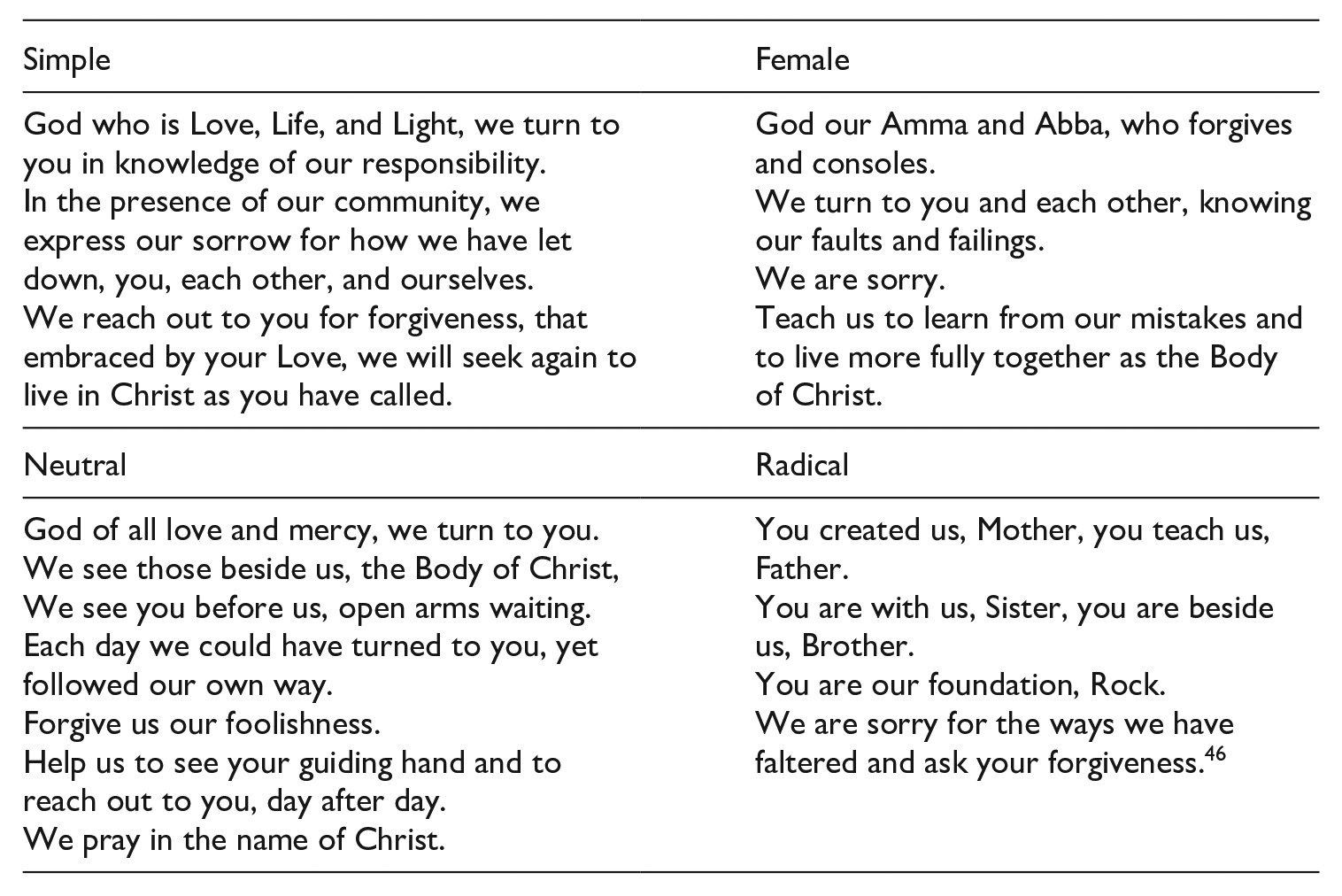
In considering how exactly to move forward and away from this male language, the first line of a new Confession could go in a number of different directions. Is it most fruitful to include a female image, maybe alongside a male image, as such: Abba, Amma, God who forgives . . .
This version continues to make use of the idea of ‘Father’, but, as in the Inclusive Bible translation of the Matthean text, sets this alongside the maternal image. Simply inserting the ‘Mother’ image beside the ‘Father’ image, however, has been deemed insufficient by a number of feminist theologians, such as Marjorie Procter-Smith. Procter-Smith has argued that for women, the ‘Mother’ symbol is, in some ways, just as limiting as the symbol of ‘Father’ and over-emphasises traditional expectations. 32 However, does the use of language likely unfamiliar to a contemporary Scottish congregation change the impact of the images? Moreover, might this contribute to the sense of mystery which some, including David Jasper, have suggested is of vital importance in the liturgy? 33
Or, should we rather turn to more abstract imagery, hoping to integrate the sense of the relational nature offered in ‘Father’ in other aspects of the language? Perhaps as follows: God of all love and mercy, we turn to you. We see those beside us, the Body of Christ, We see you before us, open arms waiting.
For my research Master’s thesis, I conducted a textual analysis of the SEC’s Confession and Absolution (as well as the Sanctus and Benedictus) and presented the analyses alongside findings from feminist and liturgical theology which related specifically to the language used for God. Over the course of writing my thesis, four possibilities for altering the liturgy to be more feminist and progressive emerged. These four categories are neutral, female, simple and radical. The creation of new liturgical prayers which are committed to both the SEC and the feminist tradition might be taken on from a number of perspectives, but these four categories arose from the work. As well as carrying out a textual analysis, I wrote new versions of the Confession and Absolution based on the four categories. Before presenting these new prayers, I will introduce the four categories further with a brief overview of how they developed.
The first category to emerge as a possibility for producing more inclusive liturgies is ‘neutral’. This category arose from the changes made to some Anglican liturgies in recent years. As opposed to the alterations employed by the SEC in recent years – replacing the male pronouns used to refer to God with ‘God’ – these changes include new imagery. For example, the Anglican Church of Australia has altered the first line of one of their Confession and Absolutions to be ‘Holy God’, with no reference to ‘Father’. This image has quite a neutral feel and does not include any female element. This approach takes away the maleness of references to God. However, this may not go far enough.
The second category to develop is that of ‘female’. A number of feminist theologians, Elizabeth Johnson being a key example, argue that it is necessary to introduce female imagery for God. According to Johnson, Language about God in female images not only challenges the literal mindedness that has clung to male images in inherited God-talk; it not only questions their dominance in discourse about holy mystery. But . . . such speech calls into question prevailing structures of patriarchy.
34
In this case, it is necessary to introduce female imagery for God in any new liturgical prayers which remain committed to the feminist tradition.
Looking to the SEC liturgical tradition, the ‘simple’ category emerges. Prayers produced by Janet Morley and Steven Shakespeare (though the latter may not profess commitment to the feminist tradition, inclusivity is important to him 35 ) provide an example. The ‘simple’ category refers to prayers which retain a very close commitment to the traditional prayers of the church. In the case of Morley and Shakespeare, this is in reference to the Church of England (CoE), whereas the prayers found here will be following the SEC tradition. Shakespeare’s commitment to the CoE is clear, as he is an ordained person in the Church. The prayers he offers in his Prayers for an Inclusive Church show this commitment, following the style of CoE prayers closely. Although he avoids referring to God as ‘Father’, Shakespeare’s Confession and Absolution offerings include regular use of the image of ‘Lord’, a first indication that the ‘simple’ category may not be critical enough for the development of truly inclusive prayers. 36 Morley’s prayers do appear to show her commitment to the feminist tradition while, for the most part, making simpler changes to the traditional prayers of the CoE. For example, Morley’s alterations to the Sanctus and Benedictus make only three small changes, though this does include replacing one use of ‘Lord’: from ‘God of power and might’ to ‘vulnerable [or resurrection] God’ and ‘Blessed is he who comes in the name of the Lord’ to ‘Blessed is the one who comes in the name of God’. 37
The final category builds largely on the work of Nicola Slee and Gail Ramshaw, as discussed above. The ‘radical’ category of prayer takes seriously the need to use images for God which surprise the worshipper. Above, I introduced Ramshaw’s discussion of ‘dead metaphors’ within the church. In order to alleviate this problem, new imagery should be introduced which may shock or amaze. The ‘radical’ category takes this idea a step further, moving away, to some extent, from not only the more traditional terms for God but also in part from the shape of the prayer as it has been used by the SEC for many years. This method takes into account in its radical approach not only the seriousness of encountering God in new ways through different imagery, but also the nature of liturgy. The terms used for God exist in a particular context when used in the prayers analysed, and the ‘radical’ category seeks to shift the context as much as the images.
I offer now a brief consideration of the work of a few feminist liturgical scholars before concluding with the new forms of the Confession and Absolution I wrote in the process of writing my MTh thesis. Marjorie Procter-Smith would argue that the lack of female imagery in the authorised liturgies of English-speaking Anglican churches mean they do not provide much needed emancipation of language. For Procter-Smith, God-language must include explicitly female referents. This means that we need to discover new female names for God, including Goddess, Mother, Sister, Lady, Queen, Grandmother. But it also means we need to use female pronouns freely in order for ‘neutral’ names for God to be claimed as much female as male, challenging androcentric assumptions.
38
The lack of female imagery holds the old male image of God in place despite the use of apparently genderless words. Elizabeth Johnson would certainly agree with this proposition. Johnson finds that there is a need to skew language for God in favour of female images for a period in order to balance the scales against the centuries of exclusively male metaphors. It would be interesting to see the results of a survey asking church attenders whether their image of God is as much female as male (or indeed ‘neutral’). Does the near complete lack of female imagery help to retain old attitudes of the male as normative? Johnson suggests building the female imagery on the language of God as ‘Sophia’, Wisdom.
39
Johnson also turns to the work of Aquinas who argued that ‘this name HE WHO IS is the most appropriate name for God’. Johnson explains that Aquinas reached this conclusion by interpreting ‘the burning bush scene metaphysically’.
40
While agreeing with Aquinas’ affirmation of the importance of the name given to Moses, Johnson acknowledges the ‘androcentric character of the standard English translation’. However, she also suggests the Latin ‘could be rendered differently . . . The name could be translated quite literally “who is” or “the one who is”’.
41
Given Johnson’s commitment to female imagery for God, it is a natural progression for her to then provide a ‘feminist gloss’ to the I AM and render it ‘SHE WHO IS’.
42
Gail Ramshaw follows Johnson’s line of thinking leading her to the I AM as well. Ramshaw, however, keeps the ‘neutral’ formulation of the name. Looking specifically at terms which might replace ‘Lord’, Ramshaw suggests alongside ‘I AM’, ‘the Living One’ and ‘the Name’.
43
While scholars such as Ramshaw and Johnson have taken on in-depth theological work to produce suggested replacements for the male imagery that pervades the church’s prayers, liturgists such as Nicola Slee and Janet Morley have chosen a more practical approach. Slee and Morley have published collections of prayers with a wide variety of images. This is not to say that the work of Slee and Morley has no solid theological grounding. In fact, Morley makes a point to signal the biblical basis from which she works. In the introduction to her All Desires Known, Morley communicates that [t]heologically, it will be noted that I frequently refer to the Wisdom of God, who is personified in feminine terms in an important strand of Jewish thought. Strong and significant echoes of the Wisdom tradition in fact underlie many of the crucial Christological passages of the New Testament.
44
For Slee, [n]o one image or model, however elusive or rich, can do more than offer glimpses and hints towards the divine. The best poems and prayers awaken as much as they satisfy curiosity, desire, the longing for we know not what – the beyond, the Other, the One towards whom we journey and quest in all our human searchings.
45
Although some images may have stronger traditional theological bases from which to argue their appropriateness in an authorised liturgy, in the end, all language about God is only a glimpse. According to Slee, our prayers ought to surprise us as much as comfort us in our relationship with the Divine.
The prayers presented below seek to build on the work of these feminist liturgists and scholars while retaining a commitment to the general sense of the Confession and Absolution as it has been used in the SEC through the years. Key to the work of this article, and my wider thesis, is the imagery used for God, in particular, providing alternatives to ‘Lord’ and ‘Father’. An attempt has been made to offer imagery that might equally surprise and comfort contemporary congregations using language that follows the trajectory of the meaning of the terms ‘Lord’ and ‘Father’ as they may have been understood by the earliest Christians while leaving behind the androcentric thinking which solidified their place.
Confession and Absolution
Footnotes
Funding
The author(s) received no financial support for the research, authorship and/or publication of this article.