



Abstract
In the past decade, Western European countries such as Germany, the Netherlands, the UK and France have seen a sharp increase in terrorism trials. Studying these trials can provide unique insights into which terrorist offences come before the court and what legal challenges arise from this relatively novel practice. To unpack the complexity of terrorism trials, we adopt an empirical approach to terrorism trials. Based on 3 years of extensive ethnography in Dutch courts, the paper makes two contributions to the socio-legal literature. Methodologically, our ethnography connects traditional empirical methods to artistic tools. As such, we further the current debates in socio-legal studies on courtroom ethnography. Empirically, we present critical insights on the interaction between pre-emptive speculative security measures and legal procedures in the prosecution of terrorist activities.
Introduction
It is 21 November 2022, and Machteld Aardse and I are present at a terrorism trial in the Justitieel Complex Schiphol, a specially secured location of the Dutch court, right next to the airport. The surroundings of the court feel very paradoxical. On the one hand, it is a typical Dutch landscape: flat, grassland, a bike tied to a lamppost. On the other hand, the area is filled with security objects such as surveillance cameras and fences. Airplanes are resting in the distance on a parking lot, and there is nothing in the immediate surroundings except the Dutch gendarmerie. Amidst this scenery that is both ordinary and highly securitized, the court occupies an interesting in-between space. It is a normal working space, where clerks, lawyers, prosecutors and judges are busy with their job. They listen to the detailed personal accounts of the defendants or the expert witnesses. Lawyers joke amongst each other about the latest football match, families of the defendants sit nervously on the public gallery, and the police officers make sure that no mobile phones enter the court. These are mundane, everyday practices that are characteristic to any court. But this court hears quite unique cases where questions of national security are at stake. Terrorism trials, sittings related to the MH-17 trial and organized crime are some examples of the cases that come before this court. The court embodies, not unlike its surroundings, a strange combination of the exceptional and the mundane, the national and the international.
The description of our courtroom above captures some of the paradoxes that ethnographers encounter when studying law empirically (Van Oorschot, 2021). Doing courtroom ethnography is commonly understood as a research method that studies legal practices, or ‘law in action’ by observing the heterogeneous actors that are involved in legal knowledge (Klosterkamp and Anwar, 2023; Klosterkamp and Flower, 2023; Latour, 2010). This paper is an account of terrorism trials through ethnographic research in Dutch courts, expanding the current discussions on courtroom ethnography. Moving beyond observing and writing during trials, which are the traditional methods available in the ethnographic toolbox, we investigate what happens if we add drawing to this methodology. Drawing, more than writing, forces us to adopt a 360 degrees angle when sitting in the courtroom. It requires attention to small details of appearances, compositions and our own viewpoints when recording.
Our combination of drawing and observing as a form of ethnography therefore led us to examine the following question: what happens to our understanding of terrorism trials when we observe the courtroom as a landscape? The question is inspired by our conceptual and methodological positioning as an academic researcher and an artist. Interestingly, the word ‘landscape’ originates from the Dutch word ‘landschap’, made famous by Dutch painters who shifted their focus from static portraits to environmental settings. We aim to similarly work through both court observations and drawings of the courtroom as a holistic whole to map the workings of law. In this paper, we unpack the method of doing courtroom ethnography as a collaborative moment between research and art. The paper discusses how this collaborative methodology changes the interactions in the courtroom and how to investigate the court during terrorism trials as a landscape making visible novel insights on paradoxical politics, emotions and temporalities.
We argue that terrorism trials have very specific dynamics that set them apart from other criminal proceedings. Trials of national security are characterized by pre-emptive security logics where the law plays an important role in preventing security disasters (De Goede and De Graaf, 2013). Legal professionals are increasingly confronted with the need to speculate on potential terrorist threat based far in advance of any concrete terrorist violence or activities (De Goede and De Graaf, 2013; Sullivan, 2020). Mundane activities such as bank transfers or listening to music can become evidence of radicalization through a pre-emptive speculation of how such activities might lead to terrorist violence in the future (De Goede and De Graaf, 2013). Such speculations can draw on racialized and securitized understanding of suspicion, rather than on conclusive evidence or expertise (Ibid). As such, terrorism trials provide an interesting opportunity for scholars to critically investigate law's assumed universal knowledge and practice (Valverde, 2003). Within socio-legal studies, ethnographic accounts of terrorism trials have been a welcome addition to the debates at the intersection of law and security, challenging law's claims to universalism (Fernandez et al., 2024; Weill, 2020). These studies have contributed to novel insights on racism and islamophobia (Fernandez et al., 2024; Klosterkamp, 2021) and how domestic courts position themselves amidst international law and global politics of the War on Terror (Weill, 2020). While such scholarship has expanded our knowledge on the intersection of law and security, we still know very little about what actually happens in practice during terrorism trials. In particular, the courtroom remains understudied as an essential space where the universalist aspirations of law, pre-emptive security measures and novel legal practices all come together.
The paper therefore makes two important contributions to the existing literature in socio-legal studies. First, we contribute through our unique empirical data on terrorism trials. While there is a flourishing socio-legal scholarship at the intersection of law and security, those insights are mainly based on closed-door hearings (Amoore, 2013; Sullivan, 2020), landmark trials following terrorist attacks (Fernandez et al., 2024; Weill, 2020) or pre-emptive measures that circumvent domestic legal proceedings such as blacklisting (de Goede, 2018). Our ethnographic account of ‘ordinary’ terrorism trials at Dutch domestic courts provides fresh insights to this debate by illuminating the hard work of the court in navigating affective politics, speculative security logics and international counterterrorism regulations. Through our visual and written empirics, we show in detail what different roles the actors take and how exactly mundane activities are distinguished from preparatory terrorism offences. As such, we conclude that the intersection of law and security is characterized not only by secrecy (Amoore, 2013; Sullivan, 2020) or speculation (De Goede and De Graaf, 2013) but also by a complex sense-making of what counts as suspicious and mundane. Second, our paper explores courtroom ethnography as a useful method for studying law in practice. Going beyond writing and observing, we show that our knowledge of the court expands if we add artistic methods to our legal ethnography. More precisely, we unravel how the court navigates between being a neutral, predictable but also affective and political space. As such, this paper makes a case for expanding current knowledge on empirical methods in socio-legal literature by paying attention to artistic methods and visual exercises as research methodologies.
The remainder of the paper is structured as follows: the following section lays out our methodological choices and reflections on doing courtroom ethnography. We furthermore elaborate on how we came to our four main concepts to capture our artistic and academic findings. After this, we present these four parts of the landscape, through empirical examples of both text and image from terror trials. Rather than a separate theory section, we weave in theory and empirics in these four parts of the paper. The empirical sections showcase novel understandings of courtrooms as a space for socio-legal research, as well as reflections on how to understand the role of courts in a critical approach to the War on Terror. The conclusion brings novel insights into the socio-legal debates on the role of affective politics and terrorism trials between the mundane and the exceptional.
Methodological Reflections
Current literature on studying law empirically has its origins in legal anthropology (Riles, 2011), and more recently advancements have been made through Actor–Network Theory (Cloatre, 2018). This literature has broadened the traditional focus on legal instruments and texts and deepened insights into the role of objects, practices and novel actors that shape legal practices. Similarly, the literature also fostered methodological debates on how and where to study law. Scholars such as Latour (2010), Riles (2011), Scheffer (2007) and Van Oorschot (2021) propose that observing law as it unfolds in practice is a unique opportunity to unpack its intimate and interdisciplinary workings. As such, courtroom ethnography can be a useful method to investigate novel questions about evidence and procedure. Specifically in highly securitized settings, where courts deal with questions of terrorism (Anwar and De Goede, 2021; Klosterkamp and Awar, 2023) or international crimes (Bens, 2022), courtroom ethnography can shed light on the legal performances, micro-interactions and affective dimension of the court proceedings (Bögelein et al., 2022).
This paper is based on a collaborative project between an academic researcher and a visual artist. The collaboration commenced in the summer of 2021 and lasted until the summer of 2024. We were interested in two types of terrorism trials. The first type of trials, which we will not discuss in this article but elsewhere, is the terrorism trials of repatriated Dutch women from Syria and Iraq. These cases evolve around specific questions of membership of a terrorist organization, being a foreign fighter to join ISIS or Jabhat al-Nusra, and ancillary terrorism offences. The second type of terrorism trials, which are the focus of this article, is trials that centre on preparatory terrorism offences. At the time of writing this paper, we have visited nine Dutch terrorism trials, with a total of 12 full days in court. The offences varied from terrorism financing (two cases), membership of a terrorist organization (all nine cases) and preparatory terrorist activities (seven cases). In this paper, we take empirical examples from the two cases in the second category: (1) the Schiphol case, in which nine young men were suspected of preparatory terrorist activities, and (2) the Limburg case, where the defendant stood trial for terrorism financing. Both cases were selected because the legal discussions at trial specifically focused on the pre-emptive nature of the offences, making them useful case studies for studying the intersection of law and security at terrorism trials. During the sittings, we would split up, Machteld Aardse making the court drawings and Tasniem Anwar observing and writing down what occurred during the trial. We had regular briefings, where we compared our notes and experiences and wrote down ideas. The cases took place in three different courts in the Netherlands: the District Court of Rotterdam, the District Court of Limburg and Justitieel Complex Schiphol.
Together, we had multiple sessions of collaging the images, the legal texts and the notes, to investigate what new insights emerged from the combination of art and academic text. We furthermore held informal meetings with our ‘soundboard’, consisting of two lawyers and a public prosecutor. From these meetings, several interesting themes emerged including rituals of law, canalizing emotions, vulnerability, the coldness of law, positionality in the courtroom and designing the courtroom. Based on this process of collaging, the conversations with the legal practitioners, previous socio-legal literature and our experiences in the courtroom, we distilled four main themes. We have furthermore collaged our data as part of an exhibition in the summer of 2024 in the Rotterdam District Court. During this exhibition, we presented some of our landscape ideas to examine whether this would resonate with the legal practitioners visiting the court. Doing so, we are inspired by Fernandez et al. (2024: 8) who explain that ‘ethno/graphic drawing is not only a method of self-reflexivity; it is also a technique of observation in its own right and ‘a practice of representation’, which requires a clear statement that becomes a ‘line of argumentation, just like a sentence is a statement in your textual argumentation’. The outcome of the event confirmed our conceptualization of the courtroom and sharpened our thoughts on the connection between the courtroom and larger political concerns around terrorism.
The first theme concerned the question of what the materiality of the court can tell us about the law. Legal materiality is a growing body of literature in socio-legal studies, providing new insights into the everyday lives of law and legal practice. In this section, we build on this literature and reflect on how material shapes legal practice and vice versa. More specifically, we show how evidence, particularly in terrorism trials that happen in advance of concrete violence or attacks, tells us something broader about the function of the judge, the prosecutor and the defendant. This connects to the second theme of positionality, where we analyse how the design or arrangement of the court impacts how individuals feel, who or what is centred or marginalized and how interactions flow. We furthermore reflect on our own positionality as a researcher and an artist and question how perspectives on the law change when different actors are forced to see the courtroom from a new (written or visual) angle. The third theme focuses specifically on affect. In this theme, we want to bring out the affective side of the law: the jokes during court trials but also the discomfort and vulnerability. We empirically show how these affective politics have a function during terrorism trials, demarcating the mundane from the exceptional. The fourth theme attempts to bring back the paradoxical notion of the law as a landscape. Here, we focus on how our observations and situated knowledge relate to the law's universal aspirations and how the terrorism court cases balance between the mundane and the exceptional.
A few words on access and positionality are in order. Attending court cases is possible for everyone in the Netherlands: a public and transparent court system is part of a democratic rule of law. Not only are court proceedings open to ensure public accountability, but a transparent legal process also creates trust in legal and democratic institutions. Yet, there is more to visiting court cases than simply showing up. In the Netherlands as a researcher, Tasniem Anwar was often placed in a small and closed-off area sympathetically called ‘the public gallery’. In some courts, visitors share the same space as judges, lawyers and other legal professionals. Courtroom artists, however, are not limited to these ‘public galleries’ or the back of the room. They can occupy a prime spot to draw the defendant(s). They can bring different materials into the court as well. By definition, they occupy a space that is not for insiders (the legal professionals at the court) nor are they outsiders on the public gallery (family, friends and curious researchers). Attending a case from the position of the drawer, a privilege only extended to researchers during a collaboration like ours fundamentally changes the ethnographic experience of the court. It allows the observer to move out of the public gallery and closer to the actions during the proceedings.
The collaboration also led to unique conversations amongst the legal professionals at court. Usually, judges and prosecutors are quite hesitant to speak about their work with researchers our journalists. Terrorism trials are considered high priority, secretive and with high security stakes. While legal practitioners are hesitant about being portrayed in a certain way through research or the media, they are much more involved in their visual portrayal in court sketches. The collaboration therefore ‘broke the ice’ on many occasions, allowing for conversations with actors that are normally harder to reach. Race and gender always play an important role in doing ethnography, albeit difficult to grasp (Klosterkamp & Anwar, 2023). Our appearance must have been unusual in that sense: two women, but of different ages, racial backgrounds and professions. Perhaps this unusual combination made it easier to connect to various actors. Based on our mix of ethnographic methods, we have distilled four aspects of the landscape that will be further explored below, both empirically and conceptually.
The Court as a Paper Landscape
Legal scholarship has recently developed a flourishing debate on the everyday practices of law and legal materiality. In his ethnography of law, Bruno Latour writes that ‘scientists speak inarticulately about precise objects, lawyers speak in precise terms about vague objects’ (Latour, 2010: 237). Whether vague or precise, objects remain nevertheless an essential element in speaking legally. Attuning to the materiality of law requires attention to the mundane and technical practices of the law, the materiality of the courts and many other fascinating avenues of research.
Latour's ethnography presents an in-depth discussion of the legal case file, a material object that also dominates the Dutch legal system (Van Oorschot, 2021). This document might start as a legal claim and grow into a compilation of witness statements, letters, certificates and expert testimonies. This material folder becomes the foundation of legal discussions: evidence that does not make it into the file is dismissed from the deliberations at sitting. Furthermore, all papers need to meet the right legal criteria before they are added to the file (Latour, 2010). The case file, when heavy or ripe enough, serves as the foundation for legal debates and judgment. At this point, the legal practitioner is moving between one pile of papers (the case file) and another pile (the legal code). Latour (2010:87) describes that ‘these two types of literature are like the weft and the chain; one supplies the elements which arise from the case – that is everything that emerges from the file (…) – the other supplies the elements of texts, articles of law and Code which allow in the end deciding and disposing of the claim’. For international lawyers, ‘the document is not simply a concrete object; it also is a set of social practices, an aesthetic of thought and action. In essence, one lives through the document’ (Riles, 1999: 814). Van Oorschot (2021: 14) similarly describes the use of papers and the case file as a way of ‘seeing the case clearly’ for legal professionals. The thickness of the file, the ability to draw with a marker, to lay out the papers on the desk, all contribute to the practices of law. Yet, new forms of materiality are slowly replacing the traditional images of the judge behind a pile of papers and the lawyers carrying small suitcases filled with documents. Novel forms of technology are replacing paper evidence (Anwar, 2020), and courtrooms must accommodate the introduction of digital files, videoconferencing and display of videos during sittings (Bens, 2022).
In this section, we reflect on how the case file becomes part of the courtroom landscape in terrorism trials. We particularly discuss how the case file impacts legal discussions and judgements on a topic that is not only legally, but also politically contested. The first case that we attended in this collaboration was a terrorism trial that was running for 4 years, the Limburg case. By the time the trial finally came before the court in 2021, the case file consisted of more than 11.000 pages. Yet, only a handful of papers actually surfaced during the sitting, and the lawyer only brought a modest travelling bag for her items, in contrast with the more traditional image of lawyers carrying files.
Yet, the amount of pages, despite not being brought into the courtroom as material objects, becomes important during the case and in the verdict. In their concluding remarks, the judges claim that ‘this all shows that this investigation has gone out of hand, with more than 11.000 pages 1 .’ The judges clearly express their annoyance with the duration of the investigation and the weight of the documents. The 11.000 pages do not only include relevant legal evidence, but also speculative materials and evidence of tunnel vision. 2 Per Latour’s (2010) description of the ‘ripe case file’, this example perhaps shows a ‘rotten case file’. Despite the replacement of paper by digital files, the case file as a material object continues to mediate the sitting as well as the outcome and even the mood of the court. Indeed, documents are not just legal documents, but professionals live through them and experience them through aesthetic (too many of them), temporal (too long to assemble) and normative (too one-sided) lenses to come to a legal conclusion.
The issue of the ‘rotten case file’ is especially relevant in a terrorism trial. In general, counterterrorism measures are characterized by a pre-emptive logic to disrupt potential threat before it materializes. This pre-emptive logic has had a severe impact on traditional legal practices. Scholars have pointed to the way legal measures now enable prosecution of activities that take place far in advance of terrorist violence (De Goede and De Graaf, 2013; Sullivan, 2020). This alters the traditional ways of assessing terrorist intent, as will be discussed below, but also the collection and presentation of evidence. In the abovementioned case, the excessive case file speaks to the difficulties to prove that a financial transaction potentially contributed to terrorist activities in Syria. Such pre-emptive logics bring speculation at the heart of legal practices at trial (De Goede and De Graaf, 2013), to the frustration of the court. In contrast to the scholarly works that analyse how evidence of radicalization or terrorist activities is often fragmented, thin or secretive (Amoore, 2013; Sullivan, 2020), the submission of evidence in domestic court cases requires hard work to translate mundane activities into proof of potential terrorist activities. The Limburg case file consists of pages of testimonies, bank documents, travel documents, photos of the defendant in Syria and private messages (fieldwork notes, 2021). In the absence of concrete evidence of what happened with the money, such documents become essential in speculation to secure a conviction (Anwar, 2023; Sullivan, 2020).
The case file is therefore relevant not only as a material practice but also as an essential part of understanding the broader landscape of the court and terrorism trials. Van Oorschot explains that in the Dutch courts, the judge is mainly guided by the criminal case file. While the courtroom is a public space, the exact details of the case are not accessible to a broader audience. Evidence remains concealed in the case file until spoken out loud. Following the metaphor that court cases are performances (Rogers, 2008), Dutch judges are the directors of the play, and the case files are their scripts. Not only do judges direct the formal procedures of the case, but they also perform what is called ‘the investigation at sitting’ (het onderzoek ter zitting). While the defendants are usually interrogated by the police prior to the sitting, judges have their own questions they want to pose to understand the case. The case file and its containing documents might help the judges to acquire an ‘image’ of the defendants or the context of the offence, yet the judges also want to gain a ‘full picture’ during the sitting (Van Oorschot, 2021). Here, the judges transport the information from the legal documents, witness testimonies, pictures, police reports and other materials from the file to the court. Van Oorschot (2021:130) describes that for judges working with case files it is ‘Jigging, coding, highlighting, juxtaposing, and summarizing work, then, produce what we may call a ‘story-before-the-trial’.' But there is also a story at trial, where the case file is re-read, re-negotiated and re-shuffled. Particularly in terrorism trials, where speculation and pre-emption are embedded in the case file, such discussions at trial become very important. In our Schiphol case, for example, the judges ask for clarification or context by presenting information from the case file. Here follows an example:
Judge: This is a record of 15 May 2021. (…) There is a conversation in Dutch about family business, Islamic upbringing. In the background an audio recording in English and Arabic of Anwar Al Awlaki about the jihad, that it is not bounded by territory but a form of worship. Can you remember this?
Defendant: not at first sight, but after I listened to the tape I started to remember. I know that I was at home with a family member. I had put on this sermon from a link I received and in the meanwhile I was doing some chores at home. I didn’t realize what he was saying at that moment. Now that I have relistened to the recording, I did realize what he was preaching and that I am far removed from this. And that I reject his ideology. That is what I remember.
Judge: well that is certainly a different take. I was doing the dishes and listening to a speech of Anwar al Awlaki. I am not saying that you should wash the dishes with Guus Meeuwis [Dutch folk singer] in the background but this is something else.
3
Judges prepare a sitting by reading the documents in the case file and asking questions about this material. This conversation between the judge and the defendant shows that the reality of the defendant is different from the impression given in the written document. In the absence of concrete terrorist violence, it is difficult to assess the intent of a defendant listening to extremist content. Like the ‘rotten case file’, this example illustrates the growing impact of speculative terrorism measures on legal proceedings. This conclusion illuminates not only a particular way of speaking legally about potential terrorist activities, but the way the case file mediates discussions also shows us something important about the role of the different actors in the courtroom. To continue with our metaphor, if judges are directors and case files are scripts, trials are spaces where the script changes during play. Furthering the metaphor that judges function as play directors, we now turn to how the landscape of the courtroom interacts with the different positionalities and responsibilities of the legal professionals.
The Court as a Designed Landscape
Drawing attention to the material lives of law within courtrooms, Scheffer (2007) illustrates how the arrangements of courtrooms evoke very specific legal relations between the actors in the space. The positioning of the defendant tells us something about their role towards other actors during the trial and their importance for the legal process. Courtrooms have a pre-arranged setting; its standardization and predictability are part of the law's aspiration to remain neutral, fair and efficient. It shows that the law is more than only case files and judgements: the courtroom as a landscape produces in itself particular figures, roles, responsibilities and ways of seeing that all shape legal knowledge production (Vos and Stolk, 2020). Attention to this is important, as Riles reminds us that legal questions are the result of interactions between certain experts and documents, but also aesthetic practices (Riles, 1999)
Scholars have focused on the (interior) design of the courtroom and analysed how such designs impact power relations during trials. Mulcahy (2007: 390) argues that we should understand the design of the courtroom as a reflection of politics, where ‘the courtroom is seen as a frozen site of nostalgia in which designers should contain aspirations towards progress or change’. In this review of court standards, the courtroom is analysed as a static space, where discussions about where to place certain bodies and what it means are pushed out. Nevertheless, such designs also change over time, reflecting the development of legal proceedings. Mulcahy (2007) describes, for example, how in the UK the lawyer's position changed from a rather marginal spot to a more central position as the right to legal counsel was established and lawyers gained a more prominent role in legal proceedings. Even with the changing positionalities, the design of the courtroom is based on a clear segregation of roles and bodies. In the Dutch context, which is a civil law system without a jury, the court hosts six groups of people. The judges (group 1) and the public prosecutor (group 2) are seated at the front of the room. The lawyers (group 3) and the defendants (group 4) are positioned opposite from the judge's bench. The public is seated in a different gallery (group 5), yet media is often present at the back of the courtroom (group 6).
This drawing illustrates the set-up during a terrorism financing trial. To the wall of the courtroom sits the police, to secure the court. The second figure is part of the media presence, usually also located at the back of the room. The panorama in the middle (from left to right) portrays the public prosecutor, three judges, opposed by the defendant in a blue shirt, seated next to his lawyers and a clerk to the right of the judges. The journalist on the right is seated again closer to the back. Above this space hovers an art installation where a small figure navigates a thin line.
This positioning reflects the characteristics of the legal culture in the Netherlands, where the judge has an active investigative role during the sitting. As illustrated in the conversation above, the judge actively seeks to inquire and collect all the facts. The public prosecutor is not seated across from the judge, as is usual in more adversarial legal cultures, because they have a magisterial role. The prosecutor is the lead of the criminal investigation and as such has a very powerful position in deciding on how the case file looks. The magisterial responsibility is one form to contain this power: the prosecutor's ambition is not per se to convict the defendant. They have an obligation to examine and present all evidence, even if this can acquit the defendant. In the Schiphol case, for example, the prosecutor requested an acquittal for several of the defendants. Despite the persistence of suspicion against the defendants, the prosecutor finds that there is not enough legal material that meets the threshold for proving membership of a terrorist organization or preparatory terrorism offences. The central role of the defendant is also represented in their positioning in court. They are quite literally in the middle of this landscape. While they are not obliged to cooperate with the judge's investigation, the setting of the courtroom makes it quite uncomfortable not to engage with questions or statements posed. Different from other jurisdictions, the defendant is not placed in a dock or behind glass.
Legal professionals, especially those who work terrorism trials, are not unfamiliar with observers in the courtroom. Journalists, relatives of the defendants or victims, and researchers all attend terrorism trials to witness and observe how the trial evolves. It is not a one-way observation. Legal professionals also observe who sits in the courtroom and in which capacity. In our courtroom visits, we were often approached by judges, lawyers and the prosecution, curious about the strange combination of an artist producing panoramas of the court and a researcher writing non-stop during the conversations. Showing them the drawings was interesting: after they recognized themselves (everyone is first interested in their own portrayal), they re-noticed the courtroom from a different perspective and paid much more attention to actors or instances that had become routine such as clerks and security personnel. Furthermore, it allowed them to reflect critically on the positioning of different actors in the courtroom: who sits where and why. 4
From these conversations, it became evident that routine, (in)visibility and continuity are therefore core elements in the design and functioning of the courtroom. Actors immediately know their role, their responsibilities and their position as they find their place in the courtroom. This includes the judges and defendants, but also the actors who bring in the defendant, who type out the verdicts, and the clerks who manage the proceedings. The courtroom functions as a holistic whole, where disruptions and surprises are kept to a minimum. Routine is upheld to reflect the law's predictability, transparency and preventing arbitrary outcomes. A routine also reflects a particular legal culture in which actors have a role and responsibility to fulfil and makes some actors visible and others invisible.
The Court as an Affective Landscape
The description above might give the impression that the courtroom is an indifferent and predictable space. The continuous character of the sittings and actors could indeed suggest that trials are quite impersonal, connecting to law's image of an unbiased and universal practice. Young (2004: 12–13) writes that ‘legal discourse takes pleasure in its self-representation as detached, passionless, thorough, impartial, rule based. It has no place for the image, for the impresses and uncertain creativity of art’. Yet, while this is a common description of the courtroom, ethnographers have argued the opposite: the ordering of the courtroom deliberately sets a particular atmosphere or feeling. Similarly, ‘The courtroom is not designed to cast out affect and emotion but to create and arouse them’ (Bens, 2022: 25). The notion that the courtroom is a space filled with emotions is nothing new. Nevertheless, we take inspiration from the work of Sofia Stolk and Renske Vos (2020), who propose that design choices are inherently paradoxical in courtrooms. They illustrate how, despite ambitions of transparency, design choices of the court represent different roles of law that are not necessary compatible. Allowing the public to attend cases in the gallery to make legal proceedings inclusive and transparent simultaneously places them behind glass and creates distance (Vos and Stolk, 2020). Therefore despite imaginations of impartiality or distance, we need to pay attention to how affective politics operate in courts terrorism trials. According to our interlocutors, law deals with questions of accountability, violence, grief, wrongdoing and justice. Particularly in terrorism trials, emotions are not banned from the court but expressed in a legal fashion that regulates and ‘cools off’ heated or impulsive actions. Bens (2022: 141) similarly describes this in his book: ‘A politics of sentiment is successful to the degree that it manages to crystallize such narratives of justice and injustice into stable indignation regimes and, therefore, to partially stabilize political discourses on justice and belonging.’ In this section, we examine through images how emotions are canalized to differentiate between what counts as ‘normal’ and ‘suspicious’ and how this differentiation serves to form boundaries in terrorism trials.
This case, while dealing with very serious allegations of preparing terrorist activities, was not free from humour, laughs or excitement. We return to our Schiphol case and use this example below on the interpretation of several videos watched by the defendants and whether these videos contained extremist content or not:
Lawyer 1: they talk here about this fragment; it is a story about a preacher and the translation of the Quran. And my client testified that it was about a preacher Hasan Abdulrahman. This man also has a YouTube channel where he gives sermons countering extremism. You can just search and watch them if you are interested.
Judge 1: Well, can we also just watch Netflix?
Lawyer 1: Yes of course, I saw that the latest episodes of the crown are now online
Laughing in the courtroom
(…)
Lawyer 2: in the transcripts this [audio recording] refers to a sermon, but that is incorrect. It refers to a sketch by Borrelnootjez about the 2021 elections. Just another comment, if you are done watching Netflix, you can also watch this sketch online.
Judge 2: which one is that [sketch]? There are multiple, correct?
Lawyer 2: I can forward it to you.
Judge 1: I see that my colleague is familiar with this, I never heard of this. Maybe I am a bit estranged from the world.
Lawyer 2: yes it could be the age, I also never heard of it before.
5
The conversation shows a complex interplay of emotions and legal debates. This case, after all, was about the possibility that the defendants were part of a terrorist organization and involved in preparatory terrorist offences. Especially in terrorism trials, affective politics are important. Terrorism as a form of political violence invokes emotions. In some legal definitions, it is the affective politics around terrorist violence that separates it from other offences. In the Dutch penal code article 83a, the law includes violent acts with the intent to instil fear in (part of) the population. Affect is therefore already an inherent part of determining what counts as terrorist violence. Jokes and humour have been previously analysed in the context of affective politics after 9/11, sometimes as a coping mechanism, other times as a way of ridiculing and stereotyping (suspected) terrorist offenders (Heath-Kelly and Jarvis, 2017). The judge refers to this indirectly when joking to watch Netflix, juxtaposing this against issues of violence and extremism. What happens throughout this court case, and in this conversation, is a negotiation of what such ‘online youth culture’ is and how to differentiate between sensation and extremism in the absence of concrete terrorist violence (Anwar, 2022; De Goede and De Graaf, 2013). Such negotiation is not a strict legal discussion, but includes humour, self-reflection and even mockery.
Affective practices in (counter)terrorism have a particular function of establishing an insider and outsider, to normalize far-reaching counterterrorism measures and direct empathy of a broader public. While we might reserve such practices for the realm of politics, through these legal conversations and drawings, we observe similar practices in the court room. A demarcation is established through a negotiation of common knowledge (Valverde, 2003) on extremist content, dividing the court into ‘normal citizens’, who are more interested in watching Netflix shows, and ‘deviant citizens’ interested in watching absurd, extremist and violent content.
Such affective politics are similarly present in the depictions of the courtroom and its actors. Below, we illustrate with a visual example:
Above we see two images of the defendants of the Schiphol case. The first one is produced for media coverage of the trial, depicting the defendants in a very particular way: all bearded men, looking annoyed or angry and seemingly older than they appear to be in real life. The second image shows the courtroom as a whole. While the faces are less recognizable, it also conveys a different emotion and atmosphere of the court: the defendants are not radical dangerous figures, but as young men supported by legal counsel, following the case on their laptops. We aimed to bring out their vulnerability, paying attention to what it means to have intimate conversations and chat messages read out loud in a court. Barlow (2016) describes how visual representations from the court are not an objective representation but a snapshot, even a compression of hours of legal discussion and practice in the court. In her analysis, she specifically examines the portrayal of women in courts, concluding that drawings reproduce the stereotypical notions of the female offender. Women are usually depicted as both a ‘spectacle on trial’ and as a passive voiceless figure (Figures 1 to 6).
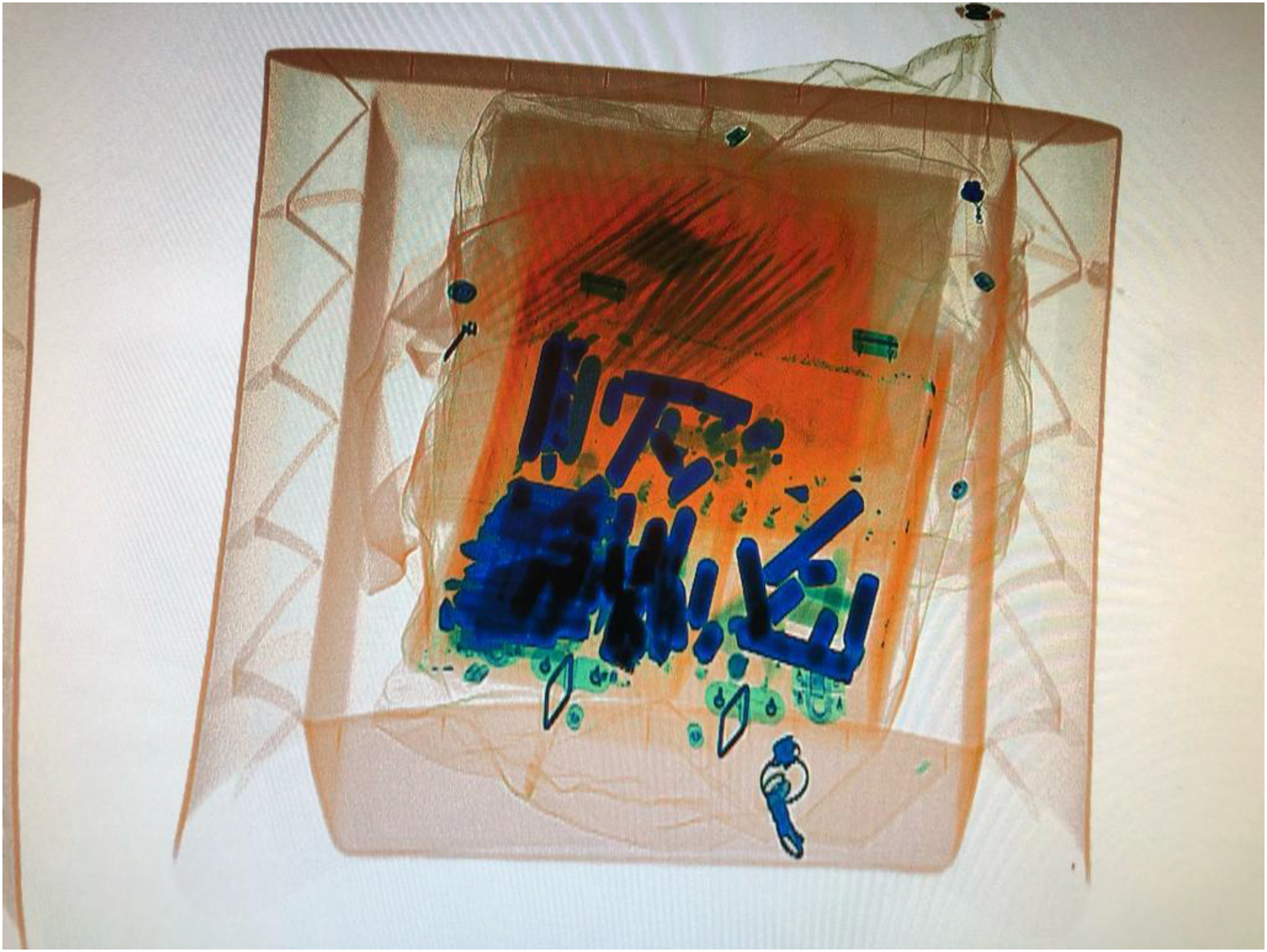
Between the exceptional and the mundane: crayons as seen through the X-ray scanner at the Rotterdam District Court.
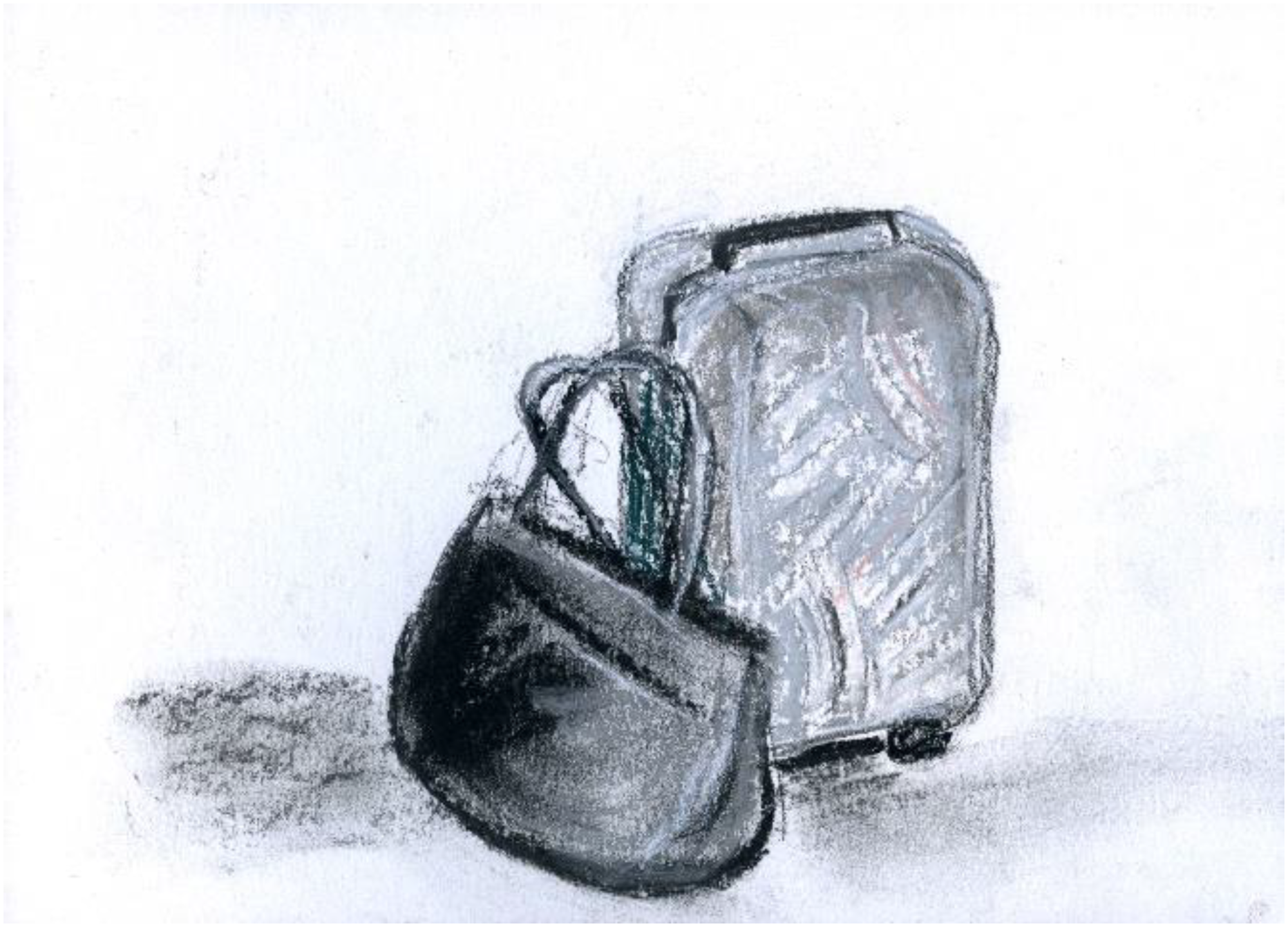
The lawyer's bag.
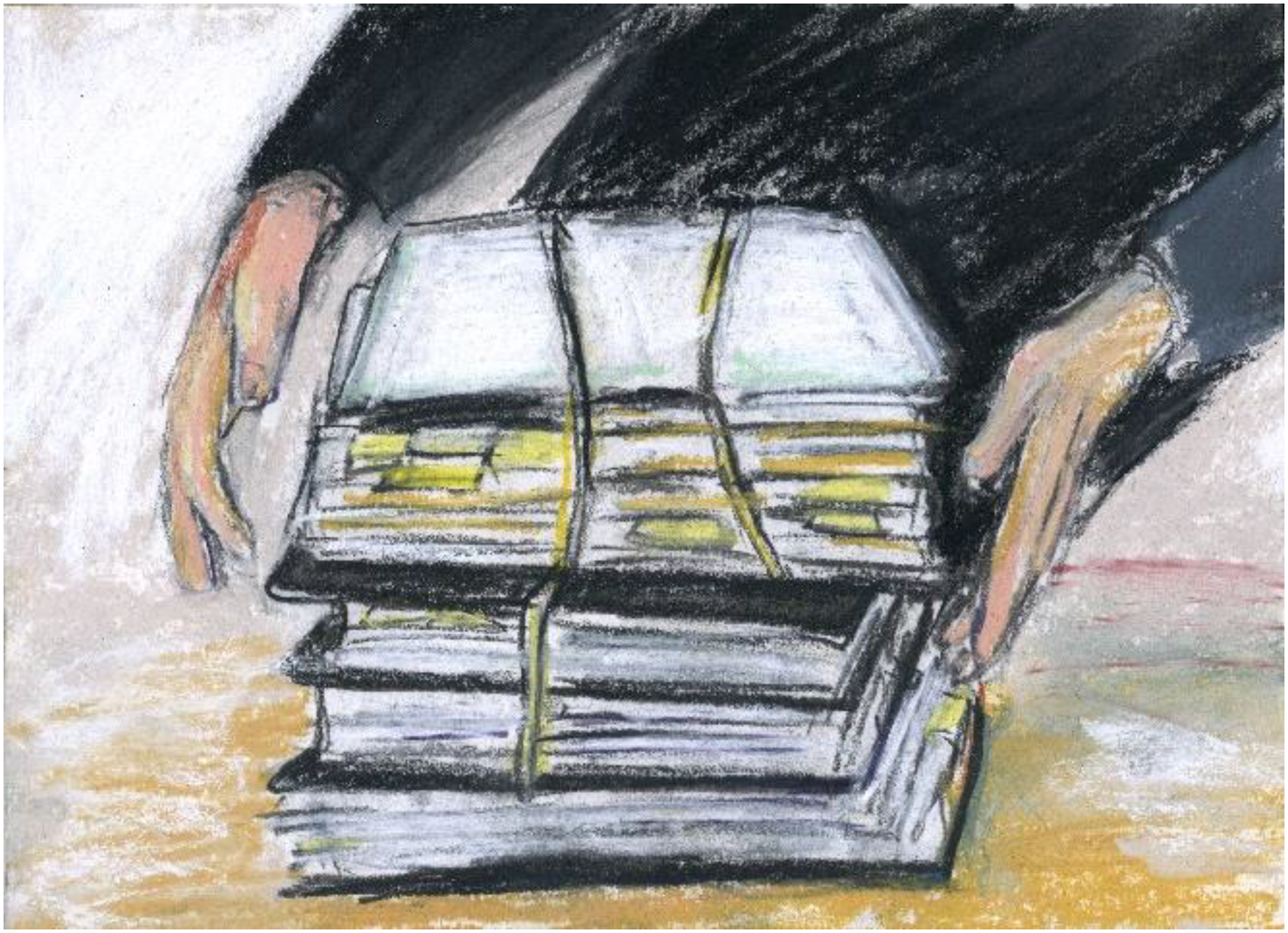
In the lawyer's office.

Panorama of the Limburg District Court, July 2021.
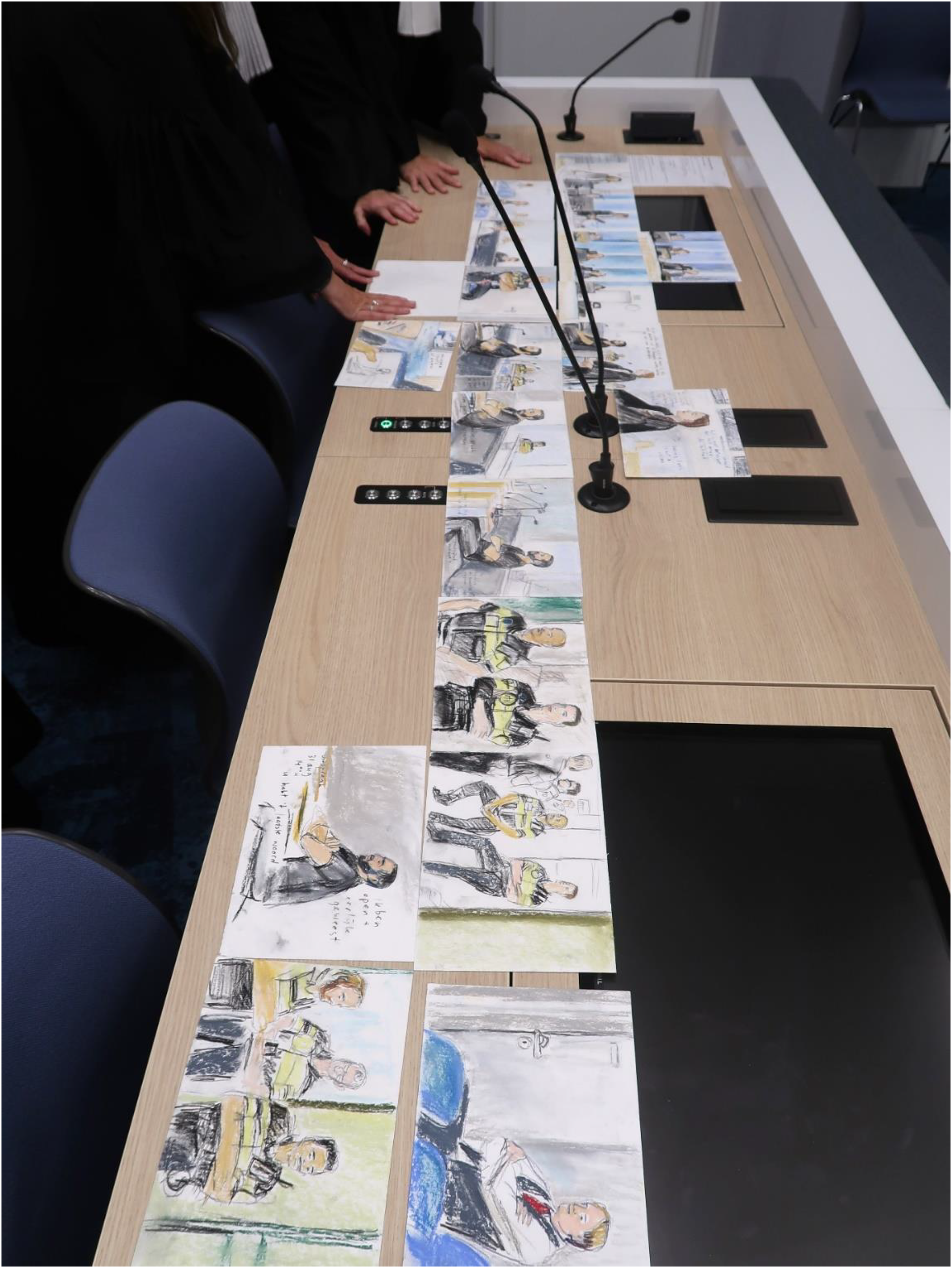
Changing points of view: judges collaging the court from a different position. Rotterdam District Court, July 2022.
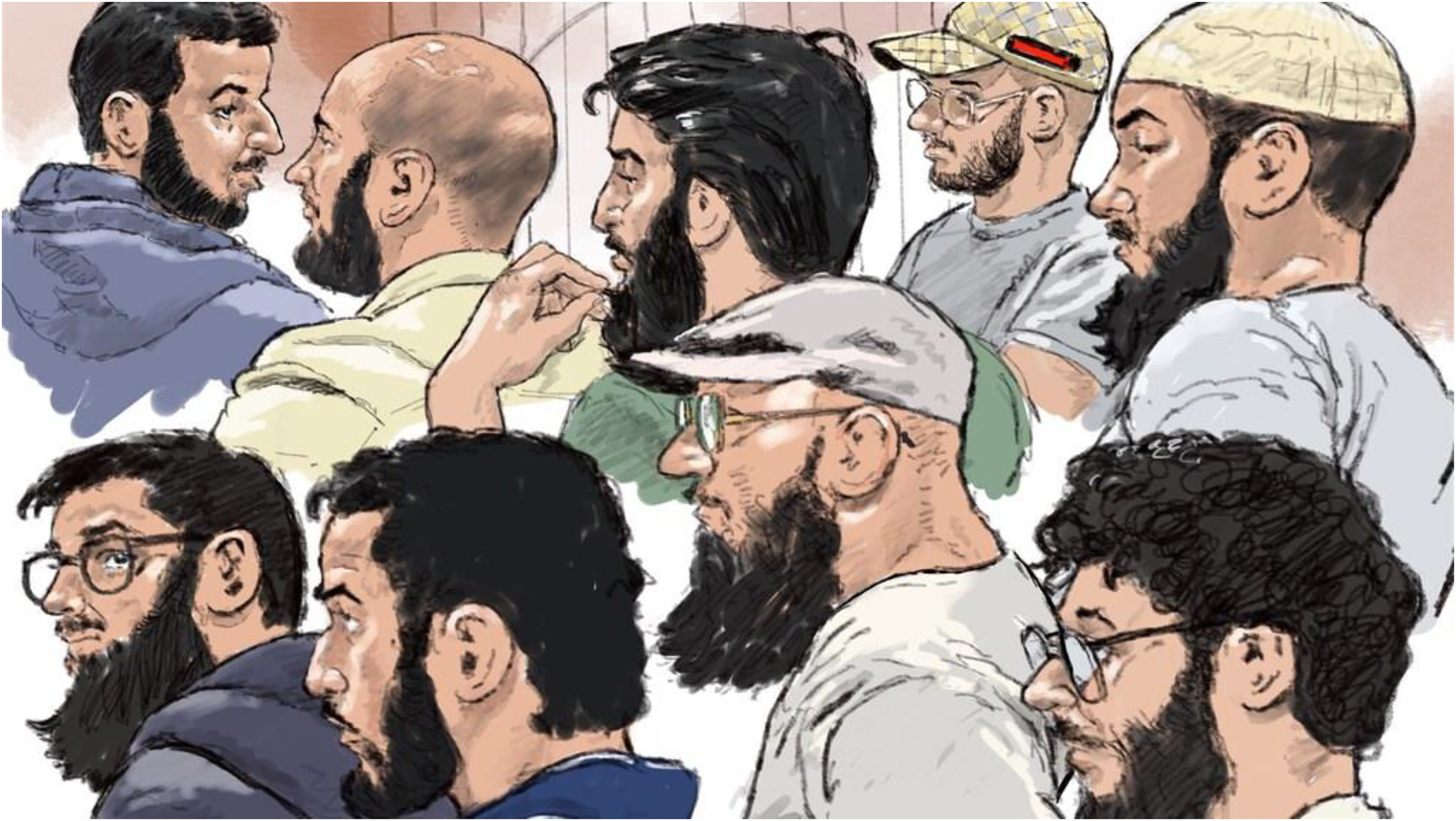
Published court drawing of terror trial ‘Dumfries’, December 2022 Justitieel Complex Schiphol.
Such court drawings, as Figure 7, similarly depict a stereotypical and racist image of the terrorist: male, beard, Arab (although not all defendants were Arab), angry or intimidating. Such drawings are often used for media representation, and therefore, drawers have a specific audience in mind. In our collaboration, we attempted to depict the courtroom as a landscape, rather than focusing on the defendant. In doing so, we do not claim to portray an objective visual representation of the courtroom. Rather, we aim to portray the affective and human interactions that are equally legally relevant as the case file and the other human and non-human actors in the courtroom. Through this visual exercise, we observe a continuation of the affective politics in counterterrorism. The judge's jokes imply an identifiable distinction between ‘normal’ activities and behaviour against ‘suspicious’ or ‘deviant’ behaviour. This distinction is at the heart of counterterrorism regulations, where (potential) terrorists are considered inherently evil, irrational and definitely not normal (Stampnitzky, 2013). The visual representation of defendants in the media follows the same affective politics of othering (Figure 8).
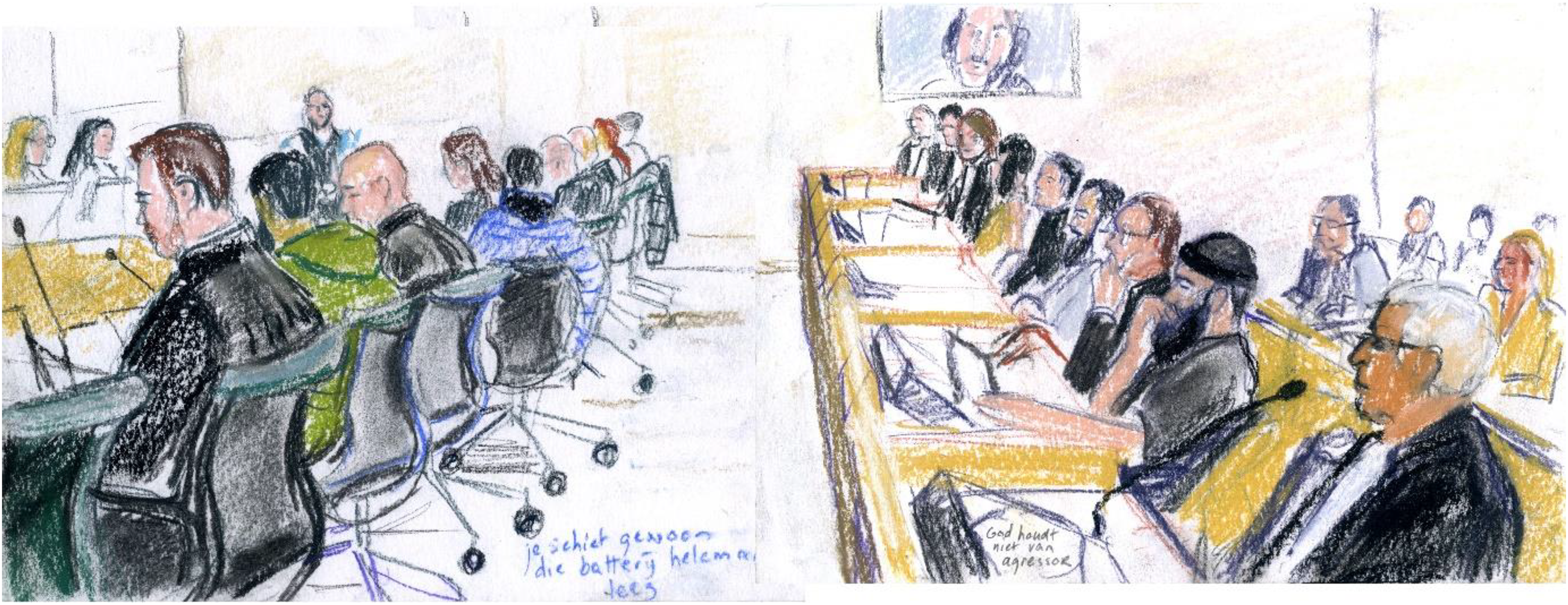
Our court drawing of terror trial ‘Dumfries’, December 2022 Justitieel Complex Schiphol.
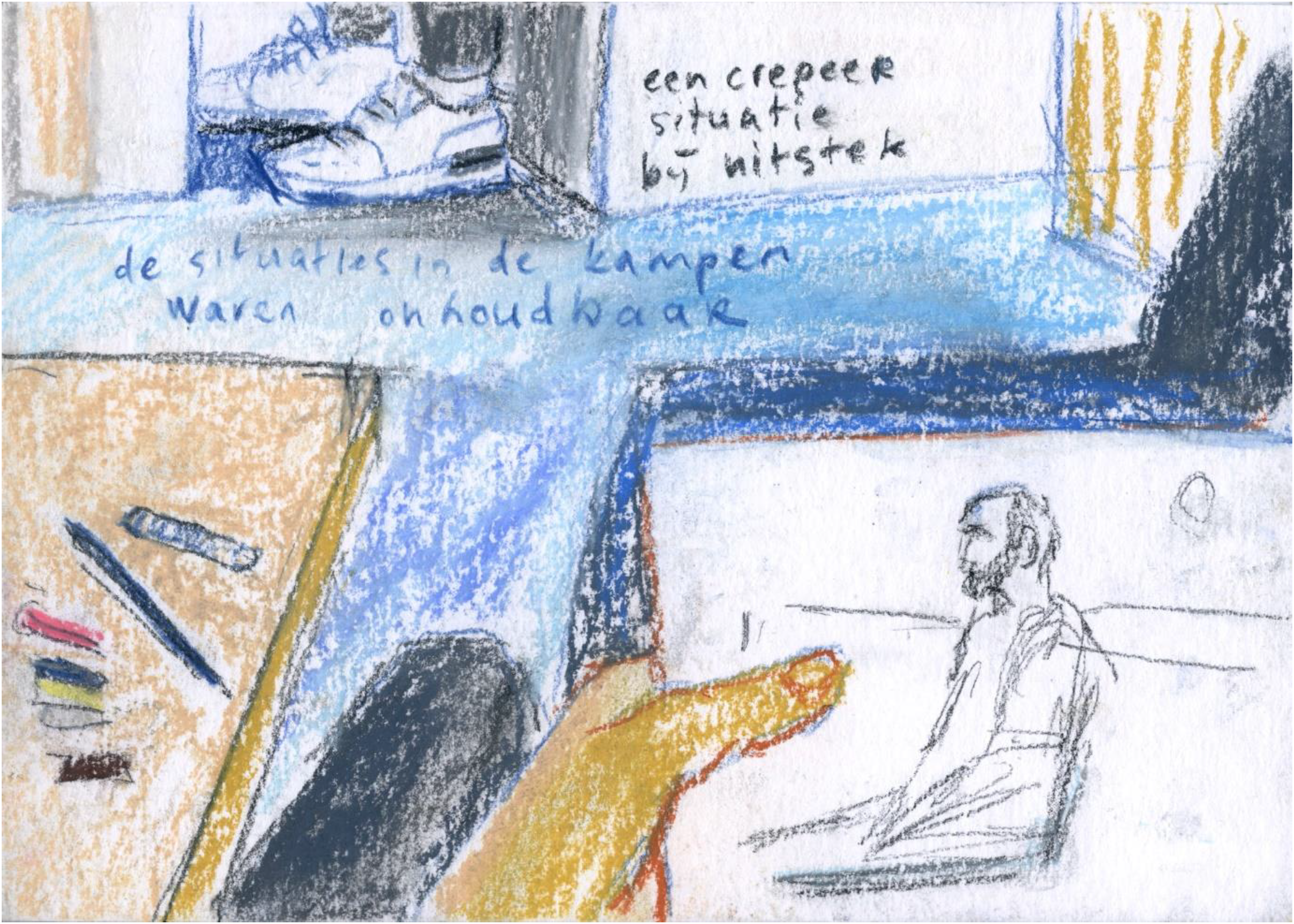
Drawing and including our own literal point of view, July 2022.
The Court as a Universal Landscape
In the previous landscapes, we have paid attention to the courtroom as a material space, where legal practices are mediated through paperwork, through positionality in the space of the courtroom and through affective politics. We have illustrated how the court functions as both a repetitive as well as an affective space. Through our visual analysis, we have questioned the positionality of the actors in court, making them see the court from a different point of view (quite literally). So far, our analysis concurs with the tensions described in the introduction; law seems to occupy a paradoxical space. In this final section, we further examine a paradoxical element of law moving between the specific and the universal. Kim Lane Scheppelle (2012: 346) writes that:
As with architecture, law also grapples with the tensions between the specific and the universal, the authoritarian and the spontaneous, the sobering effects of the possible and their relationship to the demands of the ideal.
In other words, the law needs to maintain a balance between the specificities of a court case, while remaining as repetitive and predictable as possible. Indeed, throughout this article, we have described various ways in which courtroom design and legal practices seek to uphold an image of law as distant, repetitive and impersonal. Yet, our landscape approach also illustrates how the law is affective, how designs reflect a political or legal culture and how empirical research is tied to positionality. In doing so, we acknowledge that there is no objective standpoint from which the world can be observed (Haraway, 2013)
We propose that our landscape metaphor will help us to demystify and critique the universalist aspirations that remain present in legal practices. After all, while law might have universal aspirations, what gets recognized as universal is always ‘a process of denial, differentiation and exclusion’ (Mitchell, 2002). The connection between the universal and the particular has two elements. First, part of this process of exclusion and differentiation is a methodological challenge, where the ethnographer (or the artist) always produces situated knowledge. A landscape is a concrete whole, where everything works together in complex relationships between humans and non-humans). There is no ‘outsider’ perspective on a landscape, and oftentimes, a landscape is too encompassing to see in full. It is quite similar to how Van Oorschot (2021: 178) describes law as ‘It is also too big, or rather too multi-scalar, to ever “see in full”: there is no “outside” of the law, and therefore it has no “inside” either.’ Nevertheless, we can observe the complex relationships between humans and non-humans that work together as a coherent whole to allow the court to come to a verdict and solve the legal question at hand (Latour, 2010). ‘The universal and the particular are often posited as distinct categories, with the local as the place where these two are somehow reconciled’ writes Darryl Li (2019: 55) on ethnographic lawyering. Our methodological approach then is to make visible how our findings are tied to the localities of our ethnography and how these particular observations are part of transnational legal and political efforts to counter terrorism.
Second, another part of the universal and the particular is an empirical challenge which becomes evident in the changing role of national courts in global law and security issues. In the Global War on Terror, courts play an important role in prosecuting terrorist activities, be it completed attacks or preparatory activities. Sharon Weill (2020: S51) in her ethnography of French terror trials argues that ‘We have seen how terrorism and its random violence have led to a paradigm shift in the legal system: dangerousness carries more weight than proven guilt, perceived risk more than acts actually committed, prevention more than suppression’. This observation concurs with the pre-emptive legal practices in Dutch courts, where universalist aspirations of keeping society secure are translated into concrete legal practice. Observing the courtroom as a landscape moves us beyond a narrow legal view of what makes terrorism trials possible and forces us to reckon with the broader international security issues that inform local court cases. Recall the Schiphol case, where the defendant explains that he was listening to an extremist sermon while doing the dishes. As these defendants came on the radar for potential radicalization, mundane activities were inscribed with a terrorist suspicion. The case file includes descriptions of activities such as listening to extremist sermons and ‘water training’ to paint a picture of a daunting and potentially violent terrorist plan. The prosecutor argues during the case: The prosecution always argued that we have prevented a terrorist threat. What was this threat? Did the men have any advanced plans? No. Did the men have a target? No. Were there any means? No. three times no. But our legislator has made it possible to intervene even if there are no concrete activities carried out. (…) terrorism is one of the most serious crimes. Jihadi terrorism is still a danger for the international community. Terrorist attacks are still carried out. Also for the Dutch society it remains a danger. (Public prosecutor, December 2022)
This practice concurs with De Goede and de Graaf's analysis of how precautionary criminal laws turn the court into a space of risk management where ‘intelligence services are quick to provide early warnings, prompting prosecutors to launch investigations into possible terrorist attacks before actual preparations have begun, and on the basis of fragmented and inconclusive evidence’. Earlier in the paper, we have reflected on how speculative evidence materializes during these cases. In this section, we focus on the way legal professionals need to speculate about possible futures: is a day of canoeing a fun activity or water training in preparation for a terrorist attack? The anticipatory character of terrorism regulations forces legal practitioners into the tension between the ‘universal and the particular’ as Schepelle describes, because it needs to speculate on acts not yet committed (Opitz and Tellmann, 2015). Judges are therefore tasked with a complex question how to interpret mundane activities in anticipation of potential terrorist violence. The courtroom, through this pre-emptive legal turn, becomes heavy with tensions of the particular and the universal, the mundane and the exceptional, the national and the international. Through discussions on the development of ISIS as a terrorist group, international security and national security, past activities and future violence become entangled in the courtroom. Amidst this complexity, law remains to pose itself opposite of arbitrariness, violence and politics, looking for ‘facts that the law can recognize as universal’ (Carlson, 2023: 141). Nevertheless, by projecting mundane activities into a potentially violent and terrorist future, law inevitably bridges the universal and the specific.
Conclusion
This paper has analysed four different ways of thinking about the courtroom during terrorism trials as a landscape. Doing so, this paper makes both an empirical and methodological contribution to the growing literature on socio-legal studies on terrorism trials (Fernandez et al., 2024; Faria et al., 2020; Weill, 2020).
In this paper, we have empirically studied how domestic courts play an essential role as both legal and security actors in the prosecution of terrorism trials. Rather than maintaining a narrow look on the courtroom as a space where law is practiced, we attempted to position the trials we observed in the broader pre-emptive and speculative security logics that have dominated the Global War on Terror (Anwar and De Goede, 2021; De Goede and De Graaf, 2013). Through our four landscapes, we have illustrated how this entanglement of law and security is omnipresent in the courtroom. This entanglement occurs in material practices of preparing a case file, where activities are inscribed with speculation and terrorist intent, but also through the affective politics of the courtroom where the court differentiates between ‘normal’ behaviour and ‘suspicious’ behaviour, not seldom informed by racist assumption on what counts as normal. As such, our four landscapes should not be understood as four different frames, but more as interlinked ways of seeing the courtroom. The notion of the landscapes has pushed our understanding of terrorism trials, yet its relevancy extends beyond our empirical focus and invites us to examine other trials and actors at the court. While terrorism trials are characterized by a specific pre-emptive security logic, our research provides useful tools to better understand the role courts play in issues of national security in general.
Aside this empirical contribution, we also propose that our study pushes the current debates in socio-legal studies on methodology, in particular, on courtroom ethnography (Carlson, 2023; Weill, 2020). We have presented our ethnographic research on terrorism trials as an innovative and creative way to understand legal practices. Courtroom ethnography, and empirical legal studies in general, has gained more scholarly attention in the past years. Ethnographic methods are important to gain more insights into the daily practices, the routines and symbolism during trials and attention to material lives of the law (Klosterkamp and Flower, 2023; Latour, 2010; Riles, 2011). This method focuses not on legal text but ‘the court-room ethnographer thus observes interactions, events, and scenes, seeking out patterns and rhythms, always striving to find the exception that reveals the underlying rule’ (Klosterkamp and Flower, 2023: 2). To this growing literature, we have proposed an artistic intervention by not only writing down but also drawing our courtroom observations. Our methodology of combining text and image has broadened our understanding of the courtroom in a few ways. First, as evidenced in this paper, our drawing has brought us much closer to the legal practitioners in the courthouse. Interactions with judges and prosecutors were made possible through the visual representations of the courtroom, enhancing and deepening our ethnographic experience. Second, it deepened our own reflections on positionality and being in court. As a result, this paper presents novel insights on questions of affect, politics and spacing. After all, as one court employee told us, there are a lot of different and often invisible processes going on at the court in the time between switching the light on in the morning and off in the evening. Drawing and writing are modest attempts at making these processes visible.
Footnotes
Acknowledgements
We want to thank the editors of Social and Legal Studies for their excellent guidance throughout this process and both reviewers for their constructive feedback on the manuscript. We are grateful for the professionals working at the courts for their time and cooperation on this project ‘the courtroom as a landscape’. Anna Goldberg has provided insightful comments to earlier versions of this manuscript, and we are grateful for her support.
Declaration of Conflicting Interests
The authors declared no potential conflicts of interest with respect to the research, authorship, and/or publication of this article.
Funding
The authors received no financial support for the research, authorship, and/or publication of this article.
