




Abstract
Despite almost every Australian state and territory criminalizing image-based sexual abuse (IBSA), which includes the non-consensual taking, creating, or sharing of intimate images, judicial discourse in this context remains underexplored. In this article, using feminist critical discourse analysis, we investigate how Australian courts conceptualize the harms of IBSA in 47 criminal and civil cases. We find that while the serious harms suffered by individual victim-survivors are widely recognized, judicial discourse on societal harms is limited, with little to no recognition of IBSA as a form of gender-based violence (GBV) in and of itself. This is significant for several reasons, including the overrepresentation of women victim-survivors and male perpetrators in our dataset, and the gender and other inequalities that often underpin IBSA. We argue that by adopting an inclusive gender-based approach, the courts can promote more nuanced, relational, and holistic understandings of the individual and societal harms of IBSA, knowledge of which is important for addressing this rapidly growing form of GBV in Australia and internationally.
Keywords
Introduction
Over the last several decades, partly due to enormous advances in digital technologies, image-based sexual abuse (IBSA) has become an increasingly prevalent socio-legal problem (Henry, 2024; Henry et al., 2020; McGlynn et al., 2020). 1 IBSA refers to the non-consensual taking, creating, or sharing of ‘intimate images’ (nude, semi-nude, or sexual photos or videos, or those depicting someone without attire of religious or cultural significance) (Henry et al., 2022; McGlynn and Rackley, 2017). It can also include threats to share intimate images, the use of artificial intelligence (AI) to create realistic ‘deepfake pornography’ that might, for example, depict someone in an intimate scenario in which they have never appeared, or the sending of unwanted or unsolicited images (Henry et al., 2020). Research shows that IBSA is widespread in many countries, such as Australia where it is estimated that 11% of people over the age of 18 have had an intimate image posted online, or sent on, without their consent (Office of the eSafety Commissioner, 2017). This can have devastating consequences for victim-survivors, 2 such as anxiety, depression, suicidal ideation, decreased self-esteem, and distrust of others (Bates, 2017; McGlynn and Rackley, 2017).
In recognition of these and many other harms, societal actors around the globe have developed diverse tools, programs, and interventions to better detect, prevent, and respond to IBSA (Henry and Witt, 2021). An important subset of these initiatives is regulation, including targeted criminal and civil laws, which can facilitate access to justice for some victim-survivors (Crofts and Kirchengast, 2019). While IBSA is significantly underreported and most cases do not proceed to court (Henry, 2024; Henry et al., 2018), it is important to critically examine judicial, discursive understandings of this form of abuse as the courts are a microcosm of society that reflects and shapes broader discourses on the topic (Dueck-Read, 2020). Such examination can, in turn, help to inform programs, policies, and practices that aim to better respond to and prevent IBSA.
Despite the growing body of literature analysing judicial discourse on IBSA in various countries including Canada (e.g. Aikenhead, 2018, 2021; Bailey and Mathen, 2019; Dodge, 2020, 2021; Dueck-Read, 2020), New Zealand (e.g. O’Hara et al., 2020), the United States (US) (e.g. Farries and Sturm, 2019; Gabriel, 2020; Goldman and Jin, 2018; O’Malley and Holt, 2022; Vora, 2017), and Trinidad and Tobago (e.g. Haynes, 2018), there has been limited analyses of this kind in Australia (e.g. Alosi, 2017; Bromberg, 2020; Henry and Flynn, 2021; Hancy, 2015; see more generally: Salter and Crofts, 2015; Suzor et al., 2017). In the Australian context, where IBSA offences were first enacted in South Australia in 2013, the specific question of how the courts conceptualize the harms of this type of abuse remains underexplored. Indeed, at the time of writing, an analysis of judicial discourse on the harms of IBSA across Australian state/territory and federal jurisdictions, and civil and criminal bodies of law, has not been conducted – a significant gap that we seek to address.
In this article, we undertake a critical feminist discourse analysis of 47 criminal and civil cases that involved IBSA, 3 as heard in Australian state/territory and federal courts of law. Our aim was to investigate how Australian courts conceptualize the harms of this type of abuse in practice. By ‘harms’, we mean the psychological, social, and other consequences of IBSA for individual victim-survivors and society more broadly. We explore these harms as part of the global problem of gender-based violence (GBV): 4 a range of physical, psychological, and technology-facilitated behaviours, including IBSA, sexual assault and harassment, and domestic and family violence, which arise in part from the prevailing (gendered) context of masculine power, privilege, and dominance (Boyle, 2019). In recognition of ongoing critiques of the term ‘gender-based violence’ (Boyle, 2019), we adopt an inclusive approach that aims to encompass women's, 5 men's, and other genders’ experiences of violence. We argue that an inclusive approach to gender enables more nuanced, relational, and holistic understandings of the harmful individual and societal consequences of IBSA, as one of many forms of GBV.
This article proceeds in four sections. In the first section, we provide an overview of the nature, types, and harmful consequences of IBSA, as well as extant scholarship that examines judicial discourse on this topic. In the second section, we outline our method for collecting and analysing our dataset (n = 51 documents across 47 cases), in which there were diverse motivations, contexts, and experiences of IBSA (i.e. not just archetypal ‘revenge porn’). Then, in the third section, we discuss our key findings. We find that the courts widely recognized the serious and harmful nature of this type of abuse for victim-survivors and discussed individual harms in relatively unambiguous terms. In contrast, judicial discourse around the societal harms of IBSA was less concrete, with the courts principally (and expectedly) focusing on the high-level sentencing objectives of denunciation and deterrence. Of particular note is that despite our sample of cases largely involving the victimization of women by men, and the ‘epidemic proportions’ of violence against women in Australia (Coumarelos et al., 2023), there was little to no judicial recognition of IBSA as a form of GBV in and of itself. Overall, we argue that it is important for the courts to not only recognize the serious and diverse harms experienced by individual victim-survivors (as most currently do), but also the societal harms of the often-gendered nature of IBSA. We conclude by outlining policy recommendations and future research directions.
Recognizing the Harms of IBSA
It is well-established that IBSA is a serious and harmful form of GBV (Aikenhead, 2018, 2021; Dueck-Read, 2020; McGlynn et al., 2020). While some research suggests that men and women experience this type of abuse at similar rates (Henry et al., 2020), women are more likely to report greater negative impacts than men, especially those with diverse markers of identity (Henry et al., 2020). Research also shows that some groups are disproportionately affected by IBSA, including Indigenous, lesbian, gay, bisexual, transgender, queer, intersex, and asexual (LGBTQIA+) and younger people (Coumarelos et al., 2023; Lenhart et al., 2016). Perpetrators, who can be strangers, intimate partners, acquaintances, family or community members, friends, or colleagues, often have diverse motivations for committing this type of abuse, including: to enact punishment or humiliation by, for example, non-consensually sharing intimate images on websites or social media platforms after a heterosexual relationship breaks down (colloquially known as ‘revenge porn’); 6 to obtain sexual gratification by, for instance, taking a picture up a person's skirt (‘upskirting’); to boost social status, boast among peers, or elicit a ‘laugh’; to make money from the sale of intimate images; or to extort money or force someone to perform an unwanted sexual act (‘sextortion’). These and other types of IBSA often occur alongside other forms of violence, abuse, and harassment, including rape, and domestic and family violence (Alosi, 2017; Henry et al., 2020, 2023).
At the outset, it is important to distinguish between the wrongful behaviour that can constitute IBSA, as related to but distinct from the harms or impacts of this type of behaviour. Under Australian criminal law, for example, IBSA offences do not have a harm element in that prosecutors do not have to prove that a victim-survivor suffered harm or distress, or that the perpetrator intended to cause harm or distress. It is, as Henry and Flynn note, generally accepted ‘that this form of abuse would reasonably cause distress or harm to a person’ (2021: 319). While legal approaches differ across jurisdictions (Bailey and Mathen, 2019), several countries are reforming laws in line with this approach, such as the United Kingdom (UK) which recently removed the requirement to prove intention to cause distress in its base IBSA offence (see, e.g. Government of the United Kingdom, 2023). This is due in large part to victim-survivors experiencing this type of abuse and its potential harms differently (McGlynn et al., 2020: 4), as well as the contested nature of the concept of ‘harm’ and ‘distress’ that can have different meanings in different contexts (e.g. Bartolo and Metamoros-Fernandez, 2023: 4). In this article, we therefore conceptualise ‘harm’ in terms of the consequences of IBSA for individual victim-survivors and society more broadly, as part of the global problem of GBV (Aikenhead, 2018, 2021; Dueck-Read, 2020; McGlynn et al., 2020).
All types of IBSA can give rise to diverse, cumulative, and life-changing harms for victim-survivors. Bates (2017), for example, interviewed 18 American and Canadian victim-survivors of ‘revenge porn’ who reported serious mental health effects, including post-traumatic stress, suicidality, anxiety, and depression. In a Nigerian study, Aborisade (2022) undertook interviews with 27 women, finding that self-blame, anxiety, depression, and other mental health effects, as well as experiences of victim-blaming, stigmatization, and social isolation, were common among victim-survivors. Another study by McGlynn et al. (2020), which involved semi-structured interviews with 75 victim-survivors in Australia, New Zealand, and the UK, found that the ‘all-encompassing, ongoing, and often devastating harms’ of IBSA are in many cases not recognized, validated, or acted upon by friends, family, community, and criminal justice personnel. These interconnected harms, which McGlynn et al. (2020) conceptualize from a feminist phenomenological perspective that focuses on lived experiences of this type of abuse, 7 include ‘social rupture’, ‘constancy’, ‘isolation’, ‘existential threat’, and ‘constrained liberty’, to which we now turn.
The first harm of ‘social rupture’ refers to a radical mark or breach in a victim-survivors’ life. This breach often has profound and devastating impacts, including alterations in victim-survivors’ sense of self, identity, and relationships with their own bodies and others (Henry et al., 2020; McGlynn et al., 2020). The concept of social rupture thus relocates the locus of harm from measurable individual symptoms, which are often the focus of medical, trauma-informed approaches to harm, to the holistic impacts on a victim-survivor's entire ‘lifeworld’ (McGlynn et al., 2020: 546). Second, ‘constancy’ refers to the ongoing and relentless nature of IBSA. Many victim-survivors fear that their images will be recirculated or rediscovered, as content is ‘constantly available to be shared online, viewed and re-discovered, with each viewing or distribution another iteration of the abuse’ (McGlynn et al., 2020: 552). Victim-survivors’ lack of control is exacerbated by the decentralized nature of the internet, a complex, cross-jurisdictional, and often anonymous network of networks (Henry and Witt, 2021), where there are no guarantees that intimate images will be permanently removed, or the abuse will stop (Martin, 2021). Third, as McGlynn et al. (2020: 554) explain, IBSA can cause ‘social isolation’ due to the ‘profound breach of trust, not only in relation to the abuser, but from family, friends, the internet and the world around them’. Victim-survivors can become even more isolated when, for example, they are exposed to victim-blaming attitudes or others attempt to minimize the harms of abuse.
Experiences of social rupture combined with the constancy and social isolation of IBSA can lead to the fourth harm of ‘existential threat’. This harm encompasses ‘the unnerving sense of fear, worry and uncertainty’ that persists across time and space, even if the abuse has seemingly ended (McGlynn et al., 2020: 553), and the deeper questioning of the meaning and purpose of life. Such existential crises can lead to suicide or suicidal ideation, anxiety, depression, paranoia, low self-esteem and, as previously mentioned, isolation (Aborisade, 2022; Bates, 2017; Henry, 2024). Finally, ‘constrained liberty’ refers to the limitations on victim-survivors’ choices, options, and agency following IBSA. For instance, some victim-survivors report changing their names, jobs, or career pathways, or experiencing hypervigilance in ways that restrict their self-expression and everyday activities (McGlynn et al., 2020).
In recent years, greater public awareness of the harmful nature of IBSA has contributed to lawmakers, online safety agencies, and other societal actors taking this phenomenon more seriously (Crofts and Kirchengast, 2019). For instance, Australia, New Zealand, Canada, the UK, and many other countries have introduced specific offences that criminalize IBSA, albeit in different ways and to varying degrees (McGlynn et al., 2017). Online safety agencies, such as the Australian Office of the eSafety Commissioner, and victim-support services, such as the UK Revenge Porn Helpline, have invested significant resources into responding to reports of this type of abuse and creating detailed online resources (e.g. the Helpline's StopNCII.org image hashing tool: Revenge Porn Helpline, 2023). In the private technology sector, many digital platforms have implemented intimate image policies, such as Instagram and Facebook (both owned by Meta Platforms, Inc.) that remove, inter alia, ‘images that depict incidents of sexual violence and intimate images shared without the consent of the person(s) pictured’ (Meta Platforms, Inc., 2023). Many digital platforms have also created specific tools for reporting IBSA and, in some instances, educational materials that aim to support victim-survivors (e.g. Meta Platforms, Inc. and the Cyber Civil Rights Initiative's ‘Not Without My Consent’ guide (2023)). Likewise, in the education sector, there is a growing number of campaigns that specifically aim to educate young people about this type of abuse (Rübner Jørgensen et al., 2019). Some campaigns have been controversial, such as those that promote victim-blaming attitudes and aim to responsibilize individuals, which can do more harm than good for victim-survivors and society more broadly (e.g. Albury and Crawford, 2012).
It is important then to examine societal, community, and institutional attitudes about, and understandings of, IBSA. For example, in the 2023 Australian National Community Attitudes Towards Violence Against Women Survey, 21% of respondents attributed responsibility to victim-survivors for the non-consensual sharing of an intimate image in circumstances where a woman originally shared the image with an intimate partner (Coumarelos et al., 2023: 181). Henry et al. (2017: 7–8) also found that many Australians hold victim-blaming attitudes, with 70% of survey participants agreeing that ‘[p]eople should know better than to take nude selfies in the first place, even if they never send them to anyone’. These problematic attitudes, as well as those that minimized the harms of this type of abuse, were more often held by men (50%) than women (30%) (Henry et al., 2017: 8). Not only can victim-blaming and harm minimization invalidate, silence, and potentially re-traumatize victim-survivors, but they can also promote and reinforce ‘a culture that allows this violence to perpetuate’ (Coumarelos et al., 2023: 21). Such a culture can, in turn, encourage attitudes that excuse the perpetrators of IBSA and other forms of GBV.
In addition to broader community attitudes, it is important to examine how IBSA is understood and handled within legal systems, particularly by the courts. This is because judicial discourse can shape, and can be shaped by, public understandings of the nature, harm, and wrongfulness of this type of abuse (Dueck-Read, 2020: 360). As Broughton (1999: 137) argues, ‘[l]egal meaning is not simply a reflection of fact or reality; rather, it is culturally and historically contingent, fixed in time and space’. At the time of writing, cases of IBSA, such as other forms of sexual violence, are significantly underreported in Australia and elsewhere (Henry et al., 2020). While there are many complex reasons for cases not proceeding to court, including victim-survivors' reluctance to report or lack of evidence (e.g. Coumarelos et al., 2023), judicial discourse and public debate thereof can play a role in influencing whether a victim-survivor seeks formal legal redress (Dodge, 2021). Judicial discourse can also significantly influence recommendations for policy or law reform that can shape how, when, and why a legal system regulates certain behaviours more broadly.
Judicial Discourse on IBSA
With the increasing criminalization of IBSA has come a growing body of international scholarship that analyses how different courts are dealing with this type of abuse in practice. In the US, for example, scholars have undertaken discourse analysis of copyright takedown notices (Farries and Sturm, 2019) and enforcement actions for invasion of privacy (e.g. Goldman and Jin, 2018). However, most discourse analysis is of IBSA cases or judgments, such as those in the US (see, e.g. Vora, 2017) and several Commonwealth countries, including Trinidad and Tobago (e.g. Haynes, 2018), Australia (e.g. Bromberg, 2020), and Canada (e.g. Dueck-Read, 2020). There is a considerable body of Canadian scholarship that has analysed judicial discourse on IBSA from diverse theoretical perspectives, such as feminist sexual integrity (Bailey and Mathen, 2019), intersectional and postmodern feminism (Dodge, 2020), sex positivity (Dodge, 2021), and rape culture (Aikenhead, 2021). While Canadian scholars have generally found support in judicial discourse for understanding IBSA as a serious and harmful form of sexual violence and GBV (e.g. Aikenhead 2018, 2021; Dodge, 2021; Dueck-Read, 2020), there is some suggestion that courts remain at risk of promoting and reinforcing, inter alia, gendered stereotypes and assumptions (Aikenhead, 2021), outdated public/private conceptions of privacy (Bailey and Mathen, 2019), and subtle forms of sex negativity (Dodge, 2021).
In the context of the Australian legal system, where specific IBSA offences were first enacted in South Australia in 2013, judicial discourse on this topic remains underexplored. Extant Australian case law analyses largely focus on paradigmatic examples of IBSA, such as the non-consensual sharing of images that is motivated by revenge (e.g. Al-Alosi, 2017; Haynes, 2018), rather than the broad range of behaviours outlined above. Other scholarship explores, in different ways and to varying degrees, the advantages and limitations of existing criminal and civil bodies of law for addressing and responding to IBSA (Hancy, 2015; Salter and Crofts, 2015; Suzor et al., 2017; for an overview of police responses, see Henry et al., 2018). While Australian scholars have raised concerns about leniency in sentencing (e.g. Bromberg, 2020), an empirical analysis of how Australian courts across state/territory and federal jurisdictions, and civil and criminal bodies of law, are conceptualizing the harms of IBSA has not yet been undertaken.
Methodology
The aim of this study was to empirically investigate how Australian courts across state/territory and federal jurisdictions, and criminal and civil bodies of law, conceptualize the harms of IBSA. We developed a predominantly qualitative methodology, at the core of which is a feminist critical discourse analysis (see below), an approach which coheres with most extant literature analysing judicial discourse in IBSA case law. RMIT University granted ethics approval for this study in 2021 (Ethics Approval Number: 24264).
The first step in our methodology was to establish inclusion and exclusion criteria for data collection. Given that the aim of this article is to examine judicial discourse across Australian jurisdictions, we decided to include both civil law matters, such as those for breach of confidence, and criminal law proceedings (reported and, if accessible, unreported). We searched for civil and/or criminal cases between May 2013, when Australia's first IBSA laws came into force in South Australia, and April 2022, when we finished data collection. Cases also had to involve one or more of the following three main ‘types’ of IBSA of an adult: relationship retribution (e.g. sharing intimate images without consent to ‘get back’ at a partner, ex-partner, or friend), sexual extortion (e.g. making threats to share someone's intimate images), or sexual voyeurism (e.g. taking or creating intimate images of a person without their consent). We created the category of ‘other’ to capture behaviours outside of this typology, such as someone showing images to another person to seek advice in work, social, or other settings. Given that this study focuses on the IBSA of adults, we excluded cases involving child sexual abuse, such as the sharing of intimate images of a minor. We also excluded cases that indirectly involve IBSA; for example, judicial consideration of whether someone convicted of this type of abuse can obtain a Working with Children Check clearance or be considered of ‘good character’ for a grant of Australian citizenship.
To collect the cases, we used major subscription-based legal databases, including CaseBase (via Lexis Advance) and FirstPoint (via WestlawAU), and free case citators, such as LawCite (via AustLII) and Jade. We used a wide range of search strategies, which necessarily differed according to the connectors and commands of each database, beginning with references to specific legislative provisions. For example, in the context of Queensland, we searched for charges pursuant to section 223(1) of the Criminal Code Act 1899 (Qld) – distributing intimate images – using terms such as ‘Criminal Code Act AND 223(1)’, ‘Criminal Code AND 223(1)’, and ‘criminal code AND 223’. We also searched for cases by jurisdiction, catchwords, including ‘intimate image’, ‘revenge porn’, ‘intimate AND image AND abuse’, and, if known, parties to legal proceedings. To attempt to maximize our search results, we adopted as many search strategies as possible for each case citator, often searching each citator multiple times.
To supplement legal databases, which returned a small number of results relative to those that news media and crime statistics indicated were coming before the courts, we lodged a range of document requests to relevant authorities, including courts and state law libraries. We requested judgments, sentencing remarks, and/or transcripts for all matters (reported and unreported) relating to IBSA since the enactment of specific laws in the relevant jurisdiction. By making these requests, a very small proportion of which required us to pay for copies of relevant documents, we were able to increase the size and diversity of our sample for manual coding. It is important to note that some of our requests were denied due to suppression orders or for privacy reasons, and on this basis, we did not pursue these matters further.
Once we had our final dataset for manual coding, which comprises judgments, sentencing remarks, and court transcripts (a total of 51 documents across 47 cases), we undertook a feminist critical discourse analysis (Lazar, 2007). Critical discourse analysis ‘is a qualitative analytical approach for critically describing, interpreting, and explaining the ways in which discourses construct, maintain, and legitimize social inequalities’ (Mullet, 2018). Our approach to critical discourse analysis is feminist in the way that it focuses on ‘investigating, denaturalizing, and dismantling hierarchies of difference, universal knowledge or experience, and unequal power relations’ (Hawkesworth and Disch, 2016: 2). We pay particular attention to gender power relations as they relate to women, with the aim of taking greater account of the ways that multiple structural inequalities (e.g. sexism, racism, and ableism) converge or ‘intersect’ to create different experiences of IBSA (Cho et al., 2023; Henry et al., 2020). In a legal context, a feminist critical discourse analysis enables researchers to scrutinize ‘the structures and strategies of talk and text that communicate meaning within judicial decisions’ (Dueck-Read, 2020: 361), and to ‘decipher the concealed assumptions within legal responses and to recognise how judicial discourse is influenced by the dominant social conventions of a particular time and place’ (Dodge, 2021). Feminist approaches to analysing judicial discourse are particularly important given the white heteropatriarchal underpinnings of most Western democratic legal systems that, to varying degrees and in different ways, continue to be resistant to feminist and other critical voices (see, e.g. Rubio-Marin, 2022).
Our method of undertaking a feminist critical discourse analysis involved identifying and interpreting the meaning of major themes in select case law. We coded inductively and deductively using NVivo qualitative research software. For inductive coding, we employed McGlynn et al.’s (2020) feminist phenomenological harms of IBSA – social rupture, constancy, isolation, existential threat, and constrained liberty, as outlined above – as themes. For example, we coded references to a victim-survivor no longer attending social events as ‘isolation’, and a belief that no one can be trusted as an ‘existential threat’. As McGlynn et al. (2020) provide one of many lenses through which we could view the data, we also coded deductively based on themes that emerged from the case law, such as ‘role and description of digital technologies’, ‘harm minimisation’, and ‘objective seriousness’. By adopting both an inductive and deductive approach to coding, as well as considering the internal relationships between parties and external socio-cultural influences, we were able to broaden the scope of our analysis in the section below.
Alongside our coding scheme, which coders (Authors 1, 2, and 3) individually applied to allocated cases, we established a coding procedure that aimed to enhance the overall consistency of our approach. Much of our procedure focused on how to segment the data: that is, the text of documents for manual coding. We decided to code the entire paragraph in which the relevant text (data segment) appears rather than the text – single words or sentences – in isolation. This helped to ensure that each data segment was as contextualized as possible. We also allowed data segments to have multiple codes; when a matter comprised multiple proceedings, one person coded the entire matter (i.e. all associated legal documents); and, if needed, we used the memo function in NVivo to record our reflections on select cases.
A result of our tailored methodological approach is that the findings in this article should be interpreted with limitations in mind. First, we only collected cases that met our inclusion criteria over a select timeframe, which means that our study provides an incomplete snapshot of Australian judicial discourse on IBSA. Second, our conclusions only partially reflect people's interactions with the Australian legal system, especially for Indigenous peoples who are often overpoliced and face significant barriers to accessing justice (Australian Human Rights Commission, 2023). Third, the dataset does not reflect the actual rates of IBSA, which, for the reasons outlined above, is often unreported (Henry, 2024). Even if reported, police might not press charges, and some police officers are not aware of IBSA or other related offences to begin with (Henry, 2024). Other matters are dealt with outside the courts (e.g. through expert mediation) or privately by citizens. Fourth, this study does not include family court proceedings, though many of the cases in our dataset involve family or domestic violence, as discussed below. Despite these limitations, this study sheds much-needed light on how Australian courts are dealing with IBSA not only across state/territory and federal jurisdictions, but also civil and criminal laws.
Findings and Discussion
Before exploring the composition of our dataset, which comprises 44 criminal cases and three civil cases across every state and territory (n = 47), 8 it is useful to provide a brief overview of the Australian legal system as it pertains to IBSA. In the criminal law context, there is specific legislation criminalizing this type of abuse in all states and territories except for Tasmania, but the statutory texts in each jurisdiction are different. IBSA is also captured in the federal Criminal Code Act 1995 (Cth) as part of the standard and special aggravated offences involving ‘private sexual material’ and the use of ‘a carriage service to menace, harass or cause offence’ (section 474.17A). As previously mentioned, IBSA offences in Australia do not have a harm element, which reflects a general acceptance that this kind of abuse is likely to cause harm or distress (Henry and Flynn, 2021: 319). In the civil law context, victim-survivors can seek civil redress through the Office of the eSafety Commissioner, an independent statutory office that administers an Image-Based Abuse Scheme under the Online Safety Act 2021 (Cth) (alongside an Adult Cyber Abuse Scheme and a Cyberbullying Scheme for children). As part of the Image-Based Abuse Scheme, which prohibits the non-consensual sharing of, and threats to share, intimate images, the eSafety Commissioner can issue, inter alia, substantial fines, formal warnings, infringement notices, or take-down notices to individuals and corporations (Office of the eSafety Commissioner, 2017). Other avenues for civil legal redress include breach of copyright (intellectual property law), defamation (tort law), breach of confidence (equity law), and family violence intervention orders that may impose prohibitions on sharing intimate images (see, e.g. Dickson, 2016: 52–56; Haynes, 2018). Some civil causes of action, such as defamation, require the applicant to prove that damage has occurred.
As shown in Table 1, of the 44 criminal cases in our dataset, 50% (n = 22) involve charges brought under state or territory IBSA legislation, and just under 30% (n = 13) include charges pursuant to section 474.17 or 474.17A of the federal Criminal Code Act 1995 (Cth). Only 9% (n = 4) of cases involve charges brought under both state or territory and Commonwealth criminal statutes. Other cases were prosecuted under more general state or territory legislative provisions, such as ‘filming a person engaged in a private act’ (DPP v Patterson), ‘blackmail’ (R v McGillicuddy), and ‘indecent filming’ (R v T, D). Regardless of the grounds of prosecution, we found that IBSA often occurred alongside other crimes, such as rape, assault occasioning bodily harm, stalking, and contraventions of family violence orders. Of the three civil cases in our dataset, two are actions for breach of confidence, and one is for defamation. The significantly lower representation of civil cases could be due to several factors; for instance, unlike criminal law that has specific IBSA offences, there are no similarly specific civil causes of action (e.g. a tort for serious invasions of privacy, in addition to and distinct from the support available through the eSafety Commissioner's Image-Based Abuse Scheme). There can also be greater financial costs involved in pursuing a civil cause of action (see, e.g. Mania, 2020).
Overview of civil and criminal cases (total n = 47).
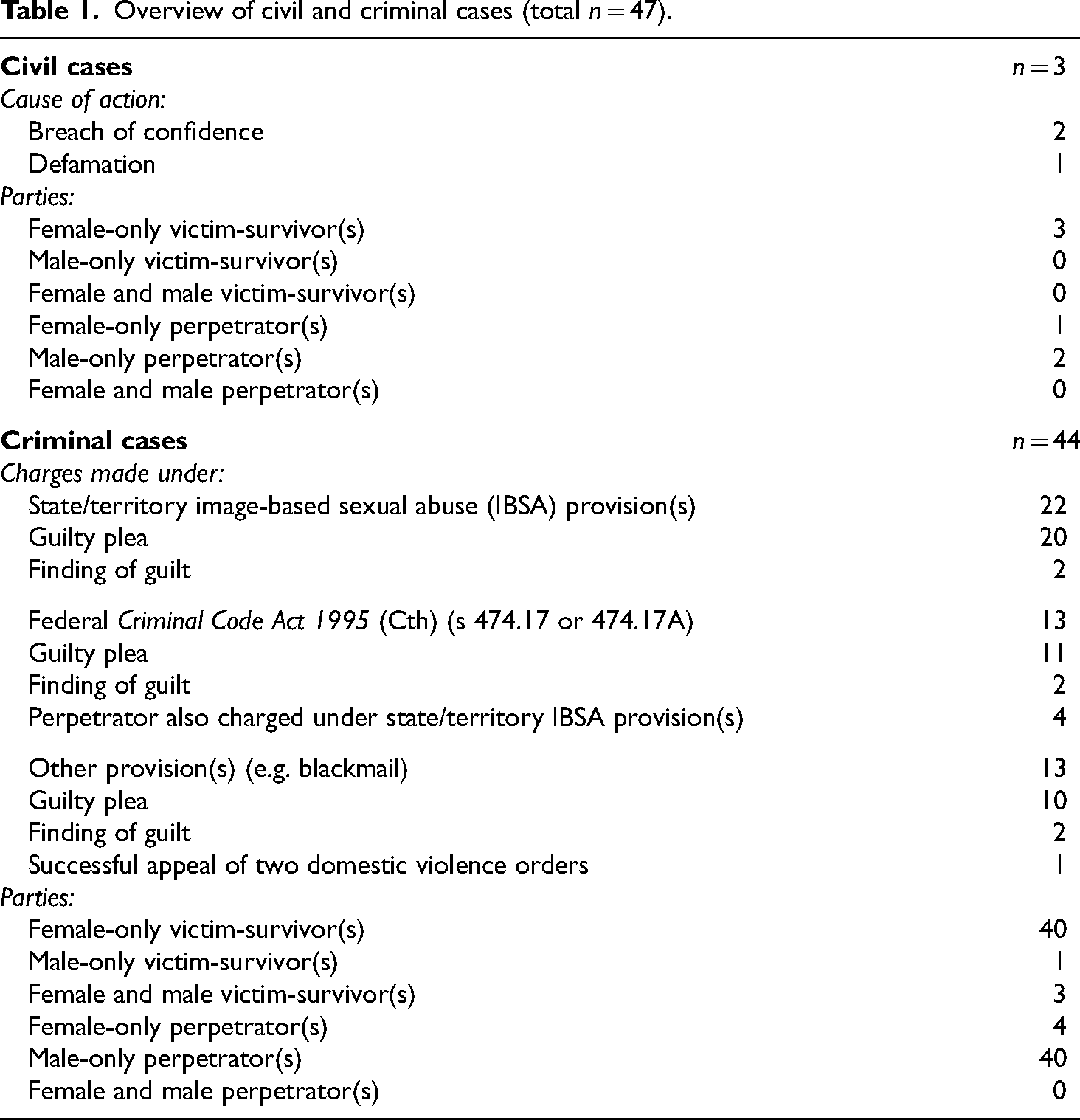
Almost all the criminal cases in our sample involved either a pleading or a finding of guilt. For instance, Table 1 shows that in the 22 cases involving charges brought under state or territory IBSA legislation, 91% of perpetrators pleaded guilty (n = 20) and 9% (n = 2) were found guilty. Similar dynamics were evident in cases involving charges under s 474.17 or 474.17A of the Criminal Code Act 1995 (Cth); of the 13 cases, 85% of perpetrators pleaded guilty (n = 11) and 15% were found guilty (n = 2). In terms of the gender of perpetrators in the select criminal proceedings, 9 as indicated by the pronouns in the documents that we analysed, 91% were men and 9% were women. By contrast, 91% of cases involved women victim-survivors only, 2% involved male victim-survivors only, and 7% involved both or were unspecified. The civil cases in our dataset reflect a similar trend with all three proceedings involving women victim-survivors and predominantly male perpetrators.
Across the entire sample of criminal and civil cases, we found that perpetrators often had multiple, interrelated motivations for committing IBSA, with relationship retribution and sexual voyeurism among the most common. In line with well-established critiques of the concept of ‘revenge porn’, a media-generated term that many experts argue overlooks the diversity of perpetrators and their motivations (McGlynn et al., 2017), cases in which defendants were chiefly (but not only) motivated by retribution (n = 28) occurred after the breakdown of heterosexual relationships (e.g. Western Australia Police v Brindley), same-sex relationships (e.g. WA Police v Frey), and platonic friendships (e.g. R v Gow). Cases predominantly involving sexual voyeurism (n = 10) were underpinned by several more specific motivations, such as: ‘boasting’ or demonstrating sexual ‘virility’ among peers (e.g. DPP v Patterson; DPP v Osborne), ‘perverse satisfaction’ (e.g. The Queen v Daniel McDonald Deblaquiere), and ‘feckless’ selfishness and indifference (e.g. Scala v Scala). ‘Other’ cases of IBSA (n = 8) involved, for example, inadvertent image sharing in the course of work (Western Australia Police v Frey). The offender in R v Tamawiwy, the only case principally involving sexual extortion (n = 1), ‘invited’ a victim-survivor to have sexual intercourse on a daily basis to avoid, inter alia, the non-consensual sharing of intimate images. In the following section, we analyse judicial discourse in select cases, with the aim of shedding light on how Australian courts conceptualize the harms of IBSA.
The Individual Harms of IBSA
Overall, we found that the courts widely recognized the serious and harmful nature of IBSA, principally with reference to the harms experienced by individual victim-survivors. The Magistrate's remarks to the defendant in R v Gow provide an illustrative example: ‘…hopefully you do now have some empathy for the position of the victim and an appreciation of how extremely serious it is to publish such private pictures, without the consent of the person who is the subject of the picture’ (lines 11–14). In addition to a ‘serious offence’ (DPP v Hartland: para 75), the courts described IBSA as, inter alia, behaviour that ‘can have immediately devastating and wide-ranging consequences for another human being because of the very nature of the technology employed’ (R v B GC: para 42). When considering the harms suffered by individual victim-survivors, often as part of sentencing in criminal matters, the courts regularly referred to Victim Impact Statements (VIS). A VIS is a voluntary ‘written or spoken statement that describes the impact of the crime on those affected by it, and the harm the victim suffered as a result’ (Commonwealth Director of Public Prosecutions, 2023). In the absence of a VIS, some judges inferred the likely harms of IBSA, which further demonstrates the seriousness that many courts ascribed to cases in our sample.
Of the individual harms recognized by the courts, social rupture and isolation were the most common. Many judges acknowledged the whole-of-life and compounding impacts of IBSA on victim-survivors. For instance, in R v Kulczycki (para 12), the court remarked: There is a victim impact from the complainant. She says that: …My life has been turned upside down and I will never be the same person again. He changed that for me. For the first time in my life, I need to take medication for anxiety and depression, which I suffer because of the abuse endured.
Some courts also considered how victim-survivors from culturally and linguistically diverse backgrounds can experience the harms of social rupture and isolation differently. For instance, in the archetypal relationship retribution case of R v Hileljic, the offender threatened to share and subsequently distributed an intimate image depicting a woman victim-survivor (referred to as ‘A’) to her ‘very strict father’ (para 10). The court strongly emphasized that the perpetrator knew A's father, who was a member of a religious community, ‘would likely react harshly’ to seeing or becoming aware of the intimate image (para 10). In R v Hileljic (para 51), the Justices opined: But A's family circumstances cannot be put to one side… it is relevant that, as the appellant well knew, the threat of distributing the video was likely to be more terrifying for A than it would be for most other victims. The appellant knew of A's tenuous relationship with her father, and of his strict views. While he would not have needed reminder of these matters at the time of his offending, as it happens both A's friend and new boyfriend provided the appellant with explicit reminders and warnings. The appellant may not have anticipated a reaction from A's father quite as extreme as that which in fact occurred, but he was certainly aware of the risk, if not likelihood, of a serious and significant reaction on the part of A's father. It is clear that his awareness of this likely significance of the threat, and hence its likely impact on A, contributed to his decision to deploy it.
The harm of constancy was also well-recognized by the courts. Many judges opined that the rapid development and global uptake of digital technologies now make it relatively easy to take, create, or share intimate images (e.g. DPP v Osborn; R v Farrawell-Smith). For example, in DPP v Patterson (para 14), the court remarked: New technologies have made it possible for anyone with a smartphone to share material like this quickly and easily. The abuse of these technologies has resulted in the criminal law having to catch up with behaviour that was just not possible even relatively recently.
In comparison to social rupture and isolation, there was limited judicial recognition of the harms of existential threat and constrained liberty, as arising specifically from IBSA. Though some concerns around social rupture and isolation could underpin, or relate to, ‘the unnerving sense of fear, worry and uncertainty’ that is one of the key components of McGlynn et al.'s (2020) conception of existential threat, we did not identify any judicial discourse on victim-survivors questioning the meaning and purpose of life. Instead, particularly when this type of abuse occurred alongside other crimes (e.g. sexual assault or domestic violence), the courts recognized victim-survivors’ ongoing risk, or fear, of physical violence. In addition to R v Hileljic, examples include R v McGillicuddy, in which the court acknowledged that the victim-survivor ‘lives in fear’ of the accused finding her (p. 4); DPP v Baker, in which the perpetrator's actions left the victim-survivor ‘terrified’ (para 30); and DPP v Hartland, in which a victim-survivor is quoted as saying ‘I am powerless to feel safe’ (para 31). It was further acknowledged that cumulative fear can, in turn, engender constraint in terms of victim-survivors’ freedom of movement or sense thereof.
Although the harms of social rupture, isolation, and constancy were more widely recognized than an existential threat and constrained liberty, we argue that the courts’ fairly wide-ranging consideration of the ways that IBSA can be harmful to individual victim-survivors is encouraging. This is bolstered by the seriousness with which the courts appear to be taking this type of abuse and the degree to which impact statements from victim-survivors, or inferences about the likely harms of abuse, appear to be informing judicial discourse. Yet IBSA is not only harmful to individuals, but also to society more broadly, which is the focus of the next subsection.
The Societal Harms of IBSA
In comparison to the individual harms of IBSA, the courts discussed societal harms less often and in more ambiguous terms, with an expectedly greater focus on the high-level sentencing objectives of denunciation and deterrence. Judges across the entire sample of cases condemned IBSA as, for instance, ‘utterly deplorable’ (R v McGillicuddy: p. 4), ‘a particularly cruel type of behaviour’ (DPP v Henderson: para 19), ‘abhorrent’ (R v Hibeljic: para 47), ‘nasty’ (R v Peter Robert Farrawell-Smith: p. 1), and ‘conduct that has been causing a lot of people in the community a great deal of pain’ (Western Australia Police v Brindley: p. 8). A common discursive thread running through most cases was the importance of the courts sending a ‘clear’ and ‘loud’ message of deterrence to local communities. Take, for example, a statement made by Her Honour Fantin J in R v KPR (para 35): In cases involving the distribution of intimate recordings without consent, it is very important that offenders are held accountable, and reflect community condemnation of this form of abuse. These recordings are easy to send but hard to retract. Sent in haste, you are left to repent at your leisure.
It is perhaps unsurprising, then, that there was little to no explicit recognition of IBSA as a form of GBV in the cases that we analysed. The courts’ discussion of broader, gender-based structural forces was predominantly limited to cases involving multiple forms of violence, abuse, and harassment, especially in domestic or family contexts (see, e.g. Western Australia Police v Singh, R v NX, R v McGillicuddy, and DPP v Alexander). Take, for instance, the court's remarks in DPP v Henderson (para 31): The community is heartily sick of violent men setting upon women who simply seek to end a relationship … When men act violently and engender fear, then the courts will reassert proper and decent values, that is, protecting the vulnerable from the violent. The courts will do this with stern punishment.
While there is no legal requirement for the courts to recognize IBSA as a form of GBV (McLoughlin and O’Brien 2019), we argue that an inclusive gender-based approach is important in this context as it underlines the broader structural (gendered) context of masculine power, privilege, and dominance from which this behaviour emerges (Henry et al., 2020). In Australia, where rates of men's violence against women are of ‘epidemic proportions’ (Commonwealth of Australia, 2022: 14), one in five women has experienced sexual violence since the age of 15 (Australian Bureau of Statistics, 2023) and, on average, one woman is killed by an intimate or ex-partner every 10 days (Commonwealth of Australia, 2022: 50). Indigenous women, women with disabilities, refugee, and migrant women, and LGBTIQA+ people face a particularly heightened risk of violence, including IBSA (Coumarelos et al., 2023; Henry et al., 2020). Indeed, while our sample of cases evidences different motivations, contexts, and experiences of IBSA, most cases involved a woman victim-survivor who was abused by a man. An inclusive gender-based lens also highlights how this form of abuse is often perpetrated to reinforce gender norms, which intersect with other markers of identity including sexuality, race, age, and class, or in response to perceived normative transgressions (Henry et al., 2020). IBSA can thus be gendered when it is perpetrated by, or against, women, men, or gender-diverse people, the greater recognition of which can help to situate this type of abuse more broadly within burgeoning national and international discourses on GBV.
Another potential cause for concern was the tendency of some courts to assume that victim-survivors felt embarrassed or humiliated about their experiences of IBSA. R v Hileljic provides a useful example: ‘…the nature of the images was such that any distribution of them would at the very least involve a gross invasion of A's privacy and be a source of immense embarrassment for her’ (para 50). While such an acknowledgement could help to validate some victim-survivors’ experiences, and potentially address embarrassment as a barrier to adults reporting this and other types of GBV, the courts assuming feelings of embarrassment can promote and reinforce the idea that all victim-survivors should feel a certain way. This is problematic as the impacts of sexual violence are highly variable (see, e.g. Gavey and Schmidt, 2011) and there is ‘no one response that is experienced by all survivors’ (Yuan et al., 2006: 6). Some discourses around embarrassment can also be ‘sex negative’ by, for instance, implying that intimate images are inherently embarrassing, shameful, or problematic (see, e.g. Aikenhead, 2021; Dodge, 2021). By countering potentially sex-negative language, judicial and other societal actors can create space for more ‘sex positive’ perspectives such as those recognizing the many legitimate reasons why someone might consensually take, create, and share intimate images (e.g. sexual expression; Dodge, 2021), or to attract potential partners (see, e.g. Dodge, 2020). A sex-positive approach can also recognize the heightened risk of harm for victim-survivors from cultural or religious communities in which the exposure of intimate images can be especially significant (e.g. the discussion of R v Hileljic above).
Against this backdrop, particularly the tendency for judicial discourse in our dataset to individualize the socio-legal problem of IBSA, we argue that more should be done to conceptualize this type of abuse as a form of GBV. This includes naming and working through IBSA as an often-gendered problem with structural and systemic causes that are rooted in, inter alia, gender inequality and heteropatriarchal gender power relationships. By doing so, the courts can help to enrich societal understandings of the nature of this type of abuse, as well as the serious consequential harms for victim-survivors and society more broadly (Aikenhead, 2018). However, in doing this work, we stress the importance of distinguishing between the non-consensual behaviours that can constitute IBSA (e.g. as in the cases analyzed above) and the consensual taking, creating, or sharing of intimate images (e.g. sexting between two consenting adults). While this distinction might seem obvious, research shows that some consensual and non-consensual uses of intimate images are conflated (e.g. Ringrose et al., 2022), which can distract from, and make it more difficult to address, the systemic and often-gendered issues underpinning IBSA in practice. Finally, it is important to emphasize that the harms explored in this article are non-exhaustive and ‘located [in] a particular time, place and context’ (McGlynn et al., 2020: 557). The nature and impacts of IBSA are constantly evolving, which highlights the importance of developing and applying diverse intersectional feminist and other critical lenses to investigating this complex, socio-legal phenomenon.
Conclusion
This article has provided a much-needed feminist critical discourse analysis of how Australian courts conceptualize the harms of IBSA. Across 47 criminal and civil cases that involved IBSA, as heard in Australian state/territory and federal courts of law, we identified a wide range of motivations, contexts, and experiences of this form of abuse that extended well beyond archetypal ‘revenge porn’ narratives. We found that the courts widely recognized the harms experienced by individual victim-survivors, particularly social rupture, isolation, and constancy. These recognitions were often quite explicit and bolstered by strong messages of deterrence and denunciation. In contrast, the courts largely discussed the societal harms of IBSA in abstract terms, with few concrete examples of how this type of abuse can impact communities in practice.
We also found that despite the courts discussing systemic, gender-based issues in cases involving domestic or family violence, there was little to no judicial recognition of IBSA as a form of GBV in and of itself. This is significant given the overrepresentation of women victim-survivors and male perpetrators in our sample of cases, and that IBSA is often perpetrated to reinforce or punish (perceived) transgressions of gender norms at the intersections of sexuality, race, and many other markers of identity. It is also out of step with growing societal recognition of the systemic problem of GBV in Australia and internationally (Commonwealth of Australia, 2022). Future research could therefore investigate a range of topics, including: changes in judicial discourse and practice over time; victim-survivors' experiences of justice processes and systems; and the use of AI, including generative technologies, as a new and evolving form of IBSA.
Overall, we argue that it is important for the courts to recognize the often-gendered nature of IBSA, as one of many growing forms of GBV. By adopting an inclusive gender-based approach to understanding the complex socio-legal problem of IBSA, the courts can advance and promote more nuanced, relational, and holistic understandings of the harms experienced by individual victim-survivors, as well as the impacts on society more broadly. Such an approach can also usefully inform policy- and lawmakers in Australia and international jurisdictions seeking to better detect, prevent, and respond to IBSA and other forms of GBV.
Footnotes
Acknowledgements
We would like to thank Dr Stefani Vasil for her generous feedback on earlier versions of this article and assistance in searching for case law. We would also like to thank the many Australian courts, state law libraries, and other authorities for responding to our case law-related queries in a timely and helpful manner.
Declaration of Conflicting Interests
The authors declared no potential conflicts of interest with respect to the research, authorship, and/or publication of this article.
Funding
The authors disclosed receipt of the following financial support for the research, authorship, and/ or publication of this article: This research was funded by the Australian Research Council (ARC) Future Fellowship Project (FT200100604).
