




Abstract
Large-scale accommodation for refugees and migrants is often approached from a humanitarian angle, examining the reception conditions on the ground. However, scholars have long shown how such care-providing spaces are also sites of social control. A close examination of the legal framework of an accommodation centre for migrants in Spain, the CETI of Melilla, finds that beyond the content of the law, it is also necessary to examine the nature of the laws framing refugee camps to understand how social control is exerted. While hard law provides a vague legal basis, the reception centre is primarily governed by a patch-work of rapidly evolving soft law emanating primarily from the executive branch. Social control in the form of coercion is facilitated by the law, but not in the form of a strong punitive legal framework, as may be expected. Instead, an effective restriction of the rights of residents is enabled through legal uncertainty.
Introduction
Large-scale accommodation for refugees and migrants is often approached from a humanitarian angle by examining the sub-standard reception conditions on the ground. However, such care-providing spaces are also sites for rights violations (Holzer, 2013) and social control. Some scholars have approached camps for migrants as a ‘total institution’, where people are placed in a closed area for a long period of time and where their life is controlled by formal authorities (Goffman, 1990), such as in Greece (Idrac, 2022), Italy (Acocella and Turchi, 2020) and Spain (Sahraoui, 2020). While care may be provided, this is often only possible at the expense of a form of control (Aris Escarcena, 2022: 79; Kreichauf and Dunn, 2022), an example of which is containment (Jaji, 2012) or outright detention. Both ‘compassion’ and ‘repression’ are exercised and reflect the sometimes conflicting tendencies at play in this form of accommodation (Fassin, 2005).
Social control can be defined as measures which aim to change the behaviour of targeted individuals (Johnsen et al., 2018: 1106). While non-legal norms are also explored as forms of social control in the literature on legal pluralism (Davies, 2010), formal legal processes remain central to understanding the ways in which social control is exercised, since ‘law and other forms of state-centered social control emerged as the central guarantors of social order over the course of social evolution’ (Horwitz, 1990: 1). The criminalisation of homelessness, for instance, can be understood as a form of control of public spaces (Auriel, 2022; Moss and Moss, 2019). In the broader literature on legal iterations of social control, it is often the content of the norms (whether formal or informal) which is examined, with little focus on the specific ways in which law enables different forms of social control. Insufficient attention has been paid to the choice of a specific type of legal tool and its impact on the measures destined at changing the behaviour of specific groups. At the same time, legal approaches may describe the human rights violations at work in reception centres for asylum-seekers, but they do not necessarily frame them as relationships of power between different actors. Some of the references made to law in refugee camps stress the existence of a ‘legal grey zone’ (Turner, 2016) or a ‘legal limbo’ (Isin and Rygiel, 2007). Effective control over the agency of migrants living in camps appears to be at odds with legal certainty.
This article thus aims to examine the legal dispositifs at work in ‘sheltering’ centres for migrants. To do so, it draws upon the case study of a reception centre for asylum-seekers and irregularised migrants to examine the role of law in the regulation of the behaviour of people housed in such structures. The Centro de Estancia Temporal de Inmigrantes (Temporary Reception Centre for Immigrants, ‘CETI’) of Melilla is chosen as the case study given the paucity of current research examining not only how specific migration policies – but, further, the regulation of the reception centre itself – can have consequences for migration governance and social control more generally. While specific policies, such as push-backs at the border and the confinement of people to the exclave have been scrutinised, the existence and running of the CETI has not received the same critical attention from legal scholars. It is however central to understanding the continuum of containment at the Spain's southern border (Ruiz Ramos, 2024). Further, as explained in the third section, Melilla is of strategic importance for both Spanish and EU migration governance more generally.
Given the intense forms of control dictating the lives of migrants in reception centres in the EU, how is social control in the CETI of Melilla exerted legally? While several relevant human rights could be considered here (such as the right to freedom of movement, the right to family life or a certain standard of material reception conditions), this article focuses primarily on the legal foundation of the CETI, without delving into an analysis of any of these more specific rights.
This article argues that while social control can be uncovered by examining the content of the norms, some dimensions of social control can only be made visible when examining the nature of the norms themselves. Hard law, soft law, policy rules or simply the absence of law may all impact the discretion that local authorities hold over residents of the CETI. In fact, more stringent forms of social control, such as ‘force’ or ‘coercion’ (Johnsen et al., 2018) do not necessarily require a strong punitive legal framework laid down in hard law. ‘Weak regulation’ (Zaun, 2017) or ‘soft legalization’ (Abbott and Snidal, 2000) also facilitate control over migrants by the staff of the CETI. Legal uncertainty should therefore be recognised as a mechanism of governance in law that also leads to ‘effective restrictions’ (Zaun, 2017) for residents. 1
First, the article briefly contextualises Melilla as a destination for people trying to reach the EU and defines the place of the CETI within the wider reception network for migrants in Spain. Then, the methodology of the article is briefly outlined. After showing how the content of the norms establishing the CETI function to secure social control through force, coercion and influence; the nature of these norms is examined, paying attention to the standards, rights and guarantees laid down in primary (created by the legislative branch of government) and secondary law (created by the executive branch of government), policy rules and soft law. The article then draws from these findings to examine the role of legal uncertainty in securing social control in the CETI, before concluding on its role in migration governance more generally.
History and Context of Reception Centres for Migrants at the Spanish Border in Morocco
Melilla is an area which has been an exclave under Spanish control since the Reconquista in the 15th century. It then became a trading post, and was later used to facilitate Spanish colonial expansion into Africa, before being repurposed as military garrisons (Mutlu and Leite, 2012: 27). To this day, Morocco still claims sovereignty over this territory (Murray, 2012: 53). The official border was fixed in conventions dating back to 1859 and 1862 in Melilla, although these do not precisely coincide with the border fences erected in the mid-1990s (Ferrer-Gallardo and Gabrielli, 2018: 15). There is no agreement between Spain and Morocco regarding territorial waters, which has led to creative interpretations of the location of the border at sea (Ferrer-Gallardo and Gabrielli, 2018: 34) (Figure 1).
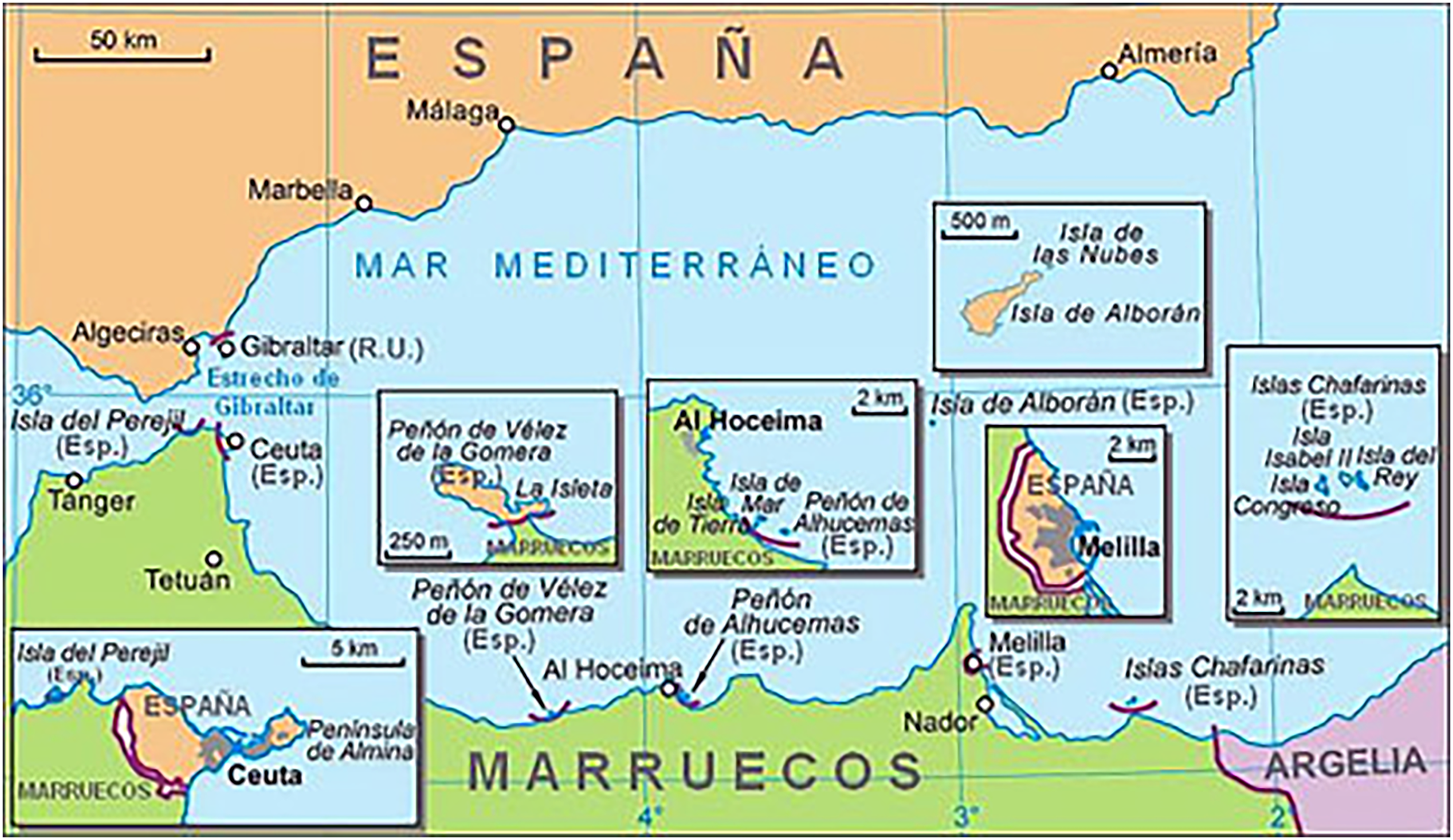
Map of Ceuta and Melilla.
Since Spain joined the Schengen Agreement in 1991, Melilla and Ceuta (another Spanish exclave in Northern Morocco) are the only EU territories in mainland Africa, though they retain a number of legal exceptions with regards to the Schengen system (Murray, 2012: 54). Crucially, this includes the possibility for systematic border controls between Melilla/Ceuta and the Spanish mainland or other EU Member States (Viguri Cordero, 2020). 2 The incorporation of Spain into Schengen has made it a plaque tournante of migration from the sub-Saharan continent to the EU (Ferrer-Gallardo and Espiñeira, 2015). As a result, EU funds have participated in the increasing securitisation of the border. Following a higher volume of arrivals in the 1990s and a series of xenophobic and racist riots in 1995, a fence was erected at the border between Ceuta and Morocco and has since come to symbolically and materially embody ‘Fortress Europe’ (Ferrer-Gallardo and Espiñeira, 2015: 253), with increasing recourse to confinement and encampment by Member States (Ferrer-Gallardo and Espiñeira, 2015: 252), where the exclave is ‘a city for some, and a refugee camp for others’ (López-Pastor, 2018: 45). In practice, the border controls imposed by the Spanish government prevent asylum-seekers present in Ceuta and Melilla from freely moving to mainland Spain despite their right to freedom of movement which has been affirmed multiple times by different Spanish courts. 3 Until the latter half of 2021, people residing in the CETI could apply for ‘transfers’ to mainland Spain, an opaque process organised at the discretion of the police, possibly in conjunction with workers in the CETI (Sahraoui, 2020: 1822). Melilla thus serves as one of the external borders between the EU and Africa. Together with the Canary Islands and Ceuta, they constitute the frontera sur (‘southern border’) of Spain.
Melilla has one CETI on its territory. It is a ‘reception centre’ intended as temporary shelter for undocumented migrants and asylum-seekers who cross from Morocco into one of the exclaves (Queirolo Palmas, 2021). The CETI of Melilla has a reception capacity of 782 places, though it is often overcrowded. In 2019 for instance, the CETI of Melilla had a 205% occupation rate, with the majority of residents being from Tunisia, Syria, Morocco, Guinea and Algeria; and most asylum application being filed by Tunisians and Egyptians, which the Spanish NGO CEAR attributes to the increased difficulties for them in accessing the territorial border (Comisión Española de Ayuda al Refugiado (CEAR), 2020).
Regarding accommodation specifically, the Spanish government has a two-phased approach to reception for asylum-seekers, as detailed in the Management Handbook: Reception System for International Protection (Ministerio de Inclusión, Seguridad Social y Migraciones, 2021). 4 The first phase is seen as a pre-reception phase and does not officially constitute a part of the actual reception system according to Spanish authorities. During this ‘assessment and referral phase’, applicants are given information on the asylum process. It is also in this phase that the authorities evaluate whether the applicant has a specific vulnerability. Most importantly, the CETIs are also located in this ‘pre-reception’ phase, where humanitarian aid is facilitated. On the Spanish mainland, this phase is for people who have arrived on Spanish soil but have not yet lodged their asylum applications. In Ceuta and Melilla, it can include people who have not yet lodged an application for international protection, who do not count on doing so, but also people who have already applied for international protection and would therefore be in the next stage (the reception phase) were they located on the mainland. This prior stage is also intended for 30 days, though in practice, stays in the CETI are often much longer (Comisión Española de Ayuda al Refugiado (CEAR), 2020: 256). After this pre-reception phase, applicants are moved to the ‘reception’ and ‘preparation for autonomy’ phases.
Since 2020, new applicants for international protection have the right to remain in the reception centres as long as they remain asylum-seekers. It should be noted that time spent in the CETIs is excluded from these calculations (Ministerio de Inclusión, Seguridad Social y Migraciones, 2021: 21). Indeed, the Ministry does not consider that CETIs are part of the Reception System for International Protection (Ministerio de Inclusión, Seguridad Social y Migraciones, 2021: 6), despite providing accommodation for a large number of applicants for international protection.
Methodology
The article employs a systematic content analysis (Hall and Wright, 2008; Salehijam, 2018; Schebesta, 2018) of legislation, policy rules and case law related to the CETI up to 2022, excluding the new Regulation on Reception Conditions of Refugees of March 2022 (‘Reception Regulation’, 220/2022, of 29 March). This article considers all legal documents (primary law, secondary law, policy rules and soft law instruments) related to the legal foundation of the CETI found in the CENDOJ, the Spanish public database for law. Publication in the Spanish Boletín Oficial del Estado is necessary for norms to be granted legal effect, so this search was exhaustive. It was extended to the Boletín Oficial de la Ciudad Autónoma de Melilla to identify the administrative norms that were specific to the city of Melilla. This article uses a directed approach to policy rules (Hall and Steiner, 2020), reading them against the legal norms they are attached to, ensuring effective comprehension of the text and its context. Policy rules were necessary when they gave body to specific laws, but also to understand the internal priorities of the administrative organs of the Spanish state. This analysis was then supplemented with reports from civil society and guidelines issued by government agencies to provide context for existing policies, as well as their implementation.
As will be argued later, the prevalence of informal and soft law necessarily implies that the selection of documents may nevertheless be incomplete, as some of the documents may not be published or otherwise publicly accessible. Further, this article focuses on the legal aspects of social control and thus adopts a primarily statist approach to law, not engaging with all forms of legal pluralism which may be at play in the CETI. However, law does not act unmediated upon social reality, as it is likely that other, non-legal norms also impact and shape the way the CETI is regulated. As Krieken discusses with regards to legal informalism, ‘there are in any case always informal aspects of supposedly formal legal processes, and that formal law is not the only realm in which questions of power, authority, coercion and justice are at issue’ (Krieken, 2001: 5). Further, law-on-the-ground will sometimes conflict with more positivist legal approaches. This article chooses to focus primarily on the legal aspects of social control while recognising that multiple mechanisms, beyond law, may intersect in reception centres and other sites for accommodation. Ethnographic work exploring the impact of the regulation of the CETI on its residents (Bondanini, 2014; Gazzotti, 2023; Johnson, 2013; Queirolo Palmas, 2021; Sahraoui, 2020) should therefore be viewed as complementary to this piece.
Examining the Content of the Norms: Reception Centres as Sites of Social Control
Social control describes measures which aim to change the behaviour of targeted individuals (Johnsen et al., 2018: 1106). The CETI of Melilla employs different forms of social control to shape the behaviour of its residents. The most intense forms of social control are mobilised by local actors to ensure the compliance of migrants (whether asylum-seekers or not) with the norms of the CETI, which is visible in the content of the norms of the CETI that explicitly create punishments.
While the literature has long made distinctions between different forms and degrees of social control, in their article, Johnsen et al. categorise these forms of social control under five broad umbrella terms, which they pull from their analysis of the social control of homelessness in the United Kingdom, but argue that it may be extended to other social welfare fields. They distinguish between force, coercion, bargaining, influence and tolerance, in decreasing order reflecting the intensity of the control exercised on the individual (Johnsen et al., 2018: 1110–1118). Force essentially removes any element of choice from the individual, since any form of non-compliance leads to immediate punishment, such as imprisonment, arrest or removal. It is also usually the most direct and formal measure of social control exercised over individuals, and often stems from legal acts. Coercion, on the other hand, moulds behaviour by threatening ‘deprivations’, which in the context of asylum accommodation may be the deprivation of material reception conditions (such as money, material resources and services), or access the asylum system, and ultimately to obtain international protection under administrative law. Bargaining is similar to coercion, in that it can also threaten (less severe) losses for the individual, but it may also offer gains. Influence relies on ‘nudging’ individuals in the right direction through persuasion, while tolerance does not explicitly aim to change the behaviour of the individual. In their analysis, they primarily consider hard law and the content of these laws to understand the consequences non-compliance has for targeted groups.
In the case of the CETI, social control is primarily secured by way of coercion, though force occurs upstream of the arrival to the reception centre. Officially, people may request asylum at one of the border crossing points in Melilla, but this is difficult, if not impossible in practice for sub-Saharan migrants due to racial profiling, especially close to Mount Gurugu (Johnson, 2013; Pasetti, 2020: 49). In practice, many thus scale the fences (both on the Spanish side and on the Moroccan side), which may be attempted as a group rather than individually to increase the likelihood of success. When they do so, they may be ‘pushed back’ by Spanish border guards, thus effectively being forced back to Morocco (without an individual examination of their asylum application), as the N.D. and N.T. v Spain case of the European Court of Human Rights showed (no. 8675/15 and 8697/15, 13 February 2020). Given the difficult access to legal pathways into Melilla, combined with the use of force at the border, access to the CETI is risky and dangerous. Subsidiarily, influence is exerted through the provision of Spanish language classes or ‘hygiene’ workshops to improve integration efforts, for instance (Sahraoui, 2020).
Coercion is perhaps the most meaningful way that social control is exerted in the CETI itself. Three central forms of conditionality threaten a form of deprivation for its residents. First, by threatening all residents with exclusion from the CETI if they fail to comply with its internal rules. Jesuit Refugee Services (SJM) reported cases of people arriving at their offices seeking accommodation because they had been excluded from the CETI temporarily. They describe situations in which residents were evicted from the CETI for a period of time for allegedly being involved in fights with the security personnel, but SJM notes that there is no way for migrants to prove their innocence in such cases (Salehijam, 2018). A young pregnant woman was also expelled from the CETI for two days and nights (during which she slept outside) because she had taken a dinner tray outside with her to eat during Ramadan. Sahraoui notes generally that ‘being excluded from the Centre as a failure to demonstrate one's integration inside was a common punishment’ (2020: 1818). In 2023, a group of people chose to apply for asylum in Melilla following difficulties due to backlogs on the peninsula. They were initially refused entry into the CETI, and had to sleep outside (Solidary Wheels, 2023). Solidary Wheels has also alerted on refusals to admit Moroccan people to the CETI (Solidary Wheels, 2022). The consequence is temporary destitution, as migrants will be left to sleep in the streets without money or any form of protection (Johnson, 2013; Manzanedo Negueruela et al., 2018: 32).
Secondly, coercion is created by threatening the reduction or complete withdrawal of material reception conditions for asylum-seekers who breach the internal rules of the CETI. Article 33 of the Law on the Right to Asylum (‘Asylum Law’, Law 12/2009) notes that this sanction will be handed out when a person ‘violates the rights of other residents or of the personnel that manages the centres where they are being received or they render coexistence particularly difficult, in accordance with the provisions of the internal rules’. Again, the staff of the CETI holds the power to unilaterally withdraw the totality or part of the material reception conditions when they consider that a resident is too disruptive. This form of conditionality is in theory reserved only to residents who apply for international protection, not residents who are undocumented or rejected asylum-seekers, but, as noted above, exclusion from the CETI is possible for any resident in any case if they fail to comply with internal rules anyway. Further, Article 33 Asylum Law authorises the reduction or complete withdrawal of material reception conditions when an asylum-seeker leaves the CETI without prior authorisation. Once again, destitution is used to ensure compliance with rules, but since these rules are not known to the residents, there is a risk of arbitrariness on the part of the staff of the CETI.
Thirdly, coercion is secured by conditioning access to the official Reception System of International Protection in mainland Spain to not leaving the CETI of one's own accord. This is further defined as meaning that one has not left the CETI without an official authorisation for transfer to the Spanish mainland (Ministerio de Inclusión, Seguridad Social y Migraciones, 2021:17). It is not only the current reception conditions of asylum-seekers that hang in the balance during their stay in the CETI, but also the possibility of accessing future reception conditions throughout their stay in Spain. This form of conditionality implies high exit costs for asylum-seekers present in the CETI who await decisions on their applications for international protection. Given that the CETI precedes the official reception system for asylum-seekers and beneficiaries of international protection in Spain, remaining in the CETI is compulsory for people arriving in Spain from the Moroccan border. It is a requirement for those who seek a legal transfer to the Spanish peninsula, as well as for access to the official reception system for asylum-seekers.
Overall, therefore, the regulation of the behaviour of people living in the centre occurs primarily through force and coercion, where migrants face destitution for failing to comply with internal rules.
The Legal Framework of the CETI
One might expect that the Spanish authorities would favour ‘hard legalization’ (Abbott and Snidal, 2000), since CETIs are public administration accommodation centres, and, as such, public authorities are responsible for their management. Hard legalisation can be understood as the process by which relations between actors are regulated by way of hard law, which Abbott and Snidal (2000) define as ‘legally binding obligations that are precise (or can be made precise through adjudication or the issuance of detailed regulations) and that delegate authority for interpreting and implementing the law’ (p. 421). In this article, this will include both primary legislation (such as the Asylum Law), but also secondary legislation. Soft legalisation, on the other hand, includes all soft law, including policy rules established by the administration but which are not binding or opposable on them. Beyond the sole content of legal norms, how is social control in the CETI, identified here primarily as coercion, enabled legally? Does it occur primarily through hard legalisation, given the intense forms of social control in the CETI? One might expect that non-compliant behaviour may be sanctioned by way of a strong punitive framework laid down in primary and secondary law, ensuring a degree of legal certainty as regards the consequences for failing to comply with such norms. A clear – if restrictive – legal framework would also grant the local authorities and the management of the CETI the necessary mandate to sanction behaviour considered to be contrary to the central aims of the CETI. It would directly grant them the legitimacy required to impose social control on the CETI. As we will see below, in reality, the legal framework of the CETI relied primarily on soft law.
This section examines the legal architecture of the camp of Melilla, paying particular attention to the role played by primary law, secondary law and further non-binding norms such as soft law, as well as instances oof non-regulation, or a ‘legal void’. It then concludes on the way social control is ‘legalised’ in the CETI and on its implications for the legal regulation of particularly coercive forms of social control more generally.
Primary Law and Secondary Law: Minimal Standards for Reception Conditions
Article 30 Asylum Law enshrines the right of an asylum-seeker to material reception conditions, including social and accommodation services for applicants for international protection who do not have sufficient means to obtain housing using their own resources. The law leaves the specific scope and standards of these material reception conditions to the later determination of the relevant Ministry by way of a Regulation (Articles 30(2) and 31(1)). However, until March 2022, Spain still lacked an Asylum Regulation to further develop the content of the Asylum Law as regards reception conditions in line with its guiding principles and despite the obligation for the government to establish one in the 6 months following the publication of the Asylum Law in 2009 (Third Final Provision). As of 2021, the applicable Asylum Regulation is that which was established for the previous asylum law and dates back to 1995 (Royal Decree 203/1995 of 10 February), creating a somewhat confusing legal regime of asylum in Spain (García Vitoria, 2018). The absence of an updated Asylum Regulation has created issues for the reception system in Spain, since the content of what constitutes material reception conditions has not been further developed, and thus neither have the rights of people sheltered in the CETI. As demonstrated below, standard-setting is therefore pushed to policy rules, at the expense of legal certainty.
The right to material reception conditions is reserved to applicants for international protection, that is to say, people who have lodged an application for international protection with the Spanish authorities and who are awaiting a decision on this application. It excludes other migrants, such as undocumented migrants or rejected asylum-seekers who are also residents of the CETI. Nevertheless, this latter group still falls under the ambit of the Law on the Rights and Freedoms of Foreigners (‘Migration Law’, 4/2000 of 11 January), whose provisions are more restrictive and do not include a right to accommodation or dignified reception conditions.
According to the Regulation on the Rights and Freedoms of Foreigners (‘Migration Regulation’, Royal Decree 557/2011 of 20 April), which lays down the specific standards of the Migration Law, the CETIs of Melilla and Ceuta are not part of the network of reception centres specifically destined for applicants for international protection that are covered by the Ministerial Order of 13 January 1989, since the CETIs did not yet exist at that time. They are not considered to be reception centres for refugees, but are instead part of the larger ‘public network of migration centres’, which ‘carry out services such as information, reception, social care, training, detection of situations of human trafficking, and, where appropriate, return’, that is to say, reception centres for all categories of migrants, not specifically asylum-seekers (Article 264(1) Migration Regulation). Article 264(2) Migration Regulation notes that this network of migration centres can develop specific programmes for applicants or beneficiaries of international protection, but they have no obligation to do so. Under Spanish law therefore, there is no obligation to provide asylum-specific services to people residing in the CETI given the way that it is classified within the legal framework of reception centres in Spain. This points to a difference in treatment between asylum-seekers depending on the place within Spain where they are assigned accommodation – with those at the periphery granted a lower standard of assistance.
Further, the Migration Regulation provides this public network of migration centres ‘will be governed by a common statute, without prejudice to the possibility for the different centres to develop programmes aimed at specific groups’ (Article 264(3)), and that it is for the executive to elaborate, inter alia, the status and internal rules for these centres, the services provided therein and their legal regime (Article 265). Article 33 Asylum Law also lists some of the possible consequences for breaching these internal rules, requiring that the responsible Ministry establish a regulation to outline the appropriate system of offences and penalties to be applied in cases of breaches. Further, Article 266(1) Migration Regulation states that the conditions of entry and stay in a migration centre (including the CETI) will be outlined in the internal rules of the centre. However, no such common framework has been adopted, the closest being non-binding Handbooks, as will be shown below, and these Handbooks does not detail specific internal rules for the CETI. The existence of internal rules as a whole remains contested: the direction of the CETI mentioned, in 2017, that the relevant governmental authorities would be working on a draft to elaborate a common legal framework for both CETIs and refugee reception centres (‘CARs'), taking into account their respective particularities. However, these internal rules are neither public nor binding, and NGOs have contested their existence (Alcántara, 2017). In recent years, it appears that residents are handed out a document outlining the basic rules for living in the CETI (Sahraoui, 2020) but these remain vague and sanctions are unclear: ‘[r]esidents for example, don’t have their rights and obligations established, only a leaflet with basic co-habitation rules, without legal status’ (Jesuit Migrant Service (SJM) and University Institute of Studies on Migration Comillas Pontifical University, 2016: 31). Despite their ambiguity, these can have far-reaching consequences for people staying in these centres, including withdrawal of reception conditions, temporary eviction from the centre and conditions for entry.
In some instances, a lack of hard legalisation at one level may be compensated at another level. Spain has not opted out of the instruments of the Common European Asylum System (‘CEAS’), the EU acquis which includes standards for reception conditions for asylum-seekers present in Member States. As of February 2022, neither the previous Reception Conditions Directive (2003/9/EC of 27 January 2003), nor the recast Reception Conditions Directive (2013/33/EU of 26 June 2013) had been incorporated into Spanish law. The Asylum Law is considered to adequately transpose the Directive, 5 despite the fact that it precedes the new phase of the CEAS, and thus the recast Reception Conditions Directive. As the deadline for the incorporation of the recast Reception Conditions Directive was 21 July 2015, it currently has direct effect in Spain. 6 In October 2019, the European Commission closed the infringement procedure with Spain regarding its non-transposition of the recast Directive. 7 It does not appear that courts make reference to the recast Reception Conditions Directive when examining infringement into the human rights of migrants in the CETI; despite specific provisions relating directly to the way that the CETI is run, such as Article 20(4) of the Reception Conditions Directive, which allows Members States to enact ‘sanctions’ for breaching the rules of accommodation centres, but only after the decision has been notified to the individual (Article 20(6) of the Reception Conditions Directive), and, in any case, Member States cannot deprive asylum-seekers of a ‘dignified standard of living’ (Slingenberg, 2022: 539). The UNHCR considered in 2015 that the conditions of stay in the CETI were not in compliance with international and EU law (Abogacía Española, 2015).
While binding, the effectiveness of EU law is limited in compensating the legal gap at national level regarding the rights of people present in reception centres. Local authorities also do not have more specific guidelines on the interpretation of Article 30 of the Asylum Act (right to material reception conditions), nor can they be guided by the overarching framework laid down in the CEAS, where the recast Reception Conditions Directive can be considered to have direct effect but does not provide more specific rules for the organisation of reception in the Spanish case. As they are not precise and are not complemented by a clear delegated norm for interpretation and implementation, it cannot be said that the CETI, or even reception conditions for asylum-seekers and migrants are regulated by way of hard legalisation (Abbott and Snidal, 2000). What forms of soft legalisation are at play in the CETI?
Under the Tip of the Iceberg: Soft Law and Policy Rules
The generally piecemeal existence of primary legislation regarding reception conditions for applicants of international protection, as well as undocumented migrants living in the CETI does not necessarily imply the existence of a ‘legal void’, even without engaging with legal pluralism. In lieu of hard law, the Spanish authorities frame reception conditions in the CETI in policy rules that are not always binding. The need for more precise standards and processes for NGOs providing reception subsidised by the Spanish government pushed the Ministry of Inclusion, Social Security and Migrations (‘MISS’) to develop Handbooks to regulate the stay in reception centres (Gabrielli et al., 2022: 17). The Handbooks provide general guidelines to harmonise the standards and provision of public services across reception centres. They present the different steps in the reception system and outline the associated range of assistance services available: language classes, psychological care, legal aid, translation and interpretation services and employment opportunities. The Handbooks set out the conditions for participation in the reception system, as well as the circumstances in which a reduction or complete withdrawal of reception services can occur (Ministerio de Inclusión, Seguridad Socialy Migraciones, 2021).
The latest version of the Handbook clearly differentiates between different types of reception centres. On the one hand, the Reception System for International Protection includes CARs, NGO-run reception centres that receive subsidies from the MISS, and ‘complementary projects and resources’ to favour the autonomy of applicants for international protection, also subsidised by the MISS. The Handbook details their associated legal framework. On the other hand, CETIs are considered to be ‘public centres conceived, from their inception, as temporary stay for foreigners while they are identified and their administrative situation is assessed with a view to their referral to the most appropriate service depending on their situation’ (Ministerio de Inclusión, Seguridad Social y Migraciones, 2021: 1). This also means that the duration of their stay in the CETI is not officially counted as a stay within the Reception System for International Protection, which conditions the phase of the Spanish reception system a person will be assigned to (Ministerio de Inclusión, Seguridad Social y Migraciones, 2021: 21). No normative framework is laid out for the CETI in the Handbooks. Further, they constitute policy rules but are not binding, meaning that though they direct the action of the executive, they cannot be used in court by migrants residing in the CETI to argue that a decision on the withdrawal of their material reception conditions was made arbitrarily or to appeal to any of the rights outlined in the Handbook. As such, soft law has ‘become an informal substitute for the development of the Asylum Law, at least for the concerns of the reception programme’ (Jubany and Rué, 2020: 156).
This reliance on policy rules and soft law also has consequences for the services and assistance that residents can expect in the CETIs. Regarding the role given to subsidies in different types of reception centres, while CARs are directed at ‘the creation and maintenance of reception facilities and the development of ‘integration itineraries’ for people seeking or having obtained international protection’, CETIs aims only at ‘facilitating socio-sanitary care’. 8 The underlying logic of the CETI is not integration, but rather providing basic assistance that can be best summarised as humanitarian. This includes housing, meals and limited medical assistance, such as the provision of medical certificates by the Red Cross to attest the presence of scars and other injuries that may be relevant for asylum applications. While the functioning of the CETI may be subjected to an ‘integration discourse’ (Sahraoui, 2020), by law, aside from the provision of Spanish classes, there is no long-term goal for the people located in these centres, as they are expected to either be returned, or to be transferred to a reception facility on the Spanish mainland. The full range of reception services for applicants or beneficiaries of international protection in particular is only possible once they have been granted access to the Spanish peninsula by way of a transfer decision on the part of the Spanish authorities. In the CETI, they are only entitled to a reduced version of the full spectrum of reception conditions.
In the case of the CETI, severe forms of social control in the form of ‘coercion’ are not primarily secured through far-reaching restrictions of rights in primary or secondary norms. Instead, the centre is governed by a patch-work of rapidly evolving soft law and policy rules in a form of ‘soft legalization’ (Abbott and Snidal, 2000). It grants high discretion to the staff of the CETI and few procedural guarantees or social rights in hard law.
Legal Uncertainty as a Form of Social Control
Since ‘soft legalization’ can also be mobilised for severe forms of social control, social control is exerted not only through the content of the norms (penalties for non-compliance), but also through the nature of the norms enacted (hard legalisation, soft legalisation, legal void). Failing to consider the level at which regulation occurs thus obscures some of the tools available to public authorities in governing specific populations such as migrants.
Soft legalisation has significant consequences for the discretionary power that the staff of the CETI holds over its residents. The norms in the CETI constitute guiding principles for the executive authorities which enacts them, as well as outlining the rights that migrants living in such spaces have and providing limits to this discretionary power. However, while the content of the norms may restrict the rights of migrants to some extent, this is compounded by the nature of the legalisation itself, which relies primarily on soft law and non-regulation: the rules are laid down in soft law, and therefore have not been through a legislative procedure while also not being subject to the same safeguards.
The Handbooks centralise and attempt to create uniform administrative practices. Some workers in reception facilities across Spain note that the MISS views the Handbook as a Royal Decree (which would be the legal basis for an Asylum Regulation), despite its lack of legal effect: it is not enforceable in a court of law and thus cannot be invoked by migrants themselves to argue that their rights have been infringed or violated. Due to its status as soft law, it is frequently updated, and workers in reception centres across Spain have complained about the multiple versions of the Handbook that are published on average every 6 months and make the understanding of the applicable norms confusing (Jubany and Rué, 2020: 160–161).
This haphazard mode of governance creates a high degree of legal uncertainty for migrants living in the CETI. As Katuna and Silfen-Glasberg note, ‘the issue is not that the lack of rules produces human rights violations, but that the inconsistent and arbitrary imposition of rules or the failure to enforce existing rules are what lead to compromised human capabilities for some but not for others’ (Katuna and Silfen-Glasberg, 2014: 27). For instance, asylum-seekers access very different standards of reception conditions depending on where in Spain their accommodation is located, which may vary over time. Even without considering the potential human rights violations, this level of discretion may slide into arbitrariness, where ‘differential social constructions of those “deserving” and “undeserving” of aid’ (Katuna and Silfen-Glasberg, 2014: 27). There is a risk that the staff of reception centres use legal uncertainty to personally evaluate the ‘deservingness’ of asylum-seekers and migrants under their control (Eule et al., 2018), with risks of arbitrary sanctions (Johnson, 2013; Jubany and Rué, 2020; Queirolo Palmas, 2021: 465; Sahraoui, 2020). In the example of people temporarily barred from the CETI as the result of breaching its opaque internal rules, SJM notes that the decision to foreclose access to the CETI or not and the duration of this exclusion remains entirely at the discretion of the staff of the Centre. They argue that such sanctions are unlikely to stand up to a proportionality analysis ‘precisely because the sanctions procedure is discretionary and people end up living on the streets’ (Jesuit Refugee Service Europe, 2018: 26–27). Residents have also in the past denounced physical violence by the private security company operating in the CETI (Irídia, 2022).
In her typology of European states and their bargaining power on asylum issues in the EU, Zaun creates a taxonomy of strong and weak regulators, and also shows how this regulation can occur. According to this taxonomy, low standards (of protection) and weak regulation contribute to an ineffective restriction of rights while effective restriction is characterised by strong regulation and low standards (2017). However, in the case of the CETI, it could be argued that the regulation occurs primarily through an array of policy rules and soft law instruments, with hard law providing little substantive regulation. Nevertheless, due to the discretion that is created by this form of weak regulation, local authorities are able to exert a high level of discretion, and thus to potentially also foster an effective restriction of rights by way of social control, despite lacking ‘strong regulation’. Further, restrictive policies need not be enacted in hard law to be effective. 9
Legal uncertainty and non-regulation has been recognised as a key tool in the apparatus of governance in migration law (Biehl, 2015; Horst and Grabska, 2015; Natter et al., 2023). Natter discusses how the Moroccan and Tunisian (2021) governments employ an ‘adhocratic’ form of governance to secure control over immigration matters. By prioritising executive policy-making (Slingenberg, 2023), exemption regimes and bureaucratic discretion at the expense of parliamentary law-making, they create a form of ambiguity that secures their power over immigration matters. Rather than viewing legal uncertainty as the exception, it may be useful to understand legal uncertainty as the norm (Horst and Grabska, 2015; Natter, 2021), and the legal regulation of the CETI as an illustration of a broader phenomenon. In other contexts, scholars have warned of the risks of legal informalism in furthering social control by States (Krieken, 2001). In the CETI, legal uncertainty is also mobilised, though at a smaller scale, to retain power over migrants. The ‘deprivation of certitude’ (Warr, 2016, quoted in Sahraoui, 2020: 1822) created by law materially impacts the stay of residents in the CETI and contributes to framing of Melilla as a ‘hostile city’ for migrants (Queirolo Palmas, 2021: 466). Of course, complete regulation is a mirage, and legal uncertainty does not always occur by design, as it may also be conditioned on the existence of specific resources (Stel, 2021: 7). However, Johnsen et al. show that it can sometimes be strategic for States to engage in these other forms of regulation. In fact, in some cases, ruling through soft legalisation is preferable for States, since it avoids hard restrictions on States’ behaviour and their sovereignty (Abbott and Snidal, 2000).
Coercive forms of social control can be made effective not only through the content of the laws regulating accommodation themselves, but also in the legal uncertainty created by the nature of those norms, which has material consequences for those living in the CETI. In the case of this reception centre, soft legalisation coupled with legal blind spots creates legal uncertainty for migrants by granting the management of the CETI a wide scope of discretion in exercising social control over migrants. This almost unfettered discretion can be productive in lifting the restrictions otherwise imposed on the executive in the exercise of their power, but also by alienating the role of the courts all the while benefiting ‘from an air of lawfulness in doing so’ (Bornemann, 2023: 12). The risk of arbitrariness that is created by this discretion allows for legal uncertainty to operate as a form of governance.
Conclusion
To conclude, this article seeks to provide greater legal nuance to the notion of social control as developed in social sciences, and to understand how it is enabled by law, more specifically by way of legal uncertainty, even in instances of more stringent forms of social control. Importantly, social control in the CETI of Melilla is not only exerted through the content of the norms that regulate accommodation for migrants. It is also further facilitated through the nature of the law itself: social control exerted by way of ‘coercion’ may also occur in weak regulatory frameworks that promote legal uncertainty, by granting local authorities a high degree of discretion over people with different administrative statuses. This facilitates social control by law in large-scale accommodation for asylum-seekers and people with other administrative statuses.
These findings create follow-up questions beyond legal evaluations of reception centres. Alongside the CETI, it would also be worth examining how other forms of governance of specific categories of legal subjects are enabled by the continued existence of strategic ambiguity (Stel, 2021), non-regulation (Natter et al., 2023), and their intersections with housing crises. It would also be interesting to understand the role of mediating actors by using a legal pluralist approach to grasp how legal uncertainty may support other forms of non-legal social control, or how it may contradict or complement legal uncertainty. Finally, the recent Reception Regulation, in force since March 2022, is likely to profoundly impact some of these structural factors. The Reception Regulation partially incorporates some of the standards of the recast Reception Conditions Directive. Its preamble states that the principle of legal certainty is central and develops a ‘stable, predictable, integrated, clear and certain regulatory framework’. The first additional provision also explicitly states that these new standards will be applicable to asylum-seekers staying in the CETIs of Melilla and Ceuta, thereby finally integrating these centres as official reception centres for applicants for international protection. Amongst other things, it also creates a complaint mechanism (Article 12(1)(f)) and conditions entry to any reception centre on the written commitment to respect the obligations inherent in participating in the reception system for international protection. On paper at least, it seems the new Regulation directly tackles the legal uncertainty of the reception system, in a way that retains strong elements of social control. It remains to be seen whether this additional legal certainty will address the significant discretion present in law until this point and provide greater protection for the people accommodated in shelters throughout Spain.
Footnotes
Acknowledgements
The author thanks prof. Lieneke Slingenberg, prof. Michel Vols and Juan Ruiz Ramos for their helpful comments; and the participants of the ‘Housing Rights and Social Control: a Legal Evaluation’ seminar for their valuable feedback on an earlier version of this manuscript.
Declaration of Conflicting Interests
The author declared no potential conflicts of interest with respect to the research, authorship, and/or publication of this article.
Funding
The author received no financial support for the research, authorship, and/or publication of this article.
