




Abstract
Despite being frequently invoked in everyday police work and immigration enforcement to justify coercive measures, public order and security remains an ambiguous legal concept. For EU citizens, the Citizens’ Rights Directive stipulates public order and security grounds to provide a higher threshold against removals than criminal convictions alone. However, the removal grounds for EU citizens were founded on even less than criminal convictions in analysis of 100 removal orders for mobile Estonian and Romanian citizens in Finland. Ultimately, the removal orders relied on the assumption of future crimes and invoked a conception of ‘dangerous individuals’ with criminal tendencies, even based on single minor offences and administrative penal orders without criminal convictions. Notwithstanding various legal meanings, I argue that the required public order and security grounds for the removal of EU citizens corresponded to police conceptions of mobile populations as a potential source of criminality and a threat to social order.
Introduction
Following security concerns associated with immigration, the deportation of unwanted foreign nationals representing a threat to public order and security has become one of the policy priorities in Western countries. Despite the prevalent conception of deportations as forced removals from the Global North to precarious circumstances in the Global South, there is limited comprehensive information on actual deportation policies across countries. Considering the fact that a significant share of removals from Europe have been enforced to former socialist countries – in particular, Ukraine, Albania, Russia and Georgia (Frontex, 2021) – the Eastern European dimension of the deportation regimes has received surprisingly limited attention. Notwithstanding considerable differences in the enforcement of removals and targeted groups among the EU Member States (Brandariz and Fernández-Bessa, 2020; Leerkes and van Houte, 2020), the deportation regimes share an intra-European aspect, as removals are implemented from one Member State to another. In addition to removals of asylum-seekers under the Dublin Regulation and third-country nationals possessing legal residence status in another Member State (Könönen, 2020), the immigration enforcement measures imposed on EU citizens consist of ‘an unaccounted dimension of the European deportation apparatus’ (Brandariz, 2021). Although EU statistics and policy reports only cover immigration enforcement measures on third-country nationals, the removal of Eastern European EU citizens has been a common practice in many European countries: for example, in France (Vrăbiescu, 2021), Italy (McMahon, 2012), Norway (Franko, 2020), Finland (Könönen, 2020) and Spain (Brandariz and Fernández-Bessa, 2020).
While several scholars have drawn attention to the discriminatory treatment of the Eastern European Roma minority (van Baar et al., 2019; Vrăbiescu, 2021) and their removals due to an assumed burden on the welfare state (e.g. Barker, 2017; Lafleur and Mescoli, 2018), there is limited official information and empirical research on the grounds and administrative practices for the removal of EU citizens – in particular, concerning criminal offences. Notwithstanding their privileged position compared to third-country nationals due to free movement and higher protection against removals, the Member States can expel EU citizens on grounds of public policy, public security and public health, as stipulated in the Citizens’ Rights Directive (2004/38/EC). 1 As legal studies examining the case law of the Court of Justice of the European Union (CJEU) have pointed out, a threat to public order and security remains a highly ambiguous concept even for the expulsion of permanently residing EU citizens convicted of serious offences (Coutts, 2019; Kochenov and Pirker, 2013; Kostakopoulou, 2014; Mancano, 2018; Maslowski, 2015; Neier, 2021). According to the Directive, expulsion measures should be based exclusively on the personal conduct of the individual that ‘must represent a genuine, present and sufficiently serious threat affecting one of the fundamental interests of society’ (Art. 27(2)). However, the Directive only stipulates abstract preconditions such as the proportionality principle and prohibition on using expulsion measures to serve economic ends or general prevention (Art. 27(1–2)) without providing any clear definition for a threat to public order and security. In particular, the Directive leaves open the criteria for removals based on criminal offences, as it only states that ‘Previous criminal convictions shall not in themselves constitute grounds for taking such measures’ (Art. 27(2)). Due to ambiguities in EU law, public order and security grounds can be invoked flexibly to justify removal measures for EU citizens, with significant implications for EU citizenship.
In this article, I examine removals of EU citizens due to the supposed threat to public order and security, based on an analysis of one hundred removal orders issued for mobile (unregistered) Estonian and Romanian citizens suspected or convicted of criminal offences in Finland. 2 While removals of foreign offenders are commonly discussed in the frameworks of crimmigration (Stumpf, 2006), the criminalisation of migration (e.g. Chacón, 2009), and border criminology (e.g. Bosworth, 2019; Franko, 2020), here I focus on the construction of a threat to public order and security in the administrative removal process. Immigration officials and other security authorities play a significant role in the formation of immigration policies because of their broad discretionary powers in individual cases (e.g. Pratt, 1999), whether concerning visa applications (Alpes and Spire, 2014), asylum decisions (Liodden, 2020) or removal orders (Könönen, 2023b). In contrast to the case law on aberrant individual cases related to serious offences (e.g. organised drug trade, sexual abuse and terrorism) for permanent EU citizens, analysis of administrative removal orders for mobile EU citizens provides wider perspectives to the employment of public order and security as removal grounds. As this research demonstrates, the threshold for the removals of EU citizens is comparatively low, as minor property or drug offences resulted in removal orders and entry bans without criminal convictions. Moreover, removal orders invoked a conception of ‘dangerous individuals’ in framing the targeted EU citizens as reoffenders, even without any criminal past. Despite the higher legal guarantees against removals intended in EU law, I argue that the required public order and security grounds for the removal of EU citizens correspond to police conceptions of mobile populations as a potential source of criminality and a threat to social order. In addition to contributing to the discussions on deportation regimes and EU citizenship, the socio-legal analysis of removal measures highlights the impact of administrative practices and police priorities in the formation of immigration policies beyond official discourses.
Public Order and Security in Law and Action
Due to conflicting national interests, immigration policies are largely left to the jurisdiction of the Member States with the main exceptions of common visa policies and free movement of EU citizens. The constitution of the Citizenship of the Union created an additional status for the citizens of the Member States in the Maastricht Treaty in 1992. At the same time, the introduction of new rights and protections for the European citizens resulted in a legal distinction between EU citizens and third-country nationals. Consequently, EU citizens are exempt from entry regulations and residency requirements targeting third-country nationals. In addition to security concerns surrounding criminality, human trafficking and terrorism related to irregular migration to Europe (see Huysmans, 2000), the unrestricted internal movement including impoverished people has caused concerns in the more affluent Member States since the beginning of European integration (Barnard and Fraser Butlin, 2022; Singer, 1977). While third-country nationals have been the primary target of coercive immigration enforcement measures, economic recessions and the Eastern enlargement of the EU have exacerbated nationalist and protectionist policies towards EU citizens (Klaus and Martynowicz, 2021; Maslowski, 2015). Although free movement of EU citizens constitutes an exception for the European states’ sovereignty in the regulation of migration, EU citizens nevertheless remain foreigners in another Member State (cf. Kostakopoulou, 2014) as they can be subject to expulsion measures. Therefore, EU citizenship is a ‘contingent citizenship, lying somewhere between a migration status and full citizenship’ (Coutts, 2020: 243).
Although intended to provide greater guarantees against removals of EU citizens, public policy and security grounds remain an undefined and multi-faceted concept open to interpretation in the EU acquis. In legal theory, public order (public policy) derives from the French term ordre public, referring to both the peaceful and orderly state of affairs in the public sphere, and in a broader sense to the fundamental interests, values and norms for the legal and social order (de Lange, 2007; Kessedjian, 2007). As a consequence, criminal law is a significant subset of public policy (Coutts, 2019: 99), whereas fundamental threats to public order and security have historically justified the state of exception, that is, the temporary suspension of the validity of legal order in order to protect society (Agamben, 2005: 14–16). Since the Treaty on the European Community in 1957, the Member States have been allowed to invoke public policy grounds to derogate from the application of European law, including free movement of workers and citizens. Indeed, the first Directive on free movement of workers in 1961 (Directive 64/22/EEC) included public policy exceptions (Singer, 1977) that were later incorporated into the Citizens’ Rights Directive, with some additional refinements based on CJEU decisions (Boeles et al., 2021). The diverse legal interpretations of public order and public security in the EU acquis further complicate the matter (Kessedjian, 2007; Chlebny, 2018): for example, the same concept is interpreted ‘more narrowly’ in the Citizens’ Rights Directive compared to refraining the period for voluntary departure for third-country nationals in the Return Directive (Queiroz, 2018: 57). Furthermore, the exact difference between public order and public security remains unclear in EU law, although the latter indicates more compelling threats related to national security, as is also indicated by the ‘imperative grounds of public security’ for removals of EU citizens after 10 years of residency (Maslowski, 2015; Coutts, 2019).
The problematic nature of public order and security grounds in the expulsion of EU citizens ultimately relates to its connotation with the essence of police work in maintaining and enforcing social order (Campesi, 2016; Fassin, 2013; Garland, 2002; Neocleous, 2021; Reiner, 2010). Historically, public order, public security, and public health have been the task of the police, who have possessed significant powers to intervene in threatening activities for the prosperity of society (see Foucault, 2009). Despite common perceptions, crime control and criminal investigation only consist of a part of the everyday police work that concern more generally the prevention of disorder and control of suspicious behaviour in the wider framework of (public) order and security (Garland, 2002; Reiner, 2010). Ultimately, public order and security represents a police paradigm. For the police, all illegal activities manifest disorder and thereby imply a threat to public order and security, whereas public order and security provides broad justifications to employ coercive measures and interfere in individuals’ fundamental rights even without any criminal offences being committed. According to Neocleous (2021: 31), order is always primary to the law for the police in the ‘law and order’ framework, since following all the legal provisions prevents effective police work in maintaining and producing order. Likewise, Agamben (2000: 103) highlights the ambiguous position of the police regarding the law: ‘The rationales of “public order” and “security” on which the police have to decide on a case-by-case basis define an area of indistinction between violence and right that is exactly symmetrical to that of sovereignty’. In other words, everyday police work always involves discretion on the use of force and the necessity of coercive measures based on estimated risks and threats, which often include biased and racialized conceptions of assumed risk groups.
Public order and security also represent a key concept in immigration law, which aims to protect society from risks and dangers associated with foreign nationals. Indeed, ‘in immigration law ordre public is the pervasive rationale of the entire system’ (Hurri, 2014: 138). Historically, immigration laws share close similarities with vagrancy laws concerning broad police powers to control mobile marginalised populations and to intervene in disruptive or otherwise disturbing conduct in the public order and security framework (Campesi, 2016; Goluboff, 2016; Neocleous, 2021). While the EU acquis leaves it for the Member States to determine the notions of ‘public order’ and ‘public security’ in accordance with national needs (European Commission, 2013: 8), in reality, everyday police practices shape the conceptions of a threat to public order and security in immigration enforcement. In addition to crime control, the police also participate in deciding which cases constitute a threat to public order and security by initiating the removal process for foreign offenders (Franko, 2020; Kalir, 2022; Könönen, 2023b). According to Ellermann (2009: 4), ‘Deportation is an expression of the basic policing powers of the state: its agents employ this tool to enforce laws that regulate entry across and residence within its borders, and to exclude individuals who may pose a threat to the public order’. Administrative coercive measures based on immigration law provide flexible instruments for the police to control presumably dangerous mobile populations and enforce social order outside the constraints of the criminal justice system (see Campesi and Fabini, 2020). The police and other security professionals ‘trained to identify and deal with challenges to public order and the rule of law’ have also played a significant role in the securitisation of migration and in the framing of migration as a danger to public order and security in EU policies (Huysmans, 2000: 761). Consequently, the police perception of mobile populations as a potential source of criminality and disorder is reflected in the flexible operationalisation of public order and security grounds to justify immigration enforcement measures beyond various legal definitions. Irrespective of criminal offences, irregular migration as an unlawful action in itself manifests a threat to public order and security.
In addition to ambiguities related to public order and security, the requirement that expulsion measures cannot be derived from previous criminal conviction alone, but shall be based solely on the personal conduct of the EU citizen brings forward a problematic conception of ‘dangerous individuals’ (Coutts, 2019; Hurri, 2014; Mancano, 2018; Maslowski, 2015; Mitsilegas, 2018). In the removals of EU citizens, previous criminal convictions are relevant ‘only insofar as they indicate a propensity to commit crimes in the future’, as Coutts (2019: 101) writes. Consequently, the removal measures for EU citizens include a future-oriented diagnosis of the level of danger of the person beyond actual offences and punishments (Hurri, 2014). In contrast to the criminal justice system adjudicating past acts, immigration enforcement measures involve a preventive rationale in that they target potential future acts that might pose threats to public order and security (Campesi, 2020; Gundhus and Jansen, 2020; Hörnqvist, 2004; Mitsilegas, 2018). As Campesi (2020: 529, 541) highlights in the context of immigration detention, ‘it possesses the characteristics of preventive measures typically related to the exercise of police powers’ and is justified based on ‘the construction of abstract typologies of “dangerous individuals” identified as presenting risks to society’. Ambiguous legal formulations concerning a threat to public order and security in the Citizens’ Rights Directive also entail a risk of racialized conceptions of ‘criminal aliens’. In addition to the mobile Roma minority, ethnic profiling and immigration enforcement measures disproportionately target mobile and disadvantaged Eastern European nationals, who stand out from the norm of whiteness and are regarded as a risk group representing a threat to public order and security (Klaus and Martynowicz, 2021; Lewicki, 2023; Vrăbiescu, 2021).
Data and Methods
The removal of EU citizens has been a common practice in Finland, accounting for around 10% of all expulsion decisions in recent years. Between 2015 and 2022, the Finnish Immigration Service annually issued approximately 660 removal orders on grounds other than a negative residence permit or asylum application, of which close to 60% were for EU citizens. During this period, Estonian citizens received 123 and Romanian citizens 163 removal orders on average each year, with the other main groups of EU citizens being Lithuanian, Latvian, Bulgarian, and Polish citizens (Finnish Immigration Service, 2023). More than 50,000 Estonians comprise the largest group among 324,000 foreign nationals living in Finland at the end of 2022, whereas over 5000 Romanian residents represent the third largest group of registered EU citizens in Finland (Statistics Finland, 2023). The number of Estonians living in Finland has increased rapidly after Estonia's EU membership in 2004, and many more Estonians commute to work in the construction and service industries (Alho and Sippola, 2019). While some hundreds of Roma migrants from Romania and Bulgaria involved in begging and street work have caused intense political debates and have been targeted by aggressive policing (Himanen, 2019), most Romanian citizens have registered their residence on the basis of employment and family ties in Finland.
The analysed data consists of one hundred crime-related removal orders for mobile unregistered Estonian (N = 50) and Romanian (N = 50) EU citizens. I received the data from the Finnish Immigration Service after a research permission process that took almost 8 months, including an ethical review process at the University of Helsinki, informing the data security ombudsman, and committing to use the data only for research purposes. The Finnish Immigration Service refused to give statistics on removal orders beforehand, based on a rather opaque argument on protection of anonymity. Furthermore, the Service provided only legally valid decisions in the data ‘for the reasons of objectivity’. The decisions were issued mostly in 2018 and 2019 based on recommendations by the police – around half by the Helsinki police department – following criminal investigations. Additionally, three decisions involving Estonians were made on the immigration authorities’ own initiative when processing their registration applications. The data did not include any decisions against removals, contrary to my request. Most of the removal orders concerned young males; 16 Romanians and 2 Estonians were women. Despite a possible bias towards more serious criminal cases – questionable decisions might have been excluded – the data provide a first-hand perspective on the employment of public order and security grounds in administrative removal orders for EU citizens.
The Finnish Alien Act (301/2004) does not provide any clear criteria for deportable offences for EU citizens. The removal orders for EU citizens are issued based on the Alien Act section 167(1) concerning denial of entry due to public order and security grounds defined in section 156, which repeats almost verbatim the general preconditions for expulsion measures stipulated in the Citizens’ Rights Directive (Art. 27(1–2)). 3 Additionally, residence time, employment, family ties and the severity of the offence(s) need to be taken into account in the overall assessment concerning the removal and the (length of) the entry ban. Removal orders consist of four parts: personal information, the applied legal sections, information on social ties and criminal offences, and the conclusion including the overall assessment. Apart from a few lengthy decisions for Estonians who had family members in Finland, the written text on criminal offences and social ties only covered around half a page. In the data analysis, I listed the relevant information in spreadsheet format, including criminal offences, current and previous penal orders or criminal sanctions, social and employment ties in Finland, EU citizens’ responses, the length of the entry ban, and the applied argumentation for removal orders. However, a lack of systematic recording of relevant information in the removal orders complicated the analysis. For example, the removal orders often lacked information on penal orders or convictions. The data demonstrated the routine nature of removals of EU citizens: the argumentation on public order and security grounds predominantly relied on standard formulations and did not involve explicit articulation of factors decisive to the outcome. The following sections focus on the administrative decision-making process based on police information, the construction of ‘dangerous individuals’ with criminal tendencies, and the operationalisation of public order and security grounds in the removal orders.
Removals as an Administrative Measure
Notwithstanding that the Finnish Immigration Service issues removal orders for EU citizens, the police play a key role in initiating the removal process in connection with criminal investigations (see Franko, 2020; Kalir, 2022). The analysed removal orders for Estonians and Romanians involved contrasting criminal profiles. Many Estonians had committed several or even dozens of offences during the preceding years in Finland, mainly consisting of property and traffic offences but also misdemeanours such as shoplifting and traffic violations. At least 16 Estonians had been removed previously and many had committed multiple (up to 10) immigration violations due to an entry ban to Finland being in effect. By contrast, a large majority of Romanians were only currently charged with minor thefts, drug dealing, or small-scale pickpocketing. One-third of Romanians received removal orders based on one or more street crimes, mainly covering pickpocketing of wallets or phones but also including rather vague charges for fraud in exchange transactions, or attempted thefts. Excluding a few serious smuggling cases, drug offences for Romanians concerned the sale of imported prescription medicines, whereas Estonians were often charged with drug use offences in connection with traffic control. In addition to minor traffic violations, many Estonians with lengthy criminal pasts in Finland were charged with traffic offences such as driving while intoxicated, speeding and endangering traffic safety, which also resulted in new removal orders; however, four persons received removal orders for current traffic offences alone. Overall, a majority of the current charges concerned different forms of property offences, varying from burglaries – for example, construction tools or electronics worth more than 10,000 euros – to attempted thefts of consumer goods in department stores. In addition to burglaries, severe charges concerned tax fraud and identity theft for acquiring considerable financial benefit and offences against persons (Table 1).
Current criminal offences and criminal sanctions in the removal orders.
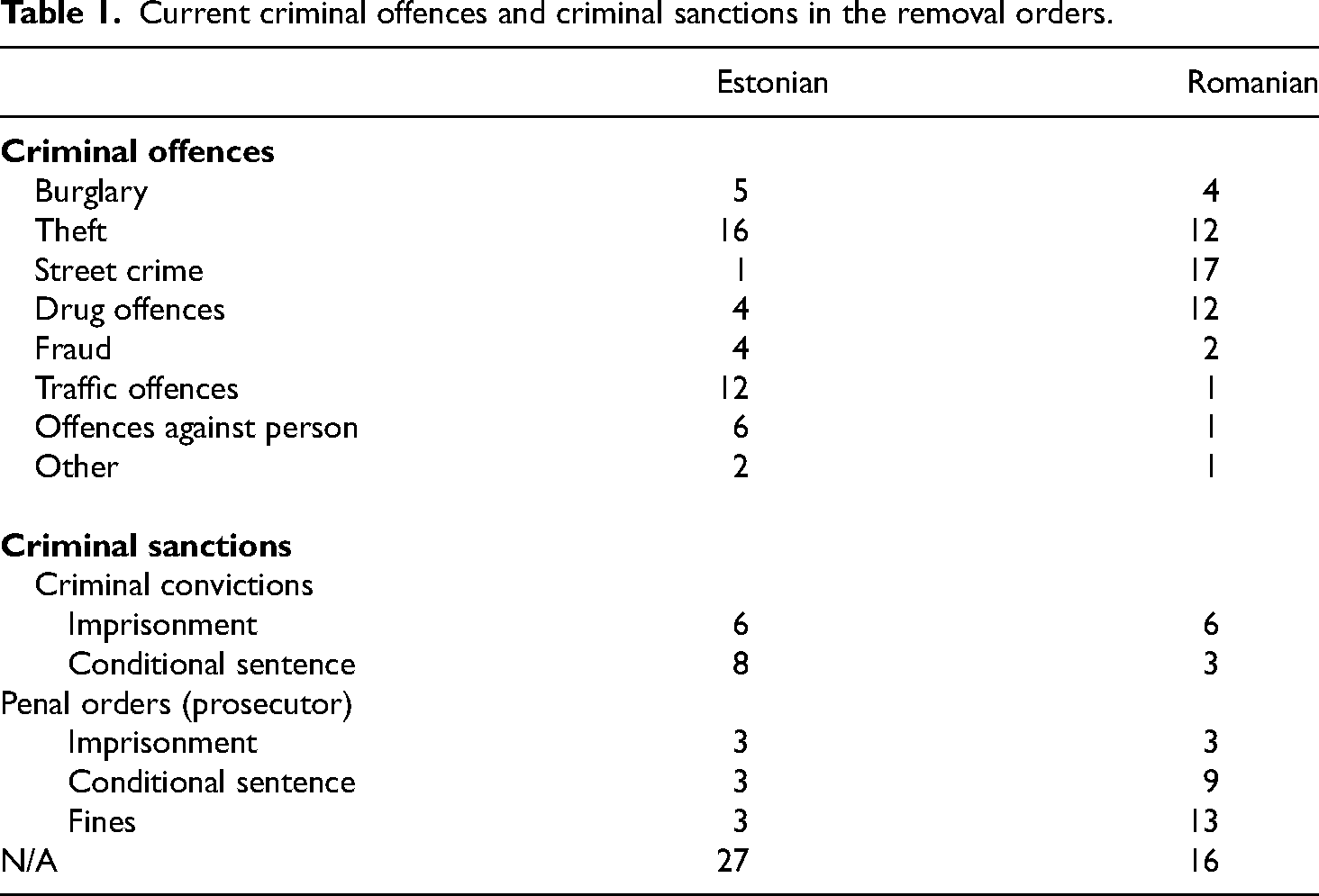
Notwithstanding that most Estonians had previous criminal sanctions or that many Romanians were charged with more than one offence, the threshold for removal orders was generally low: even a single attempted pickpocketing or theft in a department store punishable by fines resulted in a removal order and entry ban. While minor offences can cumulatively result in a removal order, half of the decisions (15 for Estonians and 35 for Romanians) did not include information on previous criminal offences in Finland. Although some decisions also mentioned fines for public order disturbance, the previous criminal sanctions for Romanians mainly consisted of single fines for shoplifting or traffic violations, which would not in themselves justify removal measures. Additionally, the data included removal orders for Romanians based on an identical offence or abetting street crimes without any consideration for the responsibility of the individual concerned. Curiously, a significant share of removal orders did not provide information on criminal sanctions. In total, only 12 removal orders included information on prison sentences and 11 on conditional sentences adjudicated by the criminal court, including also punishments for previous offences. One-third of the decisions involved summary penal orders by the prosecutor mainly accounting for pecuniary penalties or conditional sentences. 4 Despite pending criminal trials for non-custodial charges, the Finnish Immigration Service usually made the decisions in a few days, and sometimes even the same day as the issued police proposal. The fact that most removal orders were not based on criminal convictions involves significant risks for the legal protection of EU citizens. The removal process is not subject to judicial review, although EU citizens can make an appeal to the administrative court against removal orders. The short timeframes from decision making to implementation indicate the priority of removals of foreign offenders in an otherwise slow immigration bureaucracy.
The Finnish Immigration Service relies on police information in its issuance of removal orders, with the exception of investigation of residency and social ties, which is based on digital information systems and responses provided by individuals. While the analysed data covered mobile and assumingly temporarily residing EU citizens, many Estonians had employment and family ties in Finland as they had lived more or less permanently in the country even for 10 or more years. At least eight removal orders concerned Estonians whose registration application in Finland had been rejected several years earlier and three whose current registration process resulted in a removal order due to criminal offences. By contrast, almost all Romanians had been only temporarily in the country, although a few reported having family members in Finland and at least one was employed. The Citizens’ Rights Directive (Art. 27(2)) connects the proportionality principle with the level of social integration in the host society and acknowledges the serious harm of expulsion measures for ‘genuinely integrated’ persons. However, immigration officials did not take into consideration any unofficial residence periods, informal employment relations, or unregistered intimate relationships. Instead, the decisions included a standard phrase that ‘the person has not been registered in Finland nor possesses family or employment ties intended in the Alien Act’, regardless of their varying social situations. Some decisions for Estonians stated that their employment or family relations in Finland ‘has been taken into account in deciding on the length of the entry ban’, whereas other removal orders included the vague statement that ‘all relevant factors have been considered’, without any explication. While recognised social ties may shorten the entry ban, the decisions did not seem to generally involve the exercise of discretion in favour of EU citizens.
Irrespective of criminal sanctions and varying social situations, the removal orders included a national entry ban to Finland, which amounted to an additional administrative sanction for EU citizens. 5 The length of the entry ban – from 1 year to a maximum of 15 years for EU citizens – is supposed to reflect the severity of criminal offences and the threat to public and private security, based on the administrative scale set by immigration authorities themselves. According to the European Commission (2013: 9), entry bans for EU citizens ‘cannot automatically follow a criminal conviction’, and they can be imposed ‘only in grave cases where it is shown that the offender is likely to continue to be a serious threat to public order in the future’. However, all analysed removal orders included an entry ban, even if related only to minor suspected offences. 6 The average length of the entry ban was 3.6 years for Romanians and 4 years for Estonians. The bans ranged from 1 to 12 years and included extensions of existing bans for some Estonians based on new offences and immigration violations. The entry bans for Romanians based on minor thefts and street crimes, in particular, seemed excessive in many cases. Not surprisingly, 18 Estonians objected to removal and 22 objected to the issuance of the entry ban, due to family, employment, or other social ties to Finland. By contrast, only six Romanian citizens objected to the removal and entry ban, which was mainly based on their employment aspirations in Finland, whereas many others expressed their willingness to leave as soon as possible. Nevertheless, national entry bans impose long-lasting restrictions for EU citizens’ future aspirations and especially complicate the maintenance of employment, family and other social relations for those concerned (see Könönen, 2023a).
Producing ‘Dangerous’ Mobile EU Citizens
In contrast to criminal justice, where punishment is determined after the offence and the guilt of the offender is proven, administrative removal orders seeking to reduce and prevent harm to society inevitably involve predictions of an individual's conduct in the future. As several scholars have pointed out in reference to the CJEU decisions, the likelihood of reoffending is a key factor in the removal measures for EU citizens (Coutts, 2019; Mancano, 2018; Maslowski, 2015). Likewise, the Finnish Immigration Service (2019: 84) removal guide states that removal decisions need ‘to rely on predictions of the future conduct of the person concerned’: ‘An important factor in this assessment is the quality and number of convictions to date, with particular reference to the frequency of criminal behaviour’. However, the document mainly provides examples of court decisions concerning serious offences that have resulted in prison sentences of several years. While criminal records may suggest the propensity for reoffending, previous convictions are not sufficient grounds in themselves for a removal order. According to the European Commission (2013: 9), ‘In exceptional circumstances, persistent petty criminality may represent a threat to public order, despite the fact that any single crime/offence, taken individually, would be insufficient to represent a sufficiently serious threat’. While the Finnish Immigration Service (2019: 84) also states that ‘a single offense does not necessarily demonstrate sufficient threat’, in practice, immigration officials did issue removal orders based on a single offense without explicit justification in terms of a threat to public order and security.
While expulsion measures should be based exclusively on personal conduct, the removal orders for EU citizens entail a diagnosis of the dangerousness of the person beyond the actual violations of the law (Hurri, 2014: 8). The concluding overall assessment in the removal orders included some arguments concerning the person's level of threat, but they relied on abstract and unsubstantiated simplifications related to criminal offences or circumstantial factors. However, half of the removal orders for Romanians and 12 for Estonians lacked further justification, whereas 9 decisions repeated only that the harm caused to public and private security was considered. Likewise, several decisions only stated that the quality or frequency of criminal activities justified removal. In the case of serious offences such as burglary or fraud, the removal orders referred to the severity or planned nature of the criminal offence. Then again, planning was also invoked for minor thefts when instruments or tools were used. For Estonians who had previous offences and several violations of an entry ban, the decisions stated that the person had demonstrated (gross) indifference towards the laws and regulations of Finland. Fifteen decisions for Romanians and three for Estonians claimed that the main purpose of entry into Finland was to commit criminal activities, implying ‘hit and run’ crimes but including charges for shoplifting or street crimes, based on short residence times in Finland. Only the dangers related to drug offences were explicated in some cases with a standard formulation: ‘Illicit drug trafficking poses a threat to health, safety and the quality of life of citizens of the European Union, and to the legal economy, stability and security of the Member States’. 7 Many of the formulations employed resembled the description of aggravating circumstances which justify increasing punishments in the Finnish Criminal Code (VI Sec. 5), likely drawing on the police reports.
Regardless of the variety of situations, administrative decision-making practices produce removable EU citizens by postulating them as ‘criminal aliens’ and ‘dangerous individuals’ who have a propensity to continue criminal activities (see Coutts, 2019; Mancano, 2018; Mitsilegas, 2018). While the enumeration of previous minor offences or other indicators of dangerousness can be understood as legitimation work (see Borrelli and Lindberg, 2019) justifying removal measures, the removal orders brought forward a conception of EU citizens as recidivists by default, even when based on a single offence. Because criminal convictions do not provide sufficient grounds for removal, EU citizens are ultimately removed because of their potentialities. Similar to the idea of dangerous individuals in penal theories at the end of the 19th century, the assessment of immigration officials concerning foreign offenders takes place ‘not at the level of the actual violations of an actual law, but at the level of the behavioral potentialities’ (Foucault, 2000: 57). 8 Consequently, suspected minor offences among mobile and marginalised populations imply the presence of a dangerous element in society. Administrative risk analysis for the removal of EU citizens involves serious risks of racialized conceptions of ‘criminal aliens’. In particular, the police seem to be proactive in initiating the removal process for Romanians charged with street crimes and minor property offences without any prior criminal records, implying excessive and discriminatory policies towards disadvantaged groups (see Himanen, 2019). While justifications that are not related to the individual case or that arise from generalising considerations are not acceptable, in practice, the unsubstantiated and routine employment of public order and security grounds indicated generalising affiliation between social dangers and mobile EU citizens.
Due to the future-orientated rationale targeting potential risks or harms to society, removal orders imposed on seemingly dangerous individuals for the protection of public order and security are essentially preventive measures (Campesi, 2020; Coutts, 2019; Gundhus and Jansen, 2020). In contrast to criminal convictions, preventive measures interfering with the rights of individuals are applied based on their necessity to prevent assumed dangers before the threating act takes place. Furthermore, the proportionality consideration of preventive measures involves a different logic because their justification ultimately relies on the efficacy to reduce risks to the fundamental interests of the society, ‘irrespective of whether those measures are proportionate to any past or present conduct of the subject’ (Ashworth and Zedner, 2014: 18). While justified by the prevention of future criminal activities, the removal of EU citizens based on minor property offences or street crime seems a significantly disproportionate measure, considering the negligible threat to the society. Due to the low threshold for removals and the standard practice to impose entry bans, administrative removal practices constitute a serious risk to the fundamental rights of EU citizens.
Fabrication of Public Order and Security Grounds
Another key question in the removal of EU citizens is determining the level of threat to public order and security, as the Finnish government highlighted when incorporating the Citizens’ Rights Directive in the Finnish Alien Act (Council of State, 2006: 32). Despite its common usage in varying contexts, public order and security remains an empty concept in the Finnish legislation due to lack of any clear definition. The aforementioned government proposal linked public order and security to ‘the realization of important fundamental rights for citizens’ through the deportation of persons guilty of recurrent aggravated criminality without specifying the removal criteria in detail in the one paragraph devoted to the issue (Council of State, 2006: 32). 9 Instead, the document concluded that ‘Personal security and the protection of privacy and property require a pleasant and safe living environment’ (Council of State, 2006: 32). The other (eventually unimplemented) government proposal for prohibiting aggressive begging – explicitly targeting mobile EU citizens – provided an even more tautological description for public order and security: ‘The concepts of public order and security are interlinked because disorder creates insecurity’ (Council of State, 2010: 4). In turn, police documents directly link irregular migration with criminality, disorder, extremism and other threats to public order and security (National Police Board, 2017: 12). According to conceptions held by the police, an unidentified mobile population without permanent accommodation and social ties in the country presents a risk of engaging in criminal or other undesirable activities, thereby embodying in itself a threat to public order and security.
In a similar manner, the removal orders implied that mobile EU citizens charged with or convicted of criminal offences in themselves constitute a threat to public order and security. Irrespective of criminal charges and previous offences, the removal orders concluded with a standard three sentences involving tautological and circular argumentation between criminal offences and a threat to public order and security. First, the person was removed to their home country because they were considered a danger to public order and security; secondly, there were public order and security grounds for removal because of the quality (and frequency) of criminal activity; thirdly, the facts leading to a suspicion of criminal acts or a criminal conviction (and frequency of criminal activities) demonstrated an immediate threat to public order and security. An unsubstantiated and opaque concept of ‘quality of criminal offense’ was employed for all suspected offences, including minor property offences or street crimes. While more than half of the removal orders also invoked ‘frequency of criminal activity’ as an additional attribute for a threat to public order and security, they also included offences that had taken place years ago or only comprised two offences. Likewise, the removal orders did not explain how the facts leading to a suspicion demonstrated an immediate threat, or even what these facts actually were. Moreover, the phrase ‘fundamental interests of society’ from the Citizens’ Rights Directive was also explicitly connected to public order and security in the removal orders.
Removal orders linking public order and security grounds with rather ordinary criminal offences without any substantive justification reflect the police conception of illegal activities among foreign nationals as an immediate threat to public order and security, instead of the stronger legal guarantees against removal intended in EU law. Notwithstanding that drug and traffic offences have implications for public safety, and immigration violations are stipulated as offences against public order in the Finnish Criminal Code, most offences resulting in removal orders concerned private property that were rather exaggeratedly postulated as serious dangers for society. The reproduction of oft-exaggerated police views of mobile EU citizens as a threat to public order and security is not surprising, considering the prevalent security framework in immigration policies. Moreover, public order and security is a key concept both in social control and immigration enforcement, as it provides the police with a flexible justification to employ preventive coercive measures that interfere with the fundamental rights of individuals (see Neocleous, 2021; Fassin, 2013). In fact, in the Finnish Police Code (Sec. 1), maintaining public order and security precedes crime control among the tasks of the police. 10 In addition to crime prevention and control of urban space, public order and security is ‘the pervasive rationale’ of the entire immigration system (Hurri, 2014: 138). Public order and security grounds are commonly invoked to justify coercive measures in immigration enforcement – for example, in immigration detention (Könönen, 2022) and crime-related removals of third-country nationals (Könönen, 2023b) – even if the Finnish Alien Act does not mention it under the respective sections. In total, the Finnish Alien Act mentions public order and security 33 times in varying contexts, starting from the general grounds to deny entry or obtaining a residence permit.
Immigration enforcement measures enable the police to eradicate the disorder and insecurity epitomised by mobile EU citizens, eliminating the possibility of criminal activity at least temporarily – regardless of whether they might or might not commit future offences. In addition to being proactive in initiating the removal process, the police remove foreign offenders in an expedited process from the country to prevent further threats to public order and security. Due to the bilateral readmission agreements with Estonia and Romania, removals of EU citizens from Finland can be implemented without complicated logistical and administrative arrangements in a short timeframe. In fact, most removals of EU citizens from Finland are implemented with ferries, representing rather different imaginaries of deportations than escorted forced removals by plane. In particular, many Romanians expressed their willingness to cooperate with a quick removal, likely owing to their lack of social ties in Finland and the opportunities to travel elsewhere in Europe. EU citizens also can depart to another EU Member State, provided that they cover the travel costs by themselves: many Romanians preferred to leave for Sweden or Estonia, as some had arrived in Finland by car. Entry bans connected to removal orders form a part of the prevention of future threats to public order and security, aiming to deter the return of unwanted or ‘dangerous individuals’ after removal. Although national entry bans are not particularly effective measures to prevent mobility in the absence of internal border controls between the Schengen states, they cause significant problems for EU citizens by rendering them irregular migrants, if returning. Indeed, many Estonians have been detained and removed from Finland more than 10 times, as they can return quickly due to frequent and affordable ferry connections (Könönen, 2023a).
Conclusions
Despite the legal protections stipulated in the Citizens’ Right Directive, Finnish immigration officials routinely invoked a threat to public order and security to justify the removal orders for EU citizens charged mainly with property offences, relying on police information. Notwithstanding lengthy criminal records among many Estonians, most removal orders for Romanians were based on rather petty offences without any previous criminal history in Finland, implying harsh if not discriminatory practices. Indeed, the threshold for removal orders was remarkably low, and it might well be that even lesser offences have resulted in removal due to possible gaps in the data. In practice, removal orders for EU citizens can be issued based on suspected offences: only a minority of the analysed decisions involved criminal convictions. In contrast to mobile Romanian citizens, many Estonians had lived more or less permanently in Finland for years, due to their employment or family relations. Contrary to the EU guidelines, the removal orders included a national entry ban to Finland as a seemingly standard measure. Overall, the removal orders involved circular argumentation between criminal offences and a threat to public order and security, framing EU citizens as ‘dangerous individuals’ likely to continue criminal activities, even based on a single offence. Consequently, removal orders including entry bans are ultimately preventive measures that target potential future offences. In the absence of clear criteria in the EU or national law and the lack of judicial supervision of removal measures, it is the police and immigration officials who determine what accounts for a threat to public order and security.
Despite public order and security grounds aiming to provide a higher threshold than criminal convictions for the removal of EU citizens, in practice rather ordinary suspected offences entail the removal grounds for EU citizens being even less than criminal convictions. Due to the lack of a clear definition, (a threat to) public order and security remains an empty concept that enables different policies towards EU citizens. Considering the key role of the police in both crime control and immigration enforcement, it is not surprising that the public order and security grounds required for the removal of EU citizens are associated with rather mundane criminal offences. In addition to serious threats affecting the fundamental interests of society, public order and security designates a police paradigm that justifies the use of preventive coercive measures and interference with individuals’ freedoms in everyday police work and immigration enforcement (see Garland, 2002; Fassin, 2013; Neocleous, 2021). While the CJEU has played a significant role in defining ‘the European individual’ (Hurri, 2014), administrative street-level practices producing ‘dangerous individuals’ directly shape the rights of EU citizens in a far-reaching manner. Indeed, mobile EU citizens are not treated as legal subjects entitled to criminal justice protections, as removal orders can be issued and enforced without criminal convictions or judicial review. Broad jurisdiction among the police and the routine employment of coercive preventive measures in the name of public order and security not only endanger the rights of individual EU citizens but in themselves pose a threat to the core democratic values of justice and equality.
Removals of EU citizens have significant implications for the European legal order and the whole of EU citizenship: after all, deportations are technologies of citizenship that reaffirm the boundaries of membership in the community (Walters, 2002). Despite the stronger protection against removal for registered EU citizens, the use of minor property and drug offences as grounds for the removal of mobile EU citizens make them comparable to privileged third-country nationals exempt from visa requirements, rather than citizens in the host society (see Könönen, 2023b; Chelbny, 2018). Moreover, national entry bans accompanying removal orders extend the duration of expulsion measures for years and also render EU citizens irregular migrants subject to repeated removals and detentions (Könönen, 2023a). Expulsion measures targeting predominately precarious and mobile citizens from Romania, Bulgaria and Poland, in particular, reproduce racial and class hierarchies inside the European Union, despite the formal integration of Eastern European Member States (Vrăbiescu, 2021). The removal of EU citizens also complicates analyses of the European deportation regimes (see, e.g. Brandariz and Fernández-Bessa, 2020), as well as the predominant imaginaries of deportations as forced removals. While excluded from the EU migration statistics, the number of removals of EU citizens can be considerably high because of the rather uncomplicated removal logistics via commercial transport connections or transfers to border-crossing sites (Klajn, 2021). Considering the rather low threshold for removal on public order and security grounds, the right to depart to other Member States remains a privilege of EU citizenship for criminalised individuals: consequently, ‘freedom of deportation’ constitutes a complementary yet perverse form of freedom of movement.
Footnotes
Acknowledgements
The author would like to thank José A Brandariz, Valeria Ferraris, and the anonymous reviewers for their valuable comments on the manuscript.
Declaration of Conflicting Interest
The author declared no potential conflicts of interest with respect to the research, authorship, and/or publication of this article.
Funding
The author disclosed receipt of the following financial support for the research, authorship, and/or publication of this article: This work was supported by the Academy of Finland (grant number 323149).
