




Abstract
Truth is a central concept in the struggle for justice for Syrians. Many justice actors have turned to the tools and rhetoric of transitional justice to further the quest for justice and truth. Yet, while doing so has allowed them to generate some international attention for victims, the transitional justice paradigm has several pitfalls. For one, the dominant understanding of truth and truth-seeking embraced in formal mechanisms tends to be narrowly defined as forensic truth. We argue on the basis of interviews with Syrian justice actors and artists that informal, including artistic, practices can entail a thicker understanding of truth. They have the potential to disrupt several shortcomings of forensic understanding of truth and formal practices. They can ‘presence’ experiences of harm, accommodate multivocal truths, and enable epistemic resistance. Therefore, we consider how transitional justice as a field of scholarship and practice could better engage with truth-seeking in inconclusive contexts where formal truth mechanisms may be unavailable.
Introduction
When Syrians took to the streets in 2011, their aim was to usher in a new polity. A decade later the likelihood thereof seems more distant than ever as the Assad regime tightened its grip through the ruthless repression of the protest movement. Despite the regime being the main perpetrator of atrocity crimes, the transformation of the conflict and the emergence of the (so-called) Islamic State in Iraq and Syria (ISIS) have deflected international attention from the regime's violence. This, in combination with the international stalemate and the primacy of feasibility politics, has entailed a gradual international acquiescence of the Assad regime.
Against this background, Syrian and international justice actors, by whom we mean both civil society -including victim organisations- and institutional stakeholders, are pursuing opportunities to seek justice and accountability for, and recognition of this violence. Some of these justice actors have – sometimes pragmatically – embraced transitional justice as a paradigm that could further their struggle, given its versatility and its promise of initiating justice processes and disrupting cycles of violence. Despite the absence of a transition and the prevailing international passivity, these justice actors argue, transitional justice initiatives could provide some modicum of justice. For this reason, they have invested in innovative documentation efforts, criminal justice proceedings, and, crucially, truth-seeking initiatives such as a campaign to set up a mechanism for the missing and disappeared. Artistic practices, e.g., in the domain of cinema, literature and visual arts, have also engaged with the notion of truth. As informal truth-seeking initiatives take place in a non-standardized transitional justice setting in which civil society actors rather than formal stakeholders are mostly at the forefront, they have displayed much higher levels of multi-vocality and disruption, both in terms of processes adopted and in terms of the understanding of truth being promoted. The way these initiatives and artistic practices engage with and renegotiate the core concepts of the transitional justice field have to date been under-researched.
This article sets out from the normative position that justice processes generally, and truth-seeking specifically, must seek to accommodate the complex, volatile and multi-layered experiences of victims, which entails foregrounding their needs, expectations and epistemologies. First and foremost, we attempt to recast how truth is commonly understood in formal settings such as courts, truth commissions and institutional efforts (such as the work of UN bodies), that adopt a forensic understanding of truth. We use the notion of informal truth practices to refer civil society initiatives aimed at unearthing experiences of harm (such as the work of CSOs or artistic practices). While these informal practices might be very different from formal truth-seeking efforts, they are crucial in contexts where standardized mechanisms are unavailable and because they recast what is understood as truth. Based on empirical research (see below) we will argue that these truth-seeking initiatives have the potential to disrupt some shortcomings of forensic understandings of truth and formal practices, in the sense that they can ‘presence’ victims’ experiences, accommodate multivocal truths, and provide avenues for epistemic resistance. This paper charts the experimental nature of these projects as well as their interaction with more institutionalized processes.
The article is structured in four sections. First we shed light on the aptness of the transitional justice paradigm, exploring how and why justice actors adopted it in this aparadigmatic context. In the subsequent method section, we elucidate the theoretical framework and the methodology underlying the empirical research. We then address the aforementioned gap on how transitional justice's expansion to cases of ongoing violence affects the prevailing understanding of certain inherently contested concepts such as truth-seeking. Concretely, we complement formal understandings of truth with a discussion on informal truth practices. Finally, drawing on our empirical research, we apply the conceptual discussion to the Syrian context to demonstrate how artistic practices within the domain of cinema and literature may accommodate thicker understandings of truth.
Context
Syria is not a textbook case of transitional justice. It is part of a recent trend whereby transitional justice is increasingly used in cases where there has not been a formal political transition (Herremans and Destrooper, 2021). Despite the absence of a ‘transitional moment’, the discourse and normativity of transitional justice are regularly called upon in these cases because justice actors appropriate and promote transitional justice as toolkit that is sufficiently comprehensive and versatile to initiate a range of justice processes. This expansion has prompted developments along two parallel tracks: a process of standardization commencing in the 1990s and entailing the crystallization and dissemination of a transitional justice ‘model’ and a process of diversification of practice that can be understood as a reaction to the former, based on an understanding that standardized approaches need to be contextualized to become locally relevant, especially in aparadigmatic cases (Robins, 2012). As we will demonstrate, this can be observed in the Syrian context where the standardized notion of truth-seeking has been foregrounded, but in a highly innovative way. Justice actors’ choice to turn to transitional justice can be understood in light of the defeatism around pursuing justice or disrupting violence while conflict is ongoing.
To understand the context in which these transitional justice initiatives were developed, the 2011 uprising and its transformation need to be outlined. Inspired by the contemporaneous Arab revolutions, Syrian protesters massively took to the streets as of March 2011 to contest the authoritarian regime that used (threats of) violence to force its citizens into silence (Majed, 2018). An often overlooked driver of the uprising was the memory of the 1982 Hama massacre, the nadir of a period of unrest culminating in the killing of an estimated 10,000 to 20,000 people by the regime (Conduit, 2017). This memory was a driver of resistance, as well as a warning about the regime's willingness to resort to annihilation policies to suppress such resistance (Ismail, 2018; Hinnebusch, 2012). The repression of the 2011 uprising brought about a civil war involving a myriad of perpetrators that committed almost every imaginable international crime (Kaleck and Kroker, 2018). This has resulted in the death of over half a million people, over 100 000 forcible disappearances, and massive displacement. Nonetheless, the regime has stayed in power because of the international stalemate over the conflict's resolution, Russia's military intervention, the opposition's radicalization and the international prioritization of the fight against ISIS. In addition to this international stalemate, Syrian dissidents and justice actors are facing a regime engaged in narrative warfare and disinformation campaigns over the narration of the conflict and the evidence of atrocity crimes (Wedeen, 2019, 79). In this context of regime persistence and dwindling international commitment to pursue justice, many Syrian civil society organizations (CSOs) – holding on to the legacy of dissent and resistance –continue to seek change (cooke, 2016).
A divergent group of Syrian and international stakeholders (such as CSOs, NGOs and human rights activists) have framed many of these initiatives as transitional justice. This framing was also adopted early on by several governments and international institutions in the Global North. This was rooted in the assumption of a swift political transition (Haugbolle, 2019), planting the seeds for an organically emerging transnational movement of Syrian and international justice actors experimenting with elements of a classic transitional justice programme (Sawah, 2020; Nassar, 2014). A diverse group of justice actors continued to rely on elements from the transitional justice toolkit even as the non-transitioning scenario materialized and the initial transitional justice programme fell apart (Stokke and Wiebelhaus-Brahm, 2019). Syrian civil society groups – largely located in the diaspora – blended standardized and non-standardized transitional justice initiatives in an effort to address the dramatic accountability gap in the absence of effective multilateral initiatives. They prioritized efforts in the domain of documentation, criminal accountability and truth-seeking, mostly in cooperation with international groups. These justice efforts went along with the establishment of two formal United Nations entities: the Independent International Commission of Inquiry on Syria (CoI) and the International Impartial and Independent Mechanism to Assist in the Investigation and Prosecution of Those Responsible for the Most Serious Crimes under International Law Committed in Syria since March 2011 (IIIM).
The way in which Syrian and international justice actors continue to apply the transitional justice paradigm demonstrates its disruptive and innovative potential in ongoing conflict. While initially referenced for pragmatic reasons – i.e., the lack of formal avenues such as the ICC – this engagement with transitional justice can also be read as a successful attempt to advance possibilities within and beyond formal justice avenues, thus ‘opening up the justice imagination’ (Herremans and Destrooper, 2021). Particularly striking is how Syrian justice actors adopted an ecosystemic approach (Evrard et al., 2021), in which victim participation in transitional justice processes is not delimited by particular formats, spaces or moments. Rather, victims strategically choose to work across claimed and invited spaces. Their choices within these ecologies include claiming a presence in formal institutions such as the IIIM while simultaneously creating informal spaces. In doing so, they challenge the widespread idea that formal spaces are the most apt to generate justice initiatives and they reverse the hierarchy of knowledge and power where ‘the local’ is situated at the bottom (Shaw and Waldorf, 2010). This dynamism, in conjunction with targeted international efforts, has reinvigorated the struggle for justice in three fundamental ways. First, both institutional (IIIM and CoI) and civil society actors have successfully invested in the documentation of crimes for purposes such as criminal accountability. These efforts have been primordial in substantiating, for example, prosecutions under the principle of universal jurisdiction in European countries. While these cases are important to dent the wall of impunity, documentation efforts transcend the importance of criminal proceedings, and also constitute a form of resistance against various forms of epistemic violence. Second, criminal proceedings are important beyond their contribution to criminal accountability: they decisively put certain crimes, such as sexual and gender-based violence and forced disappearances, higher on the public radar. Third, the rapid development of a victim movement has demonstrated a prodigious capacity by victim groups to advance – their own participation in – justice processes, as reflected by the Truth and Justice Charter that five victim groups launched in 2021 (Herremans and Bellintani, forthcoming). 1
Method
While the development of general (transitional) justice initiatives in the Syrian context has recently attracted scholarly attention (Tenove, 2019; Van Schaack, 2020; Nassar and Rangelov, 2020; Burgis-Kasthala, 2021), the potential of informal practices to advance justice in general in the Syrian context, and truth-seeking in particular, has not garnered much scholarly attention (Nassar, 2022). For one, the way in which Syrian justice actors adopted standard transitional justice approaches has contributed to the expansion and disruption of the field and generated innovative practices. Moreover, the added value of artistic practices in opening up the justice imagination for Syrians, needs to be further explored. As such, this article can also be read as an attempt to bring these informal (and specifically artistic) practices more firmly to the centre of the debate about justice initiatives, and to explore the relationship between formal and informal truth practices, and factual and thicker understandings of truth. In doing so, we are inspired by Kieran McEvoy's illustration of the notion of ‘thick’ approaches to the law, which he defines as being rooted in lived experiences and reflecting stakeholders’ perspectives and power relations that inform their thinking, in contrast to a ‘thin’ focus on formal, legalistic aspects. We reiterate McEvoy's call for a greater willingness to give space to other forms of practice and knowledge which are not necessarily grounded in familiar understandings of law and justice. With regard to truth, this would result in a thicker understanding which could provide a corrective to the standardized truth paradigm and allow for plural and more diverse understandings. 2 Thus, we connect dominant understandings of truth practices – a conceptual exercise – with empirical research on more informal and imaginative truth and justice efforts in the Syrian context. In order to do so, we combine inductive and deductive approaches by iteratively developing a theoretical framework on the basis of scholarly research on truth-seeking in transitional justice as well as actual informal practices.
The empirical research is part of a broader project that examines how narrative artistic expressions can open up the justice imagination, what is imaginable in terms of justice for Syrians, within and beyond formal avenues. For the purpose of this article, we rely on 32 semi-structured interviews conducted between November 2020 and October 2021. First, we identified potential respondents through purposive sampling, selecting respondents in both the civil society and artistic realm engaging with justice related issues. Second, we applied snowball sampling. The subset of interviews related to justice efforts was conducted with 10 representatives of Syrian NGOs and victim organizations. The topic list covers developments with regard to the application and the relevance of transitional justice, formal justice avenues, the potential of truth-seeking and the emergence of victim groups. The subset related to artistic practices is comprised of interviews with 13 Syrian writers and 9 Syrian filmmakers who broach experiences of harm in a range of literary and cinematic responses. The topic lists centre around artists’ intentions, evolutions since 2011, the representation of harm, the nexus between arts and justice and the instrumentalization of arts. The interviews were audio recorded, when needed translated from Arabic and French to English, and transcribed, in order to thematically code and analyze the data. We have applied grounded theory coding, doing an initial open coding and then proceeding to axial coding to discern patterns and to derive the main concepts. For the purpose of this article, we have concentrated on the data related truth-seeking. This research follows the ethics protocols developed iteratively and in a participatory way for the project ‘Righting Victim Participation in Transitional Justice’, which are approved by the ethics committee of Ghent University and European Research Council.
Upon conducting the interviews, we were faced with a number of ethical issues. Firstly, while most Syrian justice actors and artists in the diaspora no longer face the acute danger of persecution, they are marked by experiences of harm. We chose not to address those experiences, as they are not the object of our research. Secondly, the commodification of the arts has confronted many respondents with the prioritization of the informative function of their art over its aesthetic qualities. Thirdly, and relatedly, many artists struggle with the question of how to address experiences of harm when these are eclipsed in prevalent narratives. We observed how narrative warfare and the strong focus on the crimes of ISIS impairs artists’ endeavours. Fourthly, the representation of lived experiences is challenging. There is an acknowledgement among interviewed artists that the balance between attempting to represent injustices truthfully and abstaining from instrumentalizing harm is a delicate one. In the context of image-making this has proven to be problematic, because of the exploitation of image-makers, the property rights of images, the exploitative structure of film industries and the circulation of gory images (Della Ratta, 2018, 247; Lenssen, 2020).
In this article we do not claim to offer a comprehensive study of justice processes in the Syrian context, nor a philosophical treatise on the nature of truth. Instead, we engage in a practice-based conceptual exploration of how and whether elements from these various formal and informal truth practices could enrich the prevailing understanding of the possibilities of truth-seeking in a non-transitional context. Our argument is that even if forensic truth continues to be a lynchpin in the struggle for justice in the Syrian context, informal truth practices have the potential of offering a more contextualized understanding of truth that better resonates with and ‘presences’ victims’ lived realities.
Truth in (the Absence of) Transition
In this section, we examine informal processes in the domain of truth, which constitutes one of the four main pillars of transitional justice and which is seen as a crucial factor in providing accountability, justice and/or reconciliation (Hayner, 2011). We build on studies that highlight the continued importance of forensic truth and formal truth mechanisms, and complement them with a discussion on informal truth practices and how these push the debate in the direction of acknowledging thicker understandings of truth.
Standardized Transitional Justice and a Thicker Understanding of Truth
In standardized processes, the notion of forensic truth quickly came to dominate most formal transitional justice mechanisms. The forensic truth paradigm emerged in a specific organizational context in the 1990s, in which the field of transitional justice evolved in the direction of more legalization. As McEvoy (2007) argues, transitional justice has become dominated by a narrow legalistic lens, resulting mainly from the tendency to see justice delivery as quintessentially the business of state or ‘state-like’ institutions, disconnecting individuals and communities from any sense of sovereignty over transitional justice processes. This legalism was defined by Judith Shklar as a process which separates legal analysis from politics and other social science disciplines, isolating law from the social context within which it exists and prioritizing formal conceptions of the law (1966). Separating law radically from morals and politics is a choice, she argued, and not an epistemic inevitability (Benhahib and Linden-Retek, 2021). This tendency towards legalism in transitional justice has manifested itself in a ‘prosecutorial preference’, i.e., the prioritization of criminal justice (Obel Hansen, 2017), the dominance of legal scholars and practitioners in the field (Fletcher and Weinstein, 2017), and the prevalence of large institutionalized mechanisms underpinned by the familiar legal or forensic approaches of bringing to light factual, corroborated evidence, and of obtaining accurate information through reliable (impartial, objective) procedures (Fournet, 2020). This legalism thus affected the mainstream understanding of truth in transitional justice, meaning that even if truth is arguably the element undergirding all other transitional justice processes, the narrow understanding of forensic truth became prevalent in these legal approaches (Rowen, 2017).
This forensic truth paradigm privileges official documents and data that provide crucial facts about what happened (Wilson, 2016). These sources of information are usually perceived as superior to, and more reliable than, for example, victims’ stories or testimonies. The logic of forensic truth is linear and straightforward: as consequence of revealing these facts, the ‘disinformation about the past that had been accepted as truth by some members of society [loses] much of its credibility’ (SATRC, 1998, 112). The promises of stability and predictability projected by this notion of forensic truth means that it easily fits the logic of standardized transitional justice, which is premised on linear cause-effect assumptions and privileges certain kinds of actors (such as institutional stakeholders) as knowers, invisibilizing others as a result (McAuliffe, 2017; Herremans and Destrooper, 2021). This means that a narrow understanding of the relationship between truth and justice, exclusively rooted in forensic truth, is potentially problematic.
Within standardized truth mechanisms there has been an acknowledgement of the need to allow for more diverse forms of truth. Initially, truth-seeking was seen as an innovative way to redress mass violence. Gradually it became an increasingly important dimension of transitional justice programmes, leading to a proliferation of commissions of inquiry, historical clarification commissions, and truth commissions (Destrooper et al., forthcoming). These commissions played an important role in marking a break with the past (Bevernage, 2011) and hold the potential of moving ‘beyond legalism’ (Lawther and Moffett, 2017, 2). In practice, however, truth commissions have often embraced narrow understandings of violence and truth (Rowen, 2017, 3). When commissions provide options to victims to engage in truth-telling, this might give them more visibility and the possibility of presenting a narrative that could contribute to thicker understandings of truth. Yet, the format and procedures of a truth commission are often ill-equipped to capture complex and multi-dimensional victims’ narratives (Wouters, 2021).
The South African Truth and Reconciliation Commission (SATRC), for example, to some extent constitutes an exception to this, as it explicitly conceptualized truth along four axes, complementing forensic truth with ‘personal or narrative truth’, ‘social or dialogical truth’ and ‘healing and restorative’ truth’ (SATRC, 1998, 30). What these notions of truth have in common is that they do not represent or cannot be reduced to a ‘final point’ (Bevernage, 2011, 48). They accommodate the idea that truth ‘implies objective credibility but also requires subjective understanding’ (Naqvi, 2006, 272). However, in spite of this work done by the SATRC, many formal truth-seeking mechanisms continue to foreground forensic truth. The next section discusses how informal truth practices could help to move the debate beyond this and propose a thicker understanding of truth that is plural, dynamic and positioned (Ainslie, 2016).
Informal Truth Practices’ Contributions to a Thicker Understanding of Truth
In this section, we address the nature of informal truth initiatives, and we zoom in specifically on the potential of artistic practices to complement our understanding of truth. We approach artistic practices as a specific kind of informal truth praxis, while insisting on the autonomy of arts and shying away from instrumentalization. We posit that truth practices with different epistemic underpinnings can offer useful insights by ‘presencing’ experiences, stimulating multivocal thruths and generating epistemic resistance.
Before theorizing how artistic practices can contribute to truth-seeking, we want to unpack our understanding of informal practices. We refer to informal truth practices as any form of truth-seeking and -telling that is not initiated by formal institutional actors, and thus not shaped by the constraints of formal institutions. These include initiatives by NGOs, religious organizations, academic institutions, international collectives using new technologies to unearth forensic truths, community initiatives in local languages and artistic practices engaging with the notion of truth. As Fuller and Weizman (2021, 17) argue, these practices expand ‘the sites of truth telling – from the courtroom, the university and the newspaper, to the gallery, street corner and Internet forum’. This diverse set of truth practices can either be stand-alone and fill a vacuum where a lack of resources or political will hampers the establishment or functioning of formal truth mechanisms, or they can serve as the basis for further investigation, or follow or complement a formal truth project that is deemed insufficient or inappropriate (Bickford et al., 2009).
We want to emphasize that informal truth practices are claimed spaces that enable victims to share their experiences and be involved in agenda-setting. As such, they are paramount for victims in the pursuit of recognition and accountability (Hayner, 2011, 5), and should become more central in the analysis of victim-centered justice efforts. Informal initiatives can also function as rehearsal space, and prepare victims and their families to share their stories publicly. During the operation of a formal truth mechanism, these practices can constitute complementary spaces for those for whom participation in the formal mechanism is difficult or not deemed the most relevant strategy, or for surfacing other kinds of stories that are not easily heard in formal spaces. These informal truth practices, both in civil society and the artistic domain, start from lived experiences. This is in line with the aforementioned actor-oriented and ecosystemic framework that Evrard et al. (2021) have conceptualized. As we will demonstrate below, these practices recast how we understand truth as well as how and where we set out to find it: in the case of artistic practices by soliciting the imagination and by proposing a more open-ended approach of truth and justice (Herremans and Destrooper, 2021).
First, artistic practices can ‘presence’ that which was previously neglected or invisible, articulate absences, and draw attention to suffering caused by invisibility (de Greiff, 2014). Artistic practices may afford one to enlarge one's perspective, explore past and ongoing violence from underrepresented points of view, communicate complex messages through visual and symbolic means, circumvent linguistic barriers, and, accordingly, contribute to a space for recognition, and to the development of a sense of solidarity with and empathy for marginalized groups (Breslin, 2017, 276). In doing so, artistic truth practices can foreground as well as acknowledge multiple layers of meaning in victims’ stories, and surface unheard voices and perspectives. This is important for present as well as for future efforts, allowing the development of a narrative memory and aspiring to forbid forgetting (Abbas, 2009).
Second, and related to this, beyond the ‘presencing’ of these complex realities, when artistic practices engage with the notion of truth, they facilitate contestation and invite doubt about how we think about reality on the basis of victims’ lived experiences (Dirnstorfer and Saud, 2020). Because of their potential of accommodating opacity, ambiguity, instability and indeterminacy (Cole, 2014, 315), artistic practices can help to acknowledge the limits of the justice that official mechanisms can deliver and of the truths proposed in them (Breslin, 2017, 269), opening up a space where different and sometimes contradictory truths rooted in peoples’ lived realities can be expressed and explored. Arts can entertain the existence of multiple truths, including those often silenced in the public arena. As Buikema (2012) puts it, ‘it is precisely art's dialogicity, materiality and medium specificity that enables [it] to tentatively perform contested truths and contain intricate complexities.’ This happens, for example, when writers solicit the imagination to give meaning to facts about injustices, or to create an intense awareness of them that cannot be transmitted through mere factual reporting (Gordimer, 2008). This tactic of calling upon imagination to describe largely unfathomable experiences is what Stacey Vorster refers to as ‘truer than truth’, pointing to a level of understanding that supersedes simply knowing the details of what happened. The implication is that, when dealing with matters that escape human understanding such as war-related violence, facts may be less helpful than the opportunity to experience these facts in their complexity as they are also experienced by those experiencing the harm (Vorster, 2019). As such, we see the potential of artistic practices to ‘evoke ambivalence, contradiction and paradox’ on the basis of lived experience as fundamental. Moreover when the value and complementarity of these perspectives is better understood and acknowledged, they can contribute to forensic truth and formal practices (Vorster, 2018).
Third, because of this potential of reflecting experiences of harm in ways that better represent lived realities, artistic practices – and informal truth initiatives more generally – can challenge epistemic kinds of injustice. For one, they can open up a space for what José Medina describes as epistemic resistance, ‘the use of our epistemic resources and abilities to undermine and change oppressive normative structures and the complacent cognitive-affective functioning that sustains those structures’ (2018, 3). Moreover, they can recast who is a knower as formal truth mechanisms are often pinned on a narrow conception of who is an expert and what kind of knowledge is considered relevant and reliable (Mihai, 2018). This conception is based on a specific and narrow episteme, lexicon or style figures, that are not equally available to all stakeholders, meaning that certain issues and actors are erased from the conversation. When people pre-emptively silence themselves because they assume that their testimonies will not be perceived as credible within the reigning truth paradigm, or when they find it hard to mould their experiences into that paradigm, victims’ experiences and knowledge remain absent from the debate. This results in practical harm as well as epistemic violence and may undermine the emergence of certain kinds of knowledge about victims’ realities (Giles, 2019; Fricker, 2007). Informal truth practices can play the role of sites of contestation and disruption that upset notions of who is commonly acknowledged as a knower and redefine where knowledge is produced. This, in turn, may open up the horizon of what is imaginable in terms of truth-telling, truth-seeking and justice activism more generally, beyond dominant paradigms.
These three contributions of artistic practices to truth-seeking are obviously intricately related to one another, as the next section will further demonstrate. In our analysis, we do not propose informal truth practices as alternatives to formal ones: forensic truth continues to be a crucial component of justice processes.
Truth Practices in the Struggle for Justice for Syrians
In this section we rely on interviews to apply the conceptual discussion above to the Syrian context. Combining elements from inductive and deductive analysis, we have organized the analysis of the empirical material around the three elements discussed in the theoretical section above. Concretely in this section, we examine how artistic practices a) ‘presence’ experiences of harm, thus countering erasure, b) foreground multivocal truths on the basis of lived experiences and c) offer avenues for epistemic resistance. While artistic truth practices can be identified in all artistic domains, we focus on cinema and literature, drawing on our empirical work on how narrative artistic practices open up the justice imagination. Before presenting the main findings from our interviews, we address the increase of informal truth practices in this ongoing conflict, zooming in on the work of Syrian justice actors.
The Growing Importance of Informal Truth Practices
In the Syrian context various kinds of truth practices are developing against the background of the deadlock in the formal justice architecture. The IIIM as a criminal-law oriented, quasi-prosecutorial UN body is the most important formal venue for truth-seeking, contributing strongly to forensic truth through preserving evidence, and facilitating criminal proceedings (Devereux, 2019). Interviews with Syrian justice actors showed that while they put forensic truth and formal truth mechanisms high on their agenda, they also see the value of informal truth practices existing in their own right, and potentially complementing forensic truth practices (al-Hallaq, 2021; al-Haj Saleh, 2021; Mahmoud, 2021). As we will argue, the climate of growing uncertainty over crimes -despite the accumulation of evidence- and the international defeatism about remedying the extensive victimization in the Syrian context were important drivers for justice actors. The turn to informal practices could be seen as a form of pragmatism inspired by the political stalemate and the need to narrate experiences of violence, rather than as a conscious choice to allow for more multivocality, generate dissensus, foster contestation or disrupt. Yet, in practice, those are some of the outcomes of these civil society led efforts, as we will show in the remainder of this section. We posit that a contextual and functional analysis can shed light on how these informal truth practices, that foreground complex and multi-vocal truths without offering definitive answers, can be meaningful to keep victims and their needs on the political agenda.
Our empirical work shows that as a response to the justice impasse, Syrian CSOs developed a wide variety of informal truth practices often involving artists (Kiki, 2021). Firstly, these emerged from the need for human testimony to prevent the obfuscation of experiences of harm, as happened in past injustices such as the Hama massacre (Darwish 2020, Nassar, 2021; Serriyeh, 2021). One of the most striking examples is the Freedom Bus, which displays over 200 pictures of missing Syrians. 3 Secondly, these initiatives can be a meaningful complementary approach in the run up to or the orbit of a formal mechanism. This was clear in the context of the universal jurisdiction al-Khatib trial- the first criminal case worldwide on Syrian state torture that took place in Germany between April 2020 and January 2022 - in Germany, where CSOs and artists have creatively raised awareness about the fate of the disappeared (Al Abdeh, 2020) (see Figure 1). Thirdly, they can introduce new initiatives based on victims’ experiences and needs, thus opening up the justice imagination. The aforementioned Truth and Justice Charter (ADMSP et al., 2021) proposes a cumulative approach to address the most urgent justice needs such as determining the fate of the forcibly disappeared and missing (Helmi, 2021). In August 2022, the UN Secretary General recommended to set up a body to determine the fate of the disappeared and the missing in Syria, which is a direct outcome of victims groups’ efforts to establish a mechanism (UN SG, 2022).
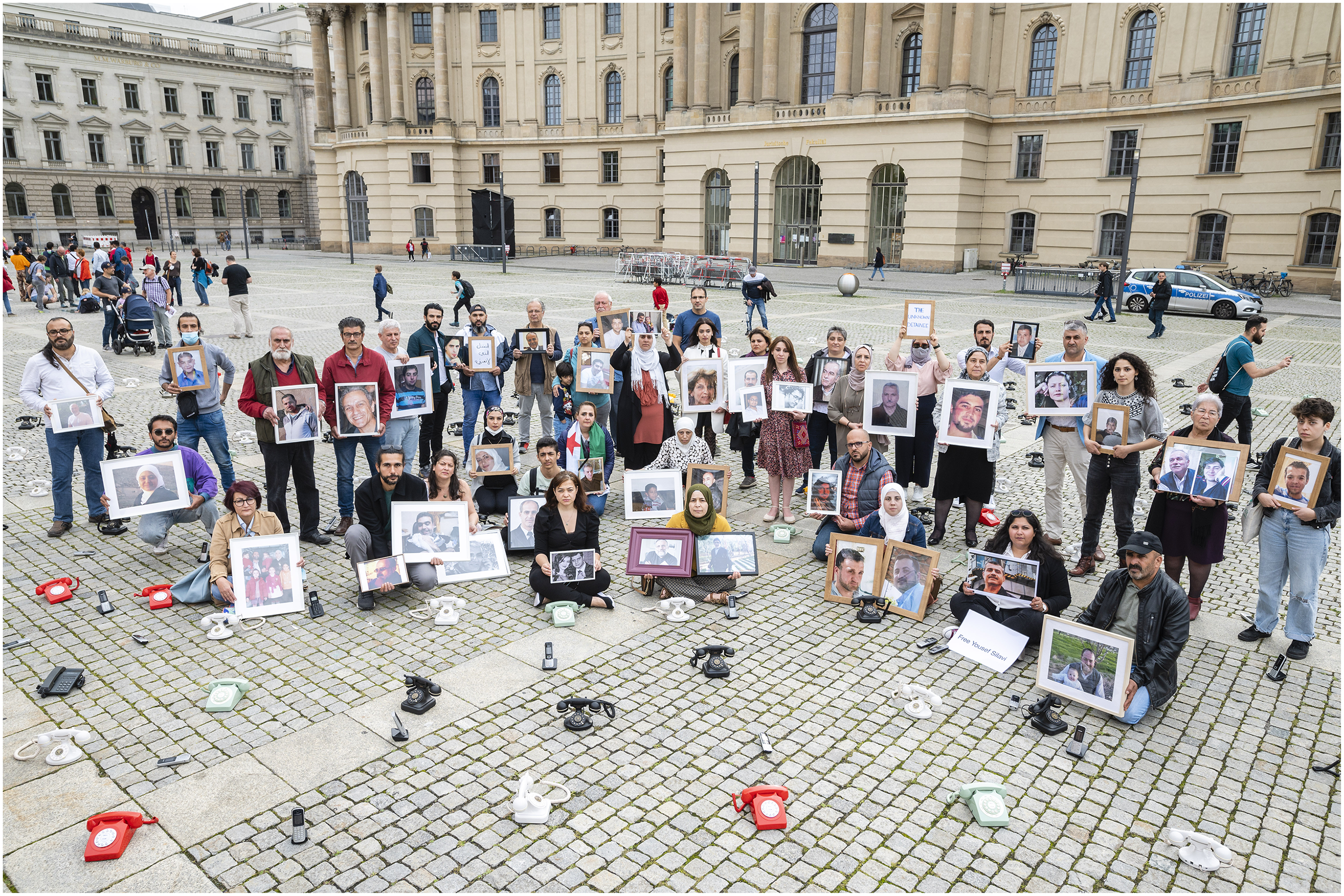
Campaign for the Forcibly Disappeared and the Missing in Syria/The Syria Campaign/Paul Wagner/Berlin/2021.
While there has been a growing societal interest in informal truth practices 4 that embrace a forensic notion of truth or the innovative efforts by victim groups, the potential of artistic practices to truth-seeking in Syria has received limited attention. Yet, there is a growing number of artistic practices in the domain of literature, cinema and visual arts that engage with the notion of truth. As Fuller and Weizman (2021) argue, artistic practices are neither separate from, nor in contradiction with the investigation of facts, and their contribution to the debate about truth needs to be better understood. In the section below, we draw on interviews with Syrian writers and filmmakers to demonstrate how artistic practices can contribute to a thicker understanding of truth by (a) countering erasure and ‘presencing’ experiences of harm, (b) foregrounding multivocal truths and (c) offering avenues for epistemic resistance.
Presencing Experiences of Harm
Many Syrian writers and filmmakers were enthused about the uprising and continue to adhere to its objectives. Although most artists would not identify as justice actors, most of the respondents share the justice community's commitment to prevent the erasure and invisibilization of victims’ experiences. 5 The ramifications of narrative warfare by the Assad regime and Russia furthered the sense of urgency to engage with the notion of truth, entailing a flurry of organic artistic truth practices. As this is not the first collective trauma Syrians have gone through, there is a prevailing fear for a cover-up of crimes. On the one hand, the memory of past failures to document and testify has strengthened the determination to engage in truth practices. On the other hand, there is an awareness among many artists that the scale of this specific conflict, combined with the tactic of narrative warfare, make it even more urgent than before to engage in truth practices.
Despite the failure of the uprising, many Syrian writers continue to adhere to the uprising's spirit of defiance, continuing to speak truth to power and representing experiences of harm. Thus, they give rise to new forms of writing that is largely of the diaspora while being strongly connected to, or rooted in, Syria. Syrian writers foreground injustices and victims’ experiences in different genres of literary writing such as novels, poetry and drama. From our empirical research it emerges that many Syrian writers share the justice community's aspiration of overcoming invisibilization or erasure and rendering present what was coercively removed or glossed over in hegemonic narratives about Syria. This translates itself to a commitment to document crimes, as a backstop against their denial, to shed light on dark places that were hidden from sight. While not necessarily proponents of realistic writing, several writers we interviewed consider that literary writing can allow readers to catch a glimpse of Syria and understand victims’ realities (Yassin Hassan, 2021; Khalifa, 2021; Youssef, 2021).
In the domain of cinema, there was a tendency at the start of the uprising to bear witness – also building on the culture of memory, informed by the memories of past injustices (Sinjab, 2021). The uprising ushered in a new generation of filmmakers, often citizen journalists, who were driven by the urgency to act and aspired to generate ‘evidence-images’ (Della Ratta, 2018), entailing forms of documentary film-making that can be called ‘emergency cinema’ (Boëx, 2013). Most of the emerging filmmakers resorted to documentary films, partly because of lower production budgets, the market demands of the news industry, and the desire to document (Hassan, 2020). Tapping into the relatively wide reach of their medium, they hoped to capture the attention of audiences in the Global North and to foster action. As of 2013, Syrian films attracted international attention, leading among others to the first Oscar-nominations in Syrian film history for Last Men in Aleppo and For Sama (Wessels, 2019). 6
Although the concern with ‘presencing’ victims’ realities is omnipresent among the interviewees, there are different perspectives on how best to avoid erasure, ranging from realistic to more symbolic renditions of harm. There is an acknowledgement among respondents on the difficulty of representing atrocities. Their vastness and intractability trigger debates about the pitfalls of – literary, visual and cinematic – documentation and the impossibility of truth-telling. This is indicative of a more general tension between documenting reality on one hand, and the primacy of the imagination in artistic practices on the other. Several respondents confirm reconsidering the impetus to let the world know. Novelist Samar Yazbek, for example, is driven by the urge to bear witness, both in order to personally grasp these experiences of harm and to render them relatable to the outside world. In order to do so, she explored the genre of testimonials, publishing two diaries of the revolution as a means to give an account of what life looked and felt like (Yazbek, 2012; 2016). Yet, because of the evolution of the conflict, she reverted to a creative approach, shunning the direct depiction of violence in her novels while nonetheless attempting to provide an intimate look into lived realities (2021). While the debate on the possibility and the dangers of writing and filmmaking during atrocities is a complex one, it has not kept artists from addressing atrocities, because of a loyalty towards victims and a doubt whether there will ever be an auspicious time and an appropriate language to consider this all. Besides giving meaning to these experiences of suffering, many artists first and foremost want to ‘presence’ experiences that would otherwise remain concealed.
Multivocal Truths
The previous section highlighted how experiences of harm are expressed through artistic practices. These practices not only ‘presence’ and give voice to injustices but they also underline the existence of a multitude of truths – not in the post-modern sense that there is no single truth, but rather as the acceptance of the complexity of truth-seeking and the existence of multiple truth claims.
While respondents see a clear role for literature and cinema in truth-seeking, they indicate that the urge to document contains a pitfall. Several interviewed writers stress that they do not attempt to provide straightforward facts, but instead seek to capture reality differently, for example by revealing the inner life of their protagonists (Yassin Hassan, 2021). Likewise, interviewed filmmakers alluded to the complexity of image-making during conflict and the multiplicity of truth. As the conflict transformed, Syrian filmmakers increasingly point to the impossibility to capture the truth. Gradually the original aspiration to document made way for more multi-vocal and personal approaches and the acknowledgement to shy away from black-and-white representations of lived experiences or simplistic schemes (Kadaan, 2021; Fattahi, 2021; Kalthoum, 2021). This is also linked to the complexity of image-making imbedded in a political economy evoking questions about the veracity of images, their use in the struggle for truth and the relationship between documentaries and the reality on the ground (Aljarod, 2021; al Mokdad, 2021). This reflects the trend towards a more personal, less ideological cinema that is more rooted in the perspective of the filmmaker (al-Atassi, 2021; Tanjour, 2021). For instance in the documentary For Sama, Wa’ad al-Kataeb bears witness to daily life under siege in Aleppo in the form of a letter to her daughter Sama, blending a subjective account with documentation, aspiring to provide counter-narratives that challenge the regime's disinformation and Western hegemonic narratives.
Thus, both the aspiration to represent experiences of harm and the impossibility to fully capture them became more prominent as the conflict evolved, arising in artistic practices that embrace multiple perspectives and ambivalence, foregrounding hitherto unrepresented or marginalized voices. This has led to a reappraisal of the subjective experience. Playwright Ramzi Choukair (2021), for instance, insists that he does not intend to bring a ‘true story’ in his plays X-Adra and Y-Saydnaya which both dwell on imprisonment in Syria and are mainly performed by former inmates of these prisons. Instead, he seeks to kindle the imagination of the spectators and to advance difficult questions that may destabilize the notion of a definite truth and allow for more perspectives on the lived truths. Several interviewees echo this desire to push readers and audiences to look at reality in a more nuanced way, stripped of certainties. This puts the emphasis on truth-seeking as a process which requires radical openness to disrupting and deconstructing dominant narratives, rather than only looking at the outcome of this process.
For several interviewees, this also relates to the impossibility of grasping the reality when one is not present on the ground, especially when sites of violence are not accessible. As such, they consider their endeavours as truth practices not so much because they come up with clear answers, but because they raise questions that are crucial in the quest for – any kind of – truth, unsettling seemingly unshakable truths (Al Attar, 2021; Kalthoum, 2021). However, we need to acknowledge the risk that because of their polyphonic nature, informal truth practices could fuel uncertainty and nurture a relativism where all truth claims are equally valid. In the Syrian context, the climate of uncertainty and indifference is conducive to relativization, confirming many outsiders’ belief that all truth claims need to be distrusted. Our interviews underline the distinction between perspectivism on the one hand and the flagrant distortion of facts on the other. Informal practices, and the arts in particular, expand the sites of truth-seeking, allowing facts to form at the convergence of multiple perspectives (Fuller and Weizman, 2021). In the next section, we reflect on how this embrace of multivocal truths can be an element of resistance.
Epistemic Resistance
The rationale behind informal truth practices is often rooted in an awareness about the danger of erasure and an understanding of the marginal role of justice actors and artists in the uphill battle against annihilationist forces, rather than in a conscious attempt to rethink truth practices. However, these practices can also be read as a means of resistance against those forces, and more broadly against hegemonic narratives that obfuscate experiences of harm or silence victims or knowers.
This kind of resistance stems from the rejection to be silenced and a desire to make the voices of victims heard. Artists reverse forced absences and reveal silences, using their practices to add those narratives and voices to the dominant epistemic frameworks and, by doing so, unsettle those. Thus, filmmaker Yasmin Fedda (2021) believes that films serve as living archives that resound people's voices and resist their absence. In doing so, they ‘presence’ their realities and allow for a multivocal truth (as discussed above). In addition, they also offer avenues for epistemic resistance to dominant narratives that may eclipse victims’ lived realities. Novelist Manhal al-Sarraj (2021) sees her attempts to foreground hidden truths in her novel about the Hama massacre as a disruption of the regime's narratives and its attempt to impose those. This resistance against dominant narratives and epistemes is raised by several artists (al Mokdad, 2021; Mohammed, 2021; Sinjab, 2021). Novelist Rosa Yassin Hassan (2021) approaches resistance as the construction of a secret human history that resists the official history proposed by the authorities.
In the context of the annihilationist forces that Syrians face, this epistemic battle of narratives is not an abstract struggle. Our empirical work demonstrates that this has real consequences in terms of resisting those who are controlling the terrain and erasing evidence and narratives. A feature of many Syrian artworks is that they point to the fact that there are several creators of truth, existing outside official knowledge, contradicting state propaganda and appraising voices that would otherwise remain marginalized or hidden, such as that of a victim of the Ghouta chemical attacks in Samar Yazbek's novel Planet of Clay. In this sense, the resistance that is implicit in these practices consists precisely in their potential to discontinue silences, disrupt dominant narratives, oppose erasure and open up the justice imagination.
Concluding Remarks
Responses to widespread or systematic violence that do not conform to the standardized transitional justice paradigm have often been relegated to the margins of the debate about how justice can be achieved (Bickford, 2007; Zunino, 2019, 198, 203). This article foregrounds such responses in the domain of truth-seeking. 7
We believe that transitional justice's expansion to aparadigmatic contexts of ongoing violence makes it even more urgent to conceptualize the notion of truth beyond forensic truth. Much has been written about the shortcomings of an exclusive focus on and the constraints of formal truth mechanisms. The stable referent offered by forensic truth is of invaluable importance in a generalized climate of uncertainty whereby conflicts are also waged over the interpretation of facts. Still, the risk of forensic truth eclipsing more contextualized understandings of truth needs to be explicitly acknowledged, and more context-sensitive understandings of truth should be appreciated in the run up to and orbit of formal processes. Informal truth practices - including artistic initiatives - can constitute crucial information about experiences of harm and keep justice on the agenda. While artistic practices are often seen as contrary to formal practices, they are essential to complement the forensic understandings of truth. Thus, our concept of truth is one of a thick, multi-layered understanding informed by lived experiences.
The Syrian case suggests that informal truth practices can complement this notion of forensic truth. Our empirical work demonstrates that formal and informal truth practices inform and complement each other. Forensic truth is a crucial pillar to moor accountability demands for victims in the Syrian context. For this reason, formal mechanisms, like the IIIM and the COI, and civil society initiatives that have sought to unearth forensic evidence, remain of paramount importance. Yet, due to the political deadlock and non-transition, most truth practices in the Syrian context today are of an informal nature. They seek to remedy the absence of a formal transitional justice process in a situation of ongoing violence. We argue that these efforts can be seen as a precursor for, or a complement to, forensic truth efforts but more importantly, they open spaces for truth claims that are not easily accommodated elsewhere. The informal truth practices described in this article ‘presence’ victims’ realities, foreground multivocal truths and promote epistemic resistance.
Irrespective of their intentions, these informal truth practices foreground the multi-layeredness of truth, open a potential for contestation and provide a stepping stone towards more inclusive truth practices. Many actors engaged in these practices do not present their work as an alternative to forensic truth. Instead, they consider these various practices are part of a complex justice ecology. Even if the choice for informal truth practices is often pragmatic, they have a disruptive potential because of their informality, spontaneity and non-institutionalization and their ‘presencing’ of victims’ lived realities and the struggle for a modicum of justice in the face of ongoing crimes. Future research could further enquire whether and how some of these concepts and practices that are based on seemingly different epistemological underpinnings may meaningfully be integrated or simultaneously activated in the Syrian case should a more formal truth mechanism be established, so as to arrive at an understanding of truth and truth practices that encompasses various epistemic communities.
Interviews
Maria Al Abdeh, director Women Now, 6 December 2020.
Mohammed Al Attar, playwright, 8 September 2021.
Ali al-Atassi, filmmaker, 29 January 2021.
Iyad Aljarod, filmmaker, 11 January 2021.
Khalil al-Haj Saleh, member Coalition of Families of those kidnapped by ISIS (Massar), 20 April 2021.
Mariam al-Hallaq, member Caesar Families, 29 April 2021.
Ghayath al-Madhoun, poet, 12 July 2021.
Eyas al Mokdad, filmmaker, 1 February 2021.
Manhal al-Sarraj, novelist, 19 August 2021.
Ramzi Choukair, playwright, 16 August 2021.
Mazen Darwish, director Syria Media Center, 11 December 2020.
Jan Dost, novelist, poet, 18 August 2021.
Sarah Fattahi, filmmaker, 26 January, 2021.
Yasmin Feddah, filmmaker, 9 March 2021.
Ahmed Helmi, founder Ta’afi, 29 April 2021.
Soudade Kaadan, filmmaker, 15 January 2021.
Ahmad Katlish, poet, 12 August 2021.
Ziad Kalthoum, filmmaker, 11 January 2021.
Khaled Khalifa, novelist, 17 March and 24 June 2021.
Leila Kiki, director Syria Campaign, 11 June 2021.
Fadwa Mahmoud, member Families for Freedom, 27 April 2021.
Hala Mohammed, poet, filmmaker, 14 September 2021.
Sema Nassar, transitional justice researcher, 2 April 2021.
Wael Sawah, transitional justice expert, 30 November 2020.
Diab Serriya, co-founder Association of Detainees and The Missing in Sednaya Prison, 29 April 2021.
Lina Sinjab, filmmaker, 12 February 2021.
Alfoz Tanjour, filmmaker, 23 February 2021.
Mustafa Taj al-deen Mosa, novelist, short story writer, journalist, 14 July 2021.
Dima Wannous, novelist, 19 July 2021.
Rosa Yassin Hassan, novelist, 26 August 2021.
Samar Yazbek, novelist, 6 September 2021.
Dellair Youssef, essayist, novelist, 16 July 2021.
Footnotes
Acknowledgements
We would like to thank to our colleagues at the Justice Visions’ team, as well as Zinaida Miller, Stef Craps, Marileen La Haije and the two anonymous peer reviewers for their insightful input and comments on earlier drafts.
Author note
Tine Destrooper, Associate Professor of Transitional Justice, Human Rights Centre, Ghent University, Belgium.
Declaration of Conflicting Interests
The author(s) declared no potential conflicts of interest with respect to the research, authorship, and/or publication of this article.
Funding
The author(s) disclosed receipt of the following financial support for the research, authorship, and/or publication of this article: This article is part of a project that has received funding from the European Research Council (ERC) under the European Union's Horizon 2020 research and innovation programme (Grant agreement No. ERC-2018-STG-804154).
