



Abstract
Scholars exploring transitions to personalist rule focus on coercive power transfer to personalist rulers and argue that forming viable political coalitions, undermining power-sharing agreements, and mobilizing non-democratic institutions play a crucial role in transferring coercive power. However, no regime can rule by coercion alone, and transitions to personalist rule also involve making new frameworks of legitimacy. Exploring the connections between Turkey's recent transition to personalist rule and the drastic jump in the number of insult proceedings that accompanied the transition, this article finds that insult proceedings play a particular role in making new frameworks of legitimacy in transitions to personalist rule. We argue that insult proceedings work as a coercive method of punishment that curbs dissent while constructing a new framework of legitimacy based on the ruler's charisma. The study builds on an in-depth examination of insult cases filed during Erdoğan's presidency in Turkey and interviews with legal experts and suspects. It contributes to the understanding of the use of laws and legality in autocratization processes.
Introduction
In Turkey, Article 299 of the criminal code punishes insults to the president by up to four years in prison. Viewing the president as a symbol of the state, Article 299 categorizes insults against the president as offences against the state. It thus offers protection to the president not only for insults to his duties but also his personality and personal relationships (Demir, 2017). In March 2016, Turkey's Minister of Justice declared that since Tayyip Erdoğan became the president in August 2014, 1845 insult cases were opened against celebrities, journalists, and even school children (Guardian, 2016). Some of these cases were so absurd that people would be put on trial for comparing the president to Gollum, a Lord of the Rings character. Compared to 20 cases opened in 2006 during Ahmet Necdet Sezer's presidency and 175 cases opened in 2011 during Abdullah Gül's presidency, 1845 cases opened in the first one-and-a-half-year rule of Erdoğan, indicated a controversial break with the national past, and given the absurdity in many cases, not only a quantitative but also a qualitative break was set in motion. Why was Erdoğan's presidency accompanied by such a sudden shift in the implementation of Article 299?
In this article, we turn our attention to the personalization of power and present how Article 299's implementation in Turkey became a strategy in the country's transition to personalist rule. Transitions to authoritarianism involve faltering institutions that curtail the chief executive (Mouzelis, 1985; Slater, 2003). In cases where such faltering involves personalization of power, decision-making and coercive power are increasingly centralized in one person's hands, unfettered by a party central committee or institutionalized military decision-making process (Geddes, 2004). The recent shift in Turkey's political system is a spot-on example. In 2018, after seventy-three years of oscillation between democracy and military intervention, the long-standing parliamentary system left its place to a heavily centralized executive presidency. The prime minister's office was abolished while the president attained a wide range of new powers, including prerogatives regarding the budget, the selection and dismissal of ministers, and the power to dissolve the parliament—confirming the personalist direction in Turkey's authoritarian journey (Esen and Gümüşçü, 2016, Somer, 2016, Öktem and Akkoyunlu, 2016, Taş, 2015, Tziarras, 2018).
Transitions to personalist rule do not happen overnight. They are products of a long process that scholars tend to explain by reference to several different strategies. Among these are forming viable coalitions with lieutenants (Geddes, 2004), undermining power-sharing agreements with antagonistic factions in the military (Barros, 2002), and mobilizing non-democratic institutions such as packing, rigging, and circumventing (Slater, 2003). While these works focus on coercive power transfer, no regime can rule by coercion alone (Gerschewski, 2013). Like other forms of authoritarianism, personalist rulers also seek legitimacy. In asserting it, they draw on several frameworks ranging from economic performance, nationalism, religion, ideology, and external threats to leaders’ charisma (Gerschewski, 2013; March, 2003; Omelicheva, 2016). Transitions to personalist rule, therefore, also involve the constitution of new frameworks of legitimacy. Through an in-depth examination of insult cases filed during Erdoğan's presidency, we argue that Article 299 proceedings work as a strategy in both ways: First, they work as a coercive method of curbing dissent, ensuring loyal law enforcement and a silent public. Second, they work to manufacture charisma, granting the regime a new framework of legitimacy to draw on.
Recently, political scientists argued that coups lost their relevance in contemporary democratic backsliding processes as executive aggrandizement has gained prominence (Bermeo, 2016). In this context, laws, legal processes and concepts have acquired particular importance as devices of democratic backsliding (Sadurski, 2019, Kelemen and Pech, 2019). Studying specifically the Turkish case, scholars have shown that legal processes were crucial in centralizing coercive power in the hands of President Erdoğan (Arslanalp and Erkmen, 2020; Taş, 2015; Yılmaz, 2020). We suggest that insult proceedings are part of this broader trend of using “legality” in autocratization. Among all the other tactics, the utilization of Article 299 is the most directly related one to the personalization of power, and specifically, to the creation of a new framework of legitimacy based on Erdoğan's charisma. Insult proceedings can assign rulers special qualities and force the public to see rulers from this perspective. This capacity renders them a particular means of making a new framework of legitimacy for the regime.
In what follows, we first discuss how sociology and political science explore legal processes’ role in transitions to personalist rule and present our argument's conceptual pillars. Next, we describe the methods used to gather data, contextualize the law's revival in contemporary Turkey, and present our argument with empirical data. We conclude the article with a summary of findings, a discussion on the public reception of this strategy, and the argument's implications for studying other cases of authoritarian transition in contemporary times.
Personalization of Power, Law & Charisma
Much of the existing literature on the relationship between authoritarian regimes and legal processes explores the construction of this relationship and its outcomes for regime durability and contestation. In one research strain, for instance, scholars have focused on how courts become the focal point of state-society contention in authoritarian regimes and have shown how courts suppress opposition in this contentious relationship (Ginsburg and Moustafa, 2008; Gomez, 2006; Moustafa, 2007; Moustafa, 2014). In another strain, scholarship has centred on the relationship between authoritarian regimes, laws and legality. Studying cases of domestic legitimacy crises such as the case of Nasser's Egypt (Moustafa, 2007) or post-Maoist China (Landry, 2008) scholars have shown that authoritarian regimes appeal to “the rule of law” as a legitimation strategy (Ginsburg and Moustafa, 2008; Peerenboom, 2002). Similarly, exploring the case of Thailand, scholars have shown that Lese Majeste laws act as a legal means for sacralizing the regime and always at the cost of popular sovereignty (Preechasilpakul and Streckfuss, 2008).
There are, however, fewer studies that explore legal processes in the context of authoritarian transitions. Explorations of the recent authoritarian transition processes in Singapore, Venezuela, Turkey, Poland, and Hungary are among the few examples. These works generally focus on two major aspects of the relationship between legal processes and autocratization, namely how legal processes become a strategy in suppressing the opposition; and how they confer legality to autocratization.
In the context of the suppression of the opposition, exploring the case of Singapore, Rajah (2012), for instance, has argued that laws have been a crucial tool in dismantling free media and civil society in the country. Defamation laws in Singapore have similarly been addressed in terms of how they worked to silence the opposition (Sim, 2011). On the legality of autocratization Corrales (2015) has shown that through use, abuse and non-use of laws, laws have been enacted constitutionally in Venezuela's authoritarian turn. In this context, increased penalties for insulting government officials have been pointed as an example of the use of laws, while creating a “communicational hegemony” and electoral irregularities were cited as examples for the abuse and non-use of laws. Studies on the Turkish case advanced this debate by noting that in Turkey first “decretismo” (Taş, 2015), then the declaration of the state of emergency and constitutional amendments (Yılmaz, 2020) became the legal means of bypassing democratic decision-making processes.
Sadurski (2019) challenged these arguments on the legality of recent autocratization processes by pointing at how the government in Poland used statutory amendments and outright breaches of the constitution. He depicted Poland as a unique case of disregard for its own formal constitutional rules. Kelemen and Pech (2019)'s study of the Polish and Hungarian cases however suggested that legality in the sense of drawing on legal concepts in justifying rulers’ attempts to dismantle the checks on their power was also the case in Poland. They have shown that Hungarian and Polish governments used the legal concepts of constitutional pluralism and constitutional identity to shield themselves against potential EU interventions. Hungary violated the EU asylum acquis and refused to recognize the primacy of EU law in this domain by claiming that control over migration is part of its constitutional identity. Poland attacked the independence of the judiciary, claiming that such matters fall within the exclusive bounds of its authority.
Our focus on the instrumentalization of insult proceedings in Turkey's autocratization process resembles these studies that address law, legal processes and legal concepts as a strategy of authoritarian transition. On the one hand, we address insult proceedings in terms of how they are instrumentalized in suppressing the opposition within law enforcement and among the people. On the other, analogous to those who study the legality of autocratization processes, we address insult proceedings as a legal means of transferring power to autocrats. As different from those who only focus on the transfer of coercive power in transitions to personalist rule, however, through the case of insult proceedings, we suggest that laws may also play a role in constructing a new framework of legitimacy in autocratization processes.
Max Weber distinguishes between three types of authority: rational-legal, traditional, and charismatic. In the former, obedience is owed to the legally established impersonal order. In the second, it is owed to the traditionally sanctioned position of authority, and in the third, obedience is produced based on personal qualities. In this third type of authority, based on these qualities, “the individual concerned is treated as a leader” (Weber, 1922 [1968]: 241). Weber's idea of charisma is akin to Durkheim's idea of sacredness, where sacred individuals or objects “strike the individual as superior to him or her, and inspire feelings of deep respect, awe, love and even dread in people” (Garland, 1990). According to Weber, the gift of charisma is not heaven-sent. It is instead a quality that followers ascribe to leaders (Joosse, 2014: 271). There is an interactional element in this understanding of charisma (Joosse, 2014, 2017, 2018). Charisma is produced and received within the interactions of the leader and the followers. No leader can be charismatic without followers attributing charisma to him. Actual personal qualities that trigger these ascriptions are, therefore, of secondary importance: “What alone is important is how the individual is regarded by those subject to charismatic authority, by his ‘followers’ or ‘disciples’“ (Weber, 1922 [1968]: 242). Charisma in Weber is thus not about the leaders themselves but how the leader's charisma is performed by the disciples (Joosse, 2017). Similarly, for Durkheim, the fact that “[a] rock, a tree, a spring…in a word, anything, can be sacred” (Durkheim, 1965: 35; Eliade, 1959) tells us that it is not an inherent or even objective property of the objects perceived to possess it. Instead, it is a projection, superimposed upon an object by some observer(s), and as such, a property of those observers rather than the objects themselves (Marshall, 2010).
Weber and Durkheim's emphasis on interaction and others’ perception has been advanced by later scholarship that approached the study of charisma or sacredness as closely attached to the study of power (Geertz, 1977; Shils, 1965). Later scholarship has suggested that people's attribution of charisma/sacredness to a leader is a consequence of the practices and self-representations of the ruling elites and power holders (Garland, 1990). This meant that leaders in awareness that charisma is an important source of authority demanded from the public to be seen as charismatic. In other words, through the instruments at their disposal, they steered society towards seeing themselves as charismatic. For this reason, if we are to understand sacralization, we need to investigate the powerholders’ behaviours that project sacredness and charisma on a person or an object. Charismatic leaders strive to derive charisma from various domains of social life, among which media and public performances in mass gatherings are the most well-known. In a similar vein, we argue that domains conventionally considered as domains of rational-legal authority can also be domains through which charismatic authority is constructed. Thus, in this study, we argue that per the demand of the leader, powerholders use the law to derive charisma for Erdoğan. We adopt the interactional perspective of Weber on charisma and contextualize it in contemporary power relationships in Turkey. The penal policy is a politically motivated undertaking often unrelated to crime control efforts (Wacquant, 2009). Through penal laws and punishment, powerholders attempt to construct and organize social relationships. They seek to teach the public what to feel, how to reach, and which sentiments should be called for in similar situations (Geertz, 1977). Political punishments and show-case trials are relayed by the media to represent the meaning of justice and symbolically assert order and authority (Garland, 1990). These instances aim at organizing people's perceptions and structuring discourses, practices of blaming, holding responsible, and thinking about deviance (Garland, 1990). We suggest that in the case of insult proceedings, the courts’ goal goes beyond crime control and the outright suppression of the opposition. The Turkish case illustrates that courts punish suspects to demonstrate how Erdoğan has to be seen. As the law fulfils its capacity as a coercive tool silencing dissent, it deems Erdoğan untouchable, assigning him the qualities of a special ruler. Insult proceedings thus work to reinstate that there is only one ruler in Turkey and that his criticism is not appropriate.
Methods and Data Collection
The argument of this article is derived from qualitative research conducted between 2018 and 2020. Data collection involved the gathering of court cases and judicial statistics and conducting interviews. To track the cases of Article 299, we examined newspaper archives, documents produced by NGOs, official statistics, and reports. In identifying cases, we referred to two primary sources that have been collecting cases of Article 299 semi-systematically: Zeit Magazine's “The Defendant People” (Davalı Halk) section, and the online news portal, Diken's, “Today in Insults against Erdoğan” (Erdoğan'a Hakarette Bugün) section. We supported these two sources with the data available on the Court of Cassation website and other news outlets, including Sözcü, Hürriyet, Cumhuriyet, and T24. The Ministry of Justice and the General Directorate of Statistics websites granted us access to judicial statistics on the implementation of laws.
To contextualize the cases, we conducted 12 semi-structured interviews with lawyers, academics, journalists, and those who were put on trial for insulting the president. Interviews with academics and journalists were conducted in 2019 in Ankara. These were expert interviews intended to gather information on the actors and the intricacies of legal proceedings. Interviewees were selected based on their expertise in the field. Two academics interviewed are known for their work on free speech in Turkey. The two journalist interviewees were chosen amongst those who were following news stories on insult cases. Interviews with people who had an insult proceeding were conducted in 2020. Some of the interviewees had only a complaint that did not turn into a case; others were found guilty and had appealed the decision. Interviewees were selected from a convenience sample. Given the topic's sensitivity, our status as professional researchers and reaching out to them through our personal networks increased interviewees’ trust levels. To protect the interviewees, before starting the interviews, we ensured that their identities would be kept anonymized. In the text, actual names of those who faced a complaint or trial for insulting the president were mentioned only if data were gathered from publicly available sources.
In analyzing the cases, we adopted an inductive theory-building approach. First, we examined trends in Article 299 proceedings in terms of frequency, decisions, and content. Next, the data gathered from the cases were put into perspective with the interviews. The interviews specifically presented an account of how the legal process worked and how it affected the stance of law enforcement and the defendants vis-a-vis the presidential system. In going back to our cases, we sought to understand how Article 299 related to the broader project of personalization of power. This iterative approach allowed us to identify the two main components of our argument: curbing dissent and creating a framework of legitimacy. We then theorized the connections between curbing dissent, charisma, legitimacy, and personalization of power.
Insult Laws As a Strategy of Personalization of Power
After the 1980 coup d’état and the drafting of the 1982 constitution, the military interveners in Turkey maintained parliamentarianism while at the same time setting up a more than symbolic presidency system. In this system, the president attained an active and powerful role. However, the instances in which s/he could act alone pertained to his capacity not as the chief executive but as the head of state. The president's office also lacked the legitimacy accorded by popular elections (Heper and Çınar, 1996; Özbudun, 1988). Presidents came to be elected by popular vote after the amendments to the constitution in 2007 (Taş, 2015).
In April 2010, months before the referendum that resulted in the reconfiguration of high courts in Turkey, Erdoğan conveyed his eagerness for a presidential system. The discussion intensified in late 2012 when his party submitted a proposal to this effect to the Constitution Conciliation Commission, a parliamentary body for drafting the new constitution. By extending broad, unchecked powers to the president, this system was inclined towards “ultra-presidentialism.” Two years later, during the 2014 presidential elections, Erdoğan openly declared his intention to establish a presidential system (Taş, 2015). The jump in insult proceedings accompanied Erdoğan's election as the president and the following switch to a presidential system.
Studies on law and authoritarianism in Turkey established that authoritarian spaces already existed within the Turkish state structure (Miller, 2005, Parslow, 2015, 2018). Turkey also has a long tradition of regulating and suppressing free speech. About 16% of all the European Court of Human Rights (ECtHR) decisions on free speech between 1959 and 2017 relate to Turkey's violation of rights. In violating norms of free speech, Turkish courts have historically relied on the anti-terror law (Law No 3713, Article 6 and 7), the articles of the criminal code on incitement of hatred (Law No 765, Article 312; Law No 5237, Articles 215 and 216), denigration of the Turkish nation, republic, parliament or the state (Law No 765, Article 159; Law No 5237, Article 301), and the law concerning crimes committed against Atatürk (Law No 5816).
After AKP's rise to power in 2002, most of these historically used articles retained their place in regulating public speech, while the anti-terror law attained special prominence in curbing opposition. Following Erdoğan's presidency in 2014 and the coup attempt in 2016, however, new articles came to be commonly used in suppressing speech; in particular, the articles of the criminal code that regulate the crimes committed against the constitutional order and the functioning of this order (Law No 5237, Articles 309–316) and Article 299 of the criminal code that regulates insults against the president (see Figure 1) (Akdeniz and Altıparmak, 2018).
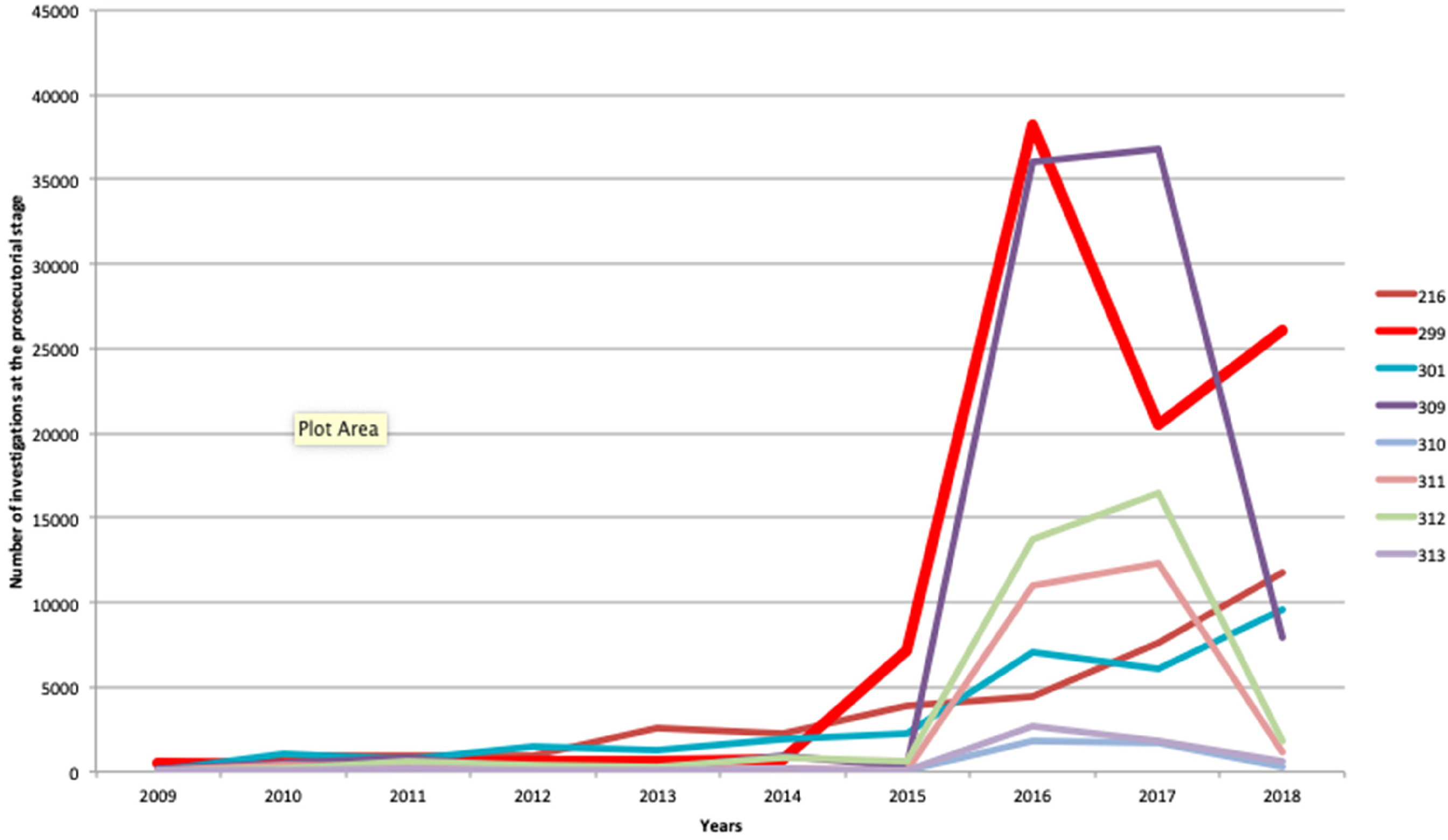
Number of investigations opened for violating articles 216, 299, 301, 309–313. Source: Judicial Statistics 2009–2018 http://www.adlisicil.adalet.gov.tr/Home/SayfaDetay/adalet-istatistikleri-yayin-arsivi.
Turkey experienced a special peak in cases opened for insulting the president following Erdoğan's election as president in 2014. The number of insult cases for which an investigation was started in 2014 was 682–the highest between 2009 and 2014. After 2014 this number increased to 7216 in 2015, 38,254 in 2016, 20.539 in 2017, and 26.115 in 2018. Of the 17,034 cases opened between 2009–2018, 16,236 were opened after 2014 (See Figure 2.). Of the 1640 imprisonment decisions between 2009–2018, 1575 were made after 2014 (See Figure 3.).
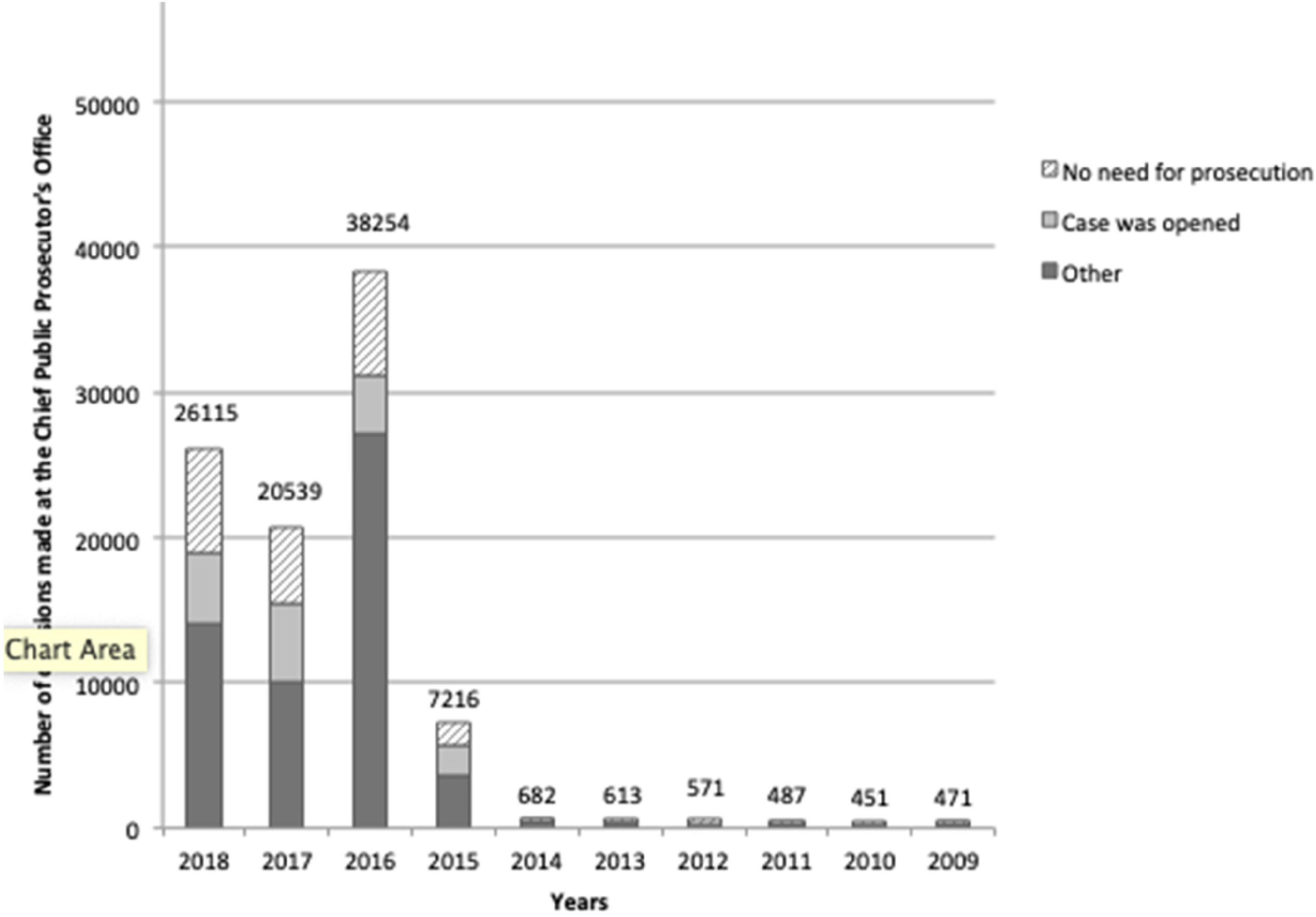
Article 299 decisions made at the chief public prosecutor's office. Source: Judicial Statistics 2009–2018 http://www.adlisicil.adalet.gov.tr/Home/SayfaDetay/adalet-istatistikleri-yayin-arsivi.
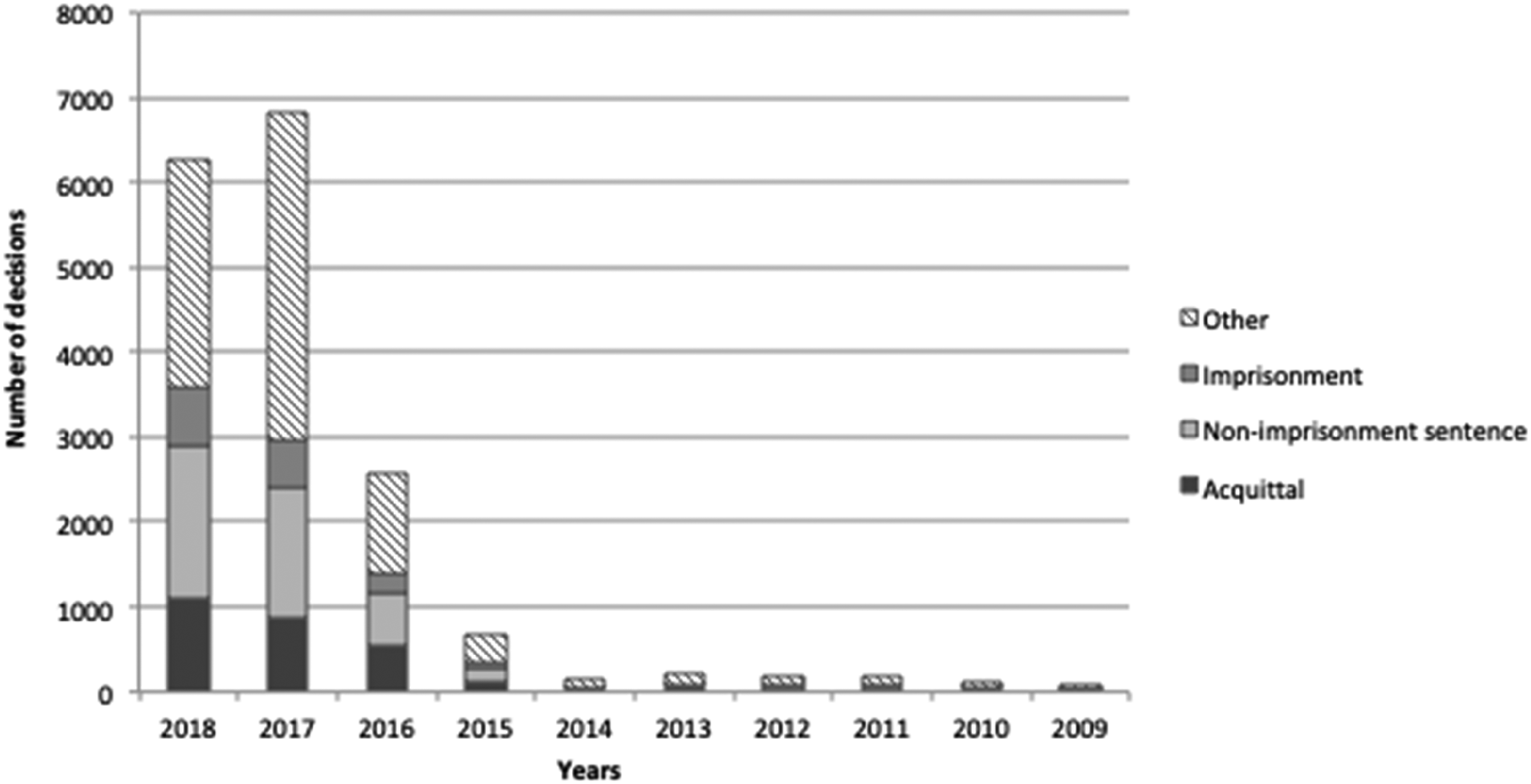
Types of article 299 decisions. Source: Judicial Statistics 2009–2018 http://www.adlisicil.adalet.gov.tr/Home/SayfaDetay/adalet-istatistikleri-yayin-arsivi.
The jump in the number of insult proceedings was not a result of changing insult laws but a shift in implementing the existing law. Before Erdoğan's presidency, cases of insulting the president generally targeted journalists, cartoonists, or other public figures. In contrast, now, ordinary people have become frequent targets. Even though the law allowed criticisms against the president's personality to be tried, cases before Erdoğan's presidency generally involved criticisms related to the president's duties (see Tamer, 2015 for a case against president Demirel). Even in cases where the suspect was not a public figure, the accusations still mostly related to criticisms of the president's duties (see Hakan, 2016 for a case against president Özal). In almost all of these cases, presidents were the ones filing complaints. Cases where citizens filed charges against each other were sporadic before Erdoğan's presidency, and even when this happened, the judiciary would quash the cases for lacking grounds (see Kızık, 2015 for a case against president Evren). In what follows, we present the links between personalization of power and the shifts in Article 299's implementation.
Curbing dissent: Loyalty to Erdoğan in Law Enforcement
The literature on personalist regimes shows that such regimes are built on patronage relationships through which autonomous institutions are taken under control. In legal and political institutions, these patronage relationships are maintained either by filling the office with loyal clients of the regime (Baturo, 2014) or through reward and punishment strategies that discipline the actors of the legal field (Ginsburg and Moustafa, 2008; Massoud, 2013; Rajah, 2012; Stockmann and Gallagher, 2011). In the Turkish case of personalization of power, both strategies were used. Article 299 proceedings provided a convenient context for implementing these strategies and rendered the law enforcement loyal to Erdoğan.
Following Erdoğan's election as president in 2014, cases of insult attained special importance for political authority. Our interviews with journalists revealed that Erdoğan established a team of about twenty lawyers dealing only with insult cases. In 2015, with the Istanbul Chief Public Prosecutor's order, a special unit of information was founded under the police's Public Security Branch Office. This unit was tasked with finding users and posts that insulted statesmen (NTV, 2015). Similarly, in Ankara Courthouse within the Bureau of Press Crimes, a subunit was founded. Besides, Article 299 was turned into a special area of investigation in the police force. On January 6, 2016, a circular was issued to monitor and report the reactions, criticisms, and verbal attacks against statesmen. This circular on “insults against statesmen” sent by the General Directorate of Security to all Directorates of Provincial Police stated that “initiating a judicial process for all incidents where there is an insult against our statesmen is a duty ascribed by the law. Especially in cases where individuals insult statesmen, the crime should not be evaluated as a simple matter of public order. Instead, our units must conduct a detailed investigation and research to establish the individual's objective and the connections of the individual to reveal the actual reasons behind the incident.” (Önderoğlu, 2016) By directing police officers not to ignore insult cases, the circular clarified that failure to do so would be consequential for the police.
All these top-down changes that called for action in insult proceedings affected law enforcement. Among the police officers, the fear of penalization led to an urge to act quickly in insult complaints. One indication is the detentions in cases where individuals report the other party for insulting the president even when the source of the conflict is a private and non-political matter. The story told by journalist Can Ataklı (2018) presents an example: Tension over a private matter arises between a tourist guide and a tour bus driver in Cappadocia. After the group arrives at the hotel, a police officer comes to the hotel asking for the tour guide. As the guide gets detained, it becomes clear that the bus driver called the police and complained about the tour guide insulting the president during their quarrel. Ataklı notes that the conflict did not involve an insult against the president. He then quotes the police officer, “we have to take action even when there is no logical ground for it. We are afraid of getting penalized if we fail to act swiftly upon receipt of an insult complaint”. The police officer goes on to explain that they had to detain the tourist guide “just in case.” This case exemplifies a general attitude on behalf of security forces when it comes to insulting the president: act now and justify later.
The consequences of failing to act went beyond the police force. Tekşen (2015) notes that judges’ and prosecutors’ appointments directly relate to the cases they file in the judiciary. The more cases a judge opens on the grounds of insulting the president, the better places s/he gets appointed to, and vice versa. The story of Judge Murat Aydın, who applied to the Constitutional Court for the annulment of Article 299 being exiled to another city in response, presents an example (CnnTürk, 2016; Habercem, 2016). In addition to being exiled, this judge was also stigmatized by pro-government news outlets as a “terrorist” who tried to topple down the government (Özgan, 2016; Yeniakit, 2017). The case of Ali Haydar Yücesoy, a judge who decided for acquittal in an insult case, is another example. The Ministry investigated Yücesoy because he did not comply with a directive that required reporting each step to the Ministry (Bursalı, 2019). Yücesoy had contested the directive claiming that the directive's legal ground is not justifiable. He had then proceeded with an interlocutory judgment in which he required further clarification and asked if this directive was a means of further political pressure over courts. In response, the Ministry appointed Yücesoy to another city and justified requiring information on each step of proceedings as statistical data collection. An investigation on Yücesoy followed the rejection of his reappointment attempts to Istanbul due to family reasons. These cases spread fear in the judiciary.
A direct result of the spread of fear is prioritizing loyalty to Erdoğan over fulfillment of duties. An insult case from the city of Konya exemplifies how fear among law enforcement officers translates into loyalty. During one of the annual Şeb-i Arus ceremonies, the incident occurs where thousands of people gather to commemorate Mevlana's death and celebrate his “reunion with the divine”. Shortly before Erdoğan enters the hall, a citizen whisper, “here is a thief” to the person next to him. Others hear him say this, and one of them files a complaint about insulting the president. When the prosecutor arrives, he takes the suspect's testimony and decides on his release. Nevertheless, the incident grows. The Undersecretary of the Ministry of Justice calls the Attorney General of Konya, asking, “How could you release someone who has insulted the president?” The attorney general then wakes the prosecutor up, and the suspect gets arrested in the middle of the night. A week later, 16-year-old M. A. A. gets arrested in as short as four hours in the same city, even before the incident gets adequately investigated. In the latter instance, the prosecutor's response shows that he learned by experience how he should act when there is an insult complaint: prioritizing loyalty over requirements of the judicial process.
Tekşen (2015) explains how the prioritization of loyalty curtails all checking mechanisms in the judicial process. In cases where the president's lawyers file complaints, they give a verbatim petition to the prosecutor, revising only the parts of the petition that present the accused's speech act. Without checking the petition, the prosecutor then sends it immediately to the Ministry of Justice. The Ministry, which is otherwise expected to act as a “filter,” directly permits the trial's opening, and the speech act becomes a matter of a criminal case. One consequence of such proceedings is the explosion in the number of cases filed such that the Istanbul Anadolu Criminal Court of First (Hereafter CCF) Instance spends its entire day on this crime and that at Istanbul Çağlayan Courthouse, three different CCFs spend their entire time on this crime (Canduran, 2015). Another consequence is the filing of scandalous trials. In one example, a columnist at the daily Sözcü, Kemal Baytaş, was put on trial for a column written by another columnist, Rahmi Turan (Aranca, 2015).
Careful readers might ask why Turkish law enforcement has been so susceptible to the reward and punishment strategies that aimed to discipline the judges and the police in the context of Article 299 proceedings. While the empirical investigation of this question remains beyond the scope of this paper, there are three possible explanations for susceptibility: staffing of high courts and the judicial administration with government loyalists before Erdoğan's rise to presidency; the atmosphere of fear created by policies targeting “political enemies”; cynicism being the dominant structure of feeling in political engagements since the early 1980s. These explanations complement, instead of challenging, one another.
The first explanation accounts for the susceptibility of the personnel appointed to the police or the judiciary before Erdoğan's rise to the presidency through clientelist networks to the governing party AKP. These clientelist appointments surged, especially after the 2010 referendum where the majority voted in favour of reconfiguring judicial institutions, including the high courts. People who attained their positions in law enforcement through their ties to the governing AKP were ideologically close to Erdoğan and depended on his support in holding onto their positions after he became the president. They, therefore, were more likely to prioritize loyalty over professional duties. Also, since 2002, political trials filed respectively against secularist, Kurdish, and Gülenist groups had led to incarceration and dismissal of officials, including those within the police force and the judiciary. Fear spread in law enforcement due to these trials. Performances of loyalty built around Article 299 protected people from being labelled a political “enemy” both among the allies and the silent critiques of the government. Cynicism, which emerged as the dominant structure of feeling in political engagements in the aftermath of the 1980 coup d’état (Navaro-Yashin, 2020), has likely normalized such performances of loyalty among those who were not proponents of Erdoğan. In Turkey, even before AKP's rise to power, people, who were critical of the state's repressive policies and had little trust in political institutions, predominantly refrained from resisting the state openly and reproduced it as a powerful actor through their daily political encounters (Lüküslü, 2013). It has been shown that such cynicism and conformism continued into the times of AKP, for instance in the media (Över, 2021). One can perhaps argue that cynicism as the dominant structure of feeling in political engagements made acting in conformity with Erdoğan's vision of transformation an easily acceptable way of protecting one's self from being identified as a political enemy and thus the law enforcement susceptible to being disciplined in the context of Article 299 proceedings.
This discussion on susceptibility raises a further question, namely whether there has been resistance to the reward and punishment strategies of the government, and if so, what the source of such resistance was. Karl Klare (1998) has once suggested that in South Africa, during the apartheid, the legal culture of cautious analysis common to lawyers had allowed many among the victims and within the opposition to keep alive a distinct faith that law could somehow cure the society's evils. Studying judges off-bench mobilization against the AKP government in Turkey, Bakiner (2017) has shown that intensification of intrajudicial conflicts in the past decade transformed the legal culture that has traditionally isolated judges from politics. Judges with a variety of political positions thus started taking political action outside the courtroom. Taking Bakiner's study as a framework of discussion, we believe that judges’ actions, such as the abovementioned application of Judge Murat Aydın to the Constitutional Court for the annulment of Article 299 and the acquittal decision of Judge Ali Haydar Yücesoy in an insult case, call for a systematic investigation. These acts that challenge the general trend of showing loyalty to Erdoğan could be manifestations of the legal culture that has traditionally isolated judges from politics or outright resistance to authoritarian transition.
It should be noted that given the staffing of loyalists in high courts, irrespective of the motivations behind such challenge, the chances in decisions of acquittal are high that the office of the Chief Public Prosecution will object, the Court of Cassation will quash the decision, and a decision for the retrial will be made. In one such case where suspects were accused of insulting the president with words, “Do not Forget Soma [mine disaster], Do not let others forget it” “Not an Accident but a Massacre” “Thief Killer Erdoğan,” Sinop 2. CCF (2016/443) decided for acquittal. However, the Sinop Office of the Chief Public Prosecution objected, and the Court of Cassation quashed the decision in favour of retrial (Demir, 2017, p. 75). Similarly, in another case, a suspect, who was accused of insulting the president on Facebook and was first released on the condition of standing trial without arrest, was put in house confinement with an electronic bracelet following the prosecution's objection (Sözcü, 2015).
Curbing Dissent: Limits to Public Speech
As a second process in insult trials, we address the penalization of suspects and how this spreads fear and self-censorship in society. The literature on defamation laws in authoritarian regimes suggests that such laws are used to discipline opposition actors (Gomez, 2006), “chill” political opposition and define the limits of freedom of speech (Sim, 2011). As addressed in the previous section, authoritarian governments perform these measures mainly by controlling the judiciary regarding how decisions are made. They accomplish such control by disciplining law enforcement officers. In this section, we look into the public effects of controlling law enforcement. We suggest that the explosion in the number of cases filed for insulting the president simply has the effect of spreading fear among the people. Ordinary people come to know what they can say about Erdoğan by looking at trials of insulting the president.
Not all cases of insult result in the punishment of suspects. There are many cases where at least local courts show resistance by quashing the cases or acquitting suspects. In one such example, the Eskişehir 2. Criminal Court of First Instance acquitted two students who wrote: “Dictators are toppled down in the street” on a photograph of Erdoğan that resembled Hitler. In this decision, the judge considered the term “dictator” not as an insult but as political criticism. However, acquittals or quashing of cases does not suffice to prevent the diffusion of fear. Detention of suspects without proper investigation or the treatment of suspects throughout the trial plays a vital role in defining people's perception of what it takes to criticize Erdoğan. As argued by Kohler-Hausmann (2015), the process often has the sociological effect of punishment.
A Professor of Human Rights Law that we interviewed for this project underlined that a power imbalance marks insult cases from the onset. He suggested that a team of lawyers works for Erdoğan, whereas suspects rarely have access to legal support. This statement is confirmed by all our interviewees against whom a complaint was filed. They noted that they lacked organized legal support in their legal struggle and turned to their personal networks for it. The suspects are thus in a disadvantaged position in terms of legal advice. They also experience financial difficulties due to the process regardless of its outcome. Even when the suspects are acquitted, their financial losses resulting from the legal process amount to punishment.
The implications of the carrots and sticks approach used in disciplining law enforcement officers present themselves in the way trials are handled. In many cases, suspects are detained in the middle of the night with raids to their homes and arrested. According to the Criminal Procedure Code, an arrest is the last precaution and should be used only under specific circumstances (Demir, 2017, 82). These detentions are, therefore, against the Code. However, they are nonetheless used as forms of early punishment in cases of insult. For instance, journalist Hüsnü Mahalli, who was detained for insulting the president on social media, was eventually released but had to stay in jail for over a month (Siyasi Haber, 2018).
Being associated with an insult case also produces stigma, and some suspects have to pay a high price even when they are acquitted. For many employers, both private and public, having an employee on trial may be too risky since it can signify anti-government sentiments. There have been several cases where suspects lost their jobs once the trial process started. The case of B.K. is an example. Once put on trial for insulting Erdoğan, B.K., a kindergarten teacher, lost her job without explanation (CNNTürk, 2020). Similarly, Bilgin Çiftçi, a doctor who went on trial because he compared the Lord of the Rings character Gollum to Erdoğan in a meme he created, lost his job at the hospital even before the trial process started. Çiftçi was not only fired but also barred from public service. In another such example, Zeynep Sayın Balıkçıoğlu, a Professor at Istanbul's Bilgi University, was dismissed after a student recorded her lecture and filed a complaint for insulting the president during a lecture (Mynet, 2017).
Statements of our interviewees, suspects speaking to the press, and random people prove that handling of insult cases and their stigmatizing impact led to fear and self-censorship. In another case, a suspect put on trial for insulting the president on Facebook removed the post and apologized for what he did following his release (Sözcü, 2015).
Similarly, all our interviewees emphasized that they were was psychologically affected by the legal process. One interviewee, who had a complaint filed by a social media user upon his comment on a news story on Facebook, underlined that for several months after receiving the first legal note, he experienced depression. He could not talk about the issue, did not want to socialize and constantly thought about what could happen due to the trial. He feared that his family could be stigmatized and harmed. Another interviewee, who was put on trial for retweeting a caricature, feared getting jailed and being separated from her children. In the end, both interviewees were acquitted of charges. However, they claimed to have stopped making public comments on social media outlets because of what they experienced over the trial process.
Making Charisma: Setting “Facts” and Sacralizing Erdoğan
The jump in insult proceedings also started a debate over what counts as an insult and what as a fact. This ambivalence is well exemplified by the case where the slogan “Facts are stronger than Erdoğan. We will continue to call thieves thieves, killers killers, dictators dictators, bigots bigots and gangsters gangsters” was put on trial. Kirchheimer (1961) notes that courts work as a forum for publicizing the “vileness” of the state's challengers. They confirm and legitimize power holders’ proposals for disposing of their opponents. Following this claim, we propose that cases opened for insulting the president work to establish “facts” about Erdoğan against his critiques’ claims. Through their decisions, courts publicize what Erdoğan did or did not do, how he should be perceived, what is an insult against him, and who is an opponent. Such construction of what is to be accepted as a “fact” legitimizes Erdoğan's actions while at the same time sacralizing him as immune to criticism.
Since 2014, Erdoğan has been criticized on three major grounds: rising authoritarianism in Turkey, engaging in concealed relationships with ISIS, and corruption. Common slogans for which people were accused of insulting the president thus described Erdoğan as a thief or killer, depicted him as Hitler or as a dictator, and alleged that he had ties to ISIS or was involved in corruption (Zeit, 2016). In explaining how courts construct “facts” about Erdoğan, and how these “facts” sacralize Erdoğan, we focus on cases that specifically deal with speech acts on Erdoğan's involvement in corruption.
At the end of 2013, the Turkish police arrested the sons of three cabinet ministers and at least 34 others in orchestrated raids on the grounds of corruption. In the following days, records of phone calls between ministers and Erdoğan, and Erdoğan and his family members were leaked. Allegedly these were phone calls made during the police operation and were proof of the Erdoğan family's involvement in corruption. In one of these phone calls, Erdoğan was alleged to ask his son to move all the money hidden in the shoeboxes away from home before the police arrived. This incident and the following arrests led to a big crisis in Turkey. Eventually, the police officers that detained people in the operation were fired or jailed, and Erdoğan claimed records of phone calls to be fake and the entire operation to be a conspiracy undertaken to topple down the AKP government.
An insult case opened during Erdoğan's presidency involved a slogan that reads, “We said we are hardly keeping millions at home; you did not believe”. The slogan was a slightly changed version of what Erdoğan had said during the 2013 Gezi Protests, the mass protest event in Turkey's history demanding the resignation of Erdoğan's government. During the protests, in response to millions of people protesting his government, Erdoğan had claimed that he had millions of supporters whom he hardly kept home from challenging the protesters on the street. In the trial, the slogan was sentenced for appearing next to a picture of Erdoğan and a picture of loads of money in shoeboxes. In its decision, the court claimed that by bringing these pictures and the expression together, suspects tried to create the impression that the president unlawfully obtained millions of money and hid this amount in shoeboxes. The court's decision that depicted corruption as an insult confirmed Erdoğan's statements on fake phone calls and established Erdoğan's claims as “facts.”
This case is not alone in making a statement on what has actually happened in a controversial event. In another trial, a lawyer, who wrote a petition to appeal for his client's case of insulting the president, was accused of insulting the president. According to the indictment prepared by Ankara West Courthouse Chief Public Prosecutor's Office, the lawyer had stated in his petition, “in the corruption operations the phone records of AKP Chairman and Prime Minister Erdoğan revealed how he stole (sıfırlamak) millions of Turkish Lira and how he engaged in corrupt relations.” The public prosecutor then accused the lawyer of insulting Erdoğan with this sentence (Odatv, 2018). Once again, a statement was being made on what the “facts” regarding Erdoğan's involvement in corruption are.
In another example related to the 2014 Soma mine disaster–the biggest mine disaster in Turkey's history that killed over 300 miners–an insult case was opened when a journalist criticized Erdoğan on a live TV show for slapping a family member of a miner. Shortly after the disaster, Erdoğan had visited the town of Soma, and it was reported that during his visit, he had slapped someone in the face by saying, “if you boo the prime minister, you get slapped in the face.” All journalists witnessing the incident had been fired, and addressing the incident had become taboo. The journalist, who criticized Erdoğan live on TV, was accused of insulting the president. By categorizing the criticisms of the slap as an insult, the courts thus claimed that Erdoğan had not slapped someone in the face after the Soma mine disaster.
Overall, decisions such as these showed how courts used their authority to claim that associations established between Erdoğan, on the one hand, and corruption and violence, on the other, are not factual. They confirmed Erdoğan's claims regarding what is factual and what is not. Moreover, they labelled alternative claims on truth as unfounded allegations intended to debase the president. We suggest that through Article 299, courts attempted to establish facts about Erdoğan, and in these facts, they presented him as someone who had no involvement in corruption and crime and who therefore cannot and should not be criticized. Article 299 proceedings thus not only rendered Erdoğan immune to criticism but also sacralized him as an impeccable leader matching his depiction in popular culture and political campaigns as “a man of the people”, a “lover of God”, and “light of hope for the millions” (Taş, 2015, Karakaya, 2020, Dallı, 2014).
Claiming Charisma: Clemency and Amnesty
On July 29, 2016, following the coup attempt of July 15, Erdoğan declared that he pardoned “all those who engaged in all kinds of disrespectful behaviour towards [his] personality” and withdrew all existing cases through this a one-time-only amnesty. In Turkey, governments traditionally saw amnesty as an “emergency button” against the clogging of the system (Kocasakal, 2010) and used it as a mechanism in dealing with the overburdened criminal justice system and overcrowded prisons (Yıldırım and Kuyucu, 2017). In fact, with 157 amnesties since 1923, 11 of which were general amnesties, the country tops the world in the number of amnesties passed (Ankara Chamber of Commerce, 2004, Cengiz and Gazialem, 2000). After 2002, however, despite the drastic increase in the prison population, the AKP government strongly rejected amnesty in alleviating structural problems in the judiciary (Yıldırım and Kuyucu, 2017). Leading party members have repeatedly claimed that the state will no longer grant amnesty to criminals and that a new general amnesty is entirely out of the question. AKP's approach stressed that the state can only “pardon” offences committed against itself—political crimes–and should not interfere when the criminal act concerns another person's right to life or property. Scholars have interpreted this shift in policy as an indication of the end of the paternalistic state that forgives unfortunate citizens pushed to crime and of its replacement with an authoritarian retributive state that can effectively deal with a crime without recourse to extraordinary measures and therefore refuses to forgive offenders (Yıldırım and Kuyucu, 2017).
The amnesty extended by Erdoğan in 2016 signalled not the return of the paternalistic state but the emergence of Erdoğan as the ruler with exceptional authority to pardon crimes. The media presented it to include all suspects of insulting the President. In reality, however, the amnesty was granted only to those tried at civil justice courts. Because the crime regulated by Article 299 is not dependent on complaints, it did not include criminal court cases. In presenting the amnesty as inclusive of all suspects, Erdoğan's other moves highlighting his clemency played a crucial role. He invited students, who were arrested for insulting Erdoğan and released a month later, to his residence for tea. Similarly, he called the world-renowned pianist Fazıl Say, who was prosecuted for attacking Muslims and had claimed Erdoğan to be behind his trial upon his mother's death. These acts were then framed in proponent outlets as “opening a path for ending social polarization” (Atilla, 2018). In some cases, Erdoğan's clemency was made conditional upon the fulfillment of tasks. Strikingly, these tasks were determined by Erdoğan himself without reference to a law or legal documents. For instance, in the case of two 10-year-old children charged with insulting Erdoğan on social media, the conditions to be pardoned were: memorizing the 10-stanza national anthem for one child and memorizing a 34-stanza poem by a conservative poet for the other. These two children were pardoned after proving they could read these poems by heart and apologising to Erdoğan.
Given this broader context of Erdoğan's clemency, we suggest that the amnesty extended to suspects of insult should be interpreted as indicating the end to the paternalistic state and its replacement, not only with a retributive but also a personalist power structure. Kirchheimer (1961) notes that clemency acts are deeply immersed in the structure of politics, its campaigns and strategies, its assumptions, and symbols. In particular, the extension of amnesty is a means of obtaining the foe's submission in that the power holder asks the suspect to accept his authority to pardon. In the Turkish case, the amnesty extended in the context of insult cases when complemented with Erdoğan's other moves of clemency made it possible for Erdoğan to claim the authority to pardon personally. Support for this argument is found in the claims of suspects who find Erdoğan's pardoning patronizing. Ayhan Erdoğan, who was put on trial for insulting the President and remained under arrest for 55 days, wrote in a blog post that he finds the President's claim to give amnesty once as “nerve-racking”. He asks, “if it is not disturbing for someone who legally should not actually be able to put people on trial for an insult to hold the status of pardoner.” (Erdoğan, 2016).
The decision to pardon is ultimately related to how a government seeks legitimacy. It gives the ruler enormous power in increasing its acceptance among specific constituencies (Yıldırım and Kuyucu, 2017). Especially during times of intense internal conflict and strife, states that are unable to pacify opponents can grant amnesty to those convicted from the opponent group to make coexistence with these groups possible. In the Turkish case, through acts of clemency, Erdoğan sought insult suspects’ acceptance of his authority as the ultimate ruler in the country and, by that means, pointed to his personality as the basis of legitimate rule in Turkey.
Concluding Remarks
This article suggests that the sudden jump in the number of insult proceedings in Turkey should be understood in the context of the personalist direction Turkey's authoritarian turn took. Specifically, the revival of Article 299 works as a strategy in personalization of power through the proceedings’ capacity to curb dissent while sacralizing the ruler. This argument is based on our findings on four fronts. First, the Justice Ministry's scrutiny over Article 299 proceedings disciplines law enforcement officers in prioritizing loyalty to Erdoğan over judicial duties, thus working to curb dissent among officials. Second, penal measures enacted in the investigation and decision stages of the proceedings limit people's tendency to make public claims on Erdoğan, thus curbing dissent among citizens. Third, courts’ authority to distinguish between insult and fact creates a new truth regime where Erdoğan is rendered immune to criticism and described as an impeccable leader. Finally, the pardoning and clemency extended in insult proceedings allow Erdoğan to claim his personality as the basis of legitimate rule in Turkey. In this manner, insult proceedings become a building block in manufacturing charisma as a new framework of legitimacy.
The article's contribution lies in bringing a political sociology perspective to the study of how legal processes are instrumentalized in authoritarian transition processes. The Turkish case presents that judicial proceedings’ role often transcends the penalization of enemies. They carry the potential to restructure state-society relations in the symbolic sense and contribute to constructing a new framework of legitimacy for the regime. This finding advances contemporary political scientists’ suggestion that coups lost their relevance in democratic backsliding processes. Adding specifically to the literature that highlights the use, abuse, and non-use of laws (Corrales, 2015) as an instrument of backsliding, we demonstrate that increasing insult proceedings is another method employed in transitions to personalist rule.
While this article highlights the use of insult proceedings as a strategy in transitions to personalist rule, social implications of the law, including its success in convincing the society to accept charisma as a legitimate basis of the rule, remain an area for further investigation. Durkheim notes that there are different audiences for penal rituals and different responses to these rituals wherever a community is divided. Therefore, while “some will experience recognition, identity, and reinforcement, for others, the process will reveal coercion rather than authority, an alien power rather than shared belief.” (Garland, 1990). In Turkey, Article 299 proceedings are received in different ways by supporters and opponents of Erdoğan. While the law unites his followers around his charisma, opponents perceive the proceedings as an instrument of coercion. Comparative research may inquire into contextual predictors of insult laws’ success in making charisma a legitimate basis of the rule.
Recently, decisions by the European Court of Human Rights and calls by UNESCO, OSCE, World Bank, and Secretary-General of the Council of Europe emphasized that offering special protection to the head of the state constitutes an apparent contradiction with democracy (Aslan, 2015; OSCE, 2017; Winfield and Mendoza, 2007). They pressed for abolishing laws that granted such protection, in response to which countries such as France and Italy took action by repealing the criminal defamation law (Guardian, 2013) or replacing the jail term with monetary fines (Browne, 2015). However, a reversed trend also appeared as countries such as Indonesia, Tajikistan, Azerbaijan and Czech Republic introduced or strengthened these laws (Reuters, 2015). In other places, such as Poland, where the law was exceptionally implemented and accepted as a dormant law, developments involved not the changes in the text of the law but its implementation. Findings from the Turkish case, where the law regulating insults against the president was also dormant until Erdoğan's presidency, suggest that the developments in the latter two groups of countries should be understood in the context of a potential transition to personalist rule and the effort of manufacturing a new framework of legitimacy. In future explorations of autocratization, special attention may be paid to obsolete laws that acquire importance as penalization and legitimation devices.
Footnotes
Acknowledgements
We wish to acknowledge the financial support provided for this research by Göttingen University's Lichtenberg Kolleg, and Humboldt University Institute for Social Science's Research Lab “Constitutional Politics in Turkey II”. We are grateful to Ran Hirschl, Kriszta Kovacs, Sylvia von Steinsdorff, Ece Göztepe, Holly A Foster, Jelena Cupać, Hendrik Schopmans, Johannes Gerschewski, and Paul Joosse for their valuable comments on various stages of preparing this article. Earlier versions of the article were presented at the WZB Berlin Social Science Centre, “Research Lab: Constitutional Politics in Turkey II” Workshop at Humboldt University, and the 2019 International Conference of Europeanists. We thank the participants for their comments.
