



Abstract
Following Brexit, European Union citizens now find their rights to live and work in the UK have changed and they had to make an application under the European Union Settlement Scheme, established under the terms of the Withdrawal Agreement, by 30 June 2021 to enable them to continue to live in the UK lawfully. This article examines the experience and perceptions of those navigating the European Union Settlement Scheme and how they feel about life in the UK post-Brexit. It raises questions about identity and belonging. We also examine the other routes European Union nationals, and their family members, are choosing to use to secure their status in the UK. Our research highlights how the impacts of Brexit and European Union Settlement Scheme are unevenly felt and experienced by different European Union national groups. The article concludes that it is likely that we will only be able to measure the true extent of the ‘success’ of the European Union Settlement Scheme after the application gateway has closed on 30 June 2021, by learning what happens to those who fall between the gap, especially those more vulnerable.
Keywords
Introduction
The UK left the EU on 31 January 2020 after a referendum on 23 June 2016 delivered a narrow victory for those voting in favour of ending the UK's membership of the European Union (EU). Universally referred to as ‘Brexit’, leaving the EU has meant the end of freedom of movement for EU nationals under EU law, together with Norwegian, Icelandic, Liechtenstein, and Swiss nationals (European Economic Area (‘EEA+’ 1 )), as well as their non-EU national family members (NEFMs), into the UK (and UK nationals in Europe). This was one aspect of the Leave Vote's call to ‘take back control’ of the UK's borders. The end of free movement was in fact delayed, due to the transition period (1 February 2020–31 December 2020), but it formally happened on 31 December 2020.
In a move to preserve the rights of those EEA+ nationals who already live in the UK, the British Government introduced an application process called the EU Settlement Scheme (EUSS). The EUSS is a Home Office (HO) scheme giving effect to the citizens' rights provisions of the Withdrawal Agreement which was implemented in the UK by the European Union (withdrawal agreement) Act 2020. The scheme went live in March 2019 and all EEA+ citizens and their non-EU family members (NEFMs) had to make an application to the scheme before the application deadline of 30 June 2021. Detailed rules on the EUSS are found in the appendix EU to the immigration rules.
In this article, we examine the position of those already living in the UK before the end of the transition period. The Office for National Statistics estimated that there were 3 million 2 EU nationals living in the UK, but no data was available on the exact number. In fact, this figure included Irish citizens, who are eligible for the scheme but do not have to apply to remain in the UK, but it did not include EEA-EFTA and Swiss citizens who must make an application, nor third-country national family members. To date, there have already been about 5.4 million applications to EUSS. The latest statistics for the EUSS show that non-EU application numbers are 340,000 (March 2021) meaning that NEFMs of EU nationals represent 6% of the total number of applications to date (Barnard and Costello, 2020b).
We examine the roll-out of the new EUSS in its first 24 months of operation, looking at how this scheme is working in practice – specifically the lived experiences of those making applications. We note that, for many, the EUSS is an achievable, relatively easy application, and the digital-only status will be manageable for them moving forward, in line with the HO's future policy move towards a largely digital immigration system. Yet even for this group, Brexit has presented a number of challenges as to how life for them has changed, especially how they feel about their life in the UK (Bueltmann, 2019; Guma and Jones, 2019).
There are also particular groups who struggled to meet the June 2021 deadline for an application, and who will struggle to maintain a digital status. To develop our understanding of this complexity and nuance we also discuss some of the perceived hierarchy within the EEA+ group of nationals in the UK – as reflected by respondents to our research.
The article is structured as follows. First, we begin by describing the methods used to do the research (section ‘Method’). Second, we present our findings about how EEA+ nationals perceive their change of status from citizen to migrant (section ‘Changing status’) and how they have experienced the process of applying for EU settled status, whether they choose to opt for UK citizenship, and the barriers within the process of applying (section ‘The EU settled status scheme’). Section ‘Conclusion’ concludes.
Method
Our research has drawn on a range of techniques in order to gather evidence of EEA+ nationals' everyday experiences of Brexit and EUSS in the broadest sense.
In the first instance, we launched an online survey, open from October 2019 to December 2019. The survey asked questions about people's experiences of making an application to EUSS as well as asking about how life has changed for them as an EEA+ national in the UK. The survey also asked about their nationality, length of time in the UK, age, and salary scale to allow us to undertake a comparative analysis under these additional markers. The digital survey was available only in English and shared online using various social media platforms and our own project website. We recognise that presenting a survey in this way risks excluding those who cannot speak English fluently or who are not digitally literate.
Follow-up phone calls and emails were undertaken with 20 survey respondents. The phone calls typically lasted 30 min and were an opportunity to discuss further some people's individual answers as well as broader trends identified. We had 181 responses to the survey, with 24 different nationalities represented in total. Nationals from France, Germany, Italy, the Netherlands and Poland made up 50% of all responses. The follow-up phone calls were with nationals from France, Germany, Italy, Austria, Finland, the Netherlands and Sweden. The quantitative survey response data was analysed using STATA and the telephone conversations were recorded and transcribed for analysis.
Those from A10 3 countries were not represented at all in the telephone follow-up and under-represented in the online survey generally, representing just 39 responses in total. This reflects research from the 3 million group 4 which notes that the concentration of responses from Western European countries and lack of representation of Central and Eastern European countries was significant in their 2019 research, especially ‘because existing evidence from other research projects indicates that Eastern Europeans are a group with specific experiences and vulnerabilities, not least because they have been particularly affected by xenophobia and hate crimes during and since the EU referendum’, (Bueltmann, 2019: 10).
We then undertook focus groups with over 50 individuals hosted by frontline community advice charities supporting individuals to make applications to the EUSS and navigate life in the UK post-Brexit. Unlike the research participants in the online survey, our research with specialist immigration and multi-lingual advice agencies 5 in community settings was almost exclusively undertaken with those from A10 countries. The non-A10 participants who engaged in the focus groups were two Pakistani-born Italian nationals in Birmingham and Portuguese nationals in Great Yarmouth who were originally from former Portuguese colonies in Western Africa and Asia – which serves to highlight the reach of EU citizenship beyond the geographical borders of the EU (see Table 1).
Focus groups (FG) locations, numbers and nationalities.
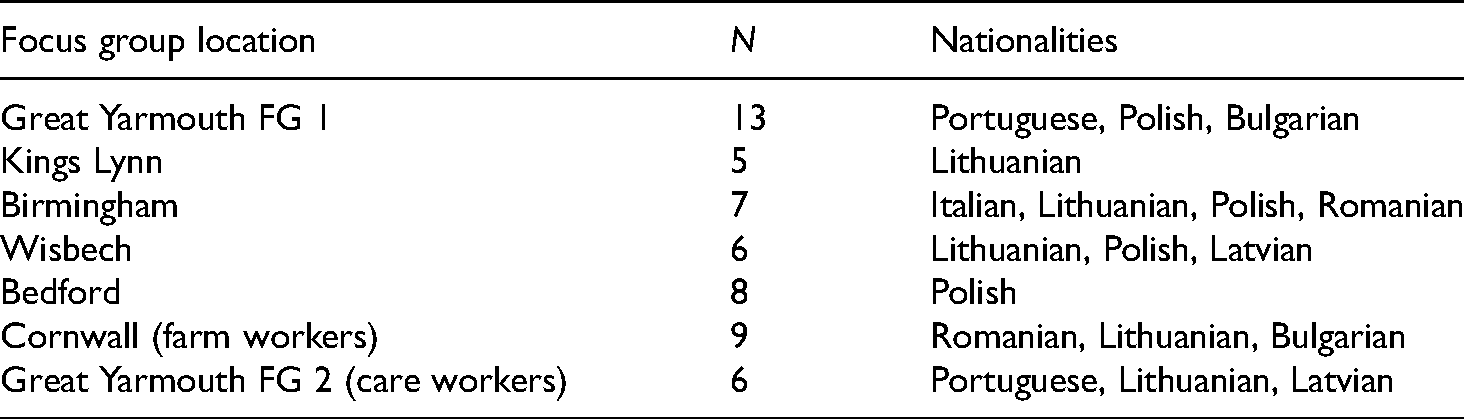
Focus groups lasted between 50 and 60 min on average and were conducted in a multi-lingual format with questions asked in English and translators available in sessions. All focus groups were recorded and transcribed (in English) to enable comparative analysis. The focus groups discussed the impact of Brexit in everyday life, EUSS applications, and experience of and/or perception of discrimination as an EEA+ national living in the UK.
To capture the realities of making applications under the new scheme – particularly for those accessing support from specialist multi-lingual advice organisations – we worked directly with two community advice agencies ACCESS and GYROS 6 based in Norfolk and Suffolk, East of England, who to date have supported over 2000 individuals to make EUSS applications in eighteen months, September 2019–March 2021. The authors were able to access client case notes and attend weekly ‘complex case’ frontline advisor team meetings to track any issues which were arising around EUSS. Field notes from these meetings were recorded each week and any individual cases were followed up through access to casework files. We have already recorded some of the issues which have arisen with applying to the EUSS via a series of blogs on the UK in a Changing Europe website. 7
We also undertook analysis of the top line EUSS data made available via the HO including both a monthly and a quarterly statistics release. This data release covers applications to the scheme, outcomes of applications, nationality and age of those applying to the scheme, and geographical/local authority level breakdown of applications to the scheme. We use this national data to contextualise our findings within the broader national landscape for EUSS applications.
The mixed-method approach adopted meant that for the purposes of the research, we were able to reach a broader representation of EU nationals living in the UK. We shall refer to those recruited into research via the online survey as Group A and those recruited via community focus groups as Group B.
Finally, the online survey, follow-up telephone interviews and majority of the focus groups (though not all) took place before the final Brexit day of 31 January 2020. This is reflected in some responses which continued to hold out the belief that Brexit would not in fact happen and would somehow be reversed. This belief was further reinforced by the fact that during this time, two Brexit dates had already been pushed back, adding to the sense on the part of some people that Brexit simply would not happen.
In the next two sections, we examine what the research showed, first about the effect the Leave vote had on EEA+ citizens already living in the UK and second, their experiences of applying for settled status.
Changing status
My experience has changed from feeling like a settled citizen to an immigrant enforced to apply for permission to reside in my own home.
It was evident from those we spoke to (especially expressed by those in Group A) that the process of Brexit made them feel like they were ‘becoming a migrant’ in the UK (see also Bhambra, 2017). Previously, many considered themselves as being an equal EU citizen who had moved to the UK under the freedom of movement rules. Brexit initiated a process of being reclassified as a ‘migrant’ which some struggled with, noting that they had never felt different in the UK before, a process of being ‘othered’ (Guma and Jones, 2019: 2).
Before the referendum I felt British. It's since been made clear to me via media and individuals that I am not part of this country.
Yes, I feel as an immigrant now whereas before I felt fully integrated in UK society.
However, for others this treatment was not just the hallmark of post-referendum life: they say that they had already experienced this less equal/more hostile undertone. However, post-Brexit people felt more empowered to voice those sentiments in public.
My feeling is that Brexit makes racist/xenophobic individuals feel entitled to openly express their feelings.
I think it also depends on which EU country you are from – potentially if I was from Poland/Romania or Bulgaria people would be much nastier.
Those from the focus groups also noted hostility towards EEA+ nationals pre-dating Brexit as a common experience. Many reported experiencing some form of ‘go home’ rhetoric during their life in the UK, pre-dating and then exacerbated by Brexit.
Years ago, before the Referendum, I was told at the NINO office to go back to where I came from.
Another time I was outside the school and was told ‘if you want to talk in your own language, go back to where you came from’.
This is supported by the literature which records a particular hostility to Polish, Romanian and Bulgarian migrants but more broadly to anyone from where is commonly referred to as ‘Eastern Europe’, (Fox, 2013; Fox et al., 2015; Guma and Jones, 2019; Lulle et al., 2018, 2019; Rzepnikowska, 2019).
Further, this feeling of increasing hostility to migrants is borne out by national police data, which shows that the number of recorded hate crimes has more than doubled in the period 2012–2018, spiking around the time of the referendum with a 41% recorded increase in the 12-month period 2015–2016, (Rzepnikowska, 2019: 61), albeit that the recorded hate crime targeted all ethnic minorities and Black British individuals.
As a Romanian, I have always felt the negativity of some of the media, politicians and general discourse on Romanians and East Europeans more broadly.
This also shines a light on a further issue, identified in other research, that there was a perceived hierarchical structure of EEA+ citizens in the UK, where (White) nationals from some European countries benefit from more acceptance of their right to access free movement to the UK than others (Favell, 2008; Fox, 2013; Fox et al., 2015; Lulle et al., 2019; Rzepnikowska, 2019). We saw this issue being internalised and articulated by some respondents:
Not really, I’m lucky enough to blend in quite well – apart from my foreign accent. I am from a wealthy Northern European country, and I am Caucasian and therefore I clearly enjoy certain privileges because of my background. People often indicate without saying it directly that I am ok because I am from one of the rich countries in the Nordics.
Being a white EU migrant in the UK from a German speaking country, I’m in a privileged position compared with other migrant communities esp. Africa, Middle Eastern, Eastern European, and ethnic minorities from EU countries.
Those from Group B, who needed to access specialist language support to participate in the research face further ‘acceptance’ hurdles. Grzymala-Kazlowska (2018: 260) in their research noted that structural constraints such as long working hours, or working solely with other non-English speakers, can make it difficult for some migrant workers to establish English language skills and connections in their wider communities. This was the reality for many of those in Group B we spoke to. They worked long, anti-social hours on farms or in local food processing factories with other non-English speaking migrant workers. Many workers in this situation often first learn another European language of their co-workers before they learn English.
I mean find me an English person in the chicken factory – there are none.
Their changing status and process of being ‘othered’ (Guma and Jones, 2019: 2) made people more conscious of their difference than they had previously been in the UK.
Who am I? Because I am very aware I am not English now. I have never been as aware of that fact. I am concerned with that idea. I am away from France – I have been away for so long. I understand two cultures now. Am I French? Am I English?
In fact, across both Groups A and B, Brexit and the Referendum were expressed as events that made people feel unwelcome in the UK. Participants expressed feeling more visible, less accepted and therefore more vulnerable in their local communities. Increasingly, they practised self-censorship in their daily lives:
After reading so many stories about hate crime, I think twice before speaking Romanian in public.
Yes. I am more careful when I speak outside, don't want people to hear my foreign accent. Recently a man shouted, ‘bloody foreigner’ hearing my conversation in a shop.
Our findings reflect the work of others (Grzymala-Kazlowska, 2018; see also Grzymala-Kazlowska, 2016; McGhee et al., 2017; Ranta and Nancheva, 2019) where those who had settled and had ‘anchors or established footholds’ (Grzymala-Kazlowska, 2018: 253) here in the UK now felt unsettled (Miller, 2019, Ranta and Nancheva, 2019) and unwelcome.
More generally Brexit and EUSS are causing EEA+ nationals heightened levels of stress and anxiety. We were told how affected some EEA+ nationals had been by the whole process and the impact it had on mental health and wellbeing. For many, Brexit has had a serious far-reaching impact on relationships with colleagues, friends and even other family members as well as more generally in their community.
I feel hunted and persecuted.
In conclusion, our research has highlighted the extensive feelings of otherness experienced by a number of our respondents because of Brexit, either as a new experience of unsettledness and self-consciousness, or as a magnification of pre-existing hostility towards them as an EU/EEA+ national. It has also identified the reinforcement of perceived acceptance hierarchies between nationals from different EEA+ states. We now consider whether the new EU settled status scheme helped them in any way.
The EU settled status scheme
The process
The immigration application process of moving from EEA+ citizen in the UK to EU migrant living here under HO rules is the EUSS. It has been described as the ‘gateway between belonging and exclusion’, 8 a process whereby people apply to access a legal immigration status to allow their continued life in the UK. The scheme was opened in the UK on 30 March 2019 after a testing phase of 200,000 people. EEA+ citizens, and all non-EU family members (NEFMs) must apply to EUSS to continue living lawfully in the UK after 30 June 2021. Depending on the length of time they can show they have been resident in the UK they will be granted settled status (EUSS) (5 or more years evidenced residency) or pre-settled status (EUPS) (less than 5 years evidenced residency). 9 EUSS is indefinite leave to remain whereas EUPS is limited leave to remain. Those with EUPS must re-apply when they reach 5 years of residence to be granted settled status. The government suggested that those who did not apply for settled status in time would be deported. 10 This statement has since been retracted, but the consequences of missing the deadline will bring EEA+ nationals face-to-face with the UK's ‘hostile environment’ 11 towards non-nationals.
The EUSS application is free and is undertaken by an app on a smartphone 12 . Guidance is that the ‘app journey’ should take around 7 min to complete – as the government advert puts it, the time it takes to make a cup of tea. To date (as of February 2021), just over 4.81 million people have received decisions under the EUSS (from 5.2 million submitted applications), with 53% receiving settled status decisions and 44% pre-settled status. For those EEA+ nationals who know about the scheme, have the accepted form of ID, documented history, the correct smartphone and IT and language skills, the process to apply for settled status can be relatively pain-free.
We’ve had very few bad experiences so far. Usually we can get people through [eventually] to the right decision. I say easy in comparison to other Home Office applications which are so difficult in comparison.
However, especially in our early research findings, awareness of the scheme was considered to be low amongst many groups especially those who did not speak English and who might not hear about the scheme from their employers or through social networks. We visited rural agricultural farm workers in Cornwall (Group B) who live on-site in caravans in remote and isolated fields on vast farmland. This group of people illustrated the complexity of firstly ensuring that the message about EUSS got out to all those who would need to apply and secondly, the practicalities of applying for EUSS while working long hours on a farm, living 6 to a caravan. This was especially problematic in relation to having the correct paperwork, access to a printer, a decent Wi-Fi connection, time and the relevant IT and language skills necessary to undertake an application (Barnard et al., 2019). Largely, workers were not allowed to keep their own transport due to parking space restrictions, so getting into the local town or city for help if needed with an application could also be a barrier, assuming help is available, which is not guaranteed.
Support from employers for the EUSS was mixed across the cohort of people we spoke with. Some of those who completed our online survey had been part of the initial testing phase (Group A) which had been supported by employers (at universities and hospitals). However, for some, it was felt that the employer saw immigration status as a ‘personal issue’ and not a ‘work issue’ so there was no support or advice available.
I got zero support from my company- they saw it as very much so a personal problem. Only got support by continuously pushing. Now there is a link on the website.
For some we spoke with (Group A), this lack of support from employers galvanised EEA+ nationals to champion support and advice within their own organisations, with some starting company-wide newsletters/blogs for other EEA+ nationals, some starting coffee mornings and others joining advocacy groups such as the 3 Million Group to join the fight to protect their rights.
I did become more politically active. Started a political group – a Pro-EU Group. Organised several events. Joined the 3 million.
Another common narrative amongst those we spoke to was to simply not believe that Brexit would actually happen which had an effect on their engagement with the EUSS process. Our research shows that due to much mixed and unclear messaging, the delays to the Brexit date (originally due to be 29 March 2019, ultimately 31 January 2020), calls for a second referendum, and a general election, there was significant disbelief that Britain would in fact ever leave the EU. For this reason, many were delaying making an application under EUSS.
My husband says we need to wait as what is the point in doing anything if we don't know what will happen?
However, even amongst those who were aware of the EUSS and planning to apply, some expressed reservations about the new scheme and also noted their mistrust in the Government. This mistrust was reflected in both Groups A and B of our research cohort. In some cases, EEA+ nationals who were aware of the scheme were suspicious of the relative ‘easiness’ of the EUSS application. For many, even settled status did not offer certainty of permanence in the UK – this could only be achieved through British citizenship – a point we will return to later.
EUSS seems too good to be true. I fear that it could just suddenly end at some point.
[I am] also stressed as I don't trust the Government to keep their word and not make any changes to our status or to the regulations that apply to our status.
Data protection emerged as a concern for some in sharing their details with the HO in both groups. Advice services reported several of their clients refusing to complete a settled status application as they had serious concerns about what would happen to their data, likely driven by the exemption clause in the Data Protection Act (DPA) (2018) which allows the HO the right to refuse access to some personal information held on individuals for immigration control purposes (DPA 2018, Schedule 2, Part 1, 4 Immigration), an exemption found unlawful in May 2021. 13
EUSS in practical terms was reasonably straight forward. I found it upsetting that I had to do it at all. I had to borrow a phone. I am worried about the biometric data where it is going and what they will do with it. Being on a Home Office database and doing god knows what with it.
While the app is (now) free, there can be hidden costs. Some in our cohort had failed to apply for EUSS because they did not have a passport and needed to apply for that first before they made their EUSS application. Others needed to send off their ID document or they needed to attend a designated document scanning centre (incurring travel and usage costs); yet others needed to pay to print off their relevant documents when further evidence was required or pay to call the advice centre for help. These hidden costs can have a big impact on those who are already economically disadvantaged. This prompted the Independent Chief Inspector of Borders and Immigration, in a report published in March 2020, to ask the HO to examine the hidden costs of making an application and look at whether the application was in fact truly free (ICIBI Report, 2020: 5). Our research also shows evidence of some in communities charging money to support people making applications for EUSS. This practice was only mentioned by those in Group B – those who had expressly sought out support to make their application to the scheme. In contrast to this, 81% percent of Group A participants reported being able to undertake their EUSS application without any help.
If GYROS wasn't here, I might go to the CAB for help or try to find someone who is computer savvy and ask them.
While charging money to help someone to make their application is not an illegal practice, these so-called ‘advice sharks' operate in a similar way to loan sharks, targeting the most vulnerable and using coercive control and sometimes violence to exert power over their ‘customers’. One frontline worker told us:
We are noticing a sharp increase in the number of clients contacting us, having paid someone in the Portuguese community to provide advice, including form filling for EUSS/benefit applications. The reason we are seeing these clients is that they have often been badly advised. We are also aware that in addition to any fee they pay for advice, some clients are having to pay part of their benefits, when in payment, to these individuals. Most of the clients have very poor English language skills, making them very vulnerable.
Security of status
Prior to Brexit, EU nationals living in the UK enjoyed the security of the supranational benefits of EU citizenship allowing them freedom of movement between member states (Seubert, 2020), introduced by the Maastricht Treaty (1992), one of the ‘four freedoms’ that form the basis of EU law (Barnard, 2019). This security of supranational EU citizenship is no longer applicable in the UK and our research shows EU nationals in the UK do not see the replacement legal status (EUSS) as providing equal security or rights.
Trust in the government – I don't trust them to make our life easy. I want to apply for citizenship – they can change the rules whenever they want it feels. Makes me a bit anxious about what is going to happen – or before they increase the price for citizenship or make regulations more difficult.
Prior to the introduction of EUSS, in the UK after a residence period of 5 years as a ‘qualified person’ an EU national automatically acquired ‘permanent resident’ EEA (PR) status 14 . In the period between the Referendum result in 2016 and the launch of EUSS in 2019 applications by EU nationals for both EEA (PR) and also British Citizenship 15 increased significantly suggesting many EU nationals were looking for pathways to secure their rights in post-Brexit Britain (Figure 1). However, for those who successfully acquired EEA (PR) status, this status became defunct after 30 June 2021, and they had to apply for EUSS (Barnard and Costello, 2020a).
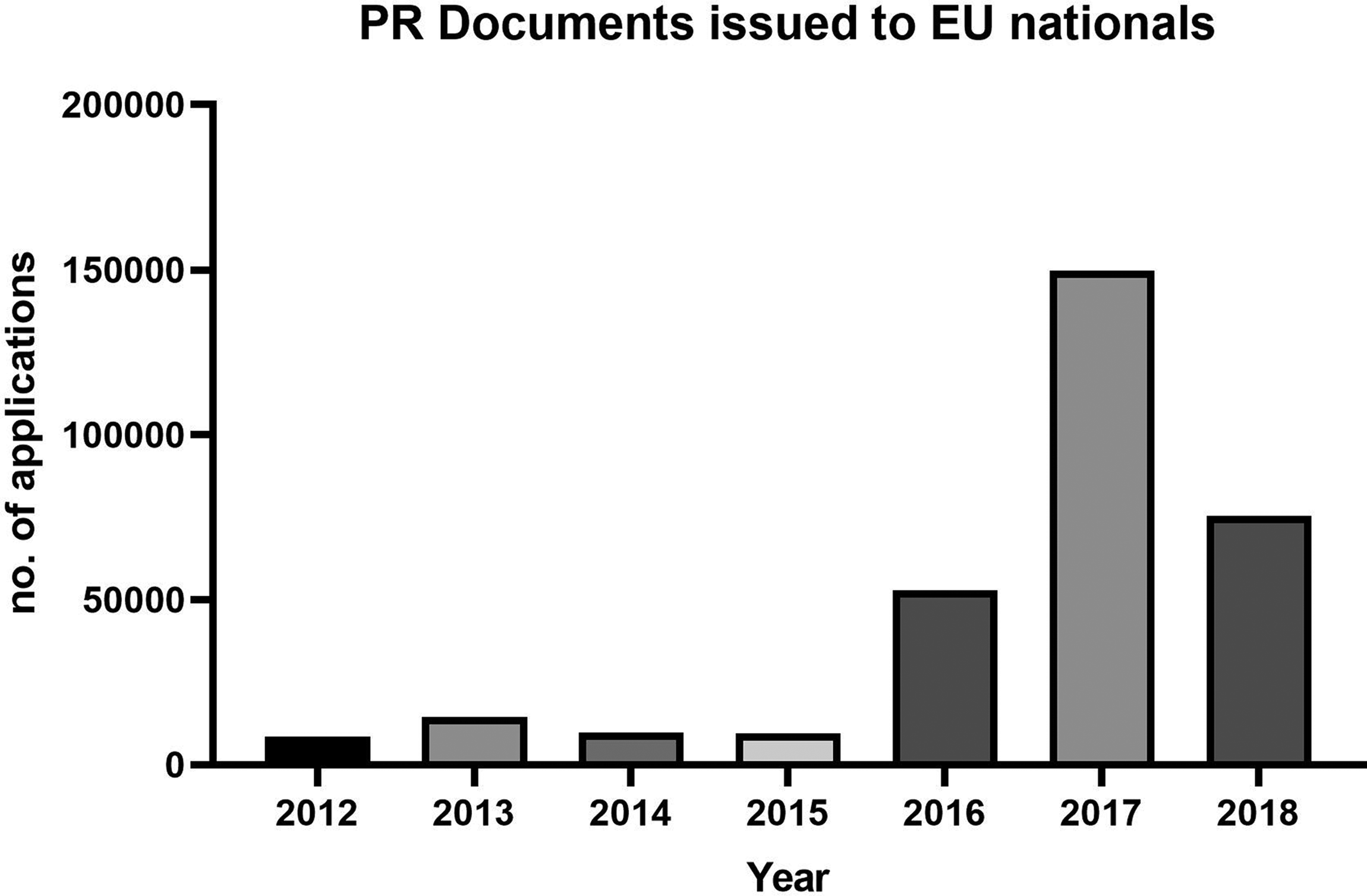
Permanent residence documents issued to European Economic Area (EEA) nationals.
In terms of applications for British citizenship, our research finds the ability to access dual citizenship varies according to different factors. The cost of naturalisation is, for many, prohibitive – at a minimum £1330 per person – and serves to further exclude those who cannot afford it.
I have been thinking about citizenship – it is quite expensive, so I don't necessarily know. I would have to decide not to do other things to save for it. I don't like that I am almost now forced to consider it.
However, most clearly in our research, we see evidence of many EEA+ nationals strategically choosing citizenship or framing it as an option in the future (Bassel et al., 2018; Bloemraad, 2004; Della Puppa and Sredanovic, 2017; Felix et al., 2008; Harpaz, 2019). Citizenship is the ‘gold standard’ legal route to security in the UK and for some who have already invested sometimes decades of their life in the UK, that security is essential. It is an effort to immunise themselves from the possible negative effects of Brexit and any reduction of rights in the future.
What if I became paralysed or got Alzheimer's and couldn't take care of myself anymore and needed access to some form of benefits. With citizenship this would be much more secure.
However, while many of those we spoke to said they intended to apply for naturalisation, EEA+ nationals are of course not one homogenous group and there were, within the cohort, those who would also refuse citizenship due to the context and fall out of Brexit.
After the referendum I really don't want to – I don't want to be British now. I can see why people do it. I would feel very awkward doing life in Britain test now. I would argue with every question.
Further, some countries such as Lithuania, Poland, Austria, the Netherlands, Germany and Bulgaria do not allow for dual nationalities or have stricter requirements around eligibility for dual nationality. If they had to give up their EU nationality, they will lose free movement rights in other EU states. Further, immigration rules on family reunification may be inferior for those with citizenship than those with EUSS.
As shown above, Brexit has required some people to rethink which citizenship they identify with the most alongside which would serve them best strategically. For some who have lived in the UK for many years it caused a crisis of identity:
I am in two minds about citizenship for me. In my heart, I don't want citizenship. I don't need it. My life here should be recognised. I am here 23 years. I might finish my PhD and leave. It is just too much. It's been 3.5 years and it is not getting any better … But on the other hand – maybe I should apply even if I leave, I have validated all the years here and contributions I have made. My daughter is now half-British.
Some mentioned securing citizenship as a route to keeping their options open – the citizenship ‘al a carte’ Fitzgerald (2012) spoke of:
With citizenship – ironically, I would apply in case I want to leave. Then it would be within my rights to come back. You have more certainly. Otherwise, it is as if I never lived here.
The irony of Brexit and the UK HO immigration policy of only allowing access to the ‘brightest and the best’ skilled workers is that our research findings show that the skilled workers are more likely to naturalise/claim settled status to retain their transnational life and secure entry and re-entry into the UK suitable to their lifestyle and needs, rather than necessarily as an indication of their commitment to being a British citizen or to long-term life in the UK (see also Lulle et al., 2018: 7). Those who expressed their wish to stay in the UK in our research cohort were exactly those in employment deemed ‘unskilled’ (farmworkers, care workers and factory workers in this case) and those to whom the Government has closed or significantly reduced future migration routes.
I like it the UK. A lot of rules. Strong rules. Bulgaria is a dangerous place. Beautiful for a holiday but no good for work. Shit money. It is great in the UK – I can get a lot of money here. Very nice.
When I arrived here five years ago, I think I want to be here forever. I want to be here for my kids’ future.
Alongside this is the reality of life events and family life in the UK. ‘Home’ is the UK, especially for children who have never lived anywhere else.
Children were born here so it would be very, very difficult to make the decision about moving back because for us adults it's coming back but for the little ones it is not coming back. Maybe not ruin their life, but life would be different because it will be a new reality for them, they know Poland of course but they know Poland to visit for holiday so it would be different for them.
This also links back to the previous point regarding English language skills and integration: McGhee et al. (2017: 2120) found in their research with Polish migrants that speaking English in the workplace was a significant indicator of further civic integration and likelihood of naturalisation of migrants in the UK.
While many in the focus groups expressed concerns about the impact that Brexit would have on the British economy and how this could affect their lives and cause hardship in their future, the general consensus from our cohort was that Britain would make it through, but it would take some time.
I am not stressed about it. I am against Brexit. I think it will be horrible for the economy. But I will go down with the ship. This is where I feel at home and I would be devastated if I had to leave.
EUSS for all?
Applications
As we have seen, there have been 5.2 million applications under the EUSS. EUSS is the first time the HO has undertaken a digital scheme of this type and scale and the number of applications processed to date is, in many ways, a tribute to the success of it. While for many millions the new status is achievable and the digital-only status manageable, there are a minority who are more vulnerable and as a result may be unable to achieve or maintain the new status. While there are no directly comparable schemes, other large-scale government regularisation schemes have never reached a 100% application rate (Clay et al., 2019; Daigneault et al., 2012). Even a 1% failure rate would mean that about 50,000 EEA+ nationals risk becoming undocumented in the UK on 30 June 2021.
There are various reasons people might miss the deadline in which to apply. In their September 2020 report Unsettled Status, the Oxford Migration Observatory (Sumption and Fernández-Reino, 2020) describe various factors which might contribute to people failing to secure their status. First, the report states, people may not know they need to apply. This may be due to the length of time already in the UK. For example, as we have seen, many people have already applied for and have been granted permanent residency (EEA (PR)), (Barnard and Costello, 2020a). In addition, an estimated 139,000 non-Irish EU nationals have been living in the UK for 30 years plus and may assume they have the right to stay (Sumption and Fernández-Reino, 2020). Second, they outline groups who already face social exclusion or individuals whose independence or autonomy is reduced, such as those with dementia, those with learning difficulties and long-term social care needs, victims of modern slavery, and members of the Roma community (Sumption and Fernández-Reino, 2020). They also describe those who may not have access to the historical paperwork needed to meet the requirements of the scheme – such as victims of domestic abuse, those rough sleeping, as well as simply those who have lost or have expired documentation (Sumption and Fernández-Reino, 2020). However, the scheme does allow for some evidential flexibility which is a unique feature of EUSS in comparison to wider HO immigration applications.
Generally, with EUSS I am impressed. EEA (PR) was what, like 82 pages as opposed to 10 min with the app. I am impressed with how they designed it. It took me two minutes to do my own. It can be just as quick for a client who comes to a grant funded organisation – as we do it for them!
Based on EUSS data there is another group that is generating concern: the young and the old. HO statistics show much lower than expected levels of applications from those aged under 18 (15% of total/December 2020) or over 65 (2% of total/December 2020) but equally (like the scheme as a whole) the numbers of those who need to apply within these age ranges are simply unknown. It is estimated that there are 689,000 non-Irish EU national children in the UK (Sumption and Fernández-Reino, 2020). However, this number does not include EU national children born in the UK. One advice agency reported speaking to some parents who had made applications in their own right or had been supported by an employer to do so but were unaware that they also needed to make an application for their children, as the child had been born in the UK. UK citizenship in relation to children is complicated, and children born here do not automatically qualify for British citizenship; it depends on their parents' legal status in the UK, such as in this instance, whether their parent(s) were permanent residency holders, settled status holders or British citizens when the child was born. The HO's own figures show that applications from looked after children and care leavers have been particularly low to date, with only 30% of children who need to make an application having received status under the scheme (December 2020) 16 .
While we have no directly comparable estimated population for those over 65, an estimated 281,000 non-Irish EU citizens have been resident in the UK for more than 20 years of which 94,000 of the group have been resident in the UK for at least 40 years (Sumption and Fernández-Reino, 2020). Neither group's application numbers (younger nor older) to EUSS have yet surpassed these estimated figures. Advice agencies in our research cohort now proactively ask everyone who accesses their service if they and all their family members have undertaken their EUSS application.
This is a moment in time we will never get back. We want to scoop people up now and get them through the system to secure their rights. Otherwise, it will be much harder for us in the future to unpick the very serious problems a lack of status will cause for individuals.
The further group who have struggled to navigate the application are those who have difficulties accessing or using the digital-only platform due to lack of digital skills, technological illiteracy or those experiencing technological poverty. The Office for National Statistics has estimated that 9% of adults in the UK are non-internet users (ONS (2019) Internet Users, UK 17 ). The Oxford Migration Observatory estimated in 2020 that 2% of non-Irish EU nationals (equivalent to 42,000) had not used the internet in the previous 3 months (Sumption and Fernández-Reino, 2020). Campaigns led by groups such as The 3 Million 18 for physical proof of status have been voted down in both Parliament and ultimately again in the House of Lords in a second vote in October 2020. Community-based migrant support organisations GYROS and ACCESS' data shows that more than 60% of their clients rate their IT skills as lower than 5 out of 10 – with 1 being non-existent and 10 being excellent.
Further, comparing ACCESS' and GYROS' EUSS support data (monthly breakdown Figure 2) to HO EUSS data for their local authority areas (Norfolk and Suffolk respectively) shows that approximately 8% of the local EU population in these areas needed to access specialist support to undertake their EUSS application. Of course, this figure represents only those who know about (a) EUSS and (b) specialist support, so the actual number could be much higher. However, even at 8%, this suggests a significant number of people who will continue to need support with their status into the future either due to English language or digital skills or for other factors. Since September 2019 these organisations have, together, supported 2140 individuals to make applications under the EUSS. 61% of their client group who have accessed this specialist support are female. The monthly support overview (Figure 2) showcases peaks and troughs in line with national HO EUSS data (Figure 3), with peaks around presumed Brexit dates (Brexit date 2, October 19) and then a significant drop in numbers March–April 2020 in line with the first coronavirus (COVID-19) national lockdown in the UK. However, the HO national data (below) then shows applications begin to rise again post-August 2020. The localised community support data on the other hand shows no such recovery post lockdown restrictions. Due to COVID-19, specialist support agencies specifically helping those who are more vulnerable or unable to complete the application by themselves have had to move to virtual support – the very online support that means these vulnerable people cannot access the EUSS application process (Barnard and Costello, 2020d).
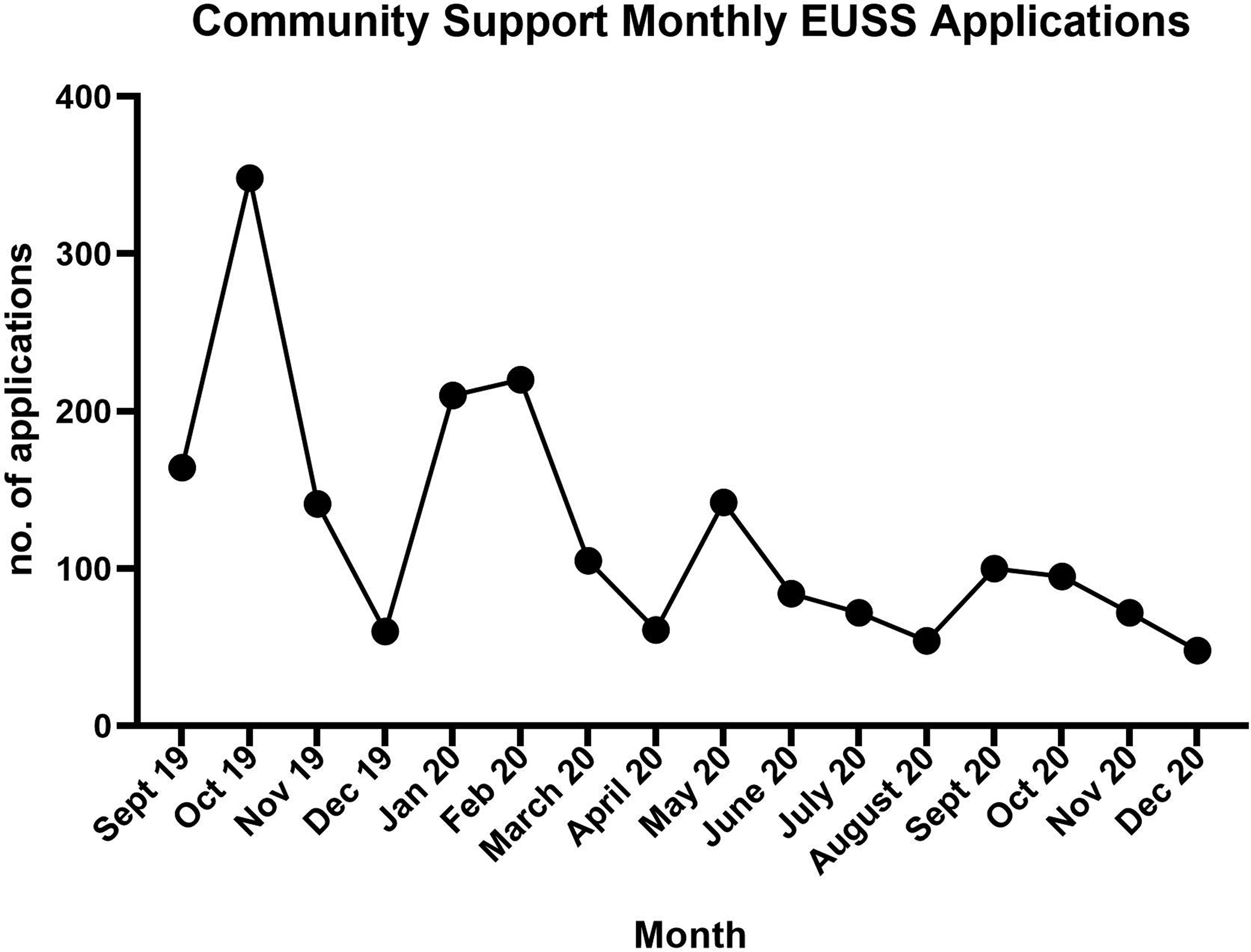
ACCESS' and GYROS' European Union Settlement Scheme (EUSS) support data.
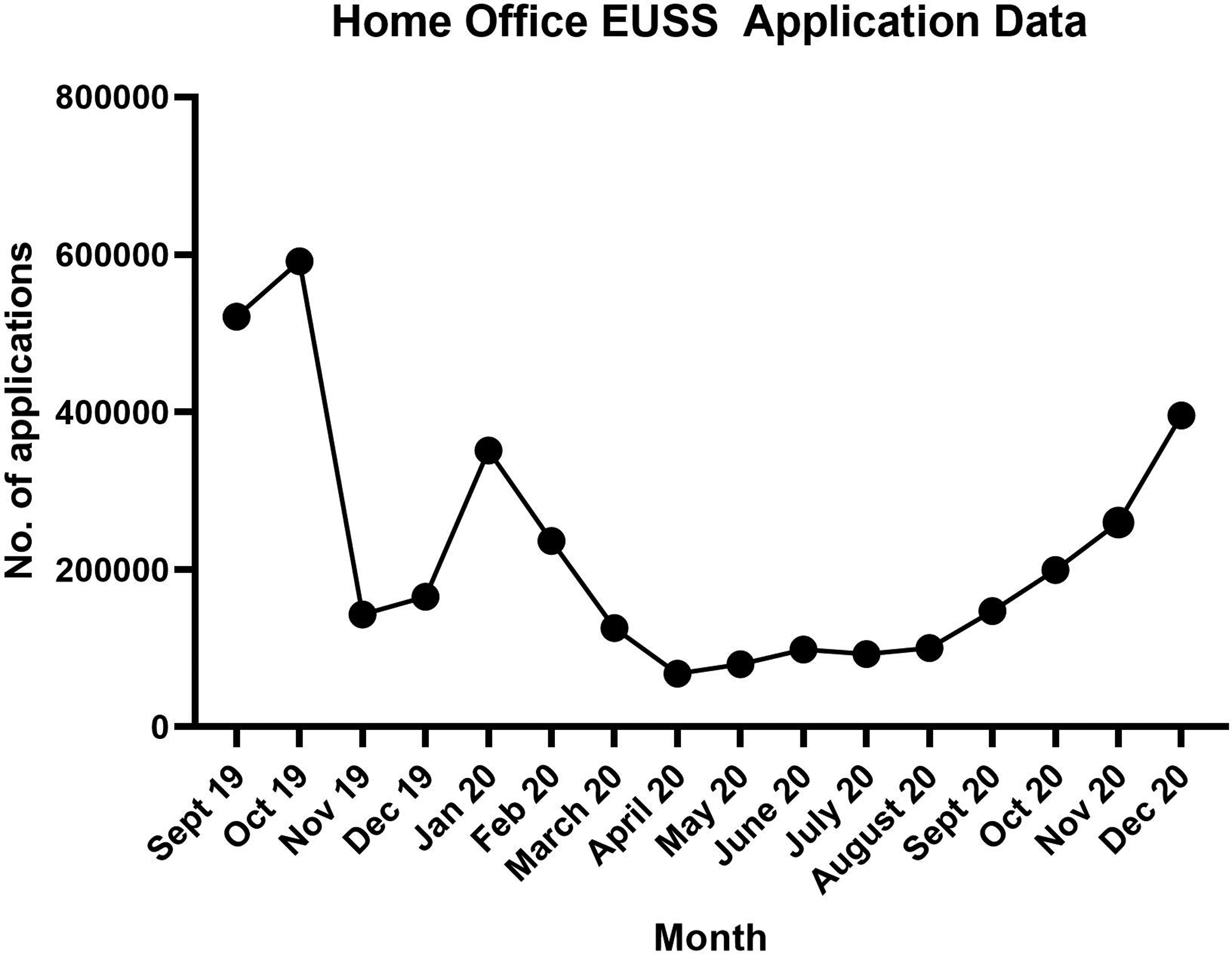
Home office European Union Settlement Scheme (EUSS) data.
If anyone asks for help with starting their application, we can still provide help, support and coaching over the phone, but it is a lot harder, more time consuming, and if evidence etc. is necessary, it will most likely delay their applications even further.
Sixth, insufficient English language skills can be a barrier for many, firstly in terms of awareness of the scheme and then in undertaking an application. The data shown in Table 2 presents the self-reported English language levels of GYROS clients in the period 2012–2020 (n = 2923), with 86% rating their English language skills as either limited, very limited or none.
Self-assessment of English language skills of GYROS' clients.

Maintenance
Even for those who achieve settled or pre-settled status they will need to manage and access their status via an online platform using their unique log-in details and ID documentation used in their original application. They must update their status whenever they have any changes in circumstance such as a new passport issued or a change of address.
We did some applications with some Bulgarian and Romanian nationals recently- some of whom couldn't read or write in their own first language. And we try to explain that they will need to update their profile and they nod and say yes but you can see they have not fully understood what you are saying about the digital status.
Should they need to share their status with a third party, for example an employer or landlord, the status will need to be accessed online, where a digital access code will be generated which can be shared with the relevant third party. This process is not straightforward. The Public Law Project has outlined the nine-step process a third party would have to undertake in order to check the status of an EEA+ citizen, which includes asking for a share code provided from the potential employee/tenant, accessing email and an online portal, inputting codes etc. (Tomlinson and Welsh, 2020: 6). It is unknown what impact the 9-step process and additional immigration check responsibilities will have on employers, landlords and others. In relation to this point, the HO's ‘right to rent’ scheme was the subject of judicial review. 19 The ‘right to rent’ scheme requires all landlords to check the immigration status of potential tenants before renting a property; failure to do so can result in a large fine and/or prison sentence. The Court of Appeal found that while some landlords did discriminate against potential tenants who had no British passport, the scheme could be justified as a proportionate measure to prevent irregular migrants from being able to rent accommodation. Five million-plus EEA/NEFM nationals will now be added to this group for whom landlords and other third parties must undertake status checks. And of course, online systems can have glitches:
We had one issue where we went to hold an EUSS advice support drop-in on a Saturday and the website was down – with no prior notification. We had to rebook everyone. Probably they [the Home Office] thought as it was a Saturday no-one would be working!
Conclusions
In this article, we have examined EEA+ nationals' experiences of Brexit and EU settled status. We have identified that large numbers of participants in our research have felt unsettled and ‘othered’ by the Brexit process. However, these lived experiences are always contextual and intersectional and were expressed here either as a new experience of unsettledness and self-consciousness, or as a magnification of pre-existing hostility as an EEA+ national. EEA+ nationals and their non-EU family members in the UK are not one homogenous group. The EUSS itself has highlighted the contextual nature of that lived experience: we saw marked differences between the experience of those in Group A and those in Group B of making an application under EUSS and the level of support that was needed to do so.
Our research findings also suggest that many people intend to apply for British citizenship in order to cement their security of status in the UK, feeling that the new settled status option does not provide enough security to those who have moved their life to the UK. Our research presents interesting findings in terms of identity and belonging theory (see also Grzymala-Kazlowska, 2018; Ranta and Nancheva, 2019) in the context of EEA+ and NEFM nationals living in the UK. Brexit offers an unprecedented situation where a member state has seceded from the European Union and now some 5 million EEA+ and NEFM citizens find their citizenship rights here have changed irrevocably, the effects of which are still not fully understood as the UK continues to navigate the post-Brexit‘ grace period’ until June 2020. Alongside citizenship, Brexit has raised issues of identity and belonging with some availing of British citizenship for convenience and security rather than from any sense of identification with this status, and with many people experiencing fundamental shifts in their sense of belonging in the UK. This has important implications for further research around identity and belonging as well as more practically for UK citizenship pathways for those with settled status in the future.
While the EUSS application has been achievable for a large number of people (with 5.4 million applications) the reality is that we do not know how many people need to apply and therefore we can never know if a 100% application rate has been achieved until after the application gateway has been closed. However, we do know that there are a number of different groups of people who need to apply that display vulnerabilities which suggest they could be more likely to be unaware of the scheme, unable to apply or could miss the deadline in which to apply for a myriad of reasons.
Further, 44% of applications have received pre-settled status, which means that for this group, their application is the first of a two-step process to secure their permanent status in the UK. They will need to re-apply to acquire ‘settled status’. In reality, this means that more than 2 million people will need, in the fullness of time, to make a further application under the EU settlement scheme.
Finally, looking to the future, all those who have secured status under the scheme will also need to undertake status maintenance for the remainder of their life in the UK, and be able to share their status with third parties at all relevant junctures. Third parties will have to undertake additional immigration checks, with significant consequences for any failure to do so, as well as the potential risk of discrimination (direct or indirect) by those who fail to undertake the 9-step process as outlined above.
The EUSS, while a remarkable success at one level has had and will continue to have serious consequences. The legacy of EU (EEA+/NEFM) migration to the UK and the roll-out of the EU Settlement Scheme will continue to have an impact for decades. The replacement of a two-tier system of migration to the UK (one for EU/EEA/Swiss nationals, one for the rest of the world) with a one-tier system for the rest of the world, including the EU, masks the significant numbers of individuals who enjoy special status under the EUSS, a status that they will have to maintain actively.
Footnotes
Declaration of conflicting interests
The authors declared no potential conflicts of interest with respect to the research, authorship, and/or publication of this article.
Funding
The authors disclosed receipt of the following financial support for the research, authorship, and/or publication of this article: This work was supported by the Economic and Social Research Council (grant number ES/T000716/1 ESRC).
