



Abstract
In the context of home, violence remains more accepted when committed against children than adults. Normalisation of parental violence has been documented in attitudinal surveys, professional practices, and legal regulation. For example, in many countries violent disciplining of children is the only legal form of interpersonal violence. This study explores the societal invisibility and normalisation of parental violence as a crime by analysing legislation and control policies regulating the division of labour and involvement between social welfare and criminal justice authorities. An empirical case study from Finland, where all forms of parental violence were legally prohibited in 1983, is used to elucidate the divergence between (criminal) law and control policies. The analysis demonstrates how normalisation operates at the policy-level where, within the same system of control that criminalised these acts, structural hindrances are built to prevent criminal justice interventions.
Keywords
Introduction
Historically, violence against women and children in private have been legally and socially condoned and morally justified by the unequal social positions and power relations between the perpetrator and the victim (Freeman and Saunders, 2014). While the societal understandings and regulation of such violence have changed, researchers have pointed out that violence against children in the context of the home is still more accepted than violence against adults (e.g. Fagerlund et al., 2014; Strauss et al., 2013). And that the change in legislation and policies has been slower concerning parental violence vis-à-vis intimate partner violence (e.g. Durrant and Smith, 2010; Sebba, 2005). Furthermore, little attention has been given to physically less injurious, yet often more frequent, acts of violence by parents, what Muncie (2015: 167) refers to as the ‘routine of violence’. The legal regulation of violent disciplining is an emblematic example of the late realisation of, and accepting attitudes towards, habitual forms of parental violence. For example, at the beginning of the millennium an explicit legal prohibition of violent disciplining of children had been enacted in only 11 countries, whereas 20 years later 61 countries 1 have legislated such a ban. Nevertheless, in numerous countries, such as England, 2 Canada, the US and many Asian countries, physical violence by parents for disciplinary purposes (usually acts equivalent to common assault or minor assault) is written into legislation as a rightful exemption thereby avoid prosecution. Thus, in many countries violent disciplining remains the only legal form of interpersonal violence. Unsurprisingly, it is globally the most common form of violence against children affecting at least four out of five children aged 2–14 years (UNICEF, 2014).
By analysing state-level policies regulating and controlling parental violence, this article contributes to the wider discussions in social sciences concerning interpersonal violence connected to structural inequalities and inflicted by the more powerful on the less powerful (e.g. Walby, 2013). It expands the critical, feminist socio-legal examinations of state’s actions and omissions in controlling private violence by exploring from a generational perspective the macro-level societal processes hindering, or even preventing, control of such violence. Parental violence, and its habitual forms in particular, is a good example of what Davies et al. (2014) have framed as invisible crimes and social harms. In other words, acts that escape societal attention and disapprobation, legal regulation and control as well as scholarly scrutiny. According to Davies et al., structural power, embedded in broader historical, socio-legal, and spatial contexts and institutions such as state, family, and home, commonly obfuscates and normalises such crimes and harms. In practice, this relates to how invisible crimes and harms are perceived, defined, and reacted to, and how resilient they are to challenge and to change. Denying, ignoring, or downplaying these acts and the resistance to change is often indicative of a tendency to preserve the prevailing social order and serve the interest of the powerful (Davies, 2014; Scraton, 2020).
In this study, the lack of control, and hindrances to intervene, are perceived as indicators of the relative invisibility and normalisation of parental violence as a crime (Davies et al., 2014; Jupp et al., 1999). This is elucidated through a policy analysis based on empirical data collected from Finland, the second country to enact a legal prohibition on all forms of parent to child violence as early as 1983. General attitudes towards violence against children have changed to become considerably more negative in Finland particularly during the 21st century (Hyvärinen, 2017), and incidences of such violence have decreased over time (Fagerholm et al., 2014). Nevertheless, researchers have pointed out that, despite the prohibition, violence against children has not been fully acknowledged as a problem in Finland, especially from the perspective of interventions (e.g. Pösö, 2011). Authorities face a very high threshold to intervene, share information and cooperate with other authorities in cases of parental violence (Ellonen and Pösö, 2014; Heinonen, 2015). This research critically examines the state-level policies concerning authority interventions to parental violence after the Finnish prohibition in 1983. It concentrates on the divergence between the criminal law and control policies by examining the practices of normalisation within the state’s system(s) of control that initially imposed the control via legal norms. Empirically, the focus is on the division of labour and involvement of the social welfare system and criminal justice system and, specifically, on the intervention threshold of the latter. Despite the focus, it is important to note that this paper does not make a value judgment regarding what is the most suitable measure of intervention, or combination of measures, in cases of parental violence. The data consists of legal documents, policy documents and reports by governmental organisations.
Generational Order, State Interventions and Invisibilities of Violence in the Private Sphere
Feminist research on violence, since the 1970s, has examined physical and sexual violence against women by men as a product of gendered social order; structural conditions and power relations that often intersect with other social categories, such as class, ethnicity, and sexuality, also generating inequalities (e.g. Hunnicutt, 2009; Walby, 2009). Gendered social order is dynamic yet formed by historically produced sets of relations and conditions where men’s domination is institutionalised and ‘naturalised’ (Connell, 2009). This study emphasises the importance of acknowledging a generational perspective in the context of violence. It draws on Leena Alanen’s (e.g. 1992, 2011) conception of generational order that is built on an understanding that society and social relations are also organised between generational categories of ‘adult’ and ‘child’. And furthermore, that generation is a similar historically produced and socially determining, intersectional macro-structural category as, for example, gender, social class, and ethnicity. Yet, as such a category, generation is more rarely challenged. Generational order, like gendered order, permeates social structures and institutions indicating different – structurally asymmetric – positions to individuals (Alanen, 2005). Another connecting feature between gendered and generational social orders, particularly relevant when examining violence, is that they both have institutionalised relationships to the normative division of social spheres into public and private, specifically to home and family (Alanen, 2011).
State is not an objective or unbiased entity; its functions are self-motivated (Walklate, 2007). As an institution, the state is constructed within gendered and generational orders and, furthermore, it is the key organiser of power relations between genders as well as between children and adults (Alanen, 2011; Connell, 2009). These social orders are embedded, produced, and reproduced in the actions of states and state representatives, for example, in policies, legislation, and authority interventions preventing and controlling violence and protecting its victims. For instance, feminists have perceived states’ reluctance to intervene against violence in the private sphere as a reflection of the heteropatriarchal nature of the state and as a way to maintain gendered social order (Boesten, 2012; Connell, 1994). This does not suggest that issues related to gender, or generation, cannot be enhanced by state policies, it does, however, mean that the ways these issues are acknowledged, or overlooked, relate to the fundamental activities and interests of the state itself (Walklate, 2007).
The lack of legal regulation of violence in the private and more recently, after criminalising several forms of violence against women, the lack of effective criminal justice interventions and sentencing are viewed as an indicator of states’ granted legitimacy for such violence (e.g. Hearn et al., 2016; Walby, 2009). In other words, that state and state agencies accommodate such (illegitimate) use of power (Connell, 2009). From the perspective of generational order, the same can be said regarding violence against children by their parents that has been, and partly still remains, similarly underregulated and unsanctioned. When parental violence has been deemed as harmful, it has been treated within the social welfare system rather than the criminal justice system, usually by social work and child protection professionals. In terms of control, social work methods and rights to intervene are less intrusive than those of criminal justice authorities, and their working measures rely largely on client cooperation. This is particularly so in Nordic countries where the child protection system is family support and service orientated offering a wide range of voluntary measures aimed at avoiding out-of-home placements as far as possible (e.g. Burns et al., 2016; Gilbert et al., 2011). Nevertheless, the resistance to interventions, by the state and across society, in the private sphere is not only an issue connected to the criminal justice system. Social work, particularly when practised with families and inside homes, has been critically viewed, for example, as social disciplining (Knepper, 2007) and policing families (Donzelot, 1980).
From the generational perspective, the resistance to state interventions to the private is rooted specifically in parents’ rights (to privacy), understandings related to parent-child-relationships, and children’s position in the family. It has been stated that childhood, as generational order, connects children spatially, economically, and ideologically to the home and the family (Qvortrup, 1993, 2017). This is evident, not just in assigning children primarily to the private sphere or in their dependent position regarding adult family members, but also in the way children’s needs and rights are often weighed against, or subordinated to, the needs and rights of the family and parents. Legal and policy initiatives for children’s rights have often been perceived as a threat to the privacy of the family and parents because of the fear of an increase in state interventions (Leonard, 2016). Raewyn Connell’s (2005, 2009) concept of patriarchal dividend refers to advantages (e.g. money, authority, access to power, and physical integrity) men gain as a group when unequal gendered order is maintained. In this study, the idea of dividend is adapted to the generational context of family. Thus, maintaining unequal generational order benefits parents as a group; here specifically in terms of rights. This generational dividend of rights in the private also applies to parental violence. For example, parental exemptions for violent disciplining are justified by weighing the negative consequences of an intervention (whether by the criminal justice system or social welfare system) for family privacy and parental rights against the harms related to violence inflicted on a child (Fortin, 2009; Shmueli, 2010). In addition, the ideal understanding of intimacy and care connected to home and parent-child-relations is effectively blurring the acknowledgement of parental violence as the relationship between care and violence is often automatically assumed to be antithetical, even though they are historically and socio-culturally tightly entwined in the context of parenting (Oswell, 2013).
Historically, the state’s criminal justice interests have been focused on controlling ‘public wrongs’; deviant and dangerous behaviours threatening to the prevailing social order in public (Farmer, 2011). Hence, it is unsurprising that invisible crimes, such as parental violence, are often acts that appear in private, non-transparent locations outside the public gaze (Davies et al., 2014). Becoming an interest of the criminal justice system requires that an act is perceived as (criminally) reprehensible and wrong (Nuotio, 2010), but societal acknowledgement of the victims and perpetrators is also essential (Jordan, 2012). One of the key dilemmas related to invisible crimes is that the related victimisation is not recognised by state and society. Furthermore, the lack of societal recognition might remain unchallenged due to the lack of recognition of the victims themselves who might not be aware of their own victimisation, and who are often powerless and in a vulnerable position (Francis et al., 1999). This is particularly relevant when harms and crimes are inflicted on children who are all, more or less, vulnerable and have restricted agency, as victims and potential reporters of crimes, due to their age, immaturity and dependence on adults. Therefore, authorities with a duty to report child abuse and intervene are perceived of as the gatekeepers of children’s safety and wellbeing (Ashton, 1999). Yet, child-victim surveys show that only a small fraction of children’s experiences of victimisation are acknowledged by authorities (Bunting, 2014; Lahtinen et al., 2020); hence, highlighting the importance of effective intervention policies and clearly stated responsibilities in this context.
As the holders of systemic, structural power, states are in a key position to maintain the invisibility or, depending on their interests, to enhance the visibility of crimes and harms (Davies et al., 2014). Here, the involvement of the criminal justice system is interpreted as a signal that the act is perceived and defined as (potentially) criminal whereas involvement of the social welfare system alone indicates the opposite. The relative nature of invisibility means that it alters over time; sometimes in a non-linear manner. For example, a form of violence is invisible as a crime if it is not even recognised as violence, but instead as an understandable incident or behaviour; consequently, obscuring the need for control. Gradually, such acts may gain some visibility as harmful but non-criminal acts that do not require criminal justice intervention. Furthermore, the invisibility may reduce to the point of criminalisation, yet there can still be resistance in society and within state agencies. The link between regulation and control is not straightforward. Criminalisation does not necessarily mean full visibility as a crime with active control measures (Davies et al., 2014; Lea, 1992). This captures the situation in Finland following the legal prohibition on all forms of parental violence explored in the next section that contextualises the following empirical analysis. Therefore, a further conceptual distinction between formal and substantive criminalisation is useful when examining the divergence between the criminal law and control policies. The former refers to law in books and the latter to the practical implementation of a formal legal norm (Lacey, 2009). Given the generational challenges regarding interventions in the private and the social position and restricted agency of children, it is argued here that the substantive criminalisation should include clearly appointed (legal) responsibilities and reporting duties for authorities to ensure that interventions, investigations, and potential prosecutions are possible.
Early Policies and Regulations on Parental Violence in Finland
The first legal change regarding parental violence was a removal of a subsection allowing parents to physically discipline their children from the Criminal Act in 1970. Regardless of the repeal, understanding among legal scholars then was that the aim had not been a criminalisation of violent punishments nor control of them by means of criminal justice (Kotanen, 2018a). The aim was to change legal praxis by instructing courts that the custom to convict a parent for a minor assault while they had committed severe violence towards their child, as the exemption had widely been interpreted, was not legitimate anymore. In practice, the repeal merely differentiated ‘acceptable’ (just) and ‘unacceptable’ (criminal) forms of violent punishments from each other; they were still considered as a legal right of a parent if the use of violence did not cause serious injuries (Kotanen, 2018a: 113–114). In general, violence against women and children in the private sphere started to garner attention as a problem in Finland in the early 1980s. Such violence was perceived as an inner dysfunction of, and conflict within, a family unit rather than an issue related to power or control. Therefore, classifying individual family members as victims and perpetrators was seen as unnecessary (Peltoniemi, 1984). Consequently, if interventions were made, they were conducted by authorities working mainly in the social and health care sector as police were rarely involved (Niemi-Kiesiläinen, 2004).
The prohibition of all forms of parental violence was included in a wider reform of the Act on Child Custody and Right of Access (361/1983). The reform aimed for broader social change and in this context, violent disciplining was considered a hindrance to the realisation of children’s wellbeing and rights. The momentum for the early prohibition was generated in 1979 by the United Nations International Year of the Child and the example of the neighbouring country of Sweden, the first country to enact such prohibition. The Finnish prohibition was drafted following closely the wording and spirit of the Swedish legislation (Kotanen, 2018a), and it reflected the above-mentioned, understanding of violence within a family as a dysfunction or conflict. Firstly, during the legal process, children were not perceived as victims of violence and, in fact, the prohibited acts were not defined as violence nor as crimes. Secondly, as a consequence, there was no discussion of control practices. Instead, similar to Sweden (Jansson et al., 2011), the explicit emphasis was to reassure that sanctions would not be imposed on parents. Rather than a measure of intervention, the prohibition appeared as an aspirational, symbolic enactment that aimed at long-term attitudinal change (Kotanen, 2018a). The only reference indicating criminalisation of violent disciplining was made in the governmental proposal where legislators suggested that the Criminal Act’s section concerning minor assaults could be applied in cases of violent disciplining by a parent.
Nevertheless, the renewed Child Protection Act (683/1983), that came into effect in tandem with the prohibition in 1984, gave some initial guidelines concerning authorities’ responsibilities. The Child Protection Act specified that if authorities (including police) and professionals working with children ‘had learnt while on duty that there is an evident need for child protection, they have to report to social services without a delay’. With this mandatory reporting obligation, social services – and child protection in particular as the receiver of these reports – was appointed as the key gatekeeper in cases of violence against children (Pösö, 1995). The reporting obligation, however, has been criticised as too ambiguous because the meaning of the phrase ‘need for child protection’ was not clarified for other authorities working with children, nor was the relationship between the reporting obligation and their obligation to maintain professional confidentiality (Pösö, 1997). It was also problematic that violence or abuse were not defined, nor mentioned, in the Child Protection Act.
The vaguely formed reporting obligation and the silence around violence caused confusion among authorities who reported cases of physical violence to child protection very rarely during the 1980s and 1990s (Pösö, 1995, 1997). Furthermore, even though the main intervention responsibility regarding violence against children was attributed to child protection professionals, according to Tarja Pösö (1995), physical violence within a home was largely overlooked in child protection unless it was proved by medical diagnosis. Parental violence was not recognised as a separate problem, or even as a form of interpersonal violence, within professional practices of child protection. Instead, it was normalised as part of a wider, nonspecific category of family conflict. The family conflict approach to violence was in line with the family-centred, therapeutic method of working that has been characteristic to professionals working with families and children in the Nordic family service-orientated child protection systems (Gilbert et al., 2011).
From a societal perspective, the situation was similarly ambiguous. Opinions towards the prohibition of parental violence were highly polarised among Finns (Kotanen, 2018a). According to attitudinal surveys, almost half of Finns agreed with the statement that the physical punishment of a child is acceptable, at least in special situations (Peltoniemi, 1983). Also, the first child victim survey, conducted in 1988, revealed that physical violence by parents was highly prevalent in Finland. Almost 10% of children had encountered grievous forms of violence and 72% of under 15-year-old children had been violently disciplined by parents during their lifetime (Sariola, 1990). Hence, regardless of the prohibition, rather than criminal behaviour, physical violence was at the time a common measure of child rearing in Finland to which most parents had, at least occasionally, resorted. Consequently, this affected the intervention threshold and attempts to control such violence by authorities across different sectors. Ambiguous authority practices and attitudes became evident, for example, in a court case regarding violent disciplining that was eventually resolved by a high court decision in 1993 stating that violent disciplining is a criminal act even when inflicted on a child by a parent (Husa, 2011). The above-described situation fits the concept of formal criminalisation (Lacey, 2009). The prohibition and the high court decision increased the visibility of parental violence as a crime. Nevertheless, the absence of intervention policies and wide disregard and normalisation of parental violence resulted in a lack of implementation of the legal norms; simultaneously, enhancing its invisibility. Therefore, the following empirical sections examine the later policy developments on a state-level towards a substantive criminalisation of parental violence by focusing on change in the division of labour and involvement between the authorities of social welfare and criminal justice sectors and, specifically, on the change in what constitutes a sufficient threshold for an intervention of criminal justice authorities.
Data and Method
The data comprises a collection of legal documents, policy documents and reports concerning violence against children produced by, or under the guidance of, the Ministry of Justice, the Ministry of Social and Health Affairs, the Ombudsman of Parliament, and parliamentary committees. All included documents are publicly available. The documents are either concentrating specifically on violence against children or on a wider range of issues of which violence against children is one concern among many (e.g. renewal of the Child Protection Act 3 ). Where the overall process was not solely focusing on violence against children, only those parts of the documents concerning issues relevant to violence have been analysed. Table 1 lists chronologically the policy processes and documents included in the data. Document identifications used in empirical analysis are in brackets after each title (e.g. LaVM 9/2006). The titles of the documents as well as data quotes in empirical sections are translated from Finnish to English by the author.
Policy processes and included documents.
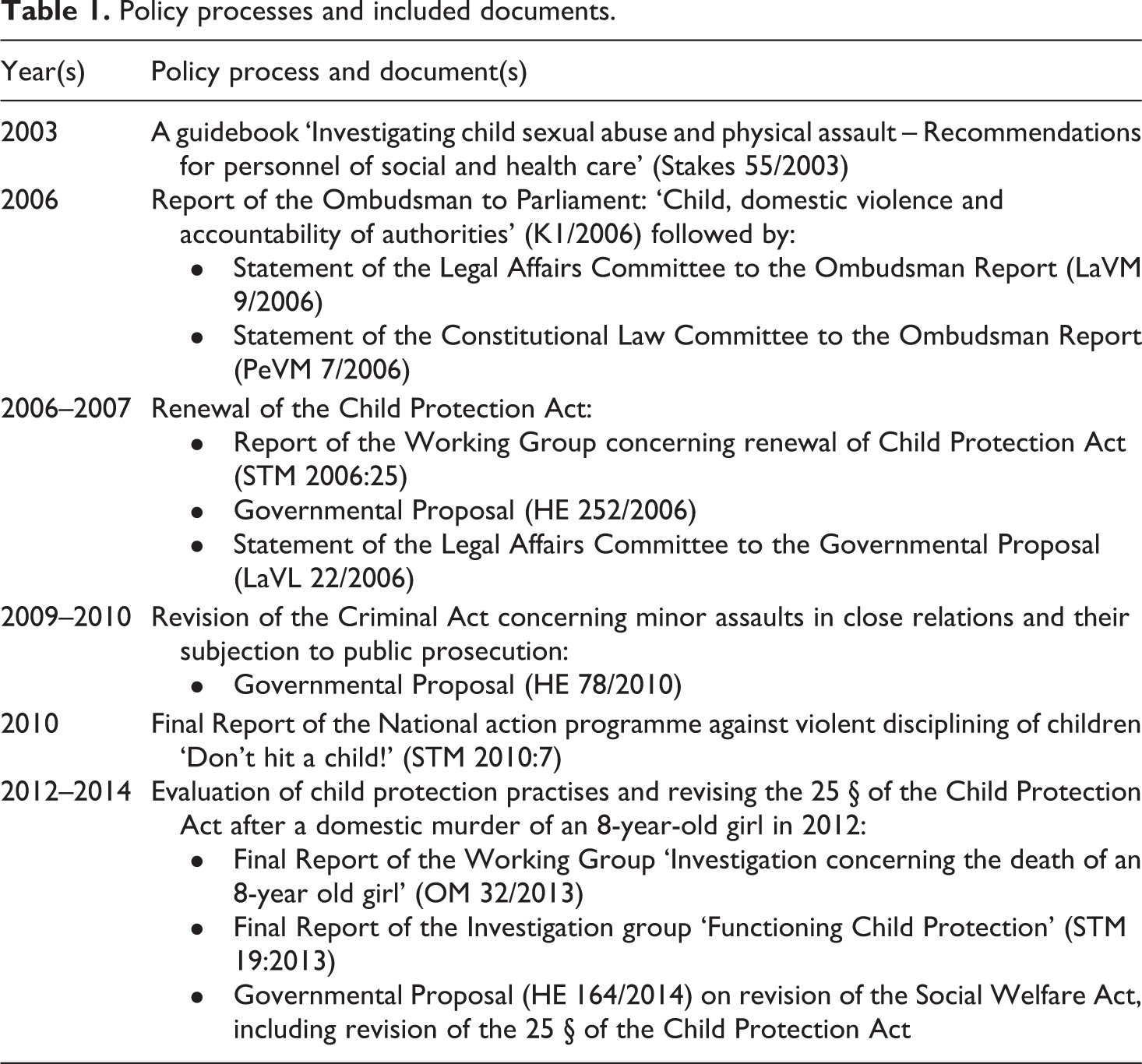
As Table 1 indicates, there was a lack of national level policy initiatives concerning physical violence against children until the early millennium. This conclusion was confirmed by expert interviews that were conducted as a part of a wider research project to curate the data collection and fill the gaps in the policy document data (see Kotanen, 2018a). Thus, the empirical analysis focuses on the developments in the 21st century. The analytical reading of the data can be described as a theory-driven text analysis (Patton, 2015). In practice, it means that the interpretation of data is guided by theoretical concepts or ideas that have been presumed as useful and valid prior to analysis (Willig, 2013). Thus, the starting points of the analysis are conditions sustaining the invisibility of parental violence as a crime. Firstly, the habitual nature of parental violence and generational order as a ‘naturalised’, unchallenged understanding of a distribution of power and rights in the private sphere. And secondly, the restricted social position and agency of children as victims of violence. Due to the restricted agency of children, the lack of clear intervention policies is interpreted here as an indicator of a formal criminalisation and, furthermore, establishing and re-adjusting such responsibilities is perceived as a development towards a substantive criminalisation (Lacey, 2009).
The analytical focus is on the normalisation of parental violence. Normalisation is a mechanism preserving the prevailing social order by creating thresholds for interventions and maintaining invisibility that operates from macro level structures to micro level interactions (Jupp et al., 1999). Normalisation can result from deliberate action as well as from omission. Active forms of normalisation include, for example, denying, downplaying, and silencing, whereas ignoring and taking for granted or implicit exclusion, denial and silence are more passive forms of normalisation (e.g. Cohen, 2001; Wicks, 2011). In practice, the following analysis concentrates on the intervention threshold. More specifically, it focuses on (I) legal regulation and policies that deny, allow, and/or obligate authorities to intervene and/or to report physical violence; and on (II) definitions concerning the degree of violence that constitutes a justification to intervene and/or report to other authorities; and on (III) the exclusion and absence of some degrees of violence. The attribution of responsibilities and adjustments of the intervention threshold are perceived as a concurrent development with changing understandings and (in)visibility of parental violence along a line from (disregarded) non-violence to (harmful) non-criminal violence to criminal violence.
Contouring the Boundaries of Parental Violence as a Substantive Crime
For Finland, the year 2012 was marked by the violent death of an 8-year-old girl who was murdered by her father and stepmother. The Ministry of Justice appointed a multi-professional team to investigate how the tragedy was possible as the girl had been a long-term client of several social and health care services. According to the case review report (OM 32/2013), the tragedy was the result of a total failure of cooperation and information sharing by the wide network of authorities working with the girl and her family. The report stated that social and health care professionals failed to recognise the indications of violence and, in general, when the source of visible injuries were questioned, authorities tended to believe the explanations given by the father. The report revealed repeated references to violence and physical injuries in the client documentation, yet no report to police was filed highlighting the ‘very high threshold for reporting to police among authorities’ (OM 32/2013).
The tragedy embodied all the already known concerns related to parental violence and authorities’ interventions: difficulties sharing information with other authorities, difficulties to recognise and acknowledge such violence, reluctance to file a child protection notice in cases of parental violence, and a very high threshold for reporting such violence to police. All these problems had been revisited in public discussion several times since January 2006 when the Parliamentary Ombudsman published their report Child, domestic violence and authorities’ accountability (K1/2006). The report set parental violence on the political agenda and launched critical public discussion regarding authorities’ actions. The report openly questioned the professional practices and understandings of parental violence in Finland after a comprehensive investigation of how the mandatory obligation to report to child protection was met in cases of violence against children by different authorities working with children. The inquiry revealed authorities’ reluctance to incentivise interventions in families by social work or police. It confirmed that the threshold for filing a child protection notice was remarkably high even when the suspicions were well-founded. If a notice was filed, it was mostly likely only after serious violence that had caused clearly visible injuries. The same was stated as applying to reports to the police by child protection leading to an alarming, cumulative lack of interventions and sentencing.
Prior to the Ombudsman’s report (K1/2006), the intervention threshold for reporting violence against children to the police was touched upon in 2003 when the national guidelines of recognition and examination of child sexual abuse (CSA) and physical violence in social and health care were revised. The guidebook Investigating child sexual abuse and physical assault (Stakes 55/2003) was the first national level policy initiative concerning physical violence since the 1980s and the first time a representative of the police was invited to join such an expert group. The guidebook recommended that child protection authorities should systematically contact police ‘when suspecting […] grievous assault’. Thus, setting the reporting threshold for physical violence remarkably high. In the Finnish Criminal Act (1889/39, Section 21) assaults are graded into three subcategories based on seriousness. Simplifying, it can be summarised that minor assaults are acts that do not cause any visible injury; (standard) assaults are more serious and cause physical injury and/or bodily harm to the victim, whereas grievous assaults are acts that cause serious bodily injury, serious illness or life-threatening conditions and are committed in a particularly cruel or brutal manner or with a firearm or bladed object such as a knife. Thus, the guidebook outlined that only grievous physical violence as a criminal act unquestionably requires and justifies criminal justice intervention in the family.
This view was contested by the Ombudsman’s report (K1/2006) that proposed serious consideration to adding a mandatory obligation for child protection authorities to report to the police ‘any suspected violent crimes or sexual abuse inflicted on a child’ without defining a specific threshold for reporting in terms of the gravity of the act. Due to the equal realisation of children’s legal protection and rights vis-à-vis adults in cases of intimate partner violence (IPV), the Ombudsman deemed it important that police investigate physical and sexual violence inflicted on children, and that prosecutors take further the cases with sufficient evidence. In addition, the Ombudsman made a demand to clarify the reporting obligations to child protection and harmonise all relevant professional confidentiality obligations so that legislation, and difficulties in interpreting it, would not prevent the reporting of violence.
The publication of the Ombudsman’s report and the following social debate was well timed as the revision of the 23-year-old Child Protection Act was ongoing in early 2006. Nevertheless, the Ombudsman’s understanding of all forms of violence against children as criminal acts and the related suggestion to include police to systematically investigate such acts, was persistently resisted during the revision process. A report of the working group (STM 2006:25) that had prepared the revision of the Act since 2004, was published in May 2006. The report outlined a new Child Protection Act in which the mandatory reporting obligation to child protection was significantly clarified. Section 25 of the proposed act stated that all professionals working with children in statutory service or in an NGO have an obligation to report to child protection immediately regardless of client confidentiality regulations if they discover that ‘a child’s welfare and need for care, circumstances endangering child’s growth and development, or child’s own behaviour requires further investigation to find out if there is a need for child protection’ (STM 2006:25). Nevertheless, the Ombudsman’s suggestion to place a mandatory obligation for child protection to report to police in cases of CSA and physical violence was not included, or mentioned, in the working group’s report.
With regard to the reporting obligation, the subsequent governmental proposal (GP) concerning the Child Protection Act (HE 252/2006) was following the preparatory report. According to the GP the recommendations for the mandatory reporting obligation were dismissed because the Act on the Position and Rights of a Social Welfare Client (812/2000) was considered to provide for social welfare authorities ‘sufficient possibility for self-imposed reporting to police in cases of serious crimes’ (HE 252/2006; italics RK). Yet, it was noted that the clauses providing this possibility were ‘obviously inadequately recognised in municipalities’ (HE 252/2006). Nevertheless, the negotiation concerning the reporting obligation continued. The Legal Affairs Committee (LaVL 22/2006) recommended in its statement to the GP that such an obligation should be legislated but with two limiting conditions. First, the suspicion of CSA or physical assault should be ‘well-founded’, and secondly, for the suspected act ‘the assumed maximum penalty should at minimum be two years imprisonment’ according to the Criminal Act (LaVL 22/2006). In practice, this meant that the reporting obligation only concerned more serious forms of violence falling into categories of grievous assault or assault. 4 This formulation was finally adapted to the 25 § of the enactment (417/2007) that came into force at the beginning of 2008.
The new Child Protection Act clarified the threshold for the police and criminal justice system interventions into the private sphere, yet the intervention threshold remained high. Clearly the understanding of parental violence presented in the Ombudsman’s report (K1/2006) emphasising the criminality of parental violence and legal rights of children vis-à-vis adults was not unreservedly accepted. The persistent resistance to the systematic involvement of the criminal justice system demonstrates the generational dividend of rights in the private (cf. Connell, 2009). In addition, the resistance highlights the difficulties to fit such understanding within the Finnish child protection system prioritising family support and voluntary services (Gilbert et al., 2011; Pösö, 2011). Consequently, some social work scholars perceived the legal obligation to report to police as an ‘intensification of criminal control over parents’ (Satka and Harrikari, 2008: 658). Therefore, focusing on the potential negative consequences for parents instead of the enhanced protection of children’s legal rights or, on a more general level, strengthening the criminal justice control of domestic violence vis-à-vis violence in the public sphere. The latter was one of the key justifications for the legal changes made in Finland regarding IPV during the 1990s and early 2000s (Kotanen, 2018b). In practice, the above-mentioned two limiting conditions created rather demanding prerequisites for a social worker to report to police. Estimating case-by-case, with the social work methods and rights to investigate, whether the conditions are met would be far from straightforward; not to mention the knowledge of criminal law the estimation implicitly requires. Hence, this process of estimation is interpreted as an hindrance to, and an additional barrier of protection for parents from, criminal justice interventions in the private. The complete invisibility of, and silence around, violent disciplining denotes a wider consensus within the state regarding the sufficiency of the formal criminalisation of such violence; continuing the ethos and aims of the 1983 legal prohibition (cf. Kotanen, 2018a).
Hesitation and Silence as Practices of Normalisation
Violent disciplining received specific attention in two rather different policy contexts during 2010. The national action programme for reducing violent disciplining, prompted by the Council of Europe’s strategy against corporal punishment of children, published their report Don’t hit the child! (STM 2010:7) in October 2010. Earlier in the same year, a GP subjecting minor assaults in close relationships under public prosecution 5 (HE 78/2010) was put before Parliament. The main aim of the GP was to enhance early interventions in cases of IPV and other forms of domestic violence, given its repetitive and progressive nature, and to ensure that even milder forms of such violence would increase the likelihood of prosecution (cf. Kotanen, 2013). Despite the rather different purpose and context of these documents, they shared several similarities in relation to parental violence. Both of them used the definition of ‘disciplinary violence’ which they explicitly outlined as a violent crime vis-à-vis IPV that should be investigated by police and prosecuted by public prosecutors. The condoning attitudes towards violence against children were acknowledged and parent to child violence was specifically highlighted as ‘the most common form of domestic violence’ (HE 78/2010).
As with the Ombudsman’s report (K1/2006), both documents (STM 2010:7; HE 78/2010) adopted rather critical perspectives towards authorities’ practices. They were seen to largely dismiss violent disciplining consequently leading to a limited number of convictions which, at first, appears as a request for substantive criminalisation. Together with the emphasised status of violent disciplining as a crime this creates an interesting inconsistency as the legal reality that child protection only had an obligation to report to the police in cases of assaults and grievous assaults – and that other authorities did not have any obligation to report to police – is completely disregarded in both documents. Social workers are identified as an important source of information. For example, the action programme (STM 2010:7) points out that most of the rarely prosecuted cases of violent disciplining were initially reported to police by child protection. Yet, the exclusion of these acts from the Child Protection Act’s mandatory reporting obligation, and how this omission is likely to contribute to the lack of reports and police investigations as well as to the scarce number of sentences, is not mentioned in the action programme nor is it raised in the GP (HE 78/2010). Instead of acknowledging and reflecting the lack of reporting obligations, the action programme (STM 2010:7) implies that other measures are preferred over enacting such an obligation. It attributes the responsibility for change to the social welfare authorities and their internal practices by outlining a wish that they ‘would create an internal supervision and monitoring system that could ensure that investigation requests to police were based on uniform and consistent precepts’ (STM 2010:7).
The tragic death of the 8-year-old girl in 2012 and the following case review report (OM 32/2013) highlighted how pressing the concerns regarding the threshold for intervention and reporting between authorities still were. Her post-mortem revealed a prolonged history of violent torture with 89 traces of violence on her body. According to the report, along with various severe forms of physical violence and emotional abuse, the girl had been habitually tied up and wrapped in a plastic tarp. Eventually this led to her death from slow suffocation following initial contact with the police. The tendency to delay in reporting parental violence to child protection and police has been so prominent among authorities that Ellonen and Pösö (2014) have characterised hesitation as a ‘system response’ to violence against children in Finland. Based on authority interviews they state that unless there is indisputable evidence and, thus, certainty of violent acts, hesitation takes the form of a case-by-case negotiation what would be the most suitable response. Furthermore, hesitation is most strongly connected to cases of parental violence perceived of as mild or unclear where the involvement of the police is seen as too punitive for parents; also, violence that is estimated as less serious is regarded as a lesser risk to the child than a false response would be for the reporting authorities and their relations with parents (Ellonen and Pösö, 2014: 741). In addition to the practitioners’ hesitance to report, hesitation takes on an institutional form in the case review report when it describes how within the Helsinki social and welfare department reporting to the police was a ‘meandering process in which the final decision-making power was held by the legal affairs unit that is located far from the actual lives of children’ (OM 32/2013). Thus, an additional reporting hindrance, effectively protecting the generational order and generational dividend of rights in the private, was built into the institutional structures of the department. Due to this institutional form of hesitation, social workers could not fulfil their legal obligation to report to the police unless they were authorised by the legal unit that estimated first whether that was the correct response in a particular situation.
Following the tragedy, the Ministry of Social Affairs and Health appointed an expert group to investigate the working structures and practices of child protection. Their concluding report Functioning Child Protection (STM 19:2013) recommended that the reporting obligations for authorities set in the 25 § of the Child Protection Act should be harmonised so that CSA and physical violence would be ‘on the same level’ (STM 19:2013). Section 25 had been revised as regards CSA in 2010 due to the ratification of the Council of Europe Convention on the Protection of Children against Sexual Exploitation and Sexual Abuse. The mandatory obligation to report to police was expanded to all authorities working with children regardless of the severity of CSA, and the threshold regarding the certainty of suspicions was lowered noticeably. The expert group’s report suggested similar changes regarding physical violence because processing these cases via child protection ‘might hinder the criminal investigation significantly […] and is thus weakening the realisation of the legal protection of children’ (STM 19:2013).
The above recommendation was promptly added to an ongoing renewal process of the Social Welfare Act (1301/2014). In the GP (HE 164/2014) the group of authorities obligated to report straight to police was widened according to the expert group’s suggestion. Also, the reporting threshold was set lower as the early involvement of the police ‘would not [after the revision] require full certainty or even liable grounds to suspect that a crime has been committed’. There were, however, clear constraints regarding the mandatory police involvement and level of criminal violence. Contrary to the expert group’s report (STM 19:2013) it is made very clear in the GP that ‘the sufficient prerequisite for the realisation of a reporting obligation would be […] a maximum sentence that is minimum 2 years imprisonment’ (HE 164/2014). Hence, the revised reporting obligation would still apply only to more serious forms of violence (i.e. assaults and grievous assaults).
Consequently, minor assaults were clearly, yet implicitly, excluded from the obligation to report to the police. The lack of discussion indicates that the silent consensus regarding the sufficiency of the formal criminalisation of violent disciplining from 2006 still holds. This also means that the other authorities’ reporting obligations to police were not completely harmonised vis-à-vis CSA; the reporting threshold for physical violence remains higher. Moreover, in cases of physical violence the additional hindrance remains. The authorities are still required to conduct a process of estimation whether the suspected violent act is serious enough to meet the minimum level of punishment. The GP included a supplementary recommendation to consult police, if needed, while considering whether ‘binding circumstances exist in a particular case’ (HE 164/2014). The suggestion to consult police in estimating the gravity of the violence is an evident attempt to lower the reporting threshold and address the fear of false reporting and potential unwarranted intervention. Yet, the legislators’ preference is to try to manage hesitation, that the required process of estimation itself potentially creates, rather than to include all acts of physical violence under the reporting obligation.
In the light of this analysis, it is obvious that the threshold for criminal justice interventions in cases of parental violence has been lowered and its prerequisites are more clearly defined compared to the beginning of millennium. Nevertheless, the ambivalence related to violent disciplining (i.e. minor/common assaults) remains as a resilient indicator of normalisation in the data where two distinctively different understandings of violent disciplining coexist. From the perspective of the criminal law, violent disciplining is unquestionably a crime in Finland. This understanding is present, for example, in the policy documents from 2010 (STM 2010:7; HE 78/2010). Nevertheless, in the context of the Child Protection Act, similar acts are implicitly but clearly excluded from police investigation. This is an interesting inconsistency, not least because of the silence surrounding it in the analysed documents. It echoes, however, the historical understanding of physical disciplining as acceptable in 1970 to a non-criminal form of violence that was present when parental violence was prohibited in Finland in 1983 (Kotanen, 2018a).
This study suggests that the silence mentioned above is, in fact, a policy-level version of the hesitation that has been identified at the practitioner-level (Ellonen and Pösö, 2014) and, earlier in this section, at the institutional-level. If reporting violent disciplining to the police and sentencing the perpetrators (i.e. substantive criminalisation) would be a preferred state of affairs, as several of the documents – mostly implicitly – indicate, then enacting the reporting obligation would be a logical step forward. This is supported by a report analysing the change in authorities’ reporting activity to police concerning physical violence after the revised reporting threshold came into force in 2015. A comparison between 2014 and 2016 shows a significant change in authorities’ reporting activity as reporting assaults increased by 51% (Järvinen, 2017). The report also points out that minor assaults are reported to police surprisingly rarely considering that they are the most common form of violence against children. In light of this analysis, however, this seems only a logical consequence of the regulation of such violence. The unwillingness to openly challenge the current state of regulation strongly implies that it is a status quo that legislators are not keen to disturb.
Conclusions
This study examined the social invisibility and normalisation of parental violence as a crime at a state-level by focusing on the divergence between (criminal) law and control policies. It analysed state policies that obscure parental violence as an illegitimate form of violence by creating structures hindering and preventing its control. The empirical focus was on the threshold for criminal justice system involvement; particularly, on the estimated seriousness of violence inflicted on a child that obligates authorities working with children to report to police. This study suggests that the threshold has two functions. It is explicitly (I) a way to manage the professional discretion of the authorities working with children when it is perceived as unwanted hesitation impacting negatively on the protection of children. More implicitly, the threshold also is (II) a measure to protect parents from criminal justice intervention that would be considered as too punitive a response when the violence is not considered severe enough. In other words, a measure to accommodate an illegitimate use of power that does not exceed the threshold (cf. Connell, 2009; Hearn et al., 2016; Walby, 2009). These two functions conflict since the first deals with a lack of authority interventions and the latter with restraining such interventions. This conflict within the threshold crystallises the generational dilemma regarding state’s interests in regulating and controlling parental violence.
From an historical perspective, the process of creating and readjusting the threshold for criminal justice involvement appears as a continuation of the early 1970s differentiating of acceptable and unacceptable (i.e. criminal) violence and the subsequent legal prohibition in 1983 (Kotanen, 2018a). The reluctance to extend criminal justice control to parents remains, but unlike earlier, it is not expressed explicitly, it is built into the policies directing and constraining criminal justice involvement. It is not a coincidence that the most common form of parental violence is still excluded from systematic criminal justice interventions. As Francis et al. (2014: 247) argue, despite regulation, prevention strategies and procedures, invisibility can appear as a consequence of the form and operation of intervention policies and control. Here, the invisibility of parental violence as a crime is maintained within the state’s systems of control by creating exemptions for criminal justice interventions regardless of the criminalisation. Maintaining invisibility protects the generational social order and unequal distribution of power within the family. This is in line with feminists’ notion that (gendered) inequalities are embedded in social action and, in the context of the state, in the way the state and its agencies function (Connell, 1994).
Moreover, normalisation of parental violence operates through different forms of hesitation. This study argues that hesitation, identified by Ellonen and Pösö (2014) as authorities’ customary response to parental violence in Finland, is not only rooted in the micro-level professional practices. Instead, hesitation is a practice that penetrates the whole regime of control from the micro-level decision-making processes to the macro-level formation of legislation and policies that steer practitioners’ decisions by creating and maintaining hindrances for reporting to police. In other words, generating conditions and situations that entail hesitation. In addition, hesitation can occur at the institutional-level embedded in the procedural practices as a way to aggregate the contrary functions of the threshold – managing unwanted hesitation and protecting parents from inappropriately punitive responses – for the practitioners. In feminist analyses of inequalities, it has been helpful to ask ‘who benefits’ to keep gendered structures and the stakes in gender politics in view (Boyle, 2019; Connell, 2009). From a generational perspective, these forms of hesitation are produced within the societal practice of weighing children’s rights against the potential negative consequences of the interventions on the rights of parents. This practice has a resilient tendency to prioritise the family as an institution and parents as the key members of the family (Leonard, 2016; Qvortrup, 1993), which is also evident in the case review report on the death of the 8-year-old girl concluding that the ‘idea of supporting the family, parental rights, and the family’s right to privacy overruled the child’s interests in decision-making situations’ (OM 32/2013). In addition to the wider practice of hesitation, the persistence in maintaining the threshold for violent disciplining highlights the importance of the generational dividend of rights in the family, and how it is in the state’s interest not to disrupt it unduly.
The broader societal context where invisibility and normalisation of parental violence becomes challenged is itself marked by hesitation as the discussion regarding the control of such violence commences very slowly in Finland considering that the legal prohibition was enacted in the early 1980s. The turn of the millennium was a national awakening to the extent of IPV following a critical public debate on its status as a crime and lack of legal protection for female victims (Kotanen, 2018b). The connection to family and the private that earlier normalised IPV began to shade into aggravating circumstances for such violence (Kotanen, 2013). Hence, it is no surprise that the critical voices calling for the acknowledgement of parental violence were searching for synergy with those challenging the normalisation of gendered violence in the private sphere (also Pösö, 2011). Yet, it is apparent that parental violence has a more binding relationship with family and the private sphere. Unless the ‘naturalisation’ of the generational dividend of rights in the family is scrutinised more critically, from the perspective of the state, the generational challenge remains how to formulate and impose public measures for protecting children’s physical integrity within families without excessively intervening in parental rights and the privacy of families. A critical step would be to acknowledge, and admit, that maintaining structures that require a constant renegotiation of this challenge is, in effect, obscuring a significant aspect of violent victimisation of children, at times, with tragic consequences.
Footnotes
Acknowledgements
The author is very grateful to the anonymous reviewers for their constructive, helpful, and kind feedback. Thanks to colleagues at the Violence and Society Centre, particularly Dr Alexandria Innes and Dr Patricia Bell. As always, many thanks to Dr Richard Wild for his comments and language revision.
Declaration of Conflicting Interests
The author(s) declared no potential conflicts of interest with respect to the research, authorship, and/or publication of this article.
Funding
The author(s) disclosed receipt of the following financial support for the research, authorship, and/or publication of this article: This study was funded by the Academy of Finland (grant number 287262).
