




Abstract
This paper draws the attention of impact-curious sociolegal researchers to the potential of participatory research strategies; and proposes that the effectiveness of those strategies can be enhanced by the introduction of ‘designerly ways’. It explores and evidences this proposition through the multi-country Facing All the Facts project which aimed to support and accelerate the process of making hate crime conceptually and empirically visible in Europe. The paper concludes that by pursuing the designerly strategy of making experiences, perceptions and expectations around hate crime reporting and recording visible and tangible in artefacts (formal graphics and collaborative prototypes), the project activities generated structured-yet-free spaces in which publics/stakeholders could more effectively participate in practical, critical and imaginative discussion about how things are, and how they might be; and that this has improved the relevance and rigour of the research, and its ability to generate meaningful change (‘impact’).
Keywords
Introduction
The idea that university-based researchers ought to engage with the non-academic world is now commonplace in the UK and elsewhere. Funders such as the UK Economic and Social Research Council (ESRC), and assessors such as the UK Research Excellence Framework (REF) increasingly require researchers to attend to the ‘impact’ or ‘demonstrable contribution’ that their research ‘makes to society and the economy’ (ESRC website). While this trend is part of a wider, often critiqued, neoliberal agenda across the public sector, it is also: part of a wider contemporary tendency toward participatory practices in areas ranging from the arts, to industry, to “open” government in which users/publics/ patients/audiences/communities are invited to take on more active roles in shaping the knowledge, policies and practices of the world around them. (Facer and Enright, 2016: 144 quoted in McDermond, 2018: 160)
Most academic research is produced in ‘Mode 1’ – that is, ‘within academic institutions’ and verified by peer review’. ‘Mode 2’ research sees knowledge produced ‘in the context of its application, being…verified by its social worth and applicability’. In its most developed form, it is ‘co-produced’ by academics and publics/stakeholders in a way that ‘assumes no hierarchy of knowledge forms’, and that sees ‘disciplinary and professional boundaries’ as ‘fluid’ (Campbell and Vanderhoven, 2016: 12–13 citing Gibbons et al., 1994 and Nowotny et al., 2001). While Mode 1 research ‘is produced in ways that are not deeply oriented to shaping or informing future change’, Mode 2 research focuses on the ‘overlaps between actualities and potentialities’ and is therefore more oriented towards producing change (Julier and Kimbell, 2016: 41).
To the extent that it engages with the perceptions, experiences and expectations of non-academics via, for example, interviews, surveys, archival analysis, content analysis or ethnographic observation (See Creutzfeld et al., 2019), sociolegal research can be seen as operating at the border between Mode 1 and Mode 2. But if the aim is for sociolegal research to produce meaningful change (‘impact’), ‘it will almost certainly be necessary – but not sufficient – for researchers to interact’ with publics/stakeholders 1 in their field (McNamara, 2018: 440). This entails a methodological shift towards ‘Mode 2’ research.
Many sociolegal researchers now proactively promise engagement with publics/stakeholders in their funding applications, or retrospectively highlight the depth of their relationships with publics/stakeholders in their REF Impact case studies. 2 But scholarly sociolegal publications that explicitly self-describe as adopting Mode-2 oriented participatory or collaborative strategies remain scarce. One especially innovative example is an exploratory study, Law in Children’s Lives (Watkins et al., 2018) in which a digital game was developed with the close and iterative participation of children and experts in childhood. Information provided by children during focus groups was used to generate ‘everyday “worlds” or domains’ such as ‘a school, a park, a shop and a friend’s house’ within the game, each of which was the site for ‘law-related hypothetical scenarios or vignettes’ which ‘provided the context for a question’, the answer. The project was conceived as a ‘first step towards’ developing resources to ‘increase [children’s] legal knowledge’ and ‘develop their legal capabilities’ (Watkins et al., 2018: 64, 77–78. See also McDermond, 2018: 160).
This paper draws the attention of impact-curious sociolegal researchers to the potential of participatory research strategies to move a project towards Mode 2, and thereby to improve its relevance, its rigour, and its ability to generate meaningful sociolegal change (‘impact’). Furthermore, it proposes that the effectiveness of those participatory strategies can be enhanced by the introduction of strategies from design, in particular those that centre on ‘making things visible and tangible’. It explores and evidences these propositions through the example of the Facing All the Facts project (2016–2019) – a ground-breaking multi-country study, conducted on behalf of a diverse partnership of public authorities and civil society organisations, which addressed a pressing policy question: How can we understand the national implementation of international standards around hate crime reporting and recording, and influence civil society organisations and public authorities to see themselves as part of a victim-centred system, so that hate crime begins to become more visible in Europe?
The paper first introduces the policy-driven aim and objectives of the Facing all the Facts project, and how the project methodology sought to achieve them by combining three strategies: non-participatory (desk-based analysis, interviews), participatory (consultation, workshops) and designerly (making things visible and tangible). It then details the project implementation and evaluates its effectiveness from the perspectives of both the researchers and the participant publics/stakeholders. The paper concludes that the designerly strategy of making things visible and tangible generated structured-yet-free spaces in which publics/stakeholders could more effectively participate in discussions about how things are, and how they might be; and that this has improved the relevance and rigour of the research, and its ability to generate meaningful change (‘impact’).
Facing All the Facts Project Overview
Hate crimes are ‘criminal acts motivated by bias or prejudice towards particular groups of people’. The ‘bias motivations’ that convert a crime – such as property damage, theft, assault or murder – into a hate crime include ‘preconceived negative opinions, stereotypical assumptions, intolerance or hatred’ that are ‘directed to a particular group that shares a common characteristic’ such as race, ethnicity, language, religion, nationality, sexual orientation, gender and disability (ODIHR, 2009). There is a growing consensus in Europe that a first step to addressing hate crime is to make its nature, prevalence and impact more visible (FRA, 2012, 2018; ODIHR, 2014). But most European countries fail to fully comply with their international commitments to record and monitor hate crime investigations, prosecutions and sentencing decisions (ODIHR, 2018).
Reasons for this slow progress include a lack of trust by victims 3 in public authorities such that they do not report or remain engaged with the criminal justice process; of skill, knowledge and commitment within public authorities to identify, support and protect victims of hate crime; of connection and cooperation, including around information sharing, across public authorities and with civil society organisations (CSOs) that support victims; and of consistency in legal approaches to defining and responding to hate crime (FRA, 2018; Perry, 2016; Schweppe et al., 2018). Indeed, there is active debate about the conceptual contours of hate crime: Which groups and types of crime, and what quality and quantity of ‘hate’, should fall within its boundaries (Chakraborti and Garland, 2012; Hall, 2013; Iganski, 2008; Perry, 2009)? An interactive timeline showing the development of international standards and their operationalisation is available on the Facing All the Facts website (n.d.). For example, the 1965 Convention on the Elimination of Racial Discrimination (CERD) directed states to criminalise racist and xenophobic violence, but only in 2009 was the term ‘hate crime’ defined, and then as a political, not legal commitment (OSCE, 2009). The 2012 EU Victim’s Directive was the first international legal instrument to use the term ‘hate crime’. While its inclusive list of ‘protected characteristics’ establishes the scope of the hate crime concept, the Directive is silent on other aspects of its definition.
As international efforts to stabilise and operationalise standards around hate crime have intensified, new spaces are emerging for policy actors, activists and academics to collaborate in defining the contours of the field. However, ‘fault lines between scholarship and policy’ remain in this field as in so many, therefore neither scholarship nor policy is entirely ‘evidenced-based’ (Chakraborti, 2014).
The resulting deficit of data – and, therefore, of information and knowledge – ensures that hate crime remains less empirically visible, impeding national and comparative efforts to understand hate crime and its impacts and to assess national progress in meeting international standards; effective resource allocation towards hate crime prevention and victim support; and public awareness of hate crime as a problem.
The ground-breaking Facing All the Facts project aimed to support and accelerate the process of making hate crime conceptually and empirically visible in Europe. It covered six countries (Greece, Hungary, Ireland, Italy, Spain and the UK), and was conducted on behalf of a diverse partnership of 11 public authorities and civil society organisations (CSOs) from nine countries (including the Observatory for Security against Acts of Discrimination within the Italian Ministry of Interior, the UK policing lead on hate crime and the National University of Public Service of Hungary) working across institutional boundaries in a live field of criminal justice policy and practice. It was led by a researcher with extensive policy and CSO experience, with methodological input from the (academic) co-author of this paper, and broader input from academic members of the project’s advisory group. 4
The project was sociolegal in the sense that it approached hate crime reporting and recording as a fundamentally social phenomenon. It was ‘juristic’ in the sense that it was committed to the wellbeing of law as a practical idea. The conceptual wellbeing of law is dependent on its ‘unity’ as a coherent ‘structure of values’. The wellbeing of law as a practical idea, one that is socially meaningful, is dependent on its ability to accommodate and nurtures diversity (‘social unity’) by ‘facilitat[ing] communication’ about the ‘need’ for ‘respect’ for ‘all’; as well as by enforcing that need by challenging inequality and bias’ (Cotterrell, 2018: 31, 33 and 170). Hate crime is new conceptual typology of violence, the insertion of which into the existing structure of a legal system generates new shared ‘spaces’ in which publics/stakeholders can work to address it as an empirical reality (Perry, 2014). In this way the legal system begins to accommodate, respect and nurture diverse, previously invisible, peoples; and it is itself enriched.
The project aim of making hate crime visible was pursued through three interconnected objectives: to develop a holistic and evidence-based understanding of the nature and effectiveness of the ‘systems’ for reporting and recording of hate crime in the project countries; to generate reflective spaces in which the actors within those ‘systems’ can share perceptions, expectations and experiences and identify solutions; and to shift those actors and systems towards a more victim-centred, system-based and action-oriented mindsets and practices.
The project methodology, available on the Facing all the Facts website, sought to achieve these objectives by combining three interconnected research strategies non-participatory (desk-based analysis, interviews), participatory (consultation, workshops) and designerly (making things visible and tangible). Non-participatory sociolegal research strategies were used primarily to support the objective of improving understandings of current hate crime reporting and recording systems. Participatory and designerly strategies were used not only to deepen that understanding, but also to support the additional project objectives of generating shared spaces and shifting mindsets and practices. The following sections introduce these strategies in turn, highlighting their methodological origins, and evaluating their implementation against both the Facing All the Facts objectives and wider sociolegal concerns.
‘Traditional’ Strategies
Like most sociolegal projects, Facing All the Facts began with a desk-based analysis of policy and academic literature. This review produced the first ever synthesis of existing international standards on reporting and recording of hate crime into a unified list of 42 standards, 5 as well as important findings about how those standards interrelate, and about their implementation at national level. For example, it was revealed that, with the important exception of the EU Victim’s Rights Directive (2012/29), international standards focus almost exclusively on institutions rather than on victims; that CSOs are not foreseen as an integral part of national hate crime reporting and data collection ‘systems’; and that institutions are conceptualised as being independent as rather than interdependent and cooperative.
The synthesised standards were used to build an ‘assessment toolkit’ which was completed by national partners, eventually producing a ‘national system report’ for each project country assessing the effectiveness of relationships between key ‘actors’ that underpin (or ought to) the national hate crime reporting and recording ‘system’. Five categories of ‘system actor’ were identified. Firstly, some civil society organisations (CSOs) have commitments to record hate crime as reported to them by victims or witnesses. Secondly, criminal justice authorities, including law enforcement agencies, are the first point of contact for most victims choosing to report, and have the strongest recording obligations under international standards; prosecution services, which have important relationships with law enforcement and are obliged under international standards to record hate crime data; and judicial bodies, which are obliged under international standards to record data on implementation. Thirdly, ministries, often of interior and justice, collate and review the data recorded by other agencies and set frameworks for data sharing. Fourthly, intergovernmental organisations (IGOs) use data provided by national authorities to track hate crime across countries, provide spaces for knowledge exchange, and assist with technical capacity building. Finally, the ‘general public’ are both part of the context within which the ‘system’ operates and stakeholders within it.
The effectiveness of relationships between these ‘system actors’ was assessed as ‘good’ adequate’ or ‘inadequate’ on two dimensions: the policy and technical ‘frameworks’ that allow for reporting, recording, sharing and analysis of hate crime data; and the ‘action’ that is taken to implement those frameworks and to respond to the results. By separately detailing the ‘frameworks’ for hate crime reporting and recording, and the ‘action’ taken to implement that framework, the toolkit makes visible both whether a system is relatively superficial (framework only) or meaningful (framework plus action), and the dynamic nature of the underpinning ‘relationships’.
Finally, in-depth interviews were conducted with ‘change agents’ – that is, actors who shift processes or perspectives within the system – to understand what factors determine the effectiveness of relationships within the system (32 overall, at least five per project country) in specific contexts and circumstances. For example, change-agents were asked to share their perspective on the ‘story’ of hate crime in the country – what were the key events that shaped the national consciousness about hate crime? Their answers informed detailed national chronologies for each national system report.
These ‘traditional’ sociolegal research methods yielded important new insights into current hate crime reporting and recording, and their rigour and relevance was enhanced by continuous consultation with national partners drawn from publics/stakeholders in each project country. But the Facing All the Facts project aimed to go further – to generate reflective spaces and to change mindsets and practices. This required the more active participation of publics/stakeholders – an engagement that goes beyond being the object of the research, or responding to the questions of the researcher. For this reason, the project turned to participatory research strategies.
Participatory Strategies
Participatory research is ‘both a range of methods and an ideological perspective’ (Participatory methods website, n.d.). It refers to a particular ‘style’, the ‘unity and justification’ of which lie less in a specific set of ‘concrete research methods’, more in an ‘orientation…in favor of the possibility, the significance, and the usefulness of involving research partners in the knowledge-production process’ (Bergold and Thomas, 2012: 42). At its core are two principles: that ‘the subjects of the research become involved as partners in the process of the enquiry, and that their knowledge and capabilities are respected and valued’. Examples of participatory strategies are wide-ranging, include crowdsourcing, focus groups, mapping and video diaries (Participatory methods website, n.d.).
Participatory methods are especially relevant to projects aimed at generating meaningful change because it is ‘[t]he ways in which things get done, ideas are generated, processes develop, and outputs take shape through people being together in a shared space (embodied connection)’ that are ‘productive of impact’; not the mere ‘fact or state of collaboration’ (Campbell and Vanderhoven, 2016: 56).
In order to achieve its (Mode 2-oriented) objectives of deepening the understanding of hate crime reporting and recording revealed by ‘traditional’ strategies, generating reflective spaces, and shifting mindsets and practices, the project brought together ‘system actors’ (about 100 total) in 12 participatory workshops (two per project country). A typical example would include civil society activists with direct experience of supporting victims, police and prosecutors with direct experience of investigating/prosecuting and recording hate crimes, statisticians responsible for reviewing data and deciding on publication, and ministry officials responsible for resource allocation. The workshops were designed to enable valuable dissenting opinions to be expressed freely, in mixed groups of civil society and public authority actors, without fear of repercussions. For example, all quotes, even where anonymous, were presented in context for clearance by the relevant participant; and it was decided that Perry-Kessaris would not attend any of the workshops for fear that her outsider status would cause anxiety or confusion.
By their very attendance at the workshops, participants made visible to themselves and to others, often for the first time, the actual/potential ‘system’ for hate crime reporting and recording it their country. But many of these system actors had never met, and their agendas and perspectives, around hate crime and more generally, varied greatly. Participatory strategies are well suited to such contexts because they treat ‘difference’ is ‘an asset’ and ‘mutual curiosity about the knowledge and ability of those on the “other side”’, and about ‘what one can learn from them’, as vital (Bergold and Thomas, 2012: 42).
The Facing All the facts participatory workshops centred on consensus-building activities designed to enable publics/stakeholders to engage freely with each other as expert critical friends, to see and experience things from each other’s point of view, to share information openly discuss issues such as reliability and validity, and to consider how they might help each other. For example, workshop participants were asked to ‘take on’ the perspective of another system actor when considering specific questions such as: what does ‘hate crime’ mean, and what resources and relationships do you ‘need’ in order to address it? Furthermore, participants worked in small mixed groups to imagine, from the perspective of a victim, the actual and potential ‘journey’ through the national system of an imaginary case of racist assault. Such consensus-building activities are useful because they allow participants not only to ‘play[] out scenarios’, but also to perform ‘collective, speculative tinkering, or bricolage’: they play with heterogenous concepts, strategies and actions with which various individuals in the group have experience, and try combining them until they create a new scenario that they collectively agree will work. (Innes and Booher, 1999: 13)
The Facing All the Facts project sought to mitigate the risks, and enhance the effectiveness, of participatory strategies by combining them with ‘designerly’ strategies that centre on making things visible and tangible.
Designerly Strategies
‘Everybody designs who devises courses of action aimed at changing existing situations into preferred ones’ (Herbert Simon, 1969). Design as a field of scholarship and practice involves the creation of everything from artefacts and sounds to processes, systems, and experiences. In recent decades, design-based processes, tools and mindsets, sometimes referred to as ‘designerly ways’ (Cross, 2006), have been deployed in an ever-wider range of other fields, from commerce to public policy, often under the misleadingly partial title of ‘design thinking’ (Kimbell, 2011: 286, 2012: 134–136 and 142). Of these, the field of ‘social design’ is of particular relevance to sociolegal research.
The idea that design is a social phenomenon – that is, created through and constitutive of social interaction, can be traced to the Arts and Crafts Movement and the Bauhaus school of design, via ‘participatory design’ or ‘co-design’ which emerged from a Scandinavian information technology-driven effort to ‘rebalance power and agency among managers and workers’ in 1970s (Bannon et al., 2018: 1; Emilson, 2014: 23. For an overview see Simonsen and Robertson, 2012). Today, social design aims to ‘meet social needs’ around, for example, ageing, loneliness, violence, nutrition, entertainment or infrastructure whilst/through creating ‘new social relationships or collaborations’ (Manzini, 2015: 11 quoting Murray et al., 2010). It is built around participatory strategies in the sense that the intended users of the output – which may be, for example, an artefact, environment, service or event – become ‘co-researchers and co-designers exploring and defining the issue, and generating…ideas’ (Kimbell, 2015: 64). What is distinctive about participation in a social design context is that ‘expert’ social designers provoke and facilitate ‘non-experts’ to become ‘diffuse’ designers (Manzini, 2015: 77) by using design-based tools, mindsets and processes (IDEO, 2015). Ezio Manzini argues that by engaging non-designers in designerly ways, social designers ‘stimulate’ and ‘cultivate’ three senses: the critical sense – that is, ‘the ability to look at the state of things and recognise what cannot or should not be acceptable’; the imaginative sense – that is, ‘the ability to imagine something that does not yet exist’; and the practical sense – that is, ‘the ability to recognise feasible ways of getting things to happen’. Social designers do this – they ‘make things happen’ – in five ways: by making things ‘possible and probable’, ‘effective and meaningful’, ‘replicable and connected’, ‘local and open’ and ‘visible and tangible’ (Manzini, 2015: 31 and 77).
The application of designerly ways to legal practice, legal activism and policy-making has grown rapidly since around 2013, increasingly under the title of ‘legal design’. Amanda Perry-Kessaris has argued that this in part because lawyers and designers share an interest/ability/need to be simultaneously practical, critical and imaginative; that sociolegal researchers too have much to gain from exploring designerly strategies; and that they ought to begin with those that centre on ‘making things visible and tangible’ in artefacts (Perry-Kessaris, 2019).
One way in which designers make things visible tangible is in formal graphic outputs such as diagrams. These can be seen as part of a wider landscape of information design which, in its legal iteration, is intended to make visible complex legal phenomena in an uncomplicated way so that they become ‘more accessible and understandable’ (Haapio and Hagan, 2016: 182–183). For example, there is a growing global expertise in, and professional acceptance of ‘visual contracts’ (see Passera, 2015).
A less well-understood way in which designers make things visible and tangible is in prototypes. Prototypes – of artefacts, spaces, processes and systems – can be thought of as practical, critical and imaginative drafts. Prototyping is favoured by social designers because it focuses minds at the intersections between the ‘actual’ and the ‘potential’ (Julier and Kimbell, 2016: 39). Done collaboratively, prototyping generates shared spaces for understanding and reflection. For example, in The Neighbourhood project social designers use ‘prototyping as a way to evoke and explore possibilities and dilemmas’ in districts in Malmo that are ‘marked by social exclusion’ (Emilson, 2014: 19). The relevance of collaborative prototyping to social science research was surfaced in the ground-breaking ProtoPublics project, led by Guy Julier and Lucy Kimbell, which was motivated by the observation that design research combines the practice of designing, which is about ‘the generation and exploration of futures’, with the practice of researching, ‘which is in essence about understanding the past or the present but which may be used to inform decision making about the future’ (Julier and Kimbell, 2016: 39); and which aimed to ‘clarify how a design-oriented approach complements and is distinct from other kinds of cross-disciplinary, co-produced research in relation to social issues’. Five interdisciplinary academic teams were assembled, each of which co-designed a social science sub-project around a physical prototype. For example, one team explored the rules governing hitching a lift, developing a visible and tangible ‘Hitching Kit’ game (ProtoPublics Website, n.d.). That project revealed two important contributions of prototyping to participatory research. Firstly, collaborative prototyping enabled participants ‘from different backgrounds and with different capacities’, including those who ‘previously did not know each other, to share information and perspectives, generate ideas and engage in sense-making together’ and, in so doing to develop interpersonal trust (Julier and Kimbell, 2016: 24). Secondly, prototyping helped participants to navigate between the actual and the potential. By creating ‘visual outputs that foreground people’s current experiences of a social issue’ or ‘mockups…that project how things might be in the future’ participants were able to ‘instantiate in the present’, digitally and/or materially, ‘provisional aspects of the future (Julier and Kimbell, 2016: 41). The ability to focus participants’ attention on the intersection between the actual and the potential in this way is invaluable to a project that seeks to generate meaningful change. Indeed, referencing Figure 1, Julier and Kimbell go so far as to propose that ‘co-produced design research’ might be acknowledged as a new Mode 3: ‘concentrated at the intersection between research and change, with a focus on mediating between actualities and potentialities’ – between how things ‘are now and how they might be’ (Julier and Kimbell, 2016: 40).
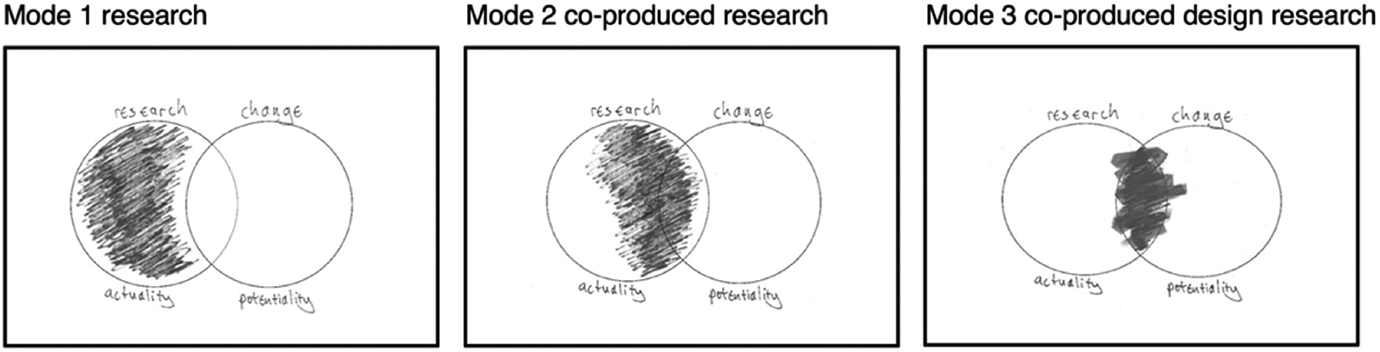
From actuality to actuality-potentiality. Adapted from Julier and Kimbell, 2016: 40. Illustrator Holly MacDonald. © University of Brighton. Reproduced with permission.
Working from a sociolegal perspective, Amanda Perry-Kessaris (2017, 2019) has argued that it is useful to think of socially designed artefacts as generating ‘structured-yet-free spaces’. The structure is established by the constraints present in the artefacts themselves and in the processes through which they are made. Within that structure are freedoms to reflect upon multiple experiences, perceptions and expectations; and to experiment with accepting, amending, or rejecting options. Furthermore, she has argued that such structured-yet-free spaces are of special relevance to sociolegal researchers because they mirror a specific tension between structure and freedom that is inherent in the ‘juristic’ sociolegal commitment to the wellbeing of law as a practical idea. On the one hand, if you care about the ‘wellbeing of law’ then you must care for its structural coherence, for legal systems that do not fit together cannot function. On the other hand, if you care about law as a ‘practical idea’ that is socially meaningful then your thinking and practice must accommodate and nurture social and legal diversity, and the freedom that makes it possible (Perry-Kessaris, 2019). The navigation of this tension requires the kind of simultaneously practical, critical and imaginative thinking to which social designers are specifically directed, and which are made more possible in the structured-yet-free spaces that they generate. So the Facing All the Facts project deployed the designerly strategy of making things visible and tangible in both formal graphics and collaborative prototypes.
Making Hate Crime Visible and Tangible in Graphics and Prototypes
Figure 2 sets out the Facing All the Facts project deployed the designerly strategy of making things tangible in artefacts. Publics/stakeholders were given tools (such as paper and string, and a template system diagram), encouraged to adopt mindsets (such as experimentation) and engaged in processes (such as prototyping) that resulted in artefacts (prototypes, graphics). And each type of artefact was fed back as a ‘tool’ in the creation of the other. Detailed guidance on how to plan and run these activities is available on the Facing All the Facts website.
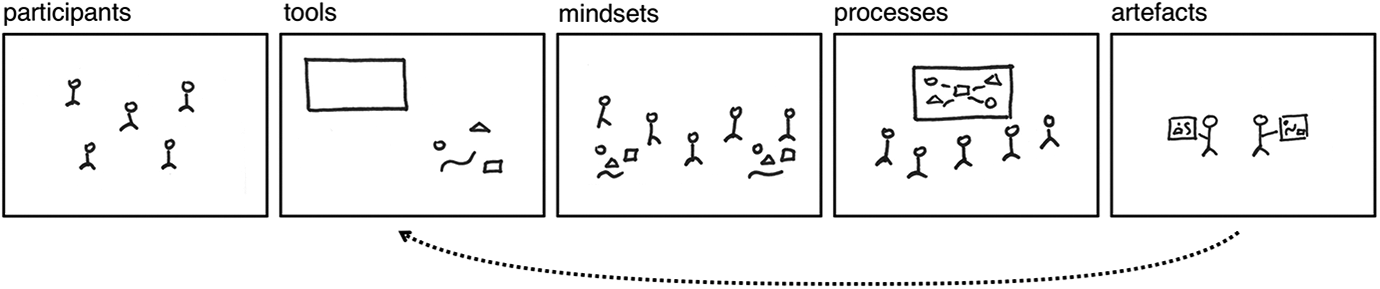
Enhancing participatory strategies with designerly tools, mindsets, processes and artefacts. Image (c) Amanda Perry-Kessaris 2019.
Participants were invited to feedback during the workshop, and to provide additional post-workshop feedback via email. Feedback was also obtained from project partners and, informally, from inter-governmental organisations (IGOs).
The following subsections evaluate the use formal graphics and collaborative prototypes in the Facing All the Facts project according to whether and how, according to publics/stakeholder feedback, it enhanced participation and, thereby, the relevance, rigour and potential impact of the research.
Prototyping
We have explained above that consensus-building activities introduced a participatory dimension to the workshops (see Participatory Strategies). Here we explain how those activities used collaborative prototyping to deepen participation and focus, using the example of an activity centred on mapping the national hate crime reporting and recording system.
As part of each consensus-building activity, groups of diverse actors engaged co-plotted facts (such as what data is/not captured at each stage of the ‘journey’ of a hate crime case) and expert perceptions (such as the strength of inter-institutional relationships within the national ‘system’) onto a large adhesive wall-mounted surface (‘sticky wall’). They worked together to attach, move and remove labelled cards and coloured string in a physical process of negotiation and debate across professional, social and cultural ‘divides’. For example, the actual/potential national system for hate crime reporting and recording was prototyped as follows. The workshop leader set out on the sticky wall a skeleton map of key system actors using coloured cards labelled (in English and the national language) with black marker. Participants negotiated towards an agreed assessment of the effectiveness of the relationship between those actors, representing their finding in red, yellow or green thread (or in instances of disagreement, threads). Following moderated discussion participants were asked to agree and post on the wall priority actions for improvement. The result was a prototype of the actual/potential national ‘system’ (Figure 3). These prototypes then informed both the formal graphic artefacts (see below) and the text-based national reports (see above).
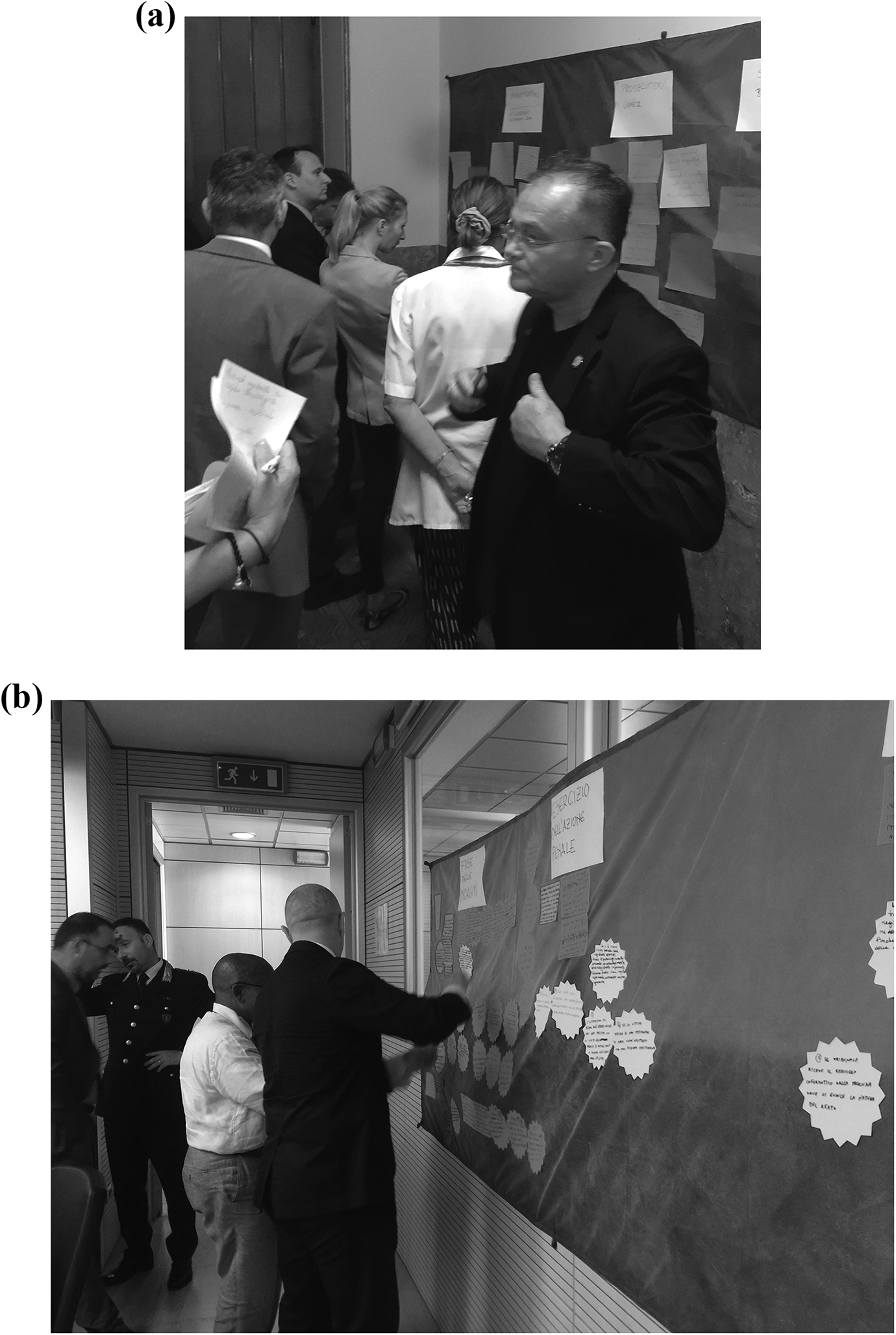
Collaborative prototyping in workshops. Photo credits Joanna Perry. Image CC-By-4.0 2019.
Participant feedback and action revealed that collaborative prototyping enhanced the level and quality of participation. Collaborative prototyping represented a complete (non-hierarchical, boundary-crossing and experimental) departure from traditional workshop, meeting and training formats that many participants, especially those working in a public authority context, are used to. ‘This way of working is not usual for me’, reported one CSO actor. Indeed, several participants associated with a public authority reflected that the ‘novelty factor’ of the sticky wall and coloured string undermined the ‘seriousness’ of the activities. Another suggested that it was risky to use it at a ‘one-off’ event, suggesting it could not be fully accepted as a credible way to engage until it had been introduced and regularly used in the more formal public authority contexts. However most demonstrated a clear openness to engaging with these strategies during the workshops, and formal feedback was overwhelmingly positive. For example, they reported that the activities were engaging and productive, allowing them to construct and critique a fuller picture of hate crime recording and data collection. They commented that it was ‘useful to see and compare peoples’ perceptions’, ‘interesting to look another person in the eye and admit that the relationship could be improved’, and ‘quite rewarding, because even though we agreed, we also had discrepancies’. ‘The most positive thing is that it reflects many elements’. Finally, most participants chose to record the final state of the sticky wall in a photo at the end of each workshop, thereby suggesting that they found it to be valuable, as well as making it possible for them to reflect on it and/or share it with other publics/stakeholders after the workshop.
Participants also indicated, both in their feedback and in their actions, that their participation in the workshops improved the likelihood of meaningful change from the wider research project. Firstly, they reported that they found it helpful to connect, often for the first time, with other system actors. Secondly, they reported that they learned new information and valued the opportunity to share knowledge. Thirdly, every workshop saw at least one country-specific recommendation agreed among participants which was then fed directly into the final research outputs; and several workshops saw participants agreeing specific actions on cooperation. For example, meetings were arranged to further discuss how hate crime recording and data collection might be improved between one or more institutions, a Ministry of Interior committed to publishing previously unavailable information, and a CSO decided to coordinate a national CSO reporting and recording network.
Formal Graphics
The Facing All the Facts project generated two sets of formal graphics: ‘national system maps’ (Figure 4) and ‘journey of a hate crime case’ (Figure 5). Final versions of the project graphics are included in the national system reports available on the project website; and an instructional video on how to use the graphic as a training and development tool has since been developed as part of an online learning module for decision makers and is available on the Facing the Facts website.
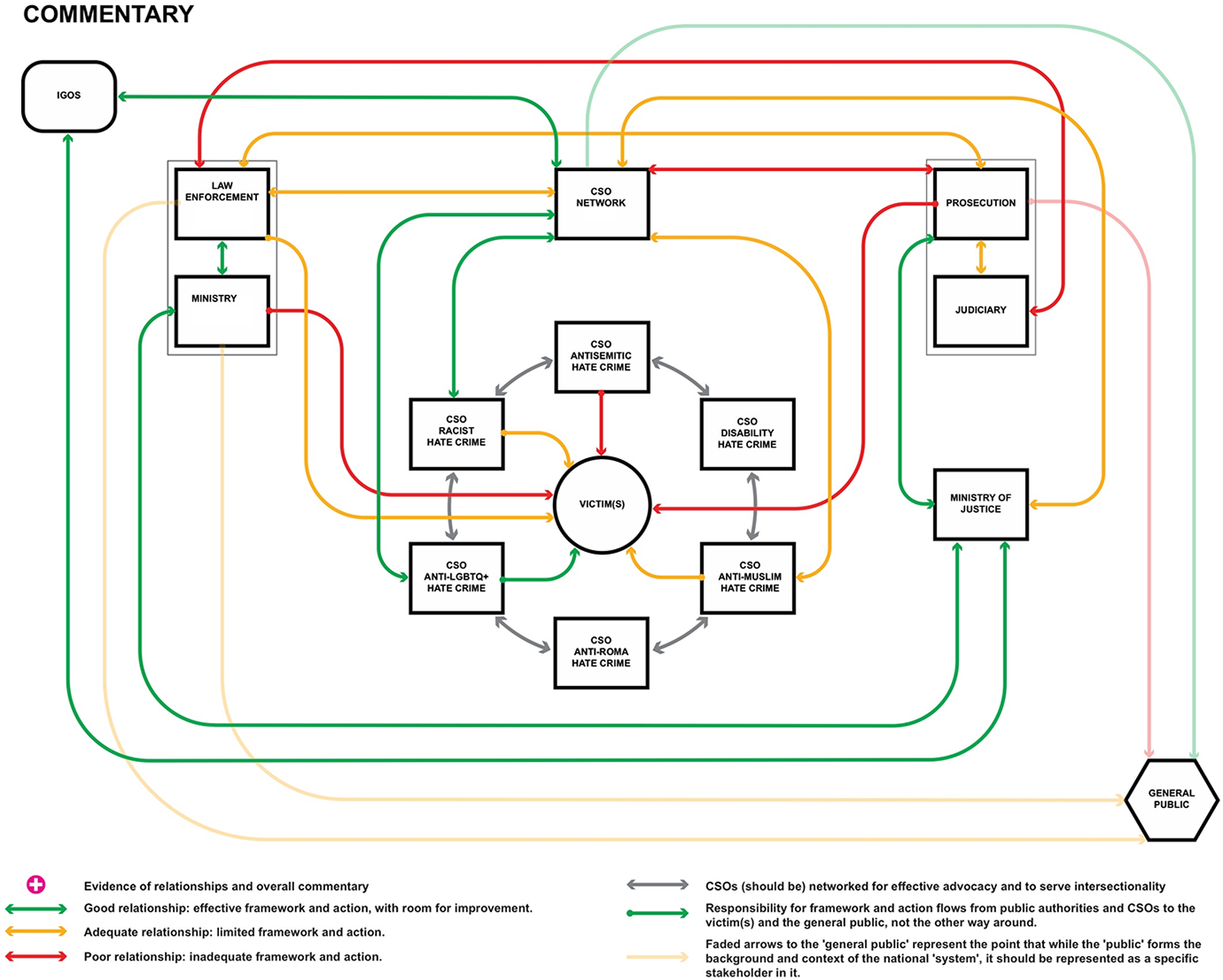
National system map. Designer Jonathan Brennan. Image © CEJI 2019. Reproduced with permission.
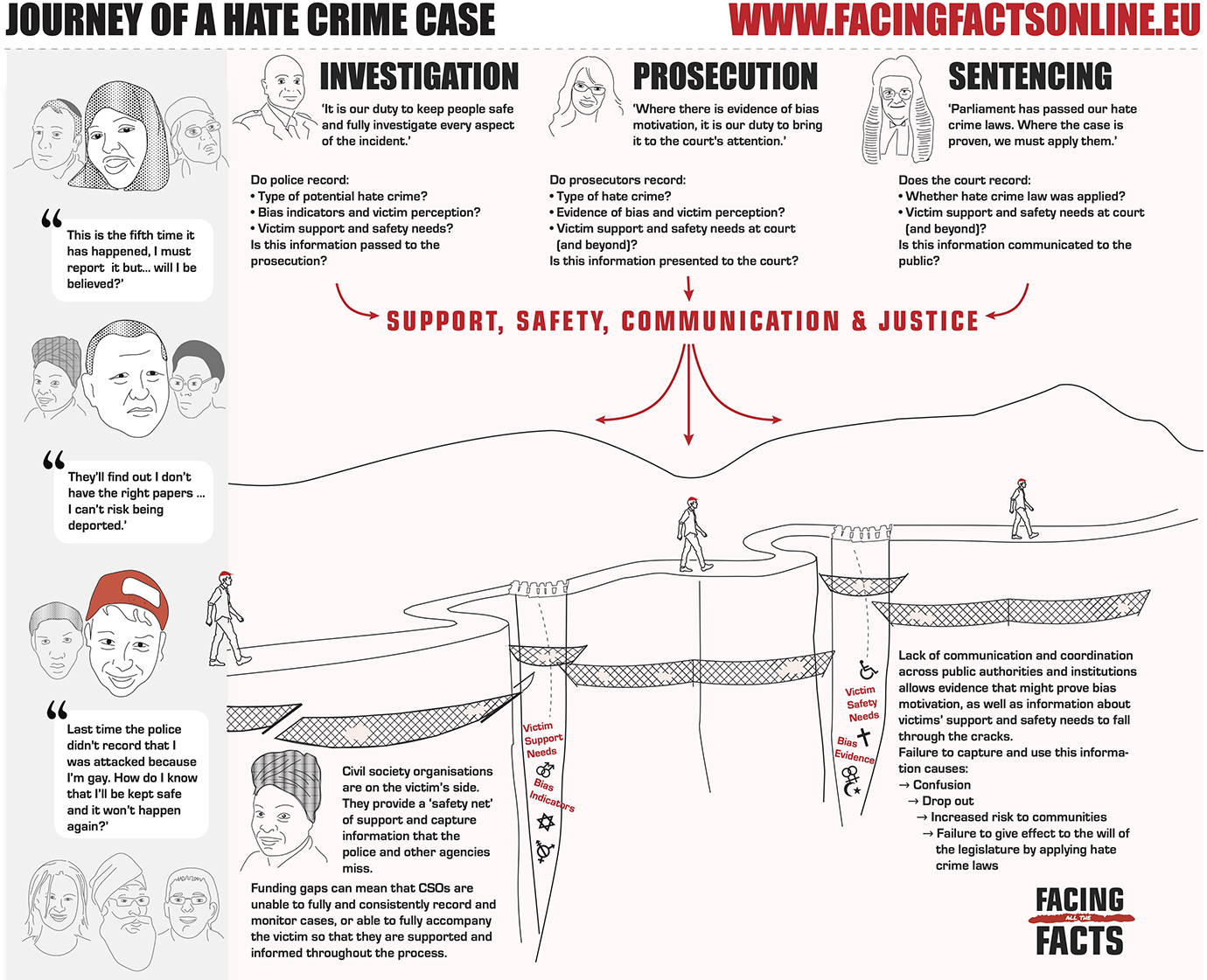
Journey of a hate crime case (English language version). Designer Jonathan Brennan. Image CC BY-NC-ND CEJI 2019.
The making of these graphics involved challenges that are common in information design. In particular, it was difficult to achieve the necessary degree of granularity, whilst remaining accessible and comparable across contexts. For example, it was not possible to capture in system maps the local and regional variety and institutional complexity of federalised systems such as Spain and Italy, and devolved contexts such as the United Kingdom. Sub-national versions could be generated in future. Furthermore, it was difficult to make visible all the nuances in a relationship using a single coloured line since some relationships are uneven, and some are unnecessary to the functioning of the system. The solution was to add pop-up explanatory textboxes, and future iterations might enable users to focus on the relationships of one particular actor, or to apply a filter to reveal system-wide strengths, gaps and weaknesses.
Crucial to the present context is the fact that both sets of graphics were co-created in an iterative process involving project publics/stakeholders, who worked collaboratively during project workshops; the lead researcher, who drew on literature, interviews, national partners and professional experience; and an expert graphic designer.
The ‘national system maps’ visualised the key ‘system actors’ in each project country using data gathered from traditional, participatory and designerly strategies. Victims are at the centre; and connecting the actors are lines colour-coded red, amber, or green to indicate the ‘effectiveness’ of their relationships. The maps are not a formal assessment of national systems. Rather they act as shared spaces, structured by reference to specific actors, institutions and standards; in which publics/stakeholders can co-identify problems and possible solutions; and which can be amended as and when new data becomes available or circumstances change.
The ‘journey of a hate crime case’ graphic visualised, from the perspective of a victim, the stages at which hate crime may or may not be reported and/or recorded within the national system; what should be recorded, by whom and why; and the consequences of not recording.
Participant feedback makes clear that the formal graphics, including the processes by which they were made, succeeded in generating shared, structured-yet-free, spaces. Some feedback highlighted the practical value of making things visible and tangible in this way. For example, participants noted that ‘it is really useful to see all agencies as part of the same picture’, ‘I can use this in my trainings with colleagues’, and it ‘presents findings that could take many pages to present in narrative form’; and advised that the graphic should be made easily downloadable; to be consulted, annotated and updated in paper form during future non-project-related trainings and other activities. Some reported an imaginative engagement with the graphics. For example, one responded to the pathway imagery used in the ‘journey’ graphic with the observation that in fact the ‘victim experience is actually more like a maze, where victims can bump into walls, feeling stuck and not knowing where to go’. Others emphasised how the graphic enable them to be critical (of themselves, of the graphic, and of the real-world context). For example, one public authority stakeholder said that by visualising the process from the perspective of the victim, the graphic ‘highlights the fact that our criminal justice system does not take this approach’; another indicated that the image did not adequately convey the ‘hostile’ environment experienced by victims of hate crime; a number of participants noted that the graphic does not capture the pre-reporting or post-sentencing stages of the journey, meaning that important local authority, probation and prison functions are not represented; and others that it does not include all victim groups. A solution might be to develop additional graphics, including animations, to represent these other aspects.
The impact of the artefacts has been wide-ranging. Over the course of the project, both during participatory workshops and in consultations, the formal graphics became shared spaces into which participants could feed suggestions about the graphics themselves, and about how the project as a whole could be continually improved. Furthermore, they have been used in digital form in online learning for a national Ombudsperson’s institution, and for national policy makers (Facing all the facts website); and in physical form, as a place to note down national level gaps and opportunities, both by police officers in a European train the trainer event and by a wider range of publics/stakeholders during a national conference to share the interim project findings (Facing All the Facts, 2018). At the same time, the visual structure of both the formal graphics and the collaborative prototypes embedded and reinforced three propositions underpinning the project: that victims ought to be at the centre; that hate crime data recording relies on a ‘system’; and that this system is composed, and reliant on the quality, of relationships between system actors. By working within the artefacts the participants reinforced the legitimacy of those propositions. As a result, the artefacts, the research process and the research findings all became more robust; and publics/participants to gain a sense of ownership over the artefacts and the research project. All of this improved he likelihood that the project would result in meaningful change.
Conclusion
Academic researchers often explicitly or implicitly treat knowledge as a ‘gift’. This is a double mischaracterisation: knowledge cannot be ‘transmitted unchanged from one person to another’, for it ‘changes as it passes from person to person through social networks, as people adapt it to their own contexts and needs’; and those ‘receiving’ knowledge ‘may not appreciate it’ or ‘be able to use it’ especially if their ‘needs and preferences’ are unknown to the ‘giver’ (Reed, 2018: 6). When academics and non-academics work together to co-produce research, or to produce research that is at least participatory in orientation, they can generate not only ‘both academic insight and public benefit’, but ‘potentially also different (and greater) intellectual insights’ than either can achieve working alone (Campbell and Vanderhoven, 2016: 14–15). This is in part because ‘[s]ocial innovation occurs when people, expertise and material assets come into contact in a new way that is able to create new meaning and…opportunities’ (Manzini, 2015: 77).
The evolution of the Facing All the Facts project methodology is a case in point. It was always intended to be participatory, and the relevance of formal graphic artefacts was identified early on by the core project team. But it was only once the project was underway that methodological conversations between the co-authors of this paper generated the insight that the designerly strategies might be of use. Perry has spent her career working with people affected by hate crime, and on policy responses to hate crime; and uses that experience to generate critical insights into the dominant academic and policy conceptualisations of hate crime. Perry-Kessaris has spent her career conducting research that is empirically grounded, theoretically-informed but only recently, and with the aid of training in design, with the intention of generating meaningful change beyond academia (‘impact’). As Campbell and Vanderhoven (Campbell and Vanderhoven, 2016: 17) would expect, the methodological consultations underpinning this article have improved our individual ‘relevance’ and ‘rigour’, and produced insights that would otherwise not have been possible.
Throughout the paper we have drawn attention to some specific risks that surfaced around the project methodology, such as over-simplification in graphics, and alienation among workshop participants. To these we now add some general cautions relating to the observation that participatory and designerly strategies are not always suitable. Firstly, most academics are not interested and/or not equipped to generate and sustain longterm ‘two-way, trusting relationships’ (Reed, 2018: 6 and 67) with publics/stakeholders, and many topics that they research are unsuited to it (Campbell and Vanderhoven, 2016: 27). Crucially, ‘[c]o-production involves learning’, so it ‘requires flexibility…to enable responsiveness as mutual understanding evolves, initial assumptions prove shaky or circumstances change’ (Campbell and Vanderhoven, 2016: 20). For example every aspect of Facing All the Facts – form the iterative co-creation of national reports and graphic artefacts, to the organisation and facilitation of workshops – was delicate, complex and resource-intensive; requiring secure access to, and intense interaction with, diverse public/stakeholders. It was only possible due to the unique blend of expertise and experience brought by Perry as lead project researcher. Having performed hate crime-related roles within public authority and CSO institutions across national and international contexts over many years, she is familiar with international terminology, national laws and criminal procedure as well as running workshops with simultaneous translation and facilitating exchange across CSO-public authority ‘divides’.
Secondly, participants need persuading. Non-academic researchers, such as the public authority-civil society partnership behind Facing All the Facts, are more likely to work on topics and in networks that are inherently Mode 2-ready. To them the idea of generating and sustaining the necessary relationships with publics/stakeholders tends to be more natural, even essential. But even non-academic researchers can find it difficult to entice certain publics/stakeholders to participate in research, and to manage the associated diversity of publics/stakeholders and perspectives. For example, although key publics/stakeholders of the Facing All the Facts project were members of the public authority-civil society partnerships responsible for it, it was still necessary to entice individuals to attend workshops, remain for the duration and engage with a methodology-in-progress. The solution was to begin workshops with a formal introduction on the current situation around international implementation of standards on hate crime reporting and recording, so by the time they were asked to participate in unfamiliar activities such as prototyping they had already gained something that they recognised as solid and valuable to take back to the office. As Mark Reed puts it, ‘people value research for its ability to provide them with answers to questions; knowledge that is new to them, relevant, interesting and useful’. Sometimes researchers are ‘so focused on generating completely new knowledge’ that they overlook the fact that their existing knowledge, built up over time that most cannot afford to invest, ‘enables [them] to answer many of the questions that people care most about’ (Reed, 2018: 78).
Thirdly, no research strategy is ‘neutral’ – all ‘originate in, derive meaning from, and effect recursive impacts upon human actors’; they ‘entail choices’ (Perry-Kessaris, 2019). For example, participatory strategies involve ‘making decisions about who is invited to participate, how participation is enabled, which tools are used, and how the outcomes of such an activity shape what goes forward’ (Kimbell, 2015: 64). Campbell and Vanderhoven (2016: 23 et seq.) suggest that participatory workshops are only appropriate when the wider national political context within which they occur is ‘democratic’. Although it makes sense to be cautious, it seems inappropriate to exclude out of hand situations where democracy is lacking – indeed in these cases participation in research might be seen as a rare democratic opportunity (See also Bergold and Thomas, 2012: 10–20). Likewise any given design either ‘serves or subverts the status quo’; is the product of the ideologies, ‘values and assumptions in which it was created’. Design also relies on communication, which is a non-universal and ‘volatile process’ in which ‘misinterpretation’ is an ever-present danger (Pater, 2016: 2 and 3). The risk of miscommunication is amplified in multilingual and comparative sociolegal contexts such as the Facing All the Facts project in which, for example, simultaneous translation was required for two thirds of the workshops.
Design is not alone in making things visible and tangible. For example, a growing multi-disciplinary literature highlights the insights that can be triggered by ‘creative methods’ (James and Brookfield, 2014) and material methods (Woodward, 2020), including the physical experience of making (Gulliksen et al., 2016; Ingold, 2013). Even within the legal sphere those who take an economic approach to law use graphs, legal geographers use maps, and law and art specialists refer to images and objects. What is distinctive about designers is their ‘expertise in materialising future possibilities’ (Julier and Kimbell, 2016: 41) by creating structured-yet-free spaces in which we can focus in practical critical and imaginative ways on the intersection between the actual and the potential. And it is this that makes their ways so relevant to impact-curious sociolegal researchers.
Footnotes
Authors’ Note
Amanda Perry-Kessaris <
Acknowledgements
Many thanks to Davina Cooper, Paul Giannasi, Rosemary Hunter, Suhraiya Jivraj, Deger Ozkaramanli, Robin Sclafani, Sally Sheldon and Dermot Walsh for generously commenting on earlier drafts; and anonymous reviewers for useful comments.
Declaration of Conflicting Interests
The author(s) declared no potential conflicts of interest with respect to the research, authorship, and/or publication of this article.
Funding
The author(s) disclosed receipt of the following financial support for the research, authorship, and/or publication of this article: The Facing all the Facts project which underpins this article was funded by the European Union Rights, Equality and Citizenship Programme (JUST/2015/RRAC/AG/TRAI/8997) with a consortium of 3 law enforcement and 6 civil society organisations across 8 countries. A complete list of consortium members can be found at  .
.