




Abstract
Drawing upon Isabelle Stengers’ notion of an ‘ecology of practices’ this article explores some of the divergent ways in which truths about the violence of Argentina’s last dictatorship period emerge in different forums. We consider how these forums deploy ‘arts of dramatization’, which is to say, the ways they stage questions about the violence of the last dictatorship period in order to propose, explore, confirm and sometimes refute ‘candidates for truth’. Following Stengers’ provocations, we argue that the various modes of staging the past conjure up its violence in distinct ways, placing different constraints on how it can appear, using different material apparatus and probing it according to different values under different obligations. Based on interviews and observational research with key personnel – including lawyers, artists, forensic anthropologists and psychologists – we suggest that while each of the forums within this ecology is concerned with truth, how and what emerges as truth necessarily differs. What counts as evidence, what is understood as ‘successful’, what is dismissed as irrelevant are all dependent upon the concerns of the forum, such that truths about Argentina’s dictatorship are not only ‘situated’ but also necessarily ‘partial’ forms of world-making. In an attempt to propose a shift from over-determined and usually binary lines of debate, we suggest that these truths exist within an ‘ecology of practices’, to use Stengers’ term, insofar as these forums are not closed off from each other, but are becoming a web of often highly interdependent connections, wherein personnel, practices, audiences and resultant ‘truths’ travel.
I would call civilized practice a practice able to exhibit its own, never innocent, divergence, the pragmatic space it creates, the specific way its practitioners world and word their world as Haraway would say. The way a practice diverges does not characterize its difference from others but the way it has its own world mattering, the values which commit its practitioners, what they take into account and how (Stengers, The Challenge of Ontological Politics: 96).
Introduction: Theoretical Principles/Provocations
Let us begin from the premise that establishing truths about the past, making them accepted as such, requires situated practices with more or less elaborate arts of dramatization, technics of persuasion, and gatherings open to being so persuaded. This is not to repeat the thesis that truths are ‘merely’ constructed and multiple, entwined with the power relations that sustain them. Nor is the argument here that truth telling is difficult because of the clandestine nature of the violence perpetrated during the last military dictatorship in Argentina and the various ways in which the perpetrators attempted to cover up their actions, governments have attempted to halt prosecutions, and political actors have challenged historical accounts of what occurred during the 1970s and 1980s (e.g., the challenge to the simplicity of the ‘two devils’ thesis). Rather than be drawn into these protracted polemics, the focus here is on the procedures and particularities of the multiple sites within which accounts of the past are presented and scrutinized before becoming accepted and established as truth. We mean to suggest that there are a diversity of sites in which truths emerge that may be understood as forums, as performative spaces that operate under specific rules or principles that pertain to and constitute their milieus. As Stengers puts it in her discussion of William James’ pragmatism, each forum affirms that there is something to think and that there is a way to think it (2009: 12); but how ‘the past’ is made to offer itself up for consideration is constrained by the specificities of where it appears. Constraint is not necessarily to be given a negative connotation; rather, it is through their specific constraints that different sites are able to put propositions ‘to the test’ as it were. The forums allow certain truths to emerge only insofar as their veracity can be proven and sustained by the mechanisms appropriate to the site of their appearance. By attending to different forums, the point is not simply that multiple truths arise, but, in the sense that our epigraph from Stengers suggests, that there are multiple modes of participation, constitutive of how worlds come to matter through the practice of values and commitments.
We draw upon Stengers’ arguments here not least because her work allows us to consider the production of truth in contemporary post-dictatorship Argentina beyond the binary terms in which they are usually situated – whether this binary is constituted along party political lines, or the binary that posits ‘civil society’ against ‘the State’ – and instead to attend to how the production of truth in various forums happens via distinct forms of telling, procedure and presentation, deploying the ‘arts of dramatization’ appropriate to and constitutive of their specific gathering. This shifts the discussion, usefully in our view, away from the suspicions of ‘motives’ and ideas of political gain, onto a more attentive analysis of the distinctive modes of demonstration in the different forums where the violent past is addressed.
The presentation of proposals or ‘candidates for truth’ within these forums often requires artifice, as do the presentation of scientific facts, as Stengers (2005) has argued, whereby a technical apparatus or device of some sort is asked to ‘testify’ to the existence of a phenomenon. This artifice does not make the truths artificial, just as, similarly, truths may take the form of fiction, be conjured up and passed along through storytelling, without being fictive in the sense of being made-up. 1 Indeed, because truths are constrained in their particular ways, produced according to certain procedures and in front of certain audiences, not all propositions can be made acceptable. To be verified, propositions about the past must be made to strongly advocate on their own behalf in some sense. It is crucial that this independence, which is achieved differently in the different spheres that are the topic of our investigations here, is met.
Drawing on her own background, Stengers offers the example of the chemist, whose art of dramatization is achieved through the staging of the experiment. That is, the chemist must create the apparatus and type of circumstances in which the chemical actants display their capabilities, producing the results the chemist seeks, while simultaneously demonstrating that the effect is independent, that she herself has no part in causing the result to be so (2005: 1000–1001). ‘Candidates for truth’ need to be presented, and they need to be presented ‘modestly’ 2 ; they must be drawn out, demonstrated, coaxed or charmed into revealing themselves as independent truths. Otherwise, audiences remain unconvinced or suspicious. Thus, establishing the truth about the past requires not only the theatrical animation of evidence, as implied by the description of the perpetrator trial as a ‘theatre of justice’, as Felman (2002) famously put it (and as Carlos (1996) and Osiel (1997) explored in relation to Argentina’s 1985 trial of the junta 3 ), but also someone who presents, reflects and performs before the forum in order to facilitate that animation. This facilitator will draw out the ‘propensity of things’ (Jullien, 1999), that is, their ability to account, attest or affect, such that the truth that emerges carries weight within and potentially beyond this forum.
These arguments are integral to Stengers’ arguments for thinking via ‘ecologies’ of truth. Forums are constituted so as to gather and enable the requisite expertise, apparatus and procedures to test whether certain propositions succeed before concerned, relevant and interested audiences. This latter point is, of course, crucial; if audiences lose interest, are frightened and turn away, or are more concerned about other objects, their role in witnessing, attesting and sustaining the truths is lost. They must be gathered and must engage in the art of ‘testing’ suggestions that are presented before them.
In relation to the truths at stake here – those concerning the history and legacy of the dictatorship period in Argentina – the arts of dramatization are staged within a wide variety of forums, each with their attendant specialists. A non-exhaustive list would include those we spoke to in our research: lawyers, psychologists, forensic anthropologists, architects, archivists, academics, curators and artists. Obviously, these ‘practitioners’ work differently, operating within their distinct milieus whose attentions diverge. Indeed by these divergent practices, they constitute their own ‘ecologies’ within which their arts are guided by their principles and values. It follows that they will have distinct modes of dramatization, imposing different constraints in order to process what comes before their forum and to seek specific forms of satisfaction.
In contrast to a common mode of argument within socio-legal literature, that values non-legal sites of cultural production but tends to maintain an implicit deference to law, seeing the non-legal realms of art and cultural practices as where legal decision is celebrated or challenged, our argument offers Stengers’ notion of ‘ecologies of practice’ to aid the exploration of specificities of practices in different forums. Indeed, a central argument here is that debates around the role of visual art, museums, archives and Spaces of Memory might be framed less deferentially than has tended to be the case. Such activities and interventions are not supplements or ‘remainder’ sites, to be considered only where formal justice processes have failed, stalled or ended, but as sites that have their own orientations and truth-telling capacities beyond law. That is, the truths that emerge are differently revealed and endorsed via different apparatuses, modes of demonstrations and audiences.
Considered alongside each other, we can begin to study how the forums produce their distinctive truths and map how they may ‘travel’ beyond their initial milieu as it were. Indeed, in addition to the figures who adopt the ‘expert’ and ‘demonstrator’ roles, Stengers describes a further figure, that of the diplomat, the one who moves between forums, who seeks agreement or connection, and who typically intervenes in a situation without asserting or defending an ‘opinion’ (2016: 90) but in order to facilitate connections. Experts appear because their practice is considered relevant to the procedures of the forum, even if they are not sure how it will be taken into account; the diplomat, however, usually comes more humbly, seeking to ask for hesitation, and to provide a voice to those whose ‘mode of existence and whose identity are threatened by a decision’ (2005: 1003). The diplomat is the one who must repeatedly check back and forth, artfully presenting possible scenarios in order to bring other potential relevancies into consideration. These figures help one to understand how the forums, including the criminal law court, necessarily entertain propositions from ‘outside’ their parameters, deciding upon their relevance and impact, as they explore the concerns before the forum.
Law’s Art of Dramatization
As the above implies, the attempt to produce truth and to speak ‘justly’ in relation to the past is not confined to legal arenas. But the legal trial remains crucial within the ecology of practices at stake, and is intuitively understood as a forum in the sense proposed here, one that many socio-legal scholars have become accustomed to consider performatively. In the terms introduced above, one can say that the trial requires the presentation of candidates for truth – that is, forms of evidence –and operates via the ability of the apparatus of law to produce the requisite problematizations of the scenario, conjured up in the minds of the juries or – as in the cases dealing with past violence in Argentina – the judges. Of course, the attribution of responsibility – law’s ‘decisionist imperative’ that ultimately relies upon a reduction of all accounts of a past event in order to facilitate the possibility of reaching a curtailment of discussion and dialogue (Christodoulidis, 2004: 193) – guides and colours the direction of the proceedings. The arch of the criminal trial from indictment to judgment is a constraint in this sense insofar as all activity within its purview takes place under the parameters of the charge and possible verdicts; hence, the constant challenges to what is relevant to the proceedings.
The criminal trials in Argentina are also constrained in ways that are taking on particular urgency at this juncture, more than 40 years after the coup, insofar as the trial must put living individuals on trial and seek to reach a conclusion about their guilt just once (i.e., unlike academic historical interpretations of the past, trials are generally understood, as a prosecutor in the Milosevic trial put it, as ‘one chance’ to interpret the evidence correctly, quoted in Wilson, 2011: 2). 4 Thus, the ongoing trials for human rights violations committed during the last dictatorship in Argentina face a problem shared with other ‘belated’ or post-transitional justice processes (Collins, 2010); if the rationale of the criminal trial is to punish the living for their actions, they are up against time. The age of the defendants interferes with the possibility of holding the trials, and can thwart the primary intention of the prosecutors to bring those responsible to justice; likewise, many witnesses are passing away 5 : ‘Time favours death and is against us’ succinctly states Camuña, a federal prosecutor in Tucumán (interview, 2015). 6 If prosecutors have convictions in their sights, and the verdict is the outcome towards which they work – their moment of satisfaction – the longer they wait for that outcome, the greater the risk that the perpetrators will ‘escape justice’ and they will be disappointed in their task. Ultimately, says Camuña, ‘the passing of time is…on the side of the perpetrators’ (interview, 2015).
For Camuña, this pressure of time relates to the performative aspects of the trial. Indeed, the sense that the trial needs to employ dramatic techniques – the ‘predilection for drama’ that pervades the prosecution in perpetrator trials, according to Douglass (2006), and that so infuriated Arendt (1963) – was confirmed in our discussions with him. The prosecution’s work proceeds more easily, Camuña commented, if one can include the immense potential of the living voice of the survivor. To lose the witnesses is to endanger the possibility of conviction, not only because the living witnesses hold the facts and the details that begin to break down the silence that the perpetrators have attempted to build around these crimes – by acting clandestinely, by destroying evidence and of course, by disappearing people – but also because they are the most electrifying part of the trial. He is explicit; they are theatrical: ‘because the trials also have to have theatrical aspects to them, the reconstruction [of the scenes of violence] has to be as close as possible’. Camuña’s aim is to bring the judges, in his words, emotionally ‘back in time’ – as ‘close’ to really having been there, to having really witnessed these events. The best way to do this, he suggests, is to have the live witnesses present their stories in court – to consciously stage their testimony as ‘unmediated’ as it were – because their presence and words enable the judges to ‘see and feel’ what the witnesses went through: ‘The empathy that a live witness generates is immensely…powerful…and the judges…end up putting themselves in the position of the victims or their families’ (interview, November 2015).
Interestingly, Camuña insists that the urgency to prosecute before the witnesses pass away is because the prosecution’s chances of gaining a conviction diminish when someone attempts to ‘play the role’ and speak for the victim. A lawyer reading a statement on behalf of a survivor about their experience, for example, cannot do that same affective work since, as Camuña cautions, ‘You will never get the same impact…nor the richness of the live witness’. 7 As these comments imply, the prosecutors need to present their case and to ‘stage’ the evidence (Keenan, 2014: 52) but this art of dramatization is not for the sake of drama but so that, through careful preparation and persuasive presentation, the (legal) truth arises. While Felman’s influential notion of a ‘theatre of justice’ enables one to grasp the performative dimension of such trials, it is too quick a conflation of the legal forum with theatre. The trial is not equivalent to theatre, but is a complex technical apparatus in which the lawyers – like the figure of the ‘modest witness’ in Stengers’ example of the chemistry demonstration – conduct events in order to facilitate the passage of an independent truth. To truly persuade the audience in a criminal trial, they (the judges or jury) must not only attribute guilt but simultaneously be persuaded that the impression of guilt is not a mere effect of the trial itself.
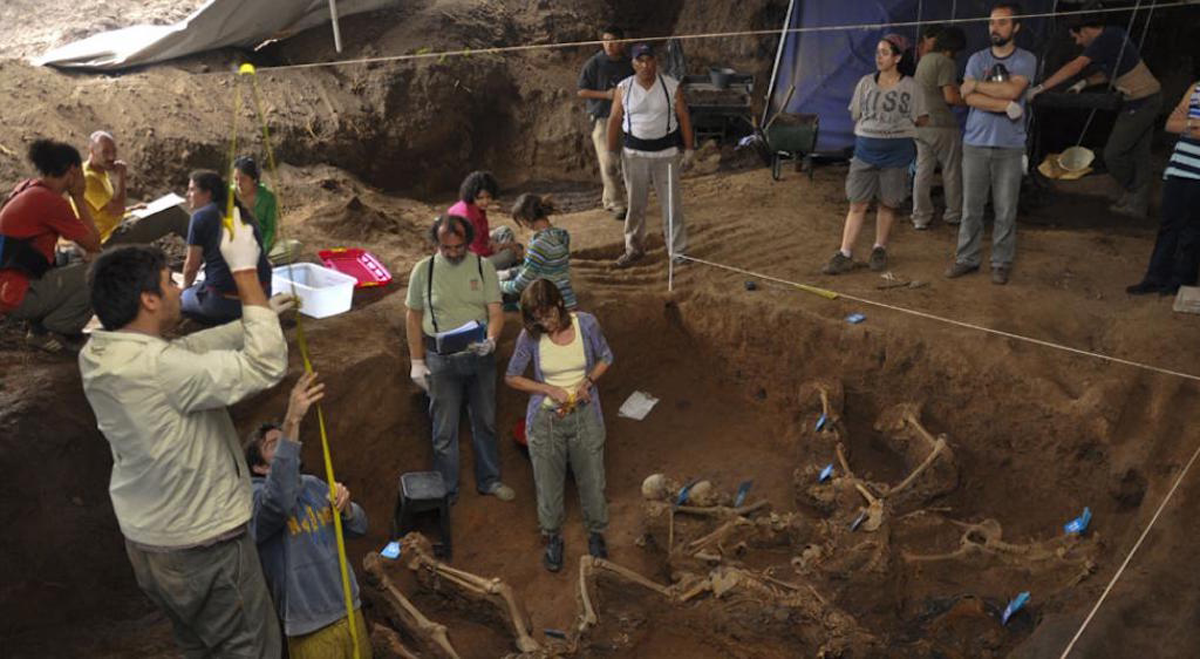
Beyond the witness statements, the court receives other forms of evidence, other arts of dramatization. In our research, we have been particularly struck by the use of visual evidence, including photographs, to mobilize the affective potentialities of the court. The photographs of human remains at the ex-clandestine centre for detention, torture and extermination (ex-ccdtye) Arsenal Miguel de Azcuénaga in Tucumán being uncovered by the Argentine Forensic Anthropology team (EAAF) in 2011 had an enormous impact in the megacausa that prosecuted those responsible for crimes at the site. 8 Camuña recalls the shock of the photographs of the graves when they were shown in the court.
The EAAF team are now world famous for their endeavours to identify victims from bones and through their DNA-matching processes. They have been involved in criminal prosecutions ever since their founder Clyde Snow was invited to go to Argentina in 1984 at the request of La Comisión Nacional sobre la Desaparición de Personas (CONADEP) and human rights organizations to help with exhuming and identifying human skeletal remains, and presented the findings at the junta trials in 1985. 9 Photographs are an integral part of their work. 10 The ones shown in the trial in Tucumán show the team at work, carefully uncovering, measuring, surveying, labelling and documenting the grave (Figure 1).
EAAF at site of a communal grave, ex-Arsenal Miguel de Azcuénaga, Tucumán, December 2011. Image Source: Centro de Información Judicial.
While any photograph shown within a court of law is intended to operate as evidence, and asks that the court understand it in an indexical manner, as a mode of documentation, what is also crucial here is the way in which, as Edwards (2001) once put it, the photograph projects the past into the present through an ‘affective tone’. Filling the frame with the human remains of the ‘disappeared’, left in the awkward positions where they were thrown, these photographs operate, unavoidably, via the ‘theatricality of framing’ and a resultant intensity (Edwards, 2001). There is both a containment of the court’s attention and a heightening of affect (Bell, 2010; Edwards, 2001).
Faced with these affective possibilities and this ‘multidirectional’ potential of photographs, the prosecutor often enrolls the figure of the ‘expert’ to help tether their meaning. 11 The forensic anthropology team continues to contribute to the images’ presentation, in Tucumán as elsewhere, usually via written reports for the court or – although less usual in Argentina – through presentations in which they interpret what is being seen for the court. In either case, the forensic anthropologists offer their expertise as a mode of translation from the silence of the skeletal remains (Weizman, 2014) and from the procedures of science into those of law in order, in the words of current President of the EAAF Luis Fondebrider, to ‘complement’ the testimony of survivors and to ‘help the judges form a more complete picture’ (interview, November 2015). At its heart, forensic work is an attempt to reconstruct what we can know of the final moments of this person’s life, despite all that has happened between then and the moment of the skeleton’s reappearance (Somigliana, 2014: 197). 12 While over the years, the science has evolved – with the discovery of DNA, crucially, so that the skills and procedures the forensic anthropology team employ have altered – it is the application of scientific procedure that grounds the veracity of what they find; it is the rigour of method and the ‘fit’ of the explanation to the material evidence that convinces the scientific community. Building on that status as scientist, the forensic expert is able to model him or herself as merely the ‘translator’ of what the remains ‘say’.
In presenting their evidence to the court, the forensic experts do not repeat but are asked to reconfigure the technical work of the laboratory in such a way that their conclusions can be persuasive in the legal forum. 13 As Snow himself once suggested, this may be through a storytelling that articulates the bones’ own narrative: ‘to be effective as an expert witness, you have to learn that in a way you’re translating the skeletons themselves. The bones are the ones telling the story’ (in Weizman, 2011: 72). An objective and neutral manner of presentation can be ‘rather cold’, Snow commented (in Weizman, 2011: 72). Interestingly, he recalls that in presenting his evidence to the 1985 junta trials, many aesthetic issues came into play. 14 Rather than present an overview of the team’s findings, they chose on that occasion to select just a few of the many cases, in order better to convey the stories. They chose the case of Liliana Pereyra, not only because she was herself a ‘beautiful girl’ but also because she was pregnant at the time of her disappearance. The bones were able to establish that they belonged to a young woman who had given birth, while photographs of several stages of the reconstruction of the face from the skull using forensic techniques were projected on the screen in order to take the court through that process, ending with ‘the last slide of this beautiful young woman’ (in Weizman, 2011: 72). The judges, Snow reports, were moved by this presentation, and people ‘told me later that many of the newsmen up in the balconies were crying’ (in Weizman, 2011: 72). Here, Snow confirms that while the forensic evidence carries the weight of having passed through the scientific forum, so that the team itself and the wider scientific community of forensic science is convinced of its truth, the law court is a different challenge, one where the scientific procedure is not repeated but where the resultant conclusions pass through a further ‘art of dramatization’.
In trials such as the Tucumán megacausa, which relate to specific sites where multiple crimes occurred, the judges will usually make at least one visit to the site. On these visits, the architecture and space is also asked to ‘testify’ as it were. Again, human guides are usually on hand. Camuña recalls: [In] our megacausa, which lasted for more than a year,…we made the whole tribunal go to where the bodies had been buried. This had a huge impact and enabled the presentation of much evidence, [especially since] over fifty people were able to speak about the place, describing it, talking about how it was, how it functioned, [showing] maps, etc. Going to the actual place – and especially to the common graves – has a great impact on the judges’ perceptions of the trial. It also galvanises us [the lawyers]. (Interview, 2015)
Similarly, we spoke to architect and member of the human rights collective Memoria Abierta, Gonzalo Conte, who has also participated in the trials, including the huge second megacausa to prosecute crimes that took place in the notorious ex-ccdtye, known by its acronym ESMA, in Buenos Aires in 2011, presenting computer-generated models of ex-ccdtyes and what are termed ‘Audiovisual Judicial Records’ (2015: 88–89). Conte explained that speaking as a professional architect about the computer models that he has created of ex-ccdtyes, especially those that have since been demolished or altered in some way, helps to focus the imagination of those gathered in the court, so that the visions they construct of the places that are being described do not diverge from each other.
The ‘Audiovisual Judicial Records’ are records that incorporate survivors’ accounts of their experiences with facts about the buildings and films of the spaces as they now appear, commissioned to aid the judges conducting the trials. Sometimes the survivors appear in the embedded videos to record their memories of the space for the camera. As the survivors walk through the clandestine centres, they point out different aspects of the site, provoked by the physical space to tell snippets of their stories on camera. Conte presents the record in court, allowing the survivors’ testimonies to be understood alongside the presentation of the physical spaces in which the crimes took place, and allowing furthermore the ‘eye of the camera’ to confirm the physical co-ordinates and appearance of the place, as well as to record chance encounters inevitably caught by a camera as it wanders through these often forlorn buildings. Sometimes, Conte suggests, it also captures the pathos of the objects that still lie around – such as, for example, parts of syringes suggesting the anaesthetic that was forcibly given to prisoners before they were killed.
Faced with such emotive material, the ability of the architect to speak ‘scientifically’, in his or her capacity as a professional, and to offer facts as ‘concrete, irrefutable’, is important for the legal process, argues Conte, not least because it eases the task of the judges in relation to the weight of the decision they have to make: when you explain [the evidence that relates to the layout of the buildings], with a lot of sincerity, the same as when [the survivor] speaks about his own torture, in that moment the judge begins to say “Ah we need more of this, we need evidence, we need facts like this.” Because [with this evidence] it is easier for the judge to condemn [the defendant] for life. (Interview, November 2015)
We have seen how the trial co-ordinates different practices – with their attendant technics, forms of expertise, spatializing and dramatizing procedures – as a network of partial connections articulated together at the site of law in order to produce legal truth. Much like Stengers’ (2016) notion of an ‘ecology of practices’, the different practices that appear at the site of law may have different interests and be only partially connected, but the event of the trial brings them into the same space. They receive audience there insofar as they articulate evidence deemed both admissible, according to legal procedure, and relevant for the purpose of the trial. In a sense all the facts that non-legal ‘experts’ bring to the court become ‘mere’ propositions in the legal realm. That is, the facts in question may have been validated elsewhere, in other forums. But here they are redeployed and re-presented within the case being made by the prosecution or defence. As Keenan has argued: evidence is what is used to persuade.…It is not the matter of fact. Evidence does not convict, nor does it decide, nor does it settle or conclude or determine…It is not an answer but a question: it asks for a decision, for a reading or an interpretation, it asks to be told what it says. (2014: 45)
The contrast between the specificity of the legal forum and the work of the other forums suggested here is nowhere more apparent than in the fascinating interview we conducted with a psychologist who has worked with survivors of detention camps giving testimony in court, including the 2011 ESMA megacausa mentioned above. Laura Sobredo explained that her own principles of professional practice, which are built around promoting healing and psychological health, were repeatedly put under pressure in the courtroom. She states: ‘an effective justice process is impossible without these witnesses. But for us [psychologists] it is impossible to ask [the survivors] to do something that is painful once again’ (interview, 2015). Working alongside the important organization Centro de Estudios Legales y Sociales (CELS), Sobredo’s role was to support those subpoenaed by the court, including those who asked for dispensation not to attend. With those who did appear, she would feel obliged to warn them not to expect that the justice process be a healing experience, to remind them that court differs markedly from other sites at which these same stories might be told. In therapeutic practices, she commented, one is able to allow people to talk at their own pace or even to fall away into silence. Silence is given space, understood as signalling the difficulties of articulating the past, and even as perhaps the most important moment in the telling of such stories, therapeutically speaking, given the effect of these precisely unspeakable events upon one’s self (interview, 2015). But in the court, she suggests, the procedure, ‘apparatus’ and the principles that guide the work diverge from those of a therapeutic setting. For this reason, Sobredo explicitly acts like Stengers’ diplomat, moving between the needs of the court and its limitations as a place to talk about personal experience of events in the past. ‘Certainly, I don’t think the court is the place to talk about everything’ she suggests.
With this diplomatic attitude, in which Sobredo is acutely aware that she is shifting between forums, and asking potentially vulnerable survivors to do the same, she told us that she would sometimes encourage her clients – where she sensed it appropriate – to use the court as a way to allow themselves to bring some small aspect of their story into a public forum. That is, even something that may be irrelevant for the court, might be worth sharing there. She offered two reasons this might be so. First, it is a public forum in which the survivor might convey what these events mean to them, personally, and to give details that continue to haunt them. To share details in this way is to ‘own’ that moment in proceedings and help avoid the risk of feeling oneself becoming objectified once again.
15
For example, Sobredo encouraged one survivor of kidnapping to mention in court that she remembered longing for a piece of clothing she had had: ‘when she told me “I always remember one thing. I had a little green dress.” I said, “Tell me about it”…“No [she replied] but…it is only a detail”.’ Or another witness, who mentioned that for a long time she held her cup with two hands; she had been handcuffed during her kidnapping so that reaching and drinking with her wrists close to each other had become automatic. Sobredo suggests that these intimate details may not be legally relevant to the trial but they enable the witness to feel something of his or her particular story was shared, and by that same token, to facilitate a wider comprehension. Sobredo says: in these trials the judges, the prosecutors and sometimes the members of the public have listened to some terrible things, many, many, many times. And then appears a person who was intimately involved in those experiences and the judges, who have listened to so much, will [nevertheless] always remember this man who told them about a brief moment. (November, 2015)
Other Forums: Art, Museum, Archive
Outside the courts, the art of dramatization of the past takes place in many other forums, such as those in which we have been particularly interested to consider alongside the legal in this research project: memorial museums, ‘Spaces of Memory’ – which frequently also house archives – and contemporary art spaces. At those we have visited in Buenos Aires (both the ex-ESMA and El Parque de la Memoria), in Rosario (Museo de la Memoria) and in Córdoba (Archivo Provincial de la Memoria, Espacio Para La Memoria La Perla), these different functions can share the same physical location.
In terms of establishing the truth about the past, such spaces are often implicitly understood as less important than legal trials as there is tendency to defer to the authority of law to write history. But in socio-legal scholarship, and especially among humanities scholars of transitional justice, they tend to be celebrated as alternative and more expansive spaces, contesting and supplementing the restricted nature of legal truths. They are praised for their ability to shelter that which would otherwise be abandoned and lost from historical narratives; visual and performance-based arts in particular are widely described as playing a crucial role. Not least, such arts are understood to produce evocative, affective spaces uniquely able to transmit the subjective experience of past violence.
While not disagreeing with such sentiments exactly, what we mean to suggest is that one might adopt a less implicitly deferential tone and understand such spaces less as supplements or alternatives to the legal and position their role more boldly, as alternative forums deploying their own arts of dramatization and thereby offering their own ‘candidates for truth’. It is important, in other words, to draw out the specificities of the forums they create in order to give full appreciation of the role they play and will continue to play, probably long after the trials have ceased, in how the past is made relevant to the present. We will discuss three brief examples in order to try to appreciate how specific principles and concerns can operate in these forums. PAyS (‘Presente, ahora y siempre’), the exhibition space of the Parque de la Memoria, Buenos Aires.
Art spaces have a certain freedom. Indeed, this freedom is arguably what, in our era, makes art recognizable as such, since the ‘aesthetic experience’ has been constituted around an embodiment of such freedom. It is a freedom that, in approaching Art, we encounter but ‘we cannot possess’ (Rancière, in Papastergiadis and Esche, 2014: 30). By definition, artists are able to choose what and how to put things in relation. Here, the small stories – those that would be under-heard or heard as ‘irrelevant’ in the courtroom – can become central, intensified through artistic attention, incorporated within unexpected montages, without the same strictures of relevance and clarity that bind a law court. In other words, artworks exhibit a sense of care for the encounters they create, and for how these position the spectator, but they are not tethered in the same way as legal presentations of evidence. It would be a mistake, however, to infer that as a consequence truths about the past are not proposed, constituted and accepted here.
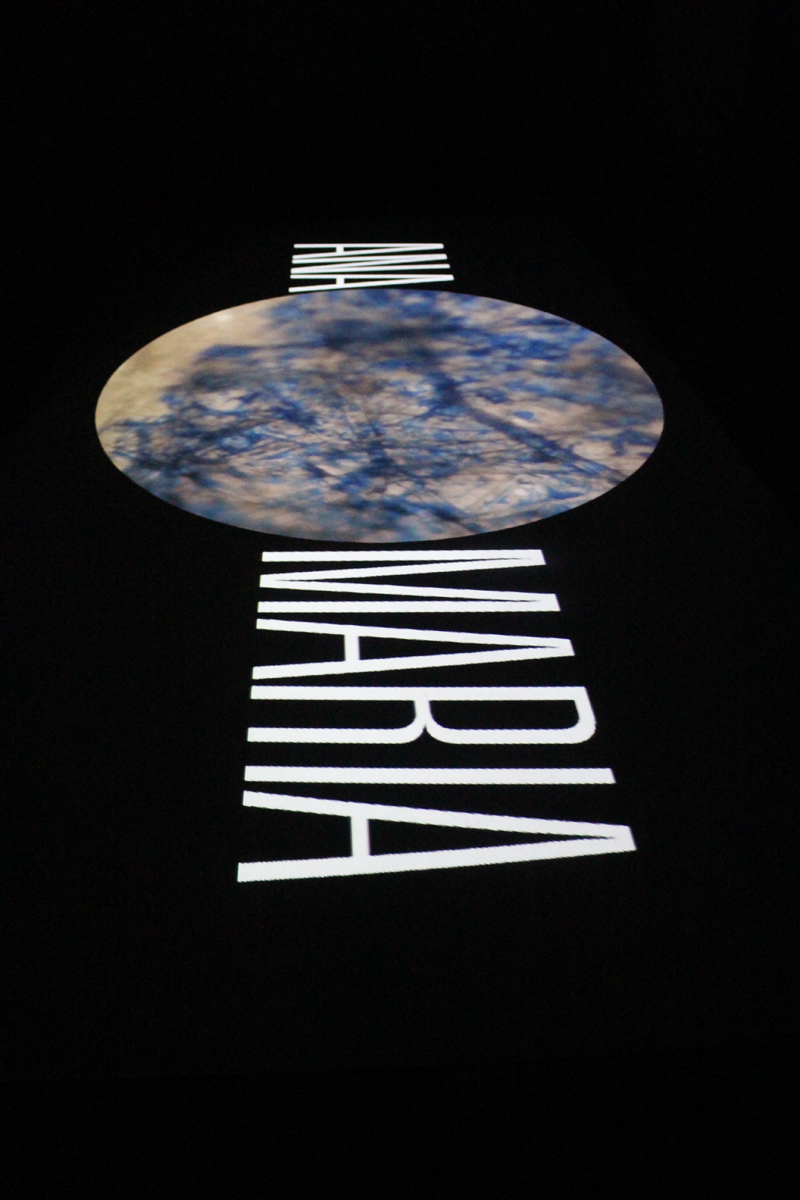
Albertina Carri’s exhibition Operación Fracasco y Sonido Recobrado (Futile Operation and Recollected Sound) at PAyS in the Parque de la Memoria in November 2015, used letters from her mother, who was detained before being disappeared, recorded by an actor and played as an audio score, while onto the floor of the gallery were projected images of the fungus which she found growing on the filmstock of militant films from the 1960s and 1970s, appearing here as enlarged, unrecognizable images, mysteriously beautiful (Figure 2). The collection of things put in relation – the disappearing images of the militant films, the pain of a mother separated from her children, the materiality of the letters and the filmstock, the encroaching life of fungus – are not random; but nor are they pursuing a decisionist imperative such as that requested by law. The provocation of facing a multiplicity of objects and sensations is part of the experience of thought, affect and visuality conveyed to the visitor of many a contemporary art exhibition. As Rancière has argued, such work purposely underdetermines how the collection of things will make meaning in relation to each other, presenting the viewer with a kind of enigma. While the spectator of artworks has always had their own kind of freedom – whether to be interested or not, of course, but also beyond this, how to ‘use’ or ‘behave’ when confronted with these unexpected or unpredictable assemblages that neither describe or explain an event (Rancière, in Papastergiadis and Esche, 2014: 39) – these works explicitly intensify the spectator position as the one to whom that enigma is posed. Indeed, as in her celebrated film Los Rubios, part of Carri’s message seems to insist that interpretations are contingently gathered from many elements, becoming indistinguishable from fictional creations, especially where issues to do with human recall and human desire are in the mix. As Blejmar has written, Los Rubios
explores the limits of the documentary form – and of the mediums that would supposedly deliver the truthful version of its object, namely testimonies, photographs and letters – and ultimately concludes that it is impossible to faithfully represent (the absence of) her parents, Ana María Caruso and Roberto Carri, using traditional documentary resources. (2016: 69)
Albertina Carri, El Parque de la Memoria, Buenos Aires, November 2015. Image: Vikki Bell, 2015.
If, in this exhibition as well as through her earlier work, Carri seeks to problematize memory in this way, this does not imply the absence of truth or ‘mere’ fictionality but rather insists upon a necessary partiality to the truths that emerge wherever understandings of the past are sought. Her artworks decline the invitation to occupy the role of witness associated with law courts – that is, telling ‘what happened’, ‘what I remember’, ‘what they looked like’. Likewise, the artist has resigned the position of the translator, for she does not request that a certain message or meaning be conveyed. She is a ‘creature of speculation’ (Stengers, 2016: 92), a different kind of diplomat, insofar as she brings offerings and suggestions without herself insisting on one interpretation. While she has certainly made a selection, and includes them precisely because she considers their relations to be potentially both relevant and provocative within the specific space of PAyS, the multiplicity simultaneously suggests a different sensibility, one that offers alternative values formed from a sensitivity to the fact that accounting for the past is not a natural process precisely insofar as it requires an apparatus. Carri repeatedly draws attention to the material support that Memory requires: the materiality of the film, the paper of the letters, and all of the decisions about ‘staging’, editing and showing. These aspects also necessarily imply a vulnerability and fragility. Even those aspects of the past that are captured on film, audio or written down, not to mention those that survive intangibly in human memory or bodies,
17
hold no guarantees that they will manage to appear and manage to convey a story in the future. Art exhibitions that deal with remnant-objects, as Groys (2009) has argued, rely therefore upon a curation that seeks to ‘cure’ their powerlessness, to rescue the object’s inability to show itself by itself, by rendering the object into an aesthetic image that we can sense and bring sense to. Such propositions are likewise Carri’s ‘candidates for truth’. (ii) Museo de la Memoria, Rosario.
How does a museum of memory differ from an art space such as PAyS? How do the truths articulated there differ from the legal truths that arise from prosecutions? According to Williams, memorial museums ‘concretise and distil’ events, providing a place for events that may otherwise only exist disparately, in personal memories or in books, films, websites and so on, becoming ‘surrogate homes for debates that would otherwise be placeless’ (2011: 233). Whereas the exhibition described above, for example, gathers its elements in order to produce an affective intensity for the spectator, the gathering that happens in a museum tends to be tethered by the institution’s sense of social purpose. Such museum spaces – including the important Museo de la Memoria in Rosario, which is to date the only institution dealing with the last dictatorship in Argentina set up solely as a museum – are rarely simply about storage; in fostering debates, giving space to new articulations around the past, and thereby implicitly refusing to be ‘historical’, they seek to enfold the past within the present and future. In line with a more widespread ‘new museum ethics’, the focus is not so much on the preservation of objects and collections, therefore, as it is on the potential of the museum to ‘do good with museum resources’ (Marstine, 2011: 7). However this injunction is understood, memorial museums are more often than not entwined with a future-oriented concern. Rosario’s Museo de la Memoria, 18 has certainly taken the view that its role is not merely to narrate the past or to present objects from it, but also to promote an ethos of continued engagement – of both the local community and the tourists who visit – with the past’s ‘lessons’. This pedagogic role for memorial museums dealing with what Roger Simon termed ‘difficult knowledge’ becomes concerned, as Simon puts it,
with the question of how exhibitions might be presented so as to serve a transitive function that could open up an indeterminate reconsideration of the force of history in social life so that exhibitions that trace the lives of those who have lived and died in times and places other than our own may yet have some force that enjoins our capacities and felt responsibilities. (2011: 208)
Yet the question of how this potential is afforded the opportunity to unfold relies upon how the space is curated, and what direction the museum desires. The present director of the Rosario museum, Viviana Nardoni, herself an ex-political prisoner, explains her own philosophy, tying her understanding of what ‘doing good’ might mean to a perceived need for national education in democratic values:
We need to educate young people in the democratic way, so we are working in that path. We need to convince people that democracy is the only way to be a strong nation, to be a healthy society and to have a strong future. It is difficult to teach about that and the examples of history help. (interview, November 2015)
This goal, somewhat loftier than tends to be articulated in art spaces, reflects a sense of purpose whose concerns flow beyond the experience offered within the walls of the institution itself.
In order to meet such aims, the museum must attend to the theoretical principles and community obligations that are relevant to secure support for the museum’s endeavours. Not least, the museum is obliged to be concerned with the experience of the visitor; this is constrained in practical and conceptual ways, and is guided by how the directorate imagine her and the museum’s role in relation to her. As we have seen, Nardoni emphasizes the importance of the museum’s pedagogic role, knowing that the museum is a resource for the city’s schools, positing it within ‘post-memorial’ endeavours at least insofar as it seeks to convey the past to those who did not experience it. While this is a pedagogical commitment to the next generation and a political commitment to democracy, Nardoni understands the museum as offering something of the intimate experience of those who lived through that time. It is as if the museum wishes to impress on its visitors a sense of the bewilderment of those caught up in the period as a prelude to the political commitment: It is so difficult for young people to understand the difference between the freedom that democracy offers you and those moments [for example] when you knew that they had taken your brother and that no one, absolutely no one, would help you find where he was. (Interview, November, 2015)
Yet there is also the need to allow for the visitors to feel engaged on their own terms, to feel free to move around the space as they choose, and not to feel overwhelmed with detail or shocking encounters with the past. Many visitors are tourists to Argentina, for example, likely to be under-educated in relation to the events of the dictatorship period. To this end, Nardoni explains that the museum’s exhibits involve not only the intimacy of first person accounts of the period of the dictatorship, but also more oblique and, as she implies, more easily digested responses to the past. The involvement of contemporary – and especially local – artists with the museum is based on the notion that their works convey the importance of the recent past through various non-didactic modes of engagement. Thus, as well as the display of selected video interviews with key protagonists in the struggle against the dictatorship, a library with many relevant publications, and permanent installations and art-works, the museum incorporates a temporary exhibition space curated by the locally based internationally renowned artist, Graciela Sacco. This non-linear, fragmentary approach to the space of the museum, in which the visitor can move around exploring the exhibits in any order and with no singular narrative of History offered, had been at the outset the agreed task for this museum, also articulated by the previous director Rubén Chababo (Andermann, 2012: 84). Whether it is anti- monumental is a matter of debate, for although there is a sense in which the installations and one’s experience of them can and should be open to change, the injunction to remember is the overarching raison d’etre of the space.
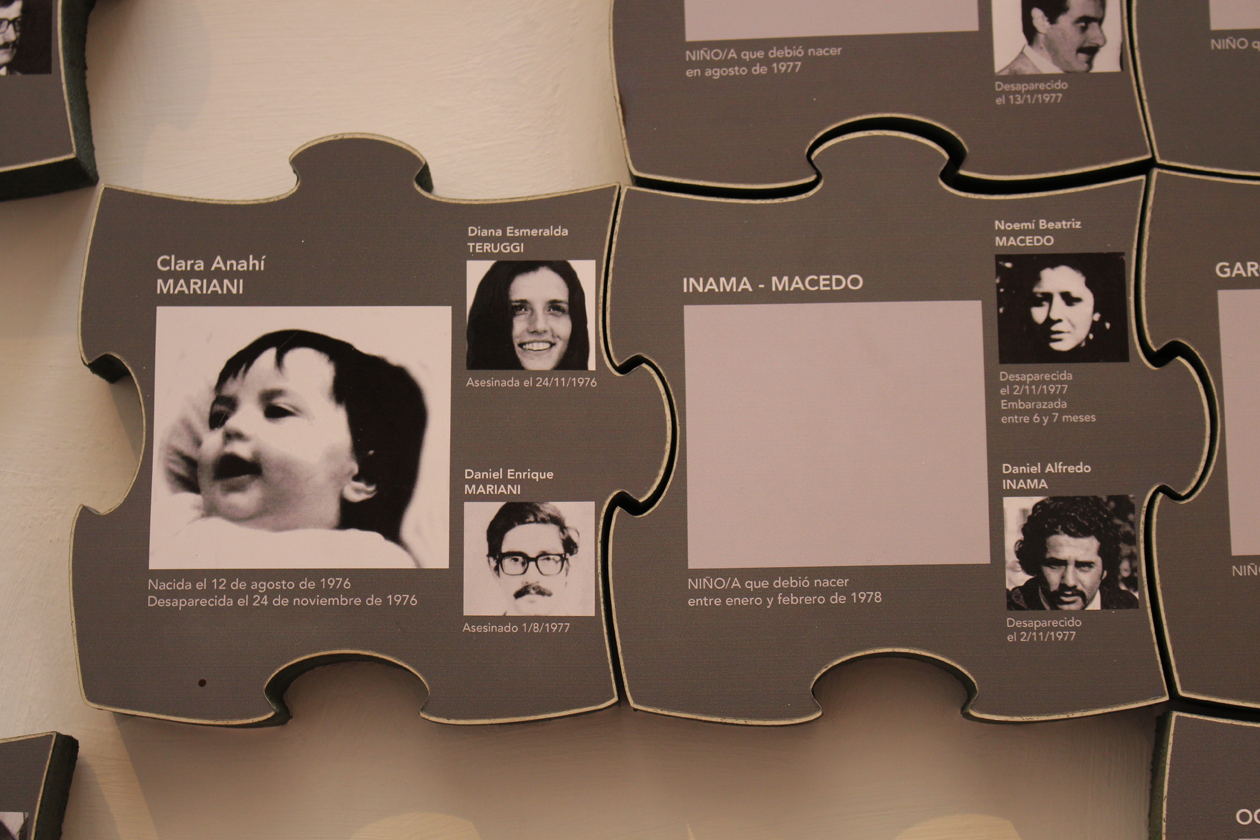
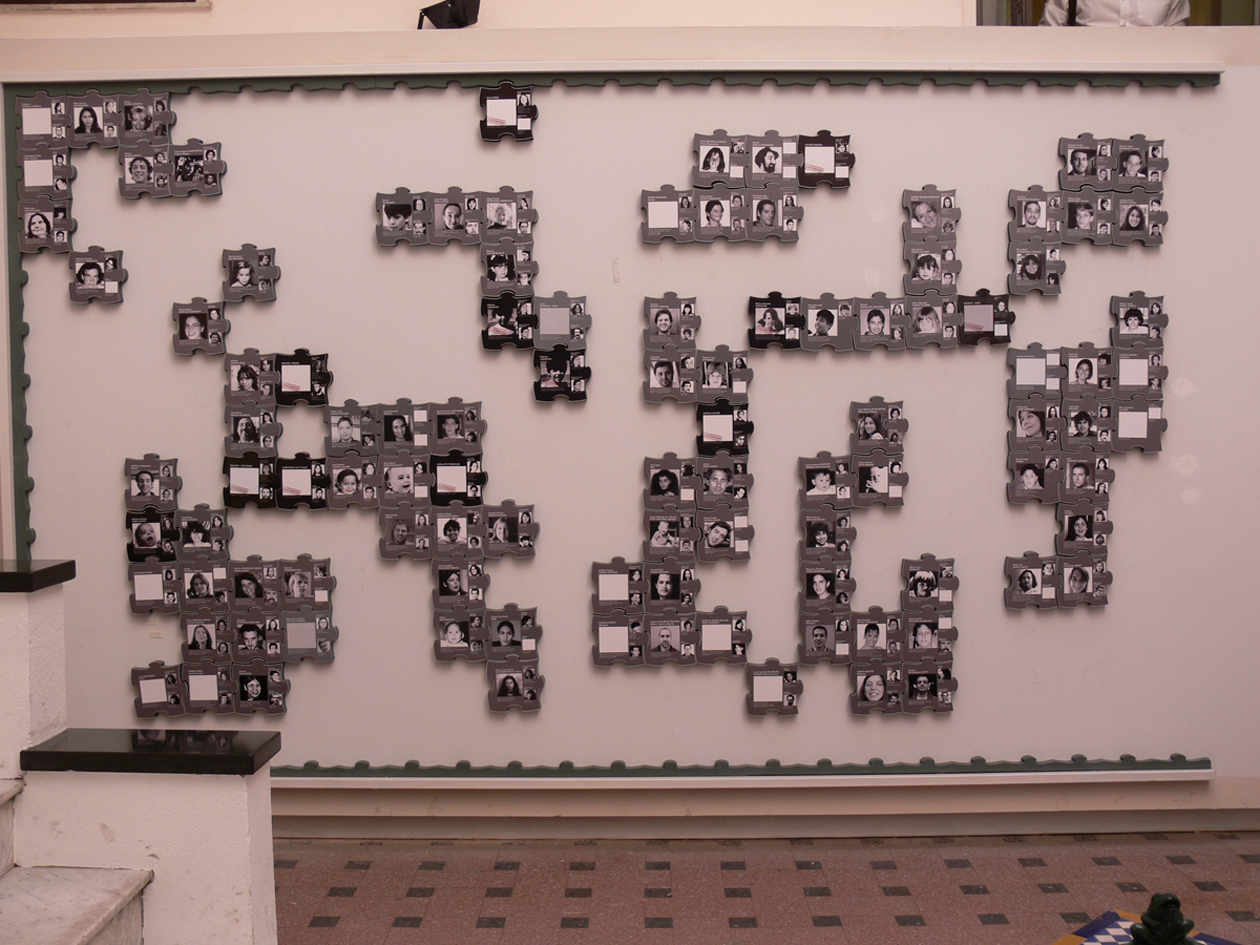
As an example, the installation by Norberto Puzzolo entitled ‘Evidencias’, offers brief poignant details of the disappeared, with its focus being on the children who were victims of the dictatorship. It uses the space – a sunken court of the atrium – to invite the viewer down the steps to read succinct information displayed on the shapes of a jigsaw puzzle. On one of the two opposing walls, the names and photographic portraits of all the children murdered or disappeared during the dictatorship are displayed on large blocks cut into the shapes of a jigsaw puzzle, together with the names and smaller portraits of their parents. If there are no existing images of the children or parents, or if they were one of the many born in captivity, there is blank where the child’s portrait would be (Figures 3 and 4). The ‘evidence’ of the installation is not legal nor do the facts relate to the crimes committed exactly, but focuses instead on the details of these families affected, simply presented, alongside the unknowns, incorporated as questions within a wider ‘puzzle’.
Norberto Puzzolo, ‘Evidencias’, Museo de la Memoria, Rosario. Image: Vikki Bell, 2015.
Norberto Puzzolo, ‘Evidencias’, Museo de la Memoria, Rosario. Image: Vikki Bell, 2013.
On the opposite wall, on another ‘puzzle’ display, there are photographic portraits of those who have been found. Every year, through the efforts of the Abuelas de Plaza de Mayo, more of these children are ‘discovered’, having questioned their identities and come forward to have their identities investigated. Many of those found were illegally ‘adopted’ into military families, and through the truth-telling apparatus of the DNA test and banks, have had their identities ‘restored’ as adults. Each year the Museum stages a ceremony in which the piece pertaining to those so ‘found’ is removed from one side of the court, a contemporary photograph is added and she or he joins those on the facing wall, a ceremony in which the museum involves the community and the relatives if they so wish. This ‘participation’ is not therefore the same as ‘participatory art’ – there is no requirement that the visitor participate, but there is a sense that this is an exhibit that has and will continue to change since facts about the dictatorship’s actions continue to be uncovered and remain consequential. Unlike the criminal trial, the gaps in information are part of the museum’s message, which, together with the lack of pressure of time, mean the exhibit can reflect the lengthy gradual coming to light of information on the identities and whereabouts of the disappeared.
While the museum holds sacrosanct its attempt to convey something of the experience of those who struggled against and who suffered losses under the dictatorship, it engages in ongoing decisions about what it understands as appropriate to its space and role. There are boundaries to what is admissible. Indeed, Nardoni cautions that it is not the role or responsibility of the museum to ‘tell all’. The video interviews, clips of which are shown on the walls of the museum and which visitors can hear through headphones, are made by the organization Memoria Abierta, whose work we discuss below. These offer, according to Nardoni, the value of personal memories; but the museum will not, she explains, grant space to the personal memories of the repressors within its walls: we want the people to know the protagonists of this story, the protagonists who were pursued by the dictatorship. We are not going to put the testimonies of the repressors. There are a few images…and you will see a brief video of when Videla said that the disappeared don’t exist and are simply “elsewhere”…But in general you will not find that here; this has also been a political decision. The words of those who committed genocide? No. (Interview, November 2015) [We tell] what we decide to tell. And what we don’t tell. There are some issues we don’t explain unless we are in court…We prefer to tell the political history: about the prisoners of the dictatorship government, about the missing people, but not about the torture. How we were tortured and how other people were tortured. That was a choice – a decision – we made a long time ago. We only talk about these issues in court. (Interview, November 2015)
19
(iii) Memoria Abierta.
The final example we will discuss is the work of the organization Memoria Abierta, mentioned above. A non-government organization made up of relatives of the disappeared and other activists, Memoria Abierta’s work is principally based around the building of an archive, but also extends to other consultancy and campaigning work. Here, we will mention only one key aspect of their archive-building, the making of video testimonies with survivors, since these offer us another intriguing example of the staging of truth-telling outside the courts, but where the different considerations at stake share little with legal procedures beyond the fact that the interviews are called ‘Testimonios’ by the group. 20 Claudia Bacci, who worked for Memoria Abierta for several years, explains that what distinguishes the project is its ‘sociological’ focus, by which she means that these are not legal interviews searching for facts and evidence, but nor are they personal life story interviews. Rather, the key constraint that the group places upon this key aspect of their endeavours is to focus on collecting and conserving experiences from a delimited time period only, guided in general terms by ‘the objective and focus of the archive [rather than an attempt to record] the story of a complete life’ (Bacci, interview, November 2015).
Claudia explains the process of conducting the interviews – of which there are now over 800 stored in the archives at the ex-ESMA site where the group is now housed – as one requiring careful preparation and sensitivity. First, the interviewers from Memoria Abierta meet with the interviewee in order to discuss the shape of the interview together, for the interviewee to raise her own doubts or share difficulties about the content or process, and to explain the technology the recording will require. This first meeting is therefore to reassure the interviewee, to establish trust, as well as to ‘establish which story they want to talk about, [and for them] to understand what the archive’s interests are.…If they don’t talk easily, we may pose questions. But the sense of the questions is solely to help develop their story’ (Bacci, interview, November 2015). Memoria Abierta operate under the principle that the story to be told belongs to the story-teller: ‘the story is not ours. It is theirs’ (Bacci, interview, November 2015). While the rule of the interview recording is consequently ‘do not interfere’, the initial meeting is also crucial so that the interviewee understands something of what will occur in practical terms while being assured that although there needs be a protocol of sorts, the story remains his or hers for the telling.
Given all that this ‘non-interventionist’ scene of the interview requires, that is, the practical assemblage – the lighting, the camera-operator who usually stands behind a large camera, the props the interviewees occasionally bring to help tell the story (photographs, letters or other objects), the interviewers and, of course, the interviewee him or herself – it might be tempting to consider the art of dramatization here as akin to film-making. However, the principles of this work suggest otherwise, not least because in addition to the ‘no scripting’ principle there is no editing. If an interviewee is very distressed or needs to stop, the filming will pause, but otherwise in almost all circumstances the interview is filmed and archived in an unedited format. It is not an exercise in drama, Bacci insists, but an exercise in what she calls ‘open listening’: ‘[The] testimonies are not simply about recording the past but…they are about how to hear, how to listen…always to be open to listening to things with respect’ (interview, November 2015).
This process and the resulting archive, therefore, do not seek to dramatize in the same way that happens in films or in a court, where people speak with the intention of convincing others of the truth of their words. Instead, as Gonzalo Conte put it, the recording of testimonies is a scenario where the golden rule is to allow a person ‘his or her own truth’, to grant and allow them space and time to articulate their accounts. While it may be that something dramatic occurs within the interview – even stunning those listening into silence as they glimpse something very profound that arises unexpected and often intensely through another’s speech, as Gonzalo put it, (interview, November 2015) 21 – the direction and intensity of its impact is deferred, left to a future unknown scenario in which the interview is replayed. The archive seeks to gift as much as possible of these protagonists’ accounts of this period in Argentina’s history to the future, maybe even with the anticipation that some aspects of these stories that we do not presently consider of interest may become so. While Memoria Abierta now has a climate controlled room where the taped interviews and other files (or ‘cuerpos’ as such files are called, colloquially) line the shelves, the archive itself does not make an argument for truth in the sense that animates historical debate or legal trials. Nor does it attempt to intrigue, delight or educate the visitor, as the museum and the art space frequently does. Its proposition is simply that these stories should be recorded and preserved because they are of some potential value to the future enquirer. And this must remain a speculative proposition insofar as the archive necessarily declines to articulate the parameters of the intervention that value might provoke.
Conclusions
What we have attempted to describe in this article are some of the divergent ways in which forums deploy ‘arts of dramatization’, which is to say, the ways they stage questions about the violence of the last dictatorship period in Argentina in order to propose, display, explore, preserve, confirm and sometimes refute, ‘candidates for truth’. As we have seen, the various modes of staging the past conjure it up in distinct ways, placing different constraints on how it can appear, using different material assemblages in order to do so, probing it according to different values and pursuing its details and contours under different principles, obligations and constraints. While each of these forums is concerned with truth, how and what emerges as truth necessarily differs. What counts as evidence, what is understood as ‘successful’, what is dismissed as irrelevant, are all dependent upon the concerns of the forum, so that such truths are not only ‘situated’ but also necessarily ‘partial’ forms of world-making. That said, they exist within an ‘ecology of practices’, to use Stengers’ term, so these forums are not closed off from each other, but exist in a web of often highly interdependent connections, wherein personnel, practices, audiences and resultant ‘truths’ travel. One example of this travelling is seen in the newly designed exhibitions in the ex-ESMA ‘Space of Memory’ in Buenos Aires, where there is an explicit ‘borrowing’ of the gravitas of legal truths. Initially left bare, a change of heart has seen this notorious building filled with audio-visual displays that inter alia show clips from the trials – both the 1985 trial of the junta and the 2011 ESMA megacausa – projected onto the walls of even those very spaces where the disappeared were sequestered.
This notion of an ecology of practices includes, of course, academia itself as a further site of proposal, dramatization and challenge, employing devices such as those utilized here – interviews, observations, forms of ‘putting in relation’ and arguments about relevance – to gather and persuade its audiences. This is not to imagine academia as a superior or ‘meta’ place of gathering. Instead, it is to acknowledge the porous interdependence of these sites. Nor is this ecology akin to a division of labour that will facilitate a collectively produced broader truth – named History no doubt – to emerge in time. The dream of such future harmony is too hasty a conclusion, one that surrenders in the face of the injunction to provide a model for Peace. But to acknowledge the various modes of animated engagement across different gatherings is also to acknowledge the role of the diplomats – or perhaps better to think less of persons than of diplomatic propositions – that do travel between these forums, challenging parameters and practices, whether quietly or boldly, or else beguiling audiences with stories from ‘elsewhere’, prompting reflexive thought about delimited modes of addressing the past and their potential implicit exclusions.
Footnotes
Acknowledgements
We would like to extend our thanks to the Economic & Social Research Council, who funded the research upon which this article is based (Grant reference: ES/N007433/1). Thanks are due also to all our interviewees, including those whose words did not appear here, and to Catherine Rottenberg and Emilios Christodoulidis who read earlier drafts and gave generous, helpful suggestions.
Declaration of Conflicting Interests
The author(s) declared no potential conflicts of interest with respect to the research, authorship, and/or publication of this article.
Funding
The author(s) disclosed receipt of the following financial support for the research, authorship, and/or publication of this article: This article arises from research generously funded by the Economic & Social Research Council (UK) Grant: ES/N007433/1.