




Abstract
This article sketches my personal impression of the changes that have occurred over the last decade in the Israeli checkpoints in and around Jerusalem. These changes have manifested both in the physical design of the checkpoints and in their human management. I discuss these changes through focusing on the women’s human rights organization ‘MachsomWatch’. The role of this organization, I claim here, has changed in ways that parallel the solidification and the bureaucratization of the border. Especially noticeable is the shift in the location of resistance and its characterization, from a direct confrontation model that occurs at the physical space of the border to a focus on legal actions and administrative strategies, performed in distant and at times even virtual locations. Alongside this process, MachsomWatch women – avid protestors of Israel’s occupation of the Palestinian West Bank – have, despite themselves, become a routine feature of Israel’s occupational apparatus. This essay’s grounded ethnographic account provides a vivid illustration of the ways in which resistance feeds from and into power.
Keywords
Maybe it doesn’t sound so bad, but it’s terrible. It was much easier when we were standing there and we were talking to the soldier and the soldier could make a decision, even if it was nasty. There was some give and take. Now there is no more give and take. It’s all bureaucracy, and no one knows it. It’s not like you get a little booklet and they tell you – ‘hey, those are the rules’. The rules change from day to day. This is the way to keep the Palestinians under severe control … I know that other countries have borders. But not like this. These are borders to keep people apart, to not let them see each other, to not talk to each other. (Hanna Barag, interview)
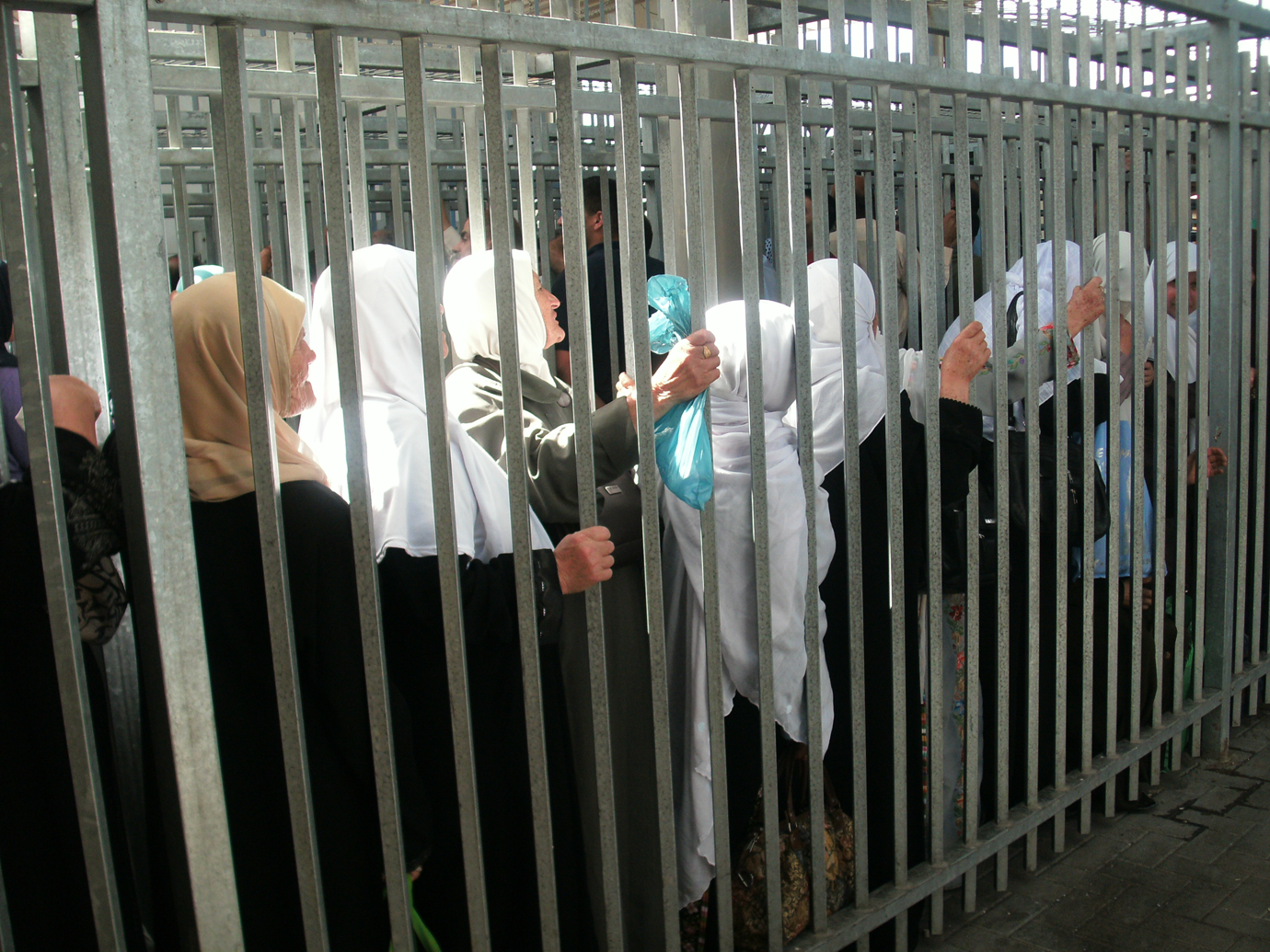
Women standing in queue at the Qalandia Crossing, June 3, 2011. Photo by author.
June 3, 2011: Qalandia Crossing
I forgot how frustrating it is to be a Jewish Israeli on the Israeli/Palestinian border. It doesn’t matter that I am an academic, that I am only observing, that I can’t really help. Just being there, clearly a non-Palestinian in this ethnically bifurcated space, is enough to attract the attention of those who are desperate for any help. ‘Please, Madam’, an elderly Palestinian in a wheelchair approaches me. ‘I have an appointment at a hospital in East Jerusalem and there’s no one in the humanitarian lane’. While he scrambles to show me his papers, a young man approaches me, asking politely in Oxford English if I would please escort him. He leads me to the long line that stretches in front of the only open turnstile. Somewhere in the middle of it all, a young woman holds a sleeping infant covered in pink blankets. ‘Is she okay?’ I ask, concerned about the blankets in what is, already at 7:00 am, a hot summer’s day. Her husband explains that the baby is sick and that they are trying to get her to the hospital in East Jerusalem. Although they have permits, they have been waiting for over an hour already. ‘She’s only two weeks old’, the husband exclaims sadly, looking around him as if to say, ‘and look what kind of life we have brought her into’.
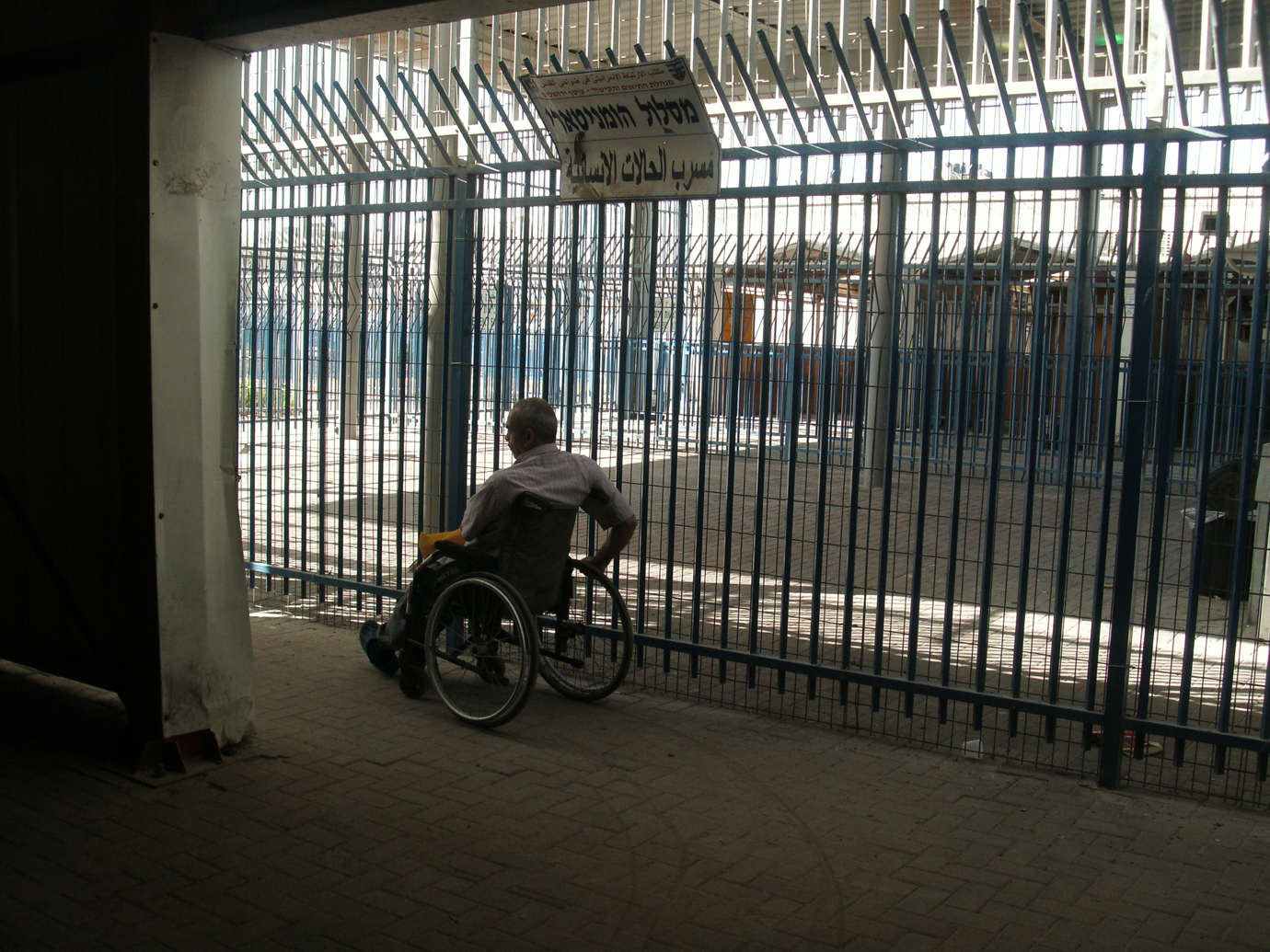
Palestinian in wheelchair approaching the closed humanitarian lane, Qalandia, June 3, 2011. Photo by author.
Ten minutes later, and I have already shed my academic stance of non-involvement. I find myself scrambling between the Palestinian queues and the Israeli soldiers, translating, negotiating, begging even. I somehow manage to persuade the Israeli soldiers to open the humanitarian lane. The man in the wheelchair is first to move through. He still has a few obstacles before him, I think to myself. But in the space of the checkpoint, moving is always better than not moving. Next, I pull the woman and her infant out of the regular lane and lead them into the (now open) humanitarian lane. She passes through, but her husband is not allowed to join them. He stays with the stroller in the regular lane. ‘He’s strong enough, he’ll survive’, Hanna Barag of MachsomWatch tells me dryly.
Hanna lives in one of West Jerusalem’s long-established neighborhoods, the German Colony. She has been leaving the comforts of her home to monitor the checkpoints on the Israeli/Palestinian border for almost 10 years now. Although Hanna is over 70 years old and has serious ankle problems as well as her own set of children and grandchildren to take care of, she goes out to the checkpoints on a weekly, sometimes even daily, basis. Through the years, I’ve encountered her there at any time between 4:00 am and nighttime, weekdays and weekends. As I travel with Hanna in her car and listen to her conversations on speakerphone, I can clearly hear the respect in the voices of Israeli commanders and Palestinians alike. The commanders call her to find out what she thinks about the latest changes they have introduced to the design of one checkpoint or about their improved performance in another. Palestinians call to see if she can help them obtain the much-desired magnetic card 1 or a permit to enter Israel. Both Israelis and Palestinians fear this small but fierce German lady with white hair.
Hanna is not alone in the struggle to bear witness at the border. The organization MachsomWatch (Machsom is Hebrew for checkpoint) was started in 2001 by five elderly Jerusalemite women (MachsomWatch, 2001). Today, it is one of the larger community-based, human rights nonprofits in Israel, encompassing over 400 women from across the country. I joined MachsomWatch in 2002. Since I left Israel for North America in 2004, I have returned periodically to observe the border, this time in an academic capacity.
Elsewhere, I have situated the changes that have taken place at the Israeli/Palestinian border within the prevailing literature on borders (Braverman, 2011). There, I contend that border regimes are historical and geographical contingencies in terms of logic and operation. In particular, I claim that if the EU and the US–Mexico borders are becoming leakier and more mobile in terms of their operation, the Israel–West Bank case is clearly not following this trend, at least not exclusively so. While some aspects of this border are indeed fluid and capricious, it is at the same time becoming more fixed, more territorial, more bureaucratic, and more infrastructural. My emphasis was a direct response to Joe Heyman’s call to create a reflective and critical literature on bureaucracies in unequal societies (Heyman, 1995: 285).
Also in response to Heyman, this essay moves away from conceptualizing the border to provide a personal account and a set of reflections on the very same changes that I have previously depicted through a conceptual lens. My discussion of the changes in the physical design of the checkpoints and in their human management is filtered here through a focus on MachsomWatch. The role of this organization, I argue, has changed alongside the solidification and the bureaucratization of the border. Through protesting the occupation in a structured, consistent, and increasingly legal manner, MachsomWatch has turned into an almost routine element of the occupation. This grounded account provides an acute example of how resistance feeds into hegemony.
Methodologically, this essay draws on 12 in-depth, semi-structured interviews conducted in the summer and fall of 2008, in the summer of 2011, and in the winter of 2012, with former and present high-level officials and with women activists of MachsomWatch. It also relies on my own observations as a former member of MachsomWatch, which I conducted on a weekly basis between 2002 and 2004, along with participatory observations in the summers of 2005, 2006, 2008 and 2011 at the checkpoints Qalandia/Atarot (Arabic/Hebrew), Bethlehem/Rachel, and Abu-Dis/Zeitim. Finally, this essay draws on the rich online reports posted by MachsomWatch as well as other human rights organizations and governmental offices. Together, the interviews, observations, and online materials offer an ‘insider ethnography’ (Gupta and Ferguson, 1997: 31) that reveals some of the concrete implications of the spatial and administrative modernization of the crossings. As far as I know, the recording of Israel’s acclaimed process of modernization from the personalized perspectives of both high military officials and human rights activists has not been used in other studies of the Israel–West Bank border (see e.g. Abu-Zahra, 2007; Gordon, 2008; Handel, 2007; Weizman, 2007; but see Kelly (2006, 2008) for a similar ethnographic approach in the West Bank, and Heyman (1995), who uses this approach in the context of the US–Mexico border).
Bethlehem – El Hader – Abu Dis: 2002–2004
I vividly remember the first time I monitored a checkpoint on the Israeli/Palestinian border. It was at the Bethlehem checkpoint, just south of Jerusalem, in 2002. I recall being very upset when witnessing an Israeli soldier detaining two attractive Palestinian female students who were trying to make their way from Bethlehem to their university inside Jerusalem. This detainment was clearly not performed for security reasons. I also remember observing how, every time the soldier would turn his back, a few of the Palestinians who hid behind the monastery across the road would run through the open fields that stretched out ahead, bypassing the necessities of permits and identification. I remember how problematically arbitrary both events seemed to be.
Later that year, I started regularly monitoring the El Hader checkpoint. This checkpoint was situated several miles into the occupied territories, in between the village of El Hader and the highway that connects Jerusalem and Hebron. At times, my Jerusalemite partner in MachsomWatch and I would find the Israeli soldiers there, standing on a pile of dirt and monitoring the movement of Palestinians in and out of their village (Figure 3). Those who were sufficiently fit to avoid the soldiers by walking around the village and through the olive groves usually did so, although sometimes they were caught too. The women, children and elderly were usually confined to the dirt path where the soldiers awaited. At times, we would get to El Hader and it would be a dirt road just like any other dirt road. At other times, we would get there to see the soldiers standing on the pile of dirt, with a long line of Palestinians stretching out on both sides. An improvised market with fruits and vegetables, coffee and sahlab, 2 would then spontaneously appear to serve those who might be hungry or thirsty from the extended journey back home.
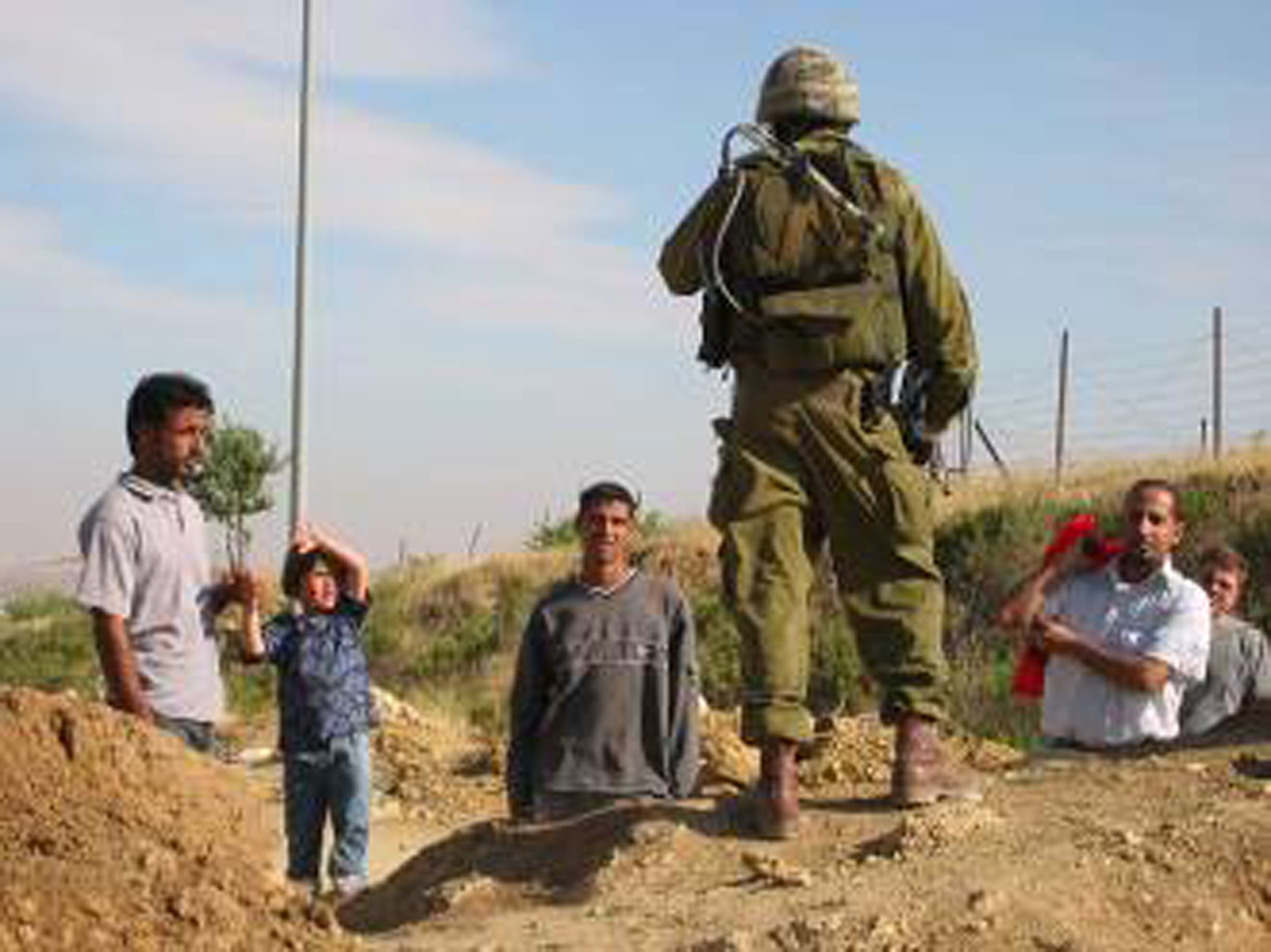
On the dirt pile. Old-style checkpoint in El Hader, south of Jerusalem. Photo by author, July 2004.
One day, as I was negotiating with the soldiers about the terms that would enable a pregnant Palestinian woman to pass the checkpoint despite the just-announced closure, I was suddenly alarmed to hear the noise of hand grenades falling nearby. I felt a strong burning sensation in my nostrils and throat. I started running away in the other direction, along with the Palestinians who had previously been standing in line. To complicate matters, we were all running back toward their village, which was formally defined by the Oslo Accords as Area ‘A’ and therefore prohibited entry for Israelis. I was trapped: if I ran to the village I would be breaking the law, yet running toward the shooting soldiers did not seem all that safe either. I suddenly realized that the pregnant woman was not among us. I can no longer remember how I returned to Israel or whether I ever found out the fate of that woman. What has stayed with me was how surprised I was to experience through my own body the extreme capriciousness of the Israeli soldiers’ behavior.
Finally, between 2002 and 2004, I frequently visited the village of Abu Dis in East Jerusalem. A set of low blockades and concrete walls that cut through the heart of this village served as a reminder that the Green Line divides this Jerusalemite village into two different zones. At the time, children were climbing through gaps in the walls, throwing their large backpacks to the other side and then jumping over. Of course, none of this happened when soldiers appeared to enforce the separation regime.
My notes from these three sites – Bethlehem, El Hader, and Abu Dis – explain the workings of the ‘old-style’ checkpoints. At the time, the checkpoints were situated in open space, where they were means of blocking movement. Palestinians were then frequently able to work around the checkpoints; many crossed illegally to get to work on the Israeli side, sometimes on a daily basis. In the old days, the situation was transient and ad hoc: one moment a soldier’s word was the official order of the place, only to be replaced by a contradictory order the next moment. There was no written set of instructions, at least not one that was visible to Palestinians. Signs were a rare occurrence. This situation placed more discretion in the hands of individual soldiers, which resulted in instances of arbitrary enforcement, on the one hand, and positive adjustments, on the other hand. In other words, alongside the arbitrariness of Israel’s operation of these checkpoints, there were usually real faces to negotiate with and a one-on-one encounter between Israeli soldiers and Palestinians.
Then came the Separation Barrier.
‘The Fence that Makes the Difference’: 3 2004
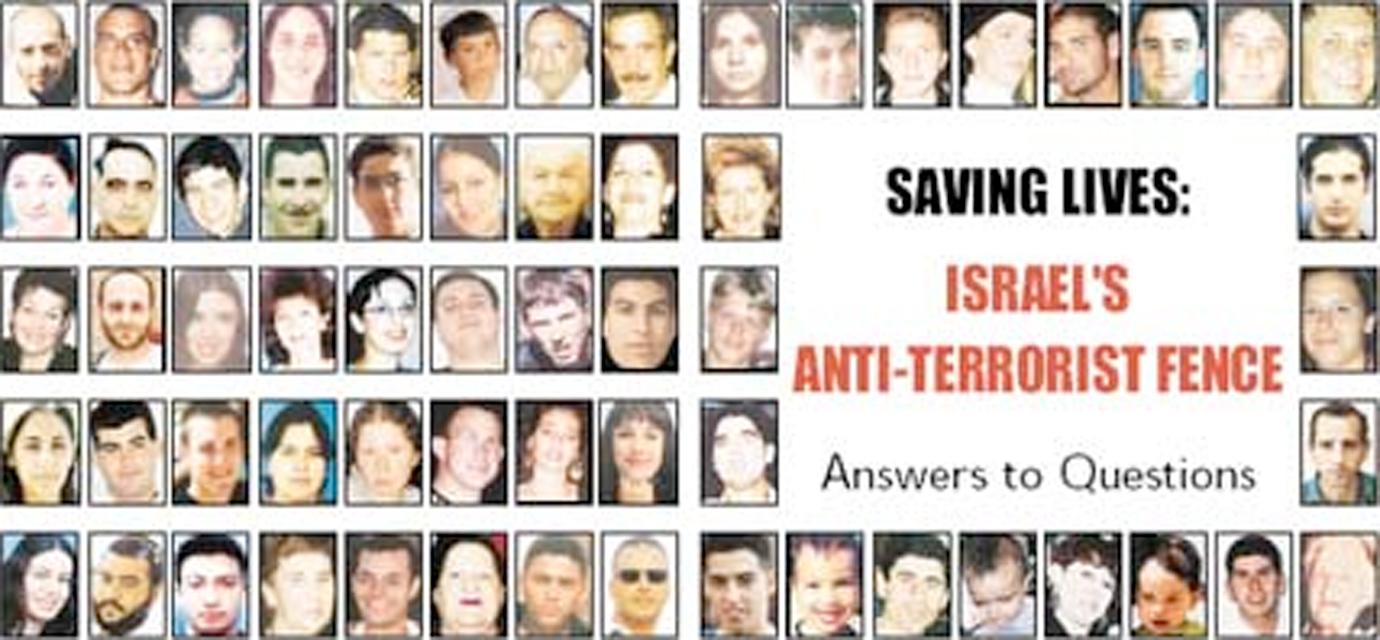
‘Saving Lives’. Faces of terror victims, image from the Israel Ministry of Foreign Affairs website 4
In June 2002, the government of Israel decided to erect a physical barrier to separate Israel from the West Bank. According to Israel, the fence was intended to limit ‘the ability of terrorist organizations to enter Israel and present operational obstacles … making it difficult for them to carry out suicide bombing attacks within Israel’. 5 In most areas along its 723 kilometer-long route, the barrier comprises an electronic fence with dirt paths, barbed-wire fences and trenches on both sides. Its average width is 60 meters. In some areas, an eight-meter-high wall has been erected instead of the barrier system. In September 2011, 62 percent of the barrier was completed, with 80 percent of the barrier route built inside the West Bank, seriously limiting access to areas behind the barrier (OCHA, 2011).
The terminology used for describing the barrier is already an indication of one’s political stance. Whereas the term ‘the Wall’ (with a capital ‘W’) is frequently used by those who oppose the construction, the term ‘fence’ is often used by Israeli officials to marginalize its effects on the landscape and to illustrate its transient nature. The Separation Barrier – the term I use here to refer to the combination of the Wall and the electronic fence – was built to replace the previous situation whereby hundreds of checkpoints, mostly transient (or, in the Israeli military jargon, ‘flying’, see Handel, 2007) were scattered through numerous roads and paths, not only those leading into Israel but also those within the occupied territories themselves (Tirza, interview). Conversely, the focus of the new border regime is on the borderline between Israel and the occupied West Bank. The military officials interviewed here have argued, accordingly, that under the new regime the total number of checkpoints and roadblocks has been reduced and that this goes to demonstrate Israel’s improved humanitarian attitude toward Palestinians (Paz and Tirza, interviews). 6
As already mentioned, several years prior to the construction of the Separation Barrier in Jerusalem, low concrete blockades and roadblocks were prominent in certain areas. This ad hoc border was ‘passable’, in the sense that Palestinians soon found routes around, under, and over it, as clearly shown in Figure 5 of Abu Dis in 2002 (left). When I visited the village of Abu-Dis in north-east Jerusalem six years later, in the summer of 2008, I encountered a different scene altogether. The semi-structured border had turned into an eight-meter-high Wall (Figure 5, right). The numerous improvised crossings had vanished from the border’s landscape, replaced by large crossings situated at significant distances from one another. In effect, the people of Abu-Dis, some of whom are Jerusalem residents, must now travel many miles – and through a border crossing – to reach what was once the other side of the street.
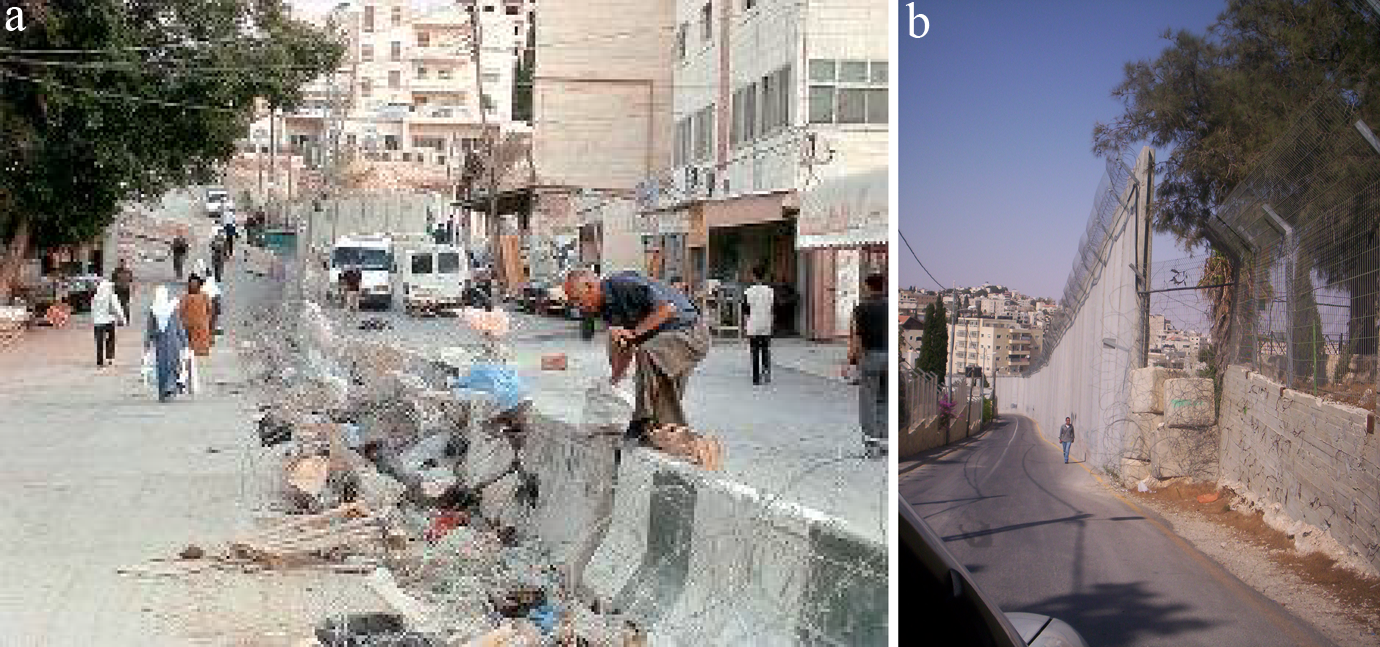
The same street in Abu Dis, before (on left) and after (on right) the Wall. Photo on left by Neta Efroni, February 15, 2002; photo on right by Rachel Naparstek, May 4, 2005. Both courtesy of MachsomWatch.
Under the new border regime, working around the Wall or Barrier is physically much more taxing: one can either dig below it or fly above it, the latter being almost impossible. The Wall’s slow but steady construction has thus gradually transformed the nature of the checkpoints, making the structure and management of the official crossings all the more important. In effect, the crossings have become potential – yet obligatory – points of passage. Under the new regime, the border crossings are the central node of Israel’s bureaucracy of occupation. This, despite the fact that according to official numbers, no more than 60,000 Palestinians – less than 3 percent of the West Bank population – have been granted permits to pass through the new crossings to work in Israel. 7
Israel’s New Border Crossings: 2004–2011
I see the passages as regular international passages. We try to make it so that the passage will be quick and swift, without any unnecessary interactions. (Interview, Micha, Head of Administration and Funding, Crossing Directorate)
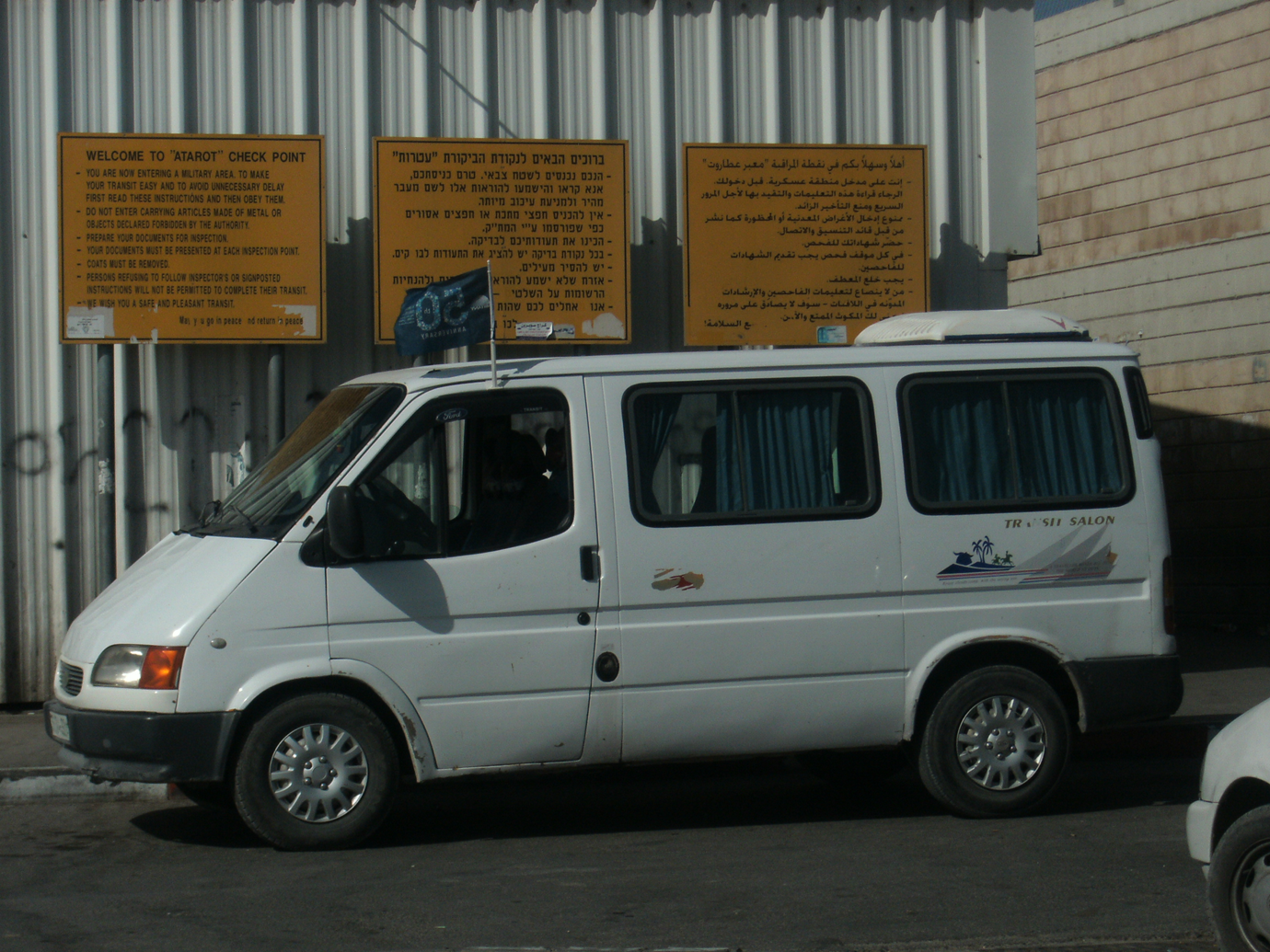
Palestinian bus in front of Israel’s border signs on the Palestinian side of Qalandia Crossing, June 3, 2011. Photo by author.
After being away for almost two years, my first encounter with the Separation Barrier and its effects was jarring. I recall that I was first struck by the abundance of signs. Indeed, at the new border crossings, a multitude of signs await Palestinians at every corner and curve, visibly instructing them how to conduct themselves in what is yet another manifestation of Israel’s show of permanence.
Another shift that occurred during my years away was in the linguistics of the occupation. Instead of what were formerly identified as ‘checkpoints’, the Israeli vocabulary now emphasizes the terms ‘border crossings’, ‘passages’, and, yet more recently, ‘international terminals’. But the shift has not merely been one of vocabulary. It is a shift in the governing philosophy applied at the Israeli–West Bank border: from a military to a consumer-based approach, and from old style checkpoints to new and modernized border crossings, administered through a rationalized bureaucracy. If before, the checkpoint represented an uncertain and transient place, operated at the whims of ad hoc, low-level soldiers and policemen, it is now being transformed, so Israel’s official claim goes, into a permanent physical construction, regulated by and operated through automated devices and professional officers. Israel’s old-time occupation, Israel’s narrative continues, with its narrow focus on security and its aggressive on-the-ground manifestations, has been replaced by an efficient regulatory system that fosters an open and cooperative relationship with Palestinians.
Since 2004, the numerous internal checkpoints scattered across the West Bank are arguably supplanted by fewer but more permanent crossings. The Israeli human rights organization B’Tselem reports that at the end of 2011, there were 91 checkpoints inside the West Bank, 66 of which were permanent and regularly staffed and the remaining 25 had infrastructure in place but were staffed sporadically. 8 In addition, nine checkpoints are located on the Green Line: these are the last inspection points before entering Israel (and referred to by Israeli officials as terminals rather than checkpoints). Finally, along the Separation Barrier there were 66 agricultural gates that enable limited Palestinian access to their agricultural land west of the Barrier. Twelve of the gates were opened daily for a few hours, the others were opened only during certain agricultural seasons. 9 Some of the checkpoints were completely or partially privatized, and several were staffed by armed civilian guards employed by private security companies under supervision of the Crossing Directorate of the Ministry of Defense (Ministry of Defense, 2003; see also Maoz, n.d.).
The change is not simply in the appearance of the checkpoint and its accompanying terminology. It is also a deep structural change in the bureaucratic operations of this space – a transformation in the organizational entities that occupy the checkpoints. Indeed, Israel has recently moved from employing military personnel to deploying security guards hired by private companies. This, government officials stress, is part of a progressive effort to professionalize border operations and make them more efficient. It also turns the border into a more humane place, these officials argue. In other borders around the world, the same process is often referred to as ‘privatization’. This, however, is not the case here. The term used by Israeli officials to indicate the shift in the human management of the border is ‘civilization’ (izruach); that is, the use of civilians (rather than soldiers) to work (rather than serve) in the checkpoints.
Privatizing the Crossings
That is one of the problems: who is responsible? ... There are five companies: the military police, the border police, the DCO, the blue police, and the private companies. So you can imagine what goes on here. Who takes what responsibility? Who makes the decisions? Who has the power? (Barag, interview, June 3, 2011)
In 2003, the Israel Defense Forces (IDF) inaugurated the program ‘Another Life’. The aim of this program was to ‘minimize the damage to Palestinian life fabric (mirkam haim) in order to avoid a humanitarian crisis that would necessitate the IDF to provide food and services to the Palestinian population’ (Weizman, 2007: 290, n.36). Baruch Spiegel, a graduate of an MBA program who had previously convinced the IDF to employ a new management strategy in Gaza – was then appointed as IDF Director of Civilian and Humanitarian Issues (Weizman, 2007: 143).
According to a plan that Spiegel devised, 12 permanent closure checkpoints were built along the length of the newly constructed Separation Barrier. As with Israel’s other international terminals, they were to be operated by Israel’s Airport Authority: Reshet. However, the first implementation stage rendered Reshet’s management of the crossing impractical ‘because of the scale ... when the Gaza Strip was open for entry into Israel many more people crossed it in a day than they cross Ben Gurion Airport, and I’m talking about one crossing only ... So, Reshet couldn’t carry this [forth]’ (Paz, interview).
The task at hand, then, was to create an alternative administration that would take on the role of managing the new crossings. Eventually, the Ministry of Defense – a governmental entity with security as its top interest – was chosen to oversee the management of the new border, while the on-the-ground work was to be conducted by private companies. In 2004, a separate body was created within the Ministry of Defense to manage this new apparatus. It was named Minhelet Ha’Maavarim, or the Crossing Directorate (Treiber, interview).
Shaul Mofaz, then Minister of Defense, appointed Bezalel Treiber to serve as head of the new administration. 10 As former head of the Minister of Defense’s cabinet and former Deputy Chief for Israel’s Airport Authority, Treiber embodied the two overarching agendas of the new border: security, on the one hand, and consumer orientation, on the other hand. The ‘civilization’ (in Hebrew izruach, literally ‘making civil’) of the crossings is an on-going process, Treiber tells me, and is taking much longer than originally expected.
Qalandia crossing, which connects Jerusalem with Ramallah, was the first to be ‘civilized’ at the end of 2005. Treiber further informs me that at the time of the interview, 11 of 40 passages have been civilized. 11 Because of their sensitive status, he says, Israeli border police continue to manage the Jerusalem passages, with assistance from private guards and Israeli soldiers.
The reason for demilitarizing and then outsourcing the crossings was mostly pragmatic: the IDF was needed for other missions, the daily border operations had a negative effect on the IDF’s reputation, and a professional workforce was deemed to be more effective in this situation (Arieli, interview). Yet Treiber strongly maintains that civilizing the crossings is worlds apart from privatizing them. In his words: [T]his is absolutely not a process of privatization. The entire passage is under government responsibility from beginning to end. Indeed, the people who are doing the work are from a private company … but we manage their job. This is completely not privatization, it’s as far from it as east is from west. This is not a soldier’s job in any part of the world. (Interview)
Treiber’s explanation stresses the importance of normalization and professionalization at the border, as he attempts to draw comparisons with other international border sites. This line of reasoning is also supported by various other governmental narratives. For example, Israel’s Ombudsman Reports of 2003 and 2005 state the urgency of professionalizing the crossings and outsourcing them from military hands (Tal, 2006). The spokesperson for the Ministry of Defense similarly declares that ‘the civilization of the checkpoints is a humanitarian action’ (Ministry of Defense Press Release, 2006). Another government statement by Israel notes along these lines that: ‘[T]o lessen the existing friction in the security checks, humanize the process, and improve standards of service, security will be privatized and civilians rather than soldiers will conduct all security checks’ (Ministry of Defense Press Release, 2006).
Who, then, is in charge at a particular place and time? According to Treiber, the hierarchy is clear: while those who do the on-the-ground work are civilians, the Crossing Directorate he leads is always in charge. The same is true with regard to the soldiers or police who operate the crossings, he says, whose authority is greater than that of private security guards. But while it might be crystal clear to Treiber, this situation has been a source of immense confusion for Palestinians. Whereas in the past, Palestinians may have been able to identify the officer who issued commands, now such identification is almost impossible. This perhaps unintended but nonetheless useful uncertainty at Israel’s new border reinforces Israel’s overall bureaucracy of occupation (Braverman, 2011; Handel, 2007).
In light of the intended transformation of the Israel–West Bank border from a military to a civilian regime, one would expect that the civilian aspects of this border management would be highlighted and made immediately apparent. Instead, the new private guards are dressed like soldiers. To the untrained eye, this seems like an extension of the old border regime. So, while Israel goes out of its way to create an impression of newness and to let the world know that through civilization, it is now aligning itself with other nations, it does not bother to make this transformation more readily visible to anyone who actually visits this space.
How to explain this discrepancy? The answer lies in the multitude of presentations that occur at the border and, more importantly, in the multitude of audiences that these presentations are intended for. One presentation is meant for the Israeli and international public eye. On this front, the border’s re-design is made to seem significant and transformative. The Palestinians, on the other hand, rarely get to see this new face-lift, and are instead confronted with the confusion of the border’s increasing bureaucratization.
At the Qalandia checkpoint, this sort of dissonance between performances is everywhere: the outside signs welcoming the passengers and wishing them good health are surrounded by heaps of trash and debris; the inside signs blinking ‘have a pleasant stay’, are obscured by thick layers of bars and fences; and the 12 new booths installed to serve passengers, of which only four are regularly operative. The general design of the place thus sends conflicting messages: you are a customer and, as such, we are here to serve you better, but you are at the same time also dangerous and, remember, you also live under an occupation regime that strictly controls your every move.
Similarly, Israel’s official brochures as well as its official website speak about a consumer model that includes considerations of the local mirkam haim (fabric of life). On the other hand, a virtual tour of recent images, videos, and reports presented on MachsomWatch’s website depicts Palestinians standing in line for hours, climbing over each other to get to the Israeli side, and subjected to overwhelming and confusing instructions. 12 Furthermore, these human rights websites do not distinguish between Israel’s old and new crossings. Have they neglected to notice the transformation in Israel’s border regime? MachsomWatch activists interviewed here are not only skeptical about this transformation, they are also pessimistic: they perceive the new regime not only as an extension of the old but, even more so, as enabling a more sophisticated mode of occupation altogether. In the name of improved service and humaneness, they say, Israel’s new border actually secures a tighter form of control.
Bureaucratization and the Legalization of Resistance
Today, there aren’t really any checkpoints like there used to be, where we could stand for hours, for an entire day even, and document the atrocities of the occupation. Nowadays, the women go from passage to passage and from there to the agricultural gates. We are usually prohibited from entering inside the passages. As for the gates, some of them are open for an hour, three times a day. We know these hours, and so we travel from one gate to another. You will no longer see an Israeli soldier beating up a Palestinian; this older form of control was replaced by incredibly complicated routines. Now, there isn’t really much we can do, just to document. (Rash, interview)
A detailed example of how the ‘new’ bureaucracy of occupation actually works is provided in MachsomWatch’s report Invisible Prisoners from November 2011. The report begins with a scene from Franz Kafka’s The Castle, which details the struggles of the protagonist K. to gain access to the mysterious authorities of a castle who govern the village for unknown reasons. The reports says: This is the story of K., but it is also the story of those that who are suddenly prohibited entry by the Israeli Shin Bet and don’t understand why this is happening to them. Put yourself in their place. You go out to work somewhere every day, for years, and suddenly they tell you ‘That’s it,’ although you’ve done nothing. (MachsomWatch, 2011a: 7, translation by author)
The report details the various changes in the official procedures for appealing the denial of Palestinian work permits. One day, the authority for appeals was a certain body, the next day it became a different body; one day, the employers were granted exclusive appeal powers, the next day the workers themselves could also appeal, but to a different address; and, at certain intervals, no appeals were allowed. Specifically, from mid-2007 through September 2008 there was one address for appeals; between September and December of that year this address became two; then in 2009 a wave of permit cancellations ensued and a new category of prohibition was introduced: ‘debriefing’ (in Hebrew tihkur). From June 2009 until April 2010 there was no process set in place for appeals. During this period, an officer in the Population Registry department of the Military Advocate General in Judea and Samaria responded to MachsomWatch’s inquiries: Recently our office has been receiving on a weekly basis a large number of copies of requests to revoke the ‘security prevention’ of residents whose request to enter Israel for employment purposes was denied ... Our office is not the authorized administrative institution for handling such requests ... [and] complaints about the conduct of the Civil Administration. I ask that the sending of these copies be stopped. [They create] a burden on the fax machine and also waste precious ecological resources. (Letter from November 9, 2009, quoted in Hass, 2012)
Until June 2007 this department was, in fact, the exclusive address for appealing against the security prevention.
Then, for the year or so that followed, the workers were once again granted the right to appeal. And, finally, from May through November 2011, MachsomWatch documented a much more stringent application of the military orders by Israeli officials and the transformation of Palestinian workers into ‘alien workers’ (in Hebrew poalim zarim). The report also points out that the right to appeal the security prohibition has been granted only to those requesting permanent entry permits to work in Israel. If one must enter Israel periodically, for medical treatment for example, they have no right to appeal. Longtime MachsomWatch activist Roni Hammerman describes this intensification of bureaucratic control: Israel’s control is becoming tighter and tighter. Nowadays, there are a hundred and one different permits that the Palestinians must acquire if they need to enter into Israel, and especially into East Jerusalem, where many of the Palestinians’ central institutions and hospitals are located ... For example, just this year we realized that a special permit is required for Palestinians to enter the Al-Aqsa Mosque in East Jerusalem during the Ramadan on Fridays, and that a different permit is required for every day of the Ramadan. So if, by any chance, a Palestinian must go to the hospital in East Jerusalem on a Friday – well, that’s absolutely out of the question because on Fridays Israel grants limited entry only for holders of Friday prayer permits. (Interview)
In addition to its operation through the physical site of the checkpoint, then, the occupation operates through an increasingly sophisticated bureaucracy. This bureaucracy is not devised at the border; more probably, it emanates from the invisible and inaccessible chambers of military bureaucrats. Resisting the occupation has therefore become much more difficult. In order to maintain their effectiveness, MachsomWatch women have altered their own technologies of resistance to the bureaucratization of the occupation. Consequently, they have gradually shifted their focus from conducting daily observations in the physical sites of the checkpoints (aka terminals) into various forms of legal and administrative resistance. In the words of journalist Amira Hass, They began waiting for hours with the workers and tradesman who went to appeal the ‘security prevention’ in the offices of the Coordination and Liaison Administration, and afterwards they helped to fill out forms and submit requests to overturn the prevention. They called everyone possible in the Civil Administration to find out why someone waits for hours and never gets to the window of a clerk, why he is not given a receipt for submitting the request, why a reply to a previous request doesn’t arrive, and why there are no forms in Arabic. They wrote letters to the officer of the employment department in the Civil Administration, to the Military Advocate General in Judea and Samaria, to the head of the Shin Bet and to the head of the Civil Administration. (Hass, 2012)
Through January 2012, MachsomWatch women have helped some 5000 Palestinians through the legal process for appealing against Israel’s decision to refuse their work permits. 13 In the initial stage of handling these cases, the ‘security prohibition’ evaporated for 35 percent of them. Some appeals then proceeded to judicial institutions, despite the financial outlay. Attorney Tamir Blank partnered with the women of MachsomWatch, whose volunteer work has lowered the cost to the Palestinian worker. Of the 283 people who turned to the courts via MachsomWatch, the security denial of about 70 percent evaporated, usually before the deliberations stage.
Clearly, the changes in the technologies of power operative at and around the border have brought about corresponding changes in the technologies of resistance to such power. In addition to devoting an internal committee to fighting the security prohibitions issued by the Israeli Shin Bet, another MachsomWatch group has been documenting and resisting the prohibitions put in place by the military police. Finally, MachsomWatch women have been observing the military courts in which Palestinians from the West Bank are tried. From the organization’s website: We follow the progress of the hearings, starting with the detention of the suspects on remand, up until and including the verdict and the sentence. These proceedings are the ‘daily bread of affliction’ of the Palestinians living in the occupied territories but are invisible and unknown to the Israeli public. (MachsomWatch, 2012)
The new form of power executed at the Israeli/Palestinian border is different not only in the bureaucratization and legalization of its elements, but also in the increasing mechanization of the border and in the arbitrariness and alienation that have ensued, what I refer to here as the de-humanization of the crossings.
De-Humanizing the Crossings
The first stage in the actual movement through the crossing is the queue. Whereas officially, the queue is not part of the crossing itself but a preliminary part thereof, it is a critical stage in the Palestinian’s experience of the border. Many Palestinians secure their position in line hours before the crossing is officially open, hoping to make it to work on time. Under the old border regime, the queues and their management were left to Palestinian responsibility. The Palestinians formed themselves into queues in open space. Under the new regime, queues are constructed and enforced through metal fences that funnel movement. Here from a description of the Qalandia Crossing by three MachsomWatch women: Long lines extended into the sleeves [queuing channels] when we arrived at 6:05 a.m. … [O]ne family (with an infant child, headed for the hospital) stood waiting by the Humanitarian Gate. When we saw no sign of the staff in charge of opening the Gate, we called the DCO and heard from a sleepy soldier, who declined to identify himself, that the Gate would not be opened before 8 a.m. (whereas it usually operates until 8 a.m.). We asked that a sign at least be posted on the gate informing people to this effect but saw no action in this direction during the half hour we were present. Soon after we arrived, however, movement through the sleeves picked up pace, and the turnstiles were opened every 8–10 minutes, with some 50 people (in total) going through each time. (MachsomWatch, 2011c)
During my 2008 visit to the Bethlehem crossing, Hanna Barag points to a special queue designed for disabled people. It is almost always closed, she laments (Barag, interview). Otherwise, Israel’s mechanically imposed queues are not designed to accommodate groups with special needs, parents with children, and women. In effect, the physical design of the new crossings already excludes many Palestinians, especially traditional Muslim women, who must refrain from direct physical contact with male strangers.
After the queue comes the turnstile. Rather than the old way of managing the Palestinian queue – which usually involved an Israeli soldier shouting ‘wahad-wahad’ or ‘one-by-one’ – the turnstile now makes it physically impossible to move in any way other than one-at-a-time and in any other direction but forward (Figure 7). This mechanism is hardly new, nor is it by any means sophisticated. Barag refers to the metal queues as ‘cattle paths’ and explains that they enable a strict control of movement by Israeli soldiers without necessitating any direct physical contact.
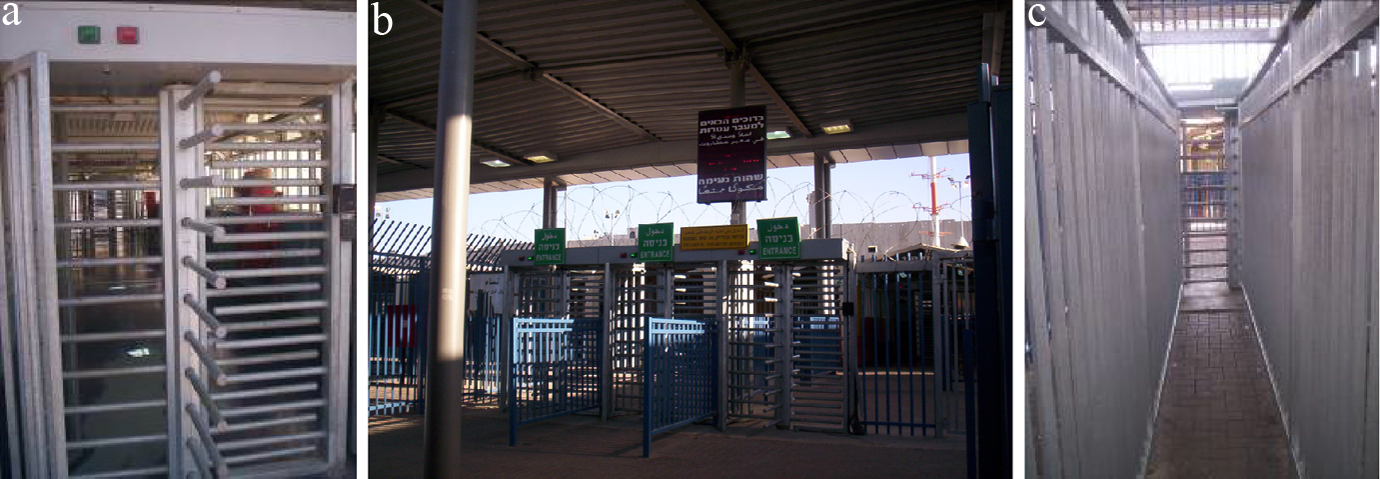
Metal queues and turnstiles in Qalandia. Photos by author, August 2008.
Barag points out that on top of the turnstiles there are two lights, green (go) and red (no go). Simultaneously, she instructs me, the turnstile’s operation is controlled by an Israeli guard, who is invisible to the passenger. Once the passenger is inside the turnstile he is locked in until the invisible operator lets him out. The physical design of go/no go that supposedly enables Palestinian discretion, however limited, is thus unnecessary and even misleading. The turnstile actually leaves no such discretion to its Palestinian user who is instead entirely controlled by the panoptic gaze of the Israeli soldier. This situation is exemplified in the following quote from the logbook of two MachsomWatch women who visited the Anata crossing, which was under construction at the time. In their words, ‘We first went to the northern entrance with the smaller checkpoint where we saw no soldiers, but two new turnstiles near the main road, which were operated from afar. The schoolgirls who entered pressed a button and the gates turned’ (MachsomWatch, 2011b).
Barag also points to the metal fences situated on the top of turnstiles to ensure that Palestinians cannot cut the queue from above (Figure 7b). Just the other day, she tells me, a Palestinian was crushed from the pressure of the crowd between the entrance to the queue, on the one hand, and the turnstile, on the other hand, and as a result broke one of his ribs (Barag, interview). The physical technology of the turnstile, presented by Israel as decreasing human friction and promoting orderliness, thus ends up increasing other forms of friction and enhancing chaos. It does so, however, with no direct involvement by border officials.
Whereas in the old border regime, personal encounters between Palestinians and Israeli soldiers were frequent, the increasing implementation of nonhuman technologies under the new regime results in much less human contact between Israelis and Palestinians. The nonhuman fixtures used in the new crossings – signs, fences, bars, turnstiles – distance their human imposers and render their effects an inevitable outcome of technical design (see also, albeit in a different context, Braverman, 2010). This new form of inspection is sunk into the infrastructure of the border, and so it becomes embedded, standardized, routinized and thus transparent (Graham, 2008). As infrastructure, these technologies both fix and normalize the securitized modes of border operation. They also severely restrict the power to resist. Roni Hammerman explains: We have less and less power to change anything. We are pushed to the margins: here we’re not allowed to enter, there it’s declared a closed military zone or Area A. So everything happens somewhere else, somewhere inside. And we are pushed further and further away from that ‘inside.’ Once, we were able to stand near the soldiers and watch. Now, the most we can do is pass through the terminals like the Palestinians – and this, too, we’re only allowed in a small minority of the passages where the other side is not in Area A. But even as we do this, the soldiers threaten us that if we don’t move along, they’ll stop checking Palestinians. By the same token, once we could attend all the military court hearings we wanted. Now, they hardly let anyone in, especially in Jerusalem. You need to send a fax on a specific date and your name needs to be on an ancient list from God knows when. The direct connection with the soldier – that has disappeared completely. There’s no more eye contact, which used to be such an important part of our work. (Interview)
Turning from the role of nonhuman technologies in reducing friction to their purported role in reducing time, Colonel Tirza insists that the new crossings facilitate swift and easy passage. In his words, ‘the intention isn’t to block passage but to let people pass and to provide a level of service to the person who needs to cross’. ‘For example’, he says: I told the Court that in the checkpoints [that] I’m building in Jerusalem, anyone who doesn’t fall into the profiling won’t wait for more than an hour and a half, even at the busiest times. Today we’re at around 20 minutes – at busy times. (Tirza, interview)
By contrast, a short video produced by MachsomWatch recorded the Bethlehem crossing at 4:30am. It shows that only four of 12 gates were operative at the time, which resulted in a several hours-long queue outside the crossing (MachsomWatch, 2008). Here, in the words of a Palestinian teacher: My main problem is on the way home … The soldier[s] make the passengers get out. They wait to be checked and then cross the checkpoint by foot. This takes lots of time, sometimes a few hours, especially if there is security activity in the area or an alert. If the soldiers are eating lunch, the wait is even longer. They stop working and we stand there under the sun or in the cold until they let us cross … I sometimes get home at 1:00 P.M., sometimes at 3:00, and sometimes later. It’s impossible to predict. It is very frustrating. Also, my family never knows whether to wait for me before eating. (B’Tselem, 2011b)
As in many other instances, it is hard to believe that the military officials and the human rights activists are actually speaking about the same places.
The only consistent theme at the border is inconsistency. This inconsistency is yet another form of arbitrariness: people never know what obstacles they will or will not encounter when crossing the border.
June 3, 2011: Qalandia Crossing, Concluding Notes
The occupation of three years ago ... is not the occupation of today. The occupation has undergone a process of professionalization, or I don’t know what to call it. Today the IDF spokesperson will tell you that everything is much more humane and much more adapted. No one stands in the rain anymore and God knows ... everything is in tip-top shape. (Hanna Barag, interview)
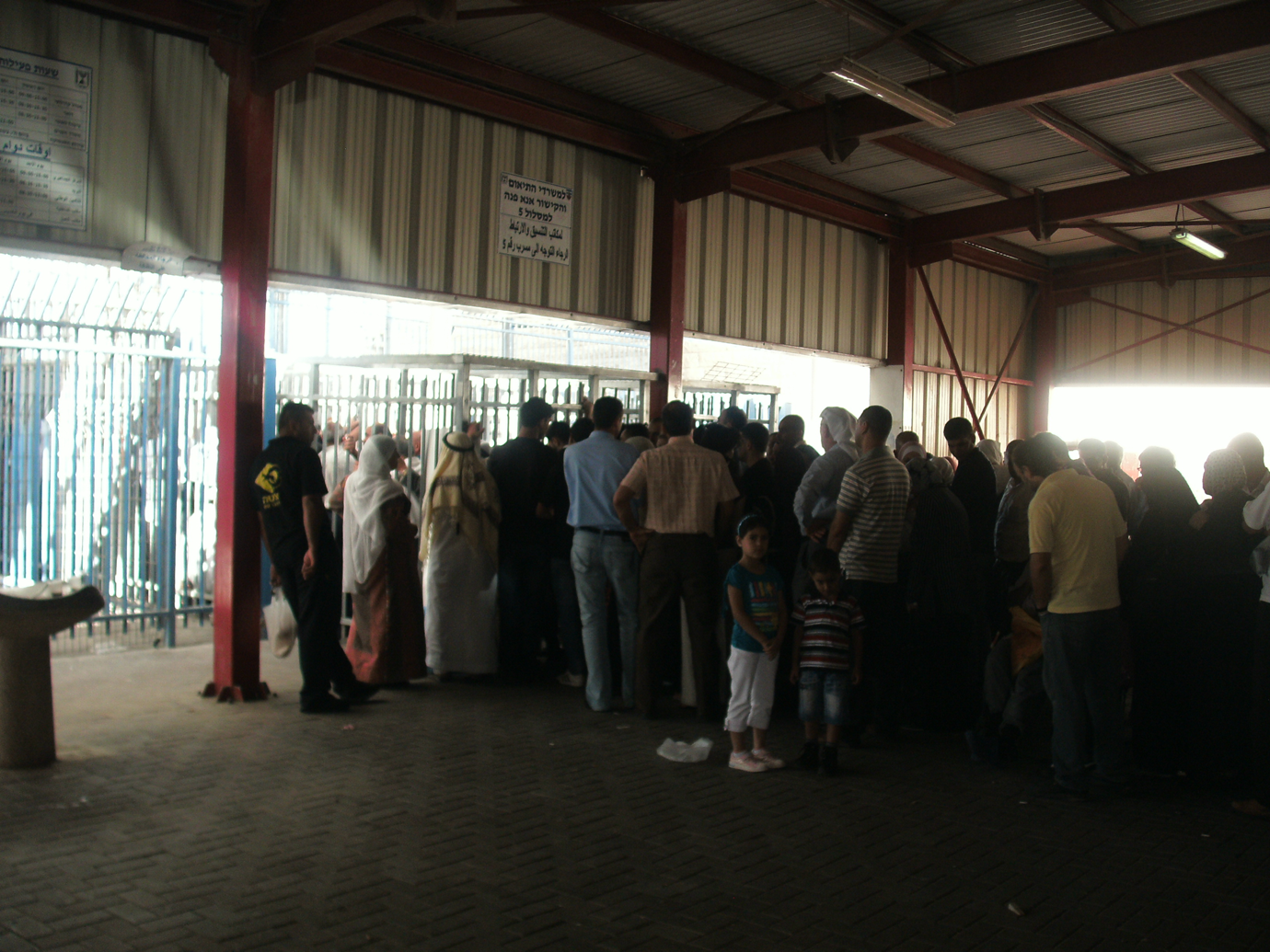
Qalandia Crossing on Friday, June 3, 2011. Photo by author.
In this essay, I have focused on the changes that have taken place at Israel’s border with the occupied West Bank in the last decade or so, and especially since the construction of the Separation Barrier. I have identified the many ways in which the administration of this border has shifted from being ad hoc and transient to a fixed infrastructural construction. I have also pointed to the consolidation of the border and its mechanization, which has created an intense network of identification and bureaucratic sophistication. These have given birth to another source of confusion, another mode of alienation of the Palestinian subject from that which was formerly produced by the face-to-face encounter that characterized the old model. The old model, I should clarify, has not entirely disappeared from this space. It has moved into the margin of Israel’s new border regime. Israel’s rhetoric throughout this shift has been consumer-based and has highlighted efficiency and globalization as its central themes. Accordingly, the new border vocabulary refers to the checkpoints as international crossings and to the Palestinians as passengers. At the same time, Israel’s neoliberal move is accompanied by a form of heightened securitization (Braverman, 2011).
The myriad changes in the Israeli/Palestinian border’s physical space and in its mode of human and nonhuman operations have engendered changes in the role of MachsomWatch in resisting the occupation. At the beginning, MachsomWatch consisted of a small group of radical women outside of the consensus, who insisted on witnessing the occupation as it happened in the everyday operation of the checkpoints and of Palestinian life. Their resistance occurred at the physical sites of the occupation: in the places where Palestinians and soldiers interacted. Many soldiers did not know about them then, and incidents of tear gas, although infrequent, were part of the risk. This was in the old days.
Alongside the solidification and bureaucratization of the official Israeli border, MachsomWatch has, in many respects, solidified and bureaucratized right along with it. First and foremost, the changes in Israel’s occupation of the West Bank have given rise to the legalization of resistance by MachsomWatch. Today, MachsomWatch resists not only at the space of the checkpoints or the terminals, but, and increasingly so, in court proceedings and administrative sessions and in the offices of military and political officials. The act of witnessing with one’s own eyes that so characterized MachsomWatch’s operations in the old days required bodily presence at certain places in specific times; this act has gradually transformed into administrative and legal networking, performed through fax machines, official forms, legal documents, and exclusive meetings with high level military officials. `The checkpoints are no longer the heart of this matter', Hanna Arnon, MachsomWatch activist since 2002, tells me along these lines. Although within her group, she is responsible for writing the weekly reports of their visits to the Bethlehem terminal, she has not written anything for months. ‘I don’t read the reports, either. They just repeat themselves over and over again. So what’s the point in reporting?’ Conversely, Arnon feels that she is making a difference in her relatively new role on the committee that challenges the prohibition status of Palestinians. ‘There, I feel like I can help’, she says, although I know that my influence is only a drop in the sea. And I certainly don’t feel like a hero. It’s just that I survived World War II in Holland, where I was persecuted for being a Jew, so I cannot be blind to what’s going on here. (Interview)
Increasingly, MachsomWatch women also routinely meet with military commanders and inform them of the checkpoints’ operations on the ground. Despite themselves, then, they have become part of the system: an instrument for improving the system from within and a way for Israel to legitimize its border operations to the outside world by attending to the demands of human rights groups. In the words of Hanna Arnon: Today the procedure is so extremely complicated that there is this feeling that all the efforts that we underwent, everything we did through the years, just provided the Civil Administration with more insight as to how to run the occupation more efficiently and how to make things even more difficult to work around. They have become super-masters in control … This has led many of us to feel guilty. Maybe if we had left the situation as it was, in its primordial state, maybe if we didn’t fight so much and think so hard about how to overcome the system – maybe then things wouldn’t have turned out so badly? (Interview)
The increasing realization of how resistance feeds into power and makes it yet more effective has resulted in growing frustration among certain MachsomWatch members. Here, from a routine report posted on the organization’s website: What new things can we write in our weekly reports? Everything remains the same. ‘For the sake of testimony,’ impels me and my companions on this shift. True, we are faithful witnesses to this humiliation of human beings, to their harassment. We give people work permits and then they are prevented from getting to work in a human, reasonable fashion; they are crowded between fences for 2 hours … And what do we, MachsomWatch, do to help them by standing there? Maybe by listening to their distress? I wish that were true. But the truth is that our empathy does not bring them any income and does not compensate for the daily humiliation that they experience. I wish that someone would finally do something to bring back our long lost self-esteem. (MachsomWatch, 2012)
14
Let me end this article with the words of Yehudit Keshet, one of the founders of MachsomWatch. She says: ‘The courteous relations between the army and Checkpoint Watch, like so much else in the strange planet of Occupation, are ambivalent, with the potential to neutralize our work’ (Keshet, 2007: 116).
Interviews
Shaul Arieli, Colonel (retired), former head of the Negotiating Administration in then-Prime Minister Ehud Barak’s office and currently a member of the board of the Council for Peace and Security, interview, Tel Aviv, August 12, 2008.
Hanna Arnon, activist, MachsomWatch, interview, Telephone, February 7, 2012.
Hanna Barag, activist, MachsomWatch, interview, Jerusalem, August 7, 2008; email communications, February 2012.
Hanna Barag, activist, MachsomWatch, participatory observation, Bethlehem Crossing, August 10, 2008.
Hanna Barag, activist, MachsomWatch, interview, Qalandia, June 3, 2011.
Yehudit Elkana, activist, MachsomWatch, interview, Jerusalem, August 3, 2008.
Roni, Hammerman, activist, MachsomWatch, interview, Telephone, February 8, 2012.
Micha, Head of Administration and Funding of the Passage Administration, interview by telephone, September 11, 2008.
Ilan Paz, Brigadier General (retired), former Head of the Civil Administration in the West Bank, interview, Tel Aviv, August 12, 2008.
Nura Rash, MachsomWatch, interview, telephone, February 7, 2012.
Danny Tirza, Colonel (retired), former Head of Security Fence Operations 1994–2007, interview, Jerusalem, August 14, 2008.
Bezalel Treiber, current Head of Minhelet Ha’Maavarim or Crossing Directorate, interview by telephone, September 18, 2008.